Showing posts with label Abbie Cornish. Show all posts

Friday, March 29, 2024

Bright Star

Every so often you get bored with writing reviews—and I don't have a supervisor or editor (that should be obvious by a scan of the material) and I do this as a hobby and a form of preserving some space in my brain. But, one gets tired of writing Thesis/Description/Particulars/Summation on a perpetual basis. One gets in a rut, which isn't good for me (the writer) and you (the reader, one hopes). So sometimes, one experiments.

This was one of those times.

Looking back on it, I find it amusing, not exactly helpful as far as details, and the writing almost as tortured as the doomed romance portrayed.

Eh. "You win some, you lose some"...just like love.

Composed at the time of the film's release...
 

"Perish the Thought"*

There are many artists I would put inside the director's pantheon,
But of all those chaps, among my faves is
Jane (the Aussie) Campion.

Her heroes (mostly female) both imbue and fight the schisms
that go along (as well they might) with social ostracism,

maintaining self, their specialness, not merely as statistic
that goes against the status quo
of things paternalistic.

Campion works in
mythic films, the types you can get lost in,
But this one takes some pages from
that other Jane (Ms. Austen).

For though her films have, in the past, explored romantic themes,
I'd call them cautionary, "
love's not always what it seems."
But
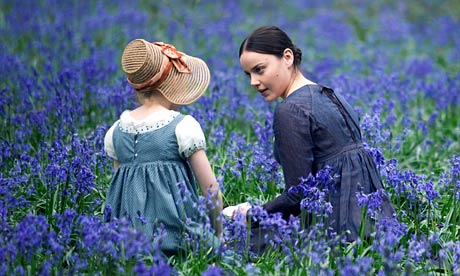
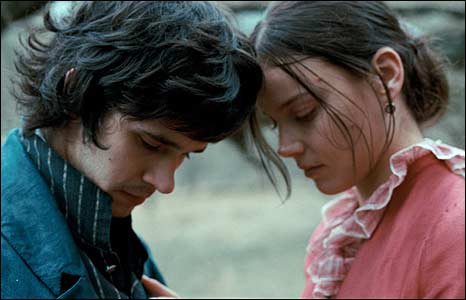
this tale of Miss Fanny Brawne and lovin' bard, John Keats
shows a more impassioned love, although keeping it discreet.

It's not like modern movies where the sex is done to death
The most explicit this one gets is int'mate shuddering breaths.
The costumes are exquisite
, the period details, right
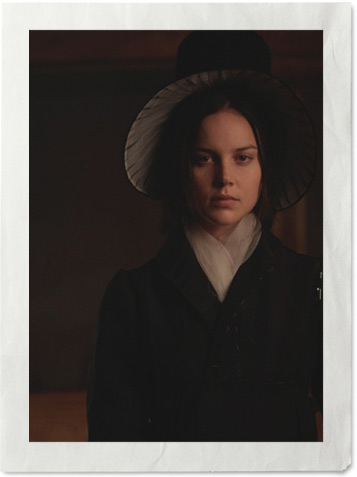
Abbie Cornish and Ben Whishaw make you feel their love's delight.

It truly is amazing the director took this chance
to realize, to dramatize unmodernized romance
I wouldn't be surprised to find this one in Oscar's thicket.

That's why I grant
Bright Star a most deserv'd "Full Price Ticket."**

* Shall I review Bright Star in verse?
(I don't know. I could do worse)

** My old blog—from where this thing comes—had a rating system (which I now don't do because I hate them and hate the parsing—3 stars or 4 stars? Hmmm), which based movies on the amount of money you should spend on it, which went (from highest to lowest):


Full Price Ticket
Matinee
Rental ("Rental? What's THAT?!")
Cable-Watcher
A Waste of Time 


When I started B/C-L, I abandoned the rating system entirely, as I've reconsidered the monetization of worth, but, at the time, I thought it was a good idea, as it was inspired by the quote from Alfred Hitchcock: "A good film is when the price of the dinner, the theatre admission and the babysitter were worth it."

Wednesday, February 10, 2021

Legends of the Guardians: The Owls of Ga'hoole

Written at the time of the film's release...

"Use the Gizzard, Luke"
or
"Not So Much 'Hoo' as 'What' and 'Why'"


I loves me my fantasy films. You give me a good fantasy film, and I'm back to being 5 years old, giddy with the possibilities of a world-view that has no knowledge of mortgages, property tax, paralyzing self-doubt, and Glenn Beck.* Innocence makes a comeback, the world seems simpler, and it gives us something to aspire to besides not hitting the "Snooze" alarm in the morning. I miss those pre-cynical days.

Which is why a lot of the current crop of kids' flicks leaves me cold. Harry Potter used to be fun, but they've gotten increasingly dark and creepy, and they're going to end with an inevitability that's telegraphed and a bit morose (and I wouldn't be surprised if the last one were just a black screen). I mean, c'mon, the kid has an invisibility cloak and flies a broomstick for crying out loud, what's he got to be depressed about? The Star Wars films were fun before Darth Freud came waltzing in, then they careened into the side of the Death Star trench—impressively, one must say, but they weren't too much fun trying to present their civics lessons.

One goes into these things with that same innocence. Tell me a story. Gladden my eyes. Charm me. Seduce me. Make me not think about the $10 admission and the two hours I'm wasting of my too-short life. Give me something new and let me walk out with a spring in my step and a song in my heart, and maybe...maybe...a fresh, better way of looking at the world. We don't have to be friends, just don't make me regret the time I spent with you. I'm easy. I came to buy.
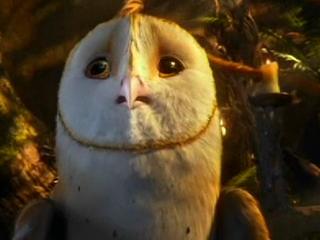
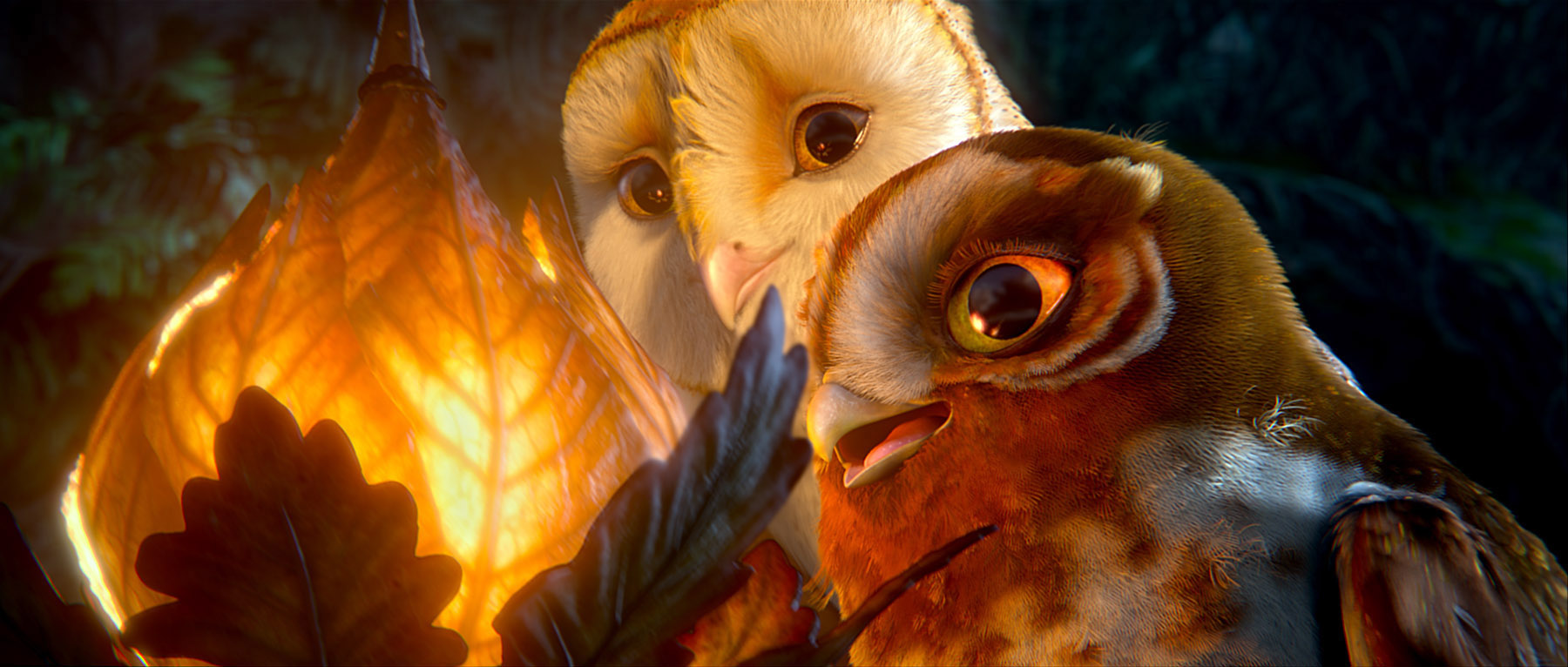
So, an animated owl movie sounds like just the ticket. I like owls, even though they're predators. They impress me, and I've enjoyed a couple of them as neighbors. But, Legend of the Guardians: The Owls of Ga'hoole (they needed the post-colon part, as the title couldn't be more generic) left me wanting to repeal the Endangered Species Act. Yeah, I know, the thing's popular with kids, but I remember kids used to like Clutch Cargo, which was the lowest form of animation there was

The story is Template No.2 in the Fantasy genre—ostracized something-or-other must prove its worth against big, bad oppressors, while putting aside its childhood loyalties in some small way. But I couldn't help but think the authors just did a cut-and-paste job putting owls into Star Wars (yes, they really DO say "Use the gizzard" as a euphemism for instinct). The complete lack of anything original in the plot can sometimes be overcome by clever film-makers with style.  Zack Snyder, as successful as he can be adapting other media—specifically graphic media—to a cinematic form, seems to be up a tree when making the leap from prose to image. 
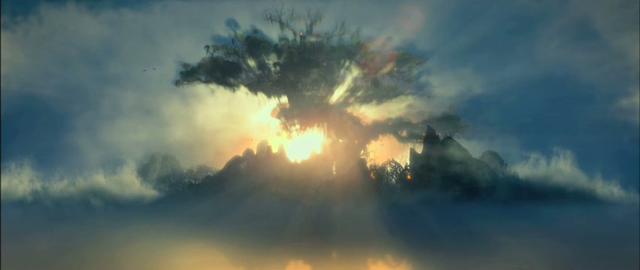
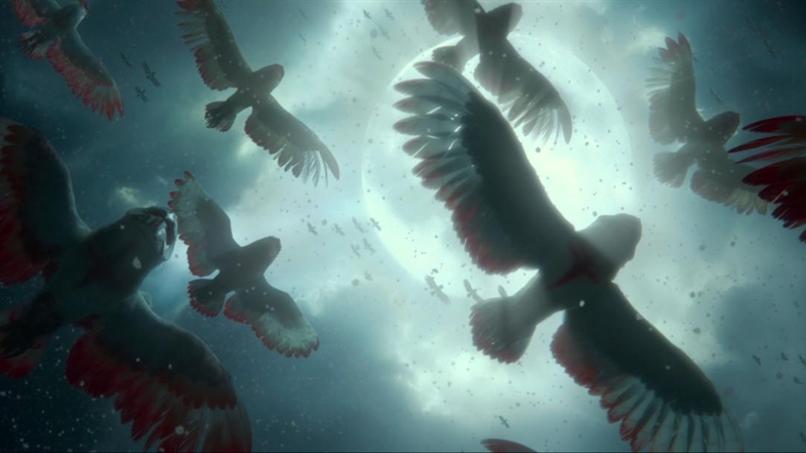
I've often mentioned that graphic novels are movie storyboards with better writing, and it would appear that is how Snyder managed to make good movies out of 300 and WatchmenLOTG:TOOG is a mess. It's an unmemorable mess, that flies out of the mind as if it was searching for a more palatable meal—something with meat and gristle—the only memorable thing about it being its own lack of anything that sticks. The owls look like sock-puppets with beaks, devoid of distinguishing characteristics that allow you to follow their progress in the storyThe flying scenes are choreographed with the intention to disorient, rather than create empathy or epiphanyThe only thing I took note of were the impressive background vistas the critters inhabited, but it is the faintest of praise to say that the best thing about the movie was the stuff you'd see in the rear-view mirrorThis film is totally devoid of charm, and even, coherence.
Now, I'm sure there will be some parent out there who'll read this and immediately take umbrage ("My child LOVED this movie!!"**) and want to go on the attack, as if I was writing this with their precious issue particularly in mind.  For all you potentially psychotic parents, I don't question your child's taste (although I'd be willing to bet they were as fidgety as the kids I saw it with—and as I was—and I'd also wager that if they liked it, it was because they were familiar with the source material, and would be happy if there were a Ga'hoole breakfast cereal consisting of twigs and feathers), but this is a BAD movie. Really bad. 
A reasonable child can like bad stuff (I loved the TV-show "
Supercar" as a kid—which was a marionette show about a flying car, and I never questioned why all the cars were convertibles—so I speak from experience), but this is cotton candy movie-making, spun to give an ephemeral surge of interest, but with zero nutritional value (perhaps the calories should be posted in the End-Credits, I didn't stay to find out). When one considers how much time and money has been spent digitizing (one hesitates using the word "creating") this exercise, you begin to fantasize staking yourself out in a field, wearing a mouse-suit ("Come and get me, owls, you can't do anything worse than you already have!!). Better to salve your inner child with a daily dose of Babe, or Charlotte's Web.

If your child does drag you to this mess, I would suggest texting your friends throughout the entire movie...or even watching another movie.

I can't help but think that Ga'Hoole is a cynical writer's malaprop of "Go to Hell."


* The problem with re-posting old reviews is that there are references the reader might not have any clue about—like Glenn Beck who used to be somebody. Billy Wilder ran the same danger when he put in topical references into his movies. Unless he was very careful, 50 years on people wouldn't know what he was talking about, cultural-reference-wise.

** I still remember the time some parent castigated me for hating Speed Racer.  The movie sucked...and it's a deeply cynical thing to show a child.  I'm unremorseful in my assessment.  (2021 Update: I'll be re-posting reviews of Speed Racer and Watchmen next week).

Wednesday, March 25, 2020

Sucker Punch (2011)

Written at the film's escape. Further thoughts after the repeat, with some video point/counter-point.

"Girls Acting Badly (Acting Badly)"
or
"Showgirls—The Sequel"

Look. I'm a healthy, red-blooded American male and I can certainly appreciate gorgeous, pouty young women in provocatively scanty attire. But Zack Snyder's semi-new Sucker Punch just made me angry. And not just because the thing is so derivative as to be wholly unoriginal—that's usually not a deal-breaker with me, as my enthusiasm for Star Wars or Rango will attest.

But don't tell me you're making a movie about empowering women while objectifying them to the Nth degree in the manner of a "women-in-prison" film. A women-in-prison film with a red-curtain veneer of strip-club in it. Don't make an action film where giant things toss the femi-ninjas through walls and across rooms without their make-up getting messed up (violence without consequences), and don't make the message of your film "Fight" and contrarily show 4/5 of those fighters being taken down (through their own actions) and the only one survivor being the one who isn't sure of the struggle. 

The messages are so mixed as to be incoherent.
But one shouldn't expect nutrition from eye-candy.

It's all about the illusion in this one, the presentation, and the surface. It's "Alice in Green-Screen-Bump-and-Grinder-land: the Video-Game." All paste-up and no depth, just a good job of dry-wall, in the de-saturated style of Sky Captain and the World of Tomorrow.* Looks greatBut rotten to the core.
And it is too bad. We need more women-heroes. We need more women-hero movies. We just need someone with more enlightenment to create them so that they don't simultaneously make them strong and tear down the message by tarting them up (like William Moulton Marston, the shrink who created "Wonder Woman" and liked to put her in bondage situations). I'm not saying all women-characters should be pedestal-toppers. Let's just not kick the dignity out from underneath them.
And any writer worth his word processor shouldn't be undercutting his message, anyway.

If you're going to lower the bar so far you have to dig a trench six feet deep to do so, you might as well complete the job, dig the grave and toss the whole enterprise into it.
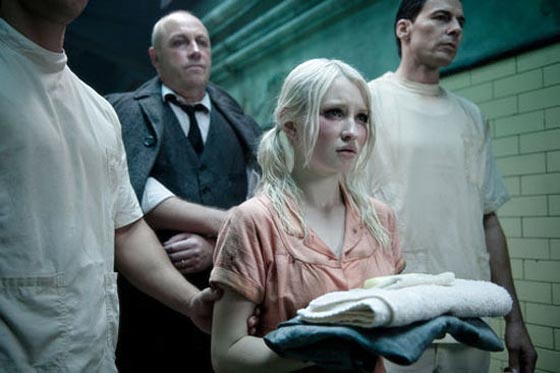
Young "Baby Doll" (Emily Browning) is having a bad time of it. Her mother dies, and she and her sister are left in the care of her evil step-father (Gerard Plunkett) with nothing but abuse on his mind. "Baby Doll" (that's her only name) tries to shoot him when he attempts to rape her sister, but ends up killing her with the bullet, instead. As if this scenario weren't dire enough, Snyder films it all over-cranked to give it a lethargic, dreamy "bad portent" feel.  It's the type of overkill you can expect throughout the entire movie. No lock goes bolted or unbolted except in clanking close-up. Nothing is relevant unless it's in your face (AND it's in IMAX).
ES-F has "Baby Doll" committed to the Lennox House for the Mentally Insane, where he bribes an orderly (Oscar Isaac, no scenery goes un-chewed) to lobotomize "Baby Doll" to shut her up so he can inherit his wife's fortune uncontested and in the five days before the doctor (Jon Hamm, who's actually subtle in this movie) arrives for the procedure, the girl fantasizes a scenario in which she's not in an asylum, but a strip-club/bordello and she recruits four other girls—"Blondie" (Vanessa Hudgens), "Amber" (Jamie Chung) and the sisters, "Rocket" (Jena Malone) and "Sweet Pea" (Abbie Cornish)* to plan an escape, an escape concocted in a "delusion within a delusion" (Hello, Inception!) when she rehearses her dance number for the john (whose the lobotomist in the slow-mo reality) to whom her virginity will be sold in five days. This dance number is apparently so erotic that it paralyzes all, male and female, who watch it, so that the other girls can acquire those articles needed to escape.
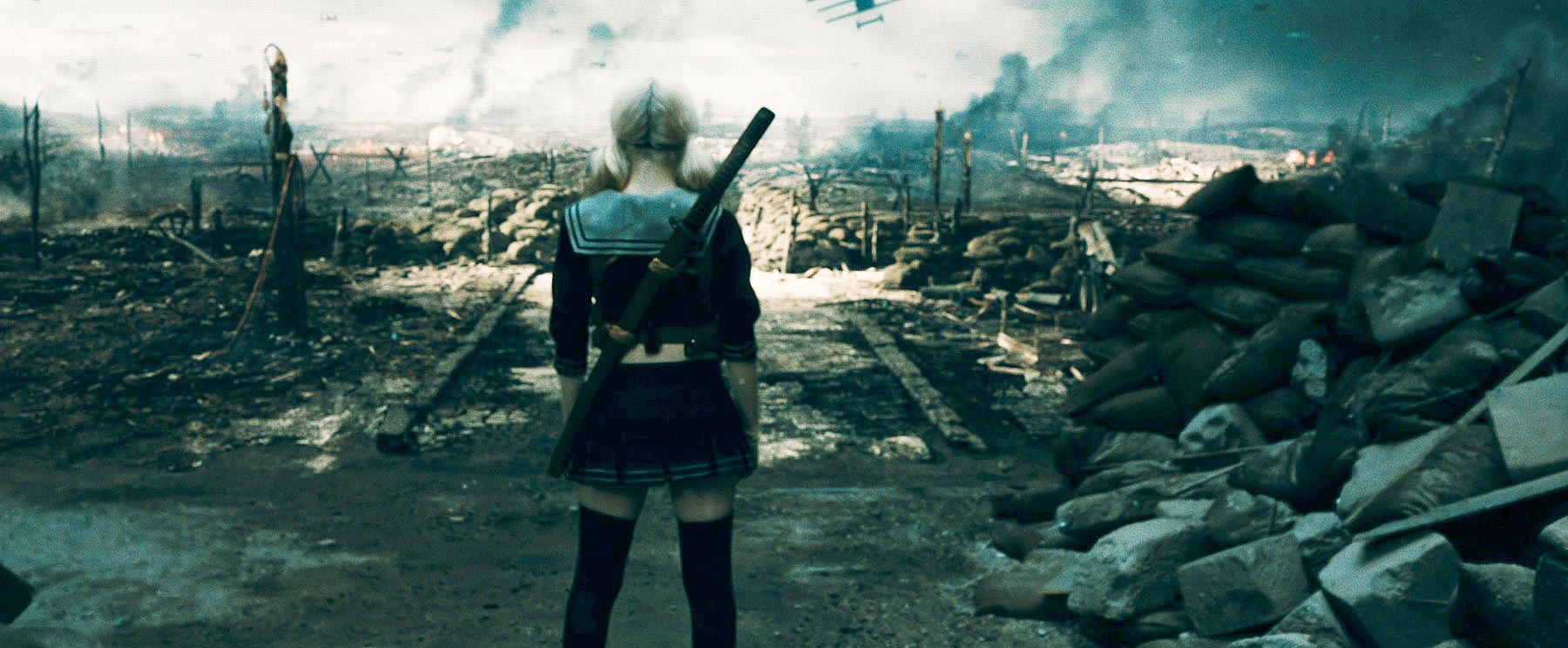
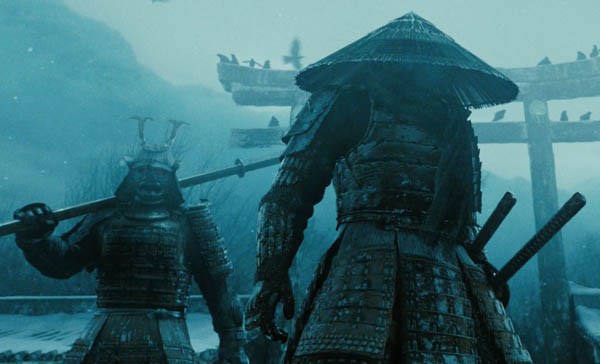
We don't see the dance. We see the resulting fantasies "Baby Doll" imagines in order TO dance, and these make up the action scenarios in the film: the first, a snowy martial arts fight with three giant statues; the second, a WWI fight in the trenches with steam-punk Nazis; the third, a Peter Jackson-ish Middle-Earth with dragons and Orcs; the fourth, a SCI-FI battle on a bullet-train that's part super-hero and part Matrixit becomes readily apparent that most of the thought and work of this film went into these second-level fantasy sequences, all played out over Moulin Rouge!-styled song mash-ups.
It is also apparent that the entire movie is a pre-lobotomized fantasy (only I think they got the timing wrong!).
So many good ideas are borrowed from other movies. But, just because the ingredients are good doesn't mean the dish they create doesn't taste like dog-food. I used to be a fan of Zack SnyderI thought 300 was dumb, but had flashes of clever presentationI genuinely admired his adaptation of Alan Moore's Watchmen, and still do. But now with the 1-2 sucker-punch of Legend of the Guardians: the Owls of Ga'hoole*** and...Sucker Punch, I'm going to have to do a gut-check before dropping all pretense that I can be objective before going to see another of his films. 

Which will be the new "Superman" film. I don't even think The Blue Boy Scout can pull a rescue of that one. We shall see...
After-thoughts: First off, "I am shocked, shocked" that there is objectification going on in this movie. It IS Zack Snyder, after all, who made 300 and who is equally adept at showing both male and female pulchritude—actually, with all the super-hero movies out there, maybe that's WHY we go to movies anymore. Also, the film has a lot of Japanese manga sensibility to it, so, the women will be big-eyed, and under-dressed. Blame pop-culture, where a lot of this film resides.

I still think the narrative is confused, and it depends on whether you think it is "Baby Doll's" story (which I think it is, as the long preamble would indicate) or whether it is "Sweet Pea's" story (and "Baby Doll" is merely the "body-image/avatar" in her mind used to escape). That's an interesting interpretation, but I don't think I believe it, but it just goes to show how porous the scenario is that you can pour that defense into it and it seems to stick.

Also, the "violence without consequence" comment? It's fantasy sequences, and so "Looney-Tune" rules apply. And "derivative" might have been part of the point, given the pop-culture "call-backs" for the fantasy sequences, which are all "quest" narratives. 

Snyder has a habit of throwing so much information into his movies—sometimes to the point of obfuscation—that narratives can become muddled (which is very problematic when he has to do a course correction, as he had to do with his DCEU movies, where his films are left with dangling plot threads that never get resolved...even with his "extended cuts"), but there is a real problem when it's a point of debate of who the protagonist is and what has been accomplished on all planes of the endeavor.

There are some interesting points about "empowerment" and how, in the war between men and women, that empowerment may be merely exploiting the weaknesses of your opponent (starting with their own feelings of superiority), without having to "own" the means of exploitation. It made me wonder how much of a woman's time is spent "in disguise" for survival. We all do, to a certain extent, but what a different world might come of dropping pretense and just "being." I must, at least, thank Sucker Punch for putting that thought in my head.

Below, two videos on the film: one, with a condescending chip on its shoulder, but a surprising number of good points; and the other from the long-running (and entertaining) "Cinemasins" series that still takes things to task while acknowledging the meta-narrative.


* We'll be talking about this tomorrow (digital fingers crossed) and Rango when we delve into a couple of "shelter-in-place" weeks of Westerns.

** Throughout, I kept imagining the nasty Twitter message Jane Campion would be sending her Bright Star lead after seeing this movie. 

*** Now, the question is: do I re-publish the reviews for these films or just do a "Now I've Seen Everything Dept." career overview of Zack Snyder? The latter would probably have better insight than the "first-blush" reactions.

Wednesday, January 23, 2019

Elizabeth: The Golden Age (2007)

Elizabeth: The Golden Age (Shekhar Kapur, 2007) Like its 1998 predecessor, Elizabeth, The Golden Age is sumptuously produced, ornate in both costuming and production design, but also in filming and conceptual work. It is one of the most beautiful films I've seen in a longish time—excepting the sequences of torture and carnage—but the material feels a bit shallow (if not altogether juggled, shuffled and finagled*), like one of those bio-pic's that attempt to tell a tumultuous life in 90 minutes; no one likes to have their life, especially a Queenly one, summed up in Cliffs Notes.

"When last we left"
Elizabeth I, she had ascended the throne, unmarried and without heir, but unbowed as "The Virgin Queen." Catholics to the right of her, Mary, Queen of Scots (Samantha Morton) to the left of her, and a seemingly endless line of suitors brought before her. No one has her back except her adviser Francis Walsingham (Geoffrey Rush returning to the role) and lady in waiting Bess Throckmorton (Abbie Cornish).

But there's one angle overlooked, although director Kapur has it covered with a dizzying number of overhead shots. Since the issue in The Golden Age boils down to whose side is God on—between the Protestant England and the Catholic Spain—a lot of time is spent from His point of view.**

Kapur, who started his career in Bollywood, uses color more imaginatively than most current directors (rather than embracing the current trend of leeching the color from films, he adheres to using it as another communicative tool). At the end of Elizabeth the audience was confronted with Elizabeth "the Virgin Queen" symbolized in all her alabaster glory. We see that same white Queen often in The Golden Age but are also confronted with different aspects of Elizabeth. Here, with the issue of finding a proper husband and the potential of an heir, she is frequently seen behind closed doors in far rosier tones than the alabaster appearance—"the divine here on Earth," in the words of Walsingham—that she uses for regal functions. She tells the Archduke Charles, a negligible suitor: "I have a secret, my dear. I pretend there's a pane of glass between me and them. They can see me, but they cannot touch me."


In times of regal impartiality, that "pane of glass" informs itself as the color blue in Kapur's direction. It sets Elizabeth apart and keeps her coolly disengaged and formal, as in the scene below, her she visits her former suitor, Sir Walter Raleigh (Clive Owen), and wife, her former lady-in-waiting to bestow her blessing on their first-born. The rest of the room, in slightly gloomy but warm colors, are off-set by her glowing in a frosty light.
And here, leaving the death-bed of a trusted adviser, she shows no emotion as Queen, allowing the man to know that he can die in peace, his work preserving her Monarchy—and her—is done.
The shot is also centered and composed like a Baroque painting, with many tableau layered in three-dimensions within it, each with their own lighting scheme. Kapur and his production designers fill the movie with such images (when the camera isn't flitting from one side of the room to the other), especially in the climactic sea-battle where some of the battle sequences look like they could have been copied from the cover of a Patrick O'Brian novel.
Ultimately, the cold blues and alabasters give way to "the golden age," and Elizabeth is bathed in a warm glowing sunlight, holding the child of Raleigh and Bess—her position of Queen finally legitimized in reality and defended in battle—and the child that might have been hers, a subject—part of her charge, with no man her master and all of England under her protection.


* The Wikipedia entry on "Elizabeth: The Golden Age" has a nice run-down of the shuffling of events in the Queen's reign. One wonders if they'll be more accurate in the inevitable sequel—after all, we haven't seen Essex yet.

** Before I get e-mails from the indignant, we'll use the paternalistic designation...because the participants of the film did.

Friday, December 1, 2017

Three Billboards Outside Ebbing, Missouri

Mutiny and Rage
or
"You're So Pretty. But She's Still Dead."

A line from Seven Psychopaths might be a good preamble for Three Billboards Outside Ebbing, Missouri: "An eye for an eye leaves the whole world blind."

A timely film about the dangers of acting without filters, Martin McDonagh's new film (after In Bruges and Seven Psychopaths) shows what can happen when the thirst for revenge overruns your life: it escalates, creates consequences, and expands in ever-increasing ripples of cause and effect. You want revenge? Don't stop at digging two graves.

Three Billboards defies pigeon-holing and genre-fication. It's too commonplace to be a thriller. It's too intense to be a drama. It's too dark to be a comedy. But it's all of those things at one time (the comedy being more of the Black-Irish variety). It is too sunny and rural to be a noir, but it does share one quality with that type of film: there is no merciful God in evidence in Three Billboards Outside Ebbing, Missouri.
Driving on the seldom-used road by her house, Mildred Hayes (Frances McDormand) sees three billboards in disrepair that haven't been used in decades. She stops, backs up and takes in all three of them and the impact they'd have driving past them—1...2...3. And something sparks her. She takes five thousand in cash and strides into the local marketing agency and announces she wants to rent those billboards. After going what can't be on the signs ("Well, I think I'll be alright then" she says), she signs the contract and soon, the billboards are up, and their message is provocative.
The first person to see them is Deputy Dixon (Sam Rockwell), a not-too-competent law officer, who drives by one night and is shocked, angered and his first reaction is to call the Ebbing chief of police Bill Willoughby (Woody Harrelson) as the billboards are a direct challenge to him. The chief is trying to have dinner with his family and Dixon's a hot-head that, for some reason, Willoughby keeps on the force, but his a cooler head and not nearly as reactionary. He'll wait and talk to Mildred in the morning.
News of the billboards has now spread throughout Ebbing and the subject is divisive. The chief has a lot of friends and Mildred has made a few enemies because of them. But a visit from the Chief to try and mollify the situation does help things any much. The Chief wants the billboards down, but he understands the situation; it's been seven months since Mildred's daughter Angela (Kathryn Newton) was raped and murdered, her body burned in the very area of the billboards, and, as they accuse, no arrests have been made in the case. Angela is dead and buried, but Mildred and her son Robbie (Lucas Hedges) have been living with the consequences and their own consciences ever since. Mildred's abusive husband (John Hawkes) has moved out and taken up with a 19 year old intern at the zoo (Samara Weaving).
The Chief is empathetic to Mildred—he has been trying to solve the case and it has been frustrating that there is no forensic evidence to follow up on and tells her that, eventually—in these cases—someone will say something out of turn, someone will slip up, some code of silence will be broken and then, they can act. And as aggrieved as he is about events, he still thinks the billboards are unnecessary. "I don't think those billboards are very fair," he says. Mildred has none of it. "The time it took you to get out here whining like a bitch, Willoughby, some other poor girl's probably out there being butchered." Even telling her that he has cancer doesn't soften her resolve or her frustration. The billboards will stay, come what will.
Dixon is pissed. He wants something done. But, he's under a bureaucratic cloud for beating up an African-American while in custody. He's the loudest and crudest of the local constabulary and has very little anger-management skills—something he probably learned from his mother (Sandy Martin), with whom he still lives. Willoughby can barely contain him during a visit to the ad office—across from the police station—to pressure them to take the signs down, but don't press the point when they realize that they really have no justification within the law to do it. Willoughby, however, starts to re-examine the evidence and crime scene to see if there is something—anything—he might have missed in the initial investigation. 
Confrontations with Dixon (at a bar where he regularly drinks himself into a stupor) and some of the locals causes Mildred to be arrested, but she remains committed to keeping the signs up and the pressure on. Neither side is going to budge, and it's only Willoughby's keeping things from escalating that keeps the town from exploding or Dixon from doing something stupid...or more stupid than is typical for him.
It is that constant, simmering feel of menace that makes Three Billboards a thriller. It is the unblinking directness of everybody's words and actions (and their inability to hedge anything) that makes it funny. It is the utter helplessness and casual brutality that makes it a noir. You begin to wonder if anybody has a shred of decency in the whole thing, but they're inhabiting an indecent uncaring world and the posturing, the implied threats, the "scorched Earth" unequivocation, and the tit-for-tat intensification of hostilities has to come to a head. Before the movie's over, things will flare up to a combustible heat, leaving behind devastation in its wake, if not entirely due to the actions/reactions taken, even if, in the circle outside the fire, it's perceived to be.
Three Billboards is a great movie and, dare I say it, a sign of our times. It is tough—it is not for the blue-hairs and the easily offended (because there is something to offend just about everybody). It has the huevos to to put a lie to the phrase "profound rage." There is nothing "profound" about it (perhaps another word should be found to be paired with it, lest there be any confusion), certainly not in this context. A terrible wrong committed by arrogance has occurred, in the quest for vengeance it gets compounded, and then compounded and then compounded again. We as a people (urged on by simplistic morality plays, such as can be found at the movies) are spoon-fed viscerally satisfying revenge-scenarios that make us think such a thing is commonplace and normal in a philosophy that is based on "an eye for an eye." If we could stop with just an eye, maybe it could work, but the instinct is escalate and with no end in our cyclopean sight.
The performances in this things are brilliant. McDormand is totally unafraid to make her Mildred ugly, both in spirit and face. Keeping her chin up has solidified it to granite, and cocked it forward with a invitation to, go ahead, take a swipe at it...at your peril. A monologue planting flowers near the billboards where her daughter was murdered reveals a person so consumed by grief and guilt and anger that nothing in this world, no miracle, could pull her out of her single-minded need to see somebody pay...and it can be anyone, so far as she's concerned. Thought has left the building. The un-nuanced need for revenge has replaced it. Interestingly, an inspiration for her performance came from John Ford's The Man Who Shot Liberty Valance. Every morning, McDormand sat in her make-up chair staring at pictures of John Wayne, while Rockwell's mirror was covered by pictures of Lee Marvin...and Barney Fife (from "The Andy Griffith Show"). Apt.
I've listened to some hand-wringing on public radio about the movie being insensitive to some issues—like spousal abuse and race-baiting—and being caustic in its humor, which is mostly ironic in nature (folks don't know what they're saying is innately absurd) and that "there is no one to root for." Well, no shit, Sherlock. This isn't a super-hero movie (which, by the way, are based on the notion of crowd-pleasing revenge at any costs). This is about people so burning with anger and self-righteousness that they believe they can do anything, within or without the borders of lawfulness or decency, in the pursuit of their personal cause, effects be damned. We're seeing a lot of that in the world today—letting the world burn because the "cause" is right, without the foresight to see what might be the consequence. If anything, the movie is closer to the "Incredible Mess" version of comedy, where people just dig themselves a deeper hole for themselves without the perspective to see that things are getting more dire the harder they pursue it. In that realm, there is very little to distinguish between comedy and tragedy.
Even it's ending is maddeningly ambiguous, as the most unlikely of partners go off in pursuit of the most tenuous of missions, leaving the audience with (if they're of the mind) only the most thread-bare of hope that someone will come to their senses. But, it's a bit like hoping you can convince someone to consider that they might be wrong. It doesn't work for ideologues, Trump-voters, Nazi's, the PC-GI's...Hell, it doesn't even work for film-critics. Ahab must be led to the whirlpool, and fools hoisted on their own petard. Because doubt is perceived to be weakness in a patriarchy, as opposed to being thought of as open-mindedness and thoughtfulness.

So it goes. Until we can find something better.