Showing posts with label Robert Pattinson. Show all posts

Saturday, March 15, 2025

Mickey 17

Essential Worker
or
"Go Ye Forth and Multiply"

Mickey Barnes (Robert Pattinson) has a sketchy past-he has an issue with a loan-shark-and so he wants to get off-planet as soon as possible. Fortunately, there's a private mission to the planet Niflheim that has been spear-headed by a former Senator Kenneth Marshall (Mark Ruffalo) to form a colony where he's the Supreme Leader (Marshall has lost his last two elections and no doubt wants to leave democracy behind). Mickey, seeing the long lines of potential volunteers for the exploration flight, volunteers to be an "expendable"--a low-level worker position that no one wants, mostly because the fine-print is egregious, saying that he can be assigned guinea-pig positions that will probably kill him, at which point he will be "re-printed" body and mind, his memories downloaded into the new Mickey. In the 4.5 years it takes to get to Niflheim, he's died and been re-manufactured 11 times. Once land-fall occurs, Micky dies a few more times testing the environment and the various vaccines for the planet's endemic diseases, before anyone else is allowed out in the glacial environment. And, at the time of the movie's start, he is Mickey 17.
But, at the movie's start, that won't last long. 17's fallen into a crevasse in the freezing cold, nothing's broken, but there's no way he can get out. His co-hort from Earth, Timo (
Steven Yeun), has a job as a pilot and he could rescue him from his predicament...but, hey, why bother? They're just going to make another one, anyway. He leaves with a genuine "Hey, nice knowing you. Have a nice death." And a question everyone asks, "Hey...what's it like to die?" After all, Mickey's had experience.
I won't give too much away, but 17 survives the fall and the cold and is only too happy to get back to the base-camp where he gets a bit of a shock. Despite the lack of protocol and general laxity of safety conditions—especially in the science department—it seems they're very johnny-on-the-spot (or one should say Mickey-on-the-spot) for replacing their expendable: another Mickey has already been re-printed, who, of course, is Mickey 18. Because cloning is not an exact science, 18 is a bit more aggressive and less forgiving than his predecessor (hey, he's young, having only a few hours of life to his credit). But, the two have an immediate problem: duplicates are illegal in the colony and so, they it's a literal case of there not being room enough for the two of them, which makes both Mickeys beside themselves.
One of them, then, has to go. Although they basically have the same brain, they are of two minds on the matter. 18, of course, says that because 17 is considered dead, he's overstayed his welcome and he needs to die; 17 considers 18 to be unnecessary and superfluous and so he should be the one to die. Neither one of them wants to have a twin—do they split their rations?—and, besides, Mickey 17 has a girlfriend, Nasha (
Naomi Ackie), who's one of the base's security forces, and although she's intrigued with the possibilities, neither one of the Mickeys are into open relationships.
The problem is, the question of who lives and who dies is out of all of their hands—duplicates are illegal and if it's one thing former Senator Marshall is consistent at it's in following the rules that he's put in place (and that's just about the only thing he's consistent about other than maintaining absolute power over the colony). This puts Nasha and the two Mickeys in conflict with the social order and their functions, but, hey, movies need conflict and there's quite a lot of it in Mickey 17.
It's clever, entertaining, and adaptor-director Bong Joon Ho (he of Parasite, Mother, and The Host) has created another of his intricate little "trap" movies where you wonder where he might be going with it, but it's less devious then his previous films, and suffers from a "Chekhov's gun" situation which makes the resolution of the film feel slightly telegraphed and less of a surprise than in previous work. There are a couple superfluous characters (besides the extra Mickey) and one sees a trope (let's be kind and call it "inspiration") from an early "Star Trek" episode that makes it seem overly-familiar. That's a slight disappointment. 
And he gets entertaining work from his cast—Pattinson plays dual roles, of course (actual multiple versions of the same character), and, dang, if you can't tell the two of them apart merely by his playing of them, and Ackie has never been more kinetic as she is here. Ruffalo and Toni Collette (playing Marshall's Lady MacBeth of a wife) play it broad, but then, the characters are broad, as most autocratic figures are before they fall into the self-destruction of self-parody.
That broadness will, no doubt, raise hackles in some quarters, but those hackles are always on the alert, anyway. Best to look at the more subtle statement Mickey 17 is making about the irony of "essential workers" being regarded as the most disposable in business and governmental circles. Twas ever thus, whether it's in war, shirtwaist factories, or food-processing plants during a pandemic, this "dammit-I-can-have-it-both-ways" canard of the powerful sees far less exposure than it should. I'd like to see more of it, if only in the public interest.
 
The novel on which Mickey 17 is based has a sequel called "Antimatter Blues", but if it gets made into a movie, I'm sure they'll call it Mickey 19.

Wilhelm Alert @ 01:17:00
 

Friday, March 4, 2022

The Batman

It was a Dark and Stormy Knight
or
How Many Batmen Does It Take to Change a Light-bulb?

You know how it went: in "Peanuts", Snoopy would sit on top of his dog-house type-writing—"It was a dark and stormy night. Suddenly a shot rang out. The maid screamed. A door slammed.
 
 
That's how Matt Reeves' The Batman felt to me after I'd survived it. Just as suddenly as something is resolved, you think there's some breathing room, and then you think "Geez! They haven't even figured out the serial killer yet!" And then that starts and you think THAT's finished, and you go "Wait a minute, that seemed kind of easy", and that's when the guano really hits the fan, and things get even more complicated, and you start looking for something to tell you what time it is, because you really think that the thing is never going to end, and then, they distract you and you think "Oh no, they're going to bring him in?"
It's at that point you realize that it's no fun being the Batman—because the job just never stops. You wonder if you even want to admire the Batman or pity him, but you sure don't want to be him. 
 
And maybe...you don't want to watch him.
"So, is it even worth going?" Hell, yeah. Because The Batman is more like the Batman from the comics (depending on the period of origin—in this case, the 1930's and 70's) than he's ever been. Stripped down and deconstructed, this version escapes the taint that has hung on the character ever since the TV-series from the 1960's. There's no "camp". There's no crazy costumes...well, except for the Bat-suit (which is armored to the point that it's bullet-proof and probably tough to maneuver in—he even thuds when he walks)...and there's no goofy archness or hysterical theatricality, which still remained even in the Christopher Nolan-directed trilogy. Not even an artfully-choreographed fight; they're all thumping and brutal.
It's perfectly serious. And does things the "Batman" series has never done before. For instance, this is the first Batman movie since the series started (with Tim Burton back in 1980), where Batman doesn't kill anybody—oh, he messes people up really bad, but they don't die unless it's due to their own actions—and that was a "code" that an orphan who lost his parents to gun-violence strictly adhered to. And the "Batman" in the movies has always stood for vengeance, and here, the character arc has him realize how limiting that is—when he sees the main villain of the piece committing heinous acts to avenge his own circumstances. His self-imposed mission changes during the course of the movie; the film pointedly ends with Batman looking forward and not back.
Now to say I "survived" it takes an explanation. The Batman is just shy of three hours long. And it feels like it*—Reeves can make fascinating movies, but he's not an editorial trickster (like Nolan) so things happen at a steady, remorseless pace (Reeves uses Nirvana's "Something in the Way" as background, and that's the beat that he uses for the film). It's a long run-time, and the story covers a lot of ground, dealing with corruption, organized crime, and striking out against sins of the past. It's less a "super-hero" film than a police procedural along the lines of contemporary British mysteries or "Law and Order"—this Batman even walks through crime-scenes with the police (despite "official" disapproval of vigilantes by the Gotham City Police Department), making observations, providing lines of investigation. It's an intricate maze of clues and evidence that increases the run-time. What would I take out? Not a jot. Certainly not with the Warner studio's recent insistence of cutting things down to near-incomprehensibility.
Because it's a good story that has the construction of the best of the (Batman co-creator) Bill Finger-penned Batman stories: murder victims of a prominent vintage, all seemingly unrelated but leading inexorably to a far greater threat (it's nice that the clues are multi-layered without the usual *snap* "I've got it! He's going to rob the Obvious Clue Savings and Loan!"). And we've become so used to comic-book threats—penguins with rocket launchers, "fear-gas," 'memory-sucking devices" and ice-guns—that it's a little disconcerting—even creep-inducing—that the various plots all nudge at real-world headlines: "Zodiac" messages, "collar-bomb" extortion, mailed death-packages, internet zombies, even Hurricane Katrina.

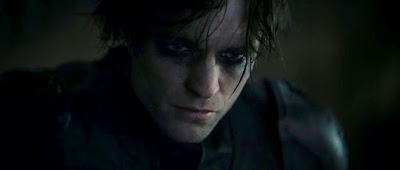
Ah, but you don't want to know all that. You want to know how the Patt-Bat is! He's darned good if you want to discard the whole "Zorro"/"Scarlet Pimpernel" vibe that inspired the character. Pattinson's Bruce Wayne is a brooding recluse holed up in Wayne Tower in the middle of Gotham City, and he'd probably be a prime suspect in the "Riddler" case if the police just looked at the power being used by the dingy bat-filled basement of the building (nah, they wouldn't—he has too much money). His Bruce is so emo, he almost wears a bat on his sleeve—so much for secret identities. But, his Batman is slow, hulking and fills a room, the eyes constantly moving and the perfect jaw-line not at all. It would almost be a mime act if he didn't have Jeffrey Wright doing heavy-lifting (and expositing) as Lieutenant James Gordon ("You could have pulled the punch..." "I did"). Wright makes a character important no matter how much he's pushed to the background, but here, he's the other half of a buddy act. By contrast, Andy Serkis' Alfred is the character who's given short shrift.
But, it's the villains that everybody pays attention to in Batman movies and there's a lot of them: It's a great cast and everybody does very good work.
Zoë Kravitz is a fine addition to the ever-growing litter of cat-women, with the appropriate fanged snark and a duplicitous sensuality that one expects of the character by this time. Her scenes with Pattinson fall a bit flat unless they're quarrelling, because he doesn't give out that much as far as any sort of response. That's on him; not her.
Paul Dano leans in to his cherubic looks to create an intensely creepy Riddler—he has several aliases—internalizing the schitzy nature of the character with the same intensity with which Heath Ledger externalized his Joker in The Dark Knight. Ledger is a tough act to follow, but Dano isn't as theatrical and does more with little expressions than anything playing to the loges.
Speaking of which, if Dano leans in,
Colin Farrell leads out with his take on "The Penguin" ("Call me 'Oz'") as a voluble Chicagoan gangster with none of the panache or freakishness in past portrayals, but bearing a family resemblance to Rod Steiger's Al Capone. He is wholly unrecognizable, physically or in performance, and it's not just the elaborate prosthetics he's forced to wear to pull off the job, the acting is larger than it can contain, making a huge impact in a role that's a supporting character to John Turturro's Carmine Falcone, the Gotham boss who's pulling all the strings only to find his organized crime operation being undone by a lone outlier. Also Peter Sarsgaard should be given a hand-clap for his portrayal of a weak Gotham D.A. caught up in the carnage.   
Is it the best Batman movie? I think it's too soon to tell. I didn't come away from it thrilled with it as a whole (as with others), but was delighted at its parts (and little touches like
the bust of Shakespeare in Wayne Tower, the very apt use of DOS graphics, the song that plays when Bruce Wayne visits Mob-boss Falcone)
There is no doubt that this is the best interpretation of the character if you want to do it as a straight-ahead portrayal, ignoring the many iterations that have made up its history, the bad and the good. Someone had to do it—to put the detective back in The Darknight Detective. And Reeves, who has proved time and again that he can make something special and unique out of retread material, has managed to make something original with Batman.

* It isn't helping that the theaters front-load this particular attraction with more than the usual number of commercials (even inserted between previews—which, let's be honest—are commercials, too). The whole presentation is like 4 hours long. One can see why the theater-chains are doing this—a 3 hour movie limits the number of times it can be screened, even though they've Bat-jammed as many  showings in as many plex's as they can manage. And those commercials pay the chains. But, it is testing the endurance of an audience not expecting an epic Lawrence of Arabia roadshow. 

Tuesday, September 15, 2020

Tenet

Ohmigosh, it's a new movie...in a THEATER!

En-tropical Adventure ("Well, Try and Keep Up")
or
We Live in a Twilight World ("And There Are No Friends who Understand This Movie, Either")


Christopher Nolan finally gets to do his "James Bond" movie, but—being Christopher Nolan—it had to be with a twist. In this case it's the twist you find in a möbius strip for his "Yeah, you can only release this in theaters" spy/sci-fi hybrid Tenet.

And, yeah, at least for the first four/five viewings, it should only be seen in theaters. Having access to a "Rewind" button would only confuse the issue. Plus, the details...the details...some things will get lost on a small screen given some of the intricacies going on, and at times the film is so disorienting that a large screen will make you a bit more sure of what you're seeing.

Nolan likes to stretch the underpinnings of his movies, fracturing time-lines, setting up nesting dolls of narratives, and investigating the possibilities of the image and editing while maintaining a forward momentum. Here, though, he has it both ways.

The film begins with a terrorist attack on a Ukrainian opera house, the perpetrators appearing from the stage as if part of the performance. How they planned all this without somebody noticing off-site that a major counter-terrorist operation was being set up in the general area is one of those post-"Dark Knight" "just-go-with-it" sleights of hand that directors have been taking advantage of when going for spectacle rather than logic. But, Tenet is so full of such things that it would be better to switch one's mind off if one is to experience any enjoyment out of this.
During this sequence, Nolan has one train going forward and one back.
It's a sort of subliminal training for what we're about to see.
 
The operation is two-fold: the extraction of a personage from the scene and the retrieval of stolen plutonium and the situation is so dire that the agent we're focused on—played by John David Washington—basically has to make it up as he goes along. During the raid, he comes to understand that the plutonium is not as it appears and that, at some point, he is nearly shot by a bullet coming out of one of the auditorium steps. Part of his team is captured, and, rather than give anything away, he takes a cyanide pill. He dies.
Short movie.

He wakes up...from a medically-induced coma. He's told that he survived the cyanide...that his jaw has been rebuilt*...but he is officially "dead" and he is to recover and has been chosen for a special assignment as his willingness to take the pill rather than give away secrets makes him a valuable asset. A further briefing tells him there WAS no cyanide...("eh?"), but that his devotion and the planned mission are real. He is given a gesture—interlocking fingers—and the word "Tenet" ("It'll open the right doors. Some of the wrong ones, too" he's told in the evasive generalized way that passes for exposition in the film). 

"Is 'bunjee-jumpable' a word?"
He's taken to a facility—for a second briefing—of what his next assignment (his first as a dead man) is, more specifically what the mechanics of the assignment entails. Turns out the issue isn't plutonium, but a possible WWIII is the end-game. This turns out, also, not to be true, not in the strictest sense, but a world-ending scenario is involved. He is shown what caused that little surprise of the backwards-bullet at the Kiev Opera House was all about: that bullet was manufactured in the future with a technology that allows it to move backwards through time by means of its own inverted entropy. If that's confusing, the scientist studying the ammunition has a handy piece of non-advice that will work for the viewer: "Don't try to understand it. Feel it." Especially when you point a weapon and the bullet jumps back into the gun. The kick-back must be intense.
Already, this is a little headache-inducing. But, it would help if we recall an episode of "The Big Bang Theory" (Season 3 Episode 22—"The Staircase Implementation") and Section 9 from Dr. Sheldon Cooper's Roommate Agreement: If one of the roommates ever invents Time Travel, the first stop has to aim exactly five seconds after this clause of the Roommate Agreement was signed. "Well, that's disappointing..." is Sheldon's reply when nobody shows up. If you laugh at that, you might be alright.

Our Man in Confusion meets up with a British intelligence operative, Neil (Robert Pattinson), who helps him meet up with an arms dealer who gives him the low-down—the man who's behind (or in front of) all this reverse-entropy stuff is a Russian oligarch named Andrei Sator (Kenneth Branagh) who has seen the future and wants to exploit it to his own ends. The Protagonist (as he's called in the credits, but the arms-dealer tells him "You're the fresh-faced Protagonist, and you're as fresh as a daisy" so I will call him "Daisy") is told that he can get to Sator through his wife, Kat (Elizabeth Debicki), who is kept in a bad marriage by her error in selling Sator a fake Goya

That is all the story I want to relate, because at this point...or later...or earlier (I'm not sure which) my understanding—or my willingness to understand—started to get a little hazy. My appreciation for what I was seeing didn't dampen, because the logistics and the talent to pull these things off (imagine if you will a "Bourne" type fight where one fighter is moving forwards and "the other" is moving backwards) and you begin to shake your head in wonder at the logistics needed to imagine, let alone carry off, such a sequence. There's a chase down a freeway involving cars moving forwards and backwards that is as twisty and GPS-frying as all get-out, and the final showdown with troops advancing and retreating (backwards) simultaneously has to be seen to believe.
"What happened here?" "It hasn't happened yet."
Or not. One of the stipulations for the production of Tenet is that all the explosions and practical effects had to be practical—in other words, no CGI—things had to really happen. So, yes, troops are running forwards into battle-areas where explosions are reverse-sucking into the ground. Fights happen forward and in reverse. Why, Branagh even had to learn to speak backwards (with a Russian accent, yet...or "nyet"). It's all done for real, so that when things are reversed, it's the real deal backwards. This still produces a feeling of visual deja vu, where you begin to suspect everything of being reversed...at least looking for tell-tale wisps of smoke not rising, but falling.
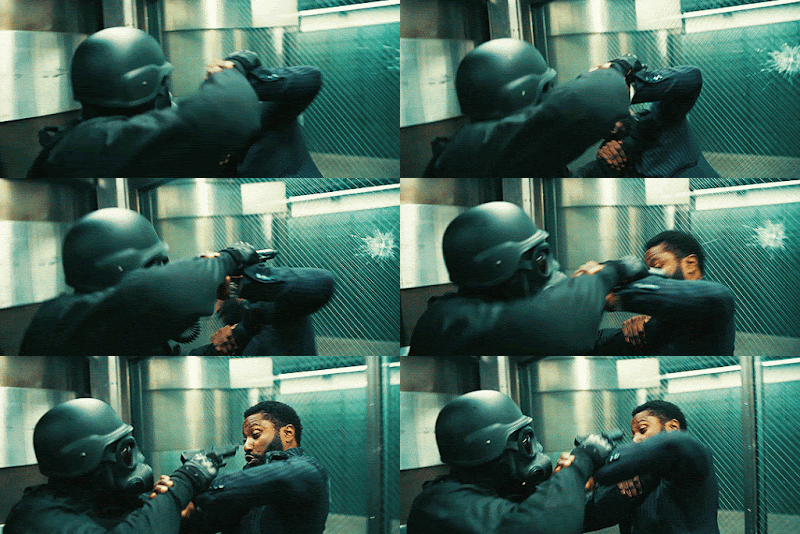
It's happening...
It's disorienting...like a kind of "magical seeing" where thinking doesn't come into it because that would lead to some sort of synaptic anarchy that would make you distrust the simple action of putting popcorn in your mouth. At one point, "Daisy" is seen doing his customary pull-ups on a ship going backwards—he's been reversed temporally but the ships are going forwards, obviously, because that is what they do. But, from our perspective (which is constantly his) the ships are going backwards, reversing into their own wakes. Okay, but if he's inverted and doing everything backwards, what does he eat? How does he eat?Is there enough negative entropic infrastructure that they have entropic meals? At least, reverse Tang? And if everything he experiences is working backwards, I don't even want to think about how the toilets work!
Kenneth Branagh counting backwards...or is it forwards?
This leads to an audience-disconnect where you begin to suspect everything in the film of being untrue...or at least, the natural order of things. The Daniel Craig Bond's have made an entire through-line of its hero learning not to trust anything, not even his past...but, at least, he's still got his senses. Most movies endeavor—from their core—to create a belief in their reality; "Ignore the crewman out of frame with the pastry in his hand, this is true." Yes, there is music—from an unseen orchestra—and we're directing your point of view, so you don't see the reality we don't want you to see, but we're trying to make this as real as possible. Nolan is making as radical a move in breaking "the rules" as when Hitchcock killed off his leading lady half-way through Psycho: He's trying to make the "real" fantastical, in a way the Wachowski's with their computers couldn't with the Matrix movies.

It is mind-bending. And revolutionary. But, then Nolan has always played with the rules and mechanics of film, both in terms of story-telling and in its expectations. He can leave an audience gob-smacked...and deceived. Sometimes both, simultaneously.
Here's the same car-flip backwards and forwards...hope they called insurance before.

I don't know how advisable it is to question or not question the mechanics of what goes on here. In an era of "deep-fakes," one should always be suspicious of "face-value" and just not take things as they appear. Nor, can I interpret the measure of enjoyment you'll have in the movie if it doesn't make any sense. "Seeing is believing" is the old saw, and though I accepted the images, there was the doubter in my mind that kept kibitzing through the movie saying "that just wouldn't work." The answer, in retort, is to recall Hitchcock's rejoinder—"it's only a moovie."  

At least, Tenet is entertaining enough that you don't want to re-live those 2 1/2 hours...backwards or forwards.

Here's a shot from the battle-climax of Tenet:
Take a moment and think about what you're seeing here.
It looks spectacular...but is it possible?
* Yeah, that's usually not how potassium cyanide works—unless you've seen Skyfall.

Saturday, March 7, 2020

The Lighthouse (2019)

Saturday is "Take Out the Trash" Day

Wickie-Weeks
or
Pardon Me, Myth, But I'm Having a Tiff with a Real Live Gull (This Film Has Been Formatted to Fit Your Fever-Dream)

Picture (if you will) a deserted island with one lone working lighthouse that never sees any boats, populated by two men named Thomas: one young, one old; one apprentice, one veteran; one false, one true. Two Thomases, doubting each other, lashed together like Ahab to the White Whale, on an island at once too desolate and too populated, and where madness is the constant forecast...with partially scattered mythology and superstition, fueled by an alcoholic rage. One would say batten down the hatches, but the demons have already entered the room, and crossed the threshold from...the worst episode you could imagine from "The Twilight Zone."

(Sorry, Rod. Hope you're not spinning)

You walk into a movie theater hopeful, but not anticipatory. One should not pre-judge without evidence. The proof is what you see on the screen, not the previews, not the hype, not the tomatoes, squashed or otherwise.
When the film starts, you think there's a mistake—first thing you see is a gray square—it's the view of the fog from a ship that's taking the next shift of wickies (as light-house keepers are known) to a small rock of land in the middle of a stormy sea. The film is in black and white and formatted in the rarely used Movietone ratio (1.19:1) that was only used just before the sound era. The effect is claustrophobic, whether outside on the island, where there's not anything that would approach a vista, or inside in the cramped quarters the two men are squeezed into. We're so used to wide-screens now (in all media) that something this fore-shortened makes you constantly aware of the narrowed confines—and lack of options—afforded to the two men cooped up in the wind-lashed tower.
The two lighthouse-keepers are Ephraim Winslow (Robert Pattinson), new to the job after a career as a timberman, and Thomas Wake (Willem Dafoe), a grizzled veteran of many shifts at this spot. The dynamic between the two men is immediate—Winslow will be doing the menial jobs, the maintenance, the cleaning, the chamber-pot duties, while Wake will be tending the light, making sure that it stays constant and true. Wake disappears for hours at the top of the lighthouse, while Winslow stays down below, as per her position and duties. Wake bars Winslow from ever going up to the level of the Fresnel lens at the light-house's apex. 
Things start to go south quickly. Wake runs a tight ship and, being a particularly garrulous type—whereas Winslow is moody, sullen, and not given to conversation—constantly badgers the less-experienced man on how to do his job and waxing about past experiences (including the last man in Winslow's position going insane). It doesn't take long for Winslow to admit that he's not Ephraim Winslow, but actually Thomas Howard, who took the name of a colleague's killed in the woods. Howard succumbs to the isolation, beginning to see visions of mermaids and bodies washed ashore, and, at night, sees Wake at the top of the lighthouse, naked in the beam.

Howard starts to snap, beginning to think that nature has turned against him, including one particular one-eyed seagull, who aggressively attacks him, until Howard grabs it and kills it. The weather turns fowl, keeping the ship from picking up Howard at the appointed time, stranding him on the island with Wake. And, once having been a teetotaler, Howard starts to drink...incessantly. Things can only get better.
Of course, they don't. The Lighthouse becomes as excruciating as a bad marriage—Who's Afraid of Virginia Woolf? but without the social niceties. You got two guys in a lighthouse, both of whom are listing starboard, and pushed to the limits of a very limited space...and no women. So, there's a lot of farting, an entire conversation that is just the two men saying "What?", and quite a few instances of masturbation, to which I could only think "That's appropriate, because the director is doing it, too."
Give some credit to director Robert Eggers (and his co-writer brother) for creating a particularly unpleasant psychological horror film and for the wonderfully arcane language squawked by the actors*, and to Pattinson and Dafoe for giving it their all up to a decibel level of 12. But, criminy, it is a movie-experience almost intolerably unpleasant and devoid of charm, or even anything to be admirable. Then, to ultimately run out of ideas on how to end it, other than to assign some hither-to unknowable power to the lighthouse and have the film come to a crashingly obtuse end, just makes you want to re-wind your watch and pretend that the nearly two hours you spent in that world never happened. It's been a couple of months since I've seen the thing, and usually some obscure reason for being will percolate into my mind about something that might have made the experience worthwhile, but this one comes up empty.
What it could have used was a dinosaur.


* Try this Wake tirade on for size: "Damn ye! Let Neptune strike ye dead Winslow! HAAARK! Hark Triton, hark! Bellow, bid our father the Sea King rise from the depths full foul in his fury! Black waves teeming with salt foam to smother this young mouth with pungent slime, to choke ye, engorging your organs til' ye turn blue and bloated with bilge and brine and can scream no more - only when he, crowned in cockle shells with slitherin' tentacle tail and steaming beard take up his fell be-finned arm, his coral-tine trident screeches banshee-like in the tempest and plunges right through yer gullet, bursting ye - a bulging bladder no more, but a blasted bloody film now and nothing for the harpies and the souls of dead sailors to peck and claw and feed upon only to be lapped up and swallowed by the infinite waters of the Dread Emperor himself - forgotten to any man, to any time, forgotten to any god or devil, forgotten even to the sea, for any stuff for part of Winslow, even any scantling of your soul is Winslow no more, but is now itself the sea!"

Wednesday, October 9, 2019

Life Sucks for a Teen-Age Vampyre (In Love)

Written at the time of each film's release.... 

"Fangs for the Memories"

Bella Swan (Kristen Stewart) may be the palest student ever to transfer to Forks High School from Arizona. For some reason her inability to maintain a tan is given a pass by her class-mates (who all try a bit too hard acting like fun-loving "with-it" teens-in-the-woods), but the constant topic of conversation are the equally pale Cullen family.

The Cullens keep to their ruby-lipped, paler-than-pale selves. They don't mingle and are a clique unto themselves. When the weather is good (rare in
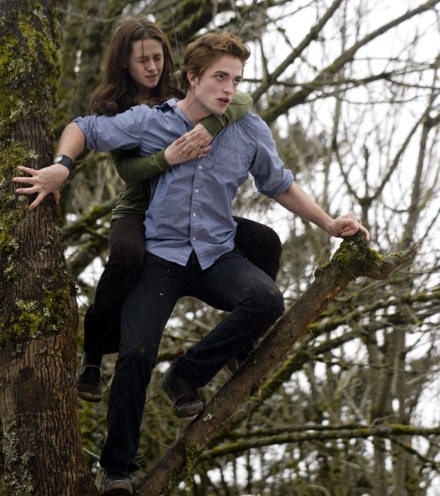
Forks, Washington out there on the Olympic Peninsula) the Cullens don't show up for school, but instead "go camping," as the story goes. Bella, a natural klutz physically and socially, is drawn to the unattached Cullen, Edward (Robert Pattinson). And why wouldn't she be? Like the rest of the Cullens he always appears to be walking in an undercranked slo-mo dream state, the chiseled delicate face of a Orlando Bloom/Johnny Depp/Jude Law, stops careening vans like Superman, growls like Elvis, and has the hair, neuroses and doomed bad-boy presence of James Dean, and perfect skin that glows translucently in the sun-light like diamonds . He seems particularly drawn to her, too. He can't eat, can't sleep, and has a lean and hungry look all the time.

It might be love, but maybe it's the vampirism.
It must be nice to be Stephanie Meyer right now. She's making a ton of dough off of recycled ideas and the cross...uh, sorry...combining of similar genres to create the biggest literary sensation since....well, since "Harry Potter" claimed to be literary. The "Twilight" series mixes equal parts Gothic Romance, standard Romance novel tropes and vampires and comes up with "Dark Shadows." Except Dan Curtis came up with that idea in the 1960's, so toss in a healthy dose of Judy Blume, and you produce what 'tweenettes have been swooning over the past couple years.
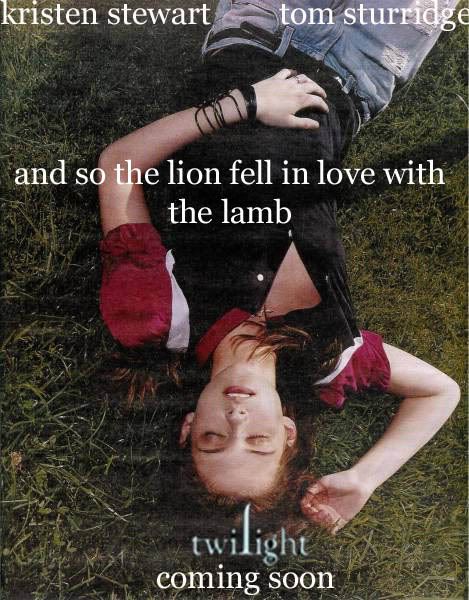
Now, here comes Twilight, the movie, and like the "Harry Potter" films it distills the essence of the plot without communicating what makes both of those series fun reads in the first place. Instead, everything comes across just a bit cheesily dramatic: Edward is all lowered gaze and wolfish teeth, and Bella (the name clues you in that Meyer is being a bit playful with her writing) is all heaving commitment. Edward's self-loathing for his disease puts up a barrier that confuses and messes with Bella's head (the only mind that Edward can't read), and his affliction just attracts her all the more. Which is bad for Edward because he and the other Cullens subsist on only animal, not human, blood (which he says is like humans on a steady diet of tofu: sufficient, but not very satisfying--a nice touch, that), and Bella is a constant temptation. "You're like my form of heroin," he says to her. And for all the romantic hooey of "the lion falling in love with the lamb," it feels a bit more like falling in love with a T-bone steak.
Yeah, well, I love chocolate, but not enough to marry it.
Remember, back when I wrote about Dracula, and said that it was a metaphor for raw hetero-sexuality?** Here, it's spelled out in big block letters Barbara Cartland could read with her lowest level bejewelled spec's: a vampire's blood-lust is just lust with everybody's formal-wear on. And penetration is penetration. Edward is the good boy with manners enough not to soil his lady-love ("killing" her for real, not just her reputation), while Bella is the willing maid panting for "it" (Kristen Stewart basically fulfilled that same role in Into the Wild). In one particularly heaving bedroom scene, they kiss to test how far they can restrain themselves (him to chomp on her, she to have sex with him) and just when things get a little out of control, he heaves himself against the opposite wall--like he was spring-loaded, or something.
That scene, and a lot of others, boast some of the most poorly done practical effects work done since Clark Kent's "skimming" run in the original "Superman" movie. We're in the post CGI-realm, folks, things could look a lot better than the FX one would expect on "Smallville."
That's another issue: Director Catherine Hardwicke makes "Twilight" looks cheap. I've seen Billy Burke (Fracture) before, and Elizabeth Reaser (she was wonderful in Sweet Land), but they're the only recognizable faces in the film, and the movie seems to have a film of murk all over it. As they filmed it in the Northwest--Oregon substituting for Washington (nice work, again, Washington Film Board!)--it might be fog getting under the lens. These books are making ga-zillions of dollars, you'd think they'd throw some money at the adaptations.

It takes the film a bit to get going, because Bella has to do research to discover what vampires are--seemingly being out of touch with culture her entire life--but it does spring to life in a decidedly unexpected way: when the two kids have to meet the families. Edward turns a bit paler meeting Bella's cop-dad, and the joke about the Cullens having Bella over for dinner is nicely mined for uncomfortable laughs. "Bella, you're about to go to a house full of vampires, and the only thing you're worried about is making a good impression?" is the best line in the film. Then, it all goes completely south with a vampire baseball game (seriously) and a tedious version of "The Most Dangerous Game" with a trio of "bad" vampires, who are evidently playing for another team. At that point, everyone stops thinking and starts doing stupid things when there is so much at...stake.

................................................................................................................
But just when one thinks there's not enough blood in the genre that hasn't already been regurgitated along comes this modest film from half-a-world away that covers a lot of the same unconsecrated earth as "Twilight' but gives it a poignant spin.

Let the Right One In (aka "LÃ¥t den rätte komma in") introduces us to Oskar (KÃ¥re Hedebrant), a child of divorced parents living in an apartment block in a Stockholm suburb in 1982. When first seen, one could mistake him for a Renfield-type, babbling to an unseen person to "squeal like a pig" while brandishing a knife. He watches from his window as a car pulls up in the middle of the night, and a man and a girl get out and move in to the apartment next door. Cardboard is put up in the windows and things go quiet.
Then, strange ritualistic murders begin happening around town, and Oskar's fellow students are warned to beware of strangers in the night walking home from school. Oskar has his own problems with an unholy trinity of bullies that regularly taunt him--they're the reasons for his revenge fantasies played out in the safety of his own home. 
About the same time, he makes the acquaintance of a pale girl named Eli (the excellent Lina Leandersson), who's about his age..."more or less," she says. When she learns of his bully troubles, her answer is simple: "Oskar, hit back. Hit them harder than you dare. Then they'll stop." Eli gives him the courage to do just that, and he begins to take weight-lifting classes.
Eli has her own problems: her benefactor and procurer has begun to make mistakes and the towns-people are getting suspicious, as the attacks become more random and more vicious. Eli and Oskar grow closer, deciding to go "steady," as events threaten to tear them apart.

Let the Right One In may sound sweet, but the savagery of the attacks is anything but—director Tomas Alfredson stages them swiftly and suddenly, and they can catch the audience by surprise. Plus, some of the happenings have a giddy violence that may produce uncomfortable giggles along with the chill up the spine (not unlike those of the excellent, though little seen, Exorcist III).
There is visceral, grisly horror in the story of the both supernatural and all-too-human varieties. The vampires of "Twilight" are ethereally pretty in the sunlight of the Northwest. In the similar light of Sweden, the results are decidedly different and more spontaneous. To say more would rob the film of its twisted charm, something that can't be said for the cob-webbed cliches of Twilight. That an American remake is in the works is news that can be regarded with its own brand of horror.

May it never see the light of day.


"Just So You Know, I Won't Be Your Friend"

Let Me In is an American remake of Let the Right One In, the terrifically creepy 2008 Swedish film. For those who hate sub-titles, this is probably a good thing. And what's good about the original is slavishly copied here, but director Matt Reeves (Cloverfield) does some good things (and a couple bad) to move the situations from frozen Sweden to a wintry Los Alamos, New Mexico.* The best thing is the acting.  Let Me In includes such great thesps as Richard Jenkins (a fine actor and more people will see him in this than any other film he's done) and Elias Koteas. But, it's the kids who are the best thing about it.  Anyone who's seen Kick-Ass already knows Chloe Moretz is terrific, but this is less of a joke-performance, and plumbs the depths of what she can do dramatically. Her waif, Abby ("I'm 12...more or less") starts out alarmingly strange, but as the movie progresses, the character turns more vulnerable and sympathetic—far more than Lina Leandersson in the original. 
But, the stand-out here is Kodi Smit-McPhee as the initially screwed-up Owen, a victim in danger of continuing in an unthinking cycle of violence. McPhee's Owen wears his heart on his sleeve—he just won't show it on his girlish face—but as the movie progresses, that face starts to beam (he is far more expressive than the Swedish version's KÃ¥re Hedebrant, in fact, both kids in the first have a Teutonic reserve that is appropriate for that film's style, but would seem catatonic in this version) as he approaches his relationship with Abby with the same vulnerable hopefulness he just can't allow in his other interactions.
Reeves does manage to make some things his own, as well. He mostly discards the firsts glacial blue color palette for a neon orange that suffuses scenes, and he nicely captures a bit of the gender-bending feel of the first, though differently. Also, he very cleverly stages some of the violent sequences obliquely, thrusting them in the stage-rear of the frame while the main focus is going on in the foreground. The more human attacks are handled extremely well, surprisingly—alarmingly so, but the movie veers into goofiness whenever more occultish violence occurs. The director holds on the scenes too long, and even though a lot of it is done in back-lit cameo, the effects make it look like the perp is less a savage beast than a crazed monkey with a banana-buzz. 
Sure, there should be some giddy thrill involved in horror, but "giddy" shouldn't translate to guffaws. He also makes crystal-clear the true horror of the piece, something that only occurred to me, after a bit of time of contemplation—for some reason, I like my "OMG" moments to be outside the theater. And he gums up the last scene of the film with a too-nostalgic pop reference that negates its effectiveness.

Still, after having dismissed the idea of an American remake with "may it never see the light of day," I have to admit that this one doesn't suck badly.
* Yes, it DOES snow in Los Alamos, New Mexico, and it has nothing to do with a Nuclear Winter.

** No, you don't because it's being posted Friday, so consider this a teaser.