Showing posts with label John David Washington. Show all posts

Wednesday, October 12, 2022

Amsterdam (2022)

"What Fresh Hell Is This?"
or
The Endurability of Good Intentions. ("He Followed the Right God Home...")
 
Who knows when it really, really started in the scheme of things, but it really started to get intense with the dead Senator in the box with no lid.
 
Just back from Europe by ship, he turns up dead and his daughter (Taylor Swift) wants an autopsy. So, she calls two guys from the former General's old integrated unit in WWI, Burt Berendsen (Christian Bale), a doctor of "experimental medicine," and Harold Woodman (John David Washington), Columbia University-trained lawyer, to oversee the procedure. To ensure that the procedure is done without prejudice, Dr. Irma St. Clair (Zoe Saldana) does the autopsy.
 
What the autopsy reveals is suspicious, but when Harold and Burt attend a pre-arranged meeting with the general's daughter to report their findings, they see her running away for their rendezvous, stricken. "He knew something. He saw something terrible," she says while she can.
 
Join the crowd.
Before the night is over, Burt and Harold are on the run from the police, accused of a murder they didn't commit, but sure of who committed it, not that it matters in the short run. They have to hide...and they have to find out who killed the General and who's behind all this...because...they're veterans. Their commander has died. And they owe him.
But, that's history. In that history, Burt found himself the medic for the 369th Infantry, an integrated unit in WWI France. Its commander was such a racist that he required the black infantry to wear French uniforms, rather than American ones due to white soldier complaints, but he was replaced by his commander General Bill Meekins (
Ed Begley Jr.), and to further cement fences, Berendsen made a pact with the most vocal soldier, Woodman, that they would always have each other's backs. Even during "The Argonne."
Berendsen and Woodman are severely wounded, requiring many operations to remove shrapnel by a diligent French nurse named Valerie (Margot Robbie), who repairs their wounds and forms a bond with the two men, eventually taking them to Amsterdam, ostensibly to take Burt to a company called Cambridge Glass (run by characters played by Michael Shannon and Mike Myers), manufacturers of the best quality glass eyes, but more to live together in peace and fellowship and recover from "the war to end all wars." They become "lost."
It is an idyll that can't last. "Choice matters over needs." Burt, finally becoming comfortable in his scarred skin, decides to return to America out of his devotion to his wife. Harold stays with Valerie, but sees no future in it ("We only exist in Amsterdam") and returns to America to pursue a law degree. Then, their General comes home in a box.
David O. Russell's Amsterdam is being marketed as a star-filled cream-puff of a movie, but it isn't that. Instead, it's a good-natured political screed on the dangers of fascism roosting in America, basing it on the "Business Plot", a little remembered attempt by conservative business interests, unhappy with liberal Franklin Roosevelt's election, to use veteran protests over delayed bonuses by the Hoover administration, to install an un-elected military official to essentially oust FDR as President. As a modern context, let's suppose that the MyPillow guy and the CEO of Overstock didn't like the results of the 2020 election and were taking aggressive actions to have it over-turned. Couldn't happen, right?
 
It's a curious little gremlin of a movie. There are going to be a certain number of people—on the far right, maybe fascist, certainly white supremacist side—that would never see this movie. And then there are others—people who are stuck in the post Nixon era cynical groove (which has only atrophied during the Trump years to the point where late-night comedians can barely keep up) who will look at it and pooh-pooh it as satire-lite, which is easy to do if you're viewing it with the same attitude as one would have now.
But, the folks depicted in this movie didn't live through Nixon. They lived through World War I and came home to depressions, both Great and small. They still believed in government and they still believed in the United States, no matter what tough times they'd been through. The same starry-eyed patriots who volunteered in droves during World War II. Because they believed in something bigger than themselves. That's not a popular sentiment these days.
And Russell's movie may be off-putting for those who want their messages obvious and with the tone of righteous indignation (that is also popular these days) instead of the quick-paced Wes Anderson whimsy that it evokes. Still, it doesn't shirk from portraying grievous war-wounds—praise must be heaped on the make-up department for their relentless consistency—on people who refuse to see themselves as victims.
These are people who, despite their quirks, walk the talk and aspire to good intentions despite the consequences. Burt, being Half-Jewish, Half-Catholic goes to war at the behest of his Park Avenue in-laws only to find that the means are more important than the ends, especially considering that their respect for the military doesn't extend to veterans. He is kicked out of his lofty office address and starts work in the streets and then in Harlem, to the point of moving out of the apartment he shares with his wife...he's so straight an arrow that he doesn't even think that's perverse. Woodburn is black in an early 20th century—he already knows the heartbreak of good intentions when your skin isn't the predominant color. Yet, he has found validity and valediction in another country fighting for a country that wouldn't consider giving it. And Verna is a rich girl considered a kook, but whose dedication in the operating room goes above and beyond the requirements and limitations of triage. Their actions all make sense in a society that ignores their sacrifices while reaping the rewards of the very things they fought to protect.
The cast is uniformly excellent with Bale coming up with a fully realized character taking advantage of the limitations of a back-brace and glass eye and turning it into a performance reminiscent of Peter Falk—and in moments of agitation, Martin Scorsese, while Washington is his most relaxed since BlacKKKlansman. Robbie has a little trouble with accents, but manages to make a performance that is both alluring and comedic, and it's all photographed with a slight sepia tone by
Emmanuel Lubezki, who manages to turn out top-tier work under technically challenging conditions.  
One has to admit, though, that Amsterdam is better in the after-glow than in the light of projection. Free from its manic energy in that post-viewing meditation, two aphorisms come to mind—for a movie that is full of them. One (that I've heard quoted so many times it defies origination) is "If you have a message, call Western Union", something that Amsterdam does with tenacity in its reckless abandon to obfuscate with comedy. The other I heard from legendary baseball announcer "Red" Barber on one of his weekly talks with Bob Edwards on the NPR Morning Edition. He said
"It's not the one with the most toys, wins. God doesn't count the toys. He counts the scars."
 
There are a lot of scars in Amsterdam. I like that.

Tuesday, September 15, 2020

Tenet

Ohmigosh, it's a new movie...in a THEATER!

En-tropical Adventure ("Well, Try and Keep Up")
or
We Live in a Twilight World ("And There Are No Friends who Understand This Movie, Either")


Christopher Nolan finally gets to do his "James Bond" movie, but—being Christopher Nolan—it had to be with a twist. In this case it's the twist you find in a möbius strip for his "Yeah, you can only release this in theaters" spy/sci-fi hybrid Tenet.

And, yeah, at least for the first four/five viewings, it should only be seen in theaters. Having access to a "Rewind" button would only confuse the issue. Plus, the details...the details...some things will get lost on a small screen given some of the intricacies going on, and at times the film is so disorienting that a large screen will make you a bit more sure of what you're seeing.

Nolan likes to stretch the underpinnings of his movies, fracturing time-lines, setting up nesting dolls of narratives, and investigating the possibilities of the image and editing while maintaining a forward momentum. Here, though, he has it both ways.

The film begins with a terrorist attack on a Ukrainian opera house, the perpetrators appearing from the stage as if part of the performance. How they planned all this without somebody noticing off-site that a major counter-terrorist operation was being set up in the general area is one of those post-"Dark Knight" "just-go-with-it" sleights of hand that directors have been taking advantage of when going for spectacle rather than logic. But, Tenet is so full of such things that it would be better to switch one's mind off if one is to experience any enjoyment out of this.
During this sequence, Nolan has one train going forward and one back.
It's a sort of subliminal training for what we're about to see.
 
The operation is two-fold: the extraction of a personage from the scene and the retrieval of stolen plutonium and the situation is so dire that the agent we're focused on—played by John David Washington—basically has to make it up as he goes along. During the raid, he comes to understand that the plutonium is not as it appears and that, at some point, he is nearly shot by a bullet coming out of one of the auditorium steps. Part of his team is captured, and, rather than give anything away, he takes a cyanide pill. He dies.
Short movie.

He wakes up...from a medically-induced coma. He's told that he survived the cyanide...that his jaw has been rebuilt*...but he is officially "dead" and he is to recover and has been chosen for a special assignment as his willingness to take the pill rather than give away secrets makes him a valuable asset. A further briefing tells him there WAS no cyanide...("eh?"), but that his devotion and the planned mission are real. He is given a gesture—interlocking fingers—and the word "Tenet" ("It'll open the right doors. Some of the wrong ones, too" he's told in the evasive generalized way that passes for exposition in the film). 

"Is 'bunjee-jumpable' a word?"
He's taken to a facility—for a second briefing—of what his next assignment (his first as a dead man) is, more specifically what the mechanics of the assignment entails. Turns out the issue isn't plutonium, but a possible WWIII is the end-game. This turns out, also, not to be true, not in the strictest sense, but a world-ending scenario is involved. He is shown what caused that little surprise of the backwards-bullet at the Kiev Opera House was all about: that bullet was manufactured in the future with a technology that allows it to move backwards through time by means of its own inverted entropy. If that's confusing, the scientist studying the ammunition has a handy piece of non-advice that will work for the viewer: "Don't try to understand it. Feel it." Especially when you point a weapon and the bullet jumps back into the gun. The kick-back must be intense.
Already, this is a little headache-inducing. But, it would help if we recall an episode of "The Big Bang Theory" (Season 3 Episode 22—"The Staircase Implementation") and Section 9 from Dr. Sheldon Cooper's Roommate Agreement: If one of the roommates ever invents Time Travel, the first stop has to aim exactly five seconds after this clause of the Roommate Agreement was signed. "Well, that's disappointing..." is Sheldon's reply when nobody shows up. If you laugh at that, you might be alright.

Our Man in Confusion meets up with a British intelligence operative, Neil (Robert Pattinson), who helps him meet up with an arms dealer who gives him the low-down—the man who's behind (or in front of) all this reverse-entropy stuff is a Russian oligarch named Andrei Sator (Kenneth Branagh) who has seen the future and wants to exploit it to his own ends. The Protagonist (as he's called in the credits, but the arms-dealer tells him "You're the fresh-faced Protagonist, and you're as fresh as a daisy" so I will call him "Daisy") is told that he can get to Sator through his wife, Kat (Elizabeth Debicki), who is kept in a bad marriage by her error in selling Sator a fake Goya

That is all the story I want to relate, because at this point...or later...or earlier (I'm not sure which) my understanding—or my willingness to understand—started to get a little hazy. My appreciation for what I was seeing didn't dampen, because the logistics and the talent to pull these things off (imagine if you will a "Bourne" type fight where one fighter is moving forwards and "the other" is moving backwards) and you begin to shake your head in wonder at the logistics needed to imagine, let alone carry off, such a sequence. There's a chase down a freeway involving cars moving forwards and backwards that is as twisty and GPS-frying as all get-out, and the final showdown with troops advancing and retreating (backwards) simultaneously has to be seen to believe.
"What happened here?" "It hasn't happened yet."
Or not. One of the stipulations for the production of Tenet is that all the explosions and practical effects had to be practical—in other words, no CGI—things had to really happen. So, yes, troops are running forwards into battle-areas where explosions are reverse-sucking into the ground. Fights happen forward and in reverse. Why, Branagh even had to learn to speak backwards (with a Russian accent, yet...or "nyet"). It's all done for real, so that when things are reversed, it's the real deal backwards. This still produces a feeling of visual deja vu, where you begin to suspect everything of being reversed...at least looking for tell-tale wisps of smoke not rising, but falling.
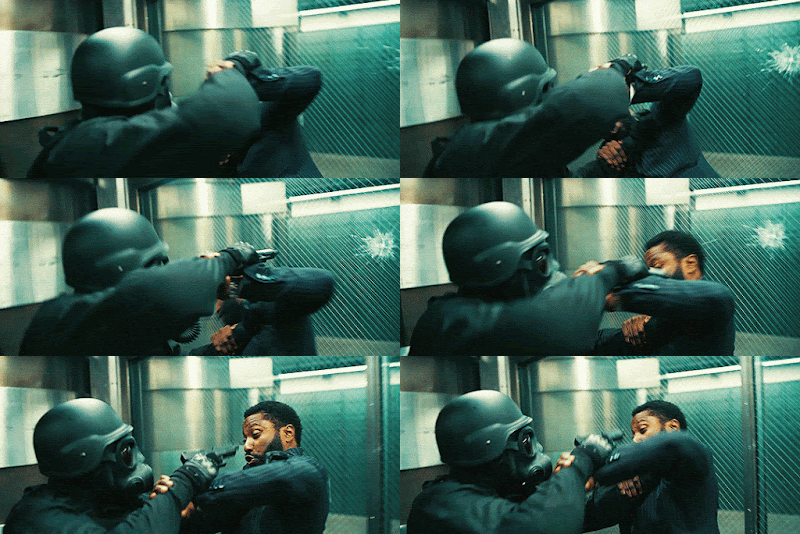
It's happening...
It's disorienting...like a kind of "magical seeing" where thinking doesn't come into it because that would lead to some sort of synaptic anarchy that would make you distrust the simple action of putting popcorn in your mouth. At one point, "Daisy" is seen doing his customary pull-ups on a ship going backwards—he's been reversed temporally but the ships are going forwards, obviously, because that is what they do. But, from our perspective (which is constantly his) the ships are going backwards, reversing into their own wakes. Okay, but if he's inverted and doing everything backwards, what does he eat? How does he eat?Is there enough negative entropic infrastructure that they have entropic meals? At least, reverse Tang? And if everything he experiences is working backwards, I don't even want to think about how the toilets work!
Kenneth Branagh counting backwards...or is it forwards?
This leads to an audience-disconnect where you begin to suspect everything in the film of being untrue...or at least, the natural order of things. The Daniel Craig Bond's have made an entire through-line of its hero learning not to trust anything, not even his past...but, at least, he's still got his senses. Most movies endeavor—from their core—to create a belief in their reality; "Ignore the crewman out of frame with the pastry in his hand, this is true." Yes, there is music—from an unseen orchestra—and we're directing your point of view, so you don't see the reality we don't want you to see, but we're trying to make this as real as possible. Nolan is making as radical a move in breaking "the rules" as when Hitchcock killed off his leading lady half-way through Psycho: He's trying to make the "real" fantastical, in a way the Wachowski's with their computers couldn't with the Matrix movies.

It is mind-bending. And revolutionary. But, then Nolan has always played with the rules and mechanics of film, both in terms of story-telling and in its expectations. He can leave an audience gob-smacked...and deceived. Sometimes both, simultaneously.
Here's the same car-flip backwards and forwards...hope they called insurance before.

I don't know how advisable it is to question or not question the mechanics of what goes on here. In an era of "deep-fakes," one should always be suspicious of "face-value" and just not take things as they appear. Nor, can I interpret the measure of enjoyment you'll have in the movie if it doesn't make any sense. "Seeing is believing" is the old saw, and though I accepted the images, there was the doubter in my mind that kept kibitzing through the movie saying "that just wouldn't work." The answer, in retort, is to recall Hitchcock's rejoinder—"it's only a moovie."  

At least, Tenet is entertaining enough that you don't want to re-live those 2 1/2 hours...backwards or forwards.

Here's a shot from the battle-climax of Tenet:
Take a moment and think about what you're seeing here.
It looks spectacular...but is it possible?
* Yeah, that's usually not how potassium cyanide works—unless you've seen Skyfall.

Friday, August 17, 2018

BlacKkKlansman

Politics is Another Way to Sell Hate
or
You've Got No Skin in This Game

Any time Spike Lee does a movie, it's an event; he's one of the few filmmakers who can actually be called a "stylist" (along with Spielberg, Scorsese, and a handful of others), who even as he explores the story-telling form, advances film-language, expands the vocabulary and moves the art forward, stylistically, artistically, and in the form of content and how it can be effectively communicated to an audience.

His new film, BlacKkKlansman—based on a true story (or, as expressed in the film, "this joint is based on some for real, for real shit") tells the story of Ron Stallworth (played in the film by John David Washington, son of Denzel) who, working as the "first black recruit" in the Colorado Springs police department, decides to investigate the local chapter of the Ku Klux Klan—or, as it was preferred to be called internally, "The Organization" or "The Secret Society" (all in the interest of removing any "stigma" that might be associated with white supremacy or Neo-Nazi's of the past and selling bigotry and racism as inoffensively as white bread).

Now, how would a black officer do that, specifically? Well, it turns out, it takes a village, and making sure that you're targeting village idiots.

After Lee does some priming back-story for the youngsters—in the form of Alec Baldwin portraying a racist cleric making a propaganda film (for comedic effect, we get the out-takes) against a projected backdrop of D.W. Griffith's Birth of a Nation—we see young Stallworth—his 'fro is perfect—going to a job interview at the Colorado Springs precinct, where he is being considered as its first black officer, a position he is warned, that will make him the district's Jackie Robinson, breaking barriers but also having to endure the resistance of his fellow officers ("Do you really think a police officer would call me that?" he asks, rather naively, in front of dumbfounded interviewers). 
Well, he's a perfect candidate, a credit to his race. The thing is, the duties for the barrier-breaking first black officer is to work in the basement records department fishing for files on demand. As he tells his captain (Robert John Burke) this is not what he signed up for.
Then, a breakthrough: he's asked to go undercover at a speech given by radical Stokely Carmichael (Corey Hawkins), presented by the Colorado Black Student Union. See who's there, find out what the speech is, see if Carmichael, who was with the Black Panthers, is going to be stirring up any trouble in town. Stallworth will be the plant—as he's the only black officer—with the operation to be run by two other undercover cops: Jimmy Creek (Michael Buscemi, and, yeah, he's just like his brother) and "Flip" Zimmerman (Adam Driver). They wire Stallworth up for sound and monitor his activities, including chatting up the head of BSU, Patrice Dumas (Laura Harrier, from Spiderman: Homecoming), all in the interest of research, of course.
Patrice and Carmichael get roughed up after the speech, when she and Stallworth hook up at a bar later, and he asks her enough questions that she starts to suspect that he's a cop—"pig" is her word, and he tells her he doesn't use that term. But, he's clearly interested in her and she in him—it's too bad that this is the part of the story that's completely fictional, but it does give Lee a chance to openly contrast the merits of changing "the system" from within and without, using Ron and Patrice for point-counter-point.
His jaunt undercover lands him a promotion to detective, where he gets to decide what he wants to investigate—he doesn't want to do the drug detail—but a recruiting ad in the local paper for the KKK gets his attention. He calls it, gets a voice-mail, leaves a message. He gets a reply about joining "The Organization," to which he expresses enthusiasm using racial slurs and his fear that his sister is dating his sister and his revulsion at the man "touching her pure lily-white body." That sells him to the recruiter.
One little problem: Ron makes a rookie mistake on the phone call by giving the guy his real name. Since Ron is (ya know) "black" there is the distinct possibility (not certain, though) that the Kluxers might suspect something suspicious if he actually goes to one of the meetings himself. So, the police force decides to put its collective head together and decide that a white detective should  maybe go in his place, posing as Ron. In a line that evoked the biggest laugh in the theater, Ron says "With the right white man, anything is possible!"
It's decided that detective Flip will be Ron at the face-to-face meeting, as he has the closest sounding voice to Ron (Jimmy Creek, frankly, sounds like Steve Buscemi!). That has its own potential danger, even for a white guy—Flip is Jewish. But, then, whoever they pick would probably have something about them to offend the KKK. As Flip-Ron gets indoctrinated amid the misfits making up the small Klan chapter, Ron-Ron steps up his game, keeping Flip surveilled during his encounters, and keeping in touch with The Organization, developing a phone-relationship with Wizard David Duke (Topher Grace). Between the work of the two "Stallworth brothers," they raise their creation's prominence in the KKK, to the point where "Ron Stallworth" is in line to become the local chapter's next leader.
Things come to a climax when Duke comes to Colorado Springs to meet "the boys in the hoods" while the chapter plans to bomb another meeting of the Student Union. And, as if there isn't enough going on, Ron-Ron is picked by his boss for the job of protecting Duke while he's in Colorado Springs. Why any police captain in their right mind would do that is one of the biggest "Oh, Really?" moments in the film. 

The thing is...it really happened that way.
This is one of the least mannered films in Lee's career. It's as if the absurdity of the situation allows him to let loose of the clasped-tight reins that he usually keeps on his films. Maybe it's the setting or the time-frame, as he and cinematographer Chayse Irvin use a 70's pallet and some of the forms of 70's blax-ploitation films (split-screens, anyone?) to evoke the era. There's an almost Brooksian verve in the presentation of Ron-Ron on the phone, contrasted with the constant tension of Flip-Ron at his meetings. The KKK are never shown as less than dangerous, but concurrently shown as less than organized and structured, like a glorified Scout troop without a den-Mother.
But, loose as it might be, it still comes with a strategically designed "all-stories-come-together" climax that is as deft as anything Lee has made in the past, where stakes are high, and resolutions are not as easy as they may appear. And, once again, he caps it with a coda that easily transitions to current affairs, set to an amazing rendition of "Mary, Don't You Weep"—by Prince—that moves and reverberates long after leaving the theater.

Rest in Power, indeed.

BlacKkKlansman won the Grand Prix at this year's Cannes Film Festival.