Showing posts with label Matt Reeves. Show all posts

Friday, March 4, 2022

The Batman

It was a Dark and Stormy Knight
or
How Many Batmen Does It Take to Change a Light-bulb?

You know how it went: in "Peanuts", Snoopy would sit on top of his dog-house type-writing—"It was a dark and stormy night. Suddenly a shot rang out. The maid screamed. A door slammed.
 
 
That's how Matt Reeves' The Batman felt to me after I'd survived it. Just as suddenly as something is resolved, you think there's some breathing room, and then you think "Geez! They haven't even figured out the serial killer yet!" And then that starts and you think THAT's finished, and you go "Wait a minute, that seemed kind of easy", and that's when the guano really hits the fan, and things get even more complicated, and you start looking for something to tell you what time it is, because you really think that the thing is never going to end, and then, they distract you and you think "Oh no, they're going to bring him in?"
It's at that point you realize that it's no fun being the Batman—because the job just never stops. You wonder if you even want to admire the Batman or pity him, but you sure don't want to be him. 
 
And maybe...you don't want to watch him.
"So, is it even worth going?" Hell, yeah. Because The Batman is more like the Batman from the comics (depending on the period of origin—in this case, the 1930's and 70's) than he's ever been. Stripped down and deconstructed, this version escapes the taint that has hung on the character ever since the TV-series from the 1960's. There's no "camp". There's no crazy costumes...well, except for the Bat-suit (which is armored to the point that it's bullet-proof and probably tough to maneuver in—he even thuds when he walks)...and there's no goofy archness or hysterical theatricality, which still remained even in the Christopher Nolan-directed trilogy. Not even an artfully-choreographed fight; they're all thumping and brutal.
It's perfectly serious. And does things the "Batman" series has never done before. For instance, this is the first Batman movie since the series started (with Tim Burton back in 1980), where Batman doesn't kill anybody—oh, he messes people up really bad, but they don't die unless it's due to their own actions—and that was a "code" that an orphan who lost his parents to gun-violence strictly adhered to. And the "Batman" in the movies has always stood for vengeance, and here, the character arc has him realize how limiting that is—when he sees the main villain of the piece committing heinous acts to avenge his own circumstances. His self-imposed mission changes during the course of the movie; the film pointedly ends with Batman looking forward and not back.
Now to say I "survived" it takes an explanation. The Batman is just shy of three hours long. And it feels like it*—Reeves can make fascinating movies, but he's not an editorial trickster (like Nolan) so things happen at a steady, remorseless pace (Reeves uses Nirvana's "Something in the Way" as background, and that's the beat that he uses for the film). It's a long run-time, and the story covers a lot of ground, dealing with corruption, organized crime, and striking out against sins of the past. It's less a "super-hero" film than a police procedural along the lines of contemporary British mysteries or "Law and Order"—this Batman even walks through crime-scenes with the police (despite "official" disapproval of vigilantes by the Gotham City Police Department), making observations, providing lines of investigation. It's an intricate maze of clues and evidence that increases the run-time. What would I take out? Not a jot. Certainly not with the Warner studio's recent insistence of cutting things down to near-incomprehensibility.
Because it's a good story that has the construction of the best of the (Batman co-creator) Bill Finger-penned Batman stories: murder victims of a prominent vintage, all seemingly unrelated but leading inexorably to a far greater threat (it's nice that the clues are multi-layered without the usual *snap* "I've got it! He's going to rob the Obvious Clue Savings and Loan!"). And we've become so used to comic-book threats—penguins with rocket launchers, "fear-gas," 'memory-sucking devices" and ice-guns—that it's a little disconcerting—even creep-inducing—that the various plots all nudge at real-world headlines: "Zodiac" messages, "collar-bomb" extortion, mailed death-packages, internet zombies, even Hurricane Katrina.
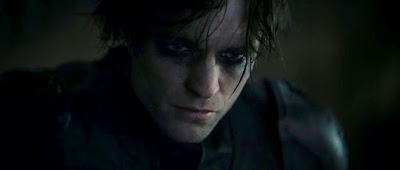
Ah, but you don't want to know all that. You want to know how the Patt-Bat is! He's darned good if you want to discard the whole "Zorro"/"Scarlet Pimpernel" vibe that inspired the character. Pattinson's Bruce Wayne is a brooding recluse holed up in Wayne Tower in the middle of Gotham City, and he'd probably be a prime suspect in the "Riddler" case if the police just looked at the power being used by the dingy bat-filled basement of the building (nah, they wouldn't—he has too much money). His Bruce is so emo, he almost wears a bat on his sleeve—so much for secret identities. But, his Batman is slow, hulking and fills a room, the eyes constantly moving and the perfect jaw-line not at all. It would almost be a mime act if he didn't have Jeffrey Wright doing heavy-lifting (and expositing) as Lieutenant James Gordon ("You could have pulled the punch..." "I did"). Wright makes a character important no matter how much he's pushed to the background, but here, he's the other half of a buddy act. By contrast, Andy Serkis' Alfred is the character who's given short shrift.
But, it's the villains that everybody pays attention to in Batman movies and there's a lot of them: It's a great cast and everybody does very good work.
Zoƫ Kravitz is a fine addition to the ever-growing litter of cat-women, with the appropriate fanged snark and a duplicitous sensuality that one expects of the character by this time. Her scenes with Pattinson fall a bit flat unless they're quarrelling, because he doesn't give out that much as far as any sort of response. That's on him; not her.
Paul Dano leans in to his cherubic looks to create an intensely creepy Riddler—he has several aliases—internalizing the schitzy nature of the character with the same intensity with which Heath Ledger externalized his Joker in The Dark Knight. Ledger is a tough act to follow, but Dano isn't as theatrical and does more with little expressions than anything playing to the loges.
Speaking of which, if Dano leans in,
Colin Farrell leads out with his take on "The Penguin" ("Call me 'Oz'") as a voluble Chicagoan gangster with none of the panache or freakishness in past portrayals, but bearing a family resemblance to Rod Steiger's Al Capone. He is wholly unrecognizable, physically or in performance, and it's not just the elaborate prosthetics he's forced to wear to pull off the job, the acting is larger than it can contain, making a huge impact in a role that's a supporting character to John Turturro's Carmine Falcone, the Gotham boss who's pulling all the strings only to find his organized crime operation being undone by a lone outlier. Also Peter Sarsgaard should be given a hand-clap for his portrayal of a weak Gotham D.A. caught up in the carnage.   
Is it the best Batman movie? I think it's too soon to tell. I didn't come away from it thrilled with it as a whole (as with others), but was delighted at its parts (and little touches like
the bust of Shakespeare in Wayne Tower, the very apt use of DOS graphics, the song that plays when Bruce Wayne visits Mob-boss Falcone)
There is no doubt that this is the best interpretation of the character if you want to do it as a straight-ahead portrayal, ignoring the many iterations that have made up its history, the bad and the good. Someone had to do it—to put the detective back in The Darknight Detective. And Reeves, who has proved time and again that he can make something special and unique out of retread material, has managed to make something original with Batman.

* It isn't helping that the theaters front-load this particular attraction with more than the usual number of commercials (even inserted between previews—which, let's be honest—are commercials, too). The whole presentation is like 4 hours long. One can see why the theater-chains are doing this—a 3 hour movie limits the number of times it can be screened, even though they've Bat-jammed as many  showings in as many plex's as they can manage. And those commercials pay the chains. But, it is testing the endurance of an audience not expecting an epic Lawrence of Arabia roadshow. 

Wednesday, October 9, 2019

Life Sucks for a Teen-Age Vampyre (In Love)

Written at the time of each film's release.... 

"Fangs for the Memories"

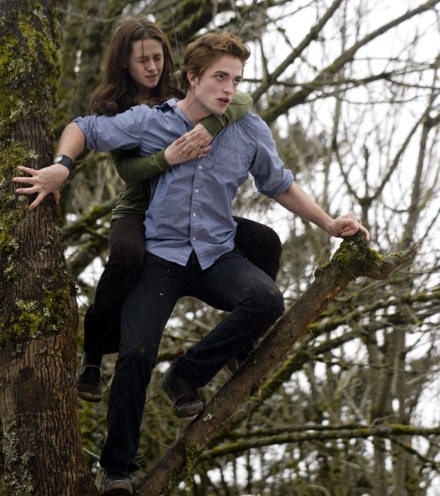
Bella Swan (Kristen Stewart) may be the palest student ever to transfer to Forks High School from Arizona. For some reason her inability to maintain a tan is given a pass by her class-mates (who all try a bit too hard acting like fun-loving "with-it" teens-in-the-woods), but the constant topic of conversation are the equally pale Cullen family.

The Cullens keep to their ruby-lipped, paler-than-pale selves. They don't mingle and are a clique unto themselves. When the weather is good (rare in
Forks, Washington out there on the Olympic Peninsula) the Cullens don't show up for school, but instead "go camping," as the story goes. Bella, a natural klutz physically and socially, is drawn to the unattached Cullen, Edward (Robert Pattinson). And why wouldn't she be? Like the rest of the Cullens he always appears to be walking in an undercranked slo-mo dream state, the chiseled delicate face of a Orlando Bloom/Johnny Depp/Jude Law, stops careening vans like Superman, growls like Elvis, and has the hair, neuroses and doomed bad-boy presence of James Dean, and perfect skin that glows translucently in the sun-light like diamonds . He seems particularly drawn to her, too. He can't eat, can't sleep, and has a lean and hungry look all the time.

It might be love, but maybe it's the vampirism.
It must be nice to be Stephanie Meyer right now. She's making a ton of dough off of recycled ideas and the cross...uh, sorry...combining of similar genres to create the biggest literary sensation since....well, since "Harry Potter" claimed to be literary. The "Twilight" series mixes equal parts Gothic Romance, standard Romance novel tropes and vampires and comes up with "Dark Shadows." Except Dan Curtis came up with that idea in the 1960's, so toss in a healthy dose of Judy Blume, and you produce what 'tweenettes have been swooning over the past couple years.
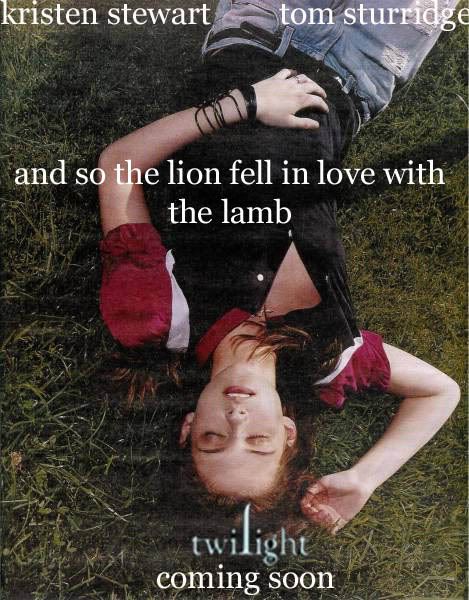
Now, here comes Twilight, the movie, and like the "Harry Potter" films it distills the essence of the plot without communicating what makes both of those series fun reads in the first place. Instead, everything comes across just a bit cheesily dramatic: Edward is all lowered gaze and wolfish teeth, and Bella (the name clues you in that Meyer is being a bit playful with her writing) is all heaving commitment. Edward's self-loathing for his disease puts up a barrier that confuses and messes with Bella's head (the only mind that Edward can't read), and his affliction just attracts her all the more. Which is bad for Edward because he and the other Cullens subsist on only animal, not human, blood (which he says is like humans on a steady diet of tofu: sufficient, but not very satisfying--a nice touch, that), and Bella is a constant temptation. "You're like my form of heroin," he says to her. And for all the romantic hooey of "the lion falling in love with the lamb," it feels a bit more like falling in love with a T-bone steak.
Yeah, well, I love chocolate, but not enough to marry it.
Remember, back when I wrote about Dracula, and said that it was a metaphor for raw hetero-sexuality?** Here, it's spelled out in big block letters Barbara Cartland could read with her lowest level bejewelled spec's: a vampire's blood-lust is just lust with everybody's formal-wear on. And penetration is penetration. Edward is the good boy with manners enough not to soil his lady-love ("killing" her for real, not just her reputation), while Bella is the willing maid panting for "it" (Kristen Stewart basically fulfilled that same role in Into the Wild). In one particularly heaving bedroom scene, they kiss to test how far they can restrain themselves (him to chomp on her, she to have sex with him) and just when things get a little out of control, he heaves himself against the opposite wall--like he was spring-loaded, or something.
That scene, and a lot of others, boast some of the most poorly done practical effects work done since Clark Kent's "skimming" run in the original "Superman" movie. We're in the post CGI-realm, folks, things could look a lot better than the FX one would expect on "Smallville."
That's another issue: Director Catherine Hardwicke makes "Twilight" looks cheap. I've seen Billy Burke (Fracture) before, and Elizabeth Reaser (she was wonderful in Sweet Land), but they're the only recognizable faces in the film, and the movie seems to have a film of murk all over it. As they filmed it in the Northwest--Oregon substituting for Washington (nice work, again, Washington Film Board!)--it might be fog getting under the lens. These books are making ga-zillions of dollars, you'd think they'd throw some money at the adaptations.

It takes the film a bit to get going, because Bella has to do research to discover what vampires are--seemingly being out of touch with culture her entire life--but it does spring to life in a decidedly unexpected way: when the two kids have to meet the families. Edward turns a bit paler meeting Bella's cop-dad, and the joke about the Cullens having Bella over for dinner is nicely mined for uncomfortable laughs. "Bella, you're about to go to a house full of vampires, and the only thing you're worried about is making a good impression?" is the best line in the film. Then, it all goes completely south with a vampire baseball game (seriously) and a tedious version of "The Most Dangerous Game" with a trio of "bad" vampires, who are evidently playing for another team. At that point, everyone stops thinking and starts doing stupid things when there is so much at...stake.

................................................................................................................
But just when one thinks there's not enough blood in the genre that hasn't already been regurgitated along comes this modest film from half-a-world away that covers a lot of the same unconsecrated earth as "Twilight' but gives it a poignant spin.

Let the Right One In (aka "LĆ„t den rƤtte komma in") introduces us to Oskar (KĆ„re Hedebrant), a child of divorced parents living in an apartment block in a Stockholm suburb in 1982. When first seen, one could mistake him for a Renfield-type, babbling to an unseen person to "squeal like a pig" while brandishing a knife. He watches from his window as a car pulls up in the middle of the night, and a man and a girl get out and move in to the apartment next door. Cardboard is put up in the windows and things go quiet.
Then, strange ritualistic murders begin happening around town, and Oskar's fellow students are warned to beware of strangers in the night walking home from school. Oskar has his own problems with an unholy trinity of bullies that regularly taunt him--they're the reasons for his revenge fantasies played out in the safety of his own home. 
About the same time, he makes the acquaintance of a pale girl named Eli (the excellent Lina Leandersson), who's about his age..."more or less," she says. When she learns of his bully troubles, her answer is simple: "Oskar, hit back. Hit them harder than you dare. Then they'll stop." Eli gives him the courage to do just that, and he begins to take weight-lifting classes.
Eli has her own problems: her benefactor and procurer has begun to make mistakes and the towns-people are getting suspicious, as the attacks become more random and more vicious. Eli and Oskar grow closer, deciding to go "steady," as events threaten to tear them apart.

Let the Right One In may sound sweet, but the savagery of the attacks is anything but—director Tomas Alfredson stages them swiftly and suddenly, and they can catch the audience by surprise. Plus, some of the happenings have a giddy violence that may produce uncomfortable giggles along with the chill up the spine (not unlike those of the excellent, though little seen, Exorcist III).
There is visceral, grisly horror in the story of the both supernatural and all-too-human varieties. The vampires of "Twilight" are ethereally pretty in the sunlight of the Northwest. In the similar light of Sweden, the results are decidedly different and more spontaneous. To say more would rob the film of its twisted charm, something that can't be said for the cob-webbed cliches of Twilight. That an American remake is in the works is news that can be regarded with its own brand of horror.

May it never see the light of day.


"Just So You Know, I Won't Be Your Friend"

Let Me In is an American remake of Let the Right One In, the terrifically creepy 2008 Swedish film. For those who hate sub-titles, this is probably a good thing. And what's good about the original is slavishly copied here, but director Matt Reeves (Cloverfield) does some good things (and a couple bad) to move the situations from frozen Sweden to a wintry Los Alamos, New Mexico.* The best thing is the acting.  Let Me In includes such great thesps as Richard Jenkins (a fine actor and more people will see him in this than any other film he's done) and Elias Koteas. But, it's the kids who are the best thing about it.  Anyone who's seen Kick-Ass already knows Chloe Moretz is terrific, but this is less of a joke-performance, and plumbs the depths of what she can do dramatically. Her waif, Abby ("I'm 12...more or less") starts out alarmingly strange, but as the movie progresses, the character turns more vulnerable and sympathetic—far more than Lina Leandersson in the original. 
But, the stand-out here is Kodi Smit-McPhee as the initially screwed-up Owen, a victim in danger of continuing in an unthinking cycle of violence. McPhee's Owen wears his heart on his sleeve—he just won't show it on his girlish face—but as the movie progresses, that face starts to beam (he is far more expressive than the Swedish version's KĆ„re Hedebrant, in fact, both kids in the first have a Teutonic reserve that is appropriate for that film's style, but would seem catatonic in this version) as he approaches his relationship with Abby with the same vulnerable hopefulness he just can't allow in his other interactions.
Reeves does manage to make some things his own, as well. He mostly discards the firsts glacial blue color palette for a neon orange that suffuses scenes, and he nicely captures a bit of the gender-bending feel of the first, though differently. Also, he very cleverly stages some of the violent sequences obliquely, thrusting them in the stage-rear of the frame while the main focus is going on in the foreground. The more human attacks are handled extremely well, surprisingly—alarmingly so, but the movie veers into goofiness whenever more occultish violence occurs. The director holds on the scenes too long, and even though a lot of it is done in back-lit cameo, the effects make it look like the perp is less a savage beast than a crazed monkey with a banana-buzz. 
Sure, there should be some giddy thrill involved in horror, but "giddy" shouldn't translate to guffaws. He also makes crystal-clear the true horror of the piece, something that only occurred to me, after a bit of time of contemplation—for some reason, I like my "OMG" moments to be outside the theater. And he gums up the last scene of the film with a too-nostalgic pop reference that negates its effectiveness.

Still, after having dismissed the idea of an American remake with "may it never see the light of day," I have to admit that this one doesn't suck badly.
* Yes, it DOES snow in Los Alamos, New Mexico, and it has nothing to do with a Nuclear Winter.

** No, you don't because it's being posted Friday, so consider this a teaser.

Thursday, July 27, 2017

War for the Planet of the Apes

Ape-ocalypse Now (The Beginning and The End)
or
"What Would Caesar Do?" ("Jesus Christ, You're Impressive...")

The more steps you take away from War for the Planet of the Apes, the more interesting a film it is. Maybe it's the way the FX now make you "buy" the apes as credible characters and not motion-capture constructs (They always looked good, aided immeasurably by the at-the-core ape-performances of Andy Serkis and crew). Maybe because Matt Reeves doesn't do anything "fancy," just directs with an eye toward verisimilitude and not for the cutesy-kitsch (ala the first movie from 1968). Maybe because the movie touches so many cultural reference points (and not just the first "Planet of the Apes" tetrology) that you get the feeling you've seen it all before—you have, just never like this, and never from this perspective. It is a film of so much incident (although quite compact), that the Big Picture the film is aiming at doesn't become apparent until you're out of it. Like the apes in their California forest, you can't see them for the trees. It's because evolution has been upended, and Man has made his successor in the form of his ancestor. The apes become humanity...and that's not a good thing. We have met the enemy and "he is us." The humans have played God with evolution...and God's really pissed.
Those expecting a big apocalyptic nuclear set-piece will be disappointed (although I was rather expecting it when I saw a reference to Beneath the Planet of the Apes in one of the sets). The world doesn't end with a bang, or a whimper, for that matter. As George Carlin once groused about Earth Day: "The earth will be just F-I-I-NE. But WE'RE fucked!" The world doesn't end at all. It just hits "reset" as it occasionally does ("Okay, everybody outta the gene-pool!") and begins again. Cosmically speaking, The Earth bases its fiscal year on dominant species. And the new King in town is the one Evolution left behind, and that Evolution's beneficiary unknowingly gave a kick-start to in its attempt to improve itself. The next species would do well if it never invents irony.
It's been two years since Dawn of the Planet of the Apes, which saw the sentient Ape-Tribe created by the green-eyed laboratory-experiment Caesar (Serkis) going through its own Civil War, ending with the death of Caesar's Iago and rival for power, Koba. But Civil Wars never really end, and those divisions haven't quite healed, and for the human survivors of a population-consuming flu (which grew out of the same experiments that created the intelligent apes—ya  know, irony), there hasn't been any sign of Caesar and his followers, as they have dug even farther into the Muir woods outside of San Francisco.
But, just because you don't see anything doesn't mean you can't hunt for it...just ask "Bigfoot." After a brief summation of what has gone before ("Reading" is what they'll say on CinemaSins), over a darkened forest shot, we see a well-armed Special Forces team stealthily track forward. On their helmets are slogans like "Monkey-Killer" and "Bedtime for Bonzo!" Humorous cultural references aside, they're on a mission: they've come from the north of the country under the command of one Colonel McCullough (it will turn out to be Woody Harrelson) to eradicate Caesar's ape-tribe for specific reasons that will be explained later, beyond merely fear and loathing. 
The attack initially goes well, decimating forward ape-guards standing at the ape-colony's outer defenses. But, a lone ape escapes on horse-back to bring reinforcements and the superior weapons of the unit are soon overcome by sheer force of numbers in an attack consisting mostly of a coordinated arrow attack. The Special Forces are overrun, save for four prisoners, including a gorilla, recognized as one of Koba's followers.
The prisoners are defiant. "How long do you think the woods will protect you? The Colonel has more power." They have every expectation to be killed, even inviting it, but after questioning them, Caesar sets them free. "Tell your Colonel you have seen me now. Tell him leave us the woods." And he sends them packing, tied back to back, astride horseback, and the tribe attends to their dead, putting their bodies in the river to send them to the sea.
Caesar's son, Blue-Eyes (Max Lloyd-Jones) comes back to the encampment after a long sortee to report that he's found a potential permanent home for the apes across a wide desert that might provide them safety. Caesar makes plans to evacuate the current refuge in the Muir woods and head for his promised land with the surviving apes and his family.
But, that night, other plans come to fruition. In his cave with his family asleep, Caesar sees green lights through the cover of their water-fall camouflage—an attack is coming and he runs after his commanders to seek out the soldiers and defend the encampment. He tells Blue-Eyes to stay behind and guard his family as he bounds into the interconnecting tunnels to coordinate the attack.
But, coming back to his quarters, he finds his family dead, riddled with bullets...and...just about to escape the scene of the assassination, the Colonel, who fires on Caesar as he prepares to be helicoptered away. Enraged, Caesar leaps after him, grabbing onto his rappelling line and starts to climb. But McCullough cuts through the chord and Caesar falls into the lake below, his family's murderer, escaped.
The next morning, it's a different Caesar making the plans. He instructs the tribe to head to the area found by Blue-Eyes and start again. But, he won't be going with them. Instead, he's going to go to the Army compound and kill McCullough, to later re-meet with the tribe should he survive. But, at this point, that's the least of his ambitions. His face is now an almost permanent scowl not—as one reviewer has said—dissimilar from the face of one of Clint Eastwood's revengers
It's apt. Because there's a lot of The Outlaw Josey Wales in War for the Planet of the Apes, as well as The Searchers, The Great Escape, shades of Apocalypse Now (but not much) and more than a salute to "Monkey Planet" author Pierre Boulle's "other" famous work "The Bridge on the River Kwai" and before the movie's through, you'll see hints (actually, more than hints) of Spartacus, Moses, and Jesus Christ, as well as Othello and MacBeth. That's a lot of iconography to be shouldered by one ape, but, at this point, short of martyrdom, there's not much more this risen ape can do to become a mythic figure to his followers. Myth is precisely what War for the Planet of the Apes is going for. And History repeating itself, as sure as the turning of the Earth, or its era.
But, Caesar has unwelcome company on his way to McCullough's compound; he's followed by orangutan Maurice (Karin Konoval), the gorilla Luca (Michael Adamthwaite), and chimpanzee Rocket (Terry Notary), who refuse to leave his side on his journey. Before long, they come across another chimp, Bad Ape (Steve Zahn), a zoo escapee who has also learned to talk, and a mute girl (Amiah Miller), who will soon be called Nova. They soon discover others, of McCullough's troop, who have been shot, abandoned and left for dead, who also exhibit signs of mutism, apparently a mutation of the original simian flu, carried by the survivors, that affects their speech centers.
So, let's see...

Apes Talk
Humans Fewer in Number
Humans Become Mute

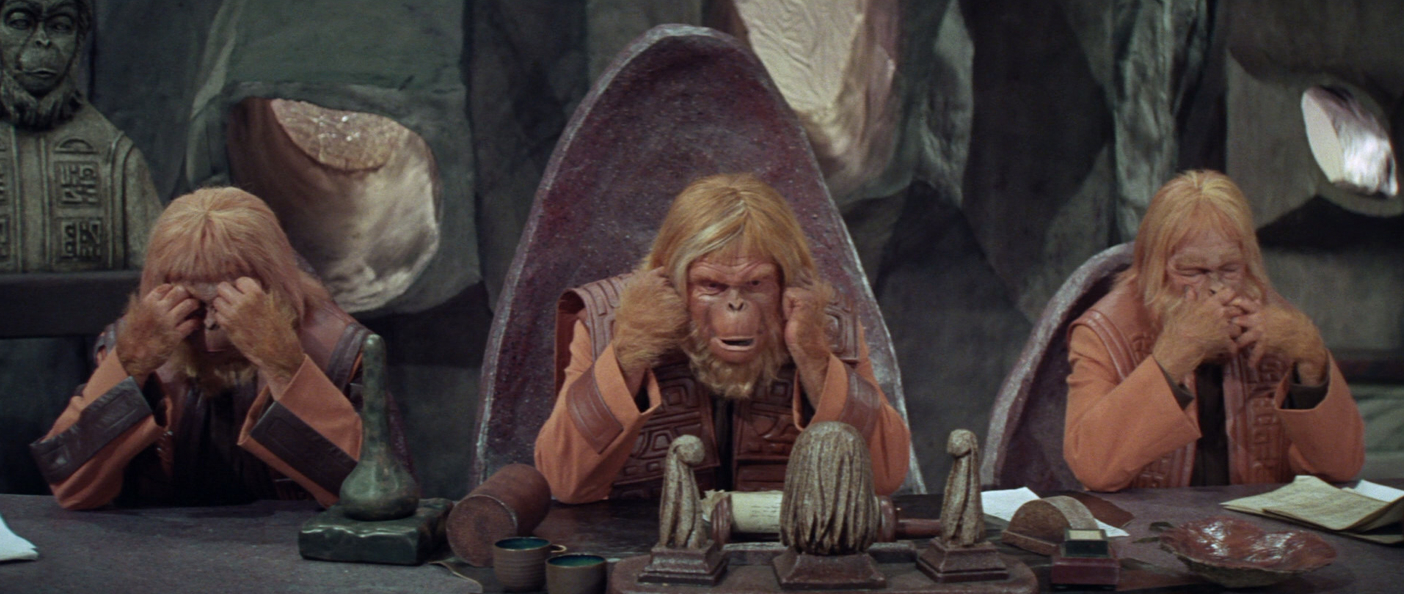
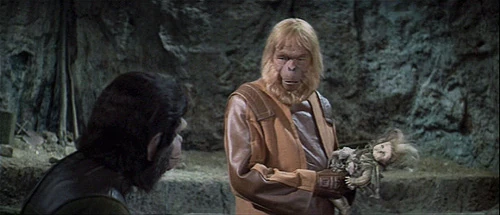
All we need is a doll that goes "Mama" and a couple ruined national monuments and we're back to the beginning.
But, we've got a ways to go still. At one of the bases of the Alpha-Omega troop (the name of McCullough's forces), the small primary band of primates learn something else. While on their exodus, the Muir apes have been outmaneuvered, captured by McCullough's forces and taken as prisoners back to his main base. Now, Caesar has another mission besides his personal revenge—free the apes so they can continue on their exodus. What he sees at the camp enrages him. The apes are back in cages and during the day, they are brought out to (without food and water) work a quarry and construct a large defensive wall for a coming attack—not from apes, but from other humans, who think, quite rightly, that McCullough has gone off his rocker and plan to (and here's the Apocalypse Now part) "terminate the colonel's command with extreme prejudice."

I guess Caesar and the humans have more in common than thought.
"Apes strong...together."
While Caesar goes after McCullough, Maurice, Nova and the others do some planning behind the scenes on trying to break the Muir apes out, and this is where the center-piece of the action starts. Now, I'm starting to read comments on IMDB* that fuss about War being being mis-titled, that it's not so much a war as a skirmish. Numbers aside, this is a whiny comment, born of a diet of super-hero movies pumped with more adrenaline than craft. There's a lot going on here, besides orange-flamed flowering explosions and gymnastics (although there's plenty of that to satisfy anyone not eating their Wheaties with RedBull). Revolutions are made with more than bullets. And, given the cultural references brought to bear in War..., the film is hardly revolutionary, even if it's depicting one. This is good, old-fashioned film-making with a lot of thought and a lot of care. I think the IMDBullshitters are reacting to the rather glowing interviews of the mainstream critics, who are probably just relieved about seeing a good story well-told. Maybe they're pissed about the military being depicted this way. But, one should be reminded that McCullough is an outlier, an extremist, opposed by even the traditional military who have been satisfied to leave the apes in peace and have no interest in what he calls his "Holy War." If you're going to defend something you have to be able to recognize extremism...even if it's in the mirror.
If there's a failing, it's one of scope. What's the rest of the world doing? (The credits of Rise... indicated that the "simian flu" became a pandemic). The experiments that created Caesar and his kin was all based in the United States, so one can forgive this; the "action" of The Planet of the Apes should be focused on where the mutated apes are and that will be where Caesar is. So, one can forgive the U.S. base (I would rather like to see what the French are doing—it's their story, after all).
So, there's action aplenty and food for thought, as well. That's in keeping with the entire series, which has always been satirical, often heavy-handedly so. This prequel series of Rise..., Dawn..., and War... has been more cunning, and far more subtle, often defiantly so. One of my favorite shots of the three films is in War... where a captured Caesar stands up for his troop in their captivity and resists, taking the whipping that one of his followers started to endure. The weakened ape is dragged to McCullough who stares at him, mutters "Jesus Christ, you are impressive" and orders him to order the apes back to work. When Caesar refuses, he takes his gun and points it Caesar's forehead...and he defiantly leans into it, staring his oppressor down. That is powerful stuff, more than explosions, more than fire-power, more than mega-tonnage.
So...how does it all end? Aptly, actually. With an ending and a beginning. 
But the POTA prequels leave one thread dangling...suspended, as it were. Back in Rise... there was the hint of a mystery that was buried in background television newscasts and newspaper headlines...of the Mars Mission Icarus that was poised to enter the Martian atmosphere but became (as the headline read) "Lost in Space." Nothing of that seemingly doomed mission is mentioned in either Dawn... or War..., but it's still out there, somewhere. War for the Planet of the Apes ends (not with a bang, not with a whimper) with a shot of the former Muir-Ape-troop in their Promised Land, as the camera tilts up to the sky and lingers there for more than a moment before the final fade-out. This may not be to connotate the freeing of a spirit, but more probably to await the promise of...something...falling to the Earth. The circle in this trilogy is now complete, but with that completion of the turning, another one has begun, in the grooves of what has come before. Is it the end of The Planet of the Apes...or just the beginning?
* I've also seen comments that it's "communist propaganda" (I'm mystified as to how, but any thought I put into it would be more than was put into the original comment) and objecting because "humans are the bad guys." Well...duh. In the POTA series, they always were. The humans were the ones in charge of the nuclear weapons that decimated the human population and created the power vacuum that the apes filled. One only has to remember the last lines of the original: "So, we finally, really did it. YOU MANIACS! YOU BLEW IT UP! AH, DAMN YOU! GOD DAMN YOU ALL TO HELL!!!" (I'm surprised I didn't see THAT reply in IMDB).