Showing posts with label Teen Movie. Show all posts

Saturday, July 8, 2023

The Art of Getting By

"Whatever..."
or
"What's Next, Basquiat? (Whoa-Whoa-Whoa-Who-o)"
 
George (Freddie Highmore, the excellent kid from Finding Neverland and Charlie and the Chocolate Factory, practically grown up) is a senior at a tony prep school in New York, in danger of getting kicked out. He's depressed. Not because he's going to get suspended, but because he's coming to grips with the fact that life is short and nobody gets out alive. So, he doesn't pay attention in class, doesn't do any work and uses his books as doodle-canvas, some of which is very not bad. His teachers (Jarlath Conroy, Ann Harada, Alicia Silverstone) know he's smart but are frustrated that he couldn't begin to apply himself. His principal (Blair Underwood) cuts him every break, but he just doesn't apply himself. "Life is meaningless," he tells a teacher when picking up assignments. "And that includes the homework, unfortunately."
He tells
his mother (Rita Wilson) and step-father (Sam Robards) "I've got it under control," but it's just a delaying tactic. He's too smart for his own good, but like most students, he doesn't know what he doesn't know. That's where life comes in. But he won't get there, by being so insular, cut off from everybody.
After another stale-mate with the principal, he goes up to the roof to smoke, where
Sally Howe (Emma Roberts) is smoking. A teacher comes up and George becomes Sally's knight-in-shining armor by pretending to be the one dragging.  Later, she confronts him about why he did it. "I'm the teflon slacker," he says.  "I'm more used to getting into trouble and I'm better at talking my way out of it."  He and Sally become friends...then things get complicated.

They do, but they don't.  
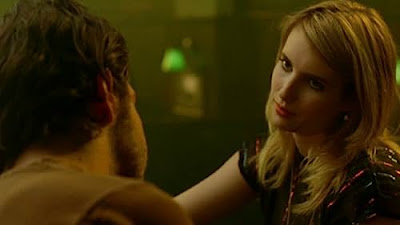
His habitual failure to commit extends to their friendship, as well, and it's a little hard to determine why—maybe he's just not willing to apply himself, or maybe he has such a fear of failure (or a fear of success, where he could lose everything). But it's pretty clear that he'll take a "wait and see" attitude with everyone...and everything.
He enjoys spending time with Sally, who's popular and a knock-out and seems to find him intriguing in that way that geek-writers think women are attracted to geeks. And she seems to want to "go there," but he's all "we're just friends" despite the time he spends with her when he'd normally be in his self-imposed solitary confinement. No wonder she sees other guys...which he thinks of as some kind of betrayal. 


What does he think would happen?
That question, and so much of the film, is intriguing and keeps your interest (like a train-wreck does), as long as there are no consequences to his actions. But, once they all start piling up, The Art of Getting By stops getting away with it. Then, it becomes frustrating (in about the same capacity as that "me stupid" feeling you get for delaying writing that term-paper for so long). Then, writer-director Gavin Wiesen swerves in his little game of "chicken," in a wish-fulfillment fantasy that even Woody Allen, schlub-fantasist that he is, would mock if he saw it.

Wiesen casts his film well, and his direction of the actors shows he's not afraid to take risks.* And the screenplay shows promise. But, that ending is a big "Fail." Maybe it was imposed to get distribution, but, man.... Like the protagonist, there is so much potential there, that just gets wasted. 
* Roberts is a heart-breaker, the teachers (even Alicia Silverstone) play tough with their characters, and props to anyone who hires Elizabeth Reaser and doesn't squander her talent (as the "Twilight" films do). 

Saturday, June 24, 2023

The Perks of Being a Wallflower

Written at the time of the film's release...

Something from Nothing
or
No Man is an Island of Misfit Toys 

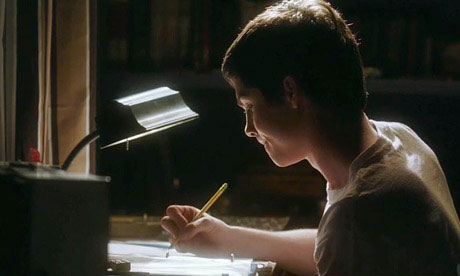
Charlie (Logan Lerman) is starting his first year in High School as a freshman and he has a lot to learn. He's shy, introverted, and fragile the result of some trauma we know not what going in. He walks the corridors friendless, a punching bag for the cool kids and their posses. His parents (Dylan McDermott and Kate Walsh) are lightly caring, and his English teacher (Paul Rudd) reassures—"If you make one friend on your first day, you'll do good." "If my English professor is the only friend I make today, that'll be sorta depressing."

But Charlie does have one friend, writing to him about his experiences, pouring out his frustrations and observations in letter after letter about his "trying not to be a loser." The friend is anonymous, may not even exist, or once existed, but those letters keep Charlie going and serve as his avenue of expression, rather than having his day pulled out of him at the family dinner table. It's an uphill battle from some valley that isn't discussed, but Charlie is self-aware enough to know some perspective. "My life is officially an after-school special," he grouses.

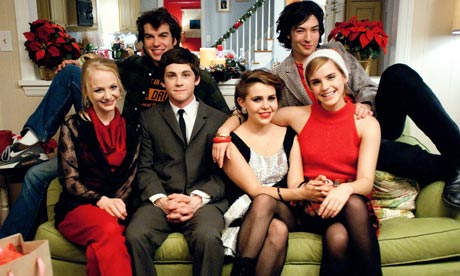
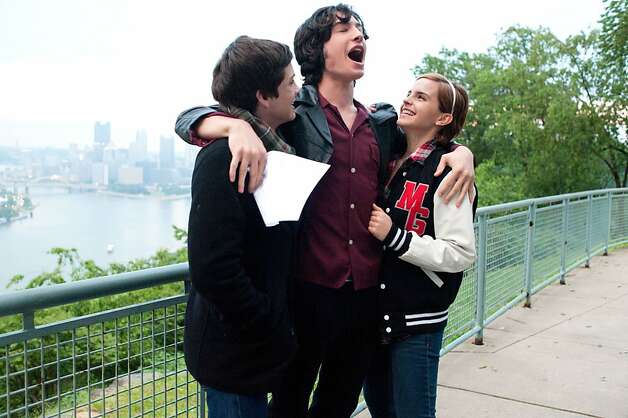
At a football game, he meets Patrick (Ezra Miller), a senior and the subject of some casual bullying, but Patrick has a wicked sense of humor that he throws out with no hesitancy as a shield. Charlie gravitates to him, and meets Patrick's step-sister Sam (Emma Watson), also a Senior, but who is coming back from "having a reputation." After the football game, the three hang out at a diner and compare notes of commonality, which involve a distinct lack of fitting in with the high school social structure, and Charlie is introduced to more of the group, who hold fast, hang out, and provide safety in numbers and a fresh perspective on the puerile benefits of normalcy.

The Perks of Being a Wallflower
(written and directed by Steven Chbosky from his own novel) is a fine quirky example of a "Coming of Age" movie, that sub-set of the teen flick where lessons are learned (his life really is an after-school special) and is not so much a film about growing up, as growing out. Growing out of the insular self-inspection, narcissism and selfishness that is comfortable and has no risk, it's dark and warm and safe in that little "black cave of the psyche." But is it? That cave only echoes one's own thoughts back to us, providing no perspective and no horizon to reach to or for.

Yeah, it's pretty safe in there...if there aren't any demons or other creatures of the nightmare lying in wait to strike when you're most vulnerable. And we all have those. And even if we don't, the echoes of our own thoughts are only phantoms and zephyrs, not sustaining, and if that's all we cling to, they become echoes of echoes, distorting, becoming less clear, and often impenetrably undecipherable—a feedback loop. 


And feedback loops, uninterrupted, can become weapons.
Charlie is scared. And ashamed. And that limits his choices, when he does make a choice. Most of the time, things are just foisted on him and he has to make a decision: like this, or don't? Comfortable or not? Aware, or comatose? And by the time, he makes a decision, it's usually too late, putting him a tail-spin, and another trap. His fellow wallflowers are in traps, too (isn't that what High School is all about?), but one thing he learns is that they're not the only ones and the traps, self-made or imposed are universal.

It's a good film, with good imagery, but a neophyte director's tendency to hit things a little too square—the shot from the communion wafer to the LSD tab, please—but the performances feel real, Emma Watson is a helluva dancer, and it's a good trip down memory lane, now that it's gone and out of our lives. "See ya, wouldn't wanna be ya"


For the truth of the matter is, we all grow out. We couldn't survive if we didn't. Yes, "we are infinite" as the movie's tag line wants to be sure we know.  

But not individually.

And not by ourselves.
Out of the black cave and into the light

Wednesday, October 9, 2019

Life Sucks for a Teen-Age Vampyre (In Love)

Written at the time of each film's release.... 

"Fangs for the Memories"

Bella Swan (Kristen Stewart) may be the palest student ever to transfer to Forks High School from Arizona. For some reason her inability to maintain a tan is given a pass by her class-mates (who all try a bit too hard acting like fun-loving "with-it" teens-in-the-woods), but the constant topic of conversation are the equally pale Cullen family.

The Cullens keep to their ruby-lipped, paler-than-pale selves. They don't mingle and are a clique unto themselves. When the weather is good (rare in
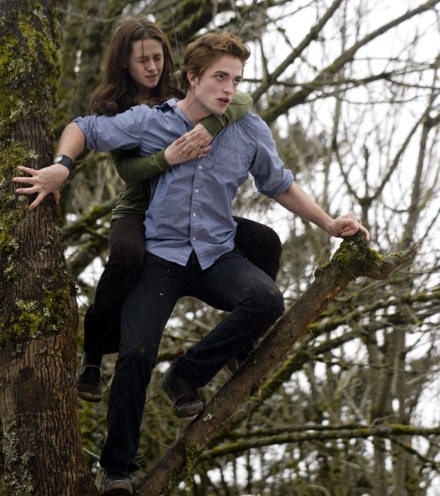
Forks, Washington out there on the Olympic Peninsula) the Cullens don't show up for school, but instead "go camping," as the story goes. Bella, a natural klutz physically and socially, is drawn to the unattached Cullen, Edward (Robert Pattinson). And why wouldn't she be? Like the rest of the Cullens he always appears to be walking in an undercranked slo-mo dream state, the chiseled delicate face of a Orlando Bloom/Johnny Depp/Jude Law, stops careening vans like Superman, growls like Elvis, and has the hair, neuroses and doomed bad-boy presence of James Dean, and perfect skin that glows translucently in the sun-light like diamonds . He seems particularly drawn to her, too. He can't eat, can't sleep, and has a lean and hungry look all the time.

It might be love, but maybe it's the vampirism.
It must be nice to be Stephanie Meyer right now. She's making a ton of dough off of recycled ideas and the cross...uh, sorry...combining of similar genres to create the biggest literary sensation since....well, since "Harry Potter" claimed to be literary. The "Twilight" series mixes equal parts Gothic Romance, standard Romance novel tropes and vampires and comes up with "Dark Shadows." Except Dan Curtis came up with that idea in the 1960's, so toss in a healthy dose of Judy Blume, and you produce what 'tweenettes have been swooning over the past couple years.
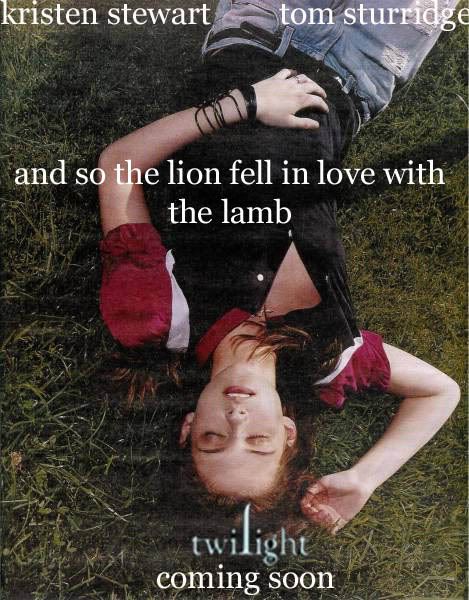
Now, here comes Twilight, the movie, and like the "Harry Potter" films it distills the essence of the plot without communicating what makes both of those series fun reads in the first place. Instead, everything comes across just a bit cheesily dramatic: Edward is all lowered gaze and wolfish teeth, and Bella (the name clues you in that Meyer is being a bit playful with her writing) is all heaving commitment. Edward's self-loathing for his disease puts up a barrier that confuses and messes with Bella's head (the only mind that Edward can't read), and his affliction just attracts her all the more. Which is bad for Edward because he and the other Cullens subsist on only animal, not human, blood (which he says is like humans on a steady diet of tofu: sufficient, but not very satisfying--a nice touch, that), and Bella is a constant temptation. "You're like my form of heroin," he says to her. And for all the romantic hooey of "the lion falling in love with the lamb," it feels a bit more like falling in love with a T-bone steak.
Yeah, well, I love chocolate, but not enough to marry it.
Remember, back when I wrote about Dracula, and said that it was a metaphor for raw hetero-sexuality?** Here, it's spelled out in big block letters Barbara Cartland could read with her lowest level bejewelled spec's: a vampire's blood-lust is just lust with everybody's formal-wear on. And penetration is penetration. Edward is the good boy with manners enough not to soil his lady-love ("killing" her for real, not just her reputation), while Bella is the willing maid panting for "it" (Kristen Stewart basically fulfilled that same role in Into the Wild). In one particularly heaving bedroom scene, they kiss to test how far they can restrain themselves (him to chomp on her, she to have sex with him) and just when things get a little out of control, he heaves himself against the opposite wall--like he was spring-loaded, or something.
That scene, and a lot of others, boast some of the most poorly done practical effects work done since Clark Kent's "skimming" run in the original "Superman" movie. We're in the post CGI-realm, folks, things could look a lot better than the FX one would expect on "Smallville."
That's another issue: Director Catherine Hardwicke makes "Twilight" looks cheap. I've seen Billy Burke (Fracture) before, and Elizabeth Reaser (she was wonderful in Sweet Land), but they're the only recognizable faces in the film, and the movie seems to have a film of murk all over it. As they filmed it in the Northwest--Oregon substituting for Washington (nice work, again, Washington Film Board!)--it might be fog getting under the lens. These books are making ga-zillions of dollars, you'd think they'd throw some money at the adaptations.

It takes the film a bit to get going, because Bella has to do research to discover what vampires are--seemingly being out of touch with culture her entire life--but it does spring to life in a decidedly unexpected way: when the two kids have to meet the families. Edward turns a bit paler meeting Bella's cop-dad, and the joke about the Cullens having Bella over for dinner is nicely mined for uncomfortable laughs. "Bella, you're about to go to a house full of vampires, and the only thing you're worried about is making a good impression?" is the best line in the film. Then, it all goes completely south with a vampire baseball game (seriously) and a tedious version of "The Most Dangerous Game" with a trio of "bad" vampires, who are evidently playing for another team. At that point, everyone stops thinking and starts doing stupid things when there is so much at...stake.

................................................................................................................
But just when one thinks there's not enough blood in the genre that hasn't already been regurgitated along comes this modest film from half-a-world away that covers a lot of the same unconsecrated earth as "Twilight' but gives it a poignant spin.

Let the Right One In (aka "LÃ¥t den rätte komma in") introduces us to Oskar (KÃ¥re Hedebrant), a child of divorced parents living in an apartment block in a Stockholm suburb in 1982. When first seen, one could mistake him for a Renfield-type, babbling to an unseen person to "squeal like a pig" while brandishing a knife. He watches from his window as a car pulls up in the middle of the night, and a man and a girl get out and move in to the apartment next door. Cardboard is put up in the windows and things go quiet.
Then, strange ritualistic murders begin happening around town, and Oskar's fellow students are warned to beware of strangers in the night walking home from school. Oskar has his own problems with an unholy trinity of bullies that regularly taunt him--they're the reasons for his revenge fantasies played out in the safety of his own home. 
About the same time, he makes the acquaintance of a pale girl named Eli (the excellent Lina Leandersson), who's about his age..."more or less," she says. When she learns of his bully troubles, her answer is simple: "Oskar, hit back. Hit them harder than you dare. Then they'll stop." Eli gives him the courage to do just that, and he begins to take weight-lifting classes.
Eli has her own problems: her benefactor and procurer has begun to make mistakes and the towns-people are getting suspicious, as the attacks become more random and more vicious. Eli and Oskar grow closer, deciding to go "steady," as events threaten to tear them apart.

Let the Right One In may sound sweet, but the savagery of the attacks is anything but—director Tomas Alfredson stages them swiftly and suddenly, and they can catch the audience by surprise. Plus, some of the happenings have a giddy violence that may produce uncomfortable giggles along with the chill up the spine (not unlike those of the excellent, though little seen, Exorcist III).
There is visceral, grisly horror in the story of the both supernatural and all-too-human varieties. The vampires of "Twilight" are ethereally pretty in the sunlight of the Northwest. In the similar light of Sweden, the results are decidedly different and more spontaneous. To say more would rob the film of its twisted charm, something that can't be said for the cob-webbed cliches of Twilight. That an American remake is in the works is news that can be regarded with its own brand of horror.

May it never see the light of day.


"Just So You Know, I Won't Be Your Friend"

Let Me In is an American remake of Let the Right One In, the terrifically creepy 2008 Swedish film. For those who hate sub-titles, this is probably a good thing. And what's good about the original is slavishly copied here, but director Matt Reeves (Cloverfield) does some good things (and a couple bad) to move the situations from frozen Sweden to a wintry Los Alamos, New Mexico.* The best thing is the acting.  Let Me In includes such great thesps as Richard Jenkins (a fine actor and more people will see him in this than any other film he's done) and Elias Koteas. But, it's the kids who are the best thing about it.  Anyone who's seen Kick-Ass already knows Chloe Moretz is terrific, but this is less of a joke-performance, and plumbs the depths of what she can do dramatically. Her waif, Abby ("I'm 12...more or less") starts out alarmingly strange, but as the movie progresses, the character turns more vulnerable and sympathetic—far more than Lina Leandersson in the original. 
But, the stand-out here is Kodi Smit-McPhee as the initially screwed-up Owen, a victim in danger of continuing in an unthinking cycle of violence. McPhee's Owen wears his heart on his sleeve—he just won't show it on his girlish face—but as the movie progresses, that face starts to beam (he is far more expressive than the Swedish version's KÃ¥re Hedebrant, in fact, both kids in the first have a Teutonic reserve that is appropriate for that film's style, but would seem catatonic in this version) as he approaches his relationship with Abby with the same vulnerable hopefulness he just can't allow in his other interactions.
Reeves does manage to make some things his own, as well. He mostly discards the firsts glacial blue color palette for a neon orange that suffuses scenes, and he nicely captures a bit of the gender-bending feel of the first, though differently. Also, he very cleverly stages some of the violent sequences obliquely, thrusting them in the stage-rear of the frame while the main focus is going on in the foreground. The more human attacks are handled extremely well, surprisingly—alarmingly so, but the movie veers into goofiness whenever more occultish violence occurs. The director holds on the scenes too long, and even though a lot of it is done in back-lit cameo, the effects make it look like the perp is less a savage beast than a crazed monkey with a banana-buzz. 
Sure, there should be some giddy thrill involved in horror, but "giddy" shouldn't translate to guffaws. He also makes crystal-clear the true horror of the piece, something that only occurred to me, after a bit of time of contemplation—for some reason, I like my "OMG" moments to be outside the theater. And he gums up the last scene of the film with a too-nostalgic pop reference that negates its effectiveness.

Still, after having dismissed the idea of an American remake with "may it never see the light of day," I have to admit that this one doesn't suck badly.
* Yes, it DOES snow in Los Alamos, New Mexico, and it has nothing to do with a Nuclear Winter.

** No, you don't because it's being posted Friday, so consider this a teaser.