Showing posts with label Judy Greer. Show all posts

Wednesday, August 19, 2020

Adaptation.

Adaptation. (Spike Jonze, 2002) I love Charlie Kaufman's writing. It reminds me of the old "Twilight Zone" series...but with depth*—but he's more of the Charles Beaumont style of TZ story-telling than Serling's or Richard Matheson's or Earl Hamner Jr.'s. Leaps are made every few minutes beyond the central conceit, and comes to a truly disconcerting kernel of truth at the end, which makes whatever frustrations made during the course of the film worth it. Being John Malkovich is a charming deconstruction of personality and wish-fulfillment, and Eternal Sunshine of the Spotless Mind is a jaded cynic's validation of love, and its intrinsic ability to be more than merely a process of instincts, chemistry and firing synapses. What's not to love?

But
Adaptation. is another animal. It's "Charlie Kaufman in crisis," and a bit of a cheat, while also being an ingenious way to solve a problem—that is, writing a screenplay for a book that is, basically, un-filmable. Given the opportunity (and contract) to write a treatment based on Susan Orlean's best-selling book "The Orchid Thief,"** Kaufman readily accepted the job, being attracted to the odd obsessive themes of the book, and found himself unable to translate it into a film-story.

So—he thought outside of the box and the story itself—he wrote about his difficulties translating it into a film-story! The book's subject, John Laroche, the poacher who was seeking the "Ghost Orchid" in the Florida Everglades was a real person who was determined to find the rare flower to clone it and sell it. The screenplay's subject is about Charles Kaufman, screenwriter, who's trying to adapt Susan Orlean's book, "The Orchid Thief," and wrestling with its themes and his own inability to create the screenplay.
Impeding his process is his twin, simpler brother Donald (both played by Nicolas Cage), who's decided he's also going to write screenplays, none of which Charlie likes. Susan Orlean figures in it (played by Meryl Streep), as does Laroche—he's the bespectacled fellow pictured to the right, not Chris Cooper's snaggle-toothed (though Oscar-winning) portrayal (pictured above)—but they're fictionalized versions of the real people, adapted to fit a more commercial film. Laroche is using the orchids to make a drug and sell it, hooks Orlean, and she begins a needy affair with him and, fueled by her addiction, becomes as obsessed with the Orchid Thief as much as he's obsessed with the orchids. Is any of that true? No. Are the people real? Yes. The website, Chasing the Frog.com had done a fairly succinct job of separating the fact from fiction here. Yes, these people do exist, as does screen-lecturer Robert McKee,*** but they're fictionalized versions of the real people. Can Kaufman get away with doing that? Yes, he obviously did, but they had to get permission from the real-life counterparts to do so (just as Jonez had to get permission from John Malkovich for Kaufman's Being John Malkovich or that would have been a moot project).
Look up the word "Adaptation" in the dictionary. "Any change in the structure or functioning of an organism that makes it better suited to its environment." There couldn't be a better explanation of the screen treatment of Adaptation. Kaufman couldn't, as they say in the trades, "crack it," so he changed the structure of the scenario...transplanted it, if you will...to make it work as a movie—especially a movie in the current environment of movie-making. And he made the debate between what he wanted to do and what he had to do part of the story in the form of the arguing screenwriting twins, Charles and Donald Kaufman.
Any writer of success must at some point deal with "the Other." The other writer, whose ideas are dismissed and shelved for work accomplished. Steven King did an experiment once to see if his writing would be as successful in other genres as opposed to the "scary fiction" writer, Steven King. So he created a psuedonym, Richard Bachman, much to the consternation of his publisher. Bachman sold well, but King had to deal with the success of his dopple-scrivener after several books were published. Ultimately, it inspired the concept of his novel "The Dark Half."
Noms de plume are as old as Bashō (and I'd bet cave paintings had false signatures, as well), and Adaptation. is credited to both Charlie and Donald Kaufman. Donald Kaufman is the first completely fictional person to be nominated for an Academy Award (at least not as a nom de plume). Donald also serves as a way for Charles to have conflict while doing something solitary—writing. For all the preciousness of the conceit, it still manages to work in a weirdly clear way, and it provides the means of this exchange, which re-defines the whole picture and sums it up: Donald and Charlie are talking about a time in school when Donald approached a girl he had a crush on, and when his back was turned, she and her gaggle of "Heathers" made fun of him.
Donald Kaufman: I knew. I heard them.
Charlie Kaufman: How come you looked so happy?
Donald Kaufman: I loved Sarah, Charles. It was mine, that love. I owned it. Even Sarah didn't have the right to take it away. I can love whoever I want.
Charlie Kaufman: But she thought you were pathetic.
Donald Kaufman: That was her business, not mine. You are what you love, not what loves you. That's what I decided a long time ago.


You are what you love. Not what loves you. For that little gem of a thought—multi-faceted, flawless and fundamental—I have enormous respect for Adaptation. for all its problems.
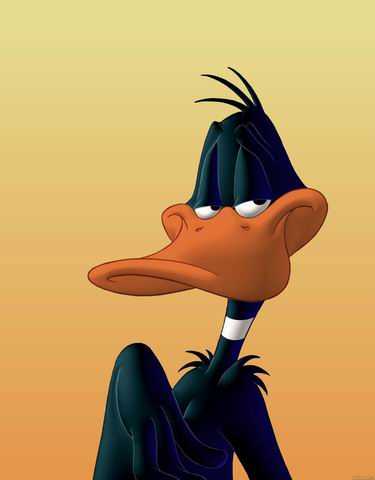
Oh, one more thing: My first impression of Adaptation. was to recall a punch-line from an ancient Warner Brothers cartoon (actually a couple of them, one of them being "Show Biz Bugs," another "Curtain Razor")—but because of what transpires (and the fear that kids would duplicate it) it's not much in circulation anymore. In it, the indefatigably fame-seeking Daffy Duck is auditioning for stage-time for his act. Each one fails miserably and he's rejected. "Next!" Finally, he shows up in a devil's costume. He eats gunpowder. He drinks gasoline and nitro-glycerine. Then...dramatically, he swallows a lit match. BOOM! There's a huge explosion. "That's incredible!" cries the ecstatic agent. "I can book you immediately!" "Yeah yeah," says the ghost of Daffy, drifting heavenward. "But I can only do it once!"****
The fictional Charles Kaufman—or is it Donald? (Nicolas Cage)
—on-set with the non-fictional Susan Orlean.

For Ned', who asked...on July 9th, 2008


* There are others who take that switcheroo-based style of writing, including M. Night Shamyalan, and Alejandro Amenábar.

**You can read the original Laroche article here, at Orlean's web-site.

***McKee suggested Brian Cox (the original Hannibal Lecter) to play him in the movie. Good suggestion, actually.


**** Because the bit is dangerous, violent...and, if improbable, actionable, it has, over the years, been censored, as has been catalogued by this YouTuber.

Thursday, February 15, 2018

The 15:17 to Paris

Based...No, Really Based...
or
"Show of Hands, Who Thinks Stone is an Asshole? That WILL Be On the Test."

So...how IS The 15:17 to Paris? Actually, it's quite good, Rotten Tomatoes be damned (No...really...Rotten Tomatoes should be damned, stupid aggregate mob-think). I can be accused of being a Clint Eastwood apologist, but you really have to give the guy an admiring grimace for trying something a bit off the multiplex track: telling the story of a foiled terrorist attack by using the actual folks who foiled it, charging the lone wolf, who'd already critically shot one passenger, to stop him.* 

It's not like the director hadn't done something like this before: in Gran Torino, he'd used untrained actors for scenes featuring his grouchy old dude's evolving relationship with his immigrant neighbors. Why? He needed Hmong actors to better reflect the immigrant population in Detroit. He didn't want to go with an "established" population with the inherent prejudices it would inspire in audiences. He wanted the unfamiliar. And last time I looked there wasn't a Hmong section at Central Casting. I thought it was an interesting and unique choice, and Gran Torino wouldn't be the film it is without them—it wouldn't be as good, and the stakes wouldn't have seemed so singular.
So, yeah, there are "the guys" (Alek SkarlatosSpencer StoneAnthony Sadler)** portraying themselves, but the folks who were terrorized on the train are playing themselves, too. Everybody involved in the incident—other than the shooter—is there in the movie, recreating it down to the last detail. That's amazing, and those minutes are the most dynamic in the movie (heck, just the idea of doing it is amazing). No one seems to be arguing about that. 
What everybody's arguing about is the rest of the movie showing how those three particular guys grew up and how the threads of their lives, together and apart, twined together to put them in that situation and how they reacted to it. Rather than being slow, it is merely slower than the train sections—the film's only ninety minutes and so it moves pretty quickly in the 65 minutes preceding the shooting on the train. At no time did I feel that the movie "dragged," though, not for what it was trying to do (maybe in comparison to an action film it does—it doesn't have the required "action bump" every 10 minutes—but I have a hard time seeing this as an action film). That early part of the movie, though, skews opinion to what the viewer thinks the "agenda" of the film is, and what the viewer's predisposition to that imagined agenda might be. I'm not sure I find that entirely fair, or right, but then, my predisposition to any film is to walk in without prejudice and take it for what it is and for what it shows on the screen. A glancing of reviews, both on the right and the left, revealed that those reviewers—for major publications and mere click-bait sites—got things wrong in the details, or just imagined they saw what they saw (that can happen, but, being given the opportunity to re-view films on video should dispense those notions, and I find that those corrections rarely, if ever, happen—because opinions are more important to the reviewer than the facts).
Those early scenes—interspersed with the moments immediately before the train shooting happens—are a mix of actor portrayals and Sadler, Stone, and Skartaros' portrayal of themselves. What's amazing is that where the movie actually fails is in some of the actor's portrayals, rather than "the guys' performances: Sadler's great,extraordinarily natural, Stone is actually better at dramatic scenes than just being a regular "joe", and Skartaros might be the weakest overall of the three, and is given the least to do, but he pulls off two of the funniest lines in the film ("You DO realize that it's not 'off the cuff' if you're posing for it, don't you?"). 
It's the scenes when they're boys growing up that are the toughest because the young actors playing Skartaros and Stone are nervous, hesitant and a bit unnatural (young Paul-Mikel Williams, playing kid-Sadler, however, is a delight). Stone and Skartaros come from broken homes (their mothers are portrayed by  Judy Greer and Jenna Fischer, respectively) and they're kids with problems—the public school wants to put them on ADHD medication, so the Moms ship them, at more expense, to a Christian school, where they're JUST as prone to getting in trouble and spending time at the principal's office. What I notice in reviews for the movie is that the reviewers don't understand that the kids have issues whether the school is public or private, heathen or faith-based. if anyone is getting the narrative shaft here, it's the adult authority figures, who are too programmed and set in their ways to deal with kids who don't conform. They're not far removed from the bullies the kids have to contend with, only older and with more power and more clout to see that the punishments are more than bruised egos—they're bullies that can shape lives.
The boys keep in contact with each other, even though circumstances force them apart—it's Sadler who insists they stay in touch. Stone never excels at anything, but he's disciplined enough to get himself in shape to join the Air Force's Pararescue unit (there is a classroom lock-down scene where Stone is prepared to take on an attacker with a ball-point pen prompting the second headline I put up for this and the line is delivered by actress Heidi Stulzman, who's a good enough actress that she "blends" between actress and amateur perfectly)—he bombs out due to his poor depth perception and gets stationed overseas. Skartaros joins the Oregon National Guard and is deployed to Afghanistan, likening the job to being "a mall-cop." Sadler is attending college at Sacramento State. Skartaros has plans to visit a girlfriend in Germany, Stone is in Portugal and proposed a European trip—it doesn't take much convincing for Sadler to join them.
This is the part that most reviewers have hated —the 15-20 minutes of "the guys" traveling in Europe—Sadler with his incessant selfie-taking, Stone's gob-smacked "touristiness"—and probably the least effective part of the movie. One of the strategies of the film's trip is that most of the people they meet have suggestions about what they should do, where they should go, what they should see—almost all of them say to avoid Paris. Given so many other options, why go there? And they meet "Lisa" (Alissa Allapach), also from California—actually, "The Real Lisa" was from New York—and she and Stone and Sadler start to travel together. It's nice and all, but by inserting this actress into the film it ruins the verisimilitude that has already been established, which is the Sadler-Stone dynamic.
These guys—the REAL guys—have been friends for years, and one of the best reasons for casting the "real guys" is in their already established relationships—which can't be faked—and can't be "unrealized" except when it is interrupted, which the insertion of the "Lisa" character manages to accomplish—and the illusion falls apart; the film feels "scripted," fake, and more than a little desperate to try and seem real. But, the illusion is briefly shattered, only to be restored when she leaves and Skartaros joins them for what will be a very scary last leg of the movie.
We knows what happens. Everybody agrees it's the best part of the movie. It is weird that it's a re-enactment by the folks who were there with two exceptions—the guy with the guns and the initial Frenchman who struggled with the guy when he came out of the compartment's bathroom (he wished to remain anonymous). But, it happened, and it is scary. 
But, not entirely unexpected.

One of the Eastwood tropes, since when he was merely acting, was exploding his own myth. I've written about how often Eastwood has mocked, worked around, or merely just debunked the trademark "Eastwood-last-man-standing-after-a-gundown" cliche that emanated from the Sergio Leone films. The 15:17 to Paris is a film-length rejoinder to that idea; you don't need an Eastwood or a Tom Cruise or (god forbid) some creepy superhero to come to your rescue—you should be doing that yourself. The "thing" about the current fad of superhero franchise movies is that they're so full of shots of people in the streets, all running pell-mell away from disaster, where real heroes—first responders— would rush in. I wonder sometimes if all the superhero movies are creating a movie-going class of victims. If so, things like The 15:17 to Paris are a welcome tonic...and rebuttal.
The fact is that the domestic war on terror started to be turned 20 minutes after the first 9-11 attacks when the passengers on United Flight 93 took matters into their own hands and refused to be terrorized, foiling the plot the hijackers had imagined. It cost them their lives, but since then, it has been down to citizens and ordinary people, who just refused to be cowed by guys with bombs in their shoes, who have done the work on the home-front to stop terrorist attacks. As long as terrorists don't hide behind the wheel of a moving vehicle,, good people will step up to do the right thing. And that's really why terrorists will lose—they're so completely outnumbered by just plain decent good people. You don't need a "Clint Eastwood" to come to the rescue. All it takes is for someone to help, regardless of self. 
But, I don't believe that to be part of "the American character." I think that's the exception and what it should aspire to. I think the reviews and the low score on Rotten Tomatoes is far more indicative of it: we Americans lionize our gangsters—like Bonnie and Clyde or The Godfather or Tony Montana***—we admire "the bad boys", but will always take the first opportunity to knock down or sneer at genuine heroes, and I think the condescending reviews of The 15:17 to Paris reflect a strain of that—it gives people a chance to rip into some real examples of the selfless (they couldn't complain about the genuine act of heroism before, but let's knock their acting!). And it's an American quality, not a political one—you see it on Fox News and MSNBC, in reviews from The National Review and The New Republic. Part of it may be wrapped up in the belief that we have a Constitutional right to say any pig-ignorant whiny-ass thing no matter how ill-informed it might be. It's a big yellow stain we have in the American character, a terrible flaw entitled of the lucky bystander. I doubt the folks on the train are so blasé. 

I hope that lazy weakness—that character flaw—can be grown out of, eventually. I tend to doubt it.


* There is this "rumor"—and I think that it just may be a rumor or a joke, despite seeing it in my research on the film (ya know, "the Internet")—that Eastwood actually wanted the terrorist to play himself, as well.  The guy's lawyer objected to the film even being MADE before his trial, let alone allowing him to do the movie, but, still...Eastwood has been known to have some very weird ideas. I mean I saw him talking to a chair once.

* Kyle Gallner, Jeremie Harris and Alexander Ludwig were originally cast to play the three Americans. Then, they weren't. I wonder why. But, I can uselessly speculate. It was far easier to cast non-actors Sadler, Stone and Skarlatos to recreate it and support each other during filming than it was to have three non-actors recreate a lifelong friendship from scratch. I've never seen a convincing Beatles movie with actors trying to recreate their relationships, and I doubt Gallner, Harris, and Ludwig could do the same. In the end, the results are convincing enough that it must have saved all sorts of time and energy to hit the ground running with the real guys, who went through their publicity swirl humbly and with grace, than having to contend with actor-ego's.

*** I think I've mentioned before how Marlon Brando was horrified—horrified!—that the biker tough he played in The Wild One became a cultural icon. He thought he was playing a creep!

Thursday, July 27, 2017

War for the Planet of the Apes

Ape-ocalypse Now (The Beginning and The End)
or
"What Would Caesar Do?" ("Jesus Christ, You're Impressive...")

The more steps you take away from War for the Planet of the Apes, the more interesting a film it is. Maybe it's the way the FX now make you "buy" the apes as credible characters and not motion-capture constructs (They always looked good, aided immeasurably by the at-the-core ape-performances of Andy Serkis and crew). Maybe because Matt Reeves doesn't do anything "fancy," just directs with an eye toward verisimilitude and not for the cutesy-kitsch (ala the first movie from 1968). Maybe because the movie touches so many cultural reference points (and not just the first "Planet of the Apes" tetrology) that you get the feeling you've seen it all before—you have, just never like this, and never from this perspective. It is a film of so much incident (although quite compact), that the Big Picture the film is aiming at doesn't become apparent until you're out of it. Like the apes in their California forest, you can't see them for the trees. It's because evolution has been upended, and Man has made his successor in the form of his ancestor. The apes become humanity...and that's not a good thing. We have met the enemy and "he is us." The humans have played God with evolution...and God's really pissed.
Those expecting a big apocalyptic nuclear set-piece will be disappointed (although I was rather expecting it when I saw a reference to Beneath the Planet of the Apes in one of the sets). The world doesn't end with a bang, or a whimper, for that matter. As George Carlin once groused about Earth Day: "The earth will be just F-I-I-NE. But WE'RE fucked!" The world doesn't end at all. It just hits "reset" as it occasionally does ("Okay, everybody outta the gene-pool!") and begins again. Cosmically speaking, The Earth bases its fiscal year on dominant species. And the new King in town is the one Evolution left behind, and that Evolution's beneficiary unknowingly gave a kick-start to in its attempt to improve itself. The next species would do well if it never invents irony.
It's been two years since Dawn of the Planet of the Apes, which saw the sentient Ape-Tribe created by the green-eyed laboratory-experiment Caesar (Serkis) going through its own Civil War, ending with the death of Caesar's Iago and rival for power, Koba. But Civil Wars never really end, and those divisions haven't quite healed, and for the human survivors of a population-consuming flu (which grew out of the same experiments that created the intelligent apes—ya  know, irony), there hasn't been any sign of Caesar and his followers, as they have dug even farther into the Muir woods outside of San Francisco.
But, just because you don't see anything doesn't mean you can't hunt for it...just ask "Bigfoot." After a brief summation of what has gone before ("Reading" is what they'll say on CinemaSins), over a darkened forest shot, we see a well-armed Special Forces team stealthily track forward. On their helmets are slogans like "Monkey-Killer" and "Bedtime for Bonzo!" Humorous cultural references aside, they're on a mission: they've come from the north of the country under the command of one Colonel McCullough (it will turn out to be Woody Harrelson) to eradicate Caesar's ape-tribe for specific reasons that will be explained later, beyond merely fear and loathing. 
The attack initially goes well, decimating forward ape-guards standing at the ape-colony's outer defenses. But, a lone ape escapes on horse-back to bring reinforcements and the superior weapons of the unit are soon overcome by sheer force of numbers in an attack consisting mostly of a coordinated arrow attack. The Special Forces are overrun, save for four prisoners, including a gorilla, recognized as one of Koba's followers.
The prisoners are defiant. "How long do you think the woods will protect you? The Colonel has more power." They have every expectation to be killed, even inviting it, but after questioning them, Caesar sets them free. "Tell your Colonel you have seen me now. Tell him leave us the woods." And he sends them packing, tied back to back, astride horseback, and the tribe attends to their dead, putting their bodies in the river to send them to the sea.
Caesar's son, Blue-Eyes (Max Lloyd-Jones) comes back to the encampment after a long sortee to report that he's found a potential permanent home for the apes across a wide desert that might provide them safety. Caesar makes plans to evacuate the current refuge in the Muir woods and head for his promised land with the surviving apes and his family.
But, that night, other plans come to fruition. In his cave with his family asleep, Caesar sees green lights through the cover of their water-fall camouflage—an attack is coming and he runs after his commanders to seek out the soldiers and defend the encampment. He tells Blue-Eyes to stay behind and guard his family as he bounds into the interconnecting tunnels to coordinate the attack.
But, coming back to his quarters, he finds his family dead, riddled with bullets...and...just about to escape the scene of the assassination, the Colonel, who fires on Caesar as he prepares to be helicoptered away. Enraged, Caesar leaps after him, grabbing onto his rappelling line and starts to climb. But McCullough cuts through the chord and Caesar falls into the lake below, his family's murderer, escaped.
The next morning, it's a different Caesar making the plans. He instructs the tribe to head to the area found by Blue-Eyes and start again. But, he won't be going with them. Instead, he's going to go to the Army compound and kill McCullough, to later re-meet with the tribe should he survive. But, at this point, that's the least of his ambitions. His face is now an almost permanent scowl not—as one reviewer has said—dissimilar from the face of one of Clint Eastwood's revengers
It's apt. Because there's a lot of The Outlaw Josey Wales in War for the Planet of the Apes, as well as The Searchers, The Great Escape, shades of Apocalypse Now (but not much) and more than a salute to "Monkey Planet" author Pierre Boulle's "other" famous work "The Bridge on the River Kwai" and before the movie's through, you'll see hints (actually, more than hints) of Spartacus, Moses, and Jesus Christ, as well as Othello and MacBeth. That's a lot of iconography to be shouldered by one ape, but, at this point, short of martyrdom, there's not much more this risen ape can do to become a mythic figure to his followers. Myth is precisely what War for the Planet of the Apes is going for. And History repeating itself, as sure as the turning of the Earth, or its era.
But, Caesar has unwelcome company on his way to McCullough's compound; he's followed by orangutan Maurice (Karin Konoval), the gorilla Luca (Michael Adamthwaite), and chimpanzee Rocket (Terry Notary), who refuse to leave his side on his journey. Before long, they come across another chimp, Bad Ape (Steve Zahn), a zoo escapee who has also learned to talk, and a mute girl (Amiah Miller), who will soon be called Nova. They soon discover others, of McCullough's troop, who have been shot, abandoned and left for dead, who also exhibit signs of mutism, apparently a mutation of the original simian flu, carried by the survivors, that affects their speech centers.
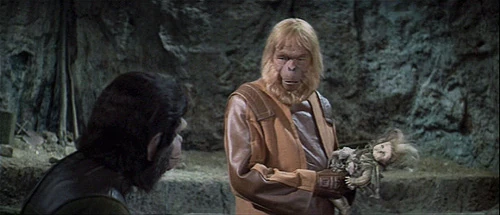
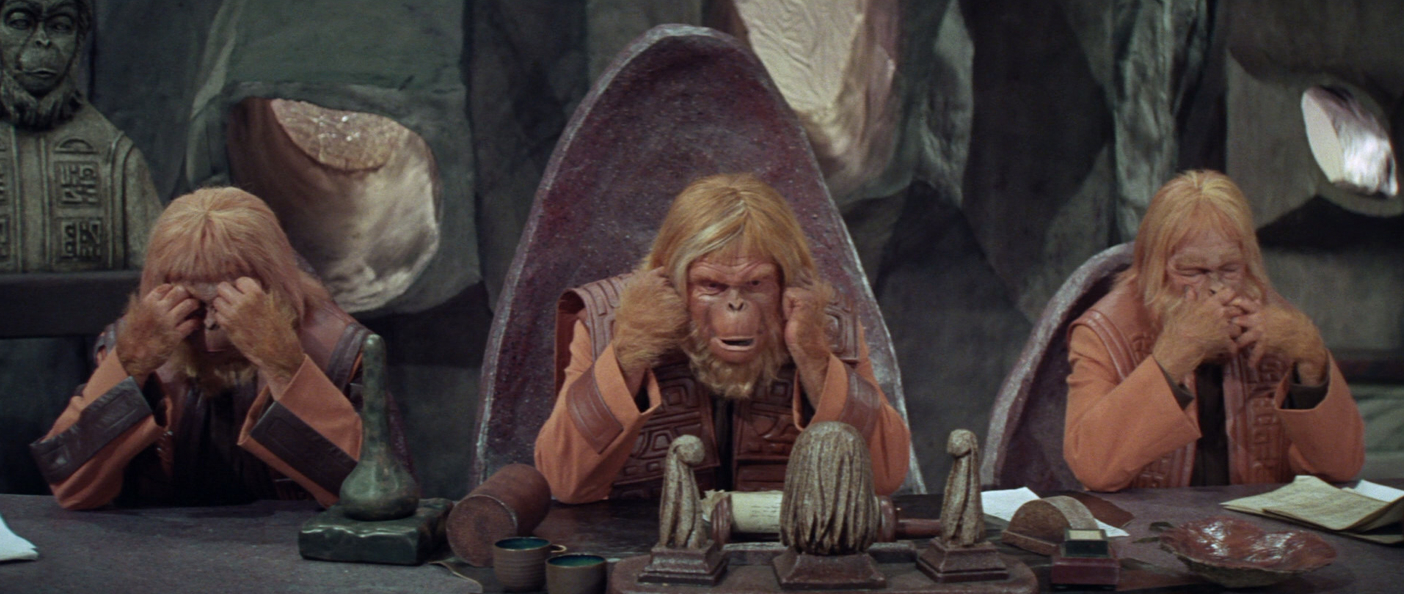
So, let's see...

Apes Talk
Humans Fewer in Number
Humans Become Mute

All we need is a doll that goes "Mama" and a couple ruined national monuments and we're back to the beginning.
But, we've got a ways to go still. At one of the bases of the Alpha-Omega troop (the name of McCullough's forces), the small primary band of primates learn something else. While on their exodus, the Muir apes have been outmaneuvered, captured by McCullough's forces and taken as prisoners back to his main base. Now, Caesar has another mission besides his personal revenge—free the apes so they can continue on their exodus. What he sees at the camp enrages him. The apes are back in cages and during the day, they are brought out to (without food and water) work a quarry and construct a large defensive wall for a coming attack—not from apes, but from other humans, who think, quite rightly, that McCullough has gone off his rocker and plan to (and here's the Apocalypse Now part) "terminate the colonel's command with extreme prejudice."

I guess Caesar and the humans have more in common than thought.
"Apes strong...together."
While Caesar goes after McCullough, Maurice, Nova and the others do some planning behind the scenes on trying to break the Muir apes out, and this is where the center-piece of the action starts. Now, I'm starting to read comments on IMDB* that fuss about War being being mis-titled, that it's not so much a war as a skirmish. Numbers aside, this is a whiny comment, born of a diet of super-hero movies pumped with more adrenaline than craft. There's a lot going on here, besides orange-flamed flowering explosions and gymnastics (although there's plenty of that to satisfy anyone not eating their Wheaties with RedBull). Revolutions are made with more than bullets. And, given the cultural references brought to bear in War..., the film is hardly revolutionary, even if it's depicting one. This is good, old-fashioned film-making with a lot of thought and a lot of care. I think the IMDBullshitters are reacting to the rather glowing interviews of the mainstream critics, who are probably just relieved about seeing a good story well-told. Maybe they're pissed about the military being depicted this way. But, one should be reminded that McCullough is an outlier, an extremist, opposed by even the traditional military who have been satisfied to leave the apes in peace and have no interest in what he calls his "Holy War." If you're going to defend something you have to be able to recognize extremism...even if it's in the mirror.
If there's a failing, it's one of scope. What's the rest of the world doing? (The credits of Rise... indicated that the "simian flu" became a pandemic). The experiments that created Caesar and his kin was all based in the United States, so one can forgive this; the "action" of The Planet of the Apes should be focused on where the mutated apes are and that will be where Caesar is. So, one can forgive the U.S. base (I would rather like to see what the French are doing—it's their story, after all).
So, there's action aplenty and food for thought, as well. That's in keeping with the entire series, which has always been satirical, often heavy-handedly so. This prequel series of Rise..., Dawn..., and War... has been more cunning, and far more subtle, often defiantly so. One of my favorite shots of the three films is in War... where a captured Caesar stands up for his troop in their captivity and resists, taking the whipping that one of his followers started to endure. The weakened ape is dragged to McCullough who stares at him, mutters "Jesus Christ, you are impressive" and orders him to order the apes back to work. When Caesar refuses, he takes his gun and points it Caesar's forehead...and he defiantly leans into it, staring his oppressor down. That is powerful stuff, more than explosions, more than fire-power, more than mega-tonnage.
So...how does it all end? Aptly, actually. With an ending and a beginning. 
But the POTA prequels leave one thread dangling...suspended, as it were. Back in Rise... there was the hint of a mystery that was buried in background television newscasts and newspaper headlines...of the Mars Mission Icarus that was poised to enter the Martian atmosphere but became (as the headline read) "Lost in Space." Nothing of that seemingly doomed mission is mentioned in either Dawn... or War..., but it's still out there, somewhere. War for the Planet of the Apes ends (not with a bang, not with a whimper) with a shot of the former Muir-Ape-troop in their Promised Land, as the camera tilts up to the sky and lingers there for more than a moment before the final fade-out. This may not be to connotate the freeing of a spirit, but more probably to await the promise of...something...falling to the Earth. The circle in this trilogy is now complete, but with that completion of the turning, another one has begun, in the grooves of what has come before. Is it the end of The Planet of the Apes...or just the beginning?
* I've also seen comments that it's "communist propaganda" (I'm mystified as to how, but any thought I put into it would be more than was put into the original comment) and objecting because "humans are the bad guys." Well...duh. In the POTA series, they always were. The humans were the ones in charge of the nuclear weapons that decimated the human population and created the power vacuum that the apes filled. One only has to remember the last lines of the original: "So, we finally, really did it. YOU MANIACS! YOU BLEW IT UP! AH, DAMN YOU! GOD DAMN YOU ALL TO HELL!!!" (I'm surprised I didn't see THAT reply in IMDB).