Showing posts with label Zoë Kravitz. Show all posts

Friday, March 4, 2022

The Batman

It was a Dark and Stormy Knight
or
How Many Batmen Does It Take to Change a Light-bulb?

You know how it went: in "Peanuts", Snoopy would sit on top of his dog-house type-writing—"It was a dark and stormy night. Suddenly a shot rang out. The maid screamed. A door slammed.
 
 
That's how Matt Reeves' The Batman felt to me after I'd survived it. Just as suddenly as something is resolved, you think there's some breathing room, and then you think "Geez! They haven't even figured out the serial killer yet!" And then that starts and you think THAT's finished, and you go "Wait a minute, that seemed kind of easy", and that's when the guano really hits the fan, and things get even more complicated, and you start looking for something to tell you what time it is, because you really think that the thing is never going to end, and then, they distract you and you think "Oh no, they're going to bring him in?"
It's at that point you realize that it's no fun being the Batman—because the job just never stops. You wonder if you even want to admire the Batman or pity him, but you sure don't want to be him. 
 
And maybe...you don't want to watch him.
"So, is it even worth going?" Hell, yeah. Because The Batman is more like the Batman from the comics (depending on the period of origin—in this case, the 1930's and 70's) than he's ever been. Stripped down and deconstructed, this version escapes the taint that has hung on the character ever since the TV-series from the 1960's. There's no "camp". There's no crazy costumes...well, except for the Bat-suit (which is armored to the point that it's bullet-proof and probably tough to maneuver in—he even thuds when he walks)...and there's no goofy archness or hysterical theatricality, which still remained even in the Christopher Nolan-directed trilogy. Not even an artfully-choreographed fight; they're all thumping and brutal.
It's perfectly serious. And does things the "Batman" series has never done before. For instance, this is the first Batman movie since the series started (with Tim Burton back in 1980), where Batman doesn't kill anybody—oh, he messes people up really bad, but they don't die unless it's due to their own actions—and that was a "code" that an orphan who lost his parents to gun-violence strictly adhered to. And the "Batman" in the movies has always stood for vengeance, and here, the character arc has him realize how limiting that is—when he sees the main villain of the piece committing heinous acts to avenge his own circumstances. His self-imposed mission changes during the course of the movie; the film pointedly ends with Batman looking forward and not back.
Now to say I "survived" it takes an explanation. The Batman is just shy of three hours long. And it feels like it*—Reeves can make fascinating movies, but he's not an editorial trickster (like Nolan) so things happen at a steady, remorseless pace (Reeves uses Nirvana's "Something in the Way" as background, and that's the beat that he uses for the film). It's a long run-time, and the story covers a lot of ground, dealing with corruption, organized crime, and striking out against sins of the past. It's less a "super-hero" film than a police procedural along the lines of contemporary British mysteries or "Law and Order"—this Batman even walks through crime-scenes with the police (despite "official" disapproval of vigilantes by the Gotham City Police Department), making observations, providing lines of investigation. It's an intricate maze of clues and evidence that increases the run-time. What would I take out? Not a jot. Certainly not with the Warner studio's recent insistence of cutting things down to near-incomprehensibility.
Because it's a good story that has the construction of the best of the (Batman co-creator) Bill Finger-penned Batman stories: murder victims of a prominent vintage, all seemingly unrelated but leading inexorably to a far greater threat (it's nice that the clues are multi-layered without the usual *snap* "I've got it! He's going to rob the Obvious Clue Savings and Loan!"). And we've become so used to comic-book threats—penguins with rocket launchers, "fear-gas," 'memory-sucking devices" and ice-guns—that it's a little disconcerting—even creep-inducing—that the various plots all nudge at real-world headlines: "Zodiac" messages, "collar-bomb" extortion, mailed death-packages, internet zombies, even Hurricane Katrina.
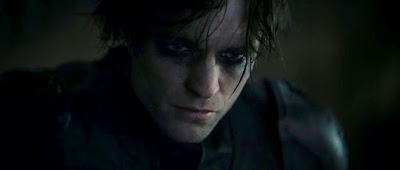
Ah, but you don't want to know all that. You want to know how the Patt-Bat is! He's darned good if you want to discard the whole "Zorro"/"Scarlet Pimpernel" vibe that inspired the character. Pattinson's Bruce Wayne is a brooding recluse holed up in Wayne Tower in the middle of Gotham City, and he'd probably be a prime suspect in the "Riddler" case if the police just looked at the power being used by the dingy bat-filled basement of the building (nah, they wouldn't—he has too much money). His Bruce is so emo, he almost wears a bat on his sleeve—so much for secret identities. But, his Batman is slow, hulking and fills a room, the eyes constantly moving and the perfect jaw-line not at all. It would almost be a mime act if he didn't have Jeffrey Wright doing heavy-lifting (and expositing) as Lieutenant James Gordon ("You could have pulled the punch..." "I did"). Wright makes a character important no matter how much he's pushed to the background, but here, he's the other half of a buddy act. By contrast, Andy Serkis' Alfred is the character who's given short shrift.
But, it's the villains that everybody pays attention to in Batman movies and there's a lot of them: It's a great cast and everybody does very good work.
Zoë Kravitz is a fine addition to the ever-growing litter of cat-women, with the appropriate fanged snark and a duplicitous sensuality that one expects of the character by this time. Her scenes with Pattinson fall a bit flat unless they're quarrelling, because he doesn't give out that much as far as any sort of response. That's on him; not her.
Paul Dano leans in to his cherubic looks to create an intensely creepy Riddler—he has several aliases—internalizing the schitzy nature of the character with the same intensity with which Heath Ledger externalized his Joker in The Dark Knight. Ledger is a tough act to follow, but Dano isn't as theatrical and does more with little expressions than anything playing to the loges.
Speaking of which, if Dano leans in,
Colin Farrell leads out with his take on "The Penguin" ("Call me 'Oz'") as a voluble Chicagoan gangster with none of the panache or freakishness in past portrayals, but bearing a family resemblance to Rod Steiger's Al Capone. He is wholly unrecognizable, physically or in performance, and it's not just the elaborate prosthetics he's forced to wear to pull off the job, the acting is larger than it can contain, making a huge impact in a role that's a supporting character to John Turturro's Carmine Falcone, the Gotham boss who's pulling all the strings only to find his organized crime operation being undone by a lone outlier. Also Peter Sarsgaard should be given a hand-clap for his portrayal of a weak Gotham D.A. caught up in the carnage.   
Is it the best Batman movie? I think it's too soon to tell. I didn't come away from it thrilled with it as a whole (as with others), but was delighted at its parts (and little touches like
the bust of Shakespeare in Wayne Tower, the very apt use of DOS graphics, the song that plays when Bruce Wayne visits Mob-boss Falcone)
There is no doubt that this is the best interpretation of the character if you want to do it as a straight-ahead portrayal, ignoring the many iterations that have made up its history, the bad and the good. Someone had to do it—to put the detective back in The Darknight Detective. And Reeves, who has proved time and again that he can make something special and unique out of retread material, has managed to make something original with Batman.

* It isn't helping that the theaters front-load this particular attraction with more than the usual number of commercials (even inserted between previews—which, let's be honest—are commercials, too). The whole presentation is like 4 hours long. One can see why the theater-chains are doing this—a 3 hour movie limits the number of times it can be screened, even though they've Bat-jammed as many  showings in as many plex's as they can manage. And those commercials pay the chains. But, it is testing the endurance of an audience not expecting an epic Lawrence of Arabia roadshow. 

Thursday, November 22, 2018

Fantastic Beasts: The Crimes of Grindelwald

Bébé LeStrange (Losing All Credence)
or
Fantastic Beasts and Where NOT to Find Them.

It is a year after the capture of Gellert Grindelwald (Johnny Depp) in New York during the events of Fantastic Beasts, and Where To Find Them, and he has spent that year locked away in the prison run by the Magical Congress of the United States of America. Unable to break him, or even learn what the dark wizard might be planning, they decide to transport him to England's Ministry of Magic, so as to...well, one isn't sure what they can do with him, exactly. But, transport him they must in order to get the plot going. While Grindelwald is sent by flying Kestrel driven chariot, one of his followers in hiding effectively distracts the guards keeping him under lock-and-wand, and the seemingly placid prisoner, manages to take control of the vehicle and send his keepers plummeting to their deaths. Well, it would be their deaths if they weren't wizards...one of them manages to halt his fall before he hits the briney and then *splash* he goes into the drink, while Grindelwald flies off to what we eventually learn to be Paris, as he has business there and people to find and corrupt.

A wizard's work is never done. 
Three months later, Newt Scamander (Eddie Redmayne) is back in London, being called on the carpet (flying, presumably) for his part in the events in New York. The Ministry has revoked his travel privileges (as if they can't be worked around) and offer them as the price to work with the Ministry to find young Credence Barebone (Ezra Miller), an Obscurial he encountered in New York, but has now been located in London. Despite the Ministry's offer and the entreaties of both his brother Theseus (Callum Turner) and his fiance Leta LeStrange (Zoë Kravitz), an old chum of Newt's from their days at Hogwarts—although it is implied that she thinks she might be engaged to the wrong brother). Newt is a magi-zoologist and "doesn't do sides" in what looks to be a nasty struggle. Famous last words.
On his way home, he runs into his old teacher Albus Dumbledore (you remember him, but either as Richard Harris or Michael Gambon, when he was an even older teacher, not, as here, by Jude Law—who is quite good). Dumbledore also asks him to find Credence, but Newt remains a neutral party. He goes home to tend to his Fantastic Charges—such as the underwater critter, a "kelpie", who has a habit of nipping Newt's fawning helper, Bunty (Victoria Yeates), before retiring for the evening. No such luck.
He finds his friends from the last adventure, Jacob Kowalski (Dan Fogler, who's starting to remind me of a fuller Alan Arkin) and Queenie Goldstein (Alison Sudol), have traveled to London on their way to visit her sister Tina (Katherine Waterston) who is doing some investigating for the Ministry in the city of Paris. Coincidence? Hardly. Newt notices that Jacob is behaving strangely—he's completely agog with Queenie and he surmises that she's used a hex on him, of which Newt strongly disapproves. Her reason? She wants to marry Jacob, but there's some dumb rule about magical miscegenation that prevents it—and Jacob is too protective of Queenie to let the Ministry punish her for her actions.
Queenie runs off to find Tina on her own—there's some business about Tina not wanting to see Newt because she read somewhere that Newt and Leta were engaged—"fake news"—and despite her being an investigator she still decides to fall for it and have nothing to do with Newt. Well, now there's a reason for Newt to choose sides, so after getting his marching orders from Dumbledore, he and Jacob go off to Paris to find Queenie and Tina and Credence (which sounds like a heckuvan "oldies" concert).
Then, there's the Ministry's business: they're also looking for Credence, as well, as they think he may be the brother of Leta LeStrange, which is ridiculous because Zoë Kravitz looks gorgeous and Ezra Miller looks...like Ezra Miller. Maybe he could be the brother of Adam Driver, but he's not in this franchise. Grindelwald is looking for Credence, too, as he thinks he's the only person on Earth—the wizarding Earth—who could kill Albus Dumbledore (other than Severus Snape, who isn't alive yet). Oh, did I mention there's a half-brother named Yusuf Kama (William Nadylam), who is also looking for him because he thinks he's his step-brother? Credence is the most popular guy in town, but the one who finds him first is Queenie, when she visits a mystical street-circus where a hunched up Credence is acting as the protector of Nagini (Claudia Kim), who will at one point become the snakey familiar of Voldemort...
See? At this point, the movie kinda breaks down and gets lost in some Potter's field of arcana that only a small handful of people might give two wand-shakes about. There are so many people who think Credence is SOME-thing, that most of them must be wrong...in which case, who cares? Credence is the MacGuffin in this one, like the Sorcerer's/Philosopher's Stone, Chamber of Secrets, Goblet of Fire, or the horcruxes of the Deathly Hallows. It's something everybody wants, but we can't guess at each one's significance until the end.

And this series is set to be five films long.

It makes your brain hurt, sets it rolling with Rowling. But, the film went astray much further than that, at least to my mind. That point came when screenwriter J. K. Rowling decided to abandon the concept of her original "Fantastic Creatures" and make it's font smaller in the title than "The Crimes of Grindelwald." For the truth of the matter is, there aren't that many "Fantastic Creatures" here, after about ten minutes of them, and they are only used as a way out of getting out of a tricky situation, whether as distraction or destructive force. I found this very disappointing. You shouldn't go into any movie with preconceived notions, but after the first, I was hoping the movie would continue its ecology theme of preserving the bewitched bio-diversity of endangered—and vexing—creatures, despite the slimness of the source material.
Instead, the stakes are expanded, creating a world-wide threat by the actions of Grindelwald, which, if we're to believe this movie, are more far-reaching even than Voldemort's: his plan is to unite the many mages throughout the wizarding world and break the 100 year peace established with the Muggles, the unenchanted. 
Newt's greatest fear: "a job in an office"
In a meeting of French wizards in the LeStrange family tomb, Grindelwald makes a case for the magical forces taking over the world out of the hands of the non-magical, starting with telling them that he wants them to live openly and to love openly (which appeals to Queenie). It's how to accomplish that utopia that bubbles the cauldron. That involves taking charge of the Muggles, poor inferior souls, dominating them rather than maintaining any co-existence, then as a capper, Grindelwald plays on their fears by displaying images from the coming second World War that ends with the apocalyptic vision of an atomic explosion. 
But, then, Grindelwald is just telling them what they want to hear—control of their world, making it theirs. You don't have to to walk to the far to the right politically to see a political parallel with today's world—Rowling injected the Potter books with flirtations of authoritarianism. But, here the parallels are far too noticeable and in a series more in line with the blockbuster sensibility of the high-earning Potter films. The studio is Warner Brothers, which used to be known as a sanctuary for letting film-makers be film-makers, but now known for sticking their grubby little hands in their franchise films.
It's a disappointment. There's only a couple of new beasts, only one of which is effectively used and that as a deus ex machina to get the heroes (and the writer) out of a jam. Unfortunately, that would appear to be the template for the rest of the films—re-do the Potter films with their well-connected central villain and just give lip-service to the Fantastic Beasts concept. The idea seems to be it's better to do something that feels more like the popular Potter films than to strike out with something different that might expand the universe and bring a unique experience.
I just participated in a podcast put out by the Large Association of Movie Blogs (LAMB) on the film and the general consensus was that the film was a big drop in quality from the first film, whether you thought the initial movie was good or not. It was amusing that the one thing everybody said was exceptional was the costumes. That sounds like the old trope that you shouldn't walk out of a musical whistling the sets. You shouldn't. But, for a fantasy that should inspire a sense of wonder, it's particularly un-magical.
"Oh! There's one!"