Showing posts with label Maya Rudolph. Show all posts

Friday, September 30, 2022

Bridesmaids

Written at the time of the film's release...

"The Miss of Sisyphus"
or
"Wiiging Out"

First off, Kristen Wiig is scary. She's scary funny. And scary smart. It's an almost sure thing that she'll be the best thing in whatever she appears in (certainly that was true of MacGruber). She has no Dolby and no squelch in her comedy, the filters are off, and she's not afraid to look like a doofus. In fact, I don't think she's afraid of anything.

And because she co-wrote this and is primarily the focus for the vast majority of Bridesmaids, it is a pretty funny, raunchy comedy of the "incredible mess" variety. And who doesn't want to see a wedding fail (especially if its not yours)? That's the premise behind this film (for better and for worse), and I've been to and/or been involved in enough weddings to know that this could easily have been a documentary.* The various rituals and ceremonies that precede, pre-function and prevaricate the actual hitching of one individual to another, are enough to wreck any marriage before it begins, and I'll frequently pontificate that if you survive the wedding, the marriage just might make it.**
And I've been to one wedding where in the course of the pre-functions, the Maid of Honor was replaced in the Bride's affections by another friend, as happens here. It happens.
Said Maid of Honor, who by herself is an "Incredible Mess," is Annie (
Wiig), who has zero self-esteem, is dating a self-absorbed creep (naturally, as he's a man, played by an un-credited Jon Hamm—who, bless him, seems to be having fun)—except it's not really dating so much as an empty sexual convenience, she's lost her specialty bakery business, and is working at a jewelry store, where her tirades about the impermanence of all relationships has a tendency to drive the customers away. Her mother (Jill Clayburgh—her last role before she died of cancer) wants her to move in with her "before she hits rock-bottom," because her room-mates are British and creepy. At least she has her best friend Lillian (Maya Rudolph), who is always good for a meltdown de-briefing.

That is,
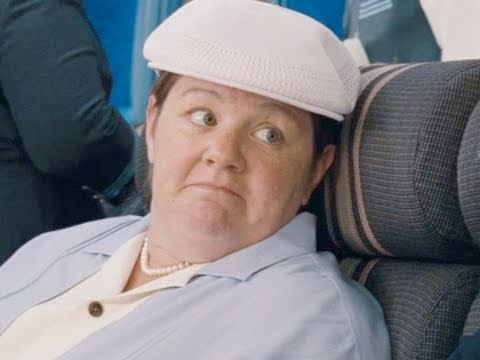
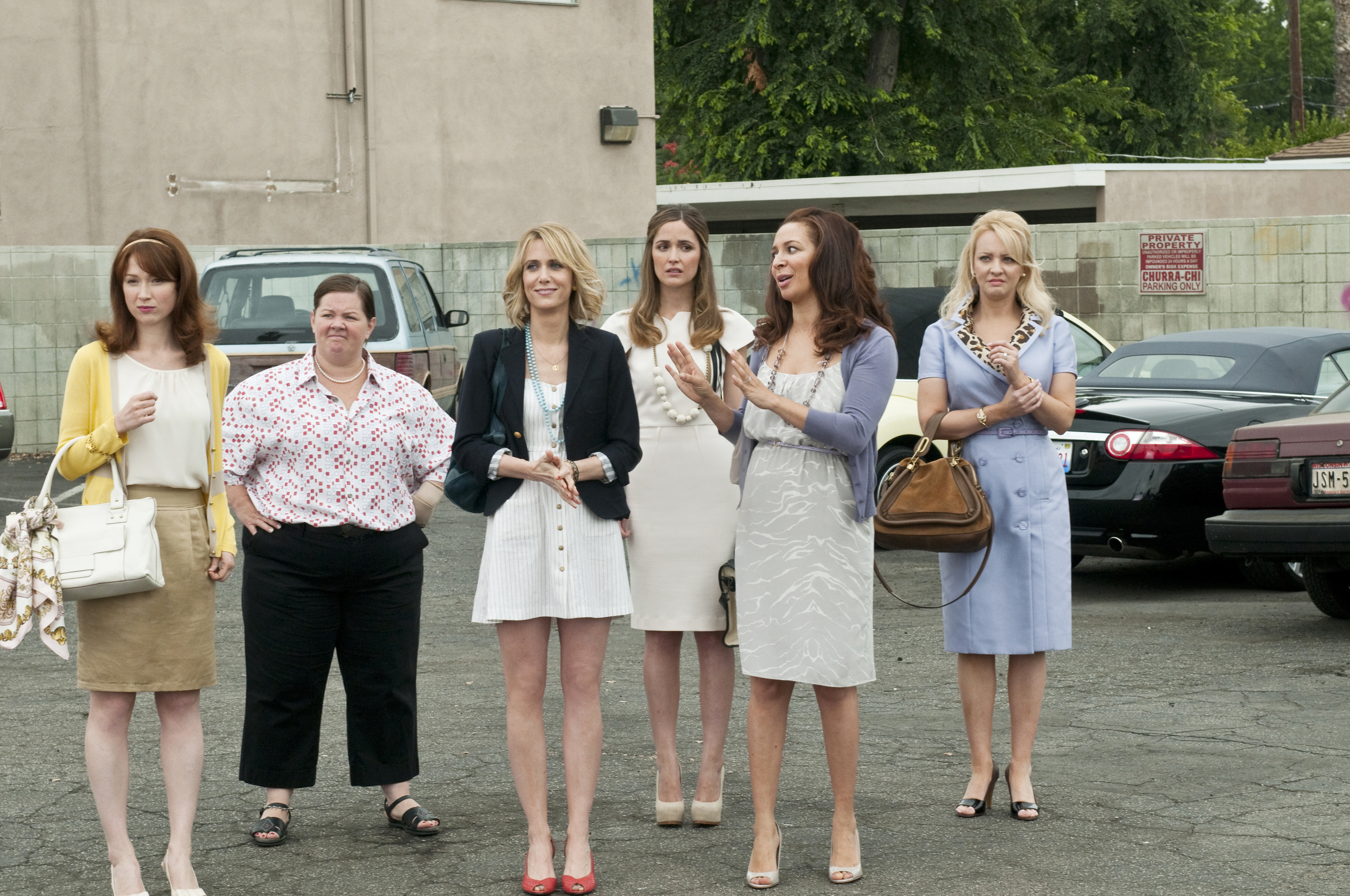
until Lillian announces her engagement and asks Annie to be the M of H.  Then, like a black hole, the downward spiral that is Annie's life starts to suck in the wedding arrangements, as well. She gets together the other bridesmaids: Rita (Wendi McLendon-Covey), a bitter wife with two problematic kids; Becca (Ellie Kemper) a chirpy newlywed; Megan (Melissa McCarthyhilarious and fearless), the groom's sister; and Helen (Rose Byrne), a trophy-wife, who is needy, tries too hard, and is aggressively perfect. This eclectic gaggle of women are tough to corral and all approach life and their duties to the bride-to-be differently, leaving the slightly scattered Annie dishonored and in their wake of agendas. In her desperate attempt to get them all on the same page (or even in the same dress-style), she only makes things worse, especially for herself.
The only non-crumbling structure in the whole disaster area that is her life is
a state patrol trooper (Chris O'Dowd—think the looks of Tim Allen, the charm of Judge Reinhold, and the accent of Craig Ferguson) but that gets doused as well. Pretty soon, rock-bottom seems like a pretty stable place to be, as she loses everything, even an invitation to the wedding.

This would be intolerably sad, if the cast and writers didn't make it so hellaciously funny, in a surprising, raunchy manner that rains humiliation down on everyone, the highlight (possibly) being
the visit to a posh, expensive bridal shop after a dysentery-inducing exotic pre-function. It's cruel...like watching a train-wreck, where all the passengers were caught in the bathroom, but it is funny—humor, one must caution, being subjective.

I'd be heartily recommending this movie
*** if it didn't go all-"Oprah" in the last section, with a tone-scrambling heart-felt ending that one is just not prepared for, and it also coasts on my most hated of rom-com tropes—"all she needs is a good man. Really? I'd've said a good psychotherapist.


But, until that time, Bridesmaids is the most snortingly funny disaster movie I've seen in a long time.
* I just had a two-hour conversation with someone who participated in a recent June wedding, where everything went flawlessly, but the backstage story was an on-going apocalyptic disaster from start to finish.

** That's an incredibly sunny view, considering I've been married twice.  On the other hand, there was one wedding I went to where the bride and groom were already arguing...at the altar.  The reception was dominated by placing wagers on how long it would last.

*** And have, to two gals who wanted a movie-night and were, understandably, less-than-thrilled with the current movie selection.  They couldn't be two more different people.  Both loved it.

Tuesday, August 31, 2021

Idiocracy

Idiocracy
(Mike Judge, 2006) The concept here is such an ingenious variation of the Planet of the Apes concept, that one wishes it were a better film.
 
An absolutely average Army recruit (Luke Wilson) is selected to participate in a cryogenics experiment (along with an average intelligence prostitute—played by Maya Rudolph
—as apparently there are no average women in the military?). Then, due to hierarchical mismanagement the program is abandoned and forgotten until the year 2505. During the course of 500 years, the process of natural selection reaches the conclusion of its "survival of the fittest" mode and sails right on past it with dire consequences. Higher IQ couples have been slow to reproduce (if they do at all), and are soon outrun in population by the lower IQ populace, who are always ready to procreate (whatever the hell THAT means) at the drop of a beer can. Or when the bar closes.
When circumstances are such that Wilson's recruit is finally awakened, he finds himself on a planet of morons, self-obsessed and ADD, the world is a corpochracy (clothing is made up of logo patches), dysfunctional, and appallingly apathetic.  He struggles through the legal and penal system (one dimly Kafkaesque, and the other startlingly easy to circumvent) to finally emerge as President of the United States...because he's the smartest guy in the country.
As right on as the satire is here, it doesn't take it to its cynical conclusion, which—if one is cynical enough already—one can see happening before one's very eyes.
 
I would be ecstatically happy if I thought that would really happen—that people would vote for the smartest guy. But I've been through enough election cycles to know that people (whatever their intelligence) are not most likely to vote for the best and the brightest—they would probably resent the more intelligent candidate, voting against them. People don't vote for seeming intelligence or competence, they vote for likability—they want someone "they can have a beer with" or "who talk like I wanna talk." God help us.
On top of that, the inherent cynicism of the concept, brilliant though it is, has no follow-through, and is merely circumvented to reach an end-point. That, and the cheesiness of the production-design (which I could actually buy given a corporate mentality and an apathetic consumer-society) work against the film, which starts out so promisingly, and has flashes of ingenuity throughout. I just wish it might have gone farther, and opted for a less easy way out.
 
Still, every few years it would be good to look at the film just to see what new similarity has become a reality.
 

Tuesday, July 31, 2018

The Way, Way Back

Written at the time of the film's release....

The Summer of Our Discontent
or
"Little Mr. Sunshine"

The summer "coming of age" movie is such a staple that it might be worthy of its own genre label, rather than merely being relegated to a sub-category. It's a natural, really. The timing seems right and appropriate for the subject of change. Summer always seems to be a time of transitions: from one school year to the next; from bring a graduate to a freshman, walking out of one door and into (and hopefully through) another one. And while the rest of the year is taken up by schooling, the ample three months of idle time gives one plenty of opportunity for other extracurricular learning—life-lessons from the school of hard knocks.

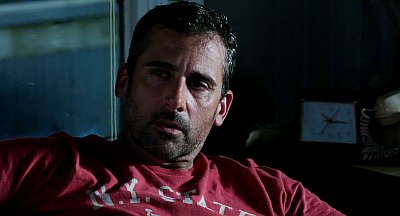
Take Duncan (Liam James), for instance (please, someone has to...) in the new film by Jim Rash and Nat Faxon (they won an Oscar for their superb script for The Descendants).  Fourteen, a 'tweener, his parents are divorced and Mom (Toni Collette) has taken up with another man. Trent (Steve Carrell), who has a daughter Steph (Zoe Levin). It is clear as this pint-sized Brady Bunch goes to an ocean beach house that it is not going to be anything resembling a beach-home. Duncan doesn't want to be there; he'd rather be with his Dad this Summer. Whether that preference has driven a previous wedge between Trent and Duncan is not know. What is known is that Trent is something of a jerk to Duncan. "One a scale of 1 to 10, what do you think you are?" he asks Duncan sequestered to the back of the station wagon on the ride to. "Six," says Duncan, noncommittally.

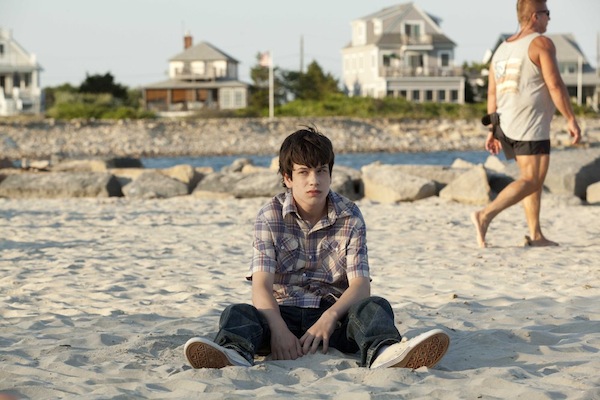
Duncan (Liam James) has a "thousand mile stare"
"I think you're a 3," says Trent imperiously.  "I just don't see you putting yourself out there..."

If Trent wanted to see Duncan put out, that remark was a good start.
Duncan settles into the teen routine of being a hot-house plant in a dark room, grunting monosyllabically at anyone over 30.  He can't relate to Trent's friends and neighbors, like the barely-together Betty (Allison Janney)—she has two kids, Susanna (AnnaSophia Robb) and Peter (River Alexander) and Kip (Rob Cordrry) and Joan (Amanda Peet).  And Mom, trying to heal after a divorce, is there for Trent. Duncan tries to be invisible and stay out of the way, and is emotionally unavailable.
It isn't until he finds Steph's abandoned pink bike (with tassles on the handlebars) that things begin to pick up speed and he feels like less of a trapped and pacing animal.  The bike gives him some mobility, some freedom, and it only has one seat, which is fine by him.  He starts to explore the beach-town and runs into Owen (Sam Rockwell at his loose best) who runs the local water-slide park, Water Wizz. Duncan gravitates there and that's when his Summer starts to get fun.  Owen takes him under his crooked wing, adding Duncan as park-help, and introducing him to what will be his new family, including Caitlin (Maya Rudolph), the responsible to Owen's irresponsible, and concessioners Roddy (Faxon) and Lewis (Rash). Pretty soon he's in a routine, interacting with sort-of adults and fitting in.
But, it causes conflicts within families; his long hours at the park causes concerns at home and puts him in further conflict with Trent, who has his own disappearing act issues.
It is no great shakes as a film, but it is a good movie, a movie you might enjoy. It is merely competent, well-written, extraordinarily cast and acted (the standouts being Rockwell and Steve Carell who works against type and proves himself capable of playing a deliberate jerk, instead of just a clueless one. And Rash and Faxon prove themselves as adept at directing as they are at screenwriting. In a disappointing Summer, this counts for a lot. And like Duncan's situation at Water Wizz, this little wayward breath of fresh air from the usual carnage perpetrated on screens is a welcome relief
The only explosion in The Way, Way Back

Saturday, January 17, 2015

Inherent Vice

Marijuana Jones and the Curse of the Golden Fang
or
"What's Up, Doc?" 

I've never smoked dope. Never been tempted and probably never will be (despite living in one of the—first—two states to legalize its recreational use). When asked why (usually by someone who has and is saying more about themselves than actually caring about the reason) my standard answer is: "The world doesn't need me any more paranoid."

It's a nice laugh line, but it's also true—the world doesn't necessarily need me any more paranoid, but I certainly don't need myself to be. I'm paranoid enough as it is.*

Which brings us to the central conceit of Inherent Vice—a film noir about a stoner detective.**  The thing about film noir (the term—meaning "black film"—coined by French film critics for the pulpy paranoid ambiguously moral post-war films that had a cynical edge to them) is that they're set in a Universe—ours, unfortunately—where unseen forces are in control of things to the detriment of the people too busy with their ordinary lives to notice something wrong.  The best description I've read of film noir is it depicts a world where "the streets are dark with something more than night."***
Precisely. There are things more black than night...especially when it comes to the motivations and the souls of men, the stuff of those "detective" stories with long shadows running through them that hide evil from detection and provide a cloak for those wanting to remain anonymous and invisible.

So, we have a stoner detective, already a little paranoid in how the world works under the influence, operating in the film noir world promoting paranoia on the not-so-grand scale. Seems a natural. ****  And Thomas Pynchon used it for "...Vice," his most accessible novel to date. Paul Thomas Anderson has made a film of it.
I'm not the biggest fan of Paul Thomas Anderson. He's a critical darling (like Quentin Tarantino, but at least P.T. isn't such a snorter of other people's material) which makes me suspicious of him. I rarely find him consistently entertaining, but his films are always interesting...well, filled with interesting ideas, bridged by some meandering sections and extended diversions that test the patience of the viewer. He is, however, never afraid to take on a challenge, even if the reach exceeds his grasp, which is always worth supporting. The works of Thomas Pynchon have never been filmed before...because they are nothing if not a challenge...and his novel of "Inherent Vice" is as close to being movie material as he has come.
It tells the story of LA P.I. Larry "Doc" Sportello (Joaquin Phoenix) who is tasked by ex-girlfriend Shasta Fay Hepworth (Katherine Waterston) with the finding of her current lover Michael Wolfmann (Eric Roberts) who has gone missing. Shasta suspects foul play—not hard to figure out since Wolfmann's wife (Serena Scott Thomas) and her current lover have asked for her cooperation with the enticement of reward, and she's laying low—staying untraceable, just in case.
Doc is not exactly a high roller (although he could easily fit one of those terms separately), having his office in an L.A. free-clinic. Almost immediately, clues start coming in about Wolfmann and his disappearance, and Doc find life getting complicated. His first recce/sortie is to a future Wolfmann development site, which is currently the site for a double-wide "massage parlor" where Doc is knocked unconscious and awakens next to the dead body of Wolfmann's body-guard (or we should say former bodyguard), surrounded by squad cars and the loaded guns of their occupants, led by the humorless presence of Lt. Det. Christian F. "Bigfoot" Bjornsen (Josh Brolin), who, along with being a part-time actor, has a checkered history with Doc.
Doc is questioned as a key-witness to the murder, before his lawyer Sauncho Silax, Esq (Benicio Del Toro) shows up to advise (despite specializing in maritime law) and spring him. Doc drifts from person of interest to person of interest—a crack Mom (Jena Malone), her "disappeared" husband (played by Owen Wilson, so obviously he's not disappeared), former clients, white supremacist groups, black activists, a drug cartel called "The Golden Fang," and a society of dentists. Clearly, there's safety in numbers and it's tough out there for a lone wolf like Doc. With all the covert operations and secret societies, professional or otherwise, it only lends to the paranoia associated with the noir world, obscured in shadow and fog, but also by Doc's personal purple haze.
Another aspect of the noir that Pynchon has hit on is the unresolved loose threads of post-war versions. Ever since Chandler and Howard Hawks' presentation of The Big Sleep***** has been the apparent lack of attention to details. Mystery aficionados and fans of Dame Agatha do not appreciate the victims who fall through the cracks, and it can be frustrating for regular audiences, too ("Wait a minute...what happened to....?"). Few questions are answered in Inherent Vice to a consistent degree. This may mar any entertainment value for the casual viewer—you'll also find the tone of the thing different from the comedy tone of the trailer; it's more of a peculiarity than a comedy.
These guys should do a movie together...maybe with music.
Still, I took pleasure in the final shot where Doc is driving through the night, the headlights of the cars behind him illuminating the suspicious squint in his eyes—as fine a visual representation of the mood of noir as I've seen.
Inherent Vice is also the first movie that genuinely gave me the munchies.

* The oldest joke I remember on the subject is "It's a wonder I'm NOT paranoid, what with the whole world against me and everything..."

** Nope.  Don't bring up comparisons to The Big Lebowski, even though its plot resembles that of the Dean of detective novels, Raymond Chandler. Jeff Bridges' "Dude" is not a detective, so much as a righteous man seeking revenge.

*** Raymond Chandler, again, from 1950's "The Simple Art of Murder."

**** I've always wanted to see a production of "Harvey" updated so that Dowd, "Elwood P," doesn't see puca's because of booze, but because of hallucinogens.  I've always imagined Jack Nicholson as Dowd.

***** There is the story where Humphrey Bogart asked Hawks who killed the chauffeur and Hawks couldn't tell him, nor could the screenwriters.  They wired Chandler who claimed it was one character and Hawks remembered that character was someplace else.  "I don't know," said Chandler.

Tuesday, November 25, 2014

Big Hero 6

Anime-zing
or
"This...Is What I've Been Working On"

Animation has come a long way since Winsor McKay first made Gertie the Dinosaur dance. From crude (if meticulous) key-animation to today's computer animation, it is still quite noticeable when somebody does something a little bit more innovative than what one is used to. Toy Story took computer imagery out of the clunky stage to give it grace, Ratatouille started to take things into the realm of photo-realism, Tangled took traditional Disney animation and gave it depth, which only advanced further with Frozen. Now, here comes Big Hero 6 (only somewhat related to the Marvel source), which advances things even further, while taking things in a slightly tangential tack in style.  

And, thematically, the way Disney has been doing lately, it manages to break away from the tropes of the genre and move in a fresh direction.


It is the future in the blended city of San Fransokyo (you can immediately tell the cross-culturalism when the Golden Gate Bridge has some decidedly pagoda-like stylings). Young Hiro Hamada (Ryan Potter) is a genius 14 year old engineer, who hasn't really applied himself except in the underground world of "bot-fights," where he wins wads of cash with his deceptively simple, unassuming little gadget that becomes a Tazmanian devil in the ring.

His hustling gets him in trouble with local toughs, but he is rescued by his older brother (Daniel Henney)—also an engineering genius—and encouraged for the umpteenth time, not to waste his life hustling, but become study and use his talents where they can do the most good—a quick stop at the San Fransokyo Institute of Technology on the way to the next bot-fight lights the spark in him, and he begins to apply himself to the Next Great Idea that will gain him entry into the Institute.

What he comes up with is a lulu, a swarm of micro-bots that, with a neural transmitter, can be controlled by its human host to become...nearly anything. His presentation at the institute attracts the attention of the school's legendary Dr. Callaghan (James Cromwell) and the corporate kingpin Allistair Krei (Alan Tudyk), both of whom want Hiro's technology; Hiro decides not to sell his tech and his presentation wins him a scholarship.
But, things do not go well that night. The presentation hall where the competition is held erupts in flames and Dr. Callaghan is trapped inside. Hiro's brother Tadashi rushes in to save his mentor and the whole place explodes. There could be no survivors. Hiro is despondent over the loss of his brother, and foregoes his college plans, despite the encouragement of Tadashi's friends and colleagues. His only comfort is the Baymax (voiced by "30 Rock's" Scott Adsit), the "healthcare companion" that Tadashi was perfecting at the time of his death. Baymax is a big inflatable medical scanner that can diagnose, prescribe and comfort the sick.   Hiro, not being in the best of shape, accidentally activates him and the two discover that one of Hiro's micro-bots has survived the explosion at the presentation center...and appears to be trying to respond to commands.

But, from whom?
Baymax and Hiro set out to find out where the tiny micro-bot is attracted to and find an abandoned warehouse, with tones of Hiro's micro-bots in stasis. They also find a Kabuki-masked stranger controlling them. Both are set upon by the controlled micro-bots and only barely manage to escape, with the help of Tadashi's fellow students. The group decides to get to the bottom of all this and form a team with their tech-gadgets to try and find "Mr. Kabuki" and bring him to justice...as Big Hero 6, each of Tadashi's friends taking on a persona and "power" that matches their personality and research path.
Not the most promising of scenarios. Two things struck me about Big Hero 6, though, that took it out of the norm of most animation and superhero stories. Number one, the animation. It is of the Disney 2-D school (the directors worked on The Emperor's New Groove, Bolt and The Princess and the Frog) that has been plumped into three dimensions the way the studio's been doing it since Tangled.  But, there's more of an emphasis on detail and shading than has been done in the past—San Fransokyo is bathed in diffused light from a combination of fog and neon. And there's no Uncanny Valley near this Silicon Valley.  The characters are clearly cartoonish and caricature, but the shading and play of light across the faces and expressions suggest a musculature that could not be found in your standard artist's maquette. That awareness comes early on with the expressions of the participants in the bot-fight sequence, and after, one just becomes used to it, noting when something is noticeably tactile looking. I've missed an animated feature or two (like the Madagascar's and Box-Trolls), but this was the first time I got a sense of depth and musculature in the faces. It's definitely a step up.
On the well-trudged superhero front, the story is interesting. It sets up the by-now required de rigeuer "revenge/eye-for-an-eye" scenario that dominates the entire sub-genre of superhero movies (born out of the more commonplace action film), but—and this might have come with the influence of Disney exec/former Pixar head John Lasseter—that "avenging" storyline is subverted to the point where the "taking revenge" impetus is both undermined and rendered moot (as being indistinguishable from the villains' motivations). It is odd that the "superhero" story has become so enmeshed in this singular through-line of story (to the point where even the most altruistic of the "meta-heroes" must be shoe-horned into the "you shall be revenged" Bat-school) when the history of the comics have been rife with different origins. Big Hero 6 breaks the mold and even questions its legitimacy.

And that, for one, makes it seem all the more fresh...and heroic.
Big Hero 6 is accompanied by a short cartoon, Feast, that pushes the way narrative is told in a purely visual way.  Definitely worth checking out.