Showing posts with label Liam Neeson. Show all posts

Friday, August 8, 2025

The Naked Gun (2025)

Serving 20 Years for Mans Laughter
or
"Usual is Unusual, Usually" 
 
I was worried about this one. The original "Naked Gun" series (the ones that starred Leslie Nielsen as Lt. Frank Drebin) came out of of the Z-A-Z team—the guys that made the original Airplane!—they would be David and Jerry Zucker and Jim Abrahams, who had a free-wheeling style of evergreen comedy and an impeccable sense of timing that made their movies work, despite production values that would have been suited for a Hallmark movie. That stuff's tough to duplicate—just ask anyone who saw the non-Z-A-Z sequel, Airplane 2, which was a desperate cash-grab and desperately unfunny despite writers credits by two of the geniuses behind "The Simpsons". 
 
"The Naked Gun" films came out of a Z-A-Z TV series that lasted all of six episodes (before being cancelled) called "Police Squad!" and I remember it as being fitfully funny and not quite up to par with the laugh-a-minute styles of Airplane! or their "Elvis-fights-the-Nazis" follow-up, Top Secret! The ideas were good, playing with the tropes of television and especially cop shows, but they were slightly hampered by 1980's TV censorship and the comedic pace never matched their movie work. That changed eight years later when they revived the concept for feature films and everything went up a few notches. Three "Naked Gun" films were produced between 1988 and 1994, the last only having David Zucker involved with the writing. The complete Z-A-Z team acted as producers. There'd been talk about doing a fourth "Naked Gun" movie with Nielsen, but nothing came of it. His death in 2010 put the stopper in it.
Now, thanks to producer Seth McFarlane's clout, there's a new one, the duplicate-titled The Naked Gun
, featuring Liam Neeson as Frank Drebin, Jr., the son of Leslie Nielsen's character, and he's a chip off the old blockhead. Not the most original of concepts, but Neeson does such an amazing job of playing it absolutely straight while still nailing the comic timing that it's a pleasure to see him make the Nielsen transition from drama to high comedy with nary a misstep. The review for the movie at RogerEbert.com stated that it is "legitimately" Neeson's best screen performance, and one comes out of The Naked Gun actually believing it, so deft is his way of fusing comedy with the deadly-serious "I have skills" intensity that he brought to his "action-star" phase.
What's the plot? Who cares? Surely, you don't think the efficacy of a "Naked Gun" entry lies in the carefully crafted screenplay. No, this is a matter of throwing all kinds of shit at a fan—which became a literal joke in Airplane!—and seeing what sticks. But, loosely, it's about a tech billionaire (
Danny Huston, who's sounding more and more like his Dad every movie), who's into breaking things and starting from scratch...including populations. Somehow, Junior Drebin gets involved in all this, as well as getting involved with the sister (Pamela Anderson, who's actually quite good) of an "accident" victim.
One is struck by how good the movie looks, with lots of mood-lighting and leaning into noir styles (as opposed to the Z-A-Z approach of key lighting everything, lest you miss a joke in the shadows, and also aping the style of its inspiration, "'M' Squad"). That's a bit of a shock, but seeing as this one is a couple generations removed from its source, it's a good shock.
Is it funny? Comedy is always subjective (he hedged)—one man's laugh-riot is another's snooze-fest—but, the first hour or so provided some genuine howlers and some inspired bits of business...then right about the time director Shaffer cuts to a shot of the house band of the villain's "Bengal Club" (and does nothing with it), the movie coasts to the end, wasting joke opportunities, occasionally perking up, but seemingly on comedy auto-pilot until the end. That wouldn't be so discouraging if the first two acts weren't so darned good.
Hopefully, there'll be more. It's refreshing to find a movie that's funnier and sillier than watching the nightly news. 
 
Oh. And don't call me "Shirley."

  Wilhelm Alert: @ 01:15.00

Friday, April 4, 2025

The Next Three Days

Written at the time of the film's release...

Thinking Outside the Cell-Block
or
"It Doesn't Matter What We Believe"

Director Paul Haggis, you either love or you hate. The haters find him manipulative and obvious (I'll buy the second charge, but movies, even documentaries, are—du-uh!—manipulative by their very nature) and will never forgive him for making Crash, which beat out Brokeback Mountain for the Best Picture Oscar.* The lovers, well, there aren't too many of them outside the movie industry—but Clint Eastwood and the Bond producers love him, and that's good enough for me.

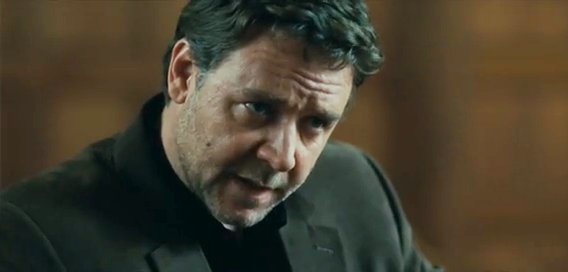
His third film, The Next Three Days, which he wrote and directed,** tells the story of a couple (with child) who are separated, when she (Elizabeth Banks) is arrested, tried and convicted for murder. Her husband (Russell Crowe), a school teacher, exhausts their finances—selling two homes—and all legal recourse, trying to prove her innocence. After three years of incarceration, her child doesn't even acknowledge her (having lived half his life without her), and after her last appeal is turned down, she attempts suicide.
Time to think outside the box...the legal system, and the penal system. The civilized courses have failed...as a matter of course. It's time to take action, and matters...into one's own hands.
In a way, this is the same movie Haggis has been making all along, his thesis converted into an action plot device more positive in its usage than negative in its omission. Both Crash and In the Valley of Elah feature protagonists trying to do more than the expected by-the-book (or society) response, to subvert the easy knee-jerk "comfortable" reaction, and (I dunno) think a little deeper. He seeks the help of a multi-prison escapee (Liam Neeson, in a too-short cameo), who gives him a broad picture of the strategies of going over the wall, and more importantly, staying out. One of the first things he says may be what's written on the first page of Haggis' screenwriting notebook, as it informs so much of his work: "You have to do a lot of lookin'—things that disrupt the day-to-day routine." That semi-somnambulent day-to-day routine has been the loam Haggis has toiled in over the years, and in this film, he finds a protagonist who tries to take advantage of it, rather than subvert it.***
It's a heist film, basically, with human valuables. It is also, for a brief time,
an "incredible mess" movie as Crowe's John Brennan must—painfully—learn the ropes of the outlaw life (and occasionally be beaten with them). This pays off later in the film—well, nearly everything pays off later in the film—as the "anything that could go wrong" scenarios start piling up in the film's nerve-rattling desperate finale, and one remembers how those early efforts only served to make matters worse.
The barriers that Brennan must overcome are represented by a filming scheme that places so much of the film behind screens and windows of various opacities—
a traditional trope of prison films (it just doesn't happen so much out in the so-called open, as it does in here—Haggis wants us to know there are traps inside and outside prison).
Great cast.
Crowe is nicely casual initially, then gradually turns into the ragged obsessive/compulsive he needs to be, Banks does drama as well as she does comedy (very), and, beyond Neeson, there are nice cameos by Daniel Stern, Olivia Wilde (as a divorcee...really?)...and particularly, Brian Dennehy, who, with the least amount of dialogue, makes the most of his scenes.
There will, no doubt, be an increase in interest in
"bump"-keys, and breaking into vehicles with tennis-balls, and Haggis even throws a bone to his critics by purposely leaving a plot-thread frustratingly unresolved. It's a good film, professionally done, and with enough twists and turns to keep one engaged, while still taking the time—one of the critical elements the film focusses on—to keep things realistic, and not turning the down-to-earth perps into clairvoyant superheroes.

* A decision I've always agreed with: I think Crash was reaching for something to say—especially about the 7-10 split of a city that is Los Angeles, and the casualness of racism as the easy way out.  Brokeback Mountain, although I admired its photography and I thought Heath Ledger had the best cowboy voice in movie history (great work, that—Jake Gyllenhaal, not so much) felt too much like a Joan Crawford movie in reverse-drag.  Mellerdrama at its sawdustiest.

** After Crash and In the Valley of Elah, The Next Three Days is not original—it is based on the French film Pour Elle (Anything for Her, 2008)

*** Even a late-minute extreme act by one of the protagonists is an expression of trying to break out of the routine, to think outside the box (or in this case, the van) and break the lock-step the other is in.

Friday, May 17, 2024

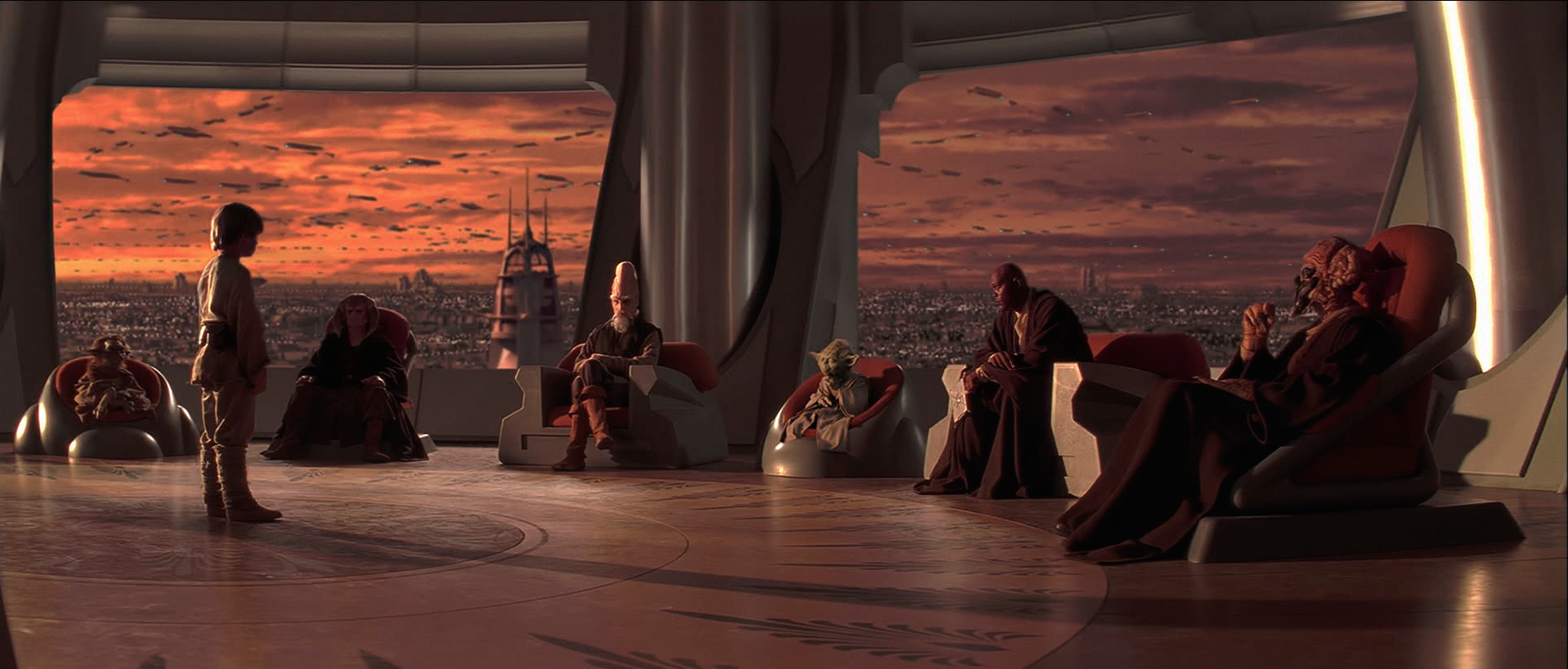
Star Wars, Episode 1: The Phantom Menace in 3-D

Episode I: The Phantom Menace is back in theaters for a 25th Anniversary (Really? That long ago?) and it's doing really well at the box-office, beating out NEW movies. And I've been hearing "buzz"...like an NPR report on "All Things Considered Weekend" that damned with faint praise (hardly the "reconsideration it promised).

But, it did raise some issues, that led to some actual...thoughts. So, I'm re-running my review of The Phantom Menace when I viewed it in its 3-D version.


Star Wars, Episode 1: The Phantom Menace (in 3-D) (George Lucas, 1999/2012/in perpetuity) "Star Wars" is the one series I was curious to see in 3-D—the clean, simple lines of force (pardon the pun) from the first immersion into those films (a long, long time ago in 1976) was along a line that extended from behind our heads to points close to the center of the screen: the opening titles that flashed, then crept into a distant infinity; hyperspace travel that zipped into that same bulls-eye quadrant; the cavernous, warehouse spaces of the Empirical HQ's; the approaching death-spirals of various death-stars; slaloms through asteroids and skimming over ice-fields. The movies already seemed yearning to stretch 2-D images into three-dimensional spaces, and although Lucas' spacial sense and action lines became increasingly complicated, and precise cutting more extreme, he always kept that sense of background/foreground busyness that leant itself to three-dimensions without (literally) rubbing our noses in it...or poking our eyes with it.
Naturally, they'd start with Episode 1 this time. After all of Lucas' tinkering over the years, 3-D seems like a natural place to go, especially for the reasons already listed, and there's been enough time out of theaters to make projected images seem unique (plus, there's a ready-made audience already grown up on all six films, who may actually prefer the prequels to their predecessors...despite the sneering of their fathers--"Shut UP, Dad!").

But, whatever the design sense going into the films, they were still SHOT flat.  Yes, there's a lot of post-production digital imagery that can be manipulated, but the actors—the live ones, anyway—are still forever tied to the backgrounds on location, and any cutting/pasting/shifting is going to make those portions look as fake as those late-model View-master pix that weren't taken with stereo-cameras on location, and looked instead like cardboard standees in front of a shifted background.

Not sure how they did it—I suspect it's the adding of shaped shadows to facial features and bodies—but, the 3-D effects are convincing and seamless, and although the picture loses some luster due to the lower light-levels (and those damn glasses), they're the same minor annoyances one finds in any 3-D presentation-it goes with the depth-of-territory.  And, as most of the SW films, pains had already been made to make things multi-planed enough to justify the conversion. Some of the speedier foreground elements tend to go rather unmenacingly phantom-like, but those are on rare occasions. 


Some random thoughts:
—The big vista shots, especially with the Naboo city-scapes, tend to look a bit more miniaturish in 3-D—although the sky-scraping Coruscant scenes play very well.
—I also got the impression that some shots which resisted conversion were just replaced with closer shots—the main ones being
Qui-Gon Jinn (Liam Neeson, who seems to have made the best choice in underplaying his radical Jedi ideologue, although it tends to undermine the character's importance) clucking a Tatooine beast-of-burden into motion, which I was under the impression was done in a fuller shot than the close-up this has, and Obi-Wan Kenobi (Ewan McGregor, who had the best acting arc of all the actors in the prequels) doing a spinning lightsaber move seems to have been moved a bit closer than the original.
—I don't remember The Phantom Menace moving as fast as this viewing seemed to. It's still pretty amazing to see how precise the editing is, and yet manage to get all the visual information necessary to follow what's going on, something not helped by the sound mix, which tends to prefer effects impression over clarity.

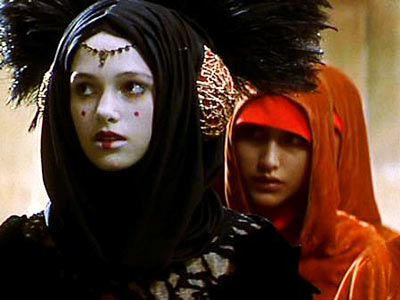
—Interesting how
Keira Knightley blends in the role of Queen Amidala's decoy/hand-maiden with Portman's more formal Queen acting (although, considering Knightley is probably a full foot taller than the miniaturish Portman, shouldn't the instinctual Jedi have noticed the subterfuge a little earlier?).

—The last 20 minutes work like gang-busters with the cross-cutting Battle for Naboo on four fronts—
the Gungan invasion by battle-droids, the Padme-led attack on the palace, the attack on the droid-command ship, and the three-sided lightsaber duel, and it's helped immeasurably by John Williams' "Duel of the Fates," which after consisting of a subdued omnipresent sonic wallpaper for most of the film, kicks things into high-gear. 

—Haters are still going to hate it—and, indeed, the fan-boy line has been staunchly adhered to in 3-D reviews—but, the Trade Federation plot resonates a bit more after the NAFTA kerfluffle and the bank meltdowns, and I still like the midi-chlorian idea making Anakin a "virgin birth"—leading me to the thought at the time "what if Jesus Christ turned out to be an asshole?"—even if it was all revealed to be a bio-engineering project by Palpatine in Revenge of the Sith.

No, it ain't perfect—it's a little stiff, with shots of smiles for smiles' sake, and the dialogue clunks along, even if some vital bits of information are slipped in under the radar, along the way. But, as one friend remarked after seeing a student-remixed version of Episode IV, "God, I forgot it was such a cheese-fest." It is. The thing is based on old "
Flash Gordon" serials and embraces the sensibilities of that style of ham-fisted major-key film-making. It's a fantasy film, not a Guide For Living, and subtlety was never in the blue-print. It is a small, quaint little conceit-film-series made Epic by the adoration of its fans. 
Yet, for some reason, George Lucas is to blame for the pushing of "product" (I haven't read any of the 3-D reviews, but the word "greed" keeps popping up in them), when it's the marketplace that drives these things. If people stopped buying this stuff, he wouldn't keep tossing it out there, revamping, tinkering, and attempting to make the films transition across the decades and technologies. We have met the Sith, and they are Us. And, boy, are we dumb!

2024 "Reconsideration"

As Roger Ebert said in his review of The Phantom Menace, "If it were the first 'Star Wars' movie, 'The Phantom Menace' would be hailed as a visionary breakthrough. But this is the fourth movie of the famous series, and we think we know the territory."

Just so. 
But, there were a couple things that Lucas hadn't really addressed in his Universe filled with exotic creatures and wondrous sights.
One of them was fashion, not only in apparel, but also in architecture. The previous films the former was dominated by uniforms and casual wear, and for the latter—other than the cloud-city of Bespin and the militaristic gloss of the Death Stars—everything else was supposed to suggest an improvised environment cobbled together with wire and spit.
Now, there had to be vast functioning cities of well-engineered design with an established history. And the clothes, for the higher end of dignitaries and royalty, had to have an air of regality and authority, where no one was allowed to dress like a scruffy nerf-herder. Nobody really complained about that.
The other was ethnicity. In a bio-diverse Uni-sphere, it was a little improbable that everybody would sound either American of British (the only exception being Millennium Falcon co-pilot Nien Nunb, who spoke in Kenyan). And so, for the sake of diversity, understand, accents were provided for the Gungans, the Trade Federation, and for Watto, the junk dealer on Tatooine. Character accents (that is, the way they speak)—eschewing the very recognizable French, German, and Italian kind—were treated as if they were racial slurs (they are considered offensive, still, in that NPR "reconsideration" above). But, the binary Yank/Brit accents are a bit limiting for such a Universe, don't you think? Shouldn't it be a bit more diverse? To American audiences, apparently not. It's not in our comfort zone. As I said at the end of the piece above, boy, are we dumb.
But, hey, it's just a movie. It's not like anybody treats it like a religion or anything.
Right?

That's right. "We think we know the territory."
 
What we don't know is how damn sensitive we are.

Saturday, February 18, 2023

Marlowe (2022)

Saturday is traditionally "Take Out the Trash" Day...

The Permanent Wave
or
A Tarantula on an Angel Food Cake

I have read everything by Raymond Chandler—the novels, the short-stories, the essays—and I've always loved his writing. His plots sometimes suffered, but the writing...the prose. The hysterical metaphors. There was a bemused humor behind the familial carnage that Chandler cranked out, and a jaded realization that behind every fortune there was some crime involved, and that, if you looked close enough, Tinsel-town was as rusty an old scow. What Chandler wrote was thrilling, even if the plots were mundane, with a depth of consciousness and virtue that a lot of pulp-writers couldn't be bothered with.  
 
Chandler wrote: “Without magic, there is no art. Without art, there is no idealism. Without idealism, there is no integrity. Without integrity, there is nothing but production." Philip Marlowe, Chandler's private detecting knight in crusted armor could have easily said those words, but he wouldn't. Especially the "magic" part. Marlowe would be watching the hands and checking for wires, and be amused while he was doing it. Like his perpetual solo chess-games.
And I've written a lot about Chandler here: the movies—a lot of them—and I had a deep affection for the TV series out of Canadian TV and HBO decades ago, the ones that starred Powers Boothe as "Philip Marlowe, Private Eye." Marlowe's a good part and most people are good at playing him—Bogart, Powell, Mitchum, both Montgomery's, Garner—even Elliott Gould had a nice "take" on the character, although director Robert Altman seemed to think of Marlowe as an out-of-date fool—"Rip Van Marlowe", he called him. So, Marlowe is good for the most part.
But, you can get Chandler wrong. One has to merely look at Michael Winner's remake of The Big Sleep, with Mitchum (who came to the part late), for what "stands out like a tarantula on an angel food cake." The money for that production came from Lord Lew Grade, so (of course) it had to be set in England. Metaphorically speaking, it's the wrong side of the road. America—and Los Angeles, in particular—was young and finding its feet, exploding with development and cash (but no water) but (changing tenses here) with the rush of money comes an emotional adolescence, that one couldn't conceive of in "old money" families. Every family has a black sheep, or secret. But, there are usually structures in place to keep everything "in house." Marlowe's job was usually to roust the cattle after the proverbial barn-door was left negligently open.
Marlowe, the latest film with the character—titular because the source novel, "The Black-Eyed Blonde"* (written by John Banville under the nom de plume Benjamin Black) has a title that implies abuse—tries to evoke the period and the convoluted scenarios that Marlowe regularly skulked, but is a misfire in so many ways that one is just tempted to ash-can with the couple other bad adaptations that have rumbled down the boulevard over the years. And one should state the obvious first: Neeson is too old to be playing Marlowe. True, there is less stunt-work needed to be done, so it's more suitable for the actor's age, but Marlowe was a perpetual 37-45 in the books. Mitchum was too old to play him at 57 in Farewell, My Lovely. Neeson is 70. It makes the redundant smashing of a chair over an already out-cold sparring partner entertainingly apt, but this Marlowe is decades too old to be duking it out with thugs and peeping through people's windows. Marlowe would regularly have his bell rung in the books, but this is the first time I've ever worried about him breaking a hip. There's a difference between being world-weary and just-plain haggard.
And, yes, the film is financed by Irish firms for Irish artists—Neil Jordan directs—but Neeson is also too Irish to be playing Marlowe, his Americanisms slipping with "yer's" and dropped "g's" (although accents usually don't bother me). He wears a three-piece suit—which I can't imagine Marlowe doing unless it was a formal dinner—and (for cryin' out loud), he has a secretary in the office. Marlowe was too loan-wolfish and, more importantly, not that successful to afford one.
They got the louvers right...
 
The story (adapted by William Monahan, who hasn't done an improvement on anything except The Tender Bar) is not much: Clare Cavendish (Diane Kruger) is shown into Marlowe's office ("How private are you?") with a job that requires discretion: her lover Nico Pederson (François Arnaud) has disappeared and she wants to know what happened to him without alerting her jerk of a husband. Nico was doing some studio work, but also had a, shall we say, "importing business" as well, the likes of which involve local crime-boss Lou Hendricks (Alan Cumming), local "bordello" manager Floyd Hanson (Danny Huston), a well-connected studio-head (Mitchell Mullen), who just happens to be involved with star Dorothy Quincannon (Jessica Lange, who is doing a tremendous job at the start of her "Kate Hepburn" eccentricity-acting phase). To paraphrase the detective: So many relations, so few brains. You could figure things out, just by following the strings attached.
Any joys are few and far between: everybody smokes, the women all have shellaced permanent waves, and sometimes the location work done in Barcelona, Spain could make you believe they found some un-gentrified corner of Los Angeles—if you squinted through the bottom of a half-empty shot-glass, that is. It doesn't quite pencil and smacks of trying to stretch a budget until you hear it snap. That stuff's always trouble. And the dialog by everybody is too clever by-half. You want them to just talk without being so damned witty. There is a nice line of dialog as Cavendish exits Marlowe's office, "You're very perceptive and sensitive, Mr. Marlowe. I imagine it gives you trouble."
I imagine a better movie, maybe finding something a little closer to home, maybe with Ron Livingston or Kyle Chandler as Marlowe, and fewer Chinatown call-backs (although the movie-eye-make-up bit produced a snort out of me). I imagine a lot of things, but I can't imagine a duller version of Chandler—or Banville—than this one.

* "The Case of the Black-Eyed Blonde" was the 37th episode of the Raymond Burr "Perry Mason" series, based on Earle Stanley Gardner's 25th book, published in November, 1944.

Saturday, April 24, 2021

The A-Team

Saturday is traditionally "Take Out the Trash" Day...

"Because Over-Kill is Underrated, My Friend"

I was never a huge fan of the TV version of "The A-Team," still in syndication around the country. A male version of "Charlie's Angels," with a for-hire team of whack-job mercenaries (that the producers claimed was inspired by the odd-ball cops of "Hill Street Blues") it was a huge hit until it ran out of steam, cycling through the script-library of adventure shows—a kind of manic, cartoon hybrid of "The Rockford Files" and "Mission: Impossible."Because the source material was rather poor, the news of a big-screen remake was not the sort that would make one hyper-anticipatory. Just the opposite; "The A-Team" sounded like a B-movie waiting to happen, perhaps even falling lower on the alphabetical scale if the creatives involved were as by-the-playbook as the series runners. 

Happily—giddily—the folks making The A-Team knew what worked with the old series and have amped it up to the nth degree, even occasionally throwing a TV-trope into the mix to show you they're not taking this too seriously. It's not Great Cinema—I don't think I can justify paying big bucks seeing it in a theater—but in its looney-toon action sequences, it approaches the manic intensity of child's play with new toys.

It's a sugar-rush.
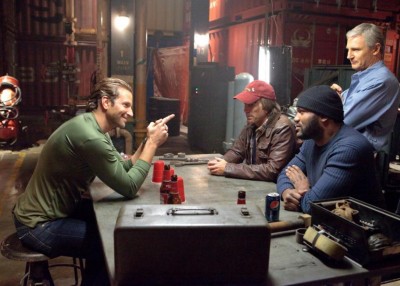
The old "A's" (Peppard, Benedict, T, and Schultz) were Viet-era grunts, but they've been re-boot-camped to the Persian Punch-Out (and Mr. Cheney says to leave the quagmire comparisons at the door, thanks, and he's got a gun). But they're still the zany merc's they always were, with their complicated strategems, the MacGyver'd weapons, "you-can't-do-that-in-this-vehicle" stunts, and the "pity the fool."  The cast is shake-your-head-til-it-rattles good: Liam Neeson, haggard and stogified, makes a great Col. "Hannibal" Smith—it's nice to see Neeson in something a little lighter, the man needs a breakBradley Cooper's "Face" has a perpetual shit-eating grin, and no dolby/no squelch for chatting people up (he's worked out and takes off his shirt a lot, ladies). As John Milius said about Arnold Schwarzenegger, if Mr. T didn't exist, they would have to construct one, and they've done that, shoe-horning "Rampage" Jackson into the role. Sadly, he doesn't have "T's" fire that smoulders during the drama scenes, but when required to turn it up to "11," Jackson comes through. But, the curdled cream-of-the-corps is Sharlto Copley as "Howling Mad" Murdock. Fans of the show loved the certified (and certifiable) pilot played by Dwight Schultz (bless 'im), but Copley (who played the harried Afrikanner middle-management hack in District 9—and you liked him in that), takes the role in his teeth and shakes it 'til it squeeks, flecks of mad-foam and scrambled accents flying in all directions. Let this be noted in the ledger—he is going to be big. He's that good. He's that funny. He's that creative, and this is him playing in the minors. There are at least two "Batman" villains with his name on them.  Sharlto. Copley.  Learn to pronounce it. You'll be using it a lot.
They could have put anybody else in this movie and it would be fine, but Patrick Wilson has a field-day with his ghost-in-the-CIA-machine, Agent Lynch. Gerald McRaney (one of those TV-elements I talked about earlier) manages to rise above the material, and Jessica Biel rocks her wardrobe, plays the straight man, and nails the movie's best line (the laughter went for 30 seconds, I clocked it).
High praise.  Brownie points for that.  And the writers weren't lazy,* the special effects crews sloppily crafty—8 of them, but they spent more time on details and in-jokes than they do on photo-realism and I can respect that.  But the direction (by Joe Carnehan—remember when he was "the next big thing" with Narc?) is a mess.  At one point, there's a heated conversation in a photo-booth between two people and you'd swear there was three.  here are odd shots during the mayhem that don't show much—and were obviously "C"-roll cameras—but are there, anyway. And more than that, the cutting scheme assumes we're morons, flashing back to scenes we might have missed adjusting our drool-cup in case we missed "the point." 
They needn't have bothered. "The point," such as it is, is to keep sharpening before it gets dull, which the movie threatens to do at several points. During the "drama," one gets the urge to get a Coke, hit the "head", or text-message, until
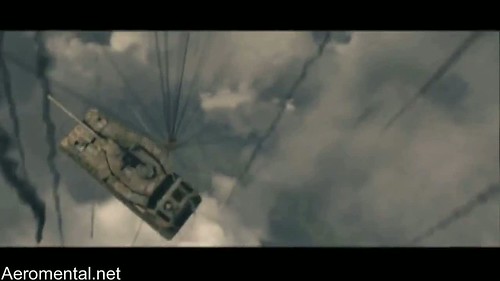
the next hyper-action sequence comes along, like the hysterical tank-bit, or the child's mayhem with a cargo-tanker, comes along.
It's entertaining.  And that's a gift.

But, like a sugar-high, it doesn't last, and makes one antsy for the next supply of "rush."

Isn't there a big-budget "Magnum: P-I" scheduled?**

* Although you will think they were.  At one point, it will be obvious what is going on, and you will (I have faith in you) go "Wait a minute...that's..."—as every member of the audience I saw it with, did, and felt the need to say it aloud.  I'm going to give the writers credit and say it's another one of the TV-tropes I alluded to earlier—the "obvious switcheroo" that Your Aunt Jessye could figure out.

** Nah. They just re-booted the TV-series.