Showing posts with label Sharlto Copley. Show all posts

Tuesday, May 9, 2023

District 9

Written at the time of the film's release (which, of course, explains the opening Ridley Scott quote—he hadn't yet made The Martian, or his "Alien" sequels, or produced his Blade Runner sequel.

"Dances With Prawns"


Ridley Scott recently said in an interview, "Science Fiction in movies is dead," proving once again that as a visionary, Ridley Scott is a superb art director.*

But, like Westerns, they can continue to cast a reflection on our life and times, just as surely as the Sun sets in the West—on Earth or Mars—wherever there are flawed humans who'll make the same mistakes in the future as they did in the past.

Take the new film by South African film-maker
Neill BlomkampDistrict 9—a re-telling of the issues of apartheid both in macro- and micro-cosm. It won't score many points for originality, but as a potent rejuvenation of how sci-fi can focus attention on an issue, it may be the best film of its type since The Road Warrior.
Twenty years ago, a large spaceship is left, stranded, hovering over Johannesburg. When official go to take a look, they find a race of aliens— emaciated, starving—and they begin transporting the survivors off the ship and into makeshift refugee camp, dubbed "District 9." And in a repeat of history, the camps "became fenced, then militarized, and then it became a slum." The Joburg citizens of all races are barely tolerant of "the prawns," as they are called, as long as they stay on their side of the fence. They become scavengers, demoralized, living on garbage taken advantage of by human predators. They're also extremely well-armed (with weapons that only respond to their DNA, so humans can't use them), and attempting to create the fuel they'll need to get back home.
This back-story is told from rough-edited documentary footage outlining "the situation." As the human/prawn tensions become high, the M.N.U. (
Multi-National United) is recruited to move the million prawns to a new relocation camp far from Johannesburg. In charge of the operation is the son-in-law of an MNU muckety-muck, Wikus van der Merwe
** (Sharlto Copley) and you just know from the documentary footage of him that 1) he's an idiot, senseless and blithely ignorant and 2) "something" happened to him, as he's always mentioned in the past tense.What's happened is that van der Merwe's evacuation plan, a disorganized xenophobic spree, has uncovered weapons cache's, nurseries (which are put to the torch—"Listen to them pop!" exults van der Merwe to the camera), and due to his pig-ignorance, he's exposed to an agent that begins to change him into one of the insectoid aliens, giving him a look at their world, walking a mile in their claws, as it were...and, oh, by the way, he can start using their weapons now.
Now, lest anyone get the impression this is a life-affirming lesson in just getting along, be advised that it's a parable soaked in blood and bile. It's one of the dankest, squishiest movies I've ever laid eyes on with much viscous vomiting, projectile blood-shed—the aliens' weapons are particularly nasty, exploding human bodies like blood-blisters with gout's of blood hitting the camera lens—and sequences of transformation somewhat akin to Cronenberg's "The Fly" (particularly when the hero tears out his fingernails). I saw more than enough folks who had to leave the theater when I saw it, so be warned (especially you parents being pressured to see
the "space-ship" movie).
It is also one of those surface-message movies that belies its point with its story presentation, the message being mixed in a left brain/right brain conflict. Xenophobia is certainly shown as wrong, but in as visceral a way possible, the only difference depending on what side of the electro-blaster-micro-waver you're on. And there isn't any direct retribution for actions taken—the film has a mindless video game feel to it, rather emptily getting the blood up, and providing no catharsis to diffuse it.
***
However, there is a lot that makes District-9 satisfying (if uncomfortable) from its performances, art direction, seamless motion capture effects, and design.
 
Oh. And in a final irony: Blomkamp's artist's representation in California is RSA...which is owned by Sir Ridley Scott.

* One wonders why he would even say such a thing as his company, Scott Free Productions, produced the egregious (but ratings-busting) A&E regurgitation of "The Andromeda Strain." One might agree if he was talking about the line of toy-ad's masquerading as entertainment (Can't wait for "Lincoln Logs: The Movie!"), but those can hardly be counted as "science fiction."

** Here's another layer to District-9—it's a cultural joke. In South Africa, there is a sub-species of joke called the "van der Merwe joke," like "blond" jokes in the U.S., or "Sven and Ole" jokes in Scandinavian communities, they're self-deprecating humor about just how dumb someone could possibly be. That D-9 starts as a van der Merwe joke and turns into a story of redemption is just one of the insidious joys of District-9.

*** District 9 came about as a substitute project for director Blomkamp and producer Peter Jackson after their planned collaboration of the film version of the popular "Halo" video game came to naught.

Saturday, April 24, 2021

The A-Team

Saturday is traditionally "Take Out the Trash" Day...

"Because Over-Kill is Underrated, My Friend"

I was never a huge fan of the TV version of "The A-Team," still in syndication around the country. A male version of "Charlie's Angels," with a for-hire team of whack-job mercenaries (that the producers claimed was inspired by the odd-ball cops of "Hill Street Blues") it was a huge hit until it ran out of steam, cycling through the script-library of adventure shows—a kind of manic, cartoon hybrid of "The Rockford Files" and "Mission: Impossible."Because the source material was rather poor, the news of a big-screen remake was not the sort that would make one hyper-anticipatory. Just the opposite; "The A-Team" sounded like a B-movie waiting to happen, perhaps even falling lower on the alphabetical scale if the creatives involved were as by-the-playbook as the series runners. 

Happily—giddily—the folks making The A-Team knew what worked with the old series and have amped it up to the nth degree, even occasionally throwing a TV-trope into the mix to show you they're not taking this too seriously. It's not Great Cinema—I don't think I can justify paying big bucks seeing it in a theater—but in its looney-toon action sequences, it approaches the manic intensity of child's play with new toys.

It's a sugar-rush.
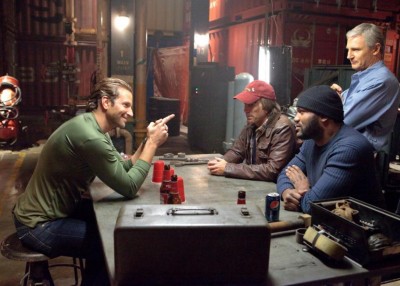
The old "A's" (Peppard, Benedict, T, and Schultz) were Viet-era grunts, but they've been re-boot-camped to the Persian Punch-Out (and Mr. Cheney says to leave the quagmire comparisons at the door, thanks, and he's got a gun). But they're still the zany merc's they always were, with their complicated strategems, the MacGyver'd weapons, "you-can't-do-that-in-this-vehicle" stunts, and the "pity the fool."  The cast is shake-your-head-til-it-rattles good: Liam Neeson, haggard and stogified, makes a great Col. "Hannibal" Smith—it's nice to see Neeson in something a little lighter, the man needs a breakBradley Cooper's "Face" has a perpetual shit-eating grin, and no dolby/no squelch for chatting people up (he's worked out and takes off his shirt a lot, ladies). As John Milius said about Arnold Schwarzenegger, if Mr. T didn't exist, they would have to construct one, and they've done that, shoe-horning "Rampage" Jackson into the role. Sadly, he doesn't have "T's" fire that smoulders during the drama scenes, but when required to turn it up to "11," Jackson comes through. But, the curdled cream-of-the-corps is Sharlto Copley as "Howling Mad" Murdock. Fans of the show loved the certified (and certifiable) pilot played by Dwight Schultz (bless 'im), but Copley (who played the harried Afrikanner middle-management hack in District 9—and you liked him in that), takes the role in his teeth and shakes it 'til it squeeks, flecks of mad-foam and scrambled accents flying in all directions. Let this be noted in the ledger—he is going to be big. He's that good. He's that funny. He's that creative, and this is him playing in the minors. There are at least two "Batman" villains with his name on them.  Sharlto. Copley.  Learn to pronounce it. You'll be using it a lot.
They could have put anybody else in this movie and it would be fine, but Patrick Wilson has a field-day with his ghost-in-the-CIA-machine, Agent Lynch. Gerald McRaney (one of those TV-elements I talked about earlier) manages to rise above the material, and Jessica Biel rocks her wardrobe, plays the straight man, and nails the movie's best line (the laughter went for 30 seconds, I clocked it).
High praise.  Brownie points for that.  And the writers weren't lazy,* the special effects crews sloppily crafty—8 of them, but they spent more time on details and in-jokes than they do on photo-realism and I can respect that.  But the direction (by Joe Carnehan—remember when he was "the next big thing" with Narc?) is a mess.  At one point, there's a heated conversation in a photo-booth between two people and you'd swear there was three.  here are odd shots during the mayhem that don't show much—and were obviously "C"-roll cameras—but are there, anyway. And more than that, the cutting scheme assumes we're morons, flashing back to scenes we might have missed adjusting our drool-cup in case we missed "the point." 
They needn't have bothered. "The point," such as it is, is to keep sharpening before it gets dull, which the movie threatens to do at several points. During the "drama," one gets the urge to get a Coke, hit the "head", or text-message, until
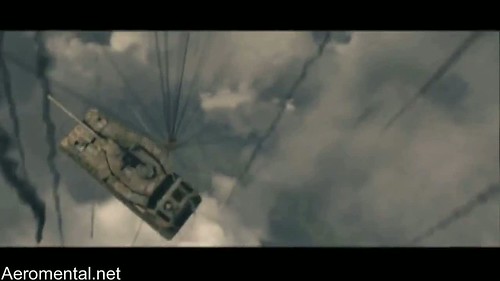
the next hyper-action sequence comes along, like the hysterical tank-bit, or the child's mayhem with a cargo-tanker, comes along.
It's entertaining.  And that's a gift.

But, like a sugar-high, it doesn't last, and makes one antsy for the next supply of "rush."

Isn't there a big-budget "Magnum: P-I" scheduled?**

* Although you will think they were.  At one point, it will be obvious what is going on, and you will (I have faith in you) go "Wait a minute...that's..."—as every member of the audience I saw it with, did, and felt the need to say it aloud.  I'm going to give the writers credit and say it's another one of the TV-tropes I alluded to earlier—the "obvious switcheroo" that Your Aunt Jessye could figure out.

** Nah. They just re-booted the TV-series.

Thursday, April 5, 2018

Elysium (2013)

Written at the time of the film's release.

Zero Tolerance for Citizens
or
Spinning That Ol' Wheel of Fortune

I expect nearly everybody was looking forward to Neill Blomkomp's next film, after the gooey splash District 9 made.  His new one, Elysium, has the same kind of life-lesson—"what have you done for someone else lately?" and how one's perspective changes when you walk around in someone else's downtrodden shoes.  

The approach is slightly different, though, even if the futuristic milieu is still glum.  In this future, the current economic climate hasn't changed, only the locations have.  Earth, after years of neglect, is one big slum, there is no distinction between urban and rural anymore, the green spaces are dead, and there is a space-age version of urban flight—the "one percenters" have moved on up to an orbiting oasis called Elysiumand it is, as in Greek Myth, the isle of the Fortunate, a paradise, with estates and luxury homes perched inside it's rotating ring. It's the ultimate gated community. A large star in the sky, it is out of reach but never out of the sight or the minds of the stragglers of Earth who hope to get there by fortune or by smuggling themselves by shuttles, which Elysium's defensive perimeter either discourages or destroys.

The parallels to today's refugee and immigrant desperation is baldly presented, and obvious to anyone whose world-view isn't in spec-fic but down here on Earth, much as apartheid was morphed into xenophobia in D-9. Add to that that the penthouse in space also seems to have access to the ultimate in universal health-care, a medi-bed that scans you and...simply cures you (it seems). Other than those fanciful details, everything's played a little straighter, no doubt because you have big stars like Matt Damon and Jodie Foster, rather than just Sharlto Copley (although he's here too, bless him), so the financial risks are slightly more, so they make the stakes in the film a little higher, too. Higher in that the government (naturally) is up there in Elysium, in the form of President Patel, who has a rather prickly defense secretary (Foster, channelling Angela Lansbury from The Manchurian Candidate), who has a unique sense of how to protect The Ring, supplementing the force of robot-police with soldiers of fortune, like a particularly nasty one named Kruger (Copley), who would probably kill for a hobby if he wasn't being paid for it.
Down on Earth, it's dog-eat-dog, and former car-thief Max Da Costa (Damon) is trying to go straight, working towards the dream of going to Elysium by working in one of the factories mass-producing the robo-cops that keep the populace under their teflon thumbs. But an industrial accident leaves Da Costa dying, with only five days to live. His only chance is to somehow get up to Elysium and one of those miracle-med-things, so, with a few super-drugs pumping through his system, he signs up to do some dirty work for a former employer, which involves stealing industrial secrets—which just happen to be Elysium's security codes—that will unlock the station's defenses and allow a mass exodus from Earth to Elysium.
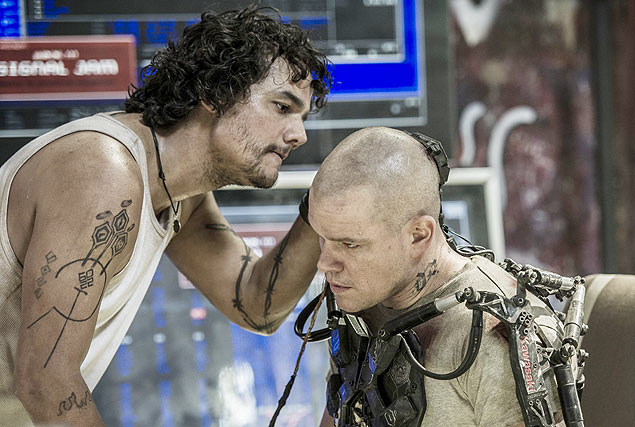
Da Costa allows himself to be merged with a powerful exo-skeleton and neural-net to download the codes, then, once there—well, let's just say things get personal, as these things are wont to do, but not selfish, as that flies against the "hero" sense that movies must have, so there has to be some deflection of need for Da Costa to some other....blah-blah-blah. Face it, the exo-skeleton could be a crucifix motif, so Da Costa has to do some sacrificing because...well, that's the way they do it in movies these days. There can't be any motivation of "self" because apparently that would make you as "bad" as the Elysium-buyers. So, ultimately, Da Costa has to do all the fighting and scraping for somebody else, and, as per usual, it's an acquaintance's sick child. Again.
And that's the main thing that makes Elysium less than thrilling: for all the "neat" visuals, for the interesting "take" on today's events, for all the good intentions and the perversions of such, it feels like every other sci-fi Christ allegory and leaves you feeling a little hollow while its trying to make you feel noble and unselfish while watching it. Well, I've seen that before, and I thought the intention of sci-fi was to show you something different. It is a noble effort, but ultimately, it suffers from story-sameness, and recycled ideas from the cookie-cutter school of script-writing. It's too bad because Elysium has a lot going for it.
Gotta say that Elysium has some pretty cool concepts for its pleasure-wheel

Saturday, July 16, 2016

Europa Report

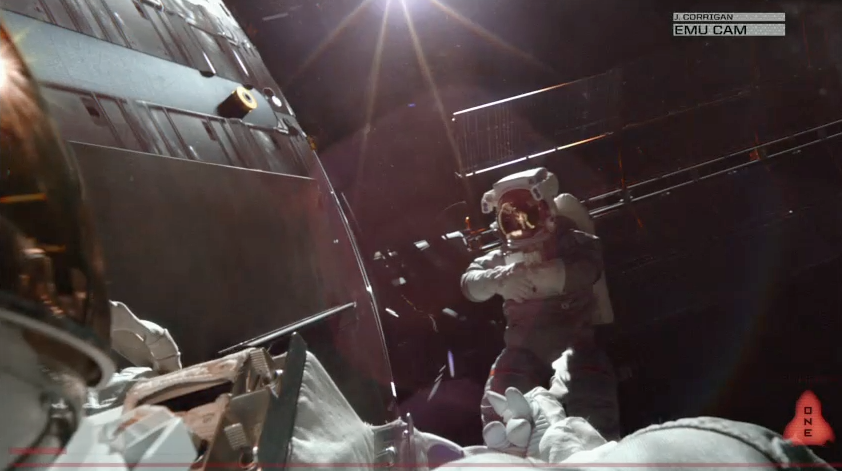
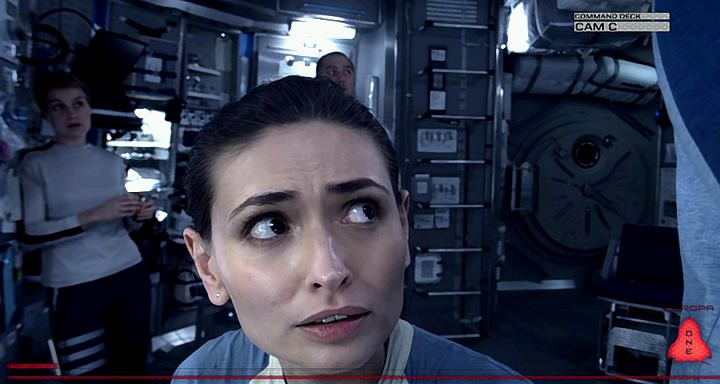
Europa Report (]Sebastián Cordero, 2013)  Sci-fi/adventure film crossing several styles of film-making, but primarily done in a faux-documentary/found footage style about a long-range NASA flight to the Jupiter moon of Europa, which, it has been speculated by many looking at it from afar and across many different spectra, is the most likely of our neighborhood system's bodies that could, maybe, possibly support life as we know it (if all the ingredients and conditions necessary for it outweigh everything that would prevent it).

The whole thing is staged like a documentary. There are pre-flight press conference archives, post-event footage of interviews (giving us a nice sense of complacency), some scrambled interference to give us the "fallible narrator" idea, and lots and lots of "normalcy" footage (something that proved useful to The Martian, which makes Europa Report, seem less of a waste of space in presentation). 
The other thing that's neat about it, is that NASA advisers worked with the film-makers to give it a sense of verisimilitude.  The gear is "lowest-contract-bidder" looking, we get a sense of the routine (just so we can tell when it gets broken), and we become acquainted with the various camera set-ups that record what's going on automatically. It looks very authentic, much more so than misfires like that lousy Apollo 18 movie a couple years back, or even the clever Ridley Scott "transmission" footage used to hide the scale models and flaws in its "planet-side" footage in Alien
The film is cast well and game, maybe a little too game, as you don't get the sense that these guys are astronauts or pilots or physicists or ice geologists or whatever they're supposed to be.  But, any more casual "reading you five-by-five, Houston" and you wouldn't have been able to distinguish one from the other at all, and that wouldn't do well with what the film wants to do, which one will become aware of fairly early on in the proceedings. It does cast a couple of fairly well known "anonymous" actors—in other words, it's not George Clooney, Sandra Bullock or Brad Pitt—but it is Michael Nyqvist (from the first versions of the "The Girl with the Dragon Tattoo" series) and Sharlto Copley (of District 9, The A-Team, and Elysium) Embeth Davidtz (of Schindler's List, Army of Darkness and "Mad Men"), and Karolina Wydra (she was briefly Mrs. House on "House, M.D."), all very good international actors that few would recognize. A good strategy, that, even if it does make it it a little hard to keep track of everybody.
And that's the main problem, here. The story is pretty standard stuff in the murder/horror realm, as we lose crew-members one by one, a sort of "Ten Little Astronauts". But by how or by what, we have no idea in a world of possibilities (other than the age-old problem of everybody ignoring the transmission to "get back in"). Ultimately, this is what limits Europa Report, despite the fact that its intention is to expand our horizons and conceptions. We know what's going to happen. We know how it's going to end. And whatever great discovery and what it might mean to our ideas of the Universe as put out by the film are overshadowed by the rote way in which its conveyed. Any uniqueness is swallowed by convention.
Which makes you wonder: if we do find life in the Universe besides us, is our reaction going to be: "Uh-huh, so what else is new?"

Saturday, March 21, 2015

Chappie

Switching Psyches (The Ol' Good Bot/Bad Bot Routine)
or
Because I'm CHAPPiE...(Like a ROM Without a Roof)

The director of the brilliant District 9 (and the more ordinary Elysium) now has a third visionary sci-film under his belt. Neill Blomkamp is a great visual stylist—none of his movies look like anything else out there, and just when somebody takes up his concepts, he pushes things further into his bleak concept of the future as an extension of the strife of Johannesburg (or Jo-burg, as it's called in his movies, eschewing the Dutch influence) despite technology continuing to move forward. His movies always have a sense of wonder about the future, but it's always along the lines of "Wonder why everything is so shitty, still," (which is a variation of "If we can get to the Moon,* why can't we fill in the blank??")

CHAPPiE is no different, even though the ads make it seem like a winsome version of a distopian "Mad Max" movie. It is anything but. Yes, the performance of Sharlto Copley as the title character is a marvel, innovative and often very charming (Copley, who is Blomkamp's "go-to" actor for...everything...does a marvelous performance of the "motion capture" variety (the thing that Andy Serkis, of Peter Jackson's movies and in the new "Planet of the Apes" series, does so extraordinarily). The movie itself is a depressing look at technology and Society, while containing a couched message about the malleability of the human spirit and a cautionary one of being too fixed to expectations.
SCOUT (CHAPPiE, specifically)
Blomkamp plops us back into the world of Elysium where the city-slums are policed by robo-cops on a set pre-program. The main defense if the Scout-droids—tall, angular humanoid shapes that patrol the streets (as outlined in the de rigeur video-fed prologue). But, all ready to go online are the Moose-droids, which are big, elephantine machines, controlled by remote human handlers using a helmet—plugged-in gamers in their own version of an urban first-person shooter. The Scouts' development team is led by Deon Wilson (Dev Patel of Slumdog Millionaire and The Best and Second Best Exotic Marigold Hotel) while the competing Moose designs, spear-headed by Vincent Moore (Hugh Jackman, in a way that we'll talk about later) are still in the development stage. Moore is impatient to get them on-line to the point where he'll sabotage the successful Scout program to do it. Boss Sigourney Weaver goes with whatever works and the Scouts, for now, are working. 
MOOSE 
But Deon is not satisfied with success, and with merely working to sets of parameters and protocols. He wants his Scouts to be more human—real-live-boy Scouts—with artificial intelligence that learns and grows as it does its job. The Boss is less than encouraging about advancing the product, as much as churning them out to meet demand. Deon conspires to develop them off-site, taking a disabled Scout, a new program he's developing, and the most guarded of the firm's gizmo's, the chip to program the 'bots.
Office politics in Jo'burg: Patel and Jackman
Wouldn't ya know it? When Deon has all that gear is precisely the time he gets kidnapped by car-jacking street punks Yo-landie (played by South African punk-rapper Yolandi Visser—real name Anri du Toit) and her partners, Ninja (played by South African punk-rapper Ninja—real name Watkin Tudor Jones) and Yankie, (played by honest-to-god actor Jose Pablo Cantillo). They're scheming, too. They're in the debt of Hippo (Brandon Auret, who adapts a patois so thick, he's actually sub-titled in the movie, even though he's speaking English). Their operations are going so poorly, thanks to the Scouts, that they decide to fight fire with fire, by getting their own Scout as a defense against the robo-force. Basic math belies this (1≠zillions), but then, if these guys were any good at numbers, they wouldn't be in debt (especially considering they're living expenses amount to bling, and stolen bling at that).
Perp walk, Jo-burg style:
Yolandi, Ninja, Yankie, and CHAPPiE
Deon is forced to fix his little experiment at gun-point and under less than ideal conditions, but the re-constituted droid comes to life with basic programming, like that of a child, and quickly learns to imprint himself on the humans, interacting with them.
What CHAPPiE sees
This is good in the case of Deon and Yo-lande, semi-okay with Yankie, and downright harmful in the case of Ninja, who tends to over-react when things don't go his way, usually with violence.** This is where the movie becomes really uncomfortable and begins to feel like watching child abuse. Look, it's a movie, okay? It's about robots. I get it. But, one is supposed to connect emotionally with a movie—that's the intent. And my reaction to watching Ninja abusing the still-in-development Scout (Yo-lande calls him "Happy Chappie," which Deon hates) creates a feeling of revulsion. Blomkamp plays rough—his settings have all the charm of a refugee camp and his environments combine grinding poverty with sci-fi tech, a not mutually exclusive reflection of reality, but amped up on both sides of the spectrum.
There's a warning label that says:
"Never fist-bump with a Scout-droid"
Yo-lande and Ninja live in a gutted out industrial site, and even as Deon tries to nurture Chappie in his intellectual growth, Ninja teaches him how to live on the streets, but when Chappie's employed to do some car-jackings, the media picks up on it, sending the city of Jo-burg into a panic. Moore is pressed (actually he does the pressing) to bring the Moose on-line, and his interests are more than stemming the tide of unrest, he wants to wipe out the gangs, Deon, and Chappie for his own career advancement. It's clear that Moore is an HR nightmare. And it's interesting to note that while Copley is busy being the title character, Jackman is copying Copley's jibbering, flinty acting style for the role that (if he wasn't busy wearing a CGI suit) would have been played, equally as manically, by Copley. It's a different (and alarming) side of Jackman that's fun to watch him pull off, even while his character is being seriously psycho.
"Walk like a man/Fast as you can"
Ninja teaches Chappie to "walk street"
That backstage swapping of personalities is a bit like a sub-plot of the movie, a variation of the Sci-Fi/Horror trope of mind-swapping (only in the new vernacular, it's "up-loading" and "down-loading"); whatever the term, it's a borrowed device, but CHAPPiE (the movie) only really does anything different, and has any spark of wonder and the fantastic (or even ingenuity) in those sections. That, and in the stunt-casting of the South African rap duo Die Antwoord as themselves (think of it in the same light as casting Prince, The Beatles, or Eminem to play fantasy versions of their personas) are the only aspects where CHAPPiE isn't terribly derivative, and becomes something more than the ol' Sci-Fi zap-'em-up with Rock'em Sock'em Robots, and becomes a sort of sweetly reversed "Frankenstein," with a conclusion that says "what matters lasts."

But, it's a lot of torture getting there.

* Or it's "conspiracy theory" variant: "If we can fool the world into thinking we went to the Moon, why can't we mass-produce tin-foil hats for the Masses?"  

And yes, I am watching you while you're reading this.

And so are they.

**  This puts him at odds...and odd kinship...with Deon, who also wants things "just so" as he defines it, and explodes when they're altered, to the point where he has enough and buys a gun. The one character who "goes with the flow" is Yo-landie.

Tuesday, June 3, 2014

Maleficent

Her Wicked, Wicked (Though Très Jolie) Ways
or
The Method Act of Evil ("So, What's My Motivation?")

I'm of two minds on Maleficent: pro and con.   This Angelina Jolie star-vehicle (she also executive produced) is one of those slam-dunks of casting real-life counterparts for animated characters—like Shelley Duvall for Olive Oyl, or John Goodman for Fred Flintstone. Make-up artist Rick Baker merely had to chisel a little more cheekbone to make her match the stylized profile from Disney's late-50's animation of Sleeping Beauty to perfect the look. Rookie Robert Stromberg is the director here (although his production design work on Avatar, Alice in Wonderland, and Oz the Great and Powerful, shows he knows his way around a complicated set). Linda Woolverton (who worked on Beauty and the Beast, The Lion King, and Alice in Wonderland) wrote the screenplay with some whispered assistance from the shadows by Paul Dini. That's some talent behind and in front of the camera, that no one can deny.

But, this one left me torn. Jolie is terrific, in a performance of such stillness and economy that a raised eyebrow can raise the hairs on the back of your neck. And when she opens up and howls in a moment of violation, it haunts. She and the production design are the whole movie, really. Sharlto Copley plays the antagonist, and he seems to be rather straight-jacketed in the role, and Elle Fanning plays the "sleeping beauty" Princess Aurora, in a performance that consists of grinning like an idiot.
Maleficent is the latest of the "Wicked" school of re-written history fairy-tales,* where the traditional villains' side of things are presented, their reasons for being bad more than just because they're "drawn that way"—there are psychological reasons for their actions, like Richard II's "I got a hump, okay?" and Oedipus' "Look, it was all a big mistake!" Maleficent takes one of Disney's more fancifully-designed villains and "explains" her away, negating what made Maleficent the character so intriguing (and inspired Jolie to take the role in the first place). So, I'm torn.
Having seen the Disney version of Sleeping Beauty (on which this is inspired), I'm con.  


But having seen the Disney version of Sleeping Beauty, I'm pro.

Perhaps I should explain. 
Submitted—Argument for the prosecution: 

Not to get too "law and order" here, but villains are villains because they are bad. Vain, selfish, of no community except of their own making, they are the cautionary "other" that fairy-tales warn us about and provide the heroic alternative to inspire us. Villains are supposed to frighten us, and be examples only in the negative. Unfortunately, the thrill of the villain can also make them attractive. Marlon Brando was famously aghast when his anti-establishment motorcycle punk in The Wild One became so popular. Darth Vader was fascinating in Star Wars and because of it, his caché increased in size and scope in the second film of the first trilogy—I suspect that part of the animosity towards the prequels is how they diminished the mystery of the character (We like to tear down our heroes, but we HATE it when we tear down our villains). 

I don't mind when a villain gets his just desserts, but I don't want to "feel for" them when they receive it. I want no sympathy for villainy, no matter the lawyering of its arguments. The fact is I don't care why the Grinch stole Christmas, why the Wicked Witches terrorize Oz, or why Booth shot Lincoln or Oswald shot Kennedy. I don't care why the creep killed those people at USC. Some things cannot be explained away, or understood for their motivations. God help me when I do understand the terrible actions in this world. They are acts of evil, un-pure and simple.


It is a tragedy that we even have the opportunity to ponder them at all. 

Making Maleficent sympathetic diminishes us...and diminishes her.

Submitted—Argument for the defense:
However, there is something good going on here that started with Disney's Beauty and the Beast and is just starting to bloom in full flower with films like Pixar's Brave and Disney Frozen—female heroes and female bonding is making a comeback in movies, and Disney, who foisted so many pliant princesses on our culture, seems to be leading the charge. However improbable it may be for Princess Aurora to see Maleficent as a fairy godmother (as she does in this), there is a bracing antidote to the traditional "true love's kiss" (as there was in Frozen) that belies the fairy-tale of the solution to problems being a handsome prince. Because if it's one thing that "Sleeping Beauty" teaches us, it's that a woman's life can really get messed up due to an unfortunate prick.

It's a lesson more important for our women-folk than sustaining the conventional jealous battles over territory for the efficacy of Evil Queens.

Still torn, though. One thing I did find perfect in this film, however, is the exit song—a new rendition of the 1959 film's song, a melancholy, minor-key version, lachrymosely husked by Lana Del Ray.


* Nah.  It's not "Wicked" that started it.  It's John Gardner's "Grendel" which told the story of "Beowulf" from the monster's perspective.