Showing posts with label Alan Cumming. Show all posts

Saturday, February 18, 2023

Marlowe (2022)

Saturday is traditionally "Take Out the Trash" Day...

The Permanent Wave
or
A Tarantula on an Angel Food Cake

I have read everything by Raymond Chandler—the novels, the short-stories, the essays—and I've always loved his writing. His plots sometimes suffered, but the writing...the prose. The hysterical metaphors. There was a bemused humor behind the familial carnage that Chandler cranked out, and a jaded realization that behind every fortune there was some crime involved, and that, if you looked close enough, Tinsel-town was as rusty an old scow. What Chandler wrote was thrilling, even if the plots were mundane, with a depth of consciousness and virtue that a lot of pulp-writers couldn't be bothered with.  
 
Chandler wrote: “Without magic, there is no art. Without art, there is no idealism. Without idealism, there is no integrity. Without integrity, there is nothing but production." Philip Marlowe, Chandler's private detecting knight in crusted armor could have easily said those words, but he wouldn't. Especially the "magic" part. Marlowe would be watching the hands and checking for wires, and be amused while he was doing it. Like his perpetual solo chess-games.
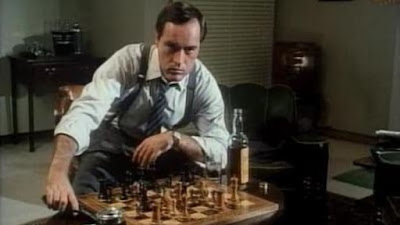
And I've written a lot about Chandler here: the movies—a lot of them—and I had a deep affection for the TV series out of Canadian TV and HBO decades ago, the ones that starred Powers Boothe as "Philip Marlowe, Private Eye." Marlowe's a good part and most people are good at playing him—Bogart, Powell, Mitchum, both Montgomery's, Garner—even Elliott Gould had a nice "take" on the character, although director Robert Altman seemed to think of Marlowe as an out-of-date fool—"Rip Van Marlowe", he called him. So, Marlowe is good for the most part.
But, you can get Chandler wrong. One has to merely look at Michael Winner's remake of The Big Sleep, with Mitchum (who came to the part late), for what "stands out like a tarantula on an angel food cake." The money for that production came from Lord Lew Grade, so (of course) it had to be set in England. Metaphorically speaking, it's the wrong side of the road. America—and Los Angeles, in particular—was young and finding its feet, exploding with development and cash (but no water) but (changing tenses here) with the rush of money comes an emotional adolescence, that one couldn't conceive of in "old money" families. Every family has a black sheep, or secret. But, there are usually structures in place to keep everything "in house." Marlowe's job was usually to roust the cattle after the proverbial barn-door was left negligently open.
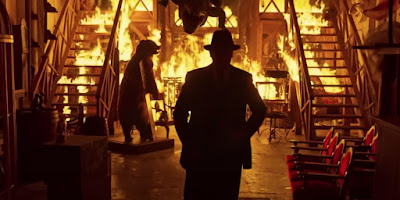
Marlowe, the latest film with the character—titular because the source novel, "The Black-Eyed Blonde"* (written by John Banville under the nom de plume Benjamin Black) has a title that implies abuse—tries to evoke the period and the convoluted scenarios that Marlowe regularly skulked, but is a misfire in so many ways that one is just tempted to ash-can with the couple other bad adaptations that have rumbled down the boulevard over the years. And one should state the obvious first: Neeson is too old to be playing Marlowe. True, there is less stunt-work needed to be done, so it's more suitable for the actor's age, but Marlowe was a perpetual 37-45 in the books. Mitchum was too old to play him at 57 in Farewell, My Lovely. Neeson is 70. It makes the redundant smashing of a chair over an already out-cold sparring partner entertainingly apt, but this Marlowe is decades too old to be duking it out with thugs and peeping through people's windows. Marlowe would regularly have his bell rung in the books, but this is the first time I've ever worried about him breaking a hip. There's a difference between being world-weary and just-plain haggard.
And, yes, the film is financed by Irish firms for Irish artists—Neil Jordan directs—but Neeson is also too Irish to be playing Marlowe, his Americanisms slipping with "yer's" and dropped "g's" (although accents usually don't bother me). He wears a three-piece suit—which I can't imagine Marlowe doing unless it was a formal dinner—and (for cryin' out loud), he has a secretary in the office. Marlowe was too loan-wolfish and, more importantly, not that successful to afford one.
They got the louvers right...
 
The story (adapted by William Monahan, who hasn't done an improvement on anything except The Tender Bar) is not much: Clare Cavendish (Diane Kruger) is shown into Marlowe's office ("How private are you?") with a job that requires discretion: her lover Nico Pederson (François Arnaud) has disappeared and she wants to know what happened to him without alerting her jerk of a husband. Nico was doing some studio work, but also had a, shall we say, "importing business" as well, the likes of which involve local crime-boss Lou Hendricks (Alan Cumming), local "bordello" manager Floyd Hanson (Danny Huston), a well-connected studio-head (Mitchell Mullen), who just happens to be involved with star Dorothy Quincannon (Jessica Lange, who is doing a tremendous job at the start of her "Kate Hepburn" eccentricity-acting phase). To paraphrase the detective: So many relations, so few brains. You could figure things out, just by following the strings attached.
Any joys are few and far between: everybody smokes, the women all have shellaced permanent waves, and sometimes the location work done in Barcelona, Spain could make you believe they found some un-gentrified corner of Los Angeles—if you squinted through the bottom of a half-empty shot-glass, that is. It doesn't quite pencil and smacks of trying to stretch a budget until you hear it snap. That stuff's always trouble. And the dialog by everybody is too clever by-half. You want them to just talk without being so damned witty. There is a nice line of dialog as Cavendish exits Marlowe's office, "You're very perceptive and sensitive, Mr. Marlowe. I imagine it gives you trouble."
I imagine a better movie, maybe finding something a little closer to home, maybe with Ron Livingston or Kyle Chandler as Marlowe, and fewer Chinatown call-backs (although the movie-eye-make-up bit produced a snort out of me). I imagine a lot of things, but I can't imagine a duller version of Chandler—or Banville—than this one.
* "The Case of the Black-Eyed Blonde" was the 37th episode of the Raymond Burr "Perry Mason" series, based on Earle Stanley Gardner's 25th book, published in November, 1944.

Friday, November 9, 2018

They'll Love Me When I'm Dead

Film Without Control
or
"A Desperate Venture Shared by Desperate Men"

With their part in the legal untanglement, restoration, editing and post-production of the last Orson Welles film The Other Side of the Wind, Netflix decided that they'd better increase their investment by simultaneously making a documentary on the making of the film—a story that is as fascinating and convoluted as the film itself (how could it not be with Welles as the central figure?). It might also be useful as a as testimony and evidence for a tale that might not be believed. Titled They'll Love Me When I'm Dead, it documents Welles' idea for the film from its inspiration through the chaotic filming some ten years later, through the complications about rights that prevented Welles from completing it in his lifetime, and ultimately covers the efforts by die-hard associates and completists to make it happen 33 years after the director's death. Documentary filmmaker Morgan Neville (who made 20 Feet from Stardom, Best of Enemies: Buckley vs. Vidal, and the recent Won't You Be My Neighbor?) has done a nearly encyclopedic job of gathering together archive footage, out-takes, interviews with survivors of the project, and bits and pieces to tell a great deal of the story—without some of the more head-scratching intricacies—and keeps it wildly entertaining...and properly melancholy, as well. Just like Welles might have done it.
Cinematographer Gary Gravers' audition—filming Orson
All of that stuff makes it fascinating, and behind it all is Welles, both master of his craft and victim of it. The story is well-documented in Josh Karp's book "Orson Welles' Last Film" in such detail that one can't help but admire Welles the film-maker making a movie with the barest bones of support, but shake your head ruefully at Welles the producer, robbing Peter to pay Paul, constantly over-spending the funds he's able to attract as performer, voice-over actor, and lecturer.
The film starts with an informal interview of Welles, where he speculates about the possibility of making "a film without controls"—"All my films have been controlled. I'd like to make a film as IF it were a documentary and all the actors improvise"—the idea being to get that one thing that Welles prized above other in his films—"the divine accidents," where the movie gods conspired to drop opportunity in your lap to photograph them and be praised for your brilliance, when it was merely happenstance taken advantage of. 

At the end of the interview, he mugs at the camera, shrugging his shoulders, as if to say "I dunno, I'm making this stuff up as I go..."

"The movie director must always remain a slightly ambiguous figure, after all, because so much of what he signs his name to came from elsewhere, so many of his best things are merely accidents over which he presides. Or the good fortune he receives. Or the grace.""This is Orson Welles" p. 259 Orson Welles and Peter Bogdanovich; ©1998 Da Capo Press

There is also that too many people asked him "what did you do after Citizen Kane?" and he had the hope that, in coming back to Hollywood, after a self-imposed exile during the McCarthy years, he was seeing kids with far less experience making movies and enjoying success—"I've lived too long not to make a successful picture."
He'd been kicking around an idea, partially inspired by an encounter with Hemingway, partially bitterness at his own circumstances, partially autobiographical, partially not, about making a movie about an old time Hollywood director (he chose John Huston to play the part) who is making an artsy movie of the type Antonioni was making at the time and trying to get funding from the studios, who are dubious at his age, dubious that there's no script, and just aren't interested. The movie juxtaposes "found footage" of the director's birthday party by (and for) his sycophants, juxtaposed with sequences from the film. That's a nutshell take on it (there'll be a review next week), but the making of it was chaotic, willfully so, in order to capture the energy and dangerousness of a Maysles Brothers film.
Huston and Little at the beginning of filming
During the course of the movie (which started filming July 4, 1970 and ended...sometime in 1975), actors came and went, ideas were filmed then tossed, then new material added, locations switched—Peter Bogdanovich started off playing one role, then years later was asked to come back and play the role that Rich Little was initially signed to play (one that was vaguely based on Bogdanovich himself). Filming finally moved from Welles' rented locations to Bogdanovich's house, which eventually caused a rift between the two film-makers, exasperated by Bogdanovich's successful directing career, creating a Shakespearean Falstaff-Prince Hal analogue. It wasn't the only one.  
Bogdanovich's nebbishy cineaste at the beginning of filming
Welles was tireless when he was creative, and he demanded a tireless loyalty. He rarely got it, but one of the technicians on the film devoted his life to Welles' every whim, just to be a part of an Orson Welles film. Cinematographer Gary Graver heard Welles was in Hollywood and simply called him up at the Beverly Hills Hotel. Welles demanded that he come over immediately with equipment and, there and then, auditioned the cameraman for the Director of Photography job. 

And Graver never left, devoting his life to filming Welles' many a-borning projects and, after Welles' death in 1985, to trying to resolve the conflicts that prevented completion of The Other Side of the Wind, until his own death in 2006.
Welles' partner, Oja Kodar, and Gary Graver.
Welles, during his last years, tried to negotiate settlements between financiers and holding companies and banks, all to no avail. After his death, there were those who were trying to protect Welles' last film (including his partner during the last years, Oja Kodar, and Beatrice Welles, his daughter by wife Paola Mori—to whom he was still married) and those making false claims that they owned the rights. One of the investors was the brother-in-law of the Shah of Iran, and after the Iranian Revolution, those funds dried up. Two of the original crew-people, Bogdanovich and Producer Frank Marshall were among those who kept the dream alive for decades...companies like Showtime and Netflix started doing their own productions to fill the need for content, and crowd-sourcing raised some funds. 
It's a maze  of cul-de-sacs, but Neville manages to make a great through-line of the history of the film—now that there IS a film, one that actually has an ending. And the way he weaves in all the archive footage is close to masterful. It's quite the juggling act, even if the star of the piece is killed off mid-way in the story.
Alan Cummings narrates
Now, it will be even more fascinating to see the end product. We'll have a review next week.


Thursday, October 19, 2017

Battle of the Sexes (2017)

Bread and Circuses
or
Tennis is a Cruel Mistress

Those of us "of an age" who lived through the "Battle of the Sexes"—the 1973 televised tennis exhibition match between Billy Jean King and Bobby Riggs proved nothing about tennis and the relative ability of men and women to play it—mostly remember the hype and hoopla of it all, rather than its relative merits of any real "battle of the sexes." 

King was 29 years young and at the top of her game. Riggs was 55 years old and at the top of his game in 1939, when he won the Grand Slam. But, Riggs was a gambler and a hustler, and he took advantage of the recent split of nine of the top female tennis players from the USTLA over the pay discrepancy between men and women players to fan the flames of sexism that were inherent in a sport that had its roots in social clubs that had discrimination of sex and religion in its by-laws. It was a calculated gamble. He won publicity either way, and, any overflow benefiting tennis and women's tennis, in particular, was an unintended benefit to those parties.
The "event" was fictionalized before; in 2001, ABC, the network that originally made hay on the televised broadcast commissioned a version "When Billie Beat Bobby" that starred Holly Hunter and Ron Silver (respectively). In the time since, much more has come out about King's personal life at the time and that becomes a major plot-point in Battle of the Sexes, the new version of the story "from the directors of Little Miss Sunshine" (that would be Valerie Faris and Jonathan Dayton*-it isn't mentioned that they also directed Ruby Sparks, presumably because it wasn't "the indie hit" their previous film was). The result is a fairly straight-forward adaptation (King was a consultant and a remarkably fair one, it turns out) that manages to show the effects of marginalization—whether sex, sexuality, or age (not that we need a demonstration of it these days)—and Society's penchant for exploitation and for waking up and considering larger issues...if there's a buck in it.
At the start—the timeline is crunched, somewhat—Billie Jean King (Emma Stone excellently not depending on her strengths) has won the Grand Slam and is the most well-known women's tennis player on the circuit. She's pulling in crowds. Despite that, tour promoter Jack Kramer (played by Bill Pullman) refuses to raise the stakes of the women's tournament in line with the men's, which, by rights, should be eight times higher than what he's offering. With World Tennis publisher Gladys Heldman (a shining Sarah Silverman), the two decide to create their own tournament, signing on for a token amount of one dollar apiece, attracting enough attention to be sponsored by Virgina Slims. 15-love for the women.
The leading women's tennis players sign on to a tournament for $1 apiece.
Women's tennis is getting attention. The women's tournament is causing controversy. Meanwhile, Bobby Riggs (Steve Carell, who plays it exactly as you'd assume he'd play it, with a sense of the outrageous and the pathetic, making him the perfect person to play Riggs) is unhappily working at a firm owned by his father-in-law, and cheerily using the contacts to make bets on his own skills as a tennis player. Bobby has a gambling addiction—one so bad that he perpetually is playing high-stakes poker with his therapist (now that's funny!)—and he sees the attention the women's tour is getting and he sees dollar signs that go along with his arrogance that he could easily beat any of the women's league. So, he goes on a public attack, challenging King to a grudge match, daring her to take him on. 
She refuses, but changes her mind when Margaret Court, also in the league, accepts the challenge and loses in what became known as "The Mother's Day Massacre." King decides to take him, seeing as how she must now defend women's tennis in the eyes of the ticket-buying public. King is used to being in the public eye, but the intense scrutiny that the Riggs dare focuses on her is something she isn't quite prepared for. And there's another complication—the married King has begun an affair with a hairdresser, Marilyn Barnett (Andrea Riseborough), who travels with the tour. The intense scrutiny of an out-of-wedlock affair, let alone a lesbian affair) could play disastrously in a playing field for hearts and minds.
This part of the story has never been told (and it's the reason Faris and Dayton wanted to make the movie) and sheds a light on the tenor of the times, the stakes at risk, and how easily a capriciously started challenge can turn deadly serious. Barnett's presence is hushed up, hidden, and fairly buried lest it cast an easy-target on women's tennis, women's roles, and feminism, already being given a pretty good beating in the public maelstrom around the event. The interesting thing is that Barnett, and the pressures she was under, are given a very sympathetic eye in the film, despite the fact that Barnett sued King for palimony in 1981, effectively "outing" the tennis star in a very public way. But, the affair is given a romantic edge and there's not a hint of animosity in the way Barnett is portrayed. That is both charitable and practical, because the true focus on the film should be the prejudices across all courts that women faced then and face now.
Mistress and Husband meet cute in an elevator before realizing that they have a loved one in common.
One should mention that the film does a fine job of presenting all these quandaries and challenges without getting more preachy than the evidence already suggests—they stick very close to events as they actually happened, and given the media coverage there is more than enough evidence to vouch for its authenticity. Some of the effects work to achieve it is amazing—they really have an archived Howard Cosell with his arm around the real-life woman playing Rosie Casals? And they do a great job of combining archival footage with match recreations that don't skimp on the dramatics on the court.
It's amazing what causes change, even a bit of one. Riggs, and his outlandish braggadocio, and hustling piggishness put out in relief that women's tennis...and women's careers...was never being played on a level court, but one always slanting uphill. His sideshow chauvinism only brought out in relief the unstated, but very real inequity that was part of the system—it just wasn't highlighted in klieg-lights for all to see. It was kept in the boardroom shadows, without even the grace to feel shame, like an illicit affair might. Grace is what ultimately wins out in Battle of the Sexes, with a victory far more lasting than a number in a records book.
Sports is a distraction—our current Society''s version of the Roman concept of "Bread and Circuses," the means by which the Romans kept the populace from any concentrating on the deficiencies of the elite in charge "through diversion, distraction, or the mere satisfaction of the immediate, shallow requirements of a populace." Keep the masses entertained and they won't notice that things aren't so good as they think. But, every so often, sports will serve as a catalyst for change. We saw it in the desegregation of baseball, the installation of Title IX, and the current "controversy" of "taking a knee" during the National Anthem—as blatant an example of the bread and circuses form of obfuscation. The "Battle of the Sexes," while ultimately being a sideshow, did bring light to the disparity of pay-offs to players of different sexes, and, by reflection, the wage-gap prevalent in the broader work-places. In that way, by shining a light on old prejudices and the status quo, such "distractions" can become genuine "game-changers" sparking advancement and keeping the flame of equality alive...or at least visible in the distance.


* The writer is Simon Beaufoy, who did a few scripts for Danny Boyle (including Slumdog Millionaire and 127 Hours) who produced this—but didn't direct as his sequel to Trainspotting became viable. Beaufoy also wrote The Full Monty, Miss Pettigrew Lives for a Day, and Salmon Fishing in the Yemen. He may not be a house-hold name, but it's quite a body of work.

Friday, July 15, 2016

Sweet Land

Written at the time of the film's release.

Let us hope that we are all preceded in this world by a love story.
Don L. Snyder "Of Time and Memory"


This was Valentine's week and the requisite rom-com, Music and Lyrics, opened on the day to generally luke-warm reviews. I was looking at Roger Ebert's web-site, and reading Jim Emerson's half-hearted 3-star review of The Fountain that ends with him saying "but I'd much rather watch somebody shoot for the moon when the stakes are sky-high than sit back while they play it safe" and I thought only a film-reviewer who'd seen too many half-hearted, limp romantic comedies could say that.
 
Myself, I'd rather see a film that succeeds, however humble its aspirations.
So to find a film like Ali Selim's feature debut Sweet Land is something of a miracle. It is simple to the point of artlessness and has the genuine tone of a film where the camera is simply turned on and happy accidents allowed to fill the screen. Of course, it was meticulously planned to appear that way (14 years, in fact) but never once does this multi-generational love story tell its oft-told tale of love and struggle in the heartland in a way that feels less than fresh and improvised. Even a descent into Capraland is greeted with something of relief.
There's more to it than this simple outline, but Sweet Land tells the story of a Norwegian Bachelor Farmer who sends for a war-bride in the days following World War I. Trouble is, she's German, speaks but a smidgen of English ("Hello" and one useful exclamation of hunger) and has no "papers." Without them, their arranged marriage can't be performed and the two must get along under the watchful eyes of their neighbors, the suspicions of the church and the post-war fear of all things German (One could say it's a film for the times, but given its long gestation period one has to conclude, sheepishly, that its a film of any time). There are the inevitable complications, but ones born of the awkwardness of the situation, vagaries of the time and the realities of the harvest. One comes away with the entirely appropriate feeling that love isn't "star-crossed" and superficial, but very hard work. A refreshingly truthful idea, that. One wants these kids to work it out, despite the odds. Most rom-com's have me wanting them to get it over with.
A good chunk of the film is spoken in Scandinavian and German, never needing to stoop to sub-titles, and that is due to the lived-in performances of its two leads, Tim Guinee--explosively self-contained and reticent as the NBF--and the gifted Elizabeth Reaser, so transparent and natural an actress that she could have done the entire movie in German and still communicated every emotion economically and fascinatingly. They say that for a movie to succeed takes a lot of work and some form of miracle and Reaser is this film's miracle. 
They are supported by many marquee names, John Heard, Ned Beatty, Lois Smith and Alan Cumming, who also produced. Audiences should be grateful to him for championing this powerful little movie of the heart, with its discreet camera work, extraordinary performances and story that transcends time and celebrates place. Released in 2005, but making it to Seattle at the end of 2006, it would have been a shame to see this exquisite movie die on the vine.
2016 Update: Ten years later and I still fondly recall Sweet Land, so special is this film—not a lot of narrative, but a lot of good film-making went into telling the story. Tim Guinee has been doing a lot of television work—a LOT of television work—and Reaser has done extended work on "Grey's Anatomy," "The Good Wife" and "Mad Men," but is probably best known as being the matriarch of the Cullen clan in the "Twilight" movies. Ali Selim has done some directing work for television, but hasn't done any feature work since. 
 
Somebody give this man some money. Sweet Land showed the mark of a brilliant director and those are few and far between and should not lay dormant.