I had a friend who disappeared for awhile, and when we made contact again after too long, he had an odd explanation: he'd become psychic, able to read people's thoughts, completely unbidden and unasked for, crowding in with his own, and had undergone a battery of tests to see if he was losing his mind.
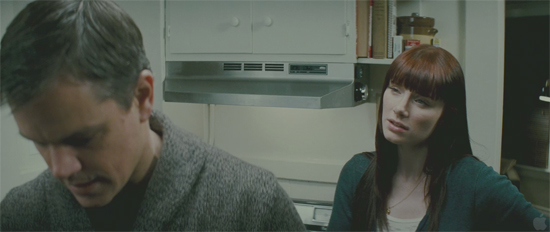
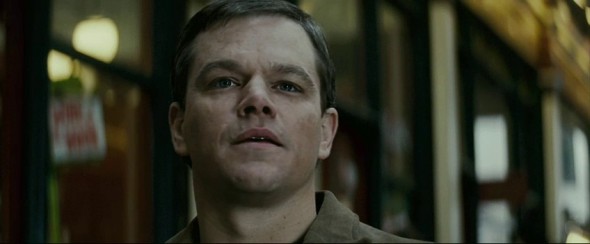
He hadn't, as much as gaining insight into other people's minds. For awhile he found ways to exploit his ability, writing a column, diagnosing illnesses (he claimed to be very accurate) and making a living as a working seer. But, he gave it up. It was too painful for him, and his clients were too needy...pathetic, even. Life is complicated enough in one's own mind to be peeping through the windows of others'. I don't know whether I absolutely believe him (I'm as psychic as a block of wood, and he was a writer), but his observations were so ironically down to Earth—"Oh, man!" he told me one time, "Ghosts are ASSHOLES! They're so obsessed with what's going on here—all the little 'unfinished business'! Why don't they just move ON?"—that I just accepted his stories, while keeping any true belief in check. He was my friend. I supported him. George Lonegan (Matt Damon) wears gloves. Childhood circumstances and medical complications damn near killed him and left him handicapped—all he need do is touch someone, "make a connection," and he is jerked back to an old haunt, the "white corridor" of light that is the foyer of Death. He's been there before, many times, but the touch of an individual's hand takes him to the spirits of the recently deceased of that particular person's past, so that he may pass on their thoughts to those left behind. He wears gloves, so he can avoid these encounters. But he can't avoid the grieving. He used to be a working psychic, ("Look, I don't even DO that anymore." he consistently tells the persistently bereaved*), but he gave it up, despite the imploring of his exploitative brother, Billy (Jay Mohr, toned down and playing a recognizable human being). "You've got a gift!" he is told. "It's not a gift! It's a curse!" Now he works, driving forklift at a sugar warehouse in San Francisco, a "normal" occupation that might lead to a "normal" life. That is his wish. Life, not Death.


My psychic friend's story is highly reminiscent of Lonegan's (nice name, that) in Hereafter, Clint Eastwood's film of an original screenplay by The Queen scribe Peter Morgan. Morgan's subjects are fairly factual, so it's surprising to see him venture into the nether-territory of Bruce Joel Rubin (Jacob's Ladder, Ghost).

But, he places it in the here and now, our world where Death can come specifically from all realms, natural and unnatural. The film begins with a spectacular effects sequence recalling the horrific tsunami in Thailand,** that viscerally places the audience into such a disaster. But that is only the beginning. It is what comes after—the surviving of such an extreme occurrence, the coming back from it—that is the subject of the film. How, after Death has touched us, can we go back to a normal life...when what awaits us, normally, is our own ending? How can we live while still grieving?
I called them "The Death Tapes." I have no idea who has them now, I passed all the copies I had to friends who were interested (and who isn't?). I did a recording session that was being used for publicity purposes for a fairly terrible Joel Schumacher pot-boiler called Flatliners, about morbid medical students experimenting with near-death experiences—it is typical hyperventilating Hollywood exploitation—all chases and races-against-time, whereas this Morgan-Eastwood film is intriguingly commonplace. The interviewees were all people who had had NDE's; they'd died, and were pulled back to the land of the living. They were from all walks of life—one woman had been electrocuted in a television studio, another was a Vietnam vet who'd been mortally wounded in a mortar attack. The particulars of how they'd gotten there were all different, but their itineraries were all the same. They'd gone to a corridor of pure white light, where they were met with spirits of their past, and informed, questioned about their circumstances and released back, back to life. They'd all been significantly changed by their experiences, but in different ways, as Death was no longer the terrifying unknowable it had once been. Been there. Done that. The woman had been yanked back through no choice of her own, through the efforts of EMT's in the studio. The soldier had volunteered to come back, in a way. Asked in that blinding corridor if there was any reason for him to go back, he implored the Voice, "I want to see my son!" which is significant for the detail—he knew his wife was pregnant, but there was no way to know the sex of the child in those years before ultra-sound (Sure, it was a 50/50 chance, but...still...). An expert (as much as one still breathing can be of such things) talked about children who'd gone through "the process" and other adults, speculating that, perhaps, it could be some spasming electrical processes of self-preservation. But the stories were so similar—the same corridor, the after-life "concierge," the specifically relevant memories of the deceased (and not the living—would a brain going through synaptic anarchy be so choosy?)—combine that with the myths of "pearly gates" and exit-interviews with St. Peter, and it becomes disquietingly consistent. Yes, we have the same meat in our brains, but chemically, we all have our own brand of soup. So, then, would everybody see it the same way? Don't know. And we won't know. Not until we "see the light."


It all sounds terribly depressing, doesn't it? But it isn't. There are moments of high drama to be sure, but moments of levity, as well. Rather than a dark and morose drama befitting the Hallowe'en season, it ultimately has the feeling more of a star-crossed romance. And Eastwood, who has been known to denature the color palette of his pictures, particularly in Letters from Iwo Jima and Changeling, returns to a more vivid color scheme here, as if to present life in all the glories of luminous sunrises and sunsets. Those looking for a spook-show, like the poor, unsure desperates who crowd the emporiums of the medium/charlatans in the film, should look elsewhere for signs of the occult, or speculation about what it all means.  Eastwood's movie gives us no definitive answers—Hereafter never crosses the threshold into Shakespeare's "undiscovered country," that final frontier we must all travel, the journey of the spirit taking flight unbound by the physical restraints of life, our mortal coil. It remains solidly in the realm of the comfortingly tactile, and concludes with a smile, a touch—simple, normal acts of being, that stave off the nullifying black and the welcoming light.


* The script by Morgan (The Queen, Frost/Nixon, The Damned United, The Last King of Scotland) is extraordinarily precise in its use of words...in English and French (there are subtitles...Eastwood, who directed the all-Japanese Letters from Iwo Jima isn't afraid of them), and quickly you pick up that, more than usual, he uses specific ones, over and over, that tie his characters together...almost like they were a mantra.
** This sequence is exploited in the trailers and advertising for the movie, making it seem like it's a 2012 disaster-like "entertainment." But, if I can be allowed a SPOILER-like caution, don't be fooled. This sequence...and another jolting one that recalls an arbitrary terrorist attack...are merely means to an end. The story is about recovery of such incidents, and in living a life of hope, despite the common glimpses through the opening of Death's Door.
Eastwood's version of the Thailand tsunami is the stuff of nightmares