Showing posts with label Pixar. Show all posts

Wednesday, November 13, 2024

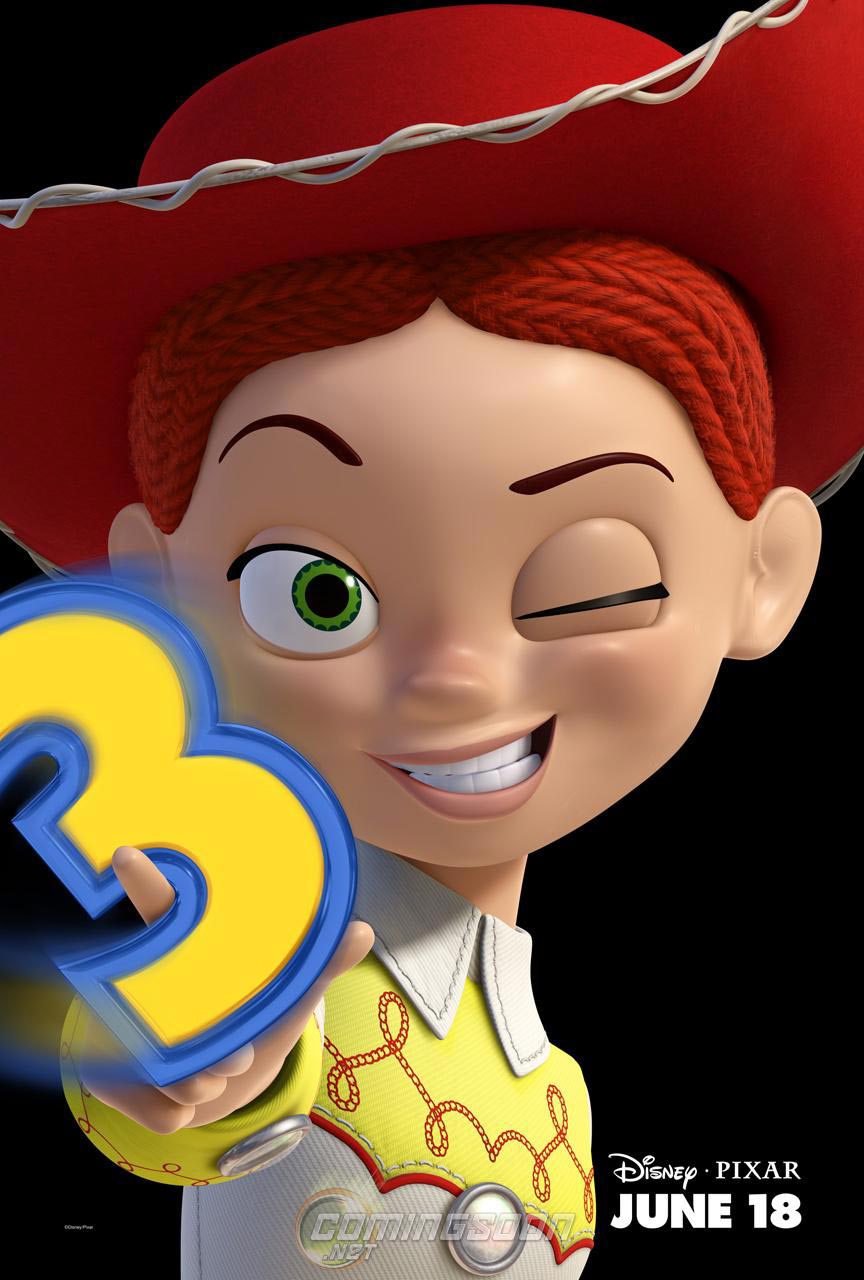
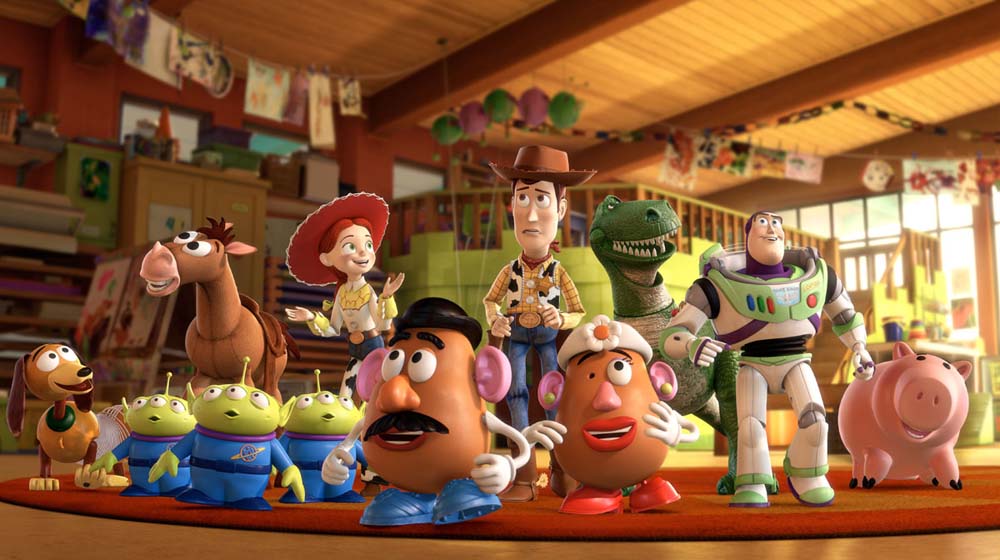
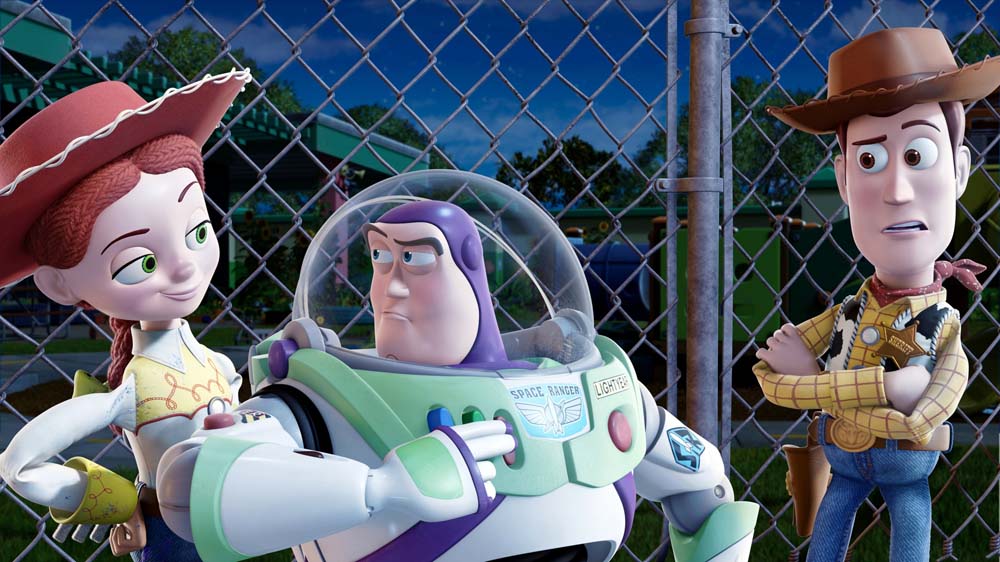
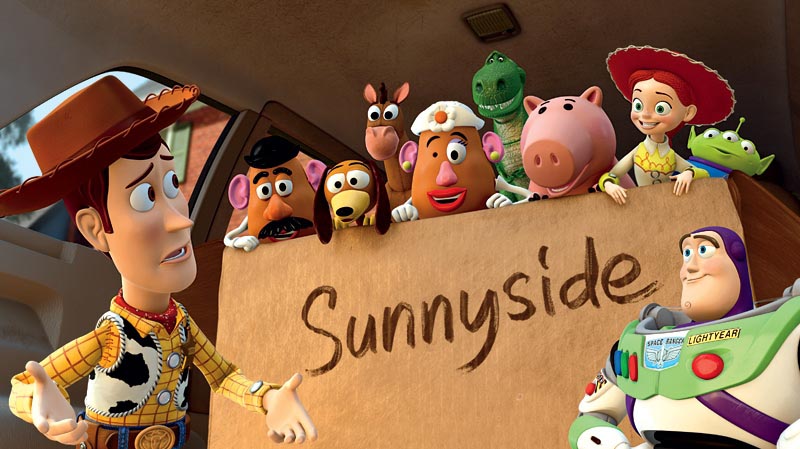
Toy Story 3

A lot of times I write and I "make do." It's alright. I think I got the point across.

And sometimes, I nail it. It's rare, but I'm capable of it. Even if the movie is just about toys. I remember a comment for this post (on that "other" site) was simply "Dude. It's Toy Story 3." (Where are you, Simon?) Yes. And good movies about love can come from anywhere.


Written at the time of the film's release...

"And if You Can't Be with the One You Love, Honey..."

One has suspected a subtle sub-text in the "Toy Story" series—every Pixar film has evoked that feeling (which is why they tower over Dreamworks and every other animation supplier and make even their rivals' three-dimensional films seem more two-dimensional) since the first film premiered (what was it?) fifteen years ago.
 
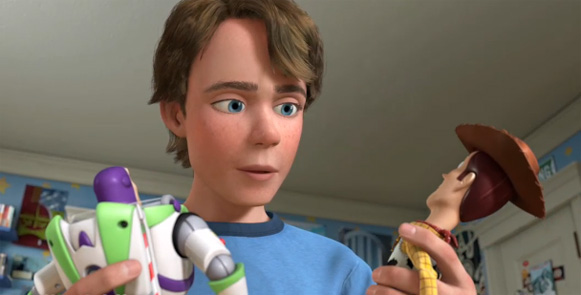
 Toy Story 3 is no less rich in sub-text. Sub-texts like the given that the toys have stayed the same, but their little owner Andy has grown up and is on his way to college by the time we hit 3; First sub-text: Change or be passed over. Any one looking for a job in these troubled times has had to be confronted with their inadequacy in some department while they're winning the daily bread. And like the toys of "Toy Story," time may be their enemy, staying consistent while the world evolves too quickly.
But, at the pace-making heart of the "Toy Story" movies has been one constant, and that is its contemplation of the nature of Love, which puts it in the same movie-case with such seminal works as
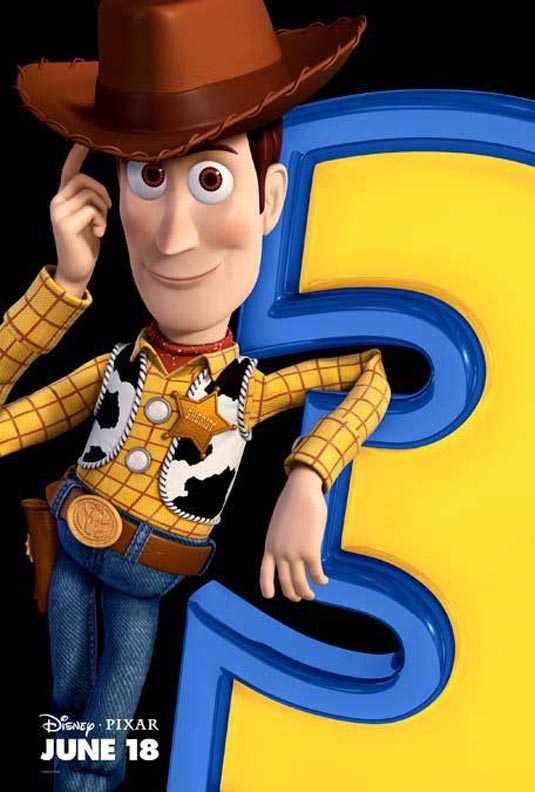
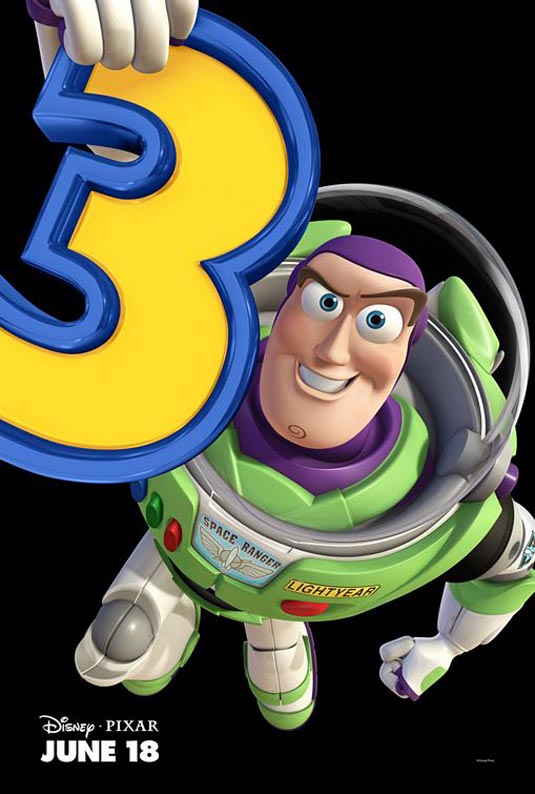
Vertigo and A.I. In the first Toy Story, cowboy-doll Woody (voiced by Tom Hanks) watched in horror as the affection of his beloved Andy was supplanted by the new space-age toy Buzz Lightyear (voiced by Tim Allen). The stakes doubled in Toy Story 2 when we witnessed the discarding of cow-girl Jessie (voiced by Joan Cusack) as her owner grew up and put away childish things (see the video below). And we witnessed Woody turned from an object of play to a rarified objet collectionner, the very definition of a "trophy love." Toy Story 3 takes Jesse's plight and applies it to the entire toy corps, facing abandonment (the attic) and, worse, discarding (at the sidewalk on garbage day). The toy soldiers take action and evacuate the premises first: "Once the garbage bags come out, the army men are the first to go" barks the commander (R. Lee Ermey) before para-sailing out of Andy's bedroom window. 
 
The others are left to contemplate their fate. 
 
Play-time's over.*

There is one axiom I've held to my heart from the moment I first recognized its truth—I'm sure it originates elsewhere, but I first read it from thriller writer John D. MacDonald: "Love is not the opposite of Hate; love and hate are merely two sides of the same coin. The opposite of love is indifference."
 
There are a lot of instances of indifference on display in Toy Story 3 (though certainly not at the hands of the creative team behind it, who have filled it with pithy circumstance and finely-wrought detail in a cartoonish 3-D photo-realism
**). But, so is love, in the through-line from the first movie, first warbled in Randy Newman's opening song "You've Got a Friend in Me." It is the banding together of the community, standing stuffed shirt to plasticene shell through adversity, the toys' answer to "Can't We All Just Get Along?" All the movies have centered around the toys—diverse as they are—keeping the group together, and welcoming the new. That reaches its dramatic climax here as the team locks hands as they face absolute destruction in a truly frightening version of Hell.
The forging of the community has been a theme running throughout the history of film (especially Westerns) since Edison, certainly John Ford, and we've all seen those films where the protagonist loses a family in order to gain another, sometimes not by choice. Those bonds are infused with strength to take on all comers and all challenges, but the heart of that coming-together has always been the one unofficial but over-arching Commandment: Love thy Neighbor.

 
I mentioned putting away childish things earlier. That's from The Bible (1 Corinthians 13), and looking over that verse again, I saw images spring up from Toy Story 3—"And though I bestow all my goods to feed the poor, and though I give my body to be burned, and have not love, it profiteth me nothing," particularly.  But especially its last devastating quality in its check-list of Love's qualities, which always makes me tear up a little when I contemplate it, and I contemplate love and loss. For toys break, batteries corrode, fabric burns and plastic will melt. But Love "never faileth."
 
Love never dies.
 
To Infinity.
 
And Beyond.
 
* How many times have we said that, as adults, mourning the loss of childhood from adult responsibilities?

** But, man, you want to see Pixar push the envelope?  Check out the sophisticated opening short Day & Night, a wordless combination of 2-D and 3-D, line animation and computer graphics, filled with rich imaginative ideas and a brilliant sound design.  The work of animator Teddy Newton, this little gem, puts him at the top of exciting animators to watch.

Friday, June 21, 2024

Inside Out 2

Pardon Our Dust. Puberty is Messy.
or
Taking Inside Out 2 Twice a Day Will Take the Place of Xanax

It's nice to see that Disney* is permitting Pixar out of its streaming jail-cell and letting its movies open in theaters again. It seems to have paid off as Inside Out 2 has out-performed expectations—certainly Disney's—and has generated Barbie-land box office. One took the hopeful sign that allowing the only-streaming releases to have a theatrical run made them re-think what they were doing with its best—and longest-held—assets. Pixar product is just too good to be restricted to home theaters, and Inside Out 2 is a good example of why.

Sure, a couple of the sequels have been less than spectacular—Monsters University, Cars 2, and Lightyear (although not technically a sequel) had a creative lethargy backing the stunning visuals, but this sequel to 2015's Inside Out takes advantage of the inevitable march of time to expand and deepen its particular cartooniverse. That it is all contained in the mind of our gal-pal Riley (now voiced by Kensington Tallman), who survived her move to San Francisco and flourished, retaining her passion for ice-hockey (a big story-point in this one) and keeping it together with some help from her humors in Head-quarters.
They are Joy (
Amy Poehler), Sadness (Phyllis Smith), Anger (Lewis Black), Fear (Tony Hale taking over for Bill Hader), and Disgust (Liza Lapira taking over for Mindy Kaling), who have negotiated Riley's emotional life in the intervening years and managed to make a go of it, despite outgrowing clothes, getting braces, and the near-occasion of pimples. Of course, she's had help from her supportive gal-pals on the hockey team, Grace (Grace Lu) and Bree (Sumayyah Nuriddin-Green). Her school has just won State and grabbed the attention of Coach Roberts (Yvette Nicole Brown) of a local high school who has invited the three to a weekend hockey camp.
Pretty easy for five emotions to handle, one would think. Especially as Joy has worked out a new doohickey that allows her to take bad memories and vacuum-tube them to the back of Riley's mind, where they won't do any harm to her burgeoning "Sense of Self." All very neat and orderly...just like kids are (he said with a wink).
But, remember how I dropped the mention of a "pimple"—well-rendered subtly by Pixar pixelators)? The night before she goes off with her friends to the camp, Riley's "Puberty Alarm" goes off, sending everyone into a panic, and requiring a crew to come in and do a "mitigation" on Riley's head-space, leaving the old crew with a new console that—shall we say?—is a bit..."sensitive". Plus, there are all sorts of new gizmo's and buttons no one's ever seen before.
Those "upgrades" are for a quartet of new emotions generated for Riley by her hormones and they are Anxiety (Maya Hawke), Envy (Ayo Edebiri), Embarrassment (Paul Walter Hauser) and Ennui (Adèle Exarchopoulos), who show up and decide they're going to run the place...that is, Riley...during her hockey weekend. This, of course, complicates matters, and one notices that having these guys around makes describing what happens in the story sounds a little too "on-the-nose." It's far more subtle—and entertaining!in the Pixar presentation than the summation, which reads like symptoms in a psychological post-mortem.
To wit: Anxiety manages to rip away Riley's Sense of Self and locks away Joy (and her comrades) in an effort to push Riley to achieve her ambitions on the ice. Sounds a bit clinical, doesn't it? It's not, but shows how cleverly director Kelsey Mann and his co-scenarists Meg LeFauve and Dave Holstein manage to integrate human turmoil into an adventure story that's enjoyable for kids and relatable for adults (who'll be answering questions with a smirking "just you wait..."). The kids watching this movie will grow up into the answers that had previously sailed over their heads.
It all feels like a natural progression to the original. Changes are made, but they're well-integrated (even if, in the story, the new emotions have to be shown some tough love) and one is propelled along with the assurance that the film has been nuanced to within an inch of perfection. And, of course, one is always amazed at the artistic leaps that Pixar makes between films; Inside Out 2 feels richer in its animation than the original with nice ethereal edges to inhabitants of Riley's head-space and one can appreciate the little details like the way Riley's teeth are crooked to the way ice erupts from the edge of a skate.
Those details are not what's flocking audiences to theaters to see this, but it's a value-added that can only be appreciated on a large screen. Inside Out 2 may not have the holistic concept brilliance of the first one, but it's a worthy sequel that builds on it, maintaining the train of thought while not derailing it (see how lame the concept could get?).
 
Inside Out 2 will get you right in "the feels."

* Although one notices that the House of Mouse has put on an ultra-long company logo (that might actually qualify as a short subject) onto the beginning and the end of this one as if to emphasize who's in charge. The Pixar logo is same as it ever was. Don't let that discourage you from missing the tag-line at the very end of the movie, though.
 
Caption quiz: "Anxiety...."

Friday, May 24, 2024

Pixar: To Infinity and Beyond

I have something to post, but best to do that after recording a podcast for The Lamb on Sunday.

Instead, an entry for the Audio-Visual Department, something I do rarely these days (as they have to be really special...and, hopefully, have a long shelf-life on the internet. This salute to Pixar from Ash Arnold would appear to have both of those qualities:

Thursday, November 30, 2023

Elemental

Elemental (Peter Sohn
, 2023) We will try to keep this review as pun-free as possible as Pixar's latest release seems to be doing somersaults trying to use every paronomasia to the four classical elements—Earth, Air, Fire and Water—as it possibly can within its slim 100 minute length (including the voluminous Pixar end-credits). The film is so crowded and over-stuffed that one should be glad they stuck with the Empedocles-ian list and tabled the other 118 (and, see, there I go).
 
It resembles Disney's Zootopia in that it posits a multi-cultural world in which there are segregated zones for the disparate groups of Earth-people, the Vapors, the Combustibles, and Those Who Go with the Flow within Elemental City, a construct that seems to have been made just for such a purpose, as things tend to melt, flow, slide, and burn when the four basics collide and exchange energy.
"Who knows?"
There's an amusing little moment when the two main characters, fiery Ember Lumen (Leah Lewis) and watery Wade Ripple (Mamoudou Athie) both walk through a chain-link fence—him gushing through and her melting it—where they muse "Why do they even have these?" "Who knows?" Indeed, in a society, however segregated, where barriers serve no purpose to mutual self-interest, what's the point? But, it's just a moment—an aside—that resonates within the bigger context of the movie's intentions.
And that is to show the "immigrant experience" in a film where that will serve as backdrop for the main relationship between Ember and Wade—a sort of "Wet Side Story" if you will (and I wouldn't blame you if you didn't).
Ember comes from the immigrant family of Bernie (
Ronnie Del Carmen) and Cinder (Shila Ommi)—two anglicized names they got when they entered Element City—who left their home island of Fireland for a better life, and who met resistance from moving into the wooden structures of the Earth area (fire danger!) and the Water sector (they'll evaporate the place!) and settled for a walk-up from the bodega they've found in order to make a living and serve the community. Their daughter, Ember, learns the ropes of minding the store, with the aim of taking over the place when the Old Man retires.
But, she has anger-management issues, which turns into a burning purple rage, when dealing obstinate customers. One of those hissy fits results in a broken pipe in the basement, which floods it, dropping Wade, a city inspector, into the mix. Wade is a bit of a sensitive soul, given to crying jags, naturally, so he is distressed to find out that the Lumen store isn't exactly up to code and must report it for multiple violations putting the business in jeopardy of being shut down. This puts him at odds with Ember, who is determined to save the store at all costs.
Though seemingly polar opposites, in nature and purposes, the two become close in their efforts—her to save the store and him to find out why Elemental City seems to be in danger of an infrastructure defect that could threaten to flood the Fire district—even as they know that any sort of relationship could mean...well, extinction or extinguishment for one or both of them. They can't help their natures, but their nature is also to be attracted to each other.
This is a different kind of Pixar movie for a number of reasons. One is that the story takes on the tropes of a film genre that the studio has never partaken before, that of the rom-com. It follows the basic steps—the meet-cute, the diametric odds, the mutual interest, the separating complication, and the final emotional epiphany that resolves all issues until the final fade-out, which leaves everyone in a soggy after-glow that assumes nothing else will compromise the happy ending. Elemental is not immune to such step-by-step manipulation, even if the characters are mere concepts rather than attractive B-listers for Hallmark. It's still a little phony and a lot trite.
The other thing is that although the backgrounds are the same Pixar magic we've come to expect and take for granted, the characters...are concepts, not some animated anthropomorphic projection of identifiable species, more of the type of animation done in the analog 2-D days. Pixar did much the same thing with their animated emotional traits in Inside Out, but they were off-set by more relatable characters in the enveloping story. There is just that couple of degrees of animated "otherness" that keeps one becoming wholly invested in the story.
Still, there are moments; there always are with Pixar, even with their handful of sub-par—and that "par" is very high—releases. There are moments that pay off quite well, even if one feels that the extra polish the film-makers usually do to nail the things feels missing.
 
It's good Pixar, not great Pixar. But, one awaits the next one with anticipation...now that Disney is allowing them back in theaters again.

Friday, September 29, 2023

Turning Red

Turning Red
(Domee Shi, 2022) Meilin "Mei-Mei" Lee (Rosalie Chiang) is a precocious 13-year old living in the Toronto of 2002. Smart, even effervescent, she is a young adult on the cusp of change, a "tween" in every sense of the word. To her parents, Ming (Sandra Oh) and Jin (Orion Lee), she is a studious, obedient, respectful child, who is only too happy to excel at school, and forego her friends and outside activities to help with the family business, the temple dedicated to her ancestor Sun Yee. She is a credit to her family. But, there must be a debit somewhere. In her own words:
The number one rule in my family? Honor your parents. They're the supreme beings who gave you life who sweated and sacrificed so much to put a roof over your head, food on your plate, an epic amount of food. The least you can do in return is every single thing they ask. 'Course some people are like, Be careful. Honoring your parents sounds great, but if you take it too far, well, you might forget to honor yourself. Luckily, I don't have that problem. I'm Meilin Lee. And ever since I turned 13, I've been doin' my own thing, makin' my own moves; 24/7/365. I wear what I want, say what I want, and I will not hesitate to do a spontaneous cartwheel if I feel so moved!
At school, she is just as industrious...and spontaneous, invoking some envy and taunting from some school-mates, but never from from her posse of gal-pals, Miriam (Ava Morse), Priya (Maitreyi Ramakrishnan), and Abby (Hyein Park). The girls are like musketeers, unquestioningly loyal and all dedicated to the hero-worship of the boy-band, 4*Town (their songs provided by Billie Eilish and Finneas O'Connell), whose posters adorn their walls and their pre-pubescent minds and are just dreeeeeeeeeeeamy! (*squeeallllll!!!*)

But, despite the rock-solid priorities and the high SAT potentials there is one thing that is starting to crowd into her thoughts: boys. For example, the monosyllabic clerk at the Daisy Mart convenience store down the block, Devon. Mei-Mei 's Devon, although this may be peer-perception because the rest of her squad 's Devon. It's not Big-L Love, because it's more like merely emoji-love, but, still, in the privacy of her bed-room and her notebook, she starts doodling fantasy pictures of Devon and when Mom finds out, it is SO embarrassing.
But it gets worse (it gets worse!!!) Mother Ming marches Mei down to the Daisey Mart and confronts the clueless clerk—she blames the clerk, not her little princess—for being a bad influence on her innocent daughter and she does it in front of "people"...and
Devon...and she could. just. DIE! And the next day, she has to go to school and EVERYBODY will know and it will be just one long humiliation only interrupted by school-bells. She. could. just. DIE. Instead, she has a nightmare involving warring factions in her brain—the temple, her family, and the boys NOT in her life. And she wakes up a giant red panda.
You heard me. She wakes up a giant red panda. Seems that's the family curse, handed down on the matriarchal side, but Mei doesn't know that. All she knows it's she's a "big fat monster" and stinks of fur. Her horror attracts the attention of her Mother, who assumes it's another "curse" ("has the red peony bloomed?") and that Mei has had her first visit from "her little friend". Well, it ain't little. And it's no friend. And it's going to be SO inconvenient at school.
Turning Red (the common phrase for "embarrassment") is not so much about Myth as about Metaphor. Oh, it's sneaky about it, hitting the nail squarely on the head a couple times...and kudos for doing so (hopefully, it'll spark some talk about "women's issues" at home), but creator Shi and her screenwriters,
and , are talking about other issues beyond mere menstruation. Mei's ursinethropy may remind of "the monthly" but it's more about the hormonal transition from child to young adult, where you're taught to think, but not for yourself. Her transformations have nothing to do with estrogen, but, instead, from moments of high anxiety and high emotion.
This is bad timing for a teen-ager, but The Ancient Ones seemed to have known what they were doing—the pandification was given to Sun Yee in order that she might protect her family and village in times of conflict—as teens are nothing but conflict. Being the sharp tack that she is, Mei comes to learn that she can control her emotions, "zen out" and she transforms back into her original self....well, a ginger version of herself. Except, there's that "raging hormone" thing again...sometimes Mei just can't control herself. Life happens.
And things happen in movies. The challenge in this involves timing and responsibility. On the one hand—the one where her friends are, their favorite band 4*Town is on tour and doing a date in Toronto. Problem? Mother Ming will NOT, absolutely NOT, allow Mei to go to the concert and will CERTAINLY not fork over the $100 bucks for a ticket (uh, remember, this is all taking place in 2002, so tickets did not bankrupt as they do today). No prob', Ming and her gal-pals will find a way. On the furry hand, the whole panda-rama can be taken care of, as it has for centuries, will a ceremony held on the occasion of a blood moon, where the panda spirit will be "re-located" to an amulet Mei will wear around her neck. It pays to accessorize.
Does it all go according to plan? What do you think? We're talking teens here.
What DOES go well is Pixar. Director Shi won an Oscar for her hilarious, emotional but wonderfully off-beat short Bao, and here, she's just as precise in her comedy timing and her way of combining heart and hilarity, about the burdens of cultural expectation (and sub-textually, a woman's lot in life) like a Looney-Tunes Amy Tan novel. And she's hip enough that she throws in quick anime and emoji references that only "ups" the game and lowers the age-requirement for "getting" the wit. This is really good stuff.
In fact, the only quibble I have is that Disney chose—in their infinite attempts to keep Disney product in theaters and Pixar product on their streaming service—to only release it in L.A. and New York theaters for the shortest available time for Oscar consideration. This is a "Big-Screen" movie, the better to appreciate the artistry of the Pixar pixelators who worked so many months to get the details 'just so." Audiences would have clamored for it if it was available (despite the pearl-clutching of some Social Watchdogs).
If anything, it should be Disney that is turning red.

Saturday, August 26, 2023

Cars 2/Transformers 3/Audiences 0

It's been a good Summer for Movies. That something you don't see every year. Summers have become the #1 pole position for opening movies—School's Out and kids are getting out—so, the hot months get stuffed with releases for franchises and action movies (the End-of-Year releases are Oscar-bait). But, this year has seen a couple of good, original movies that have beaten the trends—and beaten the franchise box office receipts—and ensured that all the doors of the multiplexes can be opened again.

But, at the time I wrote this—at the time of these films' respective releases—it had been a pretty lousy Summer.

"The Summer of Our Discontent"
or 
"Cash for Clunkers"

You almost don't want to go To the Movies this Summer. Oh, we were warned; so many sequels and comic-book movies, the "experts" pouted and clucked. But the law of averages were in the audience's favor; there had to be something good in "the numbers."* But, this Summer has made me a little gun-shy and I hesitate from pulling the trigger on my credit card for a ticket. Nothing's excited me so far (apart from The Tree of Life**) and it's July already. Of the comics films, only X-Men: First Class had powers and abilities far beyond most super-hero movies—certainly over the previous "X-Men" entries. The 3-D "phenomenon" has constricted budgets, pushed opening dates, and the only thing it seems to add is an extra dimension of "suck" to the productions in the end.

Two recent releases left me so completely unmoved—probably because they were manufactured machine-movies about manufactured machines manufacturing fights with each other—that I thought it best to combine them under one article...so I wouldn't have to spend too much time contemplating their existence, and simply move on. They also evoked the same thought of "What do I care what happens to machines? Machines can be re-built!" 

And movies series can be re-booted. There are a couple I'd like to give the boot to right now.

Ultimately, both films are just long commercials for toys. Better to buy the toys and make your own adventure than what's being served.

"Spare Parts"

I went into the original Cars with exceptionally low expectations, and found a surprisingly fun little film to appeal to the NASCAR crowd and anyone who had a love for the open road. Automobile comedy would seem to be the lowest gear for laughs, but Pixar (and its guru/director John Lasseter, this time co-directing with Brad Lewis) managed a fine film that, if it fell short of the other Pixar products, at least managed to land on all four tires...and that's where the rubber meets the road.

But, what do you do for a victory lap? Go around the field one more time? (Well...yeah). With the novelty of a talking car universe safely a given, Cars 2 expands the concept, so that everything is talking, cars, boats, planes—although the oil-rigs featured are strangely mute.  It also goes global, with an environmental plot about an oil billionaire car (???) who decides to go "green" and develops a new fuel called "Allinol" (heh) and a promotional World Grand Prix to go with it. This gives "Lightning" McQueen (voiced by Owen Wilson) to go head-gasket-to-head-gasket with his racing rival, Francesco Bernoulli (John Turturro, who is having fun) for a best two out of three.
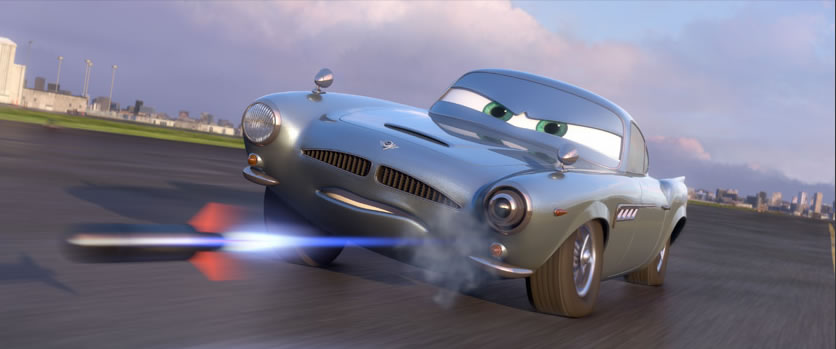
Ah, but there's sand in the gas-tank, when a car-tel of lemon-models (Pacers, Pintos, Gremlins, Ugos) led by an evil genius (my guess it was an Edsel, but I was wrong) wants to exploit a weakness in the gas to destroy the racers in the Grand Prix, and it's up to Special Agent Finn McMissile (voiced by Michael Caine, standing in for a friend, I think)—a gadget-laden Aston Martin/Miata hybrid—and his co-agent Holly Shiftwell (Emily Mortimer) to stop the plot and learn the secret identity of the evil genius behind it all. In a case of mistaken vin numbers, these crack agents think that Mater, the tow-truck (Larry the Cable Guy) is their American contact with information to stop the plot in its tire-tracks.
Now...wait a minute. I know it's a movie about talking cars (fergawdsake), but it takes a new meaning of the term British Intelligence to make that kind of mistake. So, the movie shifts its emphasis from the McQueen caracter to Mater very quickly and the movie never really recovers...I mean, there's only so much Larry the Cable Guy a person can take. The movie's tone has the feel of those '60's films where they used to shoe-horn Rowan and Martin or The Three Stooges into a spy plot because it was "a trend" and they couldn't come up with anything better...or appropriate. 
So, it's all a little "off," the timing chain a little twisted, not sparking on all cylinders. It LOOKS good—the city-scapes haven't looked so lovely since Ratatouille (
although everything looks a little miniaturized, like a play-set), and the movie has a fairly amusing sequence in Japan—but the film moves way too fast to appreciate all the chrome and options and it's too loud and obnoxious that the impulse is to roll the windows up and ignore it. Despite a stellar cast (Vanessa Redgrave voices The Queen?  And did I hear Michael Gambon—uncredited—as the disguised voice of the villain?) and despite its emphasis on Mater, nothing mattersthere's no conflict, there's no drama—just a hokey plot, some slip-shod comedy, and everything running on auto-pilot.
As such, it would have been more appropriate to have Roger Moore as the voice of the spy-car.

Cars 2 may be buffed and shined, but its parts are used and worn, and rather than having that "new car" smell, it has a distinct lemon-scent.
(Wilhelm Alert @ 01: 24)
 ——————————————————————————————————————————

"Rock-Em, Suck'n Robots"

You should have no expectations walking into any film, but you really need to lower your guard going into a Michael Bay construction. His early films are such an annihilation of style over substance—to the point where action sequences are a mashugenah mish-mash between what looks like slo-mo Americana commercials for insurance—that you wonder if the guy at that point had any sort of talent whatsoever (I mean, Tony Scott has the same commercial gloss to his films, but at least you can follow them).

Over time, though, Bay's act has gradually gotten better. The action sequences smoothed out without losing any of the kinetic energy the director was striving for. Maybe there was even a good idea or two among the shrapnel flying through the air. But, the emphasis was always, and will always be I suspect, about demolition derby film-making with the occasional "grace note" of grinning nihilism and exploitive misogyny. One suspects that Michael Bay may become a better film-maker, but he will never grow up.
And he's still playing with toys
. He directed all three "Transformer" movies, including the latest,
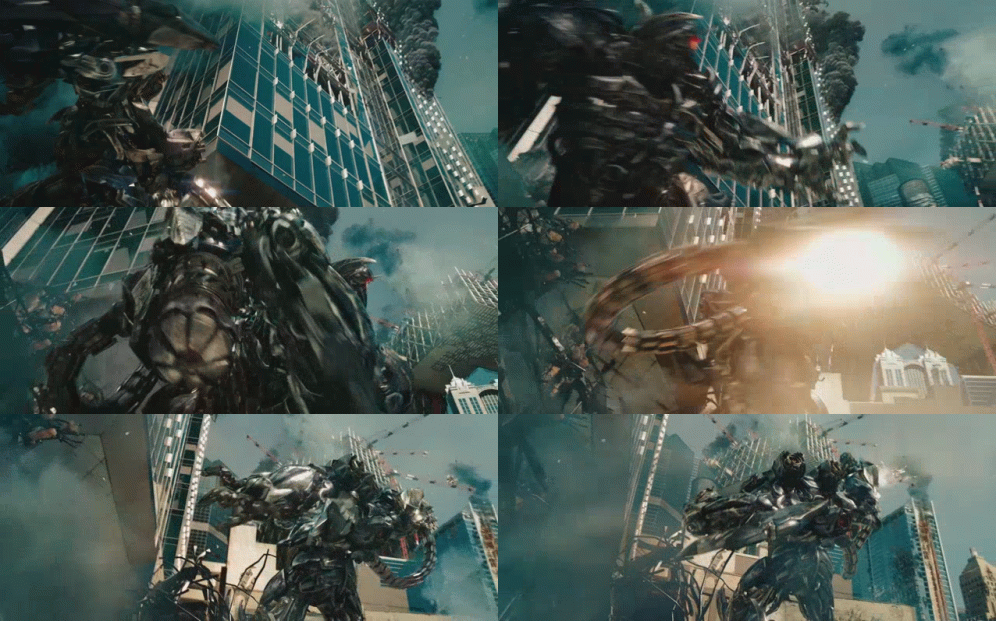
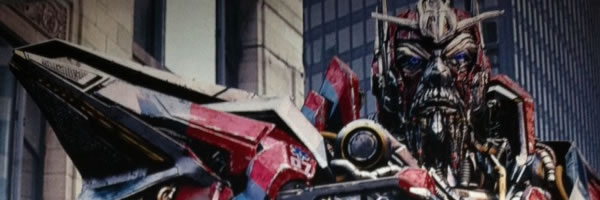
Transformers: Dark of the Moon, and before getting into what's wrong with it, here's what's right: the action sequences, particularly a crazed, high-strung highway chase and a mechanical urban brawl fought on three fronts through the high-rises of Chicago*** are marvels of imagination and quite "followable"—in other words, Bay is starting to understand the logistics of a good action sequence involve perspective and relatable occurrencesthe swooping overhead shots let you see the relationships of what's happening, rather than just presenting a hodge-podge of in-your-face shots.  Yes, they go on too long—the evidence being the kids in the audience who couldn't sit in their seats long enough even when things started to go crash and boom—but at least things made sense, rather than merely noise and rubble.  Now, if he could just have things happen simultaneously—rather than have things stop on the other fronts while he concentrates on one sector—Bay might actually generate something his movies always lack: suspense.
So, the technique is improving, but he's still a far distance from being a mature film-maker.  The few women cast in the film, save
Frances McDormand who manages to retain some inventiveness and dignity in her role, are all dressed like hookers with Bay's camera leering over their curves,
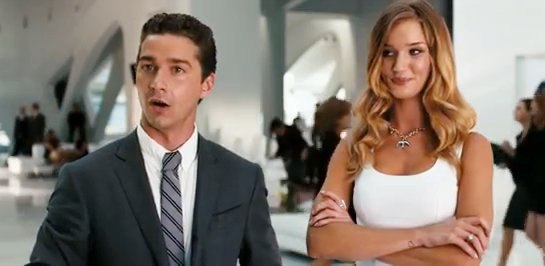
**** the dialogue attempts double entendre but never gets beyond the singular stage, and the annoying Beavis and Butt-head mini-robots from the last film are back and just as juvenile.  The whole movie has the same air of arrested development, although attempts are made to make it seem like it is happening in something more than a fantasy world where aliens disguise themselves as muscle-cars. The plot revolves around a derelict Autobot being salvaged from the Moonits detection being the genesis of Pres. Kennedy's push for a fast lunar landing (and a cameo by "Buzz" Aldrin attempts to lend credibility to the idea).*****  But, there are also "realish-world" cameos by Kennedy (eerily good effects work), Nixon and Robert McNamara (not so much), Walter Cronkite (TV archival footage) and Bill O'Reilly (which negates the credibility factor...a lot). John Turturro returns, and John Malkovich has a small role as a gung-ho business exec. Shia LaBeouf is on-hand (much more caffeinated than usual, probably to be better noticed and for good comic effect, as, Unicron knows, the robots are DEADLY serious), and there's just enough of his parents in this one to outwear their welcome, whereas they were one of the best things in the original. Here, that role is provided by Alan Tudyk, who enlivens the first half of the film before he's made into a functionary.
But, human interaction other than urgently delivered exposition or awkward comedy is rare as human beings become mere flotsam (sometimes literally) in the crushing of gears against gears. Since I've whined in the past that the "Transformers" movies have suffered from "Saved-by-a-White-Man" Syndrome (where a movie's ethnic entities' problems are solved by the usually-white star), this is actually rather refreshing (in fact, the girl-friend/model is the only one who does anything to influence the fight, by displaying the same kvetching characteristic she does with LaBouef's character, a nice touch if you actually believe it inspires what transpires, rather than her merely being turned into designer-charcoal as an annoyance). 

One looks for small signs of hope wherever one can, when one is dealing with something in so need of repair.

Ultimately, though, for all the metallicrash on the screen, my attention kept returning to my watch...I couldn't wait to get out of there.
One further thought to Bay's detriment: he can't direct 3-D (the format I saw Transformers: DOTM in. On too many occasions, the illusion was spoiled by Bay's insistence in putting an out-of-focus obstructing "something" in between the viewer and the "focus" of the scene...which in 3-D...DOES NOT WORK! The eye wants to focus on the nearest object and move outward in focus, and with merely a "blur" to look at, gets mixed signals, leading to a frustrating viewing experience. Bad idea. And given that Transformers was designed to be shown in 3-D, some bad direction.

* Just because there's a number in the movie title doesn't mean it's going to be bad—it amuses me that the intro on the Cars 2 poster says "From the Makers of Toy Story 3. And there are the inevitable jokes—that Ocean's 11 was followed by Ocean's 12, and I remember a comedian saying about Malcolm X: "I never saw Malcolm I-IX!! I saw Super and Super 8 this Summer...where're the other 6?

** Meek's Cutoff was interesting, but nobody's going to see that.  So much for blazing trails.

*** You shouldn't take these things too seriously or literally, although Roger Ebert in his nicely disingenuous journal entry "On the Origin of Transformers" wonders why such a global conflict should be limited to "the corner of Michigan Avenue and Wacker Drive in Chicago."  Um...budget?

**** Bay's very first shot of the female leadRosie Huntington-Whiteley, a Victoria's Secret Model (but still...) is an up-skirt shot of her walking up a flight of stairs. This isn't exactly the tradition of women making a "grand entrance."

***** This is the same "Buzz" Aldrin who, when confronted by an Apollo landing-hoax enthusiast, hauled off and punched the guy!  Who's getting the black eye now?