Taking Inside Out 2 Twice a Day Will Take the Place of Xanax
It's nice to see that Disney* is permitting Pixar out of its streaming jail-cell and letting its movies open in theaters again. It seems to have paid off as Inside Out 2 has out-performed expectations—certainly Disney's—and has generated Barbie-land box office. One took the hopeful sign that allowing the only-streaming releases to have a theatrical run made them re-think what they were doing with its best—and longest-held—assets. Pixar product is just too good to be restricted to home theaters, and Inside Out 2 is a good example of why.
Sure, a couple of the sequels have been less than spectacular—Monsters University, Cars 2, and Lightyear (although not technically a sequel) had a creative lethargy backing the stunning visuals, but this sequel to 2015's Inside Out takes advantage of the inevitable march of time to expand and deepen its particular cartooniverse. That it is all contained in the mind of our gal-pal Riley (now voiced by Kensington Tallman), who survived her move to San Francisco and flourished, retaining her passion for ice-hockey (a big story-point in this one) and keeping it together with some help from her humors in Head-quarters.
They are Joy (Amy Poehler), Sadness (Phyllis Smith), Anger (Lewis Black), Fear (Tony Hale taking over for Bill Hader), and Disgust (Liza Lapira taking over for Mindy Kaling), who have negotiated Riley's emotional life in the intervening years and managed to make a go of it, despite outgrowing clothes, getting braces, and the near-occasion of pimples. Of course, she's had help from her supportive gal-pals on the hockey team, Grace (Grace Lu) and Bree (Sumayyah Nuriddin-Green). Her school has just won State and grabbed the attention of Coach Roberts (Yvette Nicole Brown) of a local high school who has invited the three to a weekend hockey camp.
Pretty easy for five emotions to handle, one would think. Especially as Joy has worked out a new doohickey that allows her to take bad memories and vacuum-tube them to the back of Riley's mind, where they won't do any harm to her burgeoning "Sense of Self." All very neat and orderly...just like kids are (he said with a wink).
But, remember how I dropped the mention of a "pimple"—well-rendered subtly by Pixar pixelators)? The night before she goes off with her friends to the camp, Riley's "Puberty Alarm" goes off, sending everyone into a panic, and requiring a crew to come in and do a "mitigation" on Riley's head-space, leaving the old crew with a new console that—shall we say?—is a bit..."sensitive". Plus, there are all sorts of new gizmo's and buttons no one's ever seen before.
Those "upgrades" are for a quartet of new emotions generated for Riley by her hormones and they are Anxiety (Maya Hawke), Envy (Ayo Edebiri), Embarrassment (Paul Walter Hauser) and Ennui (Adèle Exarchopoulos), who show up and decide they're going to run the place...that is, Riley...during her hockey weekend. This, of course, complicates matters, and one notices that having these guys around makes describing what happens in the story sounds a little too "on-the-nose." It's far more subtle—and entertaining!—in the Pixar presentation than the summation, which reads like symptoms in a psychological post-mortem.
To wit: Anxiety manages to rip away Riley's Sense of Self and locks away Joy (and her comrades) in an effort to push Riley to achieve her ambitions on the ice. Sounds a bit clinical, doesn't it? It's not, but shows how cleverly director Kelsey Mann and his co-scenarists Meg LeFauve and Dave Holstein manage to integrate human turmoil into an adventure story that's enjoyable for kids and relatable for adults (who'll be answering questions with a smirking "just you wait..."). The kids watching this movie will grow up into the answers that had previously sailed over their heads.
It all feels like a natural progression to the original. Changes are made, but they're well-integrated (even if, in the story, the new emotions have to be shown some tough love) and one is propelled along with the assurance that the film has been nuanced to within an inch of perfection. And, of course, one is always amazed at the artistic leaps that Pixar makes between films; Inside Out 2 feels richer in its animation than the original with nice ethereal edges to inhabitants of Riley's head-space and one can appreciate the little details like the way Riley's teeth are crooked to the way ice erupts from the edge of a skate.
Those details are not what's flocking audiences to theaters to see this, but it's a value-added that can only be appreciated on a large screen. Inside Out 2 may not have the holistic concept brilliance of the first one, but it's a worthy sequel that builds on it, maintaining the train of thought while not derailing it (see how lame the concept could get?).
Inside Out 2 will get you right in "the feels."
* Although one notices that the House of Mouse has put on an ultra-long company logo (that might actually qualify as a short subject) onto the beginning and the end of this one as if to emphasize who's in charge. The Pixar logo is same as it ever was. Don't let that discourage you from missing the tag-line at the very end of the movie, though.
I had a Lucy Ricardo reaction to this project first coming to mind: curling my lip to show all my teeth and going "Ewwww." Even though Being the Ricardosis helmed byAaron Sorkin, Sorkin, as he's demonstrated, isn't the most effective when delivering comedy material—drama with humor and irony, sure. But comedy? C'mon, I watched the entire run of "Studio 60 on the Sunset Strip." I may have been the only one.
Lucy's been on a lot of people's minds lately: TCM had a month of Lucy movies last month in conjunction with their "highlights" podcast about her life. This movie covers a bit of what that covered, but squeezes it all in within the space of one week of production of the "I Love Lucy" show, those issues being Desi's affairs, Lucy being pregnant just ahead of shooting a season's worth of shows, and the disclosure—on Walter Winchell's radio broadcast—that Lucy (coded as "America's favorite TV comedienne") was a communist.*
All true. Desi was sneaking out on Lucy. Lucy did become pregnant while shooting a season and, despite resistance from CBS, sponsors Westinghouse, and Phillip Morris, and incorporated Lucy's pregnancy into the story-line—a first (one of many) that distinguished "I Love Lucy" from the stone age of television. And Lucy was a communist, but not a practicing one. She had checked "communist" on a voter registration card in 1936, at the behest of her beloved grandfather Fred Hunt, who raised Lucy and her brother in their childhood.
It's also true that Ball and Arnaz were better together than they were apart. Both were quick-witted dedicated hard-workers with gambler's instincts and business savvy. Together, they bought the old RKO studios (which years before had released Lucy from her contract), created the 3-camera technique for documenting TV shows—which made better clarity, guaranteed delivery, and allowed episodes to re-run—clobbered television taboos, Desi gave the green-light to "The Untouchables" (narrated by Winchell, ironically) and Lucy said yes to production of TV's "Mission: Impossible" and "Star Trek." At one point, the greatest assets for Westinghouse and Phillip Morris...and CBS. They had a lot of power, but it was all power that could be taken away, if they didn't deliver. the goods.
Aaron Sorkin knows his way around television—he's made three TV series ABOUT television ("Sports Night," the afore-mentioned "Studio 60" and "The Newsroom") and the backstage turmoil involved in filling up broadcast time on a regular consistent basis. It is a meat-grinder, and anybody wanting to cut corners to make it a little easier, risks the wrath of millions of viewers. Desi-Lucy knew that. And so does Sorkin. He also knows what it's like to produce a carefully scrutinized show while your life is falling apart. Even when things are going well, personalities and egos have to be considered and worked around, editing and second-guessing happen constantly, interference from outside sources need to be batted out to the foul-zone and sometimes the drama off-stage is more intricate—and better—than the one on-stage.
Sorkin segments the film into a television work-week: Monday-"Table Reading; Tuesday—"Blocking Rehearsal"; Wednesday-"Camera Blocking"; Thursday-"Dress Rehearsal"; Friday—"Show Night". Those are the steps for the actors and technical crew to take from the first reading of the script on Day 1. Things get changed, problems get discussed, it's staged, and how it's going to be recorded is worked out, then the final touches and intricacies before the final day when it's presented before an audience. A 25 minute play produced each week, and the audience has to be "warmed up" that it's going to be a good time and they're free to enjoy themselves.They see the fun parts. They don't see the work.
They also see the parts being played. They do not see the actors. Which brings us to casting. Cate Blanchettwas first cast but dropped out. Nicole Kidman got the "Lucille Ball" part and Javier Bardem the "Desi Arnaz" part. J.K. Simmons plays William Frawley, and Nina Ariadna plays Vivian Vance. And they work. Some may grouse that Kidman doesn't look like Lucille Ball, but then we didn't see Lucille Ball, we saw "Lucy Ricardo." Lucille Ball was a tough business woman, who knew that time was a commodity and shouldn't be wasted by niceties—there was work to be done. Kidman gets that. Yeah, she can do the schtick, exploding the blue eyes and pitching the voice to screech-mode to play "Lucy"—but she spends most of her time as the intense, driven actress with a cigarette-growl and is very serious about comedy...and character. "Lucy Ricardo" didn't just happen, she was created, given what Lucille knew about getting attention and laughs. And like the silent comedians, she worried about timing and earning guffaws without doing it cheaply. It's an interpretation, not an imitation and it works. The voice is phenomenal.
Bardem doesn't have the boyish good looks of Desi Arnaz, but he's all over the charm and the drive...his scenes with Kidman are played like an old movie with too-perfect lines and better timing. And he's pretty good doing the songs. J.K. Simmons is a delight as Bill Frawley, with the rasp but not the girth, full of cranky jibes, belying a worldly wisdom (Sorkin writes a lovely line when he invites Lucy to a bar for a drink during a fraught work-day. "It's 10 am!" "Well, it's always 10:15 somewhere!") and Ariadna's Vivian Vance is a frustrated actress, worried that she'll be typecast frumpily, playing a woman "married to my grandfather."
But, Sorkin pays particular attention to the writers of "I Love Lucy" with actors portraying them at the time of the show's creation and with "witness testimony" of the same people older trying to set the record straight: Executive producer Jess Oppenheimer (played by Tony Hale and John Rubenstein), Bob Carroll (played by Jake Lacey and Ronny Cox) and Madelyn Pugh (played by Alia Shawkat and Linda Lavin!). Being a writer himself, Sorkin gives them the roles of experts, the elder versions smoothing over the inevitable pecking battles we see occurring in a bull-pen during the earlier scenes.
And—like a good sit-com—it all gets resolved in the end. Well, almost resolved. And, while it's true that Desi (in his usual role warming up the audience) did talk to the waiting crowd about the communist accusations, but he did not use the gambit Sorkin employs—although it is true that Arnaz knew the person mentioned, having met him at the race-track. Instead, Cuban-American Arnaz merely reminded the crowd that they were all Americans, and that, in this country, the accused are innocent until proven guilty. He merely appealed to their better natures. I kind of like the truth better. And Lucy was greeted, when introduced, to thunderous applause. But, Sorkin leaves out what happened after the taping: she went back to the crowd—something she never did—and said "God bless you for being so kind," then went to her dressing room and broke down.
Tough but not invulnerable.
Instead, Sorkin leaves us with one last enigmatic image. The crises have been averted. "I Love Lucy" goes on and no is being fired or losing their job. Sorkin shows the continuity after near-disaster, and the show going on, the actors on set, and the camera slowly moves up into the stage-lights looking down on the activity, until it hovers above the beams and bracers forming a television shaped screen around the scene below. What's he saying? Are they trapped? Is this a ploy showing the metaphoric similarity of the Arnazes to the Ricardo's?—because if it is, it doesn't work. What's the gist here? Maybe it'll come to me, but it sure doesn't communicate.
And it ends with television static. I only say this because it will cause confusion when it starts streaming on monitors December 21. Do not adjust your sets.
* I love Desi's resulting line: "maybe they're talking about Imogene Coca..."
I mentioned this movie in the review of The Farewell. Written at the time of the film's release...
"Double Agent + Half-Wit = ???!" or "Greed is Good"/"Ignorance is Bliss"
A direct descendant from "This American Life,"* a screenwriter heard the story on the American Public Media radio program and thought "This would make a great movie."
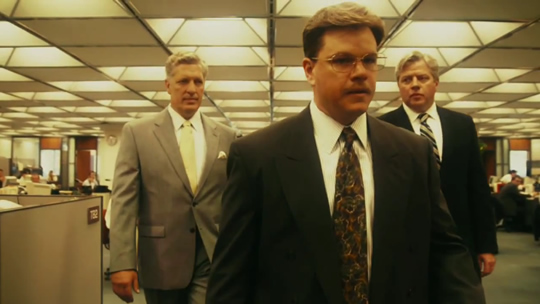
He's the perfect candidate for amateur skull-duggery—objectively smart enough to stay ahead of the game and egocentric enough to buy into the glamour of the intrigue—he basks in being a star witness and is only too happy to please, lying with the lions while lying like a rug.
Director Steven Soderbergh pulls a nifty trick here taking a very complicated story and keeping the details spinning, like so many plates on sticks. Just like that Ed Sullivan Show staple, the most difficult part is building the momentum to achieve the balance and the film starts stuttering, wobbling until it finds its center. Once it does, it becomes clear that the template Soderbergh is using is from his breezy "Ocean's" movies—lots of little con's disguising the big con. There is, however, no satisfying feeling of being part of the gag—of seeing the magic happen, or as it's labelled in Christopher Nolan's magic movie The Prestige. One is left a bit unsatisfied that it all hinges, not on success, but on failing.
The acting is top-notch. Damon's performance slowly unravelsin a series of dunce-like mis-steps and comedic ditherings and dissemblings that are sly and subtle—a whistle-blower blowing so loud so as to distract from the alarms down the street. As the FBI masters, Scott Bakula is passionately one-note as the guy who believes, while Joel McHale plays the agent who can't believe with a brilliant series of dead-pan reactions of muted horror whenever the investigation turns...complicated. At a certain point, Soderbergh starts replacing actors with comedians (Patton Oswalt, Samantha Albert, Jimmy Brogan, Bob Zany, Candy Clark, Frank Welker, both Smothers Brothers) who excel at turning conflict into comedy.
Ultimately, one is left with more questions than certainty, your footing unsure about what is true and untrue (the movie sticks scrupulously to the facts of the case) but at some point you have to look at the entire film as a con game—a caper that takes you in, making it as unscrupulous a movie as Orson Welles' F for Fake. But even more broadly, it plays fast and loose with the implicit agreement of trust between film-maker and audience.
* The Episode is 168 "The Fix Is In," although it has been repeated a few times, including the week "The Informant!" opened.
The Existential Angst of Contemplating One's Own Shelf Life or "Thanks a Lot, Inner-Voice!"
“When I was a child, I spake as a child, I understood as a child, I thought as a child: but when I became a man, I put away childish things.”
1 Corinthians 13:11
I have a nasty habit of burying my lede. I start a post with what should be the last line of the thing, the zinger. But, I start writing with what I feel is the most important thought and find that when I finish up, the last line falls a bit flat. I'm not happy with it, at least. Should have ended the entry with the first line of it. It disappoints me. But, I'm gonna do it again, because it's the most important thing to say: Pixar is the most amazing producers of the finest films extant. You fan-boys can have Marvel—their percentage is nowhere near what Pixar manages to do. Marvel's film series usually peter out with the second one. The Harry Potter films were a mixed bag. And nobody's done what Pixar has done with their Toy Story series—each new chapter of the story is better than the last one, the most recent (that being Toy Story 3) was an emotional wringer and the best of the films.
Best one, that is, up to that time. Because Toy Story 4 is an improvement over it on all fronts: animation, story, presentation, screenplay, and direction. And it's deeper and more profound than anything we've seen yet, sophisticated in its themes, and makes changes to the characters and the dynamics of established tropes and story assumptions to challenge the audience and bring them along for the ride of growing up.
And it's about toys. Toys, for pity's sake. And it does all that while still being funny and extraordinarily entertaining to boot (with a snake in it).
When last we left Andy's collection of toys, they had been saved from incineration, and transported by Andy to little Bonnie, a shy 4 year old toddler with a rich inner life. The movie begins in flashback with a crisis: it's raining and Andy has brought in his toys from playing outside. All except one. The mechanical race-car, RC, has been left outside and is struggling to keep from being swept away in a gully-washer. Woody (voiced again by Tom Hanks) organizes a rescue party and with the help of Slinky-dog (voiced by Blake Clark) rescues RC. But, another toy is about to be lost—Bo Peep (voiced by Annie Potts) and her three-headed sheep is being given away as her lamp is no longer needed in Andy's sister's room. Woody tries to rescue her—it's what he does—from being exiled to another home, but Bo Peep will have none of it. She accepts her fate. "Sometimes, toys get lost in the yard or put in the wrong box. It's okay. I'm not Andy's toy. It's time for the next kid." And she gets carted away, while Andy can only watch hopelessly, lying lumped in the car-port in the rain.
Cut to now—and Bonnie's world. Woody organizes the toys—it's what he does—calming their fears as they're consigned to the closet on cleaning day. Bonnie comes back from the dust-up and pulls the toys from their temporary confinement, all except Woody, who can only watch and wonder what's changed.*A lot, it turns out. It's the end of summer, and Bonnie is now five—time for a big transition (there a lot of them in Toy Story 4), as the shy little girl is about to be thrust into the world of an unprotective collective—kindergarten, and she is required to go to "orientation." Bonnie has always been a shy child, tremulously so. And the prospect of going to kindergarten without a parental leg to hide behind is devastating to her, causing a melt-down. What she needs is a sheriff to come to the rescue—or, at least, that's what Woody thinks—so he stashes himself in her back-pack, a stowaway to school.
It's a scary place with other kids, kids without borders or boundaries and unchecked id's. When she sits down for activities, another child swipes all her arts supplies. Woody observes all this and manages to find a way to sneak out of his hiding place and toss Bonnie with supplies in the trash. She's inspired to take a stick, a spork, pipe-cleaners, and some play-doh and makes her own toy and companion—"Forky" (voiced by a wonderful Tony Hale)—who manages to sustain Bonnie through the day and give her a sense of accomplish. Good enough. But, when Bonnie gets home ("I finished kindergarten!!" "Uh...honey?"), Woody introduces Forky to the other toys.
But, Forky has issues. He's a bit pre-verbal and can't quite see himself as a toy, but, rather as trash. It's an instinctual fixation and he must be restrained from constantly throwing himself in the nearest dumpster. Leave that to Woody, who has his own instinctual fixation—it inspires composer Randy Newman (Yay!) to write a lovely gospel song entitled "I Can't Let You Throw Yourself Away" exposing Woody as a plasticene guardian angel, a caretaker—and he wails to Buzz Lightyear (voiced by Tim Allen) "I don't know if you remember what it was like when Andy was a kid, but, I don't remember it being this hard!"
A road trip with Bonnie and her parents as a final Summer fling before school provides ample opportunity for Forky to trash himself and for Woody to come to the rescue, whether the little spork wants him to or not. It also provides him the opportunity to re-unite with Bo Peep, who has changed considerably after leaving Andy's house and, ultimately, escaping from an antiques shop called "Second Chances" (heh).
As Bo tells Woody, "I don't want to sit on a shelf waiting for my life to happen." But, Woody is in a different place. For Woody, it's all about The Child, or any toy in crisis that might adversely effect said child. It always has been. And so much of his time has been about taking care of other's needs—he's taken his fake sheriff's badge too literally—and the movie spends much of its time with Woody coming to the rescue and realizing that seems to be his sole reason for existence, because he knows no other pattern of behavior.
Bo provides another perspective; she has a good life on her own without the need for a child in her life. But, Woody is stuck in his ways—there are only so many phrases in his talk-box if you want a literalness to the concept. It's all in service to the child. It always has been and always will be.
That's the crux of the movie: a toy's need to be needed, and the damage that such activity can cause to one's own shelf-life. Along the way, Toy Story 4 delves into parallel stories of toys' needs to be given purpose—of the toys at the antiques shop waiting to be given a chance at being taken home, and a pair of prizes that never seem to be claimed at a shooting arcade at a nearby carnival—all the while the toys are working overtime trying to get Forky back to Bonnie.
The major story is at the antiques store, which is given a creepy atmosphere recalling Kubrick's The Shining—at one point, an old 78 plays "Midnight, the Stars, and You"—with the long-abandoned Gabby Gabby (Christina Hendricks), a talking doll with a damaged voice-box that she believes is keeping her from being taken home to some needy child. She keeps Forky hostage in the hopes of taking Woody's so she can have her chance, and she runs the antiques store like her own personal führerbunker with demented ventriloquist's dummies as her shock-troops. Creepy.
Then, there are the plush arcade animals, Ducky and Bunny (voiced hilariously by Keegan Michael-Key and Jordan Peele), who've been hanging around as shooting gallery prizes for so long they've developed something of an attitude waiting for kids to just hit the damn targets. They get roped into the whole "Second Chances" plot and they have a rather aggressive way of handling problems. Probably been at the range too long. Also aiding is a Canadian stunt-toy called Duke Kaboom, whose stunt skills are used for an elaborate rescue, and who is voiced by Keanu Reeves, still nailing the mock-heroic voice.
Pixar ups the artistic quality a notch—the world is a bit more complicated and messier with dust-bunnies, cob-webs and dust-motes that dance in sun-beams, little details that one didn't realize were missing until the animators made it essential (Andy, too, in the flashback sequences looks far more real than the crude animator grids in the first movie allowed). But, it's also more sophisticated in the way the film questions the series trope—that a toy is useful only if it's needed by its possessor. This one dispels that idea as a given and makes it relevant, not only to the film's characters, but to the larger issues of the audience's as well...as we all (as Bob Dylan observed) gotta serve somebody. And that's if we're a caretaker, or just a work-a-day 9 to 5'er, a Mom or a sheriff. Yeah, we gotta serve. But we also gotta know that we're not just what we work at. We gotta know when the job is done. We've got to know ourselves.
Remember Toy Story 3? Remember how it had the perfect ending, even though it was kind of sad and changed things? How it worked outside your comfort zone, but you also knew it was the perfect ending for the story? Turns out that it was for its time. But, another story needed to be told. We just didn't know it yet. And Toy Story 4 tells it with such care and such skill...and wisdom—without taking its eyes off the entertainment value—that you might think it's a perfect ending.
You might even think—like me—that it was even better than Toy Story 3, which, as I said at the beginning, was the best of the series so far. And I wept like a baby at it. I'm at the point, now, where I wouldn't mind another Toy Story movie, so good are these creators at telling a story and making it essential. Making movies that matter and increasingly raising the bar...for themselves and for us.
So exceptionally well done.
* He is consoled by some other toys, which Pixar casts with some essential voices—Alan Oppenheimer, Carol Burnett, Carl Reiner, Mel Brooks, and Betty White. That seems so right. Maybe not essential, but a lovely gesture.
** Newman does another brilliant score with two new amazing songs, and I always imagine Seth McFarland gritting his teeth and thinking "I write better stuff than THAT." No. No, he doesn't. But he tries so hard to do something better than what Newman seems to do so effortlessly. That's because Newman is a genius who makes it look easy. McFarland just studies and copies...and comes up short. Professional jealousy is a terrible thing...and not very professional

 They are Joy (Amy Poehler), Sadness (Phyllis Smith), Anger (Lewis Black), Fear (Tony Hale taking over for Bill Hader), and Disgust (Liza Lapira taking over for Mindy Kaling), who have negotiated Riley's emotional life in the intervening years and managed to make a go of it, despite outgrowing clothes, getting braces, and the near-occasion of pimples. Of course, she's had help from her supportive gal-pals on the hockey team, Grace (Grace Lu) and Bree (Sumayyah Nuriddin-Green). Her school has just won State and grabbed the attention of Coach Roberts (Yvette Nicole Brown) of a local high school who has invited the three to a weekend hockey camp.
 Pretty easy for five emotions to handle, one would think. Especially as Joy has worked out a new doohickey that allows her to take bad memories and vacuum-tube them to the back of Riley's mind, where they won't do any harm to her burgeoning "Sense of Self." All very neat and orderly...just like kids are (he said with a wink).
 But, remember how I dropped the mention of a "pimple"—well-rendered subtly by Pixar pixelators)? The night before she goes off with her friends to the camp, Riley's "Puberty Alarm" goes off, sending everyone into a panic, and requiring a crew to come in and do a "mitigation" on Riley's head-space, leaving the old crew with a new console that—shall we say?—is a bit..."sensitive". Plus, there are all sorts of new gizmo's and buttons no one's ever seen before.
.webp) Those "upgrades" are for a quartet of new emotions generated for Riley by her hormones and they are Anxiety (Maya Hawke), Envy (Ayo Edebiri), Embarrassment (Paul Walter Hauser) and Ennui (Adèle Exarchopoulos), who show up and decide they're going to run the place...that is, Riley...during her hockey weekend. This, of course, complicates matters, and one notices that having these guys around makes describing what happens in the story sounds a little too "on-the-nose." It's far more subtle—and entertaining!—in the Pixar presentation than the summation, which reads like symptoms in a psychological post-mortem.
Those "upgrades" are for a quartet of new emotions generated for Riley by her hormones and they are Anxiety (Maya Hawke), Envy (Ayo Edebiri), Embarrassment (Paul Walter Hauser) and Ennui (Adèle Exarchopoulos), who show up and decide they're going to run the place...that is, Riley...during her hockey weekend. This, of course, complicates matters, and one notices that having these guys around makes describing what happens in the story sounds a little too "on-the-nose." It's far more subtle—and entertaining!—in the Pixar presentation than the summation, which reads like symptoms in a psychological post-mortem.


.webp)