Redbelt(David Mamet, 2008) One considers carefully before accusing David Mamet of writing a fairy tale.*But, considering the genre in which he's working—the sports film, which is almost always a glucose-encrusted, tears-of-joy-stained fantasy (aren't they, basically, "Cinderella stories?")—one also must admit that he's taken as much of the slop out of the form as he can. And if it strains credulity a bit, well...."you gotta sell a story."
Michael Terry (Chiwetel Ejiofor) is an ex-military, mixed martial arts/self-defense instructor with an emphasis on ju-jitsu, running a small not prosperous training center in the land of make-believe, L.A. He's a good man doing good deeds, cloistering himself, looking to achieve his own personal best (like so many Mamet men). That he believes in honor, and the proper way ("There's always an escape") would appear to be a weakness. But incidents happen to break the hermitic seal of Terry's life and he soon finds that good deeds do not go unpunished. Encounters with an attorney with coping issues (Emily Mortimer), one of his students (Max Martini), a past-his-prime action star (Tim Allen) and his producer (Joe Mantegna) convolute to seemingly improve his life...but at a cost.
Money and legal issues force him to cross a line he'd never thought to cross—and as a result, he becomes a participant in an exhibition match with all its gloss, hyperbole, myth-making and BS. That the match is based on an anecdote that he casually mentions at a swank party, but rigged to take the chance out of it, only compounds his anger and humiliation at the corruption that he's taking part in, and he must find his own way out of a trap of his own devising. A way of his own devising.
It must have been an interesting puzzle for Mamet: "How do I make my own version...my own version...of the most manipulative and phoney-baloney film genre out there and still make it 'Mametian?" And still make it "mean" something. The disciplines and the hierarchical nature of non-exhibition MMA that feed Terry are in direct contrast to the gladiator aspect of the money game, which in the Mamet tradition, is a rigged contest. Even rigged, both Golden Rules** are in play.
Mamet's films usually exhibit stillness, but here, action is used as exposition and Mamet the director fails to do anything but document the moves, and none too well, at that. Clarity is sacrificed for speed, and no matter how long Ejiofor has trained for those scenes—he's great in the role, by the way—his efforts are for naught due to Mamet's direction and cutting of them. The cast is uniformly excellent with Mamet stock company players Ricky Jay and Joe Mantegna breezing through their roles. and Ejiofor making a superb protagonist, aided and abutted by Alice Braga as his practical wife. Tim Allen drains the comedy out of himself and is a bit of a revelation in his well-observed role as an actor coasting. You always knew there was a good actor inside the goof-ball and it's interesting to see him come out. Mamet's story-telling, casting and working with actors has never been in question. It's his use of the camera, now, that needs perfecting if he intends to pursue more action oriented films.
* It's not like he hasn't done that before. You could make a case that The Untouchables is so far from the reality of the Elliot Ness-Al Capone story that it's a blood-soaked fairy tale of revenge. But how much that was Mamet, and how much was director Brian DePalma or the producers one can't say.
** 1. "Do Unto Others as They'd Do Unto You" 2. "The One With the Most Gold Makes the Rules"
A lot of times I write and I "make do." It's alright. I think I got the point across.
And sometimes, I nail it. It's rare, but I'm capable of it. Even if the movie is just about toys. I remember a comment for this post (on that "other" site) was simply "Dude. It's Toy Story 3." (Where are you, Simon?) Yes. And good movies about love can come from anywhere.
Written at the time of the film's release...
"And if You Can't Be with the One You Love, Honey..."
One has suspected a subtle sub-text in the "Toy Story" series—every Pixar film has evoked that feeling (which is why they tower over Dreamworks and every other animation supplier and make even their rivals' three-dimensional films seem more two-dimensional) since the first film premiered (what was it?) fifteen years ago.
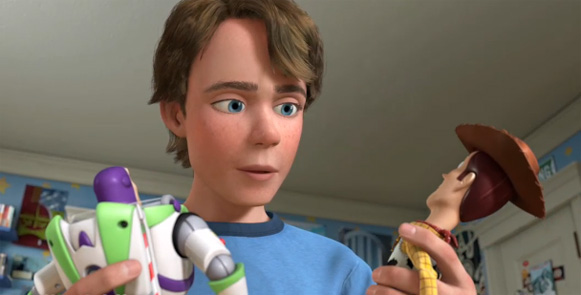
Toy Story 3is no less rich in sub-text. Sub-texts like the given that the toys have stayed the same, but their little owner Andy has grown up and is on his way to college by the time we hit 3; First sub-text: Change or be passed over. Any one looking for a job in these troubled times has had to be confronted with their inadequacy in some department while they're winning the daily bread. And like the toys of "Toy Story," time may be their enemy, staying consistent while the world evolves too quickly.
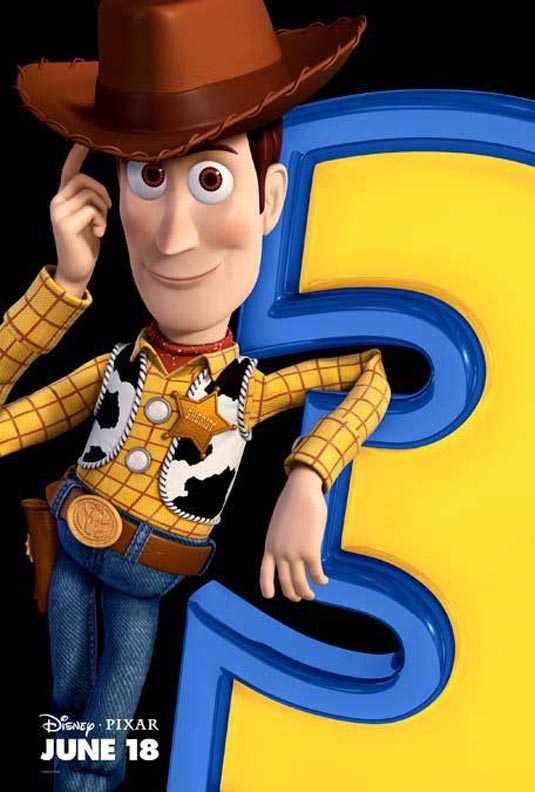
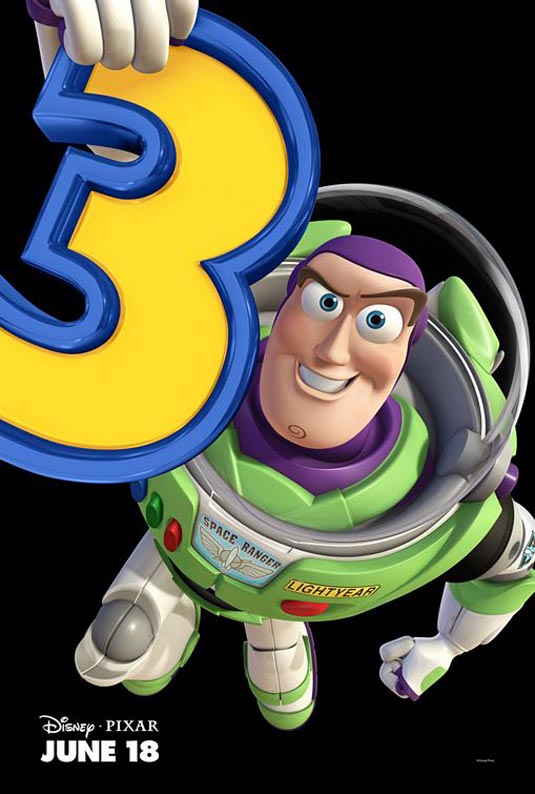
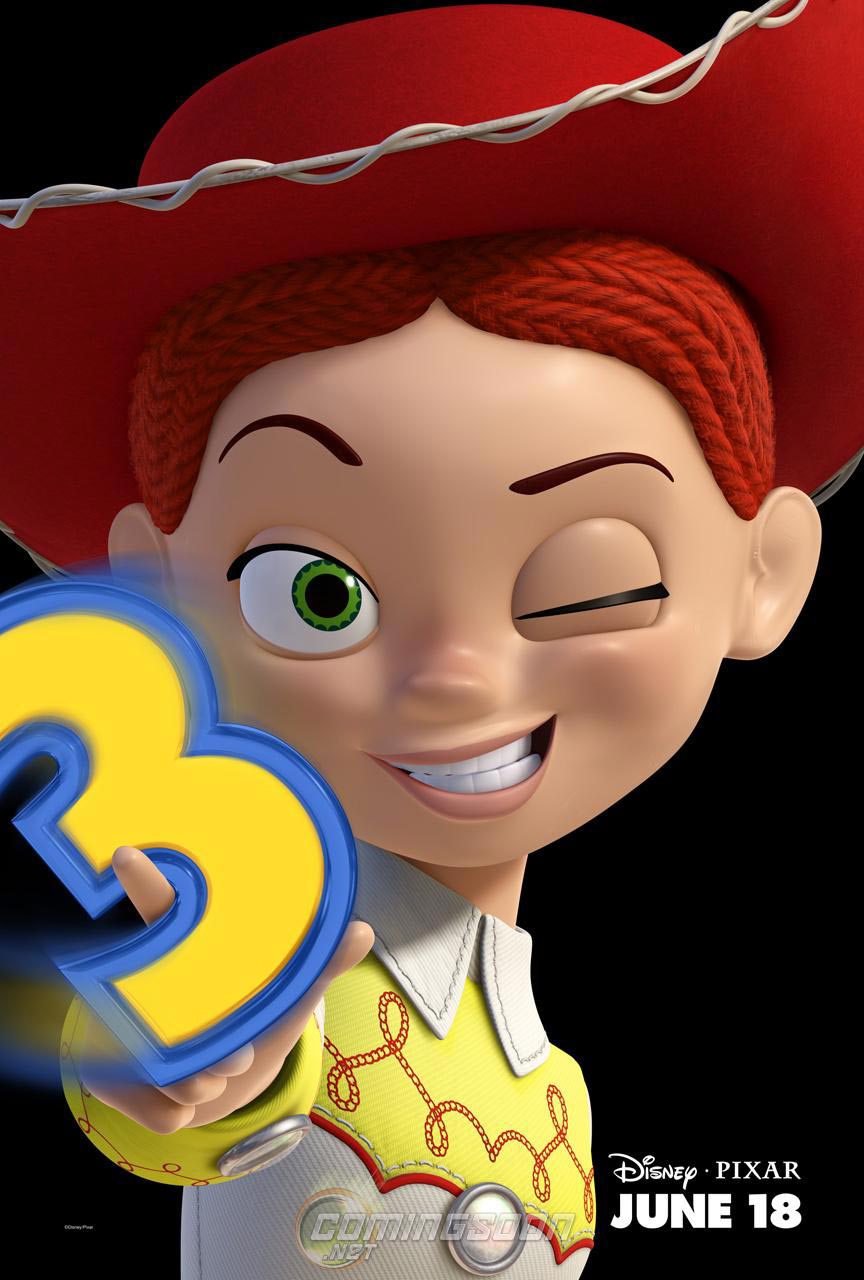
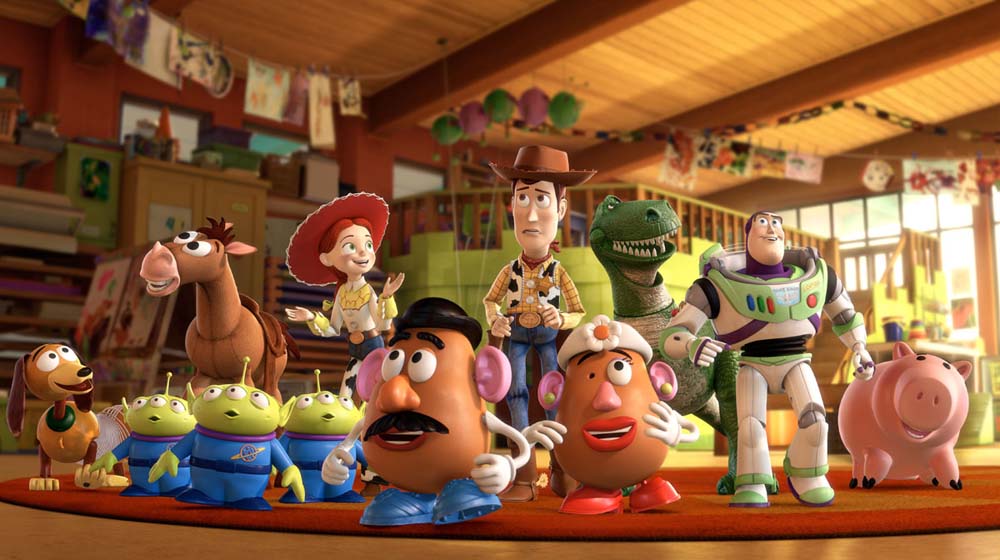
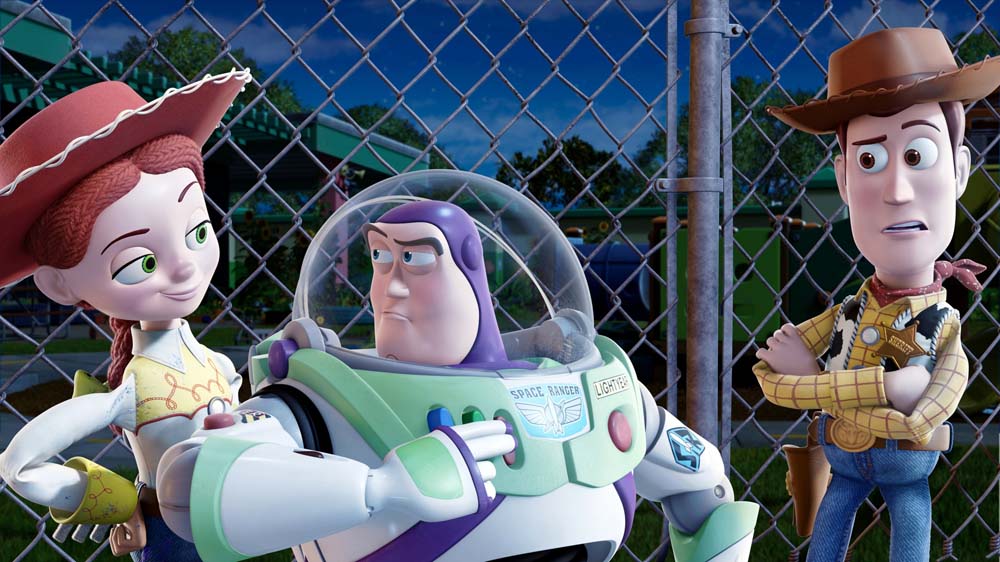
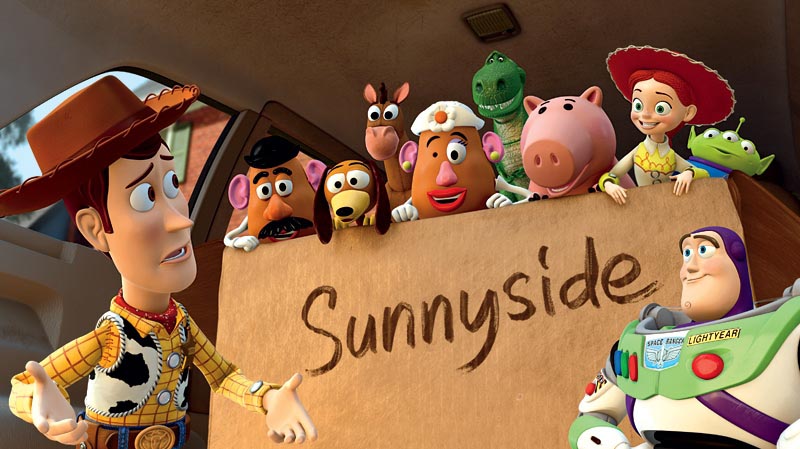
But, at the pace-making heart of the "Toy Story" movies has been one constant, and that is its contemplation of the nature of Love, which puts it in the same movie-case with such seminal works as Vertigo and A.I. In the first Toy Story, cowboy-doll Woody (voiced by Tom Hanks) watched in horror as the affection of his beloved Andy was supplanted by the new space-age toy Buzz Lightyear (voiced by Tim Allen). The stakes doubled in Toy Story 2 when we witnessed the discarding of cow-girl Jessie (voiced by Joan Cusack) as her owner grew up and put away childish things (see the video below). And we witnessed Woody turned from an object of play to a rarified objet collectionner, the very definition of a "trophy love." Toy Story 3 takes Jesse's plight and applies it to the entire toy corps, facing abandonment (the attic) and, worse, discarding (at the sidewalk on garbage day). The toy soldiers take action and evacuate the premises first: "Once the garbage bags come out, the army men are the first to go" barks the commander (R. Lee Ermey) before para-sailing out of Andy's bedroom window.
The others are left to contemplate their fate.
Play-time's over.*
There is one axiom I've held to my heart from the moment I first recognized its truth—I'm sure it originates elsewhere, but I first read it from thriller writer John D. MacDonald: "Love is not the opposite of Hate; love and hate are merely two sides of the same coin. The opposite of love is indifference."
The forging of the community has been a theme running throughout the history of film (especially Westerns) since Edison, certainly John Ford, and we've all seen those films where the protagonist loses a family in order to gain another, sometimes not by choice. Those bonds are infused with strength to take on all comers and all challenges, but the heart of that coming-together has always been the one unofficial but over-arching Commandment: Love thy Neighbor.
I mentioned putting away childish things earlier. That's from The Bible (1 Corinthians 13), and looking over that verse again, I saw images spring up from Toy Story 3—"And though I bestow all my goods to feed the poor, and though I give my body to be burned, and have not love, it profiteth me nothing," particularly. But especially its last devastating quality in its check-list of Love's qualities, which always makes me tear up a little when I contemplate it, and I contemplate love and loss. For toys break, batteries corrode, fabric burns and plastic will melt. But Love "never faileth."
Love never dies.
To Infinity.
And Beyond.
* How many times have we said that, as adults, mourning the loss of childhood from adult responsibilities?
** But, man, you want to see Pixar push the envelope? Check out the sophisticated opening short Day & Night, a wordless combination of 2-D and 3-D, line animation and computer graphics, filled with rich imaginative ideas and a brilliant sound design. The work of animator Teddy Newton, this little gem, puts him at the top of exciting animators to watch.
This was written at the time of the film's release in theaters and a cursory glance at it a couple weeks ago (in between regularly scheduled programs) revealed just as much enjoyment and admiration as the first time I watched it. "Never give up. Never surrender."
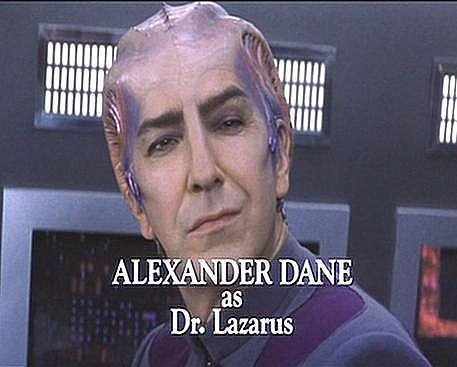
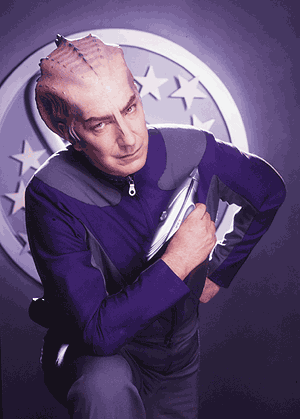
Unfortunately, it wasn't "Star Trek" but a spoof ofthe phenomenon that Paramount inherited from the originating production house Desilu (and apparently didn't know what to do with—at the the time of Galaxy Quest's release, they were in between producing the Next Generation movies Insurrection and Nemesis, which effectively killed the series).
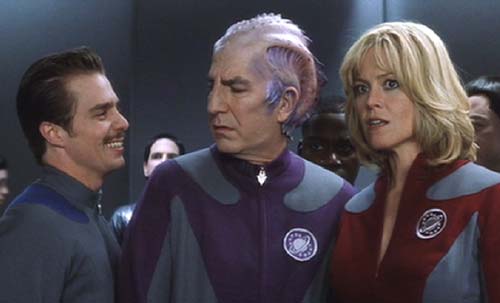
Still, this film is an affectionate send-up with a fine cast doing good comedic...and dramatic...work, and manages to pull off something of a miracle, making one one embrace the cliches of the original while at the same time making delicious fun of them. And given the ubiquity of "Star Trek", fans still recognized the show, backwards, forwards and behind-the-scenes, even when it was in the disguise of another Intellectual Property.
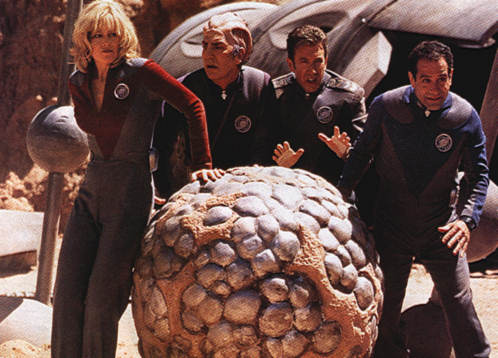
At a sci-fi convention, the cast of a long-cancelled television series "Galaxy Quest" is going through the motions of meeting their fans, even though the show has been off the air for years, and the actors are having a difficult time finding other work due to "type-casting." They squabble, each remembering personal quirks and on-set peccadilloes, either jostling for the limelight or just "doing the gig," and by happenstance, find themselves portraying their characters in a real outer-space adventure, persuaded by desperately seeking aliens who have caught transmissions of the show as it zipped through space at light-speed, and not only liked what they saw...they bought it hook, line, and beridium sphere.
It's a fun conceit, combining the background stories of actors with the characters they're playing put into a situation where their attributes as actors inform their actions in a real-life approximation of the roles they play. It stands to reason that the traits they embody to play the roles would come to the fore when reality sets in—it implies, of course, that they could do all this without "handlers," make-up assistants, or even (ya know...) decent writers and directors. It's fun to imagine.
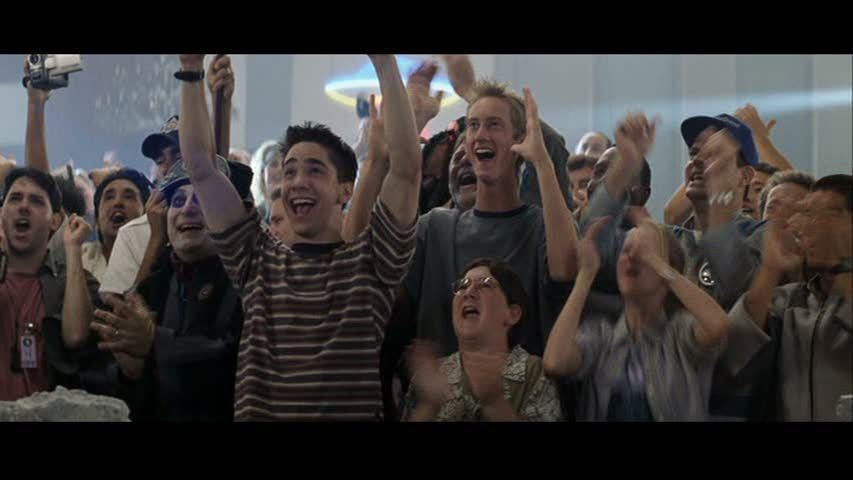
There's also a tip of the hat to the faithful fans who start out as convention geeks, then play a pivotal role in the survival of the crew and their mission—and they don't even have to do it with a write-in campaign to the network.
Fiction becomes fact becomes fiction becomes fact; Galaxy Quest is an inter-dimensional trek on a Universe that's folded in on itself, through all the frontiers influenced by TOS and its progeny that explored new frontiers on a journey that seems on-going. It's also one of the best examples of a rare film genre that usually comes off as lame, childish, or patronizing—the science fiction comedy.
The Existential Angst of Contemplating One's Own Shelf Life or "Thanks a Lot, Inner-Voice!"
“When I was a child, I spake as a child, I understood as a child, I thought as a child: but when I became a man, I put away childish things.”
1 Corinthians 13:11
I have a nasty habit of burying my lede. I start a post with what should be the last line of the thing, the zinger. But, I start writing with what I feel is the most important thought and find that when I finish up, the last line falls a bit flat. I'm not happy with it, at least. Should have ended the entry with the first line of it. It disappoints me. But, I'm gonna do it again, because it's the most important thing to say: Pixar is the most amazing producers of the finest films extant. You fan-boys can have Marvel—their percentage is nowhere near what Pixar manages to do. Marvel's film series usually peter out with the second one. The Harry Potter films were a mixed bag. And nobody's done what Pixar has done with their Toy Story series—each new chapter of the story is better than the last one, the most recent (that being Toy Story 3) was an emotional wringer and the best of the films.
Best one, that is, up to that time. Because Toy Story 4 is an improvement over it on all fronts: animation, story, presentation, screenplay, and direction. And it's deeper and more profound than anything we've seen yet, sophisticated in its themes, and makes changes to the characters and the dynamics of established tropes and story assumptions to challenge the audience and bring them along for the ride of growing up.
And it's about toys. Toys, for pity's sake. And it does all that while still being funny and extraordinarily entertaining to boot (with a snake in it).
When last we left Andy's collection of toys, they had been saved from incineration, and transported by Andy to little Bonnie, a shy 4 year old toddler with a rich inner life. The movie begins in flashback with a crisis: it's raining and Andy has brought in his toys from playing outside. All except one. The mechanical race-car, RC, has been left outside and is struggling to keep from being swept away in a gully-washer. Woody (voiced again by Tom Hanks) organizes a rescue party and with the help of Slinky-dog (voiced by Blake Clark) rescues RC. But, another toy is about to be lost—Bo Peep (voiced by Annie Potts) and her three-headed sheep is being given away as her lamp is no longer needed in Andy's sister's room. Woody tries to rescue her—it's what he does—from being exiled to another home, but Bo Peep will have none of it. She accepts her fate. "Sometimes, toys get lost in the yard or put in the wrong box. It's okay. I'm not Andy's toy. It's time for the next kid." And she gets carted away, while Andy can only watch hopelessly, lying lumped in the car-port in the rain.
Cut to now—and Bonnie's world. Woody organizes the toys—it's what he does—calming their fears as they're consigned to the closet on cleaning day. Bonnie comes back from the dust-up and pulls the toys from their temporary confinement, all except Woody, who can only watch and wonder what's changed.*A lot, it turns out. It's the end of summer, and Bonnie is now five—time for a big transition (there a lot of them in Toy Story 4), as the shy little girl is about to be thrust into the world of an unprotective collective—kindergarten, and she is required to go to "orientation." Bonnie has always been a shy child, tremulously so. And the prospect of going to kindergarten without a parental leg to hide behind is devastating to her, causing a melt-down. What she needs is a sheriff to come to the rescue—or, at least, that's what Woody thinks—so he stashes himself in her back-pack, a stowaway to school.
It's a scary place with other kids, kids without borders or boundaries and unchecked id's. When she sits down for activities, another child swipes all her arts supplies. Woody observes all this and manages to find a way to sneak out of his hiding place and toss Bonnie with supplies in the trash. She's inspired to take a stick, a spork, pipe-cleaners, and some play-doh and makes her own toy and companion—"Forky" (voiced by a wonderful Tony Hale)—who manages to sustain Bonnie through the day and give her a sense of accomplish. Good enough. But, when Bonnie gets home ("I finished kindergarten!!" "Uh...honey?"), Woody introduces Forky to the other toys.
But, Forky has issues. He's a bit pre-verbal and can't quite see himself as a toy, but, rather as trash. It's an instinctual fixation and he must be restrained from constantly throwing himself in the nearest dumpster. Leave that to Woody, who has his own instinctual fixation—it inspires composer Randy Newman (Yay!) to write a lovely gospel song entitled "I Can't Let You Throw Yourself Away" exposing Woody as a plasticene guardian angel, a caretaker—and he wails to Buzz Lightyear (voiced by Tim Allen) "I don't know if you remember what it was like when Andy was a kid, but, I don't remember it being this hard!"
A road trip with Bonnie and her parents as a final Summer fling before school provides ample opportunity for Forky to trash himself and for Woody to come to the rescue, whether the little spork wants him to or not. It also provides him the opportunity to re-unite with Bo Peep, who has changed considerably after leaving Andy's house and, ultimately, escaping from an antiques shop called "Second Chances" (heh).
As Bo tells Woody, "I don't want to sit on a shelf waiting for my life to happen." But, Woody is in a different place. For Woody, it's all about The Child, or any toy in crisis that might adversely effect said child. It always has been. And so much of his time has been about taking care of other's needs—he's taken his fake sheriff's badge too literally—and the movie spends much of its time with Woody coming to the rescue and realizing that seems to be his sole reason for existence, because he knows no other pattern of behavior.
Bo provides another perspective; she has a good life on her own without the need for a child in her life. But, Woody is stuck in his ways—there are only so many phrases in his talk-box if you want a literalness to the concept. It's all in service to the child. It always has been and always will be.
That's the crux of the movie: a toy's need to be needed, and the damage that such activity can cause to one's own shelf-life. Along the way, Toy Story 4 delves into parallel stories of toys' needs to be given purpose—of the toys at the antiques shop waiting to be given a chance at being taken home, and a pair of prizes that never seem to be claimed at a shooting arcade at a nearby carnival—all the while the toys are working overtime trying to get Forky back to Bonnie.
The major story is at the antiques store, which is given a creepy atmosphere recalling Kubrick's The Shining—at one point, an old 78 plays "Midnight, the Stars, and You"—with the long-abandoned Gabby Gabby (Christina Hendricks), a talking doll with a damaged voice-box that she believes is keeping her from being taken home to some needy child. She keeps Forky hostage in the hopes of taking Woody's so she can have her chance, and she runs the antiques store like her own personal führerbunker with demented ventriloquist's dummies as her shock-troops. Creepy.
Then, there are the plush arcade animals, Ducky and Bunny (voiced hilariously by Keegan Michael-Key and Jordan Peele), who've been hanging around as shooting gallery prizes for so long they've developed something of an attitude waiting for kids to just hit the damn targets. They get roped into the whole "Second Chances" plot and they have a rather aggressive way of handling problems. Probably been at the range too long. Also aiding is a Canadian stunt-toy called Duke Kaboom, whose stunt skills are used for an elaborate rescue, and who is voiced by Keanu Reeves, still nailing the mock-heroic voice.
Pixar ups the artistic quality a notch—the world is a bit more complicated and messier with dust-bunnies, cob-webs and dust-motes that dance in sun-beams, little details that one didn't realize were missing until the animators made it essential (Andy, too, in the flashback sequences looks far more real than the crude animator grids in the first movie allowed). But, it's also more sophisticated in the way the film questions the series trope—that a toy is useful only if it's needed by its possessor. This one dispels that idea as a given and makes it relevant, not only to the film's characters, but to the larger issues of the audience's as well...as we all (as Bob Dylan observed) gotta serve somebody. And that's if we're a caretaker, or just a work-a-day 9 to 5'er, a Mom or a sheriff. Yeah, we gotta serve. But we also gotta know that we're not just what we work at. We gotta know when the job is done. We've got to know ourselves.
Remember Toy Story 3? Remember how it had the perfect ending, even though it was kind of sad and changed things? How it worked outside your comfort zone, but you also knew it was the perfect ending for the story? Turns out that it was for its time. But, another story needed to be told. We just didn't know it yet. And Toy Story 4 tells it with such care and such skill...and wisdom—without taking its eyes off the entertainment value—that you might think it's a perfect ending.
You might even think—like me—that it was even better than Toy Story 3, which, as I said at the beginning, was the best of the series so far. And I wept like a baby at it. I'm at the point, now, where I wouldn't mind another Toy Story movie, so good are these creators at telling a story and making it essential. Making movies that matter and increasingly raising the bar...for themselves and for us.
So exceptionally well done.
* He is consoled by some other toys, which Pixar casts with some essential voices—Alan Oppenheimer, Carol Burnett, Carl Reiner, Mel Brooks, and Betty White. That seems so right. Maybe not essential, but a lovely gesture.
** Newman does another brilliant score with two new amazing songs, and I always imagine Seth McFarland gritting his teeth and thinking "I write better stuff than THAT." No. No, he doesn't. But he tries so hard to do something better than what Newman seems to do so effortlessly. That's because Newman is a genius who makes it look easy. McFarland just studies and copies...and comes up short. Professional jealousy is a terrible thing...and not very professional
 Redbelt (David Mamet, 2008) One considers carefully before accusing David Mamet of writing a fairy tale.* But, considering the genre in which he's working—the sports film, which is almost always a glucose-encrusted, tears-of-joy-stained fantasy (aren't they, basically, "Cinderella stories?")—one also must admit that he's taken as much of the slop out of the form as he can. And if it strains credulity a bit, well...."you gotta sell a story."
 Money and legal issues force him to cross a line he'd never thought to cross—and as a result, he becomes a participant in an exhibition match with all its gloss, hyperbole, myth-making and BS. That the match is based on an anecdote that he casually mentions at a swank party, but rigged to take the chance out of it, only compounds his anger and humiliation at the corruption that he's taking part in, and he must find his own way out of a trap of his own devising. A way of his own devising.
 It must have been an interesting puzzle for Mamet: "How do I make my own version...my own version...of the most manipulative and phoney-baloney film genre out there and still make it 'Mametian?" And still make it "mean" something. The disciplines and the hierarchical nature of non-exhibition MMA that feed Terry are in direct contrast to the gladiator aspect of the money game, which in the Mamet tradition, is a rigged contest. Even rigged, both Golden Rules** are in play.
 Mamet's films usually exhibit stillness, but here, action is used as exposition and Mamet the director fails to do anything but document the moves, and none too well, at that. Clarity is sacrificed for speed, and no matter how long Ejiofor has trained for those scenes—he's great in the role, by the way—his efforts are for naught due to Mamet's direction and cutting of them. The cast is uniformly excellent with Mamet stock company players Ricky Jay and Joe Mantegna breezing through their roles. and Ejiofor making a superb protagonist, aided and abutted by Alice Braga as his practical wife. Tim Allen drains the comedy out of himself and is a bit of a revelation in his well-observed role as an actor coasting. You always knew there was a good actor inside the goof-ball and it's interesting to see him come out. Mamet's story-telling, casting and working with actors has never been in question. It's his use of the camera, now, that needs perfecting if he intends to pursue more action oriented films.