Showing posts with label Shia LaBeouf. Show all posts

Saturday, September 28, 2024

Megalopolis

Marcus Unrealius
or
Utopias Turn to Dystopias
 
"Look back over the past, with its changing empires that rose and fell, and you can foresee the future too."
Marcus Aurelius, Meditations

More than a decade ago, at a second-hand book store, I picked up a tome called "The Greatest Movies Never Made,"* which detailed a lot of films that had been proposed, had gotten to the script stage or pre-production and then for whatever reason, it was never made—films like Jodorowsky's conception of Dune, Hitchcock's Kaleidoscope, Philip Kaufman's Star Trek film: Planet of the Titans...
 
 
Now, that book was written a couple decades ago, but the sound of it was intriguing, although a little vague about the details.** It sounded like Fritz Lang meets Ayn Rand in a sci-fi setting. But, Coppola was determined to get it made.
A concept drawing of Megalopolis that I remember from that book.
 
And now, using his own money, he has, at the age of 84. 
 
"A man's worth is no greater than the worth of his ambitions."
 Marcus Aurelius, Meditations
 
Based very loosely on events known as the Catilerian Conspiracy, Coppola's film tells the story of Cesar Catilina (Adam Driver), nephew of the rich and powerful Hamilton Crassus III (Jon Voight) and head of the Design Authority of New Rome in the "Third Millennia, 21st Century," a city divided between the extremely rich and the poor. Catalina has access to a wonderful substance called Megalon—another wonder-element along the lines of adamantium or unobtainium—the purpose of which is simultaneously vague and omni-versatile. With it, Catilina intends to build a "perfect school-city for the future" in the heart of New Rome, while the Mayor of New Rome, Francis Cicero (Giancarlo Esposito) would rather build a new casino, another pleasure-dome for the rich and idle. At a televised unveiling for the proposed gambling complex, Catilina interrupts by reciting Hamlet's soliloquy (almost all of it) and accusing Cicero of being nothing more than a slum-lord.
But, before one gets any further into the plot, there is one curious thing to mention: In the preliminary sequence of the film, it's shown that Cesar seems to have the ability to stop time. Walking precariously to the edge of the Chrysler Building, he leans over and stops time—the fleeting clouds halt and the traffic below comes to a standstill with nary a honk. And in that gap, Cesar rights himself, defying gravity and moves back away from the edge. That would seem to be a really big story-point, but except for another sequence where he does it and some business about losing the ability later in the script, not much is done with it. Is it a fantasy (could be)? A vision (there is evidence of such in Megalopolis)? A delusion (there, too)? As a thesis statement for a movie, it's a powerful one, but rather than hammer it home, it's a neglected conceit. 
 
The movie will have a lot of those.
"The art of living is more like wrestling than dancing, because an artful life requires being prepared to meet and withstand sudden and unexpected attacks."
 Marcus Aurelius, Meditations
 
If Cesar was just in conflict with Mayor Cicero, things would be easy, despite the considerable clout the Mayor commands (aided and abetted by characters played by Jason Schwartzman, Dustin Hoffman, and others). But, there's others including his cousin Clodio Pulcher (Shia LaBeouf), heir to the Crassus fortune, who despises Cesar and seems to live for outliving his uncle to gain his inheritance, a deep-seated attraction to debauchery and finding any means to thwart Cesar at any cost. Then there's Wow Platinum (Aubrey Plaza), a tele-"journalist" with a ravenously ambitious streak attracted to power, starting first as Cesar's mistress and then marrying Crassus with the aim of becoming a rich and powerful widow. 
All of these characters are, to say the least, self-obsessed, but, then, so is Cesar, even if his devotion is to seeing the creation of his Megalopolis and done to his precise vision of what could be possible with Megalon. Aiding him in his quest are his chauffeur/historian Fundi Romaine (
Laurence Fishburne), and a fascinated acolyte, former good-time girl Julia Cicero (Nathalie Emmanuel), daughter of the Mayor, who begins to become fascinated with Cesar after witnessing him stop time during the demolition on the Megalopolis site (how come she isn't frozen and does anybody else notice that...?...let's not quibble as you're not going to get any answers).
The film follows the burgeoning relationship between Julia and Cesar and the various machinations to discredit our hero and his ambitions, even as we're led through the decadence and the moral lassitude of the upper-crust of New Rome, living like there's no tomorrow while the vast majority of New Rome can only gawp at them through chain-link barriers. Oh...and there's one other complication—A Russian space station has become de-stabilized in orbit and will probably land square on New Rome causing mass destruction on a convenient scale.
Coppola has been working on this project since Apocalypse Now, actually starting filming it in 2000—that's where he's getting the city-spires reflecting golden hour magic on a grand scale—but financial ruin, studio cold-feet, 9-11, and his fortune-making wine business all delayed progress, while he dabbled in small films with smaller budgets to see how he could make things more economically. All the time events in the press influenced the script, concept-artists came and went, and Coppola tinkered, re-wrote and tinkered again, the idea always in the back of his mind.

"It is the responsibility of leadership to work intelligently with what is given, and not waste time fantasizing about a world of flawless people and perfect choices."
 Marcus Aurelius, Meditations

So, how is it? A bit of a mess, really. But, a glorious mess. Not unlike his movie Twixt, and not unlike the Redux cut of Apocalypse Now—with the pace-killing French plantation scene which the under-the-gun Coppola finally cut completely, making a tighter more-focused film. One should always be wary of Directors' so-called "dream projects"—sometimes they're just too close to the things to be rigorous about it and lose the sense of the audience's dispassionate perspective. It's nice to have complete control, as long as you don't Ayn Rand the thing to death with the "purity" of your vision. There are whole little bits where the actors are encouraged to improvise (I'm thinking of a scene in Cesar's office where he's supervising co-workers in forming an odd human pyramid to create a geometric shape that—although it might have been fun to do on-set at the time—seems completely nonsensical and...unnecessary to advancing the story) that might have been better left on the cutting-room floor.

Though this be madness, yet there is method in't. 
 Hamlet (Polonius, Act 2 Scene 2)
William Shakespeare
 
But...but...there are moments where the imagery is just too exquisite to ignore. Coppola has always had a great eye, whether as a consumer or as a producer of movies, and there are odes to Fritz Lang (especially his Metropolis which is a spiritual cousin to this), German expressionism in general—even an ending nabbed from The Great Dictator—and his own experiments with practical effects in Bram Stoker's Dracula, Apocalypse Now, and techniques of the silent era—so many irises, split screens, and layered images (his way of showing the satellite's destruction of New York is far more interesting than just another CGI shock-wave and he had one act of violence that propelled me out of my seat) that you can't help but be dazzled.
But maybe not seduced. For all the luxuriousness of the visuals, the story is a little threadbare, lacking some connecting tissue that might have propelled the story along, little details (something Coppola is so good at) that might have prevented some thought-stuttering that wrenches you out of the flow of  experience that a more assured story-narrative would ensure. There are just too many leaps of faith that make the watching less comfortable and more precarious.
It also might have something to do with Coppola being much more versed in the Catilerian Conspiracy than your average movie-goer. Although there's nothing wrong with aspiring to connect with the lowest common demoninating audience, I doubt that many folks will recognize his references—"Oh, yeah, that 'vestal virgin' thing!"—and be merely puzzled as they go over your head like so much satellite debris.
"Everything we hear is an opinion, not a fact. Everything we see is a perspective, not the truth."
Marcus Aurelius, Meditations
 
So, what do we have in Megalopolis?  Let's call it a tentative failure. One should always be cautious with first impressions, even though one should trust their instincts. But, the shock of the new may blind-side you—it happened with Apocalypse Now, after all—and I'm always a bit cautious with late-era directorial efforts, like the casual dismissals of Stanley Kubrick's Eyes Wide Shut or John Ford's 7 Women, both of which get better with every viewing. And one should always give extra credit to a director swinging for the fences even if they never get out of the infield. 
One might go forward by looking back. Coppola has made a wide variety of films, some of which have connected with audiences and some that haven't. With very few exceptions—I'm thinking The Conversation—they have dealt with interconnectedness, of people relating to each other despite differing perspectives, and different personal agendas.
And they're about family, whether it's a formalized family or not, nuclear or not—of the stoic and disciplined against the passionate and unprincipled. And they're about ambition and how it can inspire...or destroy. Those conflicts can exist in any person, but most obviously in artists. It's like Coppola has been making autobiographies about his own conflicting artistic instincts in the same way Howard Hawks' "teamwork" movies were inherently metaphors for making movies. A much younger Coppola would have made Megalopolis end as a cautionary tale. The older, wiser, more hopeful Coppola ends this one with positive reconciliation.
 
Perhaps reappraisals can start with that.

“The first rule is to keep an untroubled spirit. The second is to look things in the face and know them for what they are.” 
 Marcus Aurelius, Meditations
 

* Or something like that. I lent it to someone and, as I'd read it cover to cover, I didn't care if I got it back. Since it's publication, there've been a couple of other books with similar titles about the same subject. 
 
** Coppola always played things tight to the vest. I read an interview with Coppola in Andrew Sarris' "Interviews with Film Directors" where he was asked about what his next movie was (this was around the time of The Rain People) and he answered "I've written a script called "The Conversation". It's about a guy on his 50th birthday." Technically true, but he left a lot of it out.

Wednesday, October 11, 2023

Disturbia

Regular readers (I'm assuming, I know) know that I'm NOT a horror buff, usually restricting the movies to new releases that look like they have "something." I decided to "pass" on Disturbia back in the day, and this is an old review from when it was released on video.

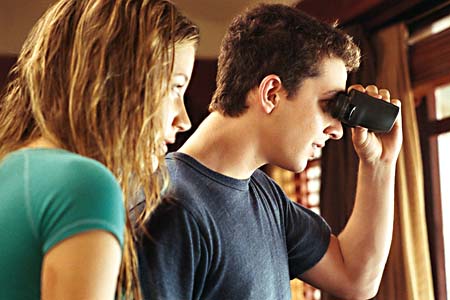
Disturbia (DJ Caruso, 2007) Take Rear Window and remove any veneer of civility to it and you have Disturbia. The voyeur this time around is a kid with an ankle bracelet and a three-month house probation. After exploring his boundaries and testing his limits, he grows tired of electronics and junk-food, and begins to spy on his neighbors for thrills. Fortunately there're the new neighbors next door with the comely daughter, and unfortunately, there's the creepy older guy (David Morse, who can play good or bad angels interchangeably) who clubs and routinely brings home one-night-stands with one-too-many.
 
Oh! Did I mention that a lot of young women are routinely disappearing?

Did I mention that said grounded voyeur's recently widowed mom might have "the hots" for this guy? And before you can say "I am thy father's spirit," the kid is thinking she's in danger.
What separates Disturbia from Hitchcock's older, wiser film and why Sir Alfred and John Michael Hayes are head and tails better that DJ Caruso and Chris Landon and Charles Ellsworth is that the situation was set up in a way that the windows that James Stewart's character peered into were like mini-movie theaters reflecting his own fears of settling down in a domestic situation (even if it is with Grace Kelly!). His voyeur recognized himself in his various targets.
Young Kale Brecht (
Shia LaBoeuf) has no such depth. True, his vantage point is limited to three houses, but all of them are occupied by antagonists of a sort. He's dead set against two of them, and the neighbor girl he just WANTS to BE against. And being as this is a movie aimed at teens, the resulting Guignol is Grand and then, not so, sort of like The Silence of the Lambs without a hint of maid service, designed to merely creep out and punch up the "ick" factor.
And, of course, it has to be resolved with the kid taking direct, violent action because, hey, he's a teen-ager—he needs to consciously murder someone to fulfill himself. Even "Hamlet" had the good moral sense to give the hero his just desserts.
As an inferior remake with borrowed pretensions, I sent Disturbia back on its merry little way to infect another household, not unlike the tape in The Ring.
Not quite "you watching you watching them," 
more like "Me watching me watching me watching me watching me..."

Saturday, August 26, 2023

Cars 2/Transformers 3/Audiences 0

It's been a good Summer for Movies. That something you don't see every year. Summers have become the #1 pole position for opening movies—School's Out and kids are getting out—so, the hot months get stuffed with releases for franchises and action movies (the End-of-Year releases are Oscar-bait). But, this year has seen a couple of good, original movies that have beaten the trends—and beaten the franchise box office receipts—and ensured that all the doors of the multiplexes can be opened again.

But, at the time I wrote this—at the time of these films' respective releases—it had been a pretty lousy Summer.

"The Summer of Our Discontent"
or 
"Cash for Clunkers"

You almost don't want to go To the Movies this Summer. Oh, we were warned; so many sequels and comic-book movies, the "experts" pouted and clucked. But the law of averages were in the audience's favor; there had to be something good in "the numbers."* But, this Summer has made me a little gun-shy and I hesitate from pulling the trigger on my credit card for a ticket. Nothing's excited me so far (apart from The Tree of Life**) and it's July already. Of the comics films, only X-Men: First Class had powers and abilities far beyond most super-hero movies—certainly over the previous "X-Men" entries. The 3-D "phenomenon" has constricted budgets, pushed opening dates, and the only thing it seems to add is an extra dimension of "suck" to the productions in the end.

Two recent releases left me so completely unmoved—probably because they were manufactured machine-movies about manufactured machines manufacturing fights with each other—that I thought it best to combine them under one article...so I wouldn't have to spend too much time contemplating their existence, and simply move on. They also evoked the same thought of "What do I care what happens to machines? Machines can be re-built!" 

And movies series can be re-booted. There are a couple I'd like to give the boot to right now.

Ultimately, both films are just long commercials for toys. Better to buy the toys and make your own adventure than what's being served.

"Spare Parts"

I went into the original Cars with exceptionally low expectations, and found a surprisingly fun little film to appeal to the NASCAR crowd and anyone who had a love for the open road. Automobile comedy would seem to be the lowest gear for laughs, but Pixar (and its guru/director John Lasseter, this time co-directing with Brad Lewis) managed a fine film that, if it fell short of the other Pixar products, at least managed to land on all four tires...and that's where the rubber meets the road.

But, what do you do for a victory lap? Go around the field one more time? (Well...yeah). With the novelty of a talking car universe safely a given, Cars 2 expands the concept, so that everything is talking, cars, boats, planes—although the oil-rigs featured are strangely mute.  It also goes global, with an environmental plot about an oil billionaire car (???) who decides to go "green" and develops a new fuel called "Allinol" (heh) and a promotional World Grand Prix to go with it. This gives "Lightning" McQueen (voiced by Owen Wilson) to go head-gasket-to-head-gasket with his racing rival, Francesco Bernoulli (John Turturro, who is having fun) for a best two out of three.
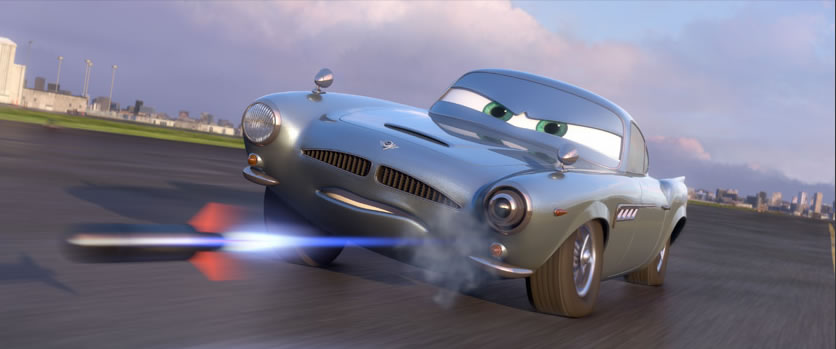
Ah, but there's sand in the gas-tank, when a car-tel of lemon-models (Pacers, Pintos, Gremlins, Ugos) led by an evil genius (my guess it was an Edsel, but I was wrong) wants to exploit a weakness in the gas to destroy the racers in the Grand Prix, and it's up to Special Agent Finn McMissile (voiced by Michael Caine, standing in for a friend, I think)—a gadget-laden Aston Martin/Miata hybrid—and his co-agent Holly Shiftwell (Emily Mortimer) to stop the plot and learn the secret identity of the evil genius behind it all. In a case of mistaken vin numbers, these crack agents think that Mater, the tow-truck (Larry the Cable Guy) is their American contact with information to stop the plot in its tire-tracks.
Now...wait a minute. I know it's a movie about talking cars (fergawdsake), but it takes a new meaning of the term British Intelligence to make that kind of mistake. So, the movie shifts its emphasis from the McQueen caracter to Mater very quickly and the movie never really recovers...I mean, there's only so much Larry the Cable Guy a person can take. The movie's tone has the feel of those '60's films where they used to shoe-horn Rowan and Martin or The Three Stooges into a spy plot because it was "a trend" and they couldn't come up with anything better...or appropriate. 
So, it's all a little "off," the timing chain a little twisted, not sparking on all cylinders. It LOOKS good—the city-scapes haven't looked so lovely since Ratatouille (
although everything looks a little miniaturized, like a play-set), and the movie has a fairly amusing sequence in Japan—but the film moves way too fast to appreciate all the chrome and options and it's too loud and obnoxious that the impulse is to roll the windows up and ignore it. Despite a stellar cast (Vanessa Redgrave voices The Queen?  And did I hear Michael Gambon—uncredited—as the disguised voice of the villain?) and despite its emphasis on Mater, nothing mattersthere's no conflict, there's no drama—just a hokey plot, some slip-shod comedy, and everything running on auto-pilot.
As such, it would have been more appropriate to have Roger Moore as the voice of the spy-car.

Cars 2 may be buffed and shined, but its parts are used and worn, and rather than having that "new car" smell, it has a distinct lemon-scent.
(Wilhelm Alert @ 01: 24)
 ——————————————————————————————————————————

"Rock-Em, Suck'n Robots"

You should have no expectations walking into any film, but you really need to lower your guard going into a Michael Bay construction. His early films are such an annihilation of style over substance—to the point where action sequences are a mashugenah mish-mash between what looks like slo-mo Americana commercials for insurance—that you wonder if the guy at that point had any sort of talent whatsoever (I mean, Tony Scott has the same commercial gloss to his films, but at least you can follow them).

Over time, though, Bay's act has gradually gotten better. The action sequences smoothed out without losing any of the kinetic energy the director was striving for. Maybe there was even a good idea or two among the shrapnel flying through the air. But, the emphasis was always, and will always be I suspect, about demolition derby film-making with the occasional "grace note" of grinning nihilism and exploitive misogyny. One suspects that Michael Bay may become a better film-maker, but he will never grow up.
And he's still playing with toys
. He directed all three "Transformer" movies, including the latest,
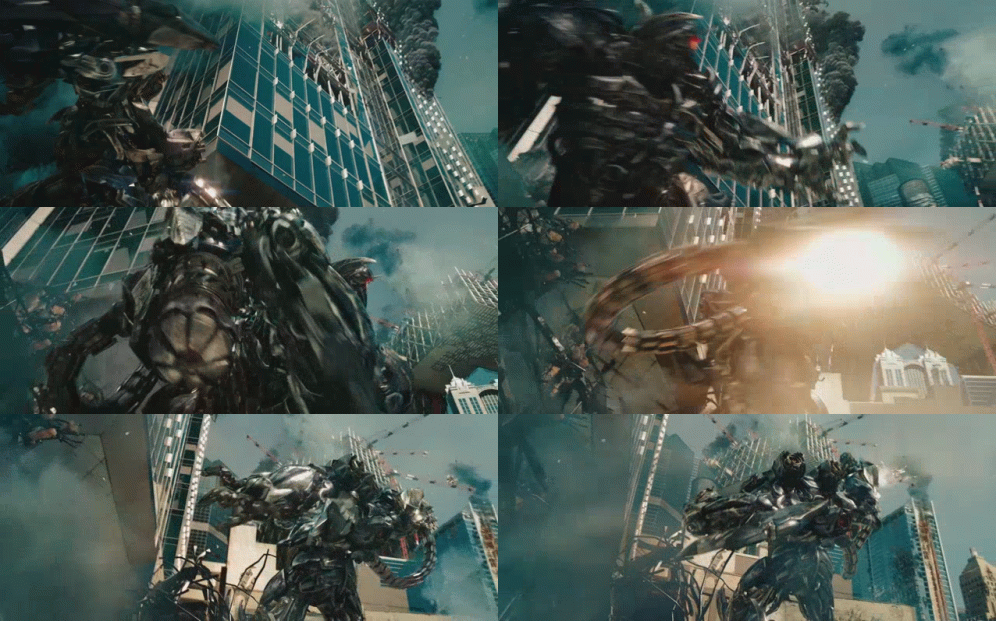
Transformers: Dark of the Moon, and before getting into what's wrong with it, here's what's right: the action sequences, particularly a crazed, high-strung highway chase and a mechanical urban brawl fought on three fronts through the high-rises of Chicago*** are marvels of imagination and quite "followable"—in other words, Bay is starting to understand the logistics of a good action sequence involve perspective and relatable occurrencesthe swooping overhead shots let you see the relationships of what's happening, rather than just presenting a hodge-podge of in-your-face shots.  Yes, they go on too long—the evidence being the kids in the audience who couldn't sit in their seats long enough even when things started to go crash and boom—but at least things made sense, rather than merely noise and rubble.  Now, if he could just have things happen simultaneously—rather than have things stop on the other fronts while he concentrates on one sector—Bay might actually generate something his movies always lack: suspense.
So, the technique is improving, but he's still a far distance from being a mature film-maker.  The few women cast in the film, save
Frances McDormand who manages to retain some inventiveness and dignity in her role, are all dressed like hookers with Bay's camera leering over their curves,
**** the dialogue attempts double entendre but never gets beyond the singular stage, and the annoying Beavis and Butt-head mini-robots from the last film are back and just as juvenile.  The whole movie has the same air of arrested development, although attempts are made to make it seem like it is happening in something more than a fantasy world where aliens disguise themselves as muscle-cars. The plot revolves around a derelict Autobot being salvaged from the Moonits detection being the genesis of Pres. Kennedy's push for a fast lunar landing (and a cameo by "Buzz" Aldrin attempts to lend credibility to the idea).*****  But, there are also "realish-world" cameos by Kennedy (eerily good effects work), Nixon and Robert McNamara (not so much), Walter Cronkite (TV archival footage) and Bill O'Reilly (which negates the credibility factor...a lot). John Turturro returns, and John Malkovich has a small role as a gung-ho business exec. Shia LaBeouf is on-hand (much more caffeinated than usual, probably to be better noticed and for good comic effect, as, Unicron knows, the robots are DEADLY serious), and there's just enough of his parents in this one to outwear their welcome, whereas they were one of the best things in the original. Here, that role is provided by Alan Tudyk, who enlivens the first half of the film before he's made into a functionary.
But, human interaction other than urgently delivered exposition or awkward comedy is rare as human beings become mere flotsam (sometimes literally) in the crushing of gears against gears. Since I've whined in the past that the "Transformers" movies have suffered from "Saved-by-a-White-Man" Syndrome (where a movie's ethnic entities' problems are solved by the usually-white star), this is actually rather refreshing (in fact, the girl-friend/model is the only one who does anything to influence the fight, by displaying the same kvetching characteristic she does with LaBouef's character, a nice touch if you actually believe it inspires what transpires, rather than her merely being turned into designer-charcoal as an annoyance). 

One looks for small signs of hope wherever one can, when one is dealing with something in so need of repair.

Ultimately, though, for all the metallicrash on the screen, my attention kept returning to my watch...I couldn't wait to get out of there.
One further thought to Bay's detriment: he can't direct 3-D (the format I saw Transformers: DOTM in. On too many occasions, the illusion was spoiled by Bay's insistence in putting an out-of-focus obstructing "something" in between the viewer and the "focus" of the scene...which in 3-D...DOES NOT WORK! The eye wants to focus on the nearest object and move outward in focus, and with merely a "blur" to look at, gets mixed signals, leading to a frustrating viewing experience. Bad idea. And given that Transformers was designed to be shown in 3-D, some bad direction.

* Just because there's a number in the movie title doesn't mean it's going to be bad—it amuses me that the intro on the Cars 2 poster says "From the Makers of Toy Story 3. And there are the inevitable jokes—that Ocean's 11 was followed by Ocean's 12, and I remember a comedian saying about Malcolm X: "I never saw Malcolm I-IX!! I saw Super and Super 8 this Summer...where're the other 6?

** Meek's Cutoff was interesting, but nobody's going to see that.  So much for blazing trails.

*** You shouldn't take these things too seriously or literally, although Roger Ebert in his nicely disingenuous journal entry "On the Origin of Transformers" wonders why such a global conflict should be limited to "the corner of Michigan Avenue and Wacker Drive in Chicago."  Um...budget?

**** Bay's very first shot of the female leadRosie Huntington-Whiteley, a Victoria's Secret Model (but still...) is an up-skirt shot of her walking up a flight of stairs. This isn't exactly the tradition of women making a "grand entrance."

***** This is the same "Buzz" Aldrin who, when confronted by an Apollo landing-hoax enthusiast, hauled off and punched the guy!  Who's getting the black eye now?

Wednesday, August 23, 2023

Eagle Eye

Written at the time of the film's release...

"Where's LaBeouf?"

Jerry Shaw (Shia LaBeouf) has just had $71,500 dropped into his bank account. Giddily, he snatches up the money, runs home, and pays two months rent in advance. The landlady mentions something about all the boxes. Jerry spins inside, turns on the light, and finds he's walked into a nightmare--crates of sensitive materials and bomb-making equipment, pistols, rifles, night-vison goggles, F-16 training manuals...oh, and several tons of ammonium nitrate—enough to level another Oklahoma municipal building.

The moment is so well-staged that it evokes an audience-wide "Woh!"

His cell phone rings. A female voice says, "The FBI will be at your apartment in thirty seconds. Get out now!" He hasn't learned to move fast enough yet.

Dedicated mom Rachel Holloman (Michelle Monaghan) has just shipped her son on a band-trip to Washington D.C. and is relaxing for some girl-talk and a boiler-maker when she gets a phone call. A female voice tells her to go outside and look at the window of the McDonald's across the street. On the promo monitor, she sees a "live" shot of her son en route, and the voice tells her to go to a specific parked car—right now—or her son will be killed. She goes.
Remember the story about the pizza-delivery guy who robbed a bank, got caught, and told the police that he was forced to do it or a necklace he was wearing would explode
?
* And while waiting for the bomb squad, the device went off, killing him? Evidently, so did the screen-writers for much of Eagle Eye recalls that bizarre scenario of an innocent forced to commit acts against their will. But that organization attached to that phone-voice must be near-messianic in scope because it can monitor your progress by hacking into security-cams, and eases their near-escapes with constant directions and remote access to reader-boards, cell-networks, automated machinery, traffic lights, military equipment, cranes, high-tension towers, anything electronic or capable of broadcasting, right down to the X-ray machines at the airport check-points. Needless to say, there's a scene at Circuit City where this anonymous group goes to town.
It's a movie that, more than any theater announcement, compels you to turn off your cell-phone in the theater.
Who or what organization is doing this and why? Throughout the movie, I was harboring the suspicion that whatever the reasoning behind the elaborate, sometimes crazy, plot, it would not live up to the preposterous hook of the film. But it almost does, using as its center a security risk that this nation has practically inscribed in its Constitution—a blunder as big as lining up all your planes at Pearl Harbor. It's a scenario that's been used before in spy/suspense fiction, and Eagle Eye owes a lot to those writers, as well as the scribes for such diverse films as
I, Robot, The Manchurian Candidate, Colossus: The Forbin Project, The Man Who Knew Too Much, 2001: a Space Odyssey, North By Northwest, Telefon, The Lady from Shanghai, and The Conversation. That's quite a diverse roster of films, paranoia being their common thread.
Director
D.J. Caruso helmed a previous Shia LaBeouf box-office winner, Disturbia, and manages to make wide-open landscapes as restrictive as the limited point-of-view of that earlier film. Sometimes too restrictive. Two highway smash-ups are shot so close that one gets no sense of the relationship of mayhem to mayhem--they could be happening in separate states for all we see. However, the strategy benefits a sequence utilizing an airport's baggage conveyor system—making it as dizzying as a turn through a carnival fun-house.
LaBeouf has a bit more energy than he displayed in the "Indiana Jones" film, and Michelle Monaghan (of Gone Baby Gone) shows she's just as capable doing action work as well. Billy Bob Thornton is wonderfully dry as an FBI agent, Rosario Dawson gets to be taken seriously as an Air Force investigator, and Michael Chiklis makes a fine Secretary of Defense.
It isn't art, but it's a good ride--a pop-corn movie with just as much shelf-life and nutrition-value, while being a nice little tumble through the history of techno-thrillers of the past thirty years.
 
* 2023 Aside: Matt Reeves used the same bit in The Batman.

Saturday, August 12, 2023

Transformers: Revenge of the Fallen

Continuing with my complete repertoire of "Transformers" movie reviews—there are three and I ran out of patience after two—for the next couple of "Take Out the Trash" Days.
 
Can Steven Spielberg convince Martin Scorsese to direct a "Transformers" movie? How about Greta Gerwig? I'd like to see an Aaron Sorkin-scripted Transformers movie (Transformers: The One About the Thing). I must be going through Post-Barbie Depression.
 
"Boys With Toys"
 or
"We Just Dropped Ten Tons of Dead Robot in the Middle of Nowhere."
 
As I recall, my three biggest beefs with the first "Transformers" movie was a) it was your basic racial bait-and-switch movie where the story of a repressed class is sublimated by having the story told through the eyes of a bankable star not of that class, b) the action sequences were ultimately boring and c) Michael Bay made every woman look like a hooker.

Other than that, I didn't mind it as some things were done quite well, indicating that Bay might actually become a filmmaker some day, as opposed to being a well-organized ring-leader and money evaporator.
But Transformers: Revenge of the Fallen* shows no such progression, and is quite a deal worse than the original. The problems with the first film have not been resolved, and the filmmakers have moved on to ignore more weighty problems like coherent writing, clear visual story-telling, or having a point besides making money and providing jobs for friends.
By now, the five-story high Auto-bots have become known to the military (thanks for noticing) if not the public at large, and should be working arm in cog to ward off alien attack, become an early, early warning system, vaporize garbage or at least become part of the motor pool. But it appears their job is to sit in one those ubiquitous governmental underground bunkers, stay out of the way of lucrative weapons manufacturers and kvetch about the government in charge. In other words, they've become part of the legislative branch with the major difference being that they actually go into battle themselves.**
And their nemeses, the evil Decepticons? They're doing much the same thing, except oiling their wounds, going back to the drawing board and plotting revenge. It would appear they have a long-standing grudge against Earth and its inhabitants, which is why this pan-galactic epic battle seems to be centered here, rather than some other arm of the Milky Way. Maybe we really are the Center of the Universe...and it attracts trouble.
***
Speaking of self-absorbed monomania, Sam Witwicky (Shia LaBeouf) is off to college, with more beating of breast and patting of wallet by his braying parents (Julie White, Kevin Dunn) who were a welcome relief last time, but are now just wacky walking punch-lines.
Then there's the only reason fathers are taking their children—
Megan Fox
who's achieved a reputation as a Hollywood hottie and probably did a lot of practicing having a cold trying to get out of her contract-mandated participation, and might have done if she were a better actress. Fortunately, she's not required to do much outside of your typical Almay or shampoo commercial, until the latter part of the film where she's required to run in front of large gasoline explosions. I'd be worried for her as her mascara doesn't appear to run at all, but she doesn't lose so much as a false eye-lash.
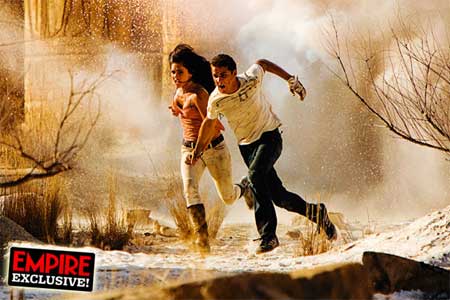
The movie is built of the spare parts of a lot of past Studio franchises, and as with most out-sourcing a lot of the pieces don't fit. The Decepticons have a tier-structure (the Decepticon Overlord at one point even says "And you will, my apprentice"), a magic bling must save the day, Sam has trouble saying the "L" word, and there are magic scribblings that they have to go to an expert (John Turturro returning to good comic effect), in order to stop the evil erector sets from setting off a device hidden in the Pyramids that will stop the sun (I'm not sure what that would be but I suspect it's some triangular Maytag ice-maker). Take Transformers, strap on "Indiana Jones," plug in "National Treasure," screw on a pneumatic "Star Wars," some "Gremlins," program in some "DaVinci Code," stir a few thousand times to make it incomprehensible and drop it with a huge clank on Independence Day.
Ultimately, it's a big mess with Bay setting up a swooping crane shot for every line of dialog, and the screenwriters setting up their expositions over explosions so you can't hear all their mumbo-jumbo. The only time the movie comes to life is an extended sequence on campus when Sam, possessed by a piece of the evil Decepticon-maker freaks out in a classroom and goes all "Beautiful Mind" scrawling encryption's on his dorm-room wall, while also avoiding the predatory come-on's of a sorority sister, who's actually a Decepticon in drag. At that point, the movie becomes giddy and fun with complication piled on complication and LaBoeuf displaying some of the manic energy that makes him interesting to watch.
But that's ten minutes out of two and a half hours of a loud, obnoxious version of "Rock'em, Sock'em Robots." And that's the bottom line of this mess. It was made for the necessities of the Studio making it, not for any artistic need to tell a story. Just as the Studios plan a few years ahead to make "tent-pole" franchises to strategically shore up dividends in the Summer and Christmas, this movie was constructed of sequences dictated by locations cheap enough to shoot in. That, unfortunately, is how the Bond producers have been manufacturing movies for the past two decades: having run out of Ian Fleming titles, they check to see where they can save the most money and set their movies there, and write the script around the location (Hitchcock would utilize locations for material as well). The problem is there's more to a screenplay than "location, location, location." The Bond series perked up only when they had Fleming's "Casino Royale" to provide that film its spine and heart.
But there's no point and no inspiration to Tranformers: Revenge of the Fallen, there is only contrivance, and the makers were scraping the bottom of the scrap-heap to do that. The old "Transformers" series used to kill off characters to encourage kids to buy their new lines of toys. One can imagine the day when Revenge of the Fallen will overcrowd the dumpsters of America, as well.
* Reviewer Jim Emerson had the foresight to alphabetize it as "Transformers: ROTFL"

** Hey kids! There are new Auto-bots based on Smart-cars, but instead of speaking French, they're street-cred hipsters and are as annoying as a weekend with Jar-Jar Binks. In fact, these characters aren't only annoying they're vaguely racist (!!??), but then there's a major disconnect with this movie about its audience. It's aimed at kids, but amid all the cussing and humping dog jokes, I could see more than a few parents putting their heads in their hands at the questioning up-turned faces of their kids. It's also aimed at the kids who played with "Transformers" in the 70's and...haven't yet evolved. They were the ones "huh-huh-huhing" at off-color humor. Hollywood has yet to learn that the AICN crowd are a fickle bunch and won't necessarily "open" a movie for you. But then, a goodly number of current directors are fan-boys themselves.

*** At one point at an attempt at depth one of the characters says of the robots: "If God made us in his image, who made them?" Hasbro, Einstein! And probably in China.