Showing posts with label Billy Bob Thornton. Show all posts

Wednesday, August 23, 2023

Eagle Eye

Written at the time of the film's release...

"Where's LaBeouf?"

Jerry Shaw (Shia LaBeouf) has just had $71,500 dropped into his bank account. Giddily, he snatches up the money, runs home, and pays two months rent in advance. The landlady mentions something about all the boxes. Jerry spins inside, turns on the light, and finds he's walked into a nightmare--crates of sensitive materials and bomb-making equipment, pistols, rifles, night-vison goggles, F-16 training manuals...oh, and several tons of ammonium nitrate—enough to level another Oklahoma municipal building.

The moment is so well-staged that it evokes an audience-wide "Woh!"

His cell phone rings. A female voice says, "The FBI will be at your apartment in thirty seconds. Get out now!" He hasn't learned to move fast enough yet.

Dedicated mom Rachel Holloman (Michelle Monaghan) has just shipped her son on a band-trip to Washington D.C. and is relaxing for some girl-talk and a boiler-maker when she gets a phone call. A female voice tells her to go outside and look at the window of the McDonald's across the street. On the promo monitor, she sees a "live" shot of her son en route, and the voice tells her to go to a specific parked car—right now—or her son will be killed. She goes.
Remember the story about the pizza-delivery guy who robbed a bank, got caught, and told the police that he was forced to do it or a necklace he was wearing would explode
?
* And while waiting for the bomb squad, the device went off, killing him? Evidently, so did the screen-writers for much of Eagle Eye recalls that bizarre scenario of an innocent forced to commit acts against their will. But that organization attached to that phone-voice must be near-messianic in scope because it can monitor your progress by hacking into security-cams, and eases their near-escapes with constant directions and remote access to reader-boards, cell-networks, automated machinery, traffic lights, military equipment, cranes, high-tension towers, anything electronic or capable of broadcasting, right down to the X-ray machines at the airport check-points. Needless to say, there's a scene at Circuit City where this anonymous group goes to town.
It's a movie that, more than any theater announcement, compels you to turn off your cell-phone in the theater.
Who or what organization is doing this and why? Throughout the movie, I was harboring the suspicion that whatever the reasoning behind the elaborate, sometimes crazy, plot, it would not live up to the preposterous hook of the film. But it almost does, using as its center a security risk that this nation has practically inscribed in its Constitution—a blunder as big as lining up all your planes at Pearl Harbor. It's a scenario that's been used before in spy/suspense fiction, and Eagle Eye owes a lot to those writers, as well as the scribes for such diverse films as
I, Robot, The Manchurian Candidate, Colossus: The Forbin Project, The Man Who Knew Too Much, 2001: a Space Odyssey, North By Northwest, Telefon, The Lady from Shanghai, and The Conversation. That's quite a diverse roster of films, paranoia being their common thread.
Director
D.J. Caruso helmed a previous Shia LaBeouf box-office winner, Disturbia, and manages to make wide-open landscapes as restrictive as the limited point-of-view of that earlier film. Sometimes too restrictive. Two highway smash-ups are shot so close that one gets no sense of the relationship of mayhem to mayhem--they could be happening in separate states for all we see. However, the strategy benefits a sequence utilizing an airport's baggage conveyor system—making it as dizzying as a turn through a carnival fun-house.
LaBeouf has a bit more energy than he displayed in the "Indiana Jones" film, and Michelle Monaghan (of Gone Baby Gone) shows she's just as capable doing action work as well. Billy Bob Thornton is wonderfully dry as an FBI agent, Rosario Dawson gets to be taken seriously as an Air Force investigator, and Michael Chiklis makes a fine Secretary of Defense.
It isn't art, but it's a good ride--a pop-corn movie with just as much shelf-life and nutrition-value, while being a nice little tumble through the history of techno-thrillers of the past thirty years.
 
* 2023 Aside: Matt Reeves used the same bit in The Batman.

Thursday, November 20, 2014

The Judge (2014)

Father Thy Honor
or
"You're a Big Boy"

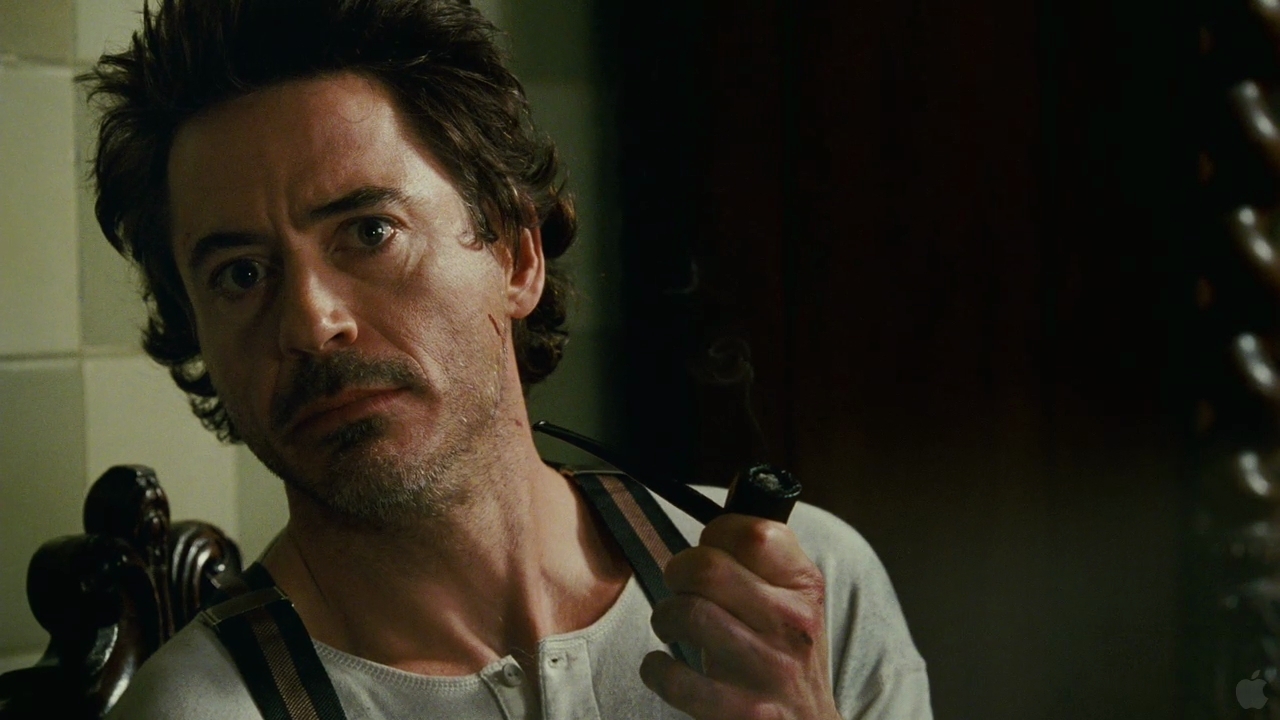
Robert Downey Jr's production company, Team Downey, produced its first feature, The Judge, and the verdict is a little mixed. One might dismiss this as a "vanity" project—he is headlining it, after all, if it wasn't such an effort to allow him to stretch out of his comfort zone as an actor (and Downey could hardly be said to have a "comfort zone") out of the iconic roles (Iron Man, Sherlock Holmes) that made him the most popular and successful actor in Hollywood.

And it is a bit of risk-taking on the actor's part. His smart-ass lawyer, Hank Palmer, is good—almost too good—at what he does in the courtroom. When asked how he feels defending the guilty, he shoots back "Innocent people can't afford me." Outside of the oak chambers, though, he's a bit of a mess. A lone wolf due to his off-putting sardonic nature, he's estranged from any family he's known; his wife is cheating on him and they're in the pre-nup phase of a divorce, and he has no contact with his family in his hometown of Carlinville, Indiana ("Grampa Palmer is dead to me," he says to his daughter when she asks why she can't go back there with him).
That's a particularly cruel and snarkily ironic way to say it to her, given the circumstances. Because he is going back home to Carlinville. His Mom is dead, and not just in a relationship way. She is dead, and he's been called home for the funeral after a decades long leave of absence. He hasn't been called by his father (Robert Duvall), who is a judge in Carlinville, but by his older brother Glen (Vincent D'Onofrio), who has never left. And so, Hank reluctantly but dutifully, drives to Indiana, knowing that disaster awaits him.

He doesn't know the half of it.

It's around this time (about fifteen minutes in) that The Judge gets in trouble, both in its story-line and behind the camera. Director David Dobkin (Shanghai Knights, Wedding Crashers) does a tight shot of Palmer driving back to Carlinville, pulls back from the SUV, then swoops around the vehicle to a high-overhead tracking shot of the surrounding (legitimately, quite lovely) countryside. It's a nifty high-tech shot, a combination of studio shot, motion graphics tracking and CGI.

But why? One could reach for an answer (moving from Palmer's self-contained city-view to the more bucolic , slower-paced country life of his youth), but...we're not there yet, and neither is the character. There is a lot of effort made to impress, and all quite unnecessarily. Dobkin is gilding the cinematic lily and without much rationale. That's a problem prevalent throughout The Judge, with an awful lot of craft going into too little art (one could say this about a lot of superhero movies, too). It times it distracts from what is going with the true focus of the story and where its strengths lie—situation and performance. Perhaps Dobkin didn't think he had enough to do, in which case, he hasn't learned one of the best rules of directing—do as little as possible. This flaw extends to camera placement and lighting, which is too often too dramatic—especially in the inevitable courtroom scenes, where it would appear none of the attorneys could actually read their notes, so dark and brooding is the lighting in these scenes (Spielberg's "prestige" cinematographer Janusz Kaminski did the photography).
"Justice is blind" they say
—probably because they didn't turn on the lights in the courtroom.
Yeah, it is dark in there, but one could say not much light is shed on the judicial process—this is more of a family drama, with familial conflicts representing the conflicts between judging and defending. Here, it's all tied up in a nice little bow. Soon after the funeral, the two Palmer's are locking horns, until the elder is placed under arrest for vehicular homicide—a felon the judge put away several years previously is out of jail and killed on the street, and the judge's car bears the marks of a collision with a body. The judge does not remember the incident—he swears he does not remember. And the animosity between father and son bubbles to the surface and becomes inextricably tangled with the advocacy/adversarial nature of court proceedings. Dad doesn't approve of his son's methods and so shuns his services for a defense; the son distrusts the father while also desperately seeking the approval the judge rarely dispenses. It's a torturous analogy—the two can only link and come to an understanding through the reversal of roles of judge to defendant and defense to prosecutor, and rely on their ingrained judicial respect to get at "the truth, the whole truth, and nothing but the truth."
So help me, God, I found the whole experience a little precious. Yes, there are interesting complications to distract: why the judge is reluctant to discuss the case for reasons physical, philosophical, and practical; the smarty-pants prosecutor (Billy Bob Thornton, bless him) whose ideals make him a vested opponent of the whole defense team; the victim's family whose vehemence only excludes torches and pitch-forks; and the township, which is divided between supporting the life-long judge and bringing him down for the justice he has meted out over the years.
The direction is problematic, but the performances can't be faulted across the line. Even Vera Farmiga, one of our best actresses, who is reduced to "the girlfriend" role, manages to rise to the occasion, and Downey and Duvall are well-matched flinty combatants, who, even as their characters veer off into territories that are hard to comprehend dramatically or logically (do either of these guys have any sense of self-preservation?) still manage to invest their characters with a sort of truthiness just short of perjury that makes one suspend disbelief...at least while the movie is going on. It's only in the cold light of deliberation that one comes up with a hung jury.