Written at the time of the film's release...
"Turning Natalie Portman Into a Girl"
or
"That 'Flippy' Thing You Did? Good Call."
"SUCH a chick-flick!" said one of the young women sitting in front of me at the conclusion of No Strings Attached, the new rom-com with Natalie Portman (who exec-produced, as if you didn't have ENOUGH reasons to hate her) and Ashton Kutcher. This one might be the most negligible film in the 12 month span which will see her in five new movies (based on previews, I think Thor might actually be the weakest link), having a kid, getting married, and probably winning an Oscar (Geez, Nat,' over-achieving much?).
And, yeah, total chick-flick, but one with a tiny spin to it, although it still falls into the "happily-ever-after" formula they've followed since the days when we innocently worried that Doris Day might lose her chastity to Rock Hudson. No such worries here. There's a lot of hay-rolling in this one, body-double or no, although we see more of Kutcher's tush than hers (for a change). Virtue is not the issue here, but "true love,"* now permanently split, I guess, from sex (not that they really got along).But, and this is the "neat twist," it is Portman's Emma Kurtzman, who has commitment issues, not, as is typical, the male of the species. "I'm not really an affectionate person," she blandly tells her camp-buddy Adam (they keep "meeting-cute" throughout their lives, which in movie terms means they're destined to be together (Hell, they're in a romantic comedy—of course, they're destined to be together!). But, when both are "available," they have a brief encounter (clocked at 45 seconds), that puts Emma in mind that, rather than suffering through that whole "relationship thing" that they become "friends with benefits," casual sex partners available at the drop of a text message. Then, in a Hawksian role-reversal, which, as in His Girl Friday, makes the original premise snap into focus a little better, it is Kutcher's TV-assistant director who wants something more, as in commitment, from which Portman's Emma wrinkles her nose, rolls her eyes and turns on her heel. It gets complicated. It gets messy. It gets resolved.
This sounds like a dreadful premise, but for all the "R"-rated language and suggestiveness (though never veering into "bro-mance" crudeness), and the seemingly-required "safe" arc of the storyline,** it is a clever and funny movie in the particulars, thanks in no small part to Elizabeth Meriwether's clever screenplay, a less-leaden-than-usual direction by Ivan Reitman, and a splendid ensemble above and below the title. Incidents and details seem fresh and buoy you up, disguising the fact that there may be some clockwork mechanism behind the face, and the cast makes the most of these moments, making it all play fast and a little loose (with the exception of Kevin Kline, who is just a little practiced and arch as Kutcher's never-grown-up father, but that could be explained away as he's an actor). Portman manages to make her "stick-in-the mud" Emma stiff and likeable simultaneously, and is only too happy to sacrifice her dignity in scenes (she has a great drunken wobble-walk in high-heels that's priceless), and Kutcher—who gets a lot of stick for just being Ashton Kutcher—doesn't take himself so seriously that he avoids turning winsomeness into weakness. Both's comic timing makes for a good chemistry, despite the obstacles their characters regularly throw between each other. In the end, it is two people's trip to normalcy in a chaotic world that seems to want to either crush them or ignore them, and only by narrowing their focus to each other can they achieve the specialness they think they deserve.
* ...and, coincidentally, Cary Elwes, Westley from The Princess Bride, is in this, although discretely disguised behind a nerdlinger beard, so he doesn't pose a realistic threat to Kutcher.
** One of these days I have to finish that post on Judd Apatow.
Showing posts with label Mindy Kaling. Show all posts
Wednesday, June 12, 2024
Wednesday, June 13, 2018
Ocean's 8
The Ego Has Landed
or
Why Does There Always Have to be an Asterisk?
So, this whole parity thing is getting complicated and a little obvious now. When men do a heist movie, they get Ocean's 11, but when women get one, they only get Ocean's 8? Really, folks, how fair is that? And they have to work even harder to get the same results, a passably entertaining little light-hearted snatch-and-grab movie, intricately plotted out and stylishly laid out to a fare-thee-well.
There are some ties to the other "Ocean's" movies—there are a couple cameos (surprisingly, current cameo-master Matt Damon isn't one of them*), and the ring-leader is the sister of the purportedly "late" Danny Ocean, Debbie (played by Sandra Bullock), and even though it's produced by the Ocean's director Steve Soderbergh, it is written (with Olivia Milch) and directed by the same guy that Soderbergh did second unit work for on The Hunger Games, Gary Ross.
Debbie, like brother Danny in Ocean's 11, talks her way into a parole from a New jersey prison (women's) and leaves with $45 dollars to her name but with a plan she's been working out for "five years, eight months, and twelve days." She makes her way to New York and, through sheer chutzpah and gall, talks her way into a swanky hotel room for the night and begins to carry out her prison-plan. She hooks up with former partner Lou (Cate Blanchett) who's been running a club and talks her into the score—to conduct a one-of-a-kind robbery at the glitzy Met Gala, and starts the recruiting process: they need a designer down on her luck—that would be Rose Weil (Helena Bonham Carter) who owes the IRS five million dollars; a hacker (who isn't Russian)—that would be "Nine Ball", the coolest hacker ever (Rihanna); a jewelry artist/appraiser (Mindy Kaling); a great pair of of hands (Awkwafina) and a Fixer (Sarah Paulson) and they lay out the plan—to steal the "biggest, spectacularly blingy Liz Taylor jewels", the legendary Toussaint necklace, worth over $150 million in cold, hard 2018 dollars.
* Well, I guess he was but his part was cut.
or
Why Does There Always Have to be an Asterisk?
So, this whole parity thing is getting complicated and a little obvious now. When men do a heist movie, they get Ocean's 11, but when women get one, they only get Ocean's 8? Really, folks, how fair is that? And they have to work even harder to get the same results, a passably entertaining little light-hearted snatch-and-grab movie, intricately plotted out and stylishly laid out to a fare-thee-well.
There are some ties to the other "Ocean's" movies—there are a couple cameos (surprisingly, current cameo-master Matt Damon isn't one of them*), and the ring-leader is the sister of the purportedly "late" Danny Ocean, Debbie (played by Sandra Bullock), and even though it's produced by the Ocean's director Steve Soderbergh, it is written (with Olivia Milch) and directed by the same guy that Soderbergh did second unit work for on The Hunger Games, Gary Ross.
Debbie, like brother Danny in Ocean's 11, talks her way into a parole from a New jersey prison (women's) and leaves with $45 dollars to her name but with a plan she's been working out for "five years, eight months, and twelve days." She makes her way to New York and, through sheer chutzpah and gall, talks her way into a swanky hotel room for the night and begins to carry out her prison-plan. She hooks up with former partner Lou (Cate Blanchett) who's been running a club and talks her into the score—to conduct a one-of-a-kind robbery at the glitzy Met Gala, and starts the recruiting process: they need a designer down on her luck—that would be Rose Weil (Helena Bonham Carter) who owes the IRS five million dollars; a hacker (who isn't Russian)—that would be "Nine Ball", the coolest hacker ever (Rihanna); a jewelry artist/appraiser (Mindy Kaling); a great pair of of hands (Awkwafina) and a Fixer (Sarah Paulson) and they lay out the plan—to steal the "biggest, spectacularly blingy Liz Taylor jewels", the legendary Toussaint necklace, worth over $150 million in cold, hard 2018 dollars.
They zero in on the host of the gala, Daphne Kluger (Anne Hathaway, clearly enjoying playing a diva with a sharp eye toward satire), manipulating her to be dressed for the gala by Weil, who suggests that she wear the thing for the night, then infiltrate the Met's security company, and embedding a spy at Vogue to get the seating arrangement for the fancy dinner.
The idea is to isolate Kluger and then rip off the necklace in the confusion. It's planned out to the second and by the inch, but even the best-laid plans have their details that complicate—like, for instance, the necklace having a fancy clasp that must be electronically triggered before it can be removed, as well as complications that might stop the gears of the plan that have to be overcome, in the best "Mission: Impossible" style.
This is a well-greased vehicle for its cast and for its intended female audience. Ocean's 11 had men (boys, really) trying to rob casinos with all the testosterone and gamesmanship associated with it. Ocean's 8 is full of opulence and fashion and glitz, the feminine equivalent of passing fancies (and, of course, all the 8 are given expensive frocks to pull off the heist).
There is the underlying satisfaction that the rich are getting soaked, but, as with the males, it's really a left-handed form of wealth distribution—the usual formula of a heist movie.
But, I kept watching Ocean's 8 and seeing how small crimes are pulled off with ease in ways that the more nefarious—or just greedy—members of the audience can take advantage of. Don't be surprised if, in the next few months, the stores you frequent really DO insist that you have the receipt when you bring in "returns" or start getting very protective of their camouflaging logo-sporting bags. Subtle corporate psychological weaknesses of the those employed in customer service are also instructionally exploited, although results may very. But, if the movie does one thing it might actually instruct folks how easy it is to gain information through Facebook. Now, that might actually do some good while doing bad.* Well, I guess he was but his part was cut.
Friday, March 30, 2018
A Wrinkle in Time (2018)
Our Father, Who Art in Hyperspace
or
Wrapping it Up in the Third Tesseract
Gosh, I think it's been a half-century since I read Madeleine L'Engle's "A Wrinkle in Time," which won the Newberry Prize (and that was the reason I read it). The particulars of the book have long passed on, but I remember how well she captured childhood angst and alienation—for an adult, she knew a lot about the trials of being a kid—and the introduction to the mind-blowing concept of a tesseract (which she described simply as a fourth dimensional space—if a square is two dimensions, a cube is its progression in three, then a tesseract is the fourth configuration). When I read it, it made absolute sense that, given a fourth dimension, a tesseract would be the way to cross space to other places, other dimensions. It was a matter of not-simple geometry and will. L'Engle made you believe...because if she knew what made you tick, she probably had a good handle on the Universe, as well.
Well, it's been 65 years since the book was published (after being rejected by all the major publishers), has never NOT been in print (owing to its popularity) and, in that time, we've seen space-time, warp-speed (Star Trek), "folding space" (Dune), "hyper-space" (Star Wars) and the ever-handy "wormhole" feature as short-cuts in space.
Disney's second attempt at making an adaptation of A Wrinkle in Time (after a 2003 Canadian adaptation that, when L'Engle was asked if it lived up to her expectations, famously said "I expected it to be a disaster and it didn't disappoint me.") has less of an "Afterschool Special" vibe and certainly creates a bigger canvas (when representing the Universe, after all). The cast of kids is great—with an especially high fist-pump for Deric McCabe of making the toughest character work as both Purpose and Antagonist, rather than "that annoying kid" who just complicates things—and lead Storm Reid as the hero on the hero's journey.
Meg Murry (Reid) is miserable. School is boring and unbearable. She's the oldest kid who has to "grow up a little early" because Dad's gone in the family dynamic. That "Dad" (Chris Pine) is a theoretical physicist who has been absent for four years—and nobody has any explanation why—is a big heart-shaped keyhole in Meg's psyche. All of her issues seem to stem from that empty space—her relation to her Mother (Gugu Mbatha-Raw), her reception at school (where his disappearance is a source of "Mean Girl" torture) and, basically, everything.
But, all that changes with the appearance of Mrs. Whatsit (Reese Witherspoon), a being whom her little brother Charles Wallace (McCabe) has befriended and she mentions a way of traversing time and dimensions called utilizing a tesseract, which Whatsit hints is behind what the elder Murry was studying and might well have created the situation of his disappearance. She is an astro-traveller, who, with Mrs. Who (Mindy Kaling), and Mrs. Which (Oprah Winfrey) help, Meg, Charles Wallace, and a tag-along sympathizer, Calvin (Levi Miller) on a quest to go and rescue Dad, and make the Universe and, thus, life better.
The other thing about the movie that bugs me is that the kids are very down-to-Earth and respectable—they're deserving of something mind-blowing to happen to them—but the adults are not awe-inspiring, not in any sense, but merely curiously eccentric or (in the case of Oprah's Which) too deliberately "sagey," who do magic things that make everything work out better because that's what's to be expected. There's never a sense of real peril or real stakes, and with mentors who are less inspiring and more window-dressing.
I walked out underwhelmed, but secretly glad I'd read the book so many years ago because, frankly, the movie wouldn't have inspired me to read it.
One wants a Wrinkle in Time to invoke a sense of wonder, rather wondering what went wrong.
or
Wrapping it Up in the Third Tesseract
Gosh, I think it's been a half-century since I read Madeleine L'Engle's "A Wrinkle in Time," which won the Newberry Prize (and that was the reason I read it). The particulars of the book have long passed on, but I remember how well she captured childhood angst and alienation—for an adult, she knew a lot about the trials of being a kid—and the introduction to the mind-blowing concept of a tesseract (which she described simply as a fourth dimensional space—if a square is two dimensions, a cube is its progression in three, then a tesseract is the fourth configuration). When I read it, it made absolute sense that, given a fourth dimension, a tesseract would be the way to cross space to other places, other dimensions. It was a matter of not-simple geometry and will. L'Engle made you believe...because if she knew what made you tick, she probably had a good handle on the Universe, as well.
Well, it's been 65 years since the book was published (after being rejected by all the major publishers), has never NOT been in print (owing to its popularity) and, in that time, we've seen space-time, warp-speed (Star Trek), "folding space" (Dune), "hyper-space" (Star Wars) and the ever-handy "wormhole" feature as short-cuts in space.
Disney's second attempt at making an adaptation of A Wrinkle in Time (after a 2003 Canadian adaptation that, when L'Engle was asked if it lived up to her expectations, famously said "I expected it to be a disaster and it didn't disappoint me.") has less of an "Afterschool Special" vibe and certainly creates a bigger canvas (when representing the Universe, after all). The cast of kids is great—with an especially high fist-pump for Deric McCabe of making the toughest character work as both Purpose and Antagonist, rather than "that annoying kid" who just complicates things—and lead Storm Reid as the hero on the hero's journey.
Meg Murry (Reid) is miserable. School is boring and unbearable. She's the oldest kid who has to "grow up a little early" because Dad's gone in the family dynamic. That "Dad" (Chris Pine) is a theoretical physicist who has been absent for four years—and nobody has any explanation why—is a big heart-shaped keyhole in Meg's psyche. All of her issues seem to stem from that empty space—her relation to her Mother (Gugu Mbatha-Raw), her reception at school (where his disappearance is a source of "Mean Girl" torture) and, basically, everything.
But, all that changes with the appearance of Mrs. Whatsit (Reese Witherspoon), a being whom her little brother Charles Wallace (McCabe) has befriended and she mentions a way of traversing time and dimensions called utilizing a tesseract, which Whatsit hints is behind what the elder Murry was studying and might well have created the situation of his disappearance. She is an astro-traveller, who, with Mrs. Who (Mindy Kaling), and Mrs. Which (Oprah Winfrey) help, Meg, Charles Wallace, and a tag-along sympathizer, Calvin (Levi Miller) on a quest to go and rescue Dad, and make the Universe and, thus, life better.
That's such a galaxy crunching scenario that it squeezes the story to white-dwarf proportions, but that is essentially that. It's Wizard of Oz, with cosmology replacing dream-states brought on by trauma, and Ava DuVernay's film of it basically takes the Oz scenario and expands on the "feel-good" aspects without dealing too much with the mechanics of how we got here in the first place. One gets the impression that everything is done by "wishing it were so" which is not exactly what L'Engle was going for (see, kids, don't get too carried away with your work wasn't exactly a theme of hers, but it seems essential to The Disney Version). The kids use Dad's work to essentially save him AND the work, validating it and him...and themselves in the process.
And that's what "gets" me about this Wrinkle in Time, as much as it struggles to "gee-whiz" me with color and imagination, pushing my buttons, but not engaging my mind, it fairly buries the world-expanding concepts it is supposed to celebrate. The movie makes the experience an internal one, not a possibilities-expanding one, and that's antithetical to the source-work. It's sure a spectacle, but it's one of those movies where (probably due to some studio dumbing-down, maybe?) things happen because you want them to happen with no limitations and no ground-rules, but is made glossy enough that it thinks it smears over the improbability and objections and resulting emptiness such processes invoke when there's nothing solid behind it.
![]() |
| Meg explains a tesseract—but it's not in the movie |
One wants a Wrinkle in Time to invoke a sense of wonder, rather wondering what went wrong.
Saturday, June 27, 2015
Inside Out (2015)
Humor Me
or
"Forget it, Jake. It's Cloud-Town."
One should never make an assumption going into a movie because it will cloud the experience and make you not appreciate what is really up there on the screen as a personal experience, rather than by, say, assessments of critics, studio-hype, or the impressions evoked by a trailer.
Pixar's latest, Inside Out, looked to be not much. The characters are cartoon-y, and not impressive in their rendering, like (you know) Minions or like a lot of the output of Dreamworks Animation. Pixar movies are events, pushing the form of animation, digital graphics and for just plain story-smarts, and the only time they've failed (I'm thinking the Cars movies and Planes) they've really dumbed down the artistry on all fronts. Inside Out looked to be like that, a place-holder until they could get The Good Dinosaur finalized.
Silly me. Inside Out may be the best Pixar movie yet, and that is saying a very Big Something. One of the best things about the studio's output has been its story-sense—that story comes out of character. Here, they do the flip-side: character comes out of story.
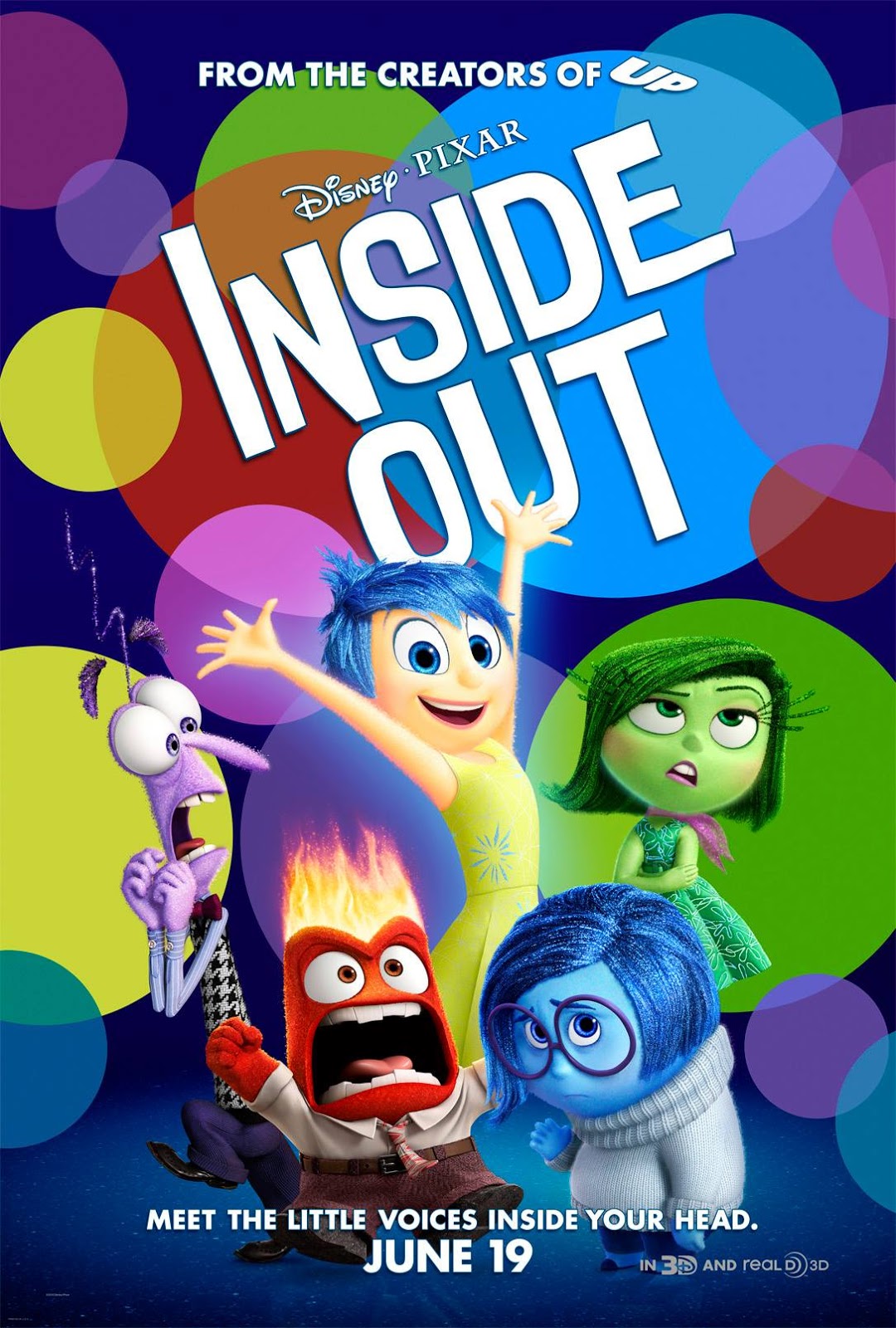
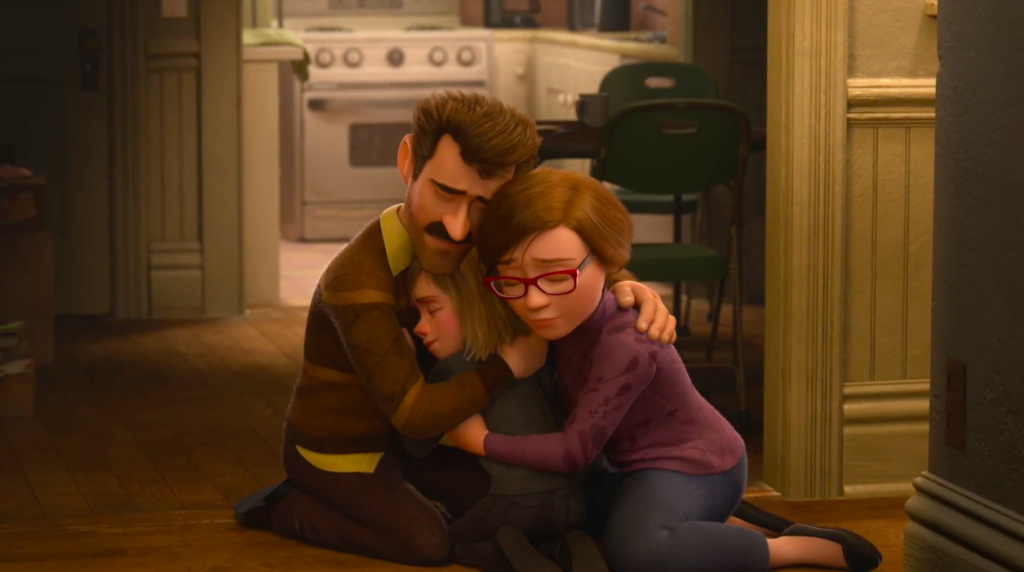
One doesn't want to talk too much about the particulars in depth because there is a lot of that, and part of the joy of Inside Out is discovering that depth and just how far the writers (especially) and the Pixar team go to achieving it. So, here's a gloss: Inside Out is about Riley (voiced by Kaitlin Dias), an 11 year-old girl living in Minnesota, into ice-hockey, and living a fairly normal life. Her family (Mom and dad are voiced by Diane Lane and Kyle McLachlan) move the family to San Francisco, uprooting Kiley's normal, changing schools, leaving friends and on a basic level shattering her "normal."
That "normal" began as an infant when she first opened her eyes and experienced "Joy" (voiced by Amy Poehler). The emotions that drive Riley throughout her childhood are brilliantly imagined and worked out on a mechanical level, but "Joy" is soon joined by "Sadness" (Phyllis Smith of "The Office"—brilliant). "Fear" (Bill Hader), "Disgust" (Mindy Kaling—ditto), and "Anger" (Lewis Black—of course). These five emotions mix and commingle, fight and compromise, getting Riley through her day, then call it "a day" when she goes to sleep. (One of my favorite lines is this summation from "Fear": "Okay, we did not die today. I call that an unqualified success!")
But "The Move" has put a serious whammy on the life of Riley, taking her completely out of her comfort zone, creating a crisis of her unconscious and throwing her emotions into a tizzy—see where this is already going? It will take some serious adjustment in her head for things to be set right, and that quest is where the bulk of Inside Out if focused. It's an animated psychology lesson (that won't freak out the Scientologists, as they say the same things at their molten core), a philosophy strategem (that can't be accused of social engineering) and probably does as much as a library of self-help books to get your head on straight (and, even in 3-D, it only charges $10.50 an hour—the chairs are comfortable, too).
I can't recommend this one highly enough. The most praise I can heap on it is to merely so "go." Do not hesitate. Go see it. Whatever version you see, however much you spend on it, will be worth it.
Inside Out is "dedicated to our kids. please don't grow up. ever."
May Pixar do the same.
If you want to see Pixar's amazing graphics capabilities, the short preceding it, Lava, will fulfill that need.
* Okay, I'm simplifying there, although the characters of the emotions are definitely mindful of basic UPA cartoons. The home scenes are the same artfully detailed images Pixar lavishes attention on.
or
"Forget it, Jake. It's Cloud-Town."
One should never make an assumption going into a movie because it will cloud the experience and make you not appreciate what is really up there on the screen as a personal experience, rather than by, say, assessments of critics, studio-hype, or the impressions evoked by a trailer.
Pixar's latest, Inside Out, looked to be not much. The characters are cartoon-y, and not impressive in their rendering, like (you know) Minions or like a lot of the output of Dreamworks Animation. Pixar movies are events, pushing the form of animation, digital graphics and for just plain story-smarts, and the only time they've failed (I'm thinking the Cars movies and Planes) they've really dumbed down the artistry on all fronts. Inside Out looked to be like that, a place-holder until they could get The Good Dinosaur finalized.
Silly me. Inside Out may be the best Pixar movie yet, and that is saying a very Big Something. One of the best things about the studio's output has been its story-sense—that story comes out of character. Here, they do the flip-side: character comes out of story.
One doesn't want to talk too much about the particulars in depth because there is a lot of that, and part of the joy of Inside Out is discovering that depth and just how far the writers (especially) and the Pixar team go to achieving it. So, here's a gloss: Inside Out is about Riley (voiced by Kaitlin Dias), an 11 year-old girl living in Minnesota, into ice-hockey, and living a fairly normal life. Her family (Mom and dad are voiced by Diane Lane and Kyle McLachlan) move the family to San Francisco, uprooting Kiley's normal, changing schools, leaving friends and on a basic level shattering her "normal."
That "normal" began as an infant when she first opened her eyes and experienced "Joy" (voiced by Amy Poehler). The emotions that drive Riley throughout her childhood are brilliantly imagined and worked out on a mechanical level, but "Joy" is soon joined by "Sadness" (Phyllis Smith of "The Office"—brilliant). "Fear" (Bill Hader), "Disgust" (Mindy Kaling—ditto), and "Anger" (Lewis Black—of course). These five emotions mix and commingle, fight and compromise, getting Riley through her day, then call it "a day" when she goes to sleep. (One of my favorite lines is this summation from "Fear": "Okay, we did not die today. I call that an unqualified success!")
![]() |
| Anger, Disgust, Joy, Fear and Sadness monitoring in Head-quarters. |
It won't affect the Greek's, either, who saw personality in the same way, although controlled by four "humors," each one tied to a body function. In decreasing orders of "Joy," they are sanguine, phlegmatic, melancholic, and choleric. These four aspects controlled personality and informed their medicine, their social interactions, even their arts. Inside Out continues the long tradition of breaking personality into aspects which control our behaviors, our actions, and, ultimately, our lives. It examines character and motivation, not as merely a means to create drama, but to explain our selves.
It does all this and it's a flippin' cartoon! A flippin' cartoon that looks as sophisticated as Gerald McBoing-Boing.* But, then when has a flippin' cartoon tackled childhood angst and the complex dynamic of personality? Of how past experience informs and shapes us, and ultimately guides us, whether we are aware of it or not. It's a cartoon that will entertain children with its bright colors and simple concepts and educate adults, while not preaching, but entertaining, teaching by example and inspiring a path. A warm feeling of familiarity spread through me while watching Inside Out and I can't believe I would be alone in this feeling.
This is what is amazing about the group of artists that make up Pixar, who pioneered the techniques and pitfalls of dimensional computer graphics, only to see their accomplishments copied and emulated. What nobody else has been able to grasp, though, is their story-telling sense. Because, even though the graphics sensibility is a technique that can be copied, their way of combining comedy with a solid lesson-learning prospectus, with the risk of injecting drama—heart-wrenching drama—into their films, whether its the melancholy 'When She Loved Me" sequence of Toy Story 2, the remarkable life-story prelude of Up, the basically-silent first section of Wall•e, or the furnace sequence of Toy Story 3, has taken narrative and emotional risks that only make the films far richer than any technological advance or artist's technique could create. This is also something inherited from the Greeks.I can't recommend this one highly enough. The most praise I can heap on it is to merely so "go." Do not hesitate. Go see it. Whatever version you see, however much you spend on it, will be worth it.
Inside Out is "dedicated to our kids. please don't grow up. ever."
May Pixar do the same.
If you want to see Pixar's amazing graphics capabilities, the short preceding it, Lava, will fulfill that need.
* Okay, I'm simplifying there, although the characters of the emotions are definitely mindful of basic UPA cartoons. The home scenes are the same artfully detailed images Pixar lavishes attention on.
Subscribe to:
Posts (Atom)