Showing posts with label Heist Movie. Show all posts

Friday, May 10, 2024

How to Steal a Million

How to Steal a Million (William Wyler, 1966) Writer Harry Kurnitz (who the story for Hatari!, the novel for A Shot in the Dark, and the screenwriter for Witness for the Prosecution and a couple entries of the "Thin Man" series) could be counted on to deliver a solid story that never really amounted to what it promised...that is, other than to entertain and entertain mightily. Especially if all the elements were in place—good photography, cracker-jack actors, an ornate location or two. He didn't write important pictures. He wrote fluff. Good fluff. That would satisfy audiences, and make critics suspicious that they were being conned.

The story goes that director William Wyler, after directing Audrey Hepburn to an Oscar for Roman Holiday, wanted to re-team her with co-star Gregory Peck for another rompish movie, this time set in Paris. In the forseeable future, however, Hepburn and Wyler worked on The Children's Hour together, Wyler had directed a little film called Ben-Hur, and Peck had won his Oscar for To Kill a Mockingbird. Somehow, the elements wouldn't gel until Wyler put together Hepburn and Peter O'Toole—who was toiling in an endless stream of drama parts, and was probably attracted to the idea of something lighter for a change.
What the fuss is all about...
The story concerns one Charles Bonnet (Hugh Griffith), whose French estate contains some of the world's most renowned art treasures, and who, also, maybe coincidentally, is also one of the world's most unknown art forgers. His daughter Nicole (Hepburn, all Givenchy'd up and no place to go—O'Toole's character makes a crack about it later in the movie) is constantly worried that Dad is going to go too far some day and the Paris gendarmes will come knocking at their door and the family's wealth and reputation will be as worthless as one of Daddy's forgeries.
Wyler, exploiting the film's wide-screen presentation,
must really love that staircase.
So, imagine her dismay when guards, police and armored cars come to the drive-way. Charles assures her that he is merely lending one of his collection, "The Cellini Venus", to the Kléber-Lafayette Museum* for display and the heavy armory is for safe passage. Except for one tiny detail—that "Cellini Venus" is a forgery, too, sculpted by Charles' father and the model for it being his mother. What's more, it is probably more susceptible to being realized as a forgery than one of the family's many paintings. Her father is not worried, and the small Venus is whisked away for display. Nicole is not so reassured.
It doesn't help that while father Charles attends a celebratory soiree at the museum, Nicole** must confront a burglar, one Simon Dermott (O'Toole), caught in the act of examining one of the Bonnet Van Gogh's. In a tuxedo, he's exceptionally well-dressed for burgling, a move no doubt inspired by Charles' absence for the night. But, he's charming enough to be able to disarm the situation, although she does manage to ruin the line of sight by accidentally shooting him in the arm. "Oh, it's just a flesh wound" Nicole scolds. "But it's MY flesh!" he retorts.
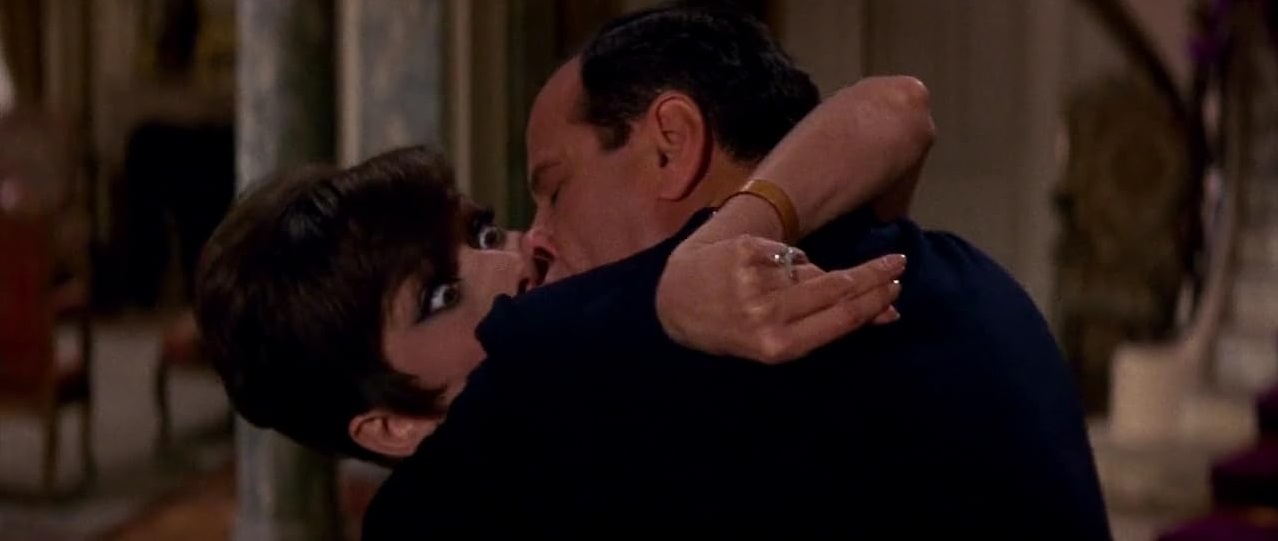
Nicole should be worried. Dermott is something of a fraud himself. Plus, the Bonnet household is being circled by art dealer DeSolnay (Charles Boyer), who has decided to look into the Bonnet provenance and have it investigated. And a rather eccentrically driven American wheeler-dealer (Eli Wallach) wants to obtain the "Venus" by any means necessary—including marrying Nicole. 
And then, there's the major complication: insurance. Charles Bonnet is not worried about the Venus being determined a forgery, as he is merely loaning it out and it need not be examined for authenticity. He thought. But, as the museum has to insure the statue from theft, it must go through the formality of a "technical examination, which will expose the fakery. Bonnet has already signed the papers, inadvertently giving the Museum permission to its study, so surely that will expose the family.
Nicole then decides—mad-cap that she is—to hire Demott (the only burglar she knows) to steal the statue before it can be found out. It takes about an hour of cute dialogue, spry encounters, several costume changes and that nearly lethal incident of "meet-cute" before we get there. The rest of the movie documents the long, drawn-out robbery which relies on false alarms—and we see all of them.
There is magnetism involved among the principal actors—Hepburn pirouettes in her own spotlight, and O'Toole observes, amused. Wyler, on the other hand, is content to make sure we see how expansive the sets are, like he was still filming Ben-Hur. Those sets, however, never seem more than nattily-dressed cavernous sound-stages (his next film would be the equally ornate Funny Girl). How to Steal a Million is a trifle, with all the consistency of just-applied meringue, and with as much confectioner's sugar.
One interesting thing to ponder is what might have been. For the role Wallach eventually played, Walter Mathau (who was in Hepburn's Charade and starred on Broadway in Kurnitz's "A Shot in the Dark" was approached but wanted too much money. Cast instead was George C. Scott, who, unfortunately, turned up late for his first day of shooting...like, after lunch. Wyler, who was already worried that O'Toole and Griffith, two notorious drinkers, were in danger of derailing the project, would not abide such behavior in a third, and promptly fired Scott, which, apparently, greatly upset Hepburn.
 
One can only imagine...
Face it. Whatever the plot, this is what audiences wanted to see.
 
* It's fictional, but then so is The Cellini Venus...

** Interestingly, she is again caught in her bed reading a book involving Alfred Hitchcock (as was also the case in Roman Holiday). I don't know if this was a nod to his fellow director by Wyler, or if Hepburn was attempting to court Hitch to appear in one of his films (although the film Charade is considered the next best thing), but the two never collaborated. Maybe because Hepburn would not have let Hitchcock decide what she wore.

Thursday, April 11, 2024

The Score (2001)

Written at the time of the film's release...

The Score (Frank Oz, 2001) This one is most notable for being the last movie Marlon Brando appeared in, and his presence is probably why DeNiro and Norton and Bassett signed on, because, really, this is no great shakes as a film. It's a rather simple "heist movie," with some interesting switch-backs along the way, which works as an effective metaphor for a bunch of people merely generating a paycheck for themselves. 
 
The first movie directed by Frank Oz that wasn't either a comedy or fantasy, the plot revolves around master-thief Nick Wells (DeNiro), who has decided to retire after a near-disaster during a routine burglary. He knows it's time to get out—he's not getting any younger or any more agile—plus, he's got a rather swanky jazz club to run and right about now would be a good time to settle down with his stewardess girlfriend (Bassett). He's smart, and lasted long enough to know enough to get out while the getting is good.
Then, his fence, Max (Brando) calls with a proposition. The proverbial "one last job" of heist movie clichés. The one to retire on. Seems there's this French scepter thingamabob that was being smuggled into the U.S. through Canada and didn't exactly pass customs. It's being held in an impenetrable safe in a security basement with extra CCTV cameras and infrared sensors at the Montréal Customs House. Everything about the job sets alarms off in Nick's head that it's too risky, from the elaborate job to the extra help he has to take on in the form of Jack Teller (Norton), who has all the details of the job from working as a mentally challenged janitor. Jack has all the details, but he's a bit headstrong, and more than a little reckless.
Of course, there are complications of extra security measures and some inconvenient timing and one twist that should be seen coming a mile away—and luckily the characters in the movie are just as prescient as the audience. It's all quite credible—Mythbusters even gave a thumbs up to the safe-cracking method—and Oz stages it elaborately, but in the end, it's just another heist movie with complications.
One can say that The Score is also notable as having three generations of the top "Method" actors—Brando, DeNiro and Norton—all in the same movie together and doing scenes with each other. But if you expect to see sparks fly between
DeNiro and Brando (The Two Don Vito Corleones) the way they did between Pacino and DeNiro in Heat, you're going to very disappointed.  
Bassett
is completely wasted in the movie as "The Girlfriend," and Norton pulls off one of his "so-good-it's-scary" impersonations, this time as a retarded kid, which borders on the cruel. No, the only sparks are the ones that happened between Brando and director Oz.
Brando didn't like the way he was being directed, so he decided he'd play games calling Oz "Miss Piggy" (of course, Oz played her in "The Muppets") It's just another indication of how far Brando was slipping—a perpetual jokester and lover of comedy, he couldn't even be charitable acknowledging Oz's gifts as a performer. The Score is not a great indicator of anyone's work (except the cinematographer's—Rob Hahn), but it's a shame that Brando went out on this one.

Saturday, May 14, 2022

The Duke

"Not That Sodding Painting Again!"
"Be discreet in all things, and so render it unnecessary to be mysterious." 
The Duke of Wellington
Kempton Bunton (Jim Broadbent) is an embarrassment. A retiree, he never seems to be able to keep a job, much to the consternation of his beleaguered wife, Dorothy (Helen Mirren) who is a house-cleaner for the ministerial Gowlings. No, instead Kempton keeps writing plays for the BBC to produce and they're always rejected. Perhaps in revolt or retribution, he's removed the coil from his telly so he doesn't have to pay the tax imposed to get the government station, which he has to pay whether he receives it or not. It's a tax revolt, he says. Pensioners and veterans shouldn't have to pay a bloody tax to get the National News. And he doesn't give a fig who knows and, in fact, instead of getting a job, he'd rather sit in the street to get petitions signed for free BBC. On top of that, son Jackie (Fionn Whitehead) is spending less time at home, wanting to become a shipbuilder, while other son Kenny (Jack Bandeira) supposedly works construction in Leeds, but might actually be doing some things unlawful in his free time. Dorothy, with so much on her shoulders is fit to bust, with her taking most of the load and him off on his do-gooder campaigns, compensating.
Compensating?  Well, it isn't discussed in the house, but there was another Bunton—Marion—dead at 18 from a bicycle accident and it was Kempton gave her the bike. He blames himself, and doesn't tell Dorothy about the visits to her grave, as she won't discuss it in her house, and Marion's portrait is itself buried...in a desk drawer. Dorothy is the bread-winner and she's the wife and that is respected, even if things happen that she doesn't need to know about.
But, a 13 day stretch in Durham prison for not paying the television tax is her last straw. Now, he's a felon and bringing dishonor to the household.
Kempton, to keep the peace, asks for one last indulgence: he wants to go to London to talk to "the Beeb" about his plays and take his tax initiative before the Parliament—after all, they just paid £140,000 for a ruddy Spanish portrait of the Duke of Wellington, it's the least they can do to hear him out. And after that, he'll get a proper job...and keep it. No more quixotic campaigns, no more lying. He'll do his bit and Helen is relieved.
The trip to London, however, does not go well. No one at the BBC will see him, and at Parliament, the guards do see him...out...onto the street. Maybe it was the bullhorn. Anyway, when he returns, there's a new resident under the roof—that portrait of the Duke of Wellington that Kempton's been grousing about. To keep Dorothy from finding out, he hides it making a false back for the bureau in Kenny's room. Nobody'll find it there.
Certainly not the authorities, who think it's commando's or super-sophisticated art thieves behind the theft and haven't a clue as to who's behind it. Certainly not the cheerfully cantankerous old duffer who is protesting in plain sight and is outspoken enough that it gets him fired from every job he's lucky enough to land.
It's "based on a true story" which means nobody could make this stuff up. Not the circumstances, not the psychological underpinnings, and certainly not the quixotic nature of its main protagonist, who, for all his bluster, is at heart a good soul. In a film full of fine performances—Mirren and Goode are especially winning—it is Jim Broadbent's fusty performance that anchors the movie even while trying so hard to rock the boat. This is one of those movies that charm "the blue-hairs" but is so winning without pushing the twee factor that one respects it for all the chuckles it induces.
Credit the excellent script—which throws in an added mystery and motivation that adds depth rather than obfuscation—and the direction of Roger Michell, who didn't live long enough to see the film released. Michell's use of split-screen might seem like a concession to 1960's period-style, but it does produce one essential grace note that moves the heart, while also locking in the notion that everyone has their own framing, whether self-induced or imposed, that we reside in, that keeps us at arm's length.
The Goya's "not all that good, is it?"  But The Duke is something of a masterpiece.

"The Duke" makes a cameo.


Sunday, January 9, 2022

Red Notice

Saturday is traditionally "Take Out the Trash" Day.

Three Eggs Make an Omelette
 or
A Gal Caught Between a Rock and a Nut-Case
 
So, the story is that Cleopatra received three ornate eggs given to her by Marcus Antonius on their wedding day (historical note: they never married), and over the centuries, two of those jewel-encrusted eggs had fallen into the hands of museums or private collectors, after being discovered by a farmer in 1907, and the third is still out there, it's whereabouts unknown.
 
That's the McGuffin of Red Noticethose three eggs—but as they're McGuffins, they could be anything. Precious jewels, gold bullion, carved birds, lottery tickets, Arks of the Covenant, Sacred Stones, The Holy Grail or Crystal Skulls. That's the curious thing about these types of movies—we as the audience don't care about what the stakes are as much as the people in the story care about them. If the story of the hunt is entertaining, we're along for the ride, whatever the thingamabob is. They can be Sacred Sow's Ears as long as they make a silk purse of a movie out of it. For the viewer, it's a lot like buying crypto-currency; Perception is all. (That's three simple words, Matt Damon)
 
The perception, of course, is that Red Notice would work. You have three stars, each capable of having a movie financed as long as they're in it (forget that the last couple of movies of each have been lackluster at the box office). They're all entertaining in their own right and have a favorable public perception, so putting them in one movie will make it three times as good. Right?
Right? Well, we'll get there. There's a lot of activity at Rome's
Museo Nazionale di Castel Sant'Angelo, where one of those Cleopatra eggs is on display. Inspector Urvasi Das (Ritu Arya) is leading a team of Interpol agents and massive FBI criminal profiler John Hartley (Dwayne Johnson) on his suspicion that the egg is about to be stolen by the legendary art thief Nolan Booth (Ryan Reynolds). The Museo's security chief is dismissive because his security measures are unbreakable, there have been no attempts, he doesn't know anything about Hartley, and, look, the egg's right there in front of all these crowds here.
But, this is The Rock, after all. He rips his own shirts, jumps around skyscrapers and pilots boats over tsunami's! He sings, he dances, he even has snit-fits with Vin Diesel! Of course, there's reason to be concerned! To everyone's surprise, Hartley breaks through security and melts the displayed egg with a can of product placed Coke®—not even the Diet or Zero Sugar version! The egg has already been stolen! Displaying his crack comic timing, Booth (who is in the crowd because he's so subtly stealthy) immediately lights out while the Museo's security measures slooooooowly go into place, allowing Hartley' FBI agent to manfully wrestle them from closing entirely in his pursuit. Booth is amazingly spry and quick-thinking and makes fast-work of evading the guards and creating a lot of damage in the museum's conveniently safety-defying construction zone—there's a Wilhelm scream and many sound-alike ones for the sharp eared. The sharp-eyed will merely start rolling them.
But, when Das and Hartley track Booth down at his home in Bali, the egg is stolen by Booth's rival Sarah "The Bishop" Black (
Gal Gadot) while it is being secured...because Gal Gadot looks so much like an Interpol strike force commando. Because of the botched recovery, Das has Hartley arrested—instead of investigating it for six weeks—and has him and Booth incarcerated...in a high security Russian penitentiary. That's right, a Russian penitentiary. Why? I don't know, I'm just reading the graphics! But, Booth and the man who arrested him get to share the same cell (!!) and plan to make their escape, after Black confronts them and offers to have them released if Booth tells her where the third egg is...as he apparently knows its location.
By now, you're asking why Booth needed to steal the museum egg if he already knew where the third one was. By now, I had stopped asking questions like that as I knew that I would have to call 9-1-1 to have them put me in a padded cell for observation if I was going to make it all the way through this 90 minute movie...and I was only 30 minutes into it. Let's just summarize that the movie continues in this throbbing vein with lots of set-pieces, changes of locale, and a snarky quip from Reynolds' Booth every 9.5 seconds—the best one is
"Man, we've got bad fathers. It's a miracle we're not strippers!"—and double, triple and quadruple crosses (if you're even bothering to keep track), underpinning the many plot-holes that the movie digs for itself.
Did I like the movie? I didn't have enough Xanax to be absolutely sure, but I will say this: with a film this that has the consistency—and nutritional value—of cotton candy, one desperately clings to the stars as if it were the last hanging thread of a rapidly fraying rope. And each, in their own way, disappoints. One can hardly blame them, the script gives them nothing—absolutely nothing—to work with, and one gets the sense that they're riffing with whatever star-stuff they can ooze from their pores. Reynolds has the "Bob Hope" role; he takes nothing seriously and just does the free-ranging Deadpool "schtick" devoid of context and appropriateness. Very early on, you get the sense that anything this character achieves is done by accident, as he is such a jabbering screwball, he must be thinking up zingers rather than keeping his mind on what he's doing. Frequently, his character is bound or tied up, but they never gag him because, as a result, 90% of the movie would just go away.
Gal Gadot is another matter. I'm a big fan of hers, my opinion only increasing after watching out-takes of the Wonder Woman movies, where she cracks up incessantly over the sheer absurdity of what she's being asked to wear and do. Yet, when the cameras roll, there is a professional dedication to making the uncredible credible and through sheer force of will makes you believe. The stakes to "make it work" aren't as high here, and so Gadot falls back on personality. Perhaps inspired by Reynolds' irreverence for the material, she, at times, just "has fun with it" (as the useless direction goes), prancing, singing, trying anything she can to make what she's got to do seem lively, but it's inconsistent throughout the movie, which, although it works when scenes are dragging, makes you take her less seriously when she drops it in scenes where she has less to do. A consistent attitude to one or both of the male leads would have helped...but that's the script's fault.
Finally, there's "The Rock". I think Dwayne Johnson is a national treasure. He is quite capable of doing anything, and he does comedy and drama equally well, and as a personality has a propensity for not taking himself seriously which puts him head and shoulders above the Schwarzeneggers and Stallones when it comes to the action genre. They're capable of dull heat, but Johnson sparkles with star quality, risking the perception that his physicality or power won't be taken seriously. The truth is he can overpower any presence sharing the screen with him, and has done so frequently. Here, though, maybe in deference to his co-stars, maybe to set himself apart and find his own lane, maybe to ground the thing a bit, he puts in less of an effort and coasts. It's disappointing, and one wonders what might have happened if he pushed it just a bit more, stepping on a Reynolds line, being more of a rogue, instead of playing straight man. Johnson should not set up, when he's capable of hitting things out of the park.
And they each got $20 million bucks doing this. The market will bear what it bears, and I don't begrudge them taking a big front-end pay-off than depending on the gamble of any back-end profits in a time of empty theaters and a streaming pandemic. But, the results are so meager and discouraging that you wonder if anybody could have made this movie work at all. All three of them are capable of "carrying" a movie by themselves, but sharing the responsibilities is a case of diminished returns, a train-wreck, and a disappointment. 
 
It feels like a "third wheel" problem, and maybe one of the three characters should have been dropped, but it's a mystery as to who it should be—it could be any of them, frankly. It's just the shell of a movie and empty inside. Like an egg. Maybe that's the real McGuffin of the movie, if anyone cared.

Wilhelm Alert at 09:50

Thursday, December 2, 2021

Deadfall (1968)

Deadfall
(Bryan Forbes, 1968) Middling Bryan Forbes drama starring Michael Caine as a cat burglar hired by a safe-cracker (Eric Portman) for a nearly impossible job. Actually, the burglar, Henry Clarke had been casing this job for awhile and has checked into a sanitorium to get close to his target, but he's lured into working with the much older safe-cracker by the man's much-younger wife (Giovanna Ralli). Consulting with the couple, the Moreaus, it is decided that they will do a trial run robbing the strong-box of another socialite, with Henry scaling the walls, gaining entrance and then letting the husband, Richard, into the house to break into the safe. The socialite couple will be attending a concert on the prospective night and while they're safely enjoying the performance, the two men will do their night-time prowling, which will involve drugging guard dogs, and Clarke scaling the outside of the mansion, having to perform a maneuver, called a "deadfall", where he must drop from a rooftop to a lower ledge without benefit of a supporting rope.
Now, just the fact that I mention that should alert anyone that Clarke is taking more risks than he should. He does, after all, use a rope to scale the outside of the estate—couldn't he, then, move the rope (or take a second one) to avoid having to perform that risky maneuver? But, no, it doesn't happen that way for the sake of ginning up the suspense, the task of a night robbery being risky enough.
But, then, the whole movie is like that. There are so many lost opportunities and so many unnecessary risks in this less-than-perfect crime that you wonder why nobody questions the job, the partnership, anything for what looks, on the face of it, to be a hopeless enterprise.
Most of the blame must fall on Forbes, who wrote and directed, and had the interesting idea to stage that first robbery to a concert performance. His favored composer, John Barry, wrote an original piece for the film—"Romance for Guitar and Orchestra"—which would serve as the background for the robbery sequence, cutting back and forth between the concert, the robbery, and the villa's staff listening to the concert over the radio. It's the same strategy Alfred Hitchcock used for the meeting of the conspirators and victims at the Royal Albert Hall in his second version of The Man Who Knew Too Much, and as Hitchcock used his composer for that picture, Bernard Herrmann, to conduct on-screen, Forbes had Barry appear as conductor. Interesting little trivia item, and Barry wouldn't appear on-screen again until serving as an orchestra conductor in The Living Daylights, his last film as composer for the James Bond series.

It's a great idea—except that Forbes can't even do that right. Barry does his job—he'd been writing romance and action cues throughout the 60's, and he'd learned that he didn't need to ramp up the pace for action sequences. But, Forbes' penchant for unusual angles and POV makes the performance footage less than interesting. The interest is far more on the robbery, which is shot well, but is rather ruinous in what happens—at one point it becomes apparent to Clarke that Moreau can't open the safe and he begins yelling (Shhhh!) and comes up with a plan B to take the safe by hammering it out of the wall.
Okay, the shouting rather kills the mood of the music, a slight offense, but then, Forbes has Caine hammering the wall...in total silence. Wouldn't the noise—and vibration—alert the staff sitting, a couple hundred feet away, enjoying their dinner to something going on—even if they weren't depending on an alarm system that Clarke had already cut? Does the music playing over the radio—and the soundtrack—mask what is some very concussive noise? One cannot have it both ways and it's stylistically patting one's head while rubbing their belly. It's a very bizarre sequence And baldly contrived.
One wonders why he did it this way; there's a long history of film-heists done in silence and stealth, and this one has neither. Forbes was very much a part of the "Swinging 60's" period of British film-making, but his films were not revolutionary, despite his stagings and sometimes pointlessly arty framing. His films are curiosities, not classics, and every so often they seem to lose the point and get distracted by some half-hearted flippancy. Watching them, they seem to exist in a world that doesn't make much sense and half little to do with the real world. 
 
Good music, though...

Wednesday, August 26, 2020

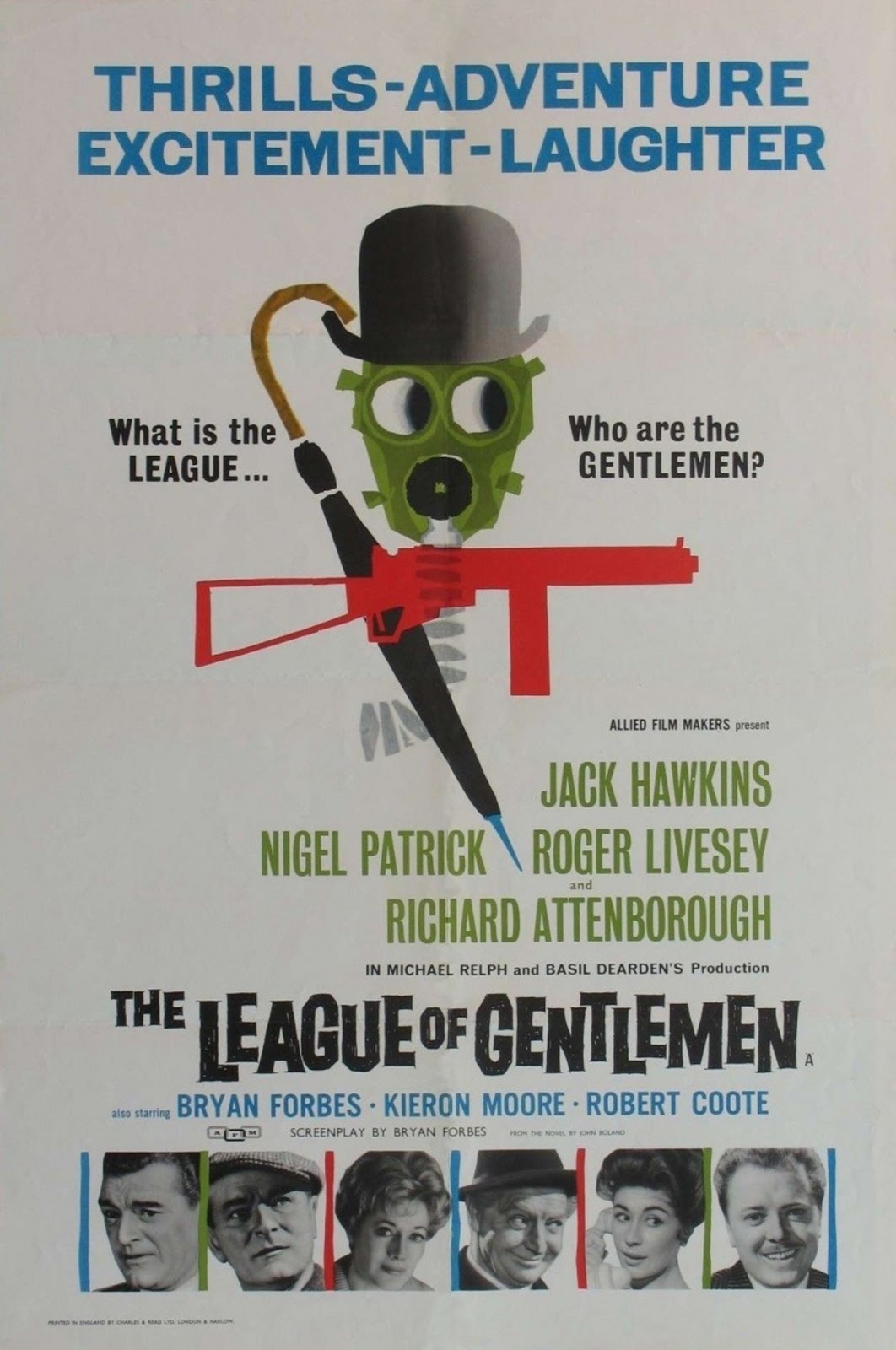
The League of Gentlemen (1960)

The League of Gentlemen (Basil Dearden, 1960) Basil Dearden's semi-whimsical heist film begins with a sequence that is quite out of whack with the rest of the film but gives a sense of the mind-set behind it. It is late at night on a dark noirish street, and the camera creeps up on a man-hole cover. It pops open to reveal Lt. Col. Norman Hyde (Jack Hawkins) surreptitiously looking about to see if his exit might be seen. Then he climbs out of the sewer dressed in a dinner suit. He then makes his way to a Rolls-Royce and and leaves the area.

It's a visual joke, one that would be expected—and was done—in a James Bond film. The juxtaposition of grime and well-heeled attire is a clever little summation of themes, especially in a society built on class, but except for the visual juxtaposition, it will have nothing to do with the rest of the film. In fact, the little episode is never mentioned again. The film proper begins with the next sequence.
Hyde returns to his home and cuts several £5 notes in half and inserts them, with an invitation from "Co-operative Removals, Ltd." to a lunch at the Cafe Royale, into copies of a paperback book of a crime novel entitled "The Golden Fleece."* He puts each into their separate envelopes and sends them out, seven in all. Their destinations are to seven particular men.
Their intended recipients—"all crooks of one kind of another," "all men of the world"—are disgraced military men, "trained at the public's great expense to do things with the utmost efficiency...which, frowned upon in peace-time are acclaimed in times of war." They are—in the photograph above, left to right: Captain Frank Weaver (Norman Bird), former leader of a bomb-disposal unit, drummed out for trying to defuse a bomb while drunk, which ended up killing four of his men—he now fixes time-pieces in his flat; Major Rupert Rutland-Smith (Terence Alexander), discharged "after some embarrassing mess of yours," resolved by hush-money from his rich wife which has left him hen-pecked and reluctantly accepting of her own many indiscretions; Captain Stevens (Kieron Moore), former fascist, forced out for his homosexual activities, which have made him a victim of blackmail, threatening his gymnasium; the high-toned Major Peter Race (Nigel Patrick), whose black-market activities led to his resignation, and now subsists on gambling and a room at the YMCA; Captain Martin Porthill (League screenwriter and future director Bryan Forbes) was kicked out for killing suspected Cypress terrorists and now makes his living playing the piano in dives and as a gigolo; Captain Padre Mycroft (Roger Livesey, of so many films by "The Archers"), formerly a quartermaster was convicted of "public gross indecency" and now, paradoxically, is a con-man using a contrivance of religious ordinations; finally, there's Lt. Lexy (Richard Attenborough), who sold secrets to the Russians and now runs an electronics repair shop for the lowliest of customers.
Hyde, for his part, "served my country well for 25 years and was suitably rewarded by being made redundant" and the experience has left him bitter and useless—all those skills and nothing to show for it. "The Golden Fleece" proved an inspiration on which he could hoist his revenge; he has researched and planned a bank robbery, and to accomplish he has gathered together a troop of morally compromised men with military discipline and specific skill sets to help plan and carry it out. He gives them a limited time to think things over, and, to a man, they agree ("Your presence here restores my basic disbelief in the goodness of human nature," he remarks); Hyde treats them as a military unit, barracking them in his own stately home for drills, research and to serve as a base of operations. Under the ruse of a food inspection for cover, they split off and while part distract the brass, the others steal guns, ammo, and other supplies making it look like an IRA action...when the loss is found.
Once all is arranged, they move their operations to a warehouse where the details are finalized. The goal is to rob a bank of enough resources that the men can split the money each receiving at least £100,000. Can British ingenuity and a proper military training pull off the raid despite improper motives (and the inevitable complications that pop up in these things?) All's fair in love and war...but war exercises?

Dearden, given the military nature of the heist is efficient and a bit ruthless in his direction—nothing fancy and nothing too rococo in how he plans his shots— Forbes' screenplay is witty and dry, and the actors all fill their niche-roles with Hawkins providing a commanding presence in both senses of the word, as both leader and star. The League of Gentlemen could be seen as a more austere version of such playful British heist films as The Lavender Hill Mob or The Ladykillers, but without their sense of twee or whimsy. Additionally, with such a collection of dedicated rotters, given their falls from grace in the eyes of Society, the film-makers evoke enough "sympathy-for-the-underdog" attitude that allows one to think that they just might pull the job off. 

It gives the film that added sense of suspense right up to the last minute.

* In the novel, the book is not "The Golden Fleece," but a real novel called "Clean Break' (written by Lionel White), which was filmed as The Killing by Stanley Kubrick in 1956.

Thursday, April 11, 2019

The Italian Job (1969)

The Italian Job (Peter Collinson, 1969) A fascination with Mini Coopers led me to red-enveloping this, the decidedly more enjoyable version of the story that turned morose when brought to the 21st Century. This version has its tongue firmly planted in its veddy British cheek, and its feet cemented in the swinging 60's. The idea revolves around newly released convict Charlie Croker (Michael Caine) is given the chance to carry-out a brilliant plan—seize four million dollars in gold bullion in Italy. Along the way scriptwriter Troy Kennedy-Martin (Edge of Darkness) and director Peter Collinson throw in a bit of wily commentary, a disdain for foreign cars (more expensive Italian cars are destroyed in this film for the sheer visceral fun of it, and an Aston Martin DB4 convertible trashed in revenge), and the loopiest car-chase in cinema history (which influenced many a car-chase after, although never surpassed), all fine and noble reasons to check out this cult favorite.
The film starts disarmingly with a title segment set to a crooning Matt Monro song (written by film composer Quincy Jones and lyricist Don Black) as a Lamborghini Miura is seen negotiating the hairpin turns of Italian Alps, just as you begin to appreciate the metaphor, the car enters a tunnel, a huge crash is heard, and the Miura is seen exiting the tunnel, wrapped around a bulldozer. Inside the car, the late Roger Breckerman (Rosanno Brazzi) who has been planning a job to steal the bullion sent from China to Turin as a proviso for Fiat to manufacture their cars there. The Mafia, getting wind of those plans, has killed Breckerman before the plan can be finalized, and to destroy the evidence the car is sent careening down the mountainside (the first of many such scenes).
Breckerman's widow recruits Croker to do the job as revenge for his murder, and for financial backing he goes right to the top—Mr. Bridger (the martini-dry Sir Noel Coward), head of a British crime syndicate, which he runs from his prison cell, entirely compromising the warden and staff to his needs. With Bridger's stern approval, the team sets off for Italy with its odd assortment of vehicles to pull off this mission: impossible and prove the superiority of British auto-works craftsmanship over its Italian equivalent.
The job itself is absurd but satisfying, the amazing stunts arranged by car-artiste Remy Julienne, with the cast headed by Caine, including Benny Hill as a perverse computer expert (good match, that). Did I mention the stunts? Beyond the interest to car-afficianado's, there is a marvelous humor to the sequences that produce gaping maws, dropping jaws, but an after-taste of raucous giggling as the cars are made to do things in the oddest places to the point where you may turn in your Hummer for a Mini.* The movie swerves from heist movie to comedy on a dime.
It's a trifle, but an entertaining trifle, far more satisfying in the memory than in the actual playing (which isn't that bad). That's what makes a cult classic, especially in the self-preservation society.


* Did I mention the other day I saw a Humvee almost cause an accident in a parking lot trying to maneuver around a speed-bump? If they're compensating for something, they're doing a lousy job.