Showing posts with label Eric Portman. Show all posts

Thursday, March 6, 2025

One of Our Aircraft is Missing

One of Our Aircraft is Missing
(The Archers, 1942) As dawn breaks at an RAF base, a squadron of planes comes back from a nighttime bombing run of a
Mercedes-Benz plant in Stuttgart. Apparently, the raid has been successful, except for one detail: Wellington bomber "B" for Bertie has not returned. It is presumed lost on the mission, possibly shot down, possibly the crew is lost.
 
One of Our Aircraft is Missing is a British propaganda film with a particular significance. Although it wasn't the first collaboration between director Michael Powell and producer-writer Emeric Pressburger, it is the first of their films that carries their particular partnering label: The Archers. Under that sobriquet, they would go on to produce some of the best British films in the 40's and 50's.
 
But, about that plane. About those pilots.
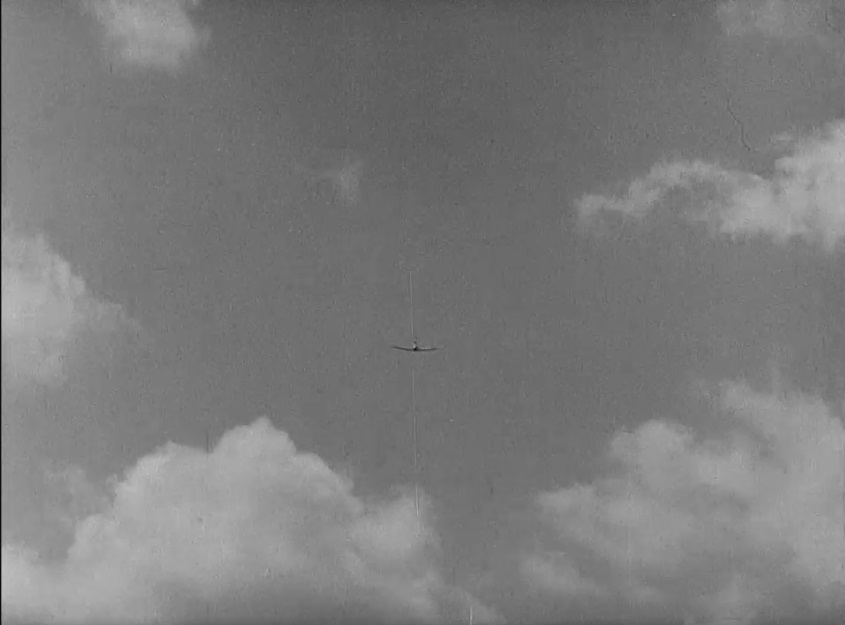
They were doing alright until they hit the Dutch coast. Leaflets were dropped over Cologne, then they headed to their primary target where they flew through some flak and then got hit, disabling their starboard engine. They navigate for a direct course home, get to Holland, but then the port engine kicks and they decide to bail out, the pilot, Haggard (Hugh Burden), stays with the plane as long as he can to try to guide it to the ground with doing as little damage as possible.
In the morning the crew gather together—the only one missing is Ashley (Emrys Jones) the wireless operator—and decide on their best course of action to get home without being detected by the occupying Germans. They are Haggard, his second pilot Earnshaw (Eric Portman), rear gunner Sir George Corbett (Godfrey Tearle), navigator Shelley (Hugh Williams), and front gunner Hickman (Bernard Miles).
Time being of the essence, they do their best to hide their parachutes and set off for the coast following the main rail-line; they hope that they can hook up with Ashley somewhere on the route.
As one of the crew can speak Dutch, an encounter with children (who show off their resistance pins) brings them to the nearest town where the local "schoolmarm" (who can speak English) sequesters them while she gathers the local townspeople to discuss what to do with these "drop-in's." Finally, the teacher named Else Merteens (Pamela Brown)
enters the room, suspiciously, and starts to grill them as to their identities and whether they can prove they're an English bomber crew and not some German "plants" trying to test their loyalties.
But, once they've proven their story, the village welcomes with open arms, with a sumptuous meal, offers of civilian clothes, even coordinated efforts to better hide their parachutes and smuggle them to the sea 15 km away. There then begins an elaborate ruse to "blend" the British pilots in with the townspeople to get them closer to the coast and once there, hopefully they can cross the Channel or alert their countrymen to pick them up.
It would seem like a grand spy story if it wasn't filled with quaint touches of the townspeople and their spirit of living under the shadow of the Nazis, feigning obedience with one hand and thumbing their noses with the other. One notable things, besides Powell and Pressburger's work, is the extraordinary cinematography of Ronald Neame (who, himself, would go on to direct such films as The Man Who Never Was, Tunes of Glory, The Horse's Mouth, The Prime of Miss Jean Brodie and The Poseidon Adventure), which has a good deal of verve to it, and, in latter stages of the film, turns moody and noirish. Also you should look out for the film debut of a skinny young character actor named Peter Ustinov, playing a Dutch priest. And (as if that weren't enough talent in the credits), the film is quite breezily edited by a young fellow named David Lean (who would go on to direct "some" films, himself).

Tuesday, December 17, 2024

A Canterbury Tale (1944)

A Canterbury Tale
(The Archers
, 1944) Directors Michael Powell and Emeric Pressburger (known collectively as "The Archers") begin their tale where Chaucer did in his "The Canterbury Tales" (their lines only slightly different in translation than the text):

WHEN APRIL with his showers sweet with fruit
The drought of March has pierced unto the root
And bathed each vein
  with liquor that has power
To generate therein and sire the flower;
When Zephyr also has, with his sweet breath,
Quickened again, in every holt and heath,
The tender shoots and buds, and the young sun
Into the Ram one half his course has run,
And many little birds make melody
That sleep through all the night with open eye
(So Nature pricks them on to ramp and rage)—
Then do folk long to go on pilgrimage,
And palmers to go seeking out strange strands,
To distant shrines well known in sundry lands.
And specially from every shire’s end
Of England they to Canterbury wend,
The holy blessed martyr there to seek
Who helped them when they lay so ill and weak.
They're setting place, showing ancient maps, and then—at the appropriate verse—show us the pilgrimage as it was, with ox-carts and donkeys, and peasantry making their ways over the hills, then the close-up of a nobleman who sees a falcon high in flight. And—cut! (24 years before Kubrick did something similar)—the falcon is replaced by a fighter-plane that zooms towards us and over the head—cut!—of a British soldier circa 1944 who watches it (in the same frame composition and is probably the same actor, now in modern military dress) and the narration begins again...with another verse over landscapes not too far afield from what we saw before:


600 years have passed. What would they see, 
Dan Chaucer and his goodly company today? 
The hills and valleys are the same.
Gone are the forests since the enclosures came.
Hedgerows have sprung. The land is under plow, 
and orchards bloom with blossoms on the bow.
Sussex and Kent are like a garden fair,
but sheep still graze upon the ridges there.
The pilgrims still wends above the wield,
through wood and break and many a fertile field.
But, though so little has changed since Chaucer's day.
Another sort of pilgrim walks the way.
 
And a tank heaves into the frame and a line of those mechanized vehicles starts to wend its their own way along the pilgrim's trail on the way to Canterbury. As subtle and artistic as The Archers could be, they could also be brutal in how they juxtaposed for contrast, sometimes uncomfortably so, even for modern audiences thinking that sophistication can only be found in late-model movies. But, with A Canterbury Tale, the filmmakers linked the past and the present, while also acknowledging the omnipresence of change. For no matter whether its war or peace, or what happens to the landscape, the one constant are the pilgrims in need of hope and maybe a miracle.
Three people are in the town of Chillingbourne, Kent, a village on the train-track to Canterbury. Two are soldiers, one a Brit, one a Yank, and a "land-girl" who's taking part in helping farmers while men-folk are away to war. They are all "in-service" but beyond that they have nothing in common...except that they're stuck in Chillingbourne. They meet by happenstance when the Yank, Sgt. Bob Johnson (played by Sgt.
John Sweet, chosen for "authenticity" rather than, initially, Burgess Meredith) gets off the train too early being lurched awake by the conductor's announcement of "Next stop...Canterbury." He's a stranger in a strange land at the wrong stop in the middle of the night and he recruits help from the other two, Sgt. Peter Gibbs (Dennis Price) and Alison Smith (Sheila Sim) to find lodgings for the night.
One complication, however: while making their way through town to get their bearings, Alison is attacked from the shadows by a stranger who throws glue in her hair. Evidently, there's a lot of that going around as she's the eleventh victim of such an attack—she'll meet other such girls in her farm duties. While she goes through numerous shampooings to try to rinse out the gunk, Sgt. Johnson reports the attack to the local magistrate Thomas Colpepper (Eric Portman), who is curiously unmoved and suggests that women should not be out at night after a black-out curfew. After all, Canterbury itself has just been bombed by the Germans.
Johnson is convinced to stay the weekend and the three determine to investigate who the mysterious "glueman" in town could be. The town is full of potential suspects, clues abound, and it does help to take the minds off things like the war, one's part in it, and its consequences past and future. A little mystery can distract from things of great import, and yet, there's the countryside and its history and the current residents of that storied real estate, which managed to survive Kings, Queens, technologies and even the German war machine. Instead of being a mere stop-over, their encounters and walkabouts bring out a resonance and maybe even a communion with the past.
Bombed out buildings, but Canterbury remains untouched.

For, despite the distraction, these three are in need. Each is suffering a loss, a regret, a yearning that makes them incomplete, even as an indeterminate future threatens all of them. It may be coincidence that they are all there at that time and at that place, but without seeking it out—hell, they don't even know the history of it—for those acres and shrines to echo what they did in Chaucer's time for those who made their own pilgrimages in their time of need. It is Colpepper who clues them in to the storied land and serves as unofficial chaperone for the trio, and indirectly guides them to the path that they don't know they seek.
The Archers, of course, lean into Chaucer and the romance of the land and its past (and the value and benefit of the pastoral existence—which they would continue in the next year's I Know Where I'm Going!—Powell called these films their "anti-capitalist period"), but there's another influence, cinematically. A Canterbury Tale was made in 1944, 5 years after The Wizard of Oz and the story of strangers, bonded together, off on a heroes' quest traveling to a source for "reward or penance" is shared by both.  
Of course, Wizard is fantasy, a fairy tale. A Canterbury Tale is fanciful. But, both have rich denouements that strike the heart and do so in quite different ways. Even though all the characters in both stories realize their hearts' desires, they come to them not knowing what they do not know. Oz and Canterbury provide the realization of their dreams, but Canterbury has no definite ending (despite an American-bound re-edit by Powell that has more of a conclusion—fortunately, I saw the original British version), the last act is open-ended, with hope for the future, if an uncertain one.

A Canterbury Tale is one of the best movie experiences I've seen this year. It left me completely enchanted.

 * The story even shares the element that both sets of heroes have already possessed what they lack—they just don't know it yet.

Wednesday, November 20, 2024

The Bedford Incident

The Bedford Incident (James B. Harris, 1965) A veritable volume of Bartlett's Quotations fills my head after seeing The Bedford Incident

For instance, the astronaut's description of his job as "98% tedium punctuated by moments of sheer terror," and Elwood P. Dowd's "You can be 'oh-so-smart' or 'oh-so-pleasant'—I recommend "pleasant." Then, because the story is basically, "Moby Dick in The Cold War," there are all sorts of Melville quotes...and one bad joke: "Cook 'em, Dan-O."

It's that last one that sticks, though. The Bedford Incident is, basically, a terrible, terrible joke with a possible several mega-tonnage punchline. And director James B. Harris, who, before making this film, was Stanley Kubrick's film-making partner, can't have missed the thought as his ex was making an out-and-out comedy of errors out of the nuclear arms race.  

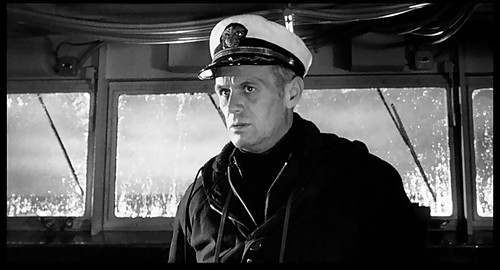
But where that one took to the air, The Bedford Incident plays out at sea in a cat-and-mouse game between a Soviet nuclear sub and a naval destroyer. In command is Captain Eric Finlander (Richard Widmark, steely with just a touch of baleful twitchiness that goes full-on berzerkoid in an interview), a determined commander who takes enormous pride in the proficiency of his crew, and in the hunt and pursuit of his targets. As an advisor is a former Nazi U-boat commander Wolfgang Shrepke (Eric Portman), who was responsible for the most tonnage (ours) sunk during the second World War. Also on board is reporter Ben Munceford (Sidney Poitier), who serves as an exposition conduit and Royal Pain In The Ass. Among the crew are Martin Balsam as the ship's new doc, James MacArthur as a too-eager ensign, Wally Cox as the sonar bat, and if you're watching early and quickly, there's a young Donald Sutherland as a garbage analyst—garbage being clues to conditions on the enemy boat, and age-analysis gives tracking position and history.
It shows how extreme the measures are on the Bedford, how detail oriented, how precise, how strategic and how puckered the thought processes go into keeping an eye on the enemy. And once found, Finlander will pursue chasing Soviet subs out of territorial waters, even forcing them to stay underwater until they're desperate for air, provoking confrontation. When your Nazi adviser tells you he's scared of your methods, it means you might be going so overboard as to pro-actively lower the life-rafts.

If you're immersed at all in pop-culture, you can see elements of Bedford in such disparate strategy plays as "Star Trek" and The Hunt for Red October. And such gamesmanship is all well and good in limited skirmishes. But, when the arsenal is nuclear? Do you really want a cigarette in a room full of gasoline?
 

No, and that the game is played despite the mega-stakes makes the movie and its characters seem not just petty, but a little dim for all the talk of brilliance. The point of hubris is well taken, but the point was better made as an out-and-out black comedy about short-term, selfish interests in the face of global catastrophe.

Thursday, December 2, 2021

Deadfall (1968)

Deadfall
(Bryan Forbes, 1968) Middling Bryan Forbes drama starring Michael Caine as a cat burglar hired by a safe-cracker (Eric Portman) for a nearly impossible job. Actually, the burglar, Henry Clarke had been casing this job for awhile and has checked into a sanitorium to get close to his target, but he's lured into working with the much older safe-cracker by the man's much-younger wife (Giovanna Ralli). Consulting with the couple, the Moreaus, it is decided that they will do a trial run robbing the strong-box of another socialite, with Henry scaling the walls, gaining entrance and then letting the husband, Richard, into the house to break into the safe. The socialite couple will be attending a concert on the prospective night and while they're safely enjoying the performance, the two men will do their night-time prowling, which will involve drugging guard dogs, and Clarke scaling the outside of the mansion, having to perform a maneuver, called a "deadfall", where he must drop from a rooftop to a lower ledge without benefit of a supporting rope.
Now, just the fact that I mention that should alert anyone that Clarke is taking more risks than he should. He does, after all, use a rope to scale the outside of the estate—couldn't he, then, move the rope (or take a second one) to avoid having to perform that risky maneuver? But, no, it doesn't happen that way for the sake of ginning up the suspense, the task of a night robbery being risky enough.
But, then, the whole movie is like that. There are so many lost opportunities and so many unnecessary risks in this less-than-perfect crime that you wonder why nobody questions the job, the partnership, anything for what looks, on the face of it, to be a hopeless enterprise.
Most of the blame must fall on Forbes, who wrote and directed, and had the interesting idea to stage that first robbery to a concert performance. His favored composer, John Barry, wrote an original piece for the film—"Romance for Guitar and Orchestra"—which would serve as the background for the robbery sequence, cutting back and forth between the concert, the robbery, and the villa's staff listening to the concert over the radio. It's the same strategy Alfred Hitchcock used for the meeting of the conspirators and victims at the Royal Albert Hall in his second version of The Man Who Knew Too Much, and as Hitchcock used his composer for that picture, Bernard Herrmann, to conduct on-screen, Forbes had Barry appear as conductor. Interesting little trivia item, and Barry wouldn't appear on-screen again until serving as an orchestra conductor in The Living Daylights, his last film as composer for the James Bond series.

It's a great idea—except that Forbes can't even do that right. Barry does his job—he'd been writing romance and action cues throughout the 60's, and he'd learned that he didn't need to ramp up the pace for action sequences. But, Forbes' penchant for unusual angles and POV makes the performance footage less than interesting. The interest is far more on the robbery, which is shot well, but is rather ruinous in what happens—at one point it becomes apparent to Clarke that Moreau can't open the safe and he begins yelling (Shhhh!) and comes up with a plan B to take the safe by hammering it out of the wall.
Okay, the shouting rather kills the mood of the music, a slight offense, but then, Forbes has Caine hammering the wall...in total silence. Wouldn't the noise—and vibration—alert the staff sitting, a couple hundred feet away, enjoying their dinner to something going on—even if they weren't depending on an alarm system that Clarke had already cut? Does the music playing over the radio—and the soundtrack—mask what is some very concussive noise? One cannot have it both ways and it's stylistically patting one's head while rubbing their belly. It's a very bizarre sequence And baldly contrived.
One wonders why he did it this way; there's a long history of film-heists done in silence and stealth, and this one has neither. Forbes was very much a part of the "Swinging 60's" period of British film-making, but his films were not revolutionary, despite his stagings and sometimes pointlessly arty framing. His films are curiosities, not classics, and every so often they seem to lose the point and get distracted by some half-hearted flippancy. Watching them, they seem to exist in a world that doesn't make much sense and half little to do with the real world. 
 
Good music, though...