
WHEN APRIL with his showers sweet with fruit
The drought of March has pierced unto the root
And bathed each vein with liquor that has power
To generate therein and sire the flower;
When Zephyr also has, with his sweet breath,
Quickened again, in every holt and heath,
The tender shoots and buds, and the young sun
Into the Ram one half his course has run,
And many little birds make melody
That sleep through all the night with open eye
(So Nature pricks them on to ramp and rage)—
Then do folk long to go on pilgrimage,
And palmers to go seeking out strange strands,
To distant shrines well known in sundry lands.
And specially from every shire’s end
Of England they to Canterbury wend,
The holy blessed martyr there to seek
Who helped them when they lay so ill and weak.They're setting place, showing ancient maps, and then—at the appropriate verse—show us the pilgrimage as it was, with ox-carts and donkeys, and peasantry making their ways over the hills, then the close-up of a nobleman who sees a falcon high in flight. And—cut! (24 years before Kubrick did something similar)—the falcon is replaced by a fighter-plane that zooms towards us and over the head—cut!—of a British soldier circa 1944 who watches it (in the same frame composition and is probably the same actor, now in modern military dress) and the narration begins again...with another verse over landscapes not too far afield from what we saw before: 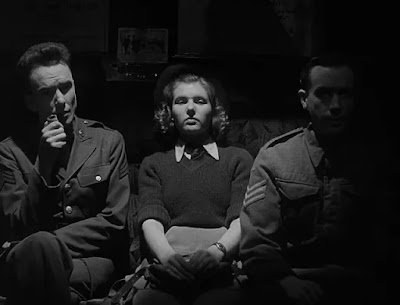 Three people are in the town of Chillingbourne, Kent, a village on the train-track to Canterbury. Two are soldiers, one a Brit, one a Yank, and a "land-girl" who's taking part in helping farmers while men-folk are away to war. They are all "in-service" but beyond that they have nothing in common...except that they're stuck in Chillingbourne. They meet by happenstance when the Yank, Sgt. Bob Johnson (played by Sgt. John Sweet, chosen for "authenticity" rather than, initially, Burgess Meredith) gets off the train too early being lurched awake by the conductor's announcement of "Next stop...Canterbury." He's a stranger in a strange land at the wrong stop in the middle of the night and he recruits help from the other two, Sgt. Peter Gibbs (Dennis Price) and Alison Smith (Sheila Sim) to find lodgings for the night.
.jpg) Of course, Wizard is fantasy, a fairy tale. A Canterbury Tale is fanciful. But, both have rich denouements that strike the heart and do so in quite different ways. Even though all the characters in both stories realize their hearts' desires, they come to them not knowing what they do not know. Oz and Canterbury provide the realization of their dreams, but Canterbury has no definite ending (despite an American-bound re-edit by Powell that has more of a conclusion—fortunately, I saw the original British version), the last act is open-ended, with hope for the future, if an uncertain one.
Of course, Wizard is fantasy, a fairy tale. A Canterbury Tale is fanciful. But, both have rich denouements that strike the heart and do so in quite different ways. Even though all the characters in both stories realize their hearts' desires, they come to them not knowing what they do not know. Oz and Canterbury provide the realization of their dreams, but Canterbury has no definite ending (despite an American-bound re-edit by Powell that has more of a conclusion—fortunately, I saw the original British version), the last act is open-ended, with hope for the future, if an uncertain one.
The drought of March has pierced unto the root
And bathed each vein with liquor that has power
To generate therein and sire the flower;
When Zephyr also has, with his sweet breath,
Quickened again, in every holt and heath,
The tender shoots and buds, and the young sun
Into the Ram one half his course has run,
And many little birds make melody
That sleep through all the night with open eye
(So Nature pricks them on to ramp and rage)—
Then do folk long to go on pilgrimage,
And palmers to go seeking out strange strands,
To distant shrines well known in sundry lands.
And specially from every shire’s end
Of England they to Canterbury wend,
The holy blessed martyr there to seek
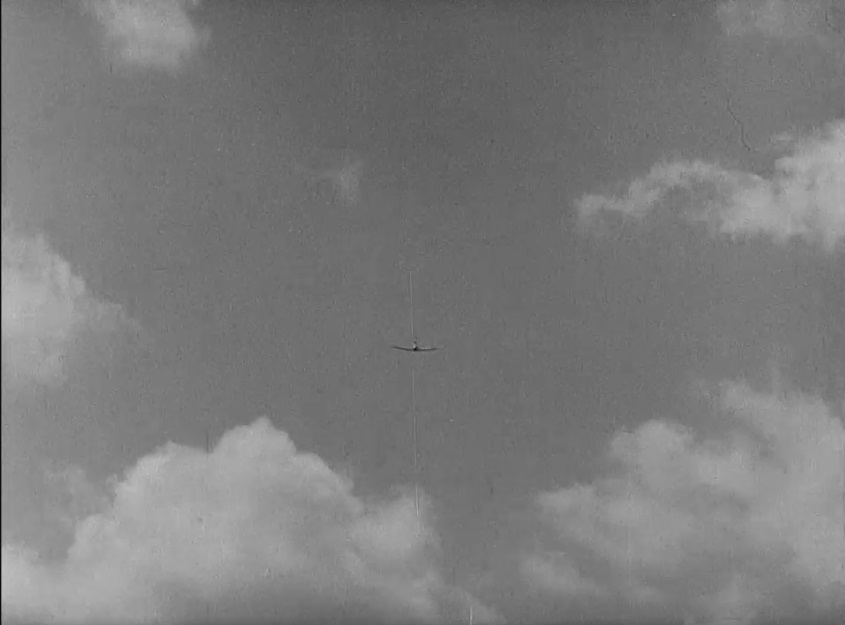
Who helped them when they lay so ill and weak.They're setting place, showing ancient maps, and then—at the appropriate verse—show us the pilgrimage as it was, with ox-carts and donkeys, and peasantry making their ways over the hills, then the close-up of a nobleman who sees a falcon high in flight. And—cut! (24 years before Kubrick did something similar)—the falcon is replaced by a fighter-plane that zooms towards us and over the head—cut!—of a British soldier circa 1944 who watches it (in the same frame composition and is probably the same actor, now in modern military dress) and the narration begins again...with another verse over landscapes not too far afield from what we saw before:


600 years have passed. What would they see,
Dan Chaucer and his goodly company today?
The hills and valleys are the same.
Gone are the forests since the enclosures came.
Hedgerows have sprung. The land is under plow,
and orchards bloom with blossoms on the bow.
Sussex and Kent are like a garden fair,
but sheep still graze upon the ridges there.
The pilgrims still wends above the wield,
through wood and break and many a fertile field.
But, though so little has changed since Chaucer's day.
Another sort of pilgrim walks the way.
And a tank heaves into the frame and a line of those mechanized vehicles starts to wend its their own way along the pilgrim's trail on the way to Canterbury. As subtle and artistic as The Archers could be, they could also be brutal in how they juxtaposed for contrast, sometimes uncomfortably so, even for modern audiences thinking that sophistication can only be found in late-model movies. But, with A Canterbury Tale, the filmmakers linked the past and the present, while also acknowledging the omnipresence of change. For no matter whether its war or peace, or what happens to the landscape, the one constant are the pilgrims in need of hope and maybe a miracle.


One complication, however: while making their way through town to get their bearings, Alison is attacked from the shadows by a stranger who throws glue in her hair. Evidently, there's a lot of that going around as she's the eleventh victim of such an attack—she'll meet other such girls in her farm duties. While she goes through numerous shampooings to try to rinse out the gunk, Sgt. Johnson reports the attack to the local magistrate Thomas Colpepper (Eric Portman), who is curiously unmoved and suggests that women should not be out at night after a black-out curfew. After all, Canterbury itself has just been bombed by the Germans. Johnson is convinced to stay the weekend and the three determine to investigate who the mysterious "glueman" in town could be. The town is full of potential suspects, clues abound, and it does help to take the minds off things like the war, one's part in it, and its consequences past and future. A little mystery can distract from things of great import, and yet, there's the countryside and its history and the current residents of that storied real estate, which managed to survive Kings, Queens, technologies and even the German war machine. Instead of being a mere stop-over, their encounters and walkabouts bring out a resonance and maybe even a communion with the past.


Bombed out buildings, but Canterbury remains untouched.
For, despite the distraction, these three are in need. Each is suffering a loss, a regret, a yearning that makes them incomplete, even as an indeterminate future threatens all of them. It may be coincidence that they are all there at that time and at that place, but without seeking it out—hell, they don't even know the history of it—for those acres and shrines to echo what they did in Chaucer's time for those who made their own pilgrimages in their time of need. It is Colpepper who clues them in to the storied land and serves as unofficial chaperone for the trio, and indirectly guides them to the path that they don't know they seek.%20eyes.jpg) The Archers, of course, lean into Chaucer and the romance of the land and its past (and the value and benefit of the pastoral existence—which they would continue in the next year's I Know Where I'm Going!—Powell called these films their "anti-capitalist period"), but there's another influence, cinematically. A Canterbury Tale was made in 1944, 5 years after The Wizard of Oz and the story of strangers, bonded together, off on a heroes' quest traveling to a source for "reward or penance" is shared by both.*
The Archers, of course, lean into Chaucer and the romance of the land and its past (and the value and benefit of the pastoral existence—which they would continue in the next year's I Know Where I'm Going!—Powell called these films their "anti-capitalist period"), but there's another influence, cinematically. A Canterbury Tale was made in 1944, 5 years after The Wizard of Oz and the story of strangers, bonded together, off on a heroes' quest traveling to a source for "reward or penance" is shared by both.*
%20eyes.jpg)
.jpg)
A Canterbury Tale is one of the best movie experiences I've seen this year. It left me completely enchanted.

* The story even shares the element that both sets of heroes have already possessed what they lack—they just don't know it yet.


