Showing posts with label Joan Greenwood. Show all posts

Thursday, March 27, 2025

The Detective (1954)

The Detective
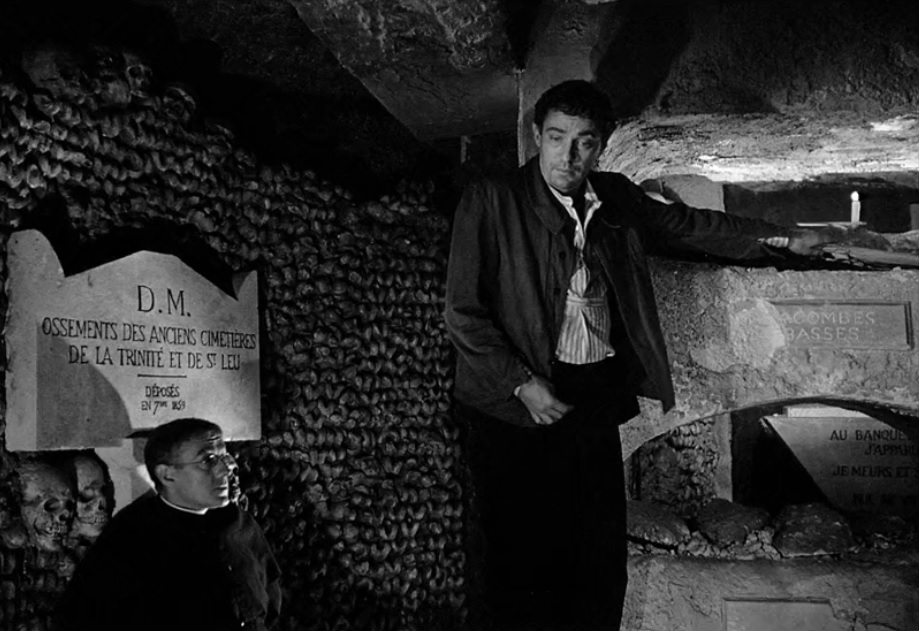
(aka Father Brown)(Robert Hamer, 1954) It's quite the scandal when Father Brown (Alec Guinness) is arrested by the local constabulary when he is caught in the act of "burglarious purposes" in front of an open safe. At police headquarters, the humble English vicker tries to explain that he was only trying to return the "swag" ("I believe that's what it's called—'swag'") for one of his parishioners (he admonishes him for being "an incompetent thief...clearly incapable of earning a dishonest living") whom he had convinced to forego a life of petty thievery and, in return, Brown would return the stolen good to the rightful place. That's when the police arrived.
 
A night in the hoosegow (which he finds "most interesting" and thanks the police for their "hospitality") and he's identified by the church authorities and sprung. So, of course, when he's hauled before the Bishop, he assumes it's for the arrest—he having a reputation in the diocese as "an odd one". But, it's of another matter entirely: it's seems that the Eucharistic Congress is soon to be held in Rome. And the Bishop has decided to send the Holy Cross of St. Augustine, which is twelve centuries old and currently resides in Father Brown's parish church. Father Brown considers the cross "not valuable...priceless," so he's alarmed when informed by a local Inspector than an "imminent criminal is intent to intercept the cross en route." The criminal's name is Gustav Flambeau* (Peter Finch) and Father Brown is only too aware of the master-thief's reputation—"a human chameleon" such an expert of disguise that no one knows what he looks like.
When Brown is informed of the precautions, the father-detective goes into a sort of distracted trance—in his mind, he's figured out three different way that the cross could be stolen. "So, if I, an amateur, can steal the cross in
three ways , one can only think what Flambeau will do!" Brown volunteers to take the cross himself—"one priest indistinguishable from hundreds carrying one cross undetectable from hundreds" But, the inspector and the Bishop are in agreement: they will have undercover men make their way to Rome in the hopes of intercepting the wiley thief. To Brown, this is "lunacy!" He makes his own arrangements to carry out his conception of a plan.
Now, as a recovering Catholic, I must confess that the closest I get to religion these days is through Father Brown, the sleuthing priest created by author G.K.Chesterton in 1910 (predating Agatha Christie's sleuths by a decade). I've watched the Mark Williams series, having seen nearly every episode, and read a few of the stories and have always found a kind of solace in the character's rock-solid faith and his unorthodox application of it when dealing with the near-occasion of sinners. He does not judge, believing not that people are good or evil, but merely people, and those that have strayed can always be moved on to the better path. He is not naive, or a cross-eyed optimist, but will argue that his faith is even more pertinent in a world where virtue is challenged. At one point in The Detective, he says: "
My son, you think that you are a man of the world and that I am not. But I assure you, my 'innocent' ears encounter every day stories of a horror that would make your sophisticated hair stand on end. Although I wear funny clothes, and have taken certain vows, I live far more in the world than you do." It's a world where his ability to pick locks, or judo-wrestle are useful tools, particularly when employed for good. He'll even pick a pocket (but only to prove a point when he returns the "swag").
When I found that there was a "Father Brown" movie, particularly to my delight that Alec Guinness played the part, I began an exhaustive search to find it. It took years, but it can now be found** And it exceeded my expectations. I've never been disappointed by a Guinness performance*** and his Brown is very much a sheep in wolfs clothing. He's as sharp as they come, if a bit idiosyncratic, and when called upon Guinness overplays the "twee" nature of Brown, his awkwardness hiding a quick-wittedness—although his humility will never allow him to admit it.
The Detective also has two of my favorite British performers: the ever-beguiling 
Joan Greenwood, (who'd starred with Guinness in a couple of his comedies) as one of Father Brown's more well-off parishioners and confidantes; and Bernard Lee (who would go on to play MI6 head "M" in the first 16 films of the Bond series) as an undercover police officer doggedly pursuing Flambeau, and who finds Brown's deft interference almost in itself criminal.
But, the surprise is Peter Finch as master-thief Flambeau. Up to this point, Finch could be rather stiff in his roles, but, here, he's light-hearted and charming, pulling off the character-work in disguise, and, when unmasked, giving off the air of a bon-vivant, quite happy in his mis-deeds. Guinness and he have a lot of dialog together and they spar winningly.
Based rather loosely on Chesterton's first Father Brown story "The Blue Cross," It's absolutely delightful and was well worth the wait.

* Interesting that they call him "Gustav" Flambeau as Chesterton gave him the christian name of "Hercule"—perhaps to not confuse him with Christie's Poirot, who debuted 10 years later—and the character is supposed to be French, and Gustav is considered a Swedish or German name.
 
** On the streaming service Tubi, but the Lord only knows how long it will remain there. 

*** Okay, there is one. It is Hitler: The Last Ten Days where I found his performance as The Führer rather dull. Time Magazine's critic said it was only useful in showing "the banality of evil." Curiously, IMDB says it's the only performance Guinness was completely happy with, having campaigned actively to play it.

Friday, February 18, 2022

Moonfleet (1955)

Moonfleet
(Fritz Lang, 1955) Fritz Lang's only film in Cinemascope—a format he famously described as only good for shooting "snakes and funerals" (well, he says it in Contempt, anyway!). 
 
"Moonfleet" was a popular novel published in 1898 and was considered a classic of literature—on a par with Robert Louis Stevenson's "Treasure Island"—but not so much in the U.S. Producer John Houseman, working at M-G-M, maybe influenced by the success of Disney's 1950 version of Stevenson's classic, wedged in Moonfleet between prestige pictures, but on a limited budget—no ocean scenes, no tall ships, no cluttered sword-riots, no piratey aspects that required crowds and location work. Lang, who actually preferred studio work over the capricious lighting of location scenes, was hired two weeks before shooting started and hadn't worked at M-G-M since his first film in America, the 1936 production of Fury. The script had aspects of the novel, but didn't follow it too closely, taking the novel's hero and making him a child, as opposed to the young man of the novel, who depends on an older mercenary smuggler to pursue his quest of a legendary diamond belonging to the pirate Blackbeard.
That's one way to use the Cinemascope frame.
 
Well, it's "Redbeard" in the movie (public domain issues?). Young John Mohune (Jon Whiteley) is sent by his dying mother to the town of Moonfleet, site of the original Mohune estate, to seek out a man with whom she had a past, Jeremy Fox (Stewart Granger). Exhausted by his travel, young John wakes up in a tavern surrounded by ruffians—including Dan Seymour and Jack Elam—who search him and find a letter from the boy's mother, appointing Fox as John's guardian. It's convenient because Fox just happens to be the man now occupying the Mohune manse.
It's inconvenient because, when Fox hears this, he wants nothing to do with the boy, being a man of the world and all. But, he does acknowledge knowing the mother, being fond of her, and that he and the boy may have more in common than Fox will acknowledge—like the boy's nightmares of being attacked by dogs echoing the scars on Fox's back from such an attack while he was running from the Mohune house so many years ago. Probably as many years as the boy's been alive, but the film skirts this issue, while hinting that it's probably true. Still, he plans to have the boy sent packing in the morning, while he continues on to Moonfleet.He, of course, hasn't reckoned with the boy being a Mohune, and a tenacious one at that. The boy manages to make his escape and, with the help of some locals, make his way back to his family's estate, where he finds Fox in mid-debauch, hosting several drunken lords, complete with entertainment by a gypsy dancer (Liliane Montevecchi). Young John insists he won't be sent away this time and that he intends to stay with Fox as per his mother's wishes. Fox is impressed by the boy, but secretly intends to send him away to the colonies on the next boat. When Fox's mistress Mrs. Minton (Viveca Lindfors) accuses Fox of his actions towards John as being proof of his continuing love for the boy's mother, he tells her that, in that case, she can leave on the same boat with him.
The next day, John attends church services, where he is informed—via a fiery sermon about superstition—that the villagers fear that the spirit of the pirate Red Beard, who was a Mohune, is haunting the church graveyard looking for the diamond that made him renounce his military career and become a pirate. While walking the grounds that night, John falls into an open grave that leads to the catacombs under the church full of broken caskets and the bones of the departed. But Fox's pirates come down there, too, looking for potential riches, and the boy finds a locket while hiding away from sight.
When rescued from the catacombs by Fox, his band is ready to slit the boy's throat for anything the kid might have found, and when Fox defends the boy, the pirates—being pirates—turn against him. This puts Fox in a difficult position—he is being challenged by his own band at the same time he's trying to finagle a deal with the duplicitous magistrate Lord Ashwood (venomed by George Sanders, as only George Sanders can) and his equally devious wife (played by the ever-delightful Joan Greenwood in her first American role).
That locket John has snatched will contain  a secret that must be decoded and from there, Fox and friend must evade his former co-conspirators, as well as the Ashwoods, and the authorities to find the diamond and extricate it from its hiding place smack-dab in the middle of a military prison, even while they're considered wanted fugitives. This gives plenty of opportunity for composer Miklós Rózsa to create bustling tension music (which sounds like it's a dress rehearsal for his score for Ben-Hur), while the duo put themselves directly in harms way to achieve their goals.
It's not the novel—which shares the diamond and the locket and the clues, and that's about it—but Lang makes the most out of the material scraped from the book to accommodate Granger's starring persona, while directing it from the vantage of a child's point of view, and enveloping it in a child's nightmare of Gothic structures and macabre situations, with a mentor who is as questionable a father-figure as one could encounter (outside of Dickens). Maybe that's why it never found an audience—too "mature" for kids, too cynical for adults, and not "family-friendly"—which led Houseman to write: "All too often, in those days, I felt that the director was receiving credit for the producer's work. This time (Lang) was taking the blame for the producer's errors." Hard to believe that—with all of his fanciful German work, Moonfleet was the most expensive film, Lang ever worked on.

Tuesday, February 8, 2022

Whiskey Galore! (1948)

Whiskey Galore!  (aka Tight Little Island)(Alexander Mackendrick, Charles Crichton, 1949) The island of Todday in the West Hebrides is dry. It's 1943 and with the world at war, rationing has drained the last drops of whisky out of the sodden land. Scots without whiskey are restless. So, it's no wonder that among the younger set, thoughts have turned to romance. Schoolmaster George Campbell (Gordon Jackson) is trying to woo Catriona Macroon (Gabrielle Blunt), one of the daughters of shopkeeper Joseph Macroon (Wylie Watson), despite his religious mother's strong disapproval. Macroon's other daughter, Peggy (the ever-charming Joan Greenwood), is being courted by Sergeant Odd (Bruce Seton), of the Home Guard, charged with keeping the island safe from attack, and bringing a rather unwelcome sense of regimentation to island life. The older folks, well, they're just trying to get by, but, without any whisky, a general pall has descended on the island. Tea is all well and good, but the strict rationing has taken its toll on tempers because of the temperance.
So, it must seem like manna from heaven, when the SS Cabinet Minister runs aground in a heavy night-time fog. A couple of the islanders try to lend assistance, and learn from the stuck crew that the ship's cargo consists of 50,000 cases of whisky. No help is requested; none is desired. The ship begins to take on water and the crew abandons ship, leaving it to the salvage folks to take care of the cargo. But, the prospect of 50,000 cases of whiskey instills in the island a severe sense of...volunteerism. Plans are immediately made to see if the citizenry can "lighten the load" of the ship—in the spirit of helping the war effort (you understand).
To the head of the Home Guard, Captain Paul Waggett (Basil Radford), the duty is clear: as property of Her Majesty, the cargo must be under the guard of their forces and must not be interfered with until the authorities deal with the situation. To him, it is as if the Germans themselves have sunk the Cabinet Minister and any thought of touching the cargo would be tantamount to treason. He orders Odd to set up a 24 hour watch on the ship to make sure that it is safe and secure.
There's a little complication, of course. Macroon reminds Odd that a bridegroom, before his nuptials, must host a rèiteach—a communal get-together—at which whisky, traditionally, is served. No whisky, no marriage (traditionally). This creates a bit of a conflict of interest for Odd, as he does want to get married, duty or no duty. So, when word gets to him that the locals may make a "reconnaisance" of the ship, he conspires with them to complete his charge, but also let them sail out to the ship. Both Odd and the locals are determined to keep Waggett ignorant of anything that might transpire.
Hi-jinks ensue. 
 
Whiskey Galore! had a difficult production history: It was the first picture produced by Ealing Studios to feature considerable location filming and, owing to that, the budget was more of an investment than had been previously produced. Weather conditions were not exactly ideal and led the film to go over-budget and over-schedule (a full five weeks on a 10 week shoot!). Also, director McKendrick was working with a fairly inexperienced crew and came away thinking it looked more "like a home movie." Not only that, McKendrick was more in sympathy with the Home Guard commander, rather than the rapskallion islanders.
Ultimately, the film was "saved" in post, due to some re-editing and extra footage, all done by Charles Crichton. And it's delightful, full of little winking touches and the sort of local color designed to melt audiences' hearts. Mckendrick, despite the experience, went on to direct some of the great British comedies, like The Man in the White Suit, The Ladykillers, and (in the States) Sweet Smell of Success. Crichton had a long career, directing The Lavender Hill Mob all the way to his last film, A Fish Called Wanda (in 1988).

Friday, May 11, 2018

The Man in the White Suit

The Man in the White Suit (Alexander Mackendrick, 1951) My favorite of the Ealing Studios British comedies of Alec Guinness is this genre-crossing sci-fi/fantasy/corporate satire about the financial efficacy of building a better movie-trap. The canard is that the world will beat a path to your door, but the reality is that the mouse-trap industry (no doubt led by the appropriately-named "Victor®"—a division of Woodstream Corp.) will probably suppress it, buy the patent, or, in some other way, bury the innovation to protect their own short-term (dare I say "fiscal") interests, even if it might (indeed) revolutionize the industry. Sure, it might be the greatest thing since sliced bread, but that's only because the knife industry allowed it (talk about "the cutting edge!).

The Man in the White Suit tells the story of researcher Sidney Stratton (Guinness), who, through chemistry and some minor combustion (which gets him fired from his original job at Corland Mills, run by Michael Corland (Michael Gough), he is snapped up by the rival Birnley Mills, where his attempts finally succeed in concocting an innovative thread, a polymer that repels everything, making an indestructible, water-proof, stain-resistant weave—it even resists dyes, thus making it a permanent glow-in-the-dark white color.
It's seen as something of a revolutionary break-through, a boon to the consumer. And Stratton sees it as a revolution of sorts: who wouldn't want an indestructible suit or dress that would never wear out and never need to be replaced?
Clothiers, for one big example. The garment industry. With clothing that can never rip, fray, stain, or shrink, who would want to buy other clothing ever again? So, after the initial flush of excitement over the innovation, the corporation Stratton works for, Birnley Mills, looks down the fiscal road and sees consumers with no need to further buy replacement clothing. And so the corporate board acts to repress Stratton's invention, trying to buy out the rights in order to do it, but Stratton, with an inventor's righteous zeal, refuses.
And lest anyone think this is a liberal screed about corporate greed, it casts equal shade at the trade unions who also want to stop progress, as the fabric is seen as a threat to industry that will cost workers' jobs, should it ever see the business end of a coat hanger. Despite being offered a million dollar deal to sell out, Stratton resists, and is held captive as long as he holds out, but he has the sympathy from the daughter (Joan Greenwood) of the mills' head (Cecil Parker), if only because the board tries to recruit her to turn Stratton's mind around.

Stratton ensures that he will always be the brightest guy in the room.
It's a great story and a great movie, and over the years I've seen it reflected—rarely—in other films. For example, Disney's The Absent-Minded Professor can be seen as an American version of the same story, with the military over-zealously pursuing Professor Brainard's version of "Flubber." A true-story equivalent is Francis Ford Coppola's Tucker: The Man and His Dream, about inventor Preston Tucker and his intent on creating a safe, stylish and efficient "car of the future"—and the auto industry's successful attempt to hinder the production of any of the innovative cars to just 50.
There's another aspect to The Man in the White Suit that endears it to me, but it's purely personal—it's the charmingly goofy lab sounds that emanate from Stratton's efforts that create a sort of obsessive fandango as he pursues his efforts. I came across the track (created by sound editor Mary Habberfield) in a BBC sound effects library, and, when I worked on a certain kids' science show, I had the intention of using the track on a proposed second season episode about "Psuedo-science." Budget considerations pushed the subject to the third season and, by that time, I had moved on to other things. Still would have loved to have had that little private joke realized, though.


Wednesday, March 30, 2016

Kind Hearts and Coronets

Kind Hearts and Coronets (Robert Hamer, 1949) A long time ago in a film world far, far away (before he was Obi-Wan Kenobi), Alec Guinness was considered "the" comic actor during his run of films with Ealing Studios and in the late 40's/50's, but his tour de force may have been the movie in which he didn't even receive top billing—but merely most of the billing!

Kind Hearts and Coronets is a black comedy—the blackest—about the peerage system in England and how the rules can be applied/disavowed at the whim of the "classy." The humor is "veddy" British; there is not a single raised voice in the entire film and the language is the highest (and snootiest) of tone. But that's where the civility ends, as the protagonist is on a mission of revenge and avarice in which he is the architect of multiples of murders in the quest for the title he feels is rightfully his and to which he has been denied.

London is abuzz on the day the film begins, as something altogether unusual is planned at dawn—the hanging, for murder, of an actual Duke, the 10th Duke of Chalfont. It is so unique that the guards have questions about precedence, how to address the soon-to-be-stretched, and the executioner is preparing a verse for the occasion. For his part, the nearly departed is spending his last night doing what any royalty is concerned with—preserving a legacy. Louis D'Ascoyne Mazzini (Dennis Price) is penning his memoirs of how he got to this position—on Death Row, the noose being tailored for his neck-size. Part confession, part explanation, part boast, the memoir frames the flash-back sequences that show the unfortunate circumstances that befell Louis that forced him to rise above through low behavior that includes seduction, cuckoldry, murder and ladies' undergarmets.
Not his fault, initially. His mother (Audrey Fildes) became infatuated with an Italian opera singer and (in the opinion of her family) married below her station and was disowned. When her husband dies, she is denied anything to do with the D'Ascoyne family (including the inclusion of her devoted son, Louis, in family matters or business), even though she believes he should be considered in line for dukeitude that goes with the D'Ascoyne name. When she dies, her final wish is to buried in the magnificent grounds around the D'Ascoyne estate.
She will have to stand in line. In order to achieve that, her son has work to do.
The D'Ascoyne family (Alec Guinness—no, really, he plays the entire family) is an entirely disreputable bunch of entitled prigs, their only saving grace (besides being played by Alec Guinness) is that their grace saves them the punishments that discreditable behavior usually affords the un-gentrified. Even if he hadn't been denied his right, Louis would despise them all. Two things provide an incentive besides that of his mother's dying wish—his childhood friend Sibella (the positively glowing Joan Greenwood) refuses his marriage proposal in favor of a richer man's, and an encounter with the son of a D'Ascoyne banker gets him fired from his job in ladies' finery. That particular D'Ascoyne scion is the first to go, in a manner (as Louis will make a habit of) befitting his interests and peccadilloes.
Joan Greenwood (positively glowing)
Louis makes his way up the ladder of peerage on the rungs of dead D'Ascoynes. He also acquires a more suitable job as a clerk for the father of his first victim (who, of necessity, must be a future one). He also begins an indiscreet dalliance with Sibella, who finds that riches do not make a wholly satisfying life (if Louis weren't taking advantage of it, he might learn a lesson there), and a discreet friendship with the widow (Valerie Hobson) of his second victim. The murders are performed bloodlessly and—for the most part—off-camera, laced with, but not limited to, irony. One could imagine, if Louis weren't in such a hurry, that the victims would have incorrigably gone that way, anyway.
The second of many D'Ascoyne funerals (Guinness has a quorum)
Guinness is a wonder here. He gives each D'Ascoyne their own voice and manner, as well as an individual invitation to hate them. And Price manages to make Louis a charming rogue, while betraying that he also has some deep character flaws, beyond his cold-blooded penchant for murder (even if keeping it in the family). Those flaws are only emboldened the closer he gets to his goal. Thereby lies madness. And the film closes with one of those charming Ealing endings that flirts with shocking your sensibilities but has an added twist that satisfies you (in no small part because it leaves it unresolved or, better put, leaves it for the viewer to speculate on what happens after "The End" credit burns in, leaving you judge, jury, and possibly executioner). It's a little thrill that makes the film linger with wickedness long after it's over.