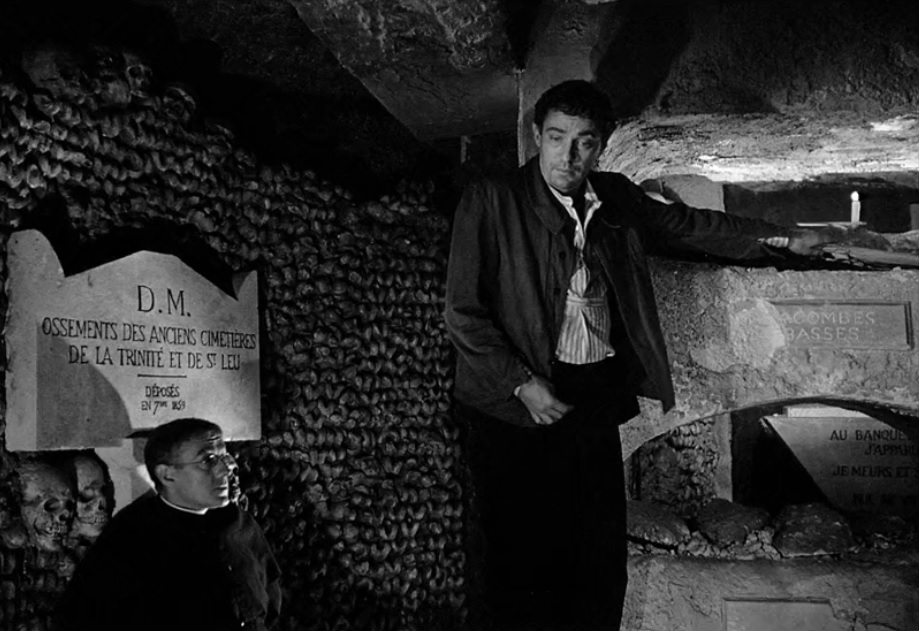
The Detective(aka Father Brown)(Robert Hamer, 1954) It's quite the scandal when Father Brown (Alec Guinness) is arrested by the local constabulary when he is caught in the act of "burglarious purposes" in front of an open safe. At police headquarters, the humble English vicker tries to explain that he was only trying to return the "swag" ("I believe that's what it's called—'swag'") for one of his parishioners (he admonishes him for being "an incompetent thief...clearly incapable of earning a dishonest living") whom he had convinced to forego a life of petty thievery and, in return, Brown would return the stolen good to the rightful place. That's when the police arrived.
A night in the hoosegow (which he finds "most interesting" and thanks the police for their "hospitality") and he's identified by the church authorities and sprung. So, of course, when he's hauled before the Bishop, he assumes it's for the arrest—he having a reputation in the diocese as "an odd one". But, it's of another matter entirely: it's seems that the Eucharistic Congress is soon to be held in Rome. And the Bishop has decided to send the Holy Cross of St. Augustine, which is twelve centuries old and currently resides in Father Brown's parish church. Father Brown considers the cross "not valuable...priceless," so he's alarmed when informed by a local Inspector than an "imminent criminal is intent to intercept the cross en route." The criminal's name is Gustav Flambeau* (Peter Finch) and Father Brown is only too aware of the master-thief's reputation—"a human chameleon" such an expert of disguise that no one knows what he looks like.
When Brown is informed of the precautions, the father-detective goes into a sort of distracted trance—in his mind, he's figured out three different way that the cross could be stolen. "So, if I, an amateur, can steal the cross in three ways , one can only think what Flambeau will do!" Brown volunteers to take the cross himself—"one priest indistinguishable from hundreds carrying one cross undetectable from hundreds" But, the inspector and the Bishop are in agreement: they will have undercover men make their way to Rome in the hopes of intercepting the wiley thief. To Brown, this is "lunacy!" He makes his own arrangements to carry out his conception of a plan.
Now, as a recovering Catholic, I must confess that the closest I get to religion these days is throughFather Brown, the sleuthing priest created by author G.K.Chestertonin 1910 (predatingAgatha Christie's sleuths by a decade). I've watched theMark Williamsseries, having seen nearly every episode, and read a few of the stories and have always found a kind of solace in the character's rock-solid faith and his unorthodox application of it when dealing with the near-occasion of sinners. He does not judge, believing not that people are good or evil, but merely people, and those that have strayed can always be moved on to the better path. He is not naive, or a cross-eyed optimist, but will argue that his faith is even more pertinent in a world where virtue is challenged. At one point in The Detective, he says: "My son, you think that you are a man of the world and that I am not. But
I assure you, my 'innocent' ears encounter every day stories of a
horror that would make your sophisticated hair stand on end. Although I
wear funny clothes, and have taken certain vows, I live far more in the
world than you do." It's a world where his ability to pick locks, or judo-wrestle are useful tools, particularly when employed for good. He'll even pick a pocket (but only to prove a point when he returns the "swag").
When I found that there was a "Father Brown" movie, particularly to my delight that Alec Guinness played the part, I began an exhaustive search to find it. It took years, but it can now be found**And it exceeded my expectations. I've never been disappointed by a Guinness performance***and his Brown is very much a sheep in wolfs clothing. He's as sharp as they come, if a bit idiosyncratic, and when called upon Guinness overplays the "twee" nature of Brown, his awkwardness hiding a quick-wittedness—although his humility will never allow him to admit it.
The Detective also has two of my favorite British performers: the ever-beguiling Joan Greenwood, (who'd starred with Guinness in a couple of his comedies) as one of Father Brown's more well-off parishioners and confidantes; and Bernard Lee (who would go on to play MI6 head "M" in the first 16 films of the Bond series) as an undercover police officer doggedly pursuing Flambeau, and who finds Brown's deft interference almost in itself criminal.
But, the surprise is Peter Finch as master-thief Flambeau. Up to this point, Finch could be rather stiff in his roles, but, here, he's light-hearted and charming, pulling off the character-work in disguise, and, when unmasked, giving off the air of a bon-vivant, quite happy in his mis-deeds. Guinness and he have a lot of dialog together and they spar winningly.
Based rather loosely on Chesterton's first Father Brown story "The Blue Cross," It's absolutely delightful and was well worth the wait.
* Interesting that they call him "Gustav" Flambeau as Chesterton gave him the christian name of "Hercule"—perhaps to not confuse him with Christie's Poirot, who debuted 10 years later—and the character is supposed to be French, and Gustav is considered a Swedish or German name.
** On the streaming service Tubi, but the Lord only knows how long it will remain there.
*** Okay, there is one. It is Hitler: The Last Ten Dayswhere I found his performance as The Führer rather dull. Time Magazine's critic said it was only useful in showing "the banality of evil." Curiously, IMDB says it's the only performance Guinness was completely happy with, having campaigned actively to play it.
The Story: One thing people always asked Alfred Hitchcock about his movies: "Why didn't they just go to the police?"
"Because it's boring" was his usual answer.
Every so often, Hitchcock would prove that point by having his people go to the police (when they weren't having to avoid them) such as what happens in Rear Window, one of Hitchcock's masterpieces.
In this movie, it's a matter of convenience: photographer L.B. Jeffries can't go to the police because he's laid up in his New York apartment with a broken leg—presumably an on-the-job accident—the very same reason he started to peer out his rear window upon his neighbors and began to suspect that one of them—a traveling salesman named Thorvald—had killed his invalid wife. He has a buddy on the force and that buddy has just left "Jeff" and his girl-friend/fashion-plate Lisa, with perfectly reasonable explanations that have put the kibosh on the inactive photographer's over-active imagination.
And they've watched when one of the neighbors—all of whom he's given churlish impertinent names to—"Miss Lonelyhearts," has fended off an attack from a would-be suitor, kicked him out of her basement flat and collapsed onto her couch in humiliated despair.
Time for some good Catholic guilt, some shame, and a re-appraisal of their actions. Hitchcock was a Catholic and he knew how much "fun" that was, so he doesn't dwell on it for too long.
But, a moral readjustment does need to be made. What Lisa and Jeff have been doing is creepy, no matter how they got into it and how hard it would be to avoid it with that VistaVision courtyard view of his. And for Lisa, the "Miss Lonelyhearts" episode reminds her of her own fruitless pursuit of Jeff, who is a selfish male and (let's face it) insane not to want to marry her. It's a reminder that they're not playing games here. These are real human beings they're amusing themselves with, watching their antics and suspecting...or wishing...the worst.
And then...after a momentary sexual tease...Hitchcock will double-down on that remorse and rather nakedly dwell on it for an extended period of time. For the watchers—and there are two sets of them—it provokes multiple reactions. For the observers inside the movie it will evoke momentary curiosity, alarm, even empathy. For the movie audience, it might provoke disdain for the director's emotional manipulation, or the feeling that the movie is momentarily directing its gaze at us and judging us.* We might even think that the director is wasting his screen-time showing it.
But, he's not. He's merely set-up his pay-off and does so in a way that's purely visual...purely (as Hitchcock would say it) "cinemah." And, so, after the level-headed police have briefly derailed the movie's train of dark thoughts...that shot of a glowing cigar in the dark puts the movie back on its track of suspicion, pathology and suspense. Hitchcock uses one of those bothersome reality-checks ("the Plausibles") to jump-start the movie to its thrilling conclusion.
Diabolical. And damned clever.
The Set-up: In a New York apartment lie "the broken bones of L.B. Jeffries" (James Stewart), photographer by trade, voyeur by habit. Not exactly a man of action, more of a man watching action. So, while he's laid up with a broken leg from a work-related accident, he has taken to watching out his window at his neighbors and become acquainted with their normal day-to-day. But, "normal" is not the word one would use for one of them, Lars Thorvald (Raymond Burr). He's a traveling salesman with an invalid wife, except she's gone missing. It's become something of an obsession for Jeffries, to the point where he's informed his girlfriend, Lisa Fremont (Grace Kelly) and his sports therapist, Stella (Thelma Ritter), who have suggested that he contact the police. An investigation has begun led by Jeffries' friend on the force, detective Tom Doyle (Wendell Corey), who has given a report that there's nothing to be concerned about (except for maybe the fact that Lisa is planning to spend the night with Jeffries to enjoy the sights...
Action...
INT. JEFF'S APARTMENT - NIGHT - MEDIUM SHOT
Lisa turns away from Jeff's chair to get a cigarette from
the table. She lights it, as Jeff turns his chair back to
the room.
JEFF
Ya know...As much as I hate to give Thomas J.
Doyle too much credit,
JEFFhe might have
gotten a hold of something when he
said this was pretty private stuff
going on out there.
He indicates the outside neighborhood with a movement of his
head. She doesn't answer, but studies the photographs on the
wall of his room.
JEFF
Do you suppose it's ethical to watch
a man with binoculars, and a long-focus lens -- until you can see the
freckles on the back of his neck,
and almost read his mail --
JEFFdo you
suppose it's ethical even if you
prove he didn't commit a crime?
LISA
I'm not much on rear window ethics.
JEFF
Of course, they have the same chance.
They can look at me like a bug under
glass, if they want to.
LISA
(Turns to him)
Jeff -- if anybody walked in here, I
don't think they'd believe what they
see.
JEFF
Huh?
LISA
You and me with long faces -- plunged
into despair --
LISAbecause we find out
that a man didn't kill his wife.
LISAWe're two of the most frightening
ghouls I've ever known.
Jeff starts to smile at the realization.
LISA
You'd think we could be a little bit
happy that the poor woman is alive
and well.
Jeff smile is broad, and he starts to chuckle.
She relaxes
and joins him. She sits on his lap, her arms around his
shoulders.
LISA
Whatever happened to that old saying
"Love Thy Neighbor."
JEFF
Hmmm, you know, I think I'll start reviving it
tomorrow,
JEFFwith say -- Miss Torso for
a start? Yeah. Yeah, I'll begin with Miss Torso.
She gets up, goes to the blinds, and proceeds to lower them
one by one.
LISA
(As she get up)
Not if I have to move into an
apartment across the courtyard way...
LISA
and
do the dance of the seven veils once
an hour.
LISA
(As she lowers the
blinds) Show's over for tonight.
He smiles. She goes to the table,
picks up the overnight case.
LISA
Preview -- of the coming attractions.
She goes to the kitchen entrance, pauses.
LISA
Did Mr. Doyle think I stole this
case?
JEFF
(Mock seriousness)
No, Lisa -- I don't think he did.
She shrugs,
goes into the kitchen, the CAMERA PANNING her.
LAP DISSOLVE TO:
INT. JEFF'S APARTMENT - NIGHT - SEMI-CLOSEUP
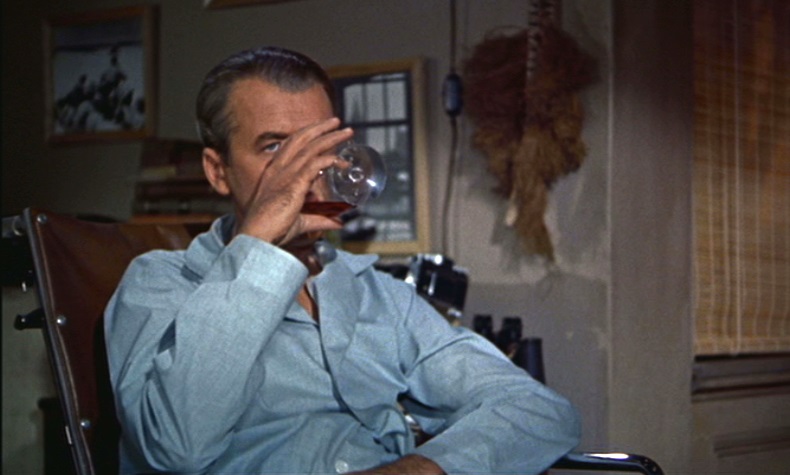
Jeff is sitting on the wheelchair near the bar, a drink in
his hand.
He starts to take a sip from the glass,
when Lisa
comes out of the kitchen.
She is an ethereal beauty, in sheer
peach nightgown, covered by a gossamer matching kimono.
She
turns gracefully in front of Jeff.
He lowers his drink.
LISA
(Softly)
What do you think?
Jeff puts his drink on the bar. He tries to decide how to
answer her question. He can't.
JEFFWell...uh...
LISA
I'll rephrase the question.
JEFF
Thank you.
Lisa holds out the folds of her kimono.
LISA
Do you like it?
JEFF(Studying it)
Well, -- if there was one less thread
this way --
(motions horizontally)
-- and two less that way --
(Motions vertically)
-- I might give up bachelorhood.
Lisa turns playfully toward the kitchen.
LISA
I'll be right back.
JEFF Yes...I like it!
LISA Wel...-
Blood-curdling scream from the courtyard outside suddenly
cuts through the night.
Startled, both Jeff and Lisa move quickly for the window --
Lisa lifting the blinds up.
The long scream subsides into
near-hysterical sobbing.
MR. SIFFLEUSEWhat's the matter?
EXT. NEIGHBORHOOD - NIGHT - LONG SHOT
We get a high comprehensive view of all the apartments.
Light are going on in some windows, shades are lifted on
others, people are beginning to lean out looking for the
source of the scream and sobbing.
The song-writer's party
comes to a sudden halt, as his guest crowd to the window.
SEMI-LONG SHOT
Lisa and Jeff at the window, looking out, startled.
VOICE: Somebody hurt?
VOICE:It's the dog! Something's...
VOICE:...happened to the dog!
SEMI-LONG SHOT
The landlord, beneath the newlyweds, looks out. Tilting his
head up toward the center of the yard.
SEMI-LONG SHOT
A couple comes out on the high balcony to the right.
Look down.
MEDIUM SHOT
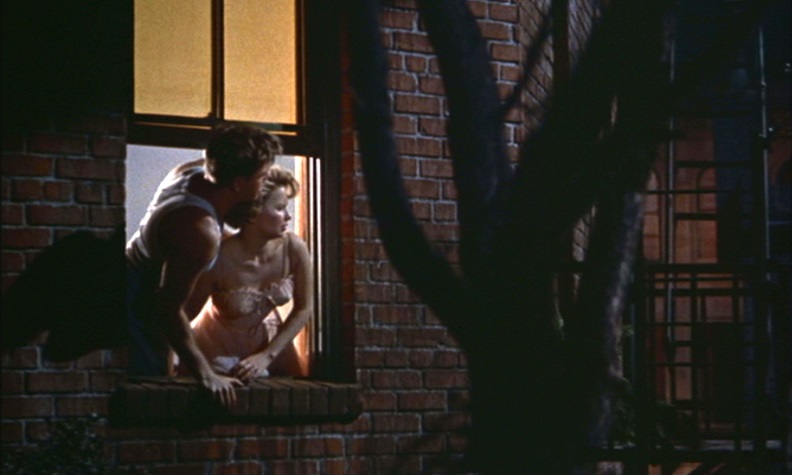
The newlywed's blinds come up, and for the first time we see
both of them at the window,
the girl looking over the boy's
shoulder.
SEMI-LONG SHOT
Some members of the song-writer's party move out to the patio-
balcony, to get a better look down in the yard.
SEMI-LONG SHOT
The bird woman comes to the window. Her white face looks
forward toward the center of the courtyard.
SEMI-LONG SHOT
Miss Torso, pulling a robe around her,
comes out onto her porch,
and looks to her left.
SEMI-LONG SHOT
Miss Hearing aid comes quickly into her backyard.
SEMI-LONG SHOT
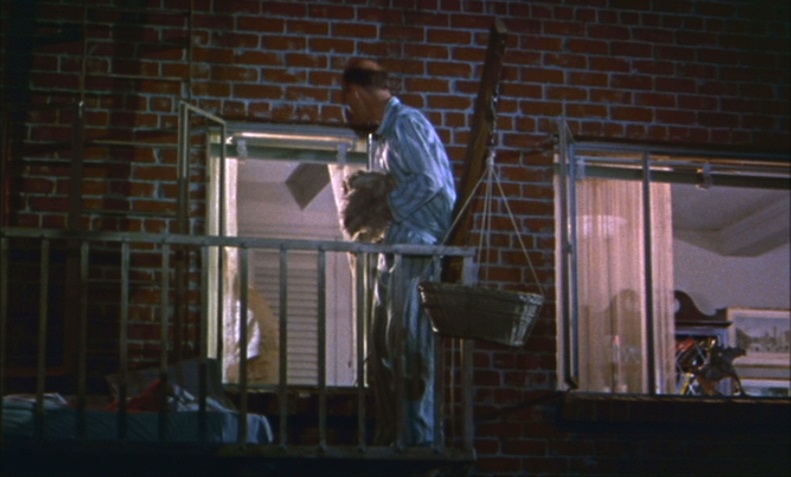
The couple who own the dog are standing on their fire escape.
They are both looking down, but while the husband is quiet,
the wife is holding her hands to the side of her head, sobbing
loudly.
We have heard her sobbing since the moment of the
scream which she uttered.
SEMI-LONG SHOT
Lying near the sidewalk in the backyard below the couple's
fire escape, is the silent body of the little dog they own.
Miss Lonely Hearts comes running out of the basement door.
She goes directly to the dog, picks it up in her arms.
Then
she slowly turns and looks up at the sobbing woman above
her.
LONELY HEARTS
(Her voice clear)
It's dead! It's been strangled and
the neck is broken!
SEMI-LONG SHOT
Instead of increasing her sobbing, this news quiets,
momentarily, the woman who owned the dog.
Her hands go down
to the railing of the fire escape, gripping it fiercely.
She
lifts her face to the neighborhood, her lips set and her
eyes burning. Her chest moves convulsively from the crying.
MRS. SIFFLEUSE
Which one of you did it?
(Loud)
Which one of you killed my dog?
MRS. SIFFLEUSE(No one answers; her
voice is acid)
You don't know the meaning of the
word "neighbor".
MRS. SIFFLEUSENeighbors like each
other --
MRS. SIFFLEUSEspeak to each other --
MRS. SIFFLEUSEcare
if anybody lives or dies.
MRS. SIFFLEUSEBut none
of you do!
You don't talk, you don't
help, you -- you don't ---
(Fighting tears)
Even see.
MRS. SIFFLEUSEBut I couldn't imagine any
of you being so low that you'd
kill a little helpless, friendly
dog!
MRS. SIFFLEUSEThe only thing in this whole
neighborhood who liked anybody!
SEMI-LONG SHOT
The guests at the song-writer's party begin to move silently
back to the studio apartment.
SEMI-LONG SHOT
The people move off their balcony into the apartment.
SEMI-LONG SHOT
The woman almost screams at the people now, as she looks up
at the apartment.
MRS. SIFFLEUSEDid you kill him because he...
MRS. SIFFLEUSE ...liked
you? Just because he liked you?
She breaks out sobbing anew, and returns to her apartment
and out of sight, the crying growing fainter with her retreat.
The husband leans over the fire-escape, and motions Miss
Lonely Hearts to place the dog in the basket, which is already
lowered.
SEMI-LONG SHOT
Miss Lonely Hearts puts the dog in the basket, and watches
as the husband draws it slowly up.
SEMI-LONG SHOT
The bathing beauties go inside their apartment.
MEDIUM SHOT
The newlyweds draw their shades again.
MEDIUM SHOT
The landlord moves away from the window.
SEMI-LONG SHOT
The dog moves closer to the fire escape, slowly, the husband
pulling the rope in hand over hand.
SEMI-LONG SHOT
Miss Torso goes back to her apartment.
SEMI-LONG SHOT
Miss Hearing Aid turns down the volume of her hearing aid
and goes back to her apartment.
SEMI-LONG SHOT
The dog reaches the fire escape, and the husband tenderly
takes it out of the basket.
He turns to carry it's body into the
apartment.
INT. JEFF'S APARTMENT - NIGHT MEDIUM SHOT
Jeff and Lisa are at the window. He is holding on of hands.
Jeff speaks without looking up.
JEFF
(Ya know) For a minute, Doyle almost had me
convinced I was wrong.
LISA
But you're not?
JEFFLook.
JEFF
In the whole courtyard,
JEFFonly one
person didn't come to the window.
JEFFLook.
(He points)
EXT. NEIGHBORHOOD - NIGHT - SEMI-LONG SHOT
Thorwald's apartment. It is dark.
The only light that can be
seen in it is the glowing end of a cigar in the center of
the room, back from the window -- as if Thorwald was sitting
quietly on his sofa, smoking.
INT. JEFF'S APARTMENT - NIGHT - MEDIUM SHOT
Lisa looks down at Jeff.
LISA
Why would Thorwald want to kill a
little dog?
LISA(Almost a laugh)
Because it knew too much?
He nods solemnly and then turns back to the window,
as both
he and Lisa look again towards
EXT. NEIGHBORHOOD - NIGHT - SEMI-LONG SHOT
Thorwald's apartment.
Still dark, and only the unmoving glow
of a cigar showing in the center of the apartment.

 When Brown is informed of the precautions, the father-detective goes into a sort of distracted trance—in his mind, he's figured out three different way that the cross could be stolen. "So, if I, an amateur, can steal the cross in three ways , one can only think what Flambeau will do!" Brown volunteers to take the cross himself—"one priest indistinguishable from hundreds carrying one cross undetectable from hundreds" But, the inspector and the Bishop are in agreement: they will have undercover men make their way to Rome in the hopes of intercepting the wiley thief. To Brown, this is "lunacy!" He makes his own arrangements to carry out his conception of a plan.
 Now, as a recovering Catholic, I must confess that the closest I get to religion these days is through Father Brown, the sleuthing priest created by author G.K.Chesterton in 1910 (predating Agatha Christie's sleuths by a decade). I've watched the Mark Williams series, having seen nearly every episode, and read a few of the stories and have always found a kind of solace in the character's rock-solid faith and his unorthodox application of it when dealing with the near-occasion of sinners. He does not judge, believing not that people are good or evil, but merely people, and those that have strayed can always be moved on to the better path. He is not naive, or a cross-eyed optimist, but will argue that his faith is even more pertinent in a world where virtue is challenged. At one point in The Detective, he says: "My son, you think that you are a man of the world and that I am not. But
I assure you, my 'innocent' ears encounter every day stories of a
horror that would make your sophisticated hair stand on end. Although I
wear funny clothes, and have taken certain vows, I live far more in the
world than you do." It's a world where his ability to pick locks, or judo-wrestle are useful tools, particularly when employed for good. He'll even pick a pocket (but only to prove a point when he returns the "swag").
Now, as a recovering Catholic, I must confess that the closest I get to religion these days is through Father Brown, the sleuthing priest created by author G.K.Chesterton in 1910 (predating Agatha Christie's sleuths by a decade). I've watched the Mark Williams series, having seen nearly every episode, and read a few of the stories and have always found a kind of solace in the character's rock-solid faith and his unorthodox application of it when dealing with the near-occasion of sinners. He does not judge, believing not that people are good or evil, but merely people, and those that have strayed can always be moved on to the better path. He is not naive, or a cross-eyed optimist, but will argue that his faith is even more pertinent in a world where virtue is challenged. At one point in The Detective, he says: "My son, you think that you are a man of the world and that I am not. But
I assure you, my 'innocent' ears encounter every day stories of a
horror that would make your sophisticated hair stand on end. Although I
wear funny clothes, and have taken certain vows, I live far more in the
world than you do." It's a world where his ability to pick locks, or judo-wrestle are useful tools, particularly when employed for good. He'll even pick a pocket (but only to prove a point when he returns the "swag").


 The Detective also has two of my favorite British performers: the ever-beguiling Joan Greenwood, (who'd starred with Guinness in a couple of his comedies) as one of Father Brown's more well-off parishioners and confidantes; and Bernard Lee (who would go on to play MI6 head "M" in the first 16 films of the Bond series) as an undercover police officer doggedly pursuing Flambeau, and who finds Brown's deft interference almost in itself criminal.
 But, the surprise is Peter Finch as master-thief Flambeau. Up to this point, Finch could be rather stiff in his roles, but, here, he's light-hearted and charming, pulling off the character-work in disguise, and, when unmasked, giving off the air of a bon-vivant, quite happy in his mis-deeds. Guinness and he have a lot of dialog together and they spar winningly.
 Based rather loosely on Chesterton's first Father Brown story "The Blue Cross," It's absolutely delightful and was well worth the wait.









butyournot.jpg)


