Showing posts with label Cecil Parker. Show all posts

Thursday, March 27, 2025

The Detective (1954)

The Detective
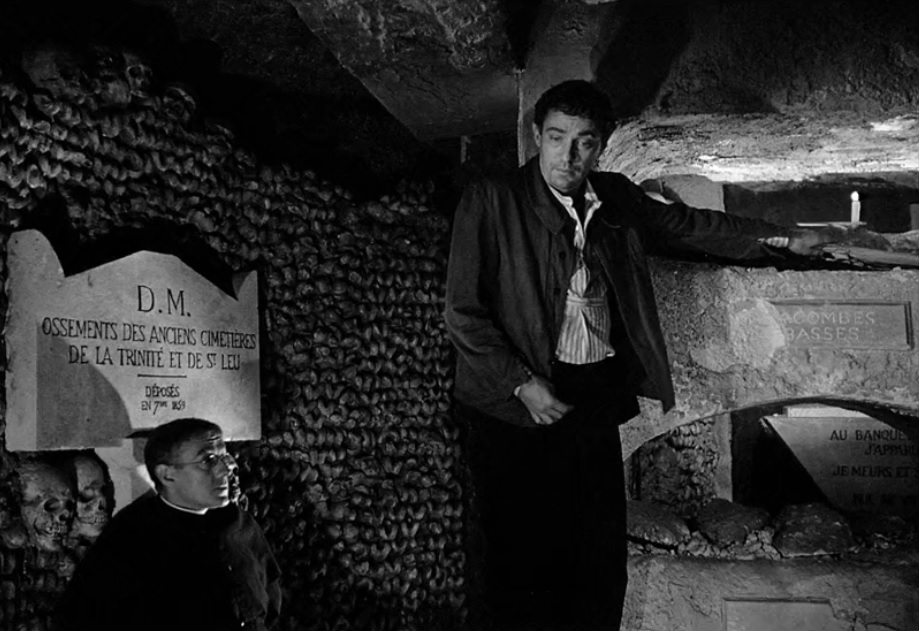
(aka Father Brown)(Robert Hamer, 1954) It's quite the scandal when Father Brown (Alec Guinness) is arrested by the local constabulary when he is caught in the act of "burglarious purposes" in front of an open safe. At police headquarters, the humble English vicker tries to explain that he was only trying to return the "swag" ("I believe that's what it's called—'swag'") for one of his parishioners (he admonishes him for being "an incompetent thief...clearly incapable of earning a dishonest living") whom he had convinced to forego a life of petty thievery and, in return, Brown would return the stolen good to the rightful place. That's when the police arrived.
 
A night in the hoosegow (which he finds "most interesting" and thanks the police for their "hospitality") and he's identified by the church authorities and sprung. So, of course, when he's hauled before the Bishop, he assumes it's for the arrest—he having a reputation in the diocese as "an odd one". But, it's of another matter entirely: it's seems that the Eucharistic Congress is soon to be held in Rome. And the Bishop has decided to send the Holy Cross of St. Augustine, which is twelve centuries old and currently resides in Father Brown's parish church. Father Brown considers the cross "not valuable...priceless," so he's alarmed when informed by a local Inspector than an "imminent criminal is intent to intercept the cross en route." The criminal's name is Gustav Flambeau* (Peter Finch) and Father Brown is only too aware of the master-thief's reputation—"a human chameleon" such an expert of disguise that no one knows what he looks like.
When Brown is informed of the precautions, the father-detective goes into a sort of distracted trance—in his mind, he's figured out three different way that the cross could be stolen. "So, if I, an amateur, can steal the cross in
three ways , one can only think what Flambeau will do!" Brown volunteers to take the cross himself—"one priest indistinguishable from hundreds carrying one cross undetectable from hundreds" But, the inspector and the Bishop are in agreement: they will have undercover men make their way to Rome in the hopes of intercepting the wiley thief. To Brown, this is "lunacy!" He makes his own arrangements to carry out his conception of a plan.
Now, as a recovering Catholic, I must confess that the closest I get to religion these days is through Father Brown, the sleuthing priest created by author G.K.Chesterton in 1910 (predating Agatha Christie's sleuths by a decade). I've watched the Mark Williams series, having seen nearly every episode, and read a few of the stories and have always found a kind of solace in the character's rock-solid faith and his unorthodox application of it when dealing with the near-occasion of sinners. He does not judge, believing not that people are good or evil, but merely people, and those that have strayed can always be moved on to the better path. He is not naive, or a cross-eyed optimist, but will argue that his faith is even more pertinent in a world where virtue is challenged. At one point in The Detective, he says: "
My son, you think that you are a man of the world and that I am not. But I assure you, my 'innocent' ears encounter every day stories of a horror that would make your sophisticated hair stand on end. Although I wear funny clothes, and have taken certain vows, I live far more in the world than you do." It's a world where his ability to pick locks, or judo-wrestle are useful tools, particularly when employed for good. He'll even pick a pocket (but only to prove a point when he returns the "swag").
When I found that there was a "Father Brown" movie, particularly to my delight that Alec Guinness played the part, I began an exhaustive search to find it. It took years, but it can now be found** And it exceeded my expectations. I've never been disappointed by a Guinness performance*** and his Brown is very much a sheep in wolfs clothing. He's as sharp as they come, if a bit idiosyncratic, and when called upon Guinness overplays the "twee" nature of Brown, his awkwardness hiding a quick-wittedness—although his humility will never allow him to admit it.
The Detective also has two of my favorite British performers: the ever-beguiling 
Joan Greenwood, (who'd starred with Guinness in a couple of his comedies) as one of Father Brown's more well-off parishioners and confidantes; and Bernard Lee (who would go on to play MI6 head "M" in the first 16 films of the Bond series) as an undercover police officer doggedly pursuing Flambeau, and who finds Brown's deft interference almost in itself criminal.
But, the surprise is Peter Finch as master-thief Flambeau. Up to this point, Finch could be rather stiff in his roles, but, here, he's light-hearted and charming, pulling off the character-work in disguise, and, when unmasked, giving off the air of a bon-vivant, quite happy in his mis-deeds. Guinness and he have a lot of dialog together and they spar winningly.
Based rather loosely on Chesterton's first Father Brown story "The Blue Cross," It's absolutely delightful and was well worth the wait.

* Interesting that they call him "Gustav" Flambeau as Chesterton gave him the christian name of "Hercule"—perhaps to not confuse him with Christie's Poirot, who debuted 10 years later—and the character is supposed to be French, and Gustav is considered a Swedish or German name.
 
** On the streaming service Tubi, but the Lord only knows how long it will remain there. 

*** Okay, there is one. It is Hitler: The Last Ten Days where I found his performance as The Führer rather dull. Time Magazine's critic said it was only useful in showing "the banality of evil." Curiously, IMDB says it's the only performance Guinness was completely happy with, having campaigned actively to play it.

Tuesday, July 26, 2022

The Wreck of the Mary Deare

The Wreck of the Mary Deare (Michael Anderson, 1959) It was intended to be an MGM production for Alfred Hitchcock—he'd liked the best-seller and he'd wanted to work with Gary Cooper since Foreign Correspondent in 1940—but screenwriter Ernest Lehman found it pretty dull with an extended, dry courtroom scene at the end, and the two decided to fulfill his real ambition—to make the "ultimate Hitchcock film"—which turned out to be North By Northwest.

We are all the better for it. 


As it is, The Wreck of the Mary Deare is an odd picture with a great mysterious opening and a dry-as-dust finale, try as scripter Eric Ambler and director Anderson might to make a suitable action closer to it.  In turbulent seas in the English Channel, a salvage tug, captained by John Sands (Charlton Heston), finds a ghost-freighter marooned and adrift, nearly colliding  and destroying his ship. Pulling alongside, Sands grabs a dangling line and laboriously clambers aboard. The rusting hulk, the Mary Deare, is without power, a large gash in its side that is slowly flooding the engine room, and with no sign of life on-board...at least initially.
One man has remained—First Officer Gerald Patch (Cooper), a merchant marine eking out an existence on the ship, which was recently abandoned, and desperately trying to scuttle it before it sinks of its own accord. The reason is not because he wants it to be salvaged; he needs it for evidence, but why is being kept a closely guarded secret. With the reluctant help of Sands, Patch gets the boiler-room going, the ship under power, and the Captain-by-default's mission accomplished.
All of which is great stuff—the conflicts, the questionable sanity of Patch, Sands' greediness in wanting to claim the salvage on the ship—which would have made a great film if it ended there. Unfortunately, that's only thirty minutes of it. It would have been a great short subject, though, but the movie trundles along over the investigation and trial over who owns the boat and the conflicting testimonies between Patch and the eventually-found crew (ring-leadered by Richard Harris, who can't seem to eke out an interesting performance from the material, try as he might).
Michael Anderson is no one's idea of an innovative director—and he started his career assisting David Lean and Carol Reed! His widescreen compositions look like they're meant to be cropped for a boxy television presentation, although he was known for taking elephantine projects—Around the World in 80 Days, Logan's Run—and making them as quickly and cheaply as possible, There is the sense watching his films that a creative presentation, rather than a practical one, was thought unnecessary—keep the focus, hit the marks, and, as far as lighting, make sure the audience can see the stars' faces.
Both Cooper and Heston are good
, in what seems to be dueling portrayals of earnestness. But, ultimately, the secrets that Patch is keeping just aren't very interesting, and although some attempt is made to salvage it at the end, the movie is, like its namesake, something of a drifting hulk. 

Wednesday, April 13, 2022

The Citadel

The Citadel (King Vidor, 1938) Dr. Andrew Manson (Robert Donat) gets off the train at the Welsh mining town of Blaenly in which he's been employed as an assistant, only to find the doctor he's working for, Page, is himself, lain up in bed. Not a good sign. He finds that in his new job he's poorly paid, and only has a small room to live in. And—as always in small towns—nobody trusts the new doctor or vet or priest or shopkeeper or whatever until he does them a good turn that seems miraculous. In small towns, trust is earned and then spread by word-of-mouth, just like a communicable disease.
 
That miraculous moment doesn't occur until, when he is called to a miner's home to deliver a child, he is confronted with the woman already having given birth, the child stillborn. But, Manson is able to resuscitate it and, for awhile, there is that trust in the community. Passed by word of mouth, trust is also communicable in small villages. He makes the acquaintance of another doctor, Denny (Ralph Richardson), who has been dealing with these issues longer and is quite cynical, a cynicism which is self-medicated with a healthy dose of alcohol. "No hospital, no X-ray, no ambulance, no anything. If you want to operate you use the kitchen table." The two compare notes on a pernicious cough that veteran miners have displayed while the two take patient calls.
A typhus epidemic, however, erupts throughout the town, devastating the community, and the two idealistic doctors decide that the best remedy is fight the source, trying to convince the mine owners of the danger of the sub-par sewer system, and then, when rebuffed, they decide to go to extremes, prescribe themselves some civil disobedience and blow it up, forcing the "do-as-little-as-possible" owners to have to replace it. The mine-owners had evidently taken a hypocritical oath. Denny tells Manson of a position to be filled in the mining town of Aberalaw, but holds little hope of being accepted as he's not a married man. Well, that's a bit of a problem. What's the remedy?
Well, it so happens the good doctor has made the acquaintance of the local school mistress, Christine Barlow (
Rosalind Russell), who's seen the good works the doctor provides her students, and the two decide to (for the betterment of Aberalaw, of course!) get hitched. The two work together, helping patients by day and by night studying the debilitating effects the mining industry has to the lungs of the community. He publishes his findings which are hailed by the medical community, but the miners—much like the mine-owners in Blaeny—are more concerned with how their livelihoods might be affected. So, they take a note from the doctor's past and before he can (maybe) blow up the mine, they ransack his office...because...the studies they don't like have already been published. Angry mobs are not so much concerned with timing. This is why they are miners and not scientists (rocket or otherwise).
Well, being the pariah of the community doesn't do much for one's medical practice no matter how altruistic, so doctor and wife move to London, deciding to set up a clinic in one of the city's poorer districts, because...hippocratic oath and humanitarianism and all that bleeding heart stuff (come to think of it, that's something I would call a doctor for!) And this is where the movie gets very interesting because at some point, he is persuaded by a school-friend of his (played by
Rex Harrison) to specialize in diseases of the rich and hypochondriacal—which is sort of a communicable disease among doctors...it doesn't blacken the lung so much as the soul.
Okay, it's 2022 and you're SO SUPERIOR for pointing out that a doctor specializing 
in Black Lung Disease is so smoking so cavalierly.

How will it turn out? Will the doctor heal himself of his over-charging frivolous ways to patients who'll pay through the nose (or any other orifice), or will he go back to helping the poor who resent him for trying to help them with things they don't want help with?
 
Do you want the movie answer, or the "real-world" answer?
 
See it twice and call me in the morning.

Friday, May 18, 2018

The Ladykillers (1955)

The Ladykillers (Alexander Mackendrick, 1955) Those who know Alec Guinness mostly for his Jedi mastery in the "Star Wars" series may have missed his amazing string of English comedies showcasing his talents, sometimes in multiple roles in the same film. A complex "interior" performer, Guinness had enormous range whether playing drama or comedy. But of the latter, the most interesting might be his ghoulish turn in Alexander Mackendrick's The Ladykillers,* the dark comedy of a motley group of robbers planning an armored car job under the nose of a little old lady who has rented them rooms in her flat.

It is a murky day when Professor Marcus (Guinness) answers an advertisement placed by neighborhood busybody and widow Mrs. Wilberforce (Katie Johnson) of rooms to let in her slightly dilapidated house. The house might be old and musty, settling, and filled with screaming parrots,** but for Marcus, it's "location, location, location." And he is willing to negotiate with Mrs. Wilberforce in order to secure rooms for himself and his band-mates, a string quartet. As he explains, his orchestra needs rooms for practicing, but that is merely a ruse for a much darker purpose: his rather suspicious looking orchestra is actually less musically inclined as criminally disposed.
Besides Marcus, there is former pugilist "One-Round" Lawson (Danny Green) tough but a bit punch-drunk, spiv Harry Robinson (Peter Sellers), con-man Major Claude Courtney (Cecil Parker) and the murderous gangster Louis Harvey (Herbert Lom). They would never pass for a quartet if anyone had discriminating eyes, but Mrs. Wilberforce, who usually eyes things suspiciously, is quite myopic when it comes to the Professor's players. Maybe it's their repertoire of Boccherini's Minuet in E that evokes fond memories for her and makes her look past their bizarre looks. 
What they have eyes for is the reason they took the rooms in the first place—the modest house is but a stone's throw from the King's Cross railway station that is the destination for a regular armored car delivery, it's cargo of cash being what they covet and the Professor's plans being how they will carry it off.
The humor of the film is how these wolves must pretend they're sheep for the benefit of the innocent Mr.s Wilberforce. The crooks so their best (or worst) to be on their most innocent—or least suspicious behavior—around Mrs. Wilberforce and her friends, and the usually suspicious landlady is unaware that she has a bunch of thugs under her roof, despite sticking out like snapdragons in a rose garden. There is the constant state of danger that could become...very uncordial.
Then once the heist has been carried off without immediate consequence, there is the tense situation that the money might be detected. The ill-gotten gains are then at risk of being discovered by the kindly, if "Kravitzy" little old landlady. All of the main cast of characters, innocent or guilty as sin, are strangers in a strange land, potentially clashing with their own natures, due to the circumstances.
Now, because it is a crime film, albeit a comedic one, from the 1950's, some comeuppance—some moral balance—must be imposed in the way the story shakes out, one that has been played out with a similarly accidental twist in later movies of the type, but takes on a decidedly macabre version of "there's no honor among thieves". That there is still some ambiguity in that resolution is what makes the film quirky, ironic and mischievous. And jolly bad fun.
 
* The Coen brothers (Joel and Ethan) remade the film, set in the South (Louisianna, actually) with Tom Hanks playing the Professor character, but their film, though different in particulars, is not an improvement over the original. Perhaps the decision to re-locate the film in the States is a reaction to the fact that this very British film was actually written by American William Rose, who wrote such other films as It's a Mad, Mad, Mad, Mad World, The Russians are Coming! The Russians are Coming!, and Guess Who's Coming to Dinner

** The parrots, amusingly, are voiced by Peter Sellers.

*** Guinness, when he was offered the script, remarked "but this is for Alastair Sim, surely" (yes, it was, but he'd turned down the part) and Guinness' character make-up design does bear a slight toothy resemblance to the actor. Sim—if you think he looks very familiar—played what many think of as the definitive Ebeneezer Scrooge in 1951's Scrooge—directed by Brian Desmond-Hurst.

Friday, May 11, 2018

The Man in the White Suit

The Man in the White Suit (Alexander Mackendrick, 1951) My favorite of the Ealing Studios British comedies of Alec Guinness is this genre-crossing sci-fi/fantasy/corporate satire about the financial efficacy of building a better movie-trap. The canard is that the world will beat a path to your door, but the reality is that the mouse-trap industry (no doubt led by the appropriately-named "Victor®"—a division of Woodstream Corp.) will probably suppress it, buy the patent, or, in some other way, bury the innovation to protect their own short-term (dare I say "fiscal") interests, even if it might (indeed) revolutionize the industry. Sure, it might be the greatest thing since sliced bread, but that's only because the knife industry allowed it (talk about "the cutting edge!).

The Man in the White Suit tells the story of researcher Sidney Stratton (Guinness), who, through chemistry and some minor combustion (which gets him fired from his original job at Corland Mills, run by Michael Corland (Michael Gough), he is snapped up by the rival Birnley Mills, where his attempts finally succeed in concocting an innovative thread, a polymer that repels everything, making an indestructible, water-proof, stain-resistant weave—it even resists dyes, thus making it a permanent glow-in-the-dark white color.
It's seen as something of a revolutionary break-through, a boon to the consumer. And Stratton sees it as a revolution of sorts: who wouldn't want an indestructible suit or dress that would never wear out and never need to be replaced?
Clothiers, for one big example. The garment industry. With clothing that can never rip, fray, stain, or shrink, who would want to buy other clothing ever again? So, after the initial flush of excitement over the innovation, the corporation Stratton works for, Birnley Mills, looks down the fiscal road and sees consumers with no need to further buy replacement clothing. And so the corporate board acts to repress Stratton's invention, trying to buy out the rights in order to do it, but Stratton, with an inventor's righteous zeal, refuses.
And lest anyone think this is a liberal screed about corporate greed, it casts equal shade at the trade unions who also want to stop progress, as the fabric is seen as a threat to industry that will cost workers' jobs, should it ever see the business end of a coat hanger. Despite being offered a million dollar deal to sell out, Stratton resists, and is held captive as long as he holds out, but he has the sympathy from the daughter (Joan Greenwood) of the mills' head (Cecil Parker), if only because the board tries to recruit her to turn Stratton's mind around.

Stratton ensures that he will always be the brightest guy in the room.
It's a great story and a great movie, and over the years I've seen it reflected—rarely—in other films. For example, Disney's The Absent-Minded Professor can be seen as an American version of the same story, with the military over-zealously pursuing Professor Brainard's version of "Flubber." A true-story equivalent is Francis Ford Coppola's Tucker: The Man and His Dream, about inventor Preston Tucker and his intent on creating a safe, stylish and efficient "car of the future"—and the auto industry's successful attempt to hinder the production of any of the innovative cars to just 50.
There's another aspect to The Man in the White Suit that endears it to me, but it's purely personal—it's the charmingly goofy lab sounds that emanate from Stratton's efforts that create a sort of obsessive fandango as he pursues his efforts. I came across the track (created by sound editor Mary Habberfield) in a BBC sound effects library, and, when I worked on a certain kids' science show, I had the intention of using the track on a proposed second season episode about "Psuedo-science." Budget considerations pushed the subject to the third season and, by that time, I had moved on to other things. Still would have loved to have had that little private joke realized, though.