Showing posts with label Charles Crichton. Show all posts

Tuesday, February 8, 2022

Whiskey Galore! (1948)

Whiskey Galore!  (aka Tight Little Island)(Alexander Mackendrick, Charles Crichton, 1949) The island of Todday in the West Hebrides is dry. It's 1943 and with the world at war, rationing has drained the last drops of whisky out of the sodden land. Scots without whiskey are restless. So, it's no wonder that among the younger set, thoughts have turned to romance. Schoolmaster George Campbell (Gordon Jackson) is trying to woo Catriona Macroon (Gabrielle Blunt), one of the daughters of shopkeeper Joseph Macroon (Wylie Watson), despite his religious mother's strong disapproval. Macroon's other daughter, Peggy (the ever-charming Joan Greenwood), is being courted by Sergeant Odd (Bruce Seton), of the Home Guard, charged with keeping the island safe from attack, and bringing a rather unwelcome sense of regimentation to island life. The older folks, well, they're just trying to get by, but, without any whisky, a general pall has descended on the island. Tea is all well and good, but the strict rationing has taken its toll on tempers because of the temperance.
So, it must seem like manna from heaven, when the SS Cabinet Minister runs aground in a heavy night-time fog. A couple of the islanders try to lend assistance, and learn from the stuck crew that the ship's cargo consists of 50,000 cases of whisky. No help is requested; none is desired. The ship begins to take on water and the crew abandons ship, leaving it to the salvage folks to take care of the cargo. But, the prospect of 50,000 cases of whiskey instills in the island a severe sense of...volunteerism. Plans are immediately made to see if the citizenry can "lighten the load" of the ship—in the spirit of helping the war effort (you understand).
To the head of the Home Guard, Captain Paul Waggett (Basil Radford), the duty is clear: as property of Her Majesty, the cargo must be under the guard of their forces and must not be interfered with until the authorities deal with the situation. To him, it is as if the Germans themselves have sunk the Cabinet Minister and any thought of touching the cargo would be tantamount to treason. He orders Odd to set up a 24 hour watch on the ship to make sure that it is safe and secure.
There's a little complication, of course. Macroon reminds Odd that a bridegroom, before his nuptials, must host a rèiteach—a communal get-together—at which whisky, traditionally, is served. No whisky, no marriage (traditionally). This creates a bit of a conflict of interest for Odd, as he does want to get married, duty or no duty. So, when word gets to him that the locals may make a "reconnaisance" of the ship, he conspires with them to complete his charge, but also let them sail out to the ship. Both Odd and the locals are determined to keep Waggett ignorant of anything that might transpire.
Hi-jinks ensue. 
 
Whiskey Galore! had a difficult production history: It was the first picture produced by Ealing Studios to feature considerable location filming and, owing to that, the budget was more of an investment than had been previously produced. Weather conditions were not exactly ideal and led the film to go over-budget and over-schedule (a full five weeks on a 10 week shoot!). Also, director McKendrick was working with a fairly inexperienced crew and came away thinking it looked more "like a home movie." Not only that, McKendrick was more in sympathy with the Home Guard commander, rather than the rapskallion islanders.
Ultimately, the film was "saved" in post, due to some re-editing and extra footage, all done by Charles Crichton. And it's delightful, full of little winking touches and the sort of local color designed to melt audiences' hearts. Mckendrick, despite the experience, went on to direct some of the great British comedies, like The Man in the White Suit, The Ladykillers, and (in the States) Sweet Smell of Success. Crichton had a long career, directing The Lavender Hill Mob all the way to his last film, A Fish Called Wanda (in 1988).

Wednesday, October 5, 2016

Dead of Night (1945)

Dead of Night (Alberto Cavalcanti, Basil Dearden, Charles Crichton, Robert Hamer, 1945) British omnibus film from Ealing Studios where four stories of the bizarre are buttressed by a framing device of an architect (Mervyn Jones) invited to a country house that evokes an inescapable sense of déjà vu. 

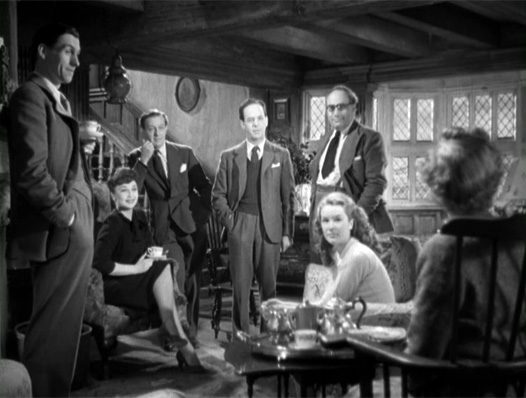
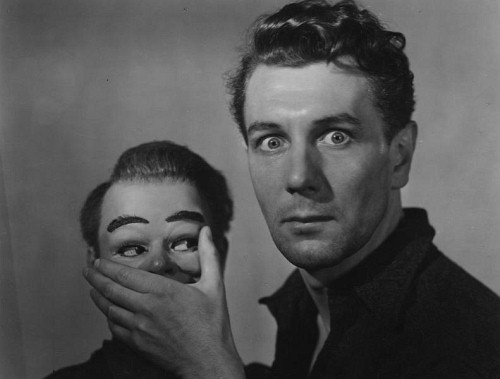
At the house is a collection of strangers with odd stories: a race car driver who barely survives a crash and during a recovery has a strange dream involving a beckoning hearse and driver who says "just room for inside, sir"—a dream that has fateful repercussions later on; a girl (Sally Ann Howes) who recounts a strange encounter at a Christmas party; a woman who buys her fiancé an antiquated mirror with a mind—and a room—of its own; a whimsical tale of of two obsessed golf duffers (Basil Radford and Naunton Wayne) who wager for the affections of a woman over a match; and the last, featuring a ventriloquist (a bravura performance by Michael Redgrave) whose dummy wants to change the act's billing.
Anyone familiar with "The Twilight Zone" will have their own distinct sense of déjà vu watching Dead of Night—the race-driving story is remarkably similar to a Bennet Cerf story that was adapted by Serling as "Twenty Two;" the Christmas story echoes others; the ventriloquist story has been dummied about several times and not just on TZ. The stories have their own specific atmospheres that cling to their stories like shrouds, and Ealing proudly displays the collection of sets and artistry that made it one of the preeminent studios in Great Britain.
The stories are all decidedly set-bound with some quick outdoor scenes—it was wartime when the film was made and although the tone is fairly nightmarish (pluckily nightmarish), escapism from the rubble and the war news was the intent, and maybe a little tonic from "boogey-man-isms" by having a psychiatrist (Viennese, of course, played by Frederick Valk) popping the bubble of the story-tellers by trying to clinically explain things away. It provides a fine counter-balance (and a bit of straight-faced comic relief) to the tales of the supernatural, with their underpinnings of hysteria and mental imbalance. Fun, unsettling and meticulously done.