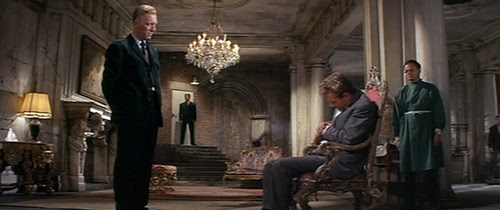
Moonfleet(Fritz Lang, 1955) Fritz Lang's only film in Cinemascope—a format he famously described as only good for shooting "snakes and funerals" (well, he says it in Contempt, anyway!).
"Moonfleet" was a popular novel published in 1898 and was considered a classic of literature—on a par with Robert Louis Stevenson's "Treasure Island"—but not so much in the U.S. Producer John Houseman, working at M-G-M, maybe influenced by the success of Disney's 1950 version of Stevenson's classic, wedged in Moonfleet between prestige pictures, but on a limited budget—no ocean scenes, no tall ships, no cluttered sword-riots, no piratey aspects that required crowds and location work. Lang, who actually preferred studio work over the capricious lighting of location scenes, was hired two weeks before shooting started and hadn't worked at M-G-M since his first film in America, the 1936 production of Fury. The script had aspects of the novel, but didn't follow it too closely, taking the novel's hero and making him a child, as opposed to the young man of the novel, who depends on an older mercenary smuggler to pursue his quest of a legendary diamond belonging to the pirate Blackbeard.
That's one way to use the Cinemascope frame.
Well, it's "Redbeard" in the movie (public domain issues?). Young John Mohune (Jon Whiteley) is sent by his dying mother to the town of Moonfleet, site of the original Mohune estate, to seek out a man with whom she had a past, Jeremy Fox (Stewart Granger). Exhausted by his travel, young John wakes up in a tavern surrounded by ruffians—including Dan Seymour and Jack Elam—who search him and find a letter from the boy's mother, appointing Fox as John's guardian. It's convenient because Fox just happens to be the man now occupying the Mohune manse.
It's inconvenient because, when Fox hears this, he wants nothing to do with the boy, being a man of the world and all. But, he does acknowledge knowing the mother, being fond of her, and that he and the boy may have more in common than Fox will acknowledge—like the boy's nightmares of being attacked by dogs echoing the scars on Fox's back from such an attack while he was running from the Mohune house so many years ago. Probably as many years as the boy's been alive, but the film skirts this issue, while hinting that it's probably true. Still, he plans to have the boy sent packing in the morning, while he continues on to Moonfleet.
He, of course, hasn't reckoned with the boy being a Mohune, and a tenacious one at that. The boy manages to make his escape and, with the help of some locals, make his way back to his family's estate, where he finds Fox in mid-debauch, hosting several drunken lords, complete with entertainment by a gypsy dancer (Liliane Montevecchi). Young John insists he won't be sent away this time and that he intends to stay with Fox as per his mother's wishes. Fox is impressed by the boy, but secretly intends to send him away to the colonies on the next boat. When Fox's mistress Mrs. Minton (Viveca Lindfors) accuses Fox of his actions towards John as being proof of his continuing love for the boy's mother, he tells her that, in that case, she can leave on the same boat with him.
The next day, John attends church services, where he is informed—via a fiery sermon about superstition—that the villagers fear that the spirit of the pirate Red Beard, who was a Mohune, is haunting the church graveyard looking for the diamond that made him renounce his military career and become a pirate. While walking the grounds that night, John falls into an open grave that leads to the catacombs under the church full of broken caskets and the bones of the departed. But Fox's pirates come down there, too, looking for potential riches, and the boy finds a locket while hiding away from sight.
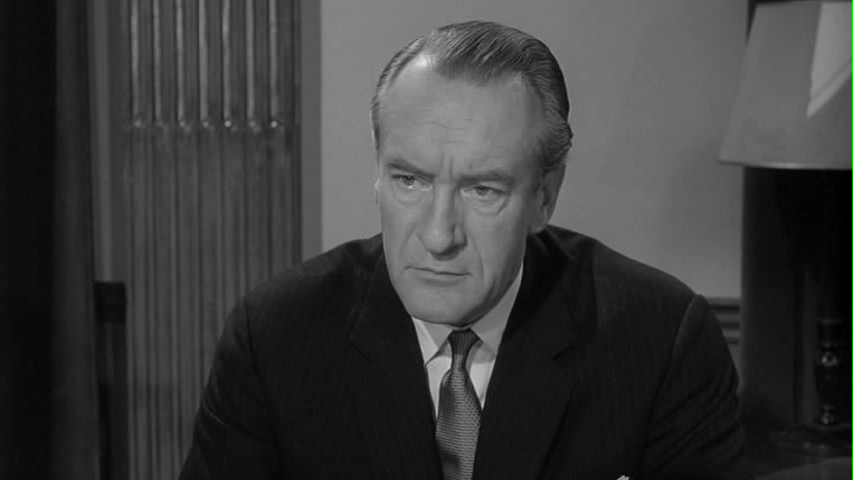
When rescued from the catacombs by Fox, his band is ready to slit the boy's throat for anything the kid might have found, and when Fox defends the boy, the pirates—being pirates—turn against him. This puts Fox in a difficult position—he is being challenged by his own band at the same time he's trying to finagle a deal with the duplicitous magistrate Lord Ashwood (venomed by George Sanders, as only George Sanders can) and his equally devious wife (played by the ever-delightful Joan Greenwood in her first American role).
That locket John has snatched will contain a secret that must be decoded and from there, Fox and friend must evade his former co-conspirators, as well as the Ashwoods, and the authorities to find the diamond and extricate it from its hiding place smack-dab in the middle of a military prison, even while they're considered wanted fugitives. This gives plenty of opportunity for composer Miklós Rózsa to create bustling tension music (which sounds like it's a dress rehearsal for his score for Ben-Hur), while the duo put themselves directly in harms way to achieve their goals.
It's not the novel—which shares the diamond and the locket and the clues, and that's about it—but Lang makes the most out of the material scraped from the book to accommodate Granger's starring persona, while directing it from the vantage of a child's point of view, and enveloping it in a child's nightmare of Gothic structures and macabre situations, with a mentor who is as questionable a father-figure as one could encounter (outside of Dickens). Maybe that's why it never found an audience—too "mature" for kids, too cynical for adults, and not "family-friendly"—which led Houseman to write: "All too often, in those days, I felt that the director was receiving credit for the producer's work. This time (Lang) was taking the blame for the producer's errors." Hard to believe that—with all of his fanciful German work, Moonfleet was the most expensive film, Lang ever worked on.
Warning Shot(Buzz Kulik, 1967) Based on a novel by Whit Masterson (who also wrote the book that had become Touch of Evil), Warning Shot was considered a good vehicle for David Janssen, who was in the middle of his run on "The Fugitive" TV series. The script was by "Fugitive" veteran Mann Rubin* a prolific writer who wrote at least one script for most of the thriller/SCI-FI series of the 1960's and 1970's.
The story has a nice affiliation with Janssen's "Fugitive" persona in that he plays a discredited cop accused of killing an unarmed man—and nobody believes his story that the dead man was carrying a gun—a search of the scene has never turned up the weapon, and the prosecuting attorney (Sam Wannamaker) is more than happy to provide no reasonable doubt. It doesn't help that the L.A. police (in the form of Ed Begley's crusty superior and partner Keenan Wynn) have their own suspicions, whether to save face for the force or attain a promotion.
Plus, it doesn't help that Janssen has a face that always looks guilty.
It's true that during a drug stakeout, Sgt. Tom Valens (Janssen) has shot a man who was running away from him in the night, in the fog of a swimming pool, but Valens swears it was a "good" shoot; he didn't fire until the suspect drew a gun on him. But, in the light of day, the dead man turns out to be a respected doctor and no weapon can be found on the scene. Valens had been shot a year previously—so the whispers are that he might be a little trigger-happy. Facing manslaughter charges, Valens is forced to do a little investigating on his own.
The victim, Tom Ruston, was a respected doctor catering to diseases of the rich, but also well-regarded for his humanitarian work in Mexico. The doc's accountant (George Sanders) and his floozy wife (Eleanor Parker) are of no help, nor is the doc's assistant (Stephanie Powers). Nope, the only people who seem to have any sympathy for Valens' plight is his ex-wife (Joan Collins) and a pilot (George Grizzard) who lives at "the scene of the crime" and who offers to fly Valens down Mexico-way to see if the doctor's work in Mexico was legit.
Then, things start to get complicated; Valens acquires quite a few bruises after he's been beat up in an apparently random attack. Then, Ruston's nurse dies and the doctor's office is ransacked. Then, Valens is dosed with a mickey in his milk—this was the days of door-stop deliveries**—and nearly gassed by his own fireplace. It would have looked like an accident. But, Valens knows it's enemy action.
Now, it being the 1960's, there's a little bit of experimentation on director Kulik's part with camera angles that are a little too precious,*** and when Valens is beat up (not too convincingly and in sloooow motion) his POV is shown with vasellined and distorting lenses, which is groovy, baby, but didn't strike me as being very convincing. Frankly, when these sorts of shots appear I think less that the person is going unconscious and more that trends in film-making in the '60's were very fleeting.
Ultimately, the entire movie is not very convincing. The plot hinges on one of the most unbelievable and least likely MacGuffins**** in movie history (nope, I won't spoil it, but, once you know, you'll say "why would they use THAT?"). It's odd, but Warning Shot is one of those movies where the script is supposed to be deadly serious, but there are those moments—when Kulik is focusing on a bottle of milk at Janssen's feet, or a shot that shows just how convenient meeting in a graveyard can be—that you think they're trying to have as much fun with the material as they can, the results seeming half-hearted, like the film-makers realizing somewhere in filming they were making one of those Hitchcock "wrong-man" movies. The film is top-heavy with talent—Sanders, Parker, Walter Pidgeon and Lillian Gish—all playing characters they've played and excelled at in their careers—but, the film is far less entertaining than one would expect given all that. The film needs a little bit more absurdity to work. Especially given its ending.
* Yeah. No, he didn't write for "Star Trek" but for Irwin Allen and the "Bionic" people. Quite a few scripts for The Alfred Hitchcock show and most of the detective/mystery shows of the era.
** It's just a cautionary note in these pandemic times, but don't be like David Janssen and leave the delivered food on the stoop all day so bad guys can poison you...or the food gets so old it poisons you.
*** Check this shot out—that's the heavy-hand of the prosecutor in the foreground during the manslaughter trial. Yup, the judge is Carroll O'Connor.
**** And just in case you don't know what a "MacGuffin" is, here is Alfred Hitchcock to explain...
Saturday is traditionally "Take Out the Trash" Day, and while this film is certainly "trashy," it's sophisticatedly multi-layered.
While the City Sleeps(Fritz Lang, 1956) "I wonder what the nice people are doing tonight?" asks esteemed writer-author-journalist-TV personality Walter Mobley (Dana Andrews). Well he should ask, because there are few nice people in his circle of work, which happens to be some form of multi-headed Hydra of journalism, known as Kyne Enterprises. The head of Kyne has just died and the heir-apparent Walter Kyne (Vincent Price) is now in charge, but is a bit feckless and knows nothing of the news business, nor, apparently is he willing to have anybody tell him about it as he decides to delegate. He's going to create a new Executive Director position that will answer to him without having to know all the details. But who is it going to be?
There're many to choose from, besides Mobley, an Edward R. Murrow-type: there's also the urbane head of the wire-service Mark Loving (George Sanders); crusty newspaper head John Day Griffith (Thomas Mitchell); and there's television head "Honest" Harry Kritzer (James Craig). They all want the job and will stoop to any advantage to get it. But Walter has other ideas. He's going to make the contenders fight for it in a "Hunger Games" kind of run-off—winner take-all, and the losers...well, they extend to more than Kyne Headquarters.
It just so happens they're in the news business and New York has a big news story: there's a serial killer in town breaking into apartments and attacking women and has been labeled "The Lipstick Killer"—that would be the ironically-named Robert Manners (John Drew Barrymore), a nervous, slimy type dressed in leathers. It's okay that we know who it is—Lang starts the film out with him carrying out one of his strangulations—as the director is more interested in the power struggle of the media elites eating each other to get the job of "Top Toady."
Meanwhile, as they connive, deceive, and block each other from finding whodunnit, the City sleeps, albeit not very peacefully.
This is territory Lang has worked with before, as early as his silent films for UFA in Germany. In his films Metropolis, Spies, the "Mabuse" features, authority figures wrangle in power struggles completely ignoring the plights of the ordinary citizens who might fall victim as a result. But, those films involve cat-and-mouse games between authorities and criminal masterminds. In Where the City Sleeps, the field of play is publishing/broadcasting, and the criminal is not mastermind, but a craven nobody like the child-murderer of Lang's M. While the department-heads wring their hands worrying about advantage, he's in the streets looking for opportunity.
Lang's film has enough layers that one might even miss that his film is lumping the newsmongers in with the serial killer in more ways than mutual benefit. For instance, how do they maneuver and manipulate the "contest" to their advantage? By throwing women under the bus, of course: Loving uses writer Mildred Donner (Ida Lupino) to seduce Mobley in order to get any inside info from the anchor (it doesn't matter that Mobley is engaged to Loving's secretary, Nancy Liggett, played by Sally Forrest); Kritzer is having an affair with Kyne's wife (Rhonda Fleming) in order to use her as a mole for scoops and news oh his standing in the contest and so she can talk up her lover—they've even set up a rendezvous apartment, which happens to be close to Liggett's, as well; and finally, Mobley hatches a scheme with the police lieutenant working the case (Howard Duff) to set up the "Lipstick Killer" using his fiancée as bait. "Nice!"
Mobley's little scheme is to go on the air, using inside knowledge of the investigation and taunt the Killer into targeting his fiancée as an act of revenge. Then, it should be an easy thing to just keep tabs on her until the killer makes his move. Easier said than done, and things get dicey enough that it gives these paragons of the public trust a little taste of terror in the midst of stabbing each other in the back for a single rung up the power ladder.
The cast is great; everybody's a character actor who can milk their scenes for all they're worth and rattle off movie lines like they're still stuck in the 40's. The only thorn among roses is Barrymore, who seems to have gotten directions from Lang that might have been more effective in the silent era. He's all slack-jawed, hooded-eye malice who could only look like more of a pervert if he had the letter "M" chalked on his leather jacket.
Still, that's the only glaring misstep from one of the masters of German cinema, still employing the old tricks and getting away with it (because the tricks were novel and original when he invented them). One still sees the high-contrast shadows—even though the film is mostly a daylight picture, it's still considered "noir"—the surprises just out of frame, the window-partitioned world, and décor that reflects character. Lang even gets to use his old trick of having his actors facing the camera and delivering their lines directly to the audience, challenging them—in the age of television, it happens all the time!
I first saw While the City Sleeps—one of the last films Lang made in America—about a year ago, and I notice it's becoming a staple of movie channels, especially those that feature packages of "noir films." It's becoming more and more available and makes for entertaining viewing.
In these days of communicable diseases and precautionary measures for the greater good, folks on both sides of the aisle and of every color-stripe are being a little flippant with the "N"-word—"Nazi." So, just for a refresher course, we are going to sub-set the "Spies" series we're doing with movies where there are Nazi's (you know, "the bad guys"—Indiana Jones fought them in Raiders of the Lost Ark!) And we're going to call it "Nazi's...Nazi's everywhere." Oh. And "Saturday is "Take Out the Trash" Day...
The Quiller Memorandum(Michael Anderson, 1966) This low-key spy film came out in the Christmas glut of 1966, competing with two other spy films released at the same time: Funeral in Berlin, the second Harry Palmer film to star Michael Caine and Murderer's Row, the second of the "Matt Helm" films starring Dean Martin. Blame Bond. The success of the James Bond series in the 1960's overwhelmed the movie marketplace with secret agents in plain sight, a rolodex of acronymically named organizations, disposable starlets, and a fawning desire to seem "hip" while toeing the party-line during the Cold War. It was a very odd time. The Quiller Memorandum slotted somewhere in between the two films, both in temperament and quality. Funeral was a typical spy film that took itself very seriously, while the Dean Martin picture was a parody of the Bond series (which itself is a bit of a parody) that took nothing seriously. And Quiller, which had an estimable cast and boasted a screenplay by Harold Pinter, should have been the best of the lot, but has a lackluster quality despite key ingredients.
The film begins with the late-night murder of a man in a phone booth in Berlin, the consequences of which inspire a breakfast meeting between two British functionaries (played by George Sanders and Robert Flemyng), who supercilliously discuss the next person to take over the assignment that got the man killed—making him the second—with as much import given to the quality of the meal as to the matter of men's lives. Pinter's dialogue is circuitous, ambiguous and names are not used, merely initials.
Quiller (George Segal) is "on holiday" after an assignment in the Middle East and has been tapped for the assignment, the third man, and he is briefed on his task ("this is not an order...more of a request...") by Pol (Alec Guinness) in Berlin's Olympiastadiom ("...certain well-known personalities used to stand right up there" Pol deadpans). Quiller knew the other agents, knows that they refused cover on their assignments and that he will be watched for his protection. "The request" is to get a handle on the base of a strong Nazi element in Berlin, a new guard, "Youth...Nazi from top to toe_in the classic tradition...difficult to pinpoint. No one wears a brown shirt anymore, you see. No banners. Consequently, they're difficult to recognize—they look like everybody else."
Quiller begins by losing a company-man tailing him, then doubling back and finding what he wants. It's his contact who gives him research papers from the previous attempts. It's not promising: a receipt from a bowling alley and a swimming center, and an article about a teacher who has committed suicide after being accused of war crimes. He checks each location, glibly giving different covers, and blithely acting the fool, but finds nothing of interest other than the dead teacher's replacement, Inge Lindt (Senta Berger), but his interest is not particularly professional.
Quiller knows he's being watched, but his plan to let "the other side" know he's in town seems to be working only too well—the number of people matching his moves is starting to increase, but it is only when he is drugged*, kidnapped and interrogated by head-man Oktober (Max von Sydow) that his suspicions solidify. Perhaps his playfully losing his body-man speeding on the highway wasn't such a good strategy.
"You must be lonely sitting here among strangers." "No...I like meeting people.."
When the drugs wear off, Oktober begins the interrogation: "My name is Oktober. What's yours?" Quiller deflects, lies, makes up fanciful stories ("They call me 'Spike'"), moving around Oktober's direct questions and attempts to appeal to the hopelessness of his situation—he already knows who Quiller is and what his past assignments are, so Quiller's cheeky replies that he's a rare book purchaser at Doubleday's named O'Reilly-Kennety ("a double barreled name I found kind of weighty"), but this gets Oktober nowhere, so he zeroes in on his specific wants.
"You got a telephone around here? I should call my lawyer in New York, a guy called Kaspensky... I'll make it collect so don't worry about that."
Oktober seeks "the exact location of your local Control in Berlin. We would like to know a little more about your current code-systems. We would like to be able to appreciate the extent of your knowledge about us. And also, what information, if any, your predecessor managed to pass to your Control. We would like to know the exact nature of your present mission in Berlin. You're a sensible man. You know perfectly well, you must give us this information since you have no alternative."Quiller considers this, looks a bit sheepish for a few beats then asks for a telephone to call his lawyer.
Sydow goose-steps a very fine line between menace and amusement during the sequence, cracking his knuckles and speaking in a cooing, clipped German accent, cajoling, seducing, grasping at straws of information that Segal babbles under further drug injections. But, Segal, try as he might, doesn't quite sell his struggles during the interrogation, except for a weak desperation. Perhaps it's because he's previously been so cocky and glib—but not in the manner of his minders with their noblesse oblique—he's a bit of a smart-ass, and if Segal was looking to inject some comedy in a straight-ahead thriller (that everyone else is treating satirically), it's at the cost of caring what he goes through and his competence at his job.
Oktober finally tires of his efforts and gives orders for another injection and when Quiller is out cold to kill him. But, Quiller wakes up on a half-submerged pier, shoe-less and groggy, but competent enough to hijack a taxi and escape pursuers. But, the point is: he's alive when he should be dead. The Nazi's want to use him as his Division does—to lead them to the opposition. At his next meeting with Pol—far less in the open that their previous one—Guinness' spy-master spells it out, using muffins:
"Let me put it this way. There are two opposing armies drawn up on the field but there's a heavy fog- they can't see each other. Oh, they want to, of course, very much. You are in the gap between them. You can just see us, you can just see them. Your mission is to get near enough to see them, to signal their position to us so giving us the advantage. But if, in signaling their position to us, you inadvertently signal our position to them it is they who will gain a very considerable advantage. That's where you are, Quiller. In the gap."
It's the most obtuse of missions without an end-game. Find out where they are, but don't tell them where we are. And Quiller, not sure of either side—having been set up as bait—and being used by friend and foe alike for the exact same purpose, becomes what he babbled under narcotics—"I am my own master." He'll do the job—give them the address of the Nazi base—but will do it his way, not telling them how, lest he be betrayed.
The film is so subtle for most of its length that when the film attempts to do something big, it comes off as ham-fisted, a bit like Segal's choice of mannerisms, played for comedy and without a lot of nuance. One wonders why he makes the choices he did, but one also wonders what would have happened to the overall tone of the film if the first choice, Charlton Heston had managed to secure the deal. One does not think it would be for the better.
Anderson's direction is better with location than people. Every so often, one gets a good composition with a cluster of actors in it, but most of the time, the shots are perfunctory and sometimes a bit clumsy, as with the shot of Senta Berger below. So much wasted space there, when he could have shown the gulf existing between Quiller and Ilsa—both kept alive as useful tools of the new Nazi's—by careful use of the widescreen format (even if subsequent versions have been cropped).
What does benefit the film is the odd score by Bond-composer John Barry, who abandons the Kentonesque jazz he'd employed in other thrillers and built his themes around a childish-tune played on a cymbalon, with an off-key whistling melody buried underneath that gets under one's skin, leaving an unsettling feeling of menace. It's not a soundtrack that would "chart," necessarily, (and has always made for an agitated listen) but it certainly works better at conveying the ambiguous ending. It's a last-minute "save" that communicates a wistful dread at what the future will hold, the battle being won but the war being lost.
* The weaknesses of Pinter's script and Anderson's direction is on display right there. Quiller is knocked in the leg by a suitcase as he's leaving his hotel, turns around and demands "What's your name?" of the clumsy man, then walks to his car and flies on the Autobahn for several minutes to lose his handler. At a stop-light, the picture tilts and goes out of focus and one may wonder why Quiller is acting a bit stupid that he gets snatched. When he's strapped down by his inquisitors, he puts two and two together, and turns and looks at the man who bumped him (separate close-up of the man). "He did it!" he says almost happily. "Oh, hi, hello!" One is in danger of missing the whole thing if one has fallen asleep waiting for something to happen...which is a danger.
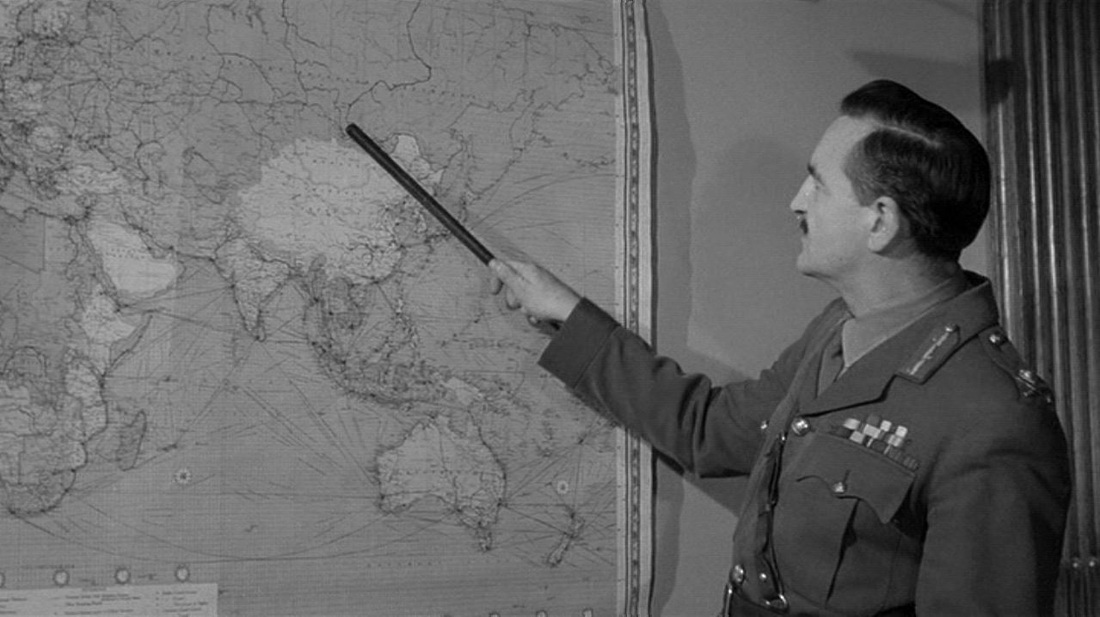
Village of the Damned (Wolfe Rilla, 1960) Based on the John Wyndham sci-fi novel "The Midwich Cukoos," adapted by Stirling Silliphant and director Rilla, Village of the Damned*is a curious mixture of sci-fi and horror—a combination of pulp sensibilities, but with a strange sub-text that could be taken as religious, mystical, or invasive, and then has the audacity to not answer any of the questions and leave you hanging as the suppositions swirl through your head. Both it and its sequel are fascinating things to watch, but each in their different way. In the town of Midwich, professor Gordon Zellaby (George Sanders) is making a call to his brother-in-law Alan Bernard (Michael Gwynn) when all of a sudden, he falls unconscious. So does the family dog. Bernard is alarmed at this and can't raise anyone in town, so he investigates and being in the military he doesn't do it subtly. What he finds is that everyone within a few mile radius of city center is unconscious...or will become unconscious (even taking preventative measures like gas-masks) if they enter within that "zone"—aeroplanes flying overhead will have their pilots drop off, the planes crashing.
It's a mystery. Why this town? Why this effect? But, two hours later, everyone awakens, mystified. They felt a cold sensation before they dropped, but that was it. The disturbance is forgotten. Until two months later, when it's determined that every woman "of child-bearing years" in Midwich is pregnant. For Zellaby and his wife (Barbara Shelley), it's a miracle though it's a little late in life for him. But, for the unmarried women in town, and for the women with husbands away, it's not only embarrassing, it has to be some bizarre mistake...and when it's confirmed it makes things uncomfortable, socially. For awhile they're stigmatized, but before long (and with the doctor's confirmation) it's determined that all the women are pregnant...and they don't how.
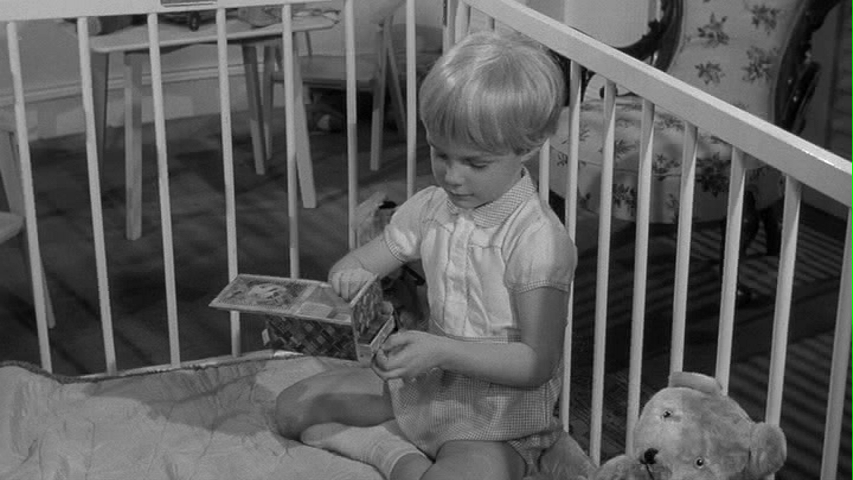
Out of this mass-immaculate conception, the village is seriously creeped out, but the children appear to be normal, if gestating at an accelerated rate. And all are born on the same night, all premature by normal standards, but all around ten pounds, all with white shocks of hair and something "weird" about their eyes, totally black. The kids grow quickly and they learn quickly, being able to figure out chinese puzzle boxes while still toddlers. Give it to one, and then another, sight unseen, will be able to figure it out, as if by telepathy or shared mental faculties.
And...if things don't go their way, they can influence the thoughts and actions of others, an act apparent when their eyes begin to glow white. The children, as they grow older and become more sophisticated, become even odder—walking as a group by themselves, dressing themselves, speaking in a tone, sophisticated and cold.**
What to do about them...and who "is" them, anyway? No one has any answers, but reports around the world suggest Midwich isn't the only village on Earth to experience this. Some of the places have murdered the children. One isolated village in Russia is trying to instruct the children to the best they can. What is the answer: to eradicate, or to exploit? The military doesn't want to do anything subtle, but Zellaby, with doubts as to their origin, staves off their eradication by seeing if he can teach them in their own segregated school (naturally). The trouble is, the children don't want to do anything subtle, either, and these kids are of a mind to stop the problem of bullying by any means necessary.
This is a great film, which doesn't shirk societal issues at the same time it doesn't pin down exactly what the hell is going on here. The fact is the kids are here and dealing must begin. But how, never mind why. Plus, it's a genuine horror-fest, making one web-site's list of "10 movies pregnant women should never watch."*** Apt. And one curious anomaly about the film is that the strange glowing eyes that signal some heavy brain-work on the part of the children (and figures in the denouement) is only seen in American prints of the film. Interesting, as they seem to appear in the British posters for the film.
But, those curiosities aside, it's well-worth seeing, and pondering.
One further note, young Martin Stephens who gives such a calmly mature performance as little David Zellaby in this (and The Innocents) left acting while still a child and became an architect. Yes, he has a web-site.
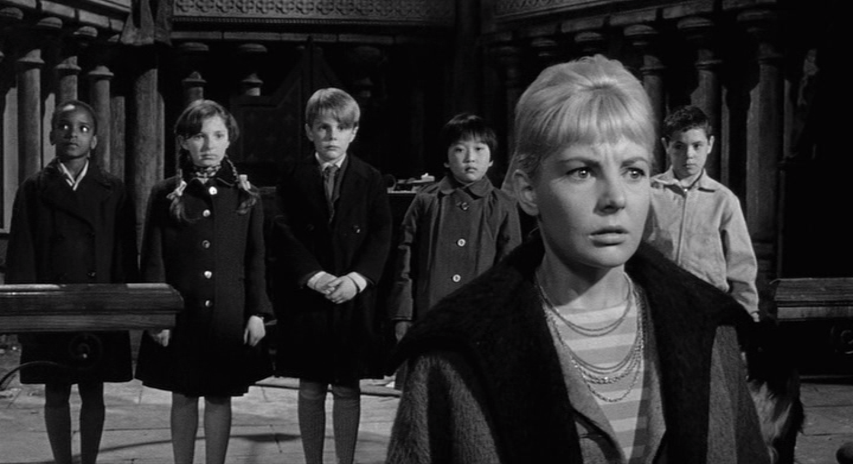
Children of the Damned(Anton M. Leader, 1964) If Village of the Damned leaves things unexplained, Children of the Damned just complicates the issue, rather than coming up with any concrete answers. The six titular children have the same powers and intellect, but not the same attributes. None of them has the tell-tale white hair or the slightly high browline as the first crop of kids. And there's only one child from Britain; the others, flown in by the UN, come from Russia, China, India, America, and Nigeria and their abilities are only discovered by a UNESCO survey on child development. The lead investigators in England, psychiatrist Tom Llewelynn (Ian Hendry) and geneticist Dr. David Neville (Alan Badel, laconically ironic) are looking into the why's and wherefore's of young Paul Looren (Clive Powell), a child of extraordinary learning skills that are frankly off their charts. A visit to his single mother only ends with her tossing them out and their disbelief in her claiming she was never "touched by a man."
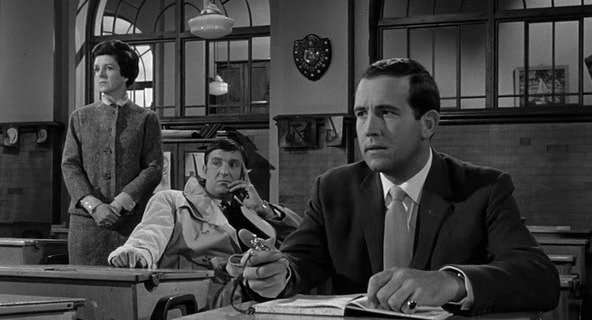
Llewelynn and Neville make an odd duck duo,**** the shrink earnest and straightforward and the geneticist cracking wise with every line. Their investigations come up with no reason why these kids have these abilities, they just do, and when Britain's Secret Service tries to take control of young Paul, he sets up a distraction and scampers, seeking out the other five children and taking up residence in an abandoned church, with Paul's aunt (Barbara Ferris) as hostage/mouthpiece. The various embassies want each of their children back to exploit them, weaponizing them, in effect. Llewlynn is thunderstruck by the idiocy of that: "As soon as one of them knows your plan, then the others will know it." So much for Cold War secrets.
Neville and Llewelynn, U.N. observers...observing
Still the various countries want their kids back, and the kids want nothing of it, attacking from their stronghold in the church, devising a broadcasting "thingie" using the church's pipe-organ to incapacitate anyone attempting to remove them, leaving their attackers dead or "wishing they were."
Children of the Damned is slightly diminished from its original, but on its own is one of those great science fiction films of limited scope and budget that still manages to evoke the sense of a much larger concept, despite narrowing down what the children "are," while giving the film a sense of cautionary tragedy that the first film doesn't have. Less a horror film than a story of sociological and political paranoia, Children of the Damned features good performances and an efficiently crackling script (by John Briley—he would go on to write Cry Freedom and Gandhi) and manages to stand on its own terms, apart from the first film, as an entertaining, if very unsettling film.
Village of the Damned(John Carpenter, 1995) This updated version of the original follows the same plot structure of the first, with less emphasis on the mysterious circumstances that cause the "immaculate" pregnancies in the town of "Midwich, California," less stigma—it is the '90's, after all, there's even the subject, given the circumstances, of aborting the children—and more emphasis on the children and the violence they mete out on the town. In color, and sporting a good cast of stars (with Christopher Reeve—his last role before his crippling riding accident—Linda Kozlowski—she of the "Crocodile Dundee" series—Michael Paré, Mark Hamill and Kristie Alley), these kids are more pointedly accusatory, speak in archly threatening whispers,*****and action-oriented, and unusually vicious in the way they have their victims destroy themselves—impaled on a broom, blinding an eye-doctor, having one of the parents driving into a propane tank (rather than a brick wall), another performs an autopsy on herself, and the botched military intervention in another country alluded to in the first film is dutifully played out with all the blood-bags the budget can allow—and Carpenter doesn't cut away as the original did. There's no implication here, which (as it usually is) isn't as powerful as leaving your audience's squirming imagination to do the dirty work.
Christopher Reeve's doctor hates talking to kids.
On the plus side, it's less of a man's world this time out on both sides: the chief investigator of the phenomenon is a woman (Alley, whose a bit cavalier in her dealing with the kids) and the leader of the children is one of the little girls, Mara (Lindsey Haun) daughter of Reeve's local physician and his wife (Karen Kahn).
This time out, the children pair off, boy-girl, with one of the children (Tom Dekker) left partnerless because one of the children is stillborn, and, as a result, being the only one to develop any empathy at all. The other kids are little monsters who, when forced to go up against an adult with any will at all, will have the pinwheels in their glowing eyes go from greento red to white, then, just to stack the deck against them further, their faces glow red into a demon's visage.
In other words, what was subtle and thought-provoking in the first film doesn't have the same effect in this one. And the reason is you're being beaten over the head with it, and rather pointlessly. There's no ambiguity here. There's no mystery. It's just a simple formula: strange is bad=kill it. Carpenter can be a good film-maker and stylist—he wrote the playbook on the post-Hitchcock slasher film (which may not be much of a recommendation—until you compare it with his imitators). Maybe this was just a case of studio expectations for meeting a carnage quotient. But whatever it is, the 1995 remake of the Village of the Damned takes all the fun...and the seriousness out of the story.
And that's a "Damned" shame.
* There is another film done by the Hammer group, and directed by American director Joseph Losey, starring McDonald Carey and Oliver Reed called (depending on which version you see) These are the Damned or The Damned, and are unrelated to this film series, although it does involve children, with special qualities.
*** That article has met its internet death, and with the recent glut of horror films since, Village of the Damned has been knocked off the Top 10 List...but it's still on IMDB's list on the topic...where it's 29. **** And no, I don't think they're gay, even if they do share a flat in London (separate rooms, mind you). Both are on assignment from Unesco in London. ***** Unfortunately, the kids' performances are melodramatically threatening, a bit like Patty McCormick in The Bad Seed.




.jpg)