Despite what "The Last Word" blurb—at the bottom of the page—says, I don't like writing reviews of bad movies. I just don't. (I don't even like WATCHING bad movies!)
But, I have to admit: I enjoyed writing this one.
Saturday is traditionally "Take Out the Trash" Day.
 "...And I Feel Fine"
But, I have to admit: I enjoyed writing this one.
Saturday is traditionally "Take Out the Trash" Day.

Earth to Roland Emmerich: "Cut it out!"
Between Independence Day, The Day After Tomorrow, and, now, 2012, the German director has personally destroyed the world three times.
Well, enough is enough. Gaea's getting pissed.
And so am I.
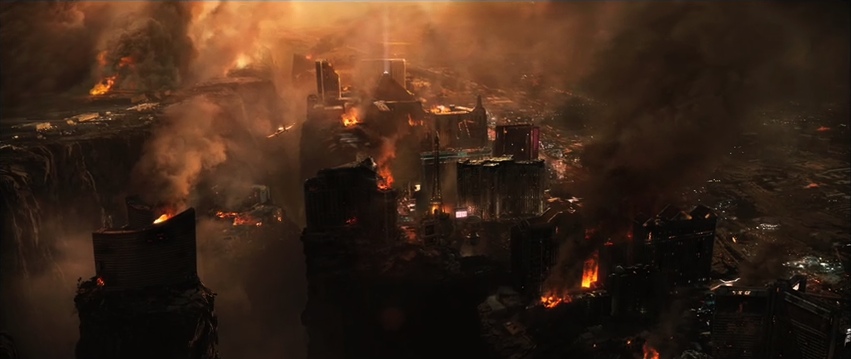
Seventeen special effects companies, including Sony and Digital Domain (two heavy-weights and they're not even the first ones listed) were employed to create the global carnage on display in this flick, and there's still a recession going on. The attention to detail and dedication to photo-realism is the only evidence of professionalism in the enterprise. That's entirely appropriate as the only reason to see this monstrosity is to witness things blow up "real good." That they do. Los Angeles develops wrinkles and cracks that even Joan Rivers' supply of Retin-A can't erase and schlumpfs into the Pacific. Yellowstone faithfully incinerates in a verrry slow pyroclastic flow that the hero can out-run. Las Vegas becomes the new Grander Canyon (they were going to knock those buildings down anyway!). Hawaii's a volcano (but the surfing's great!). Washington D.C. becomes more chaotic than it already is.
 I'll admit it. There is a giddy, monstrous 2-year old's glee in seeing the White House (which Emmerich imploded with a shiny blue destructa-beam in Independence Day) being destroyed again—this time by the aircraft carrier John F. Kennedy, propelled on a Potomac tidal wave (That's about as "high concept" as this film gets). And St. Peter's. Tibet.* All the hots spots become much hotter. The fly-over-and-through of Los Angeles over the splintering clover-leafs and under collapsing buildings is a thrilling roller-coaster ride through Hell with digi-people clinging to collapsing floors, all manner of auto-mayhem and even violence by Rolling Donut sign. But if you were to take out all the countdowns to disaster in 2012 ("We've got five minutes before everything blows!!") and just include the disasters, you'd have a 20 minute highlights reel, rather than a 158 minute poorly written series of contrivances and coincidences.
And everything blows, anyway. You'd almost think the thing was worthwhile with Chiwetel Ejiofor, Oliver Platt, John Cusack, Danny Glover, George Segal and Thandie Newton in the cast. But they're only mouth-pieces for exclamatory dialog with brows a-furrowed. Seems the whole thing starts with a planet re-alignment, which triggers solar flares which sends out neutrino's that miraculously microwave the Earth's core and destabilize the Earth's tectonic plates, reverse the Earth's magnetic field and create monster tsunami's.
 Now, in this world-wide scenario, everybody in the cast has only one degree of separation to everybody else, so that they can look with surprise at their monitors and intone "Wait! I know that man/woman/dog!" Coincidences are the order of the doomsday, and little dialog goes unmatched without the appropriate chunk of irony whistling through the air and squishing the speakers with a thud. It's the kind of movie where hubby says to wife "I feel like there's something pulling us apart" right before a fissure opens up between them. When St. Peter's Basilica starts to collapse, the cracks split down the Sistine Chapel right between Man and God's fingers. Roland Emmerich is not a subtle director. No man whose ambition is to make a better "Godzilla" movie can be.
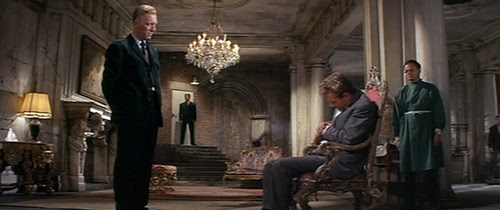
 And what Emmerich is re-making here is When Worlds Collide,** a 1950's sci-fi flick that imagined Earth hit by another planet, and its treasures, two-by-two's of animals and a lottery-chosen clutch of humans are rocketed off to the convenient companion planet that precedes it. Here, the art is rounded up, libraries accumulated, animals airlifted, and although a lottery is mentioned, the folks who go in the arks are world leaders (naturally), the folks who can afford to pay 1 billion euros per seat, and anyone conniving enough to smuggle themselves on-board. The Best and the Brightest, The Cream of Humanity. Everybody else becomes part of the new petroleum deposits the survivors will profit from in the future. Talk about your disasters. Imagine a world where among the survivors are Dick Cheney, Mahmoud Ahmadinejad, Hugo Chavez, Rod Blagojevich, Paris Hilton, Mike Tyson and Pat Robertson, but no research scientists—not even the guys who invented Post-it Notes! That's a version of Hell even Milton wouldn't have conjured.***
 It was at this point, I would have been happy to see everybody die, but no such luck. The last few minutes of the film are disaster heaped upon disaster, with survival dependent on the actions of one man—guess who? But, my concern was what exercises I could find to relieve the pain in my eyes from rolling them so much. They don't sell aspirins at the concession stand. Not even chocolate-covered ones.
 Truth be told I don't enjoy writing reviews for bad movies, as there's more inspiration in good ones. But I'll leave it with this quote from the director (in a New York Times profile by Tyler Gray) complaining about people's reactions to his making a film like 2012 in a "post-9/11 environment."
"If I cannot destroy a big high-rise anymore, because terrorists blew up two of the most famous ones, the twin towers, what does this say about our world?”
Our world is fine, Rollie, no thanks to you. But it says your priorities are really shitty.
And the only way to make it good to us is to make all your digital models of people caught in wholesale slaughter based on your likeness.
Verstehen sie?
Verstehen sie nicht.
**** Between Independence Day, The Day After Tomorrow, and, now, 2012, the German director has personally destroyed the world three times.
Well, enough is enough. Gaea's getting pissed.
And so am I.
Seventeen special effects companies, including Sony and Digital Domain (two heavy-weights and they're not even the first ones listed) were employed to create the global carnage on display in this flick, and there's still a recession going on. The attention to detail and dedication to photo-realism is the only evidence of professionalism in the enterprise. That's entirely appropriate as the only reason to see this monstrosity is to witness things blow up "real good." That they do.


And everything blows, anyway.


"If I cannot destroy a big high-rise anymore, because terrorists blew up two of the most famous ones, the twin towers, what does this say about our world?”
Our world is fine, Rollie, no thanks to you. But it says your priorities are really shitty.
And the only way to make it good to us is to make all your digital models of people caught in wholesale slaughter based on your likeness.
Verstehen sie?
Verstehen sie nicht.

"thoughts and prayers..."
* But not Mecca. Fatwa's need not apply. Kinda lily-livered of Emmerich to not risk personal destruction when destroying the world for his art. Don't they have "sins of omission" in Islam?
** And just our luck, that master of the cinematic form Stephen Sommers (The Mummy, Van Helsing, G.I. Joe: The Rise of Cobra) is making his own direct re-make of "When Worlds Collide" to be released in 2010. Oh, the joy. (As of 2023, IMDB lists it as still "In Develpment").
*** Not to politicize too much (or think, God help me) but given the Ark scenario envisioned by the movie, with the whole "two-by-two" concept, I'm imagining the passenger list is restricted to "breeders," meaning there are no gays and lesbians on the boats. Emmerich is gay. What is he thinking?
**** Part of the mission of these reviews is to promote the theatrical experience when it is deemed important to the presentation of the story. It is tempting to say that "The Big Screen" is the only way to watch 2012, because there are so many little demons in the details. But, no. The story is so lunk-headed and gleefully clap-happy nihilistic that the best presentation is merely putting a bow on a cess-pool.