Showing posts with label Q. Show all posts

Friday, March 17, 2023

The Quiet Man (1952)

The Quiet Man
(
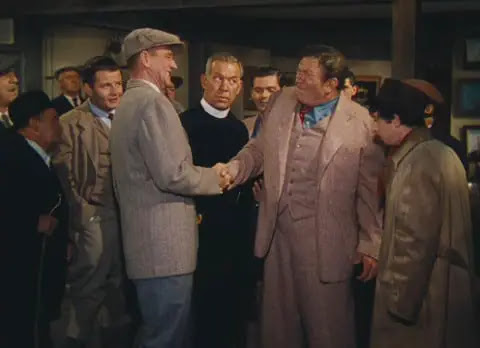
John Ford, 1952) "Trooper" Sean Thornton (John Wayne), ex-prize-fighter, comes back to the land of his birth, Innisfree, to reclaim his father's property in Ireland. Considered an outsider and a "Yank" he makes his peace with the locals—a pint is usually good enough to prove one's charity—and settles down for a simpler life than the one he knew.
 
And maybe forget.
 
There's just one hitch—it's "Red" Will Danaher (Victor McLaglen)—his neighbor on one side of his property is not interested in "easements." He has been looking balefully at that property for years, hoping to make it his own in pursuit of marriage with the widow Sarah Tillane (Mildred Natwick), who will have nothing to do with the brute. In spite, she sells the property to the green-horn Thornton and that is settled. Settlement is just what Thornton intends. But, it isn't easy, and he finds he has to go a few rounds with various opponents on their home turf. In Innisfree, it's war until there's peace.
It doesn't help that he's hit by "the lightning bolt" when he catches sight of a ginger sheep-tender and becomes instantly smitten. As the Luck of the Irish would have it, she's Mary Kate Danaher (
Maureen O'Hara), the sister of the one man in the emerald glow of Innisfree who despises him. Mary Kate makes him feel like he's gone 10 rounds in the ring without a decision, and their besottedness is mutual, but for Kate there are issues before romance that Thornton thinks are just damn archaic, having come from The New World. 
But...when in Rome (with Roman Catholics)... He's fine with the whole town knowing about it and he's reluctantly okay with the rituals—as Mary Kate prevaricates: "Well, we just started a-courtin', and next month, we, we start the walkin' out, and the month after that there'll be the threshin' parties, and the month after that..."of the very chaste chaperoned traditions in the country ("No patty-fingers, if you please!" warns squire Michaleen Oge Flynn—Barry Fitzgerald—"The proprieties at all times!"), even if the two adults are a bit long in the tooth to be treated as children, they can't help rebelling by jumping the buggy and setting off on their own, unsupervised. All well and good; they're two healthy adults with a rebellious streak that seems compatible—to which the ever-watchful community tacitly agrees. There's just that Danaher matter.
And that other Danaher matter: Mary Kate will not jump into marriage with Thornton without her dowry, which is being withheld by her lout of a brother. Now Squire Danaher objected to the marriage from the get-go, but some village conniving put the canard out there, that the widow Tillane would be more agreeable to marrying him if Mary Kate were out of the house. He consented to the marriage, and then was refused by the widow. In spite, he has decided to withhold Mary Kate's dowry and she won't get married without it.
And that's the last straw for Thornton, setting him down for the count. He came to Ireland to settle down—the consequences of a death at his hand in the ring—and has sworn to fight no more forever and leave the States and his past behind. But, for all the blarney and the twee village-life that he'd been expecting, all he gets is conflict. And, now, must fight again—gloves off this time, but the same Marquis of Queensbury rules—to fight for the woman he loves and against the old-school precepts and covenants that would keep them apart. To him, they're the same as the sheep-droppings that litter the countryside. And he's not the kind to count to 10.
Ford had wanted to make this movie for years—being romantically sentimental about the land of his parents (he was born in the state of Maine)—and made one of those "devil's bargain" deals with Republic Pictures—who didn't think the movie would be profitable and fought like Beelzebub to shoot it in black-and-white to cut costs—and put down some collateral to make a couple of Westerns beforehand in order to secure a promise to make this odd romantic comedy, which seemed way out of the captain's chair for the veteran director.
But, Ford's passion for Ireland comes through in every frame (even the ones shot in the studio), and it allowed him to cast some fine Irish actors (he'd do more with the community in later years) as well as his traditional stock company—his brother Francis, Ward Bond, Arthur Shields, McLaglen—and his two trusted key players, Wayne and O'Hara, to make a movie that was a little out of lock-step with what was "big" in the States (isn't defying lock-step what the movie is about?). He gets some of the best career-performances out of his cast—Wayne is particularly remarkable and nuanced—with moments that are very broad and some that are just economically and full-throttled perfect—think of Fitzgerald's line: "Impetuous! Homeric!"
That's the other thing about this movie. Although it's about adults acting like children, it also—for want of a better word—damned sexy. Wayne and O'Hara were friends—life-long pals, in fact, but never romantically interested in each other—but, their on-screen chemistry, nurtured by Ford in previous appearances together, is electric. Sparks fly between the two, because both were tough acts, head-strong and opinionated, challenging and supporting each other on-stage and off (they were quite different politically), but the two of them together made the most of every scene. They're just made for each other, at least on-screen. There are better actors, of course, but chemistry is magic, and has something more to do than technique and style.
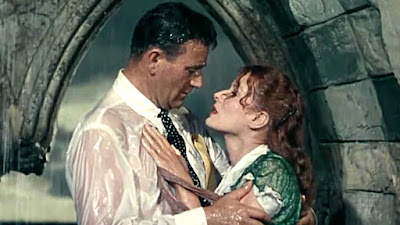
It's Ford's love-letter to Ireland (of course, he had to shoot it in Technicolor!), acknowledging the "ditriments" along with the glories of his father's land. He'd make more movies in Ireland, (a couple quite remarkable) but nothing has the off-kilter swagger that Ford at full steam could bring. And some of the images are just beautiful...museum-quality...and you get the full effect of why Ford referred to himself as "a picture-maker." That the frame is also bursting with drama, humor and corn, means that he had more than an artist's eye. He had the blarney down cold, and the magician's economy to both wow and startle.
He wanted Ireland to be proud of him. How could they not be?
The "Quiet Man" statue located in Cong, County Mayo...where parts were filmed.
 

Thursday, September 8, 2022

The Queen

Sometimes, what I haven't posted is more surprising to me than what I have. Today's case in point: this amazing film by Stephen Frears with an arch script by Peter Morgan and a terrific cast. The Queen is dead, two days after bringing in a new Prime Minister—her 15th (the first being Churchill) and a short time after celebrating her 70th year on the throne. After years of short-reigned British royalty, Elizabeth II gave a reassuring continuity to a nation going through post-imperial crises, and she managed to walk the edge of being Her Majesty and, contradictorily, Public Servant. Self-sacrifice and Privilege rarely go hand-in-hand, but she did it, and did it well.

Written at the time of the film's release.  Re-published on The Queen's.
 
Sir Paul McCartney
 
And another Beatles quote might be appropriate here, as well. George Harrison's horrified appraisal of Beatlemania: "We gave them an excuse to go mad." Surely that's how
the Royals must have felt seeing the outpouring of grief generated by the death of former Princess Diana over the week that this smart bitchy little film covers. The tone and volume of the crowds that surrounded Buckingham Palace, fueled by the predatory tabloids, approached hysteria and went well past the accepted levels of decorum practiced by its inhabitants. Flying the flag at half-mast for Diana? They hadn't even done it for the death of the King! The idea! There's a telling line QEII says in bewilderment: "But she isn't even an H.R.H.!"—a lovely combination of formality and informality within the Royal Family. But the film has its own opening quote, from Shakespeare--the one half-mocked by Jack Nicholson in The Departed--"Uneasy lies the head...etc, etc." But, in this day and age it can be asked, "Who wears the crown?" 
Is it the Queen, cosseted in formal procedure and pomp, restricted in her powers and budgeted by the government (the first scene of the movie has an arch little discussion between her and a portrait artist regarding democracy and the in-coming Labor party of Tony Blair. "You might not be allowed to vote, ma'am,* but it is your government." "Yes...it is," she replies, smiling at the constancy)? Is it the fledgling Prime Minister Tony Blair (Michael Sheen) who must bow and scrape to the Queen, but who uses whatever power he has to influence her actions? Is it Blair's eager-beaver, though cynical, staff, micro-managing and creating press-releases and agendas that sometimes frustrate, while bolstering the image of, the new PM? The Queen's consort, Prince Phillip, blusters about what is proper and how he'd do things (assuming he was in charge), and son Charles, dithering and deferential (there's a lovely moment as Charles enters a room where James Cromwell, playing Phillip--pointedly crosses his arms without even acknowledging that he knows his son is in the room), tries to sway the Queen emotionally and by proxies. Or is it the rabble with their devastated faces and the endless supply of flowers that becomes a memorial and a substitute for any public display from official sources? 
Then there is the late Princess herself, seen only in vintage news footage, at times clowning, at times vulnerable...and at times, with a look like she's viewing the proceeding with a knowing satisfaction.
 
One wonders how the Royals themselves would see this film
**...no doubt, as an affront to be taken in stoic, stony silence. Yet, one can understand their actions, and even have some sympathy for their dilemma, while also wanting to shake some sense into them.
The Queen is a fine, gossipy movie, with a literate script***(whether any of the things depicted behind closed draw-bridges is anyone's guess) by Peter Morgan—he also wrote last year's The Last King of Scotland, top-of-the-line performances led by Helen Mirren (who has the canny knowledge to know she's playing two roles: Elizabeth and an eerie "Elizabeth-as-Monarch," and, yes, she'll win the Oscar for Best Actress)**** and a direction by Stephen Frears that's smart and canny. The last shot is the most telling. Frears leaves us with an image of the Queen walking in her immaculate formal garden--her unruly Pomeranian dogs jumping and bouncing and using the facilities while Elizabeth pays no mind to the chaos.
Long Live the Queen.


* And make sure you pronounce that correctly. We're told that it is "Ma'am" as in "ham," not as in "harm." One of the conceits of the film is to show the "accepted" ways to present oneself to the Queen--always a prescribed way, no more and no less--surely a main reason for the atrophy the Windsors displayed in not responding to the public's reaction.
 
**I read somewhere in the Golden Globes coverage this morning that the Queen told Mirren "someone finally got (playing her) right."

***There's a funny scene where Blair, flush with his efforts to influence the situation starts to push for his own agenda. Elizabeth will have none of it, and warns her PM not to be too complacent for his crisis will come when he least expects it. It took every ounce of restraint to keep from yelling "Yo, Blair!" at the screen.

**** She did.


Post-script 02/07/07: Slate has quite an informative interview with director Stephen Frears

Saturday, February 20, 2021

Quo Vadis (1951)

On the old blog (requiesce in pace) this appeared under a rare category of film labeled "Missed It By That Much"—about movies that were good enough that you knew they could be better. These days, this seems really...timely...and I've made some subtle changes.


Quo Vadis
 (Mervyn LeRoy, 1951) This is M-G-M's first big biblical epic in the post-World War II environment, the one that sp
awned a genre that prospered in theaters for the next twenty years...and that has been revived for these times—you can't have enough bread and circuses for a recessed populace. The studio re-built the war-torn studios of Cinecittà, which would be home to Roman epics for the next two decades. The expansive sets would increasingly overtake the films created, until the out-sized production of Cleopatra nearly bankrupted 20th Century Fox

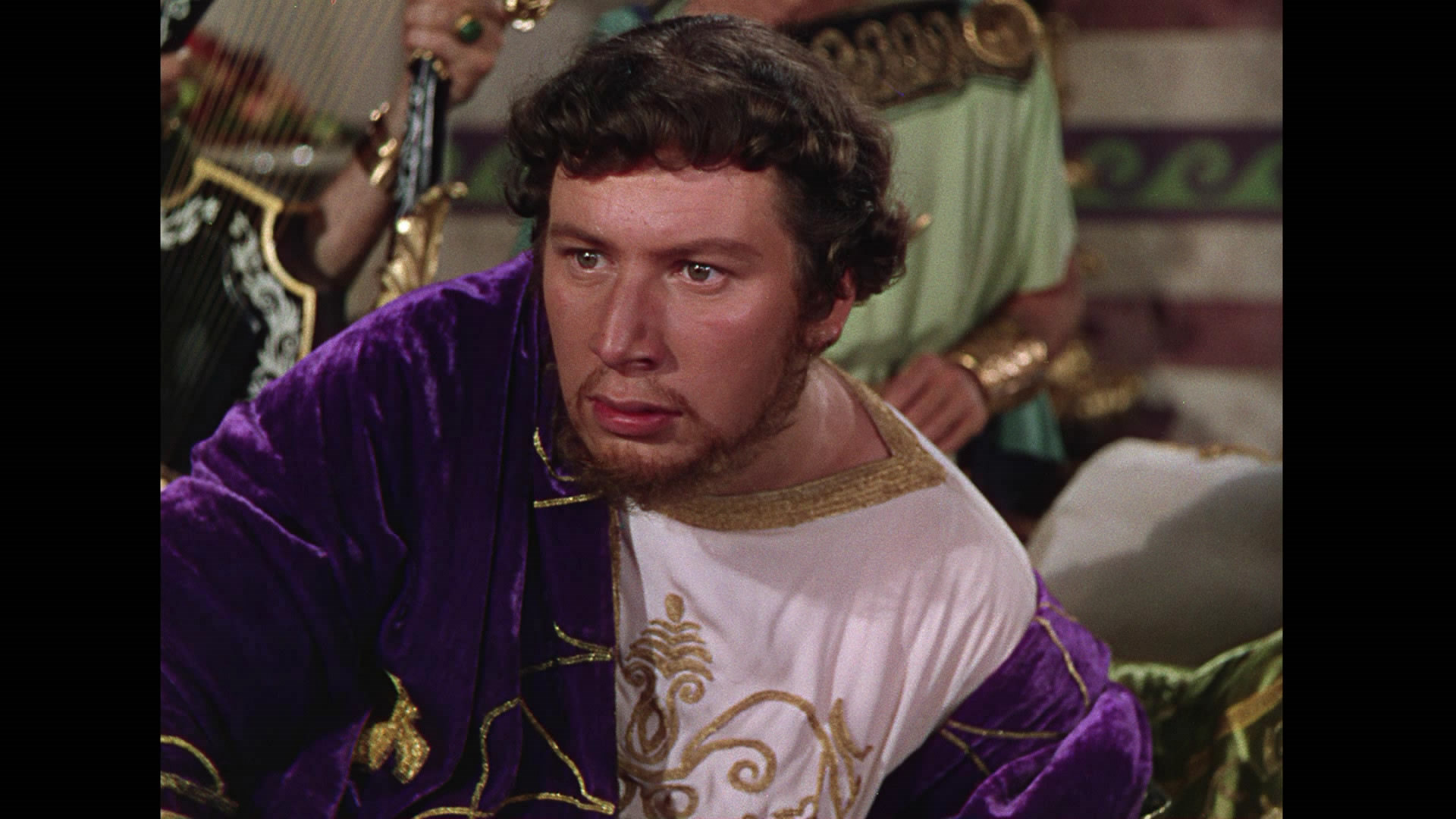
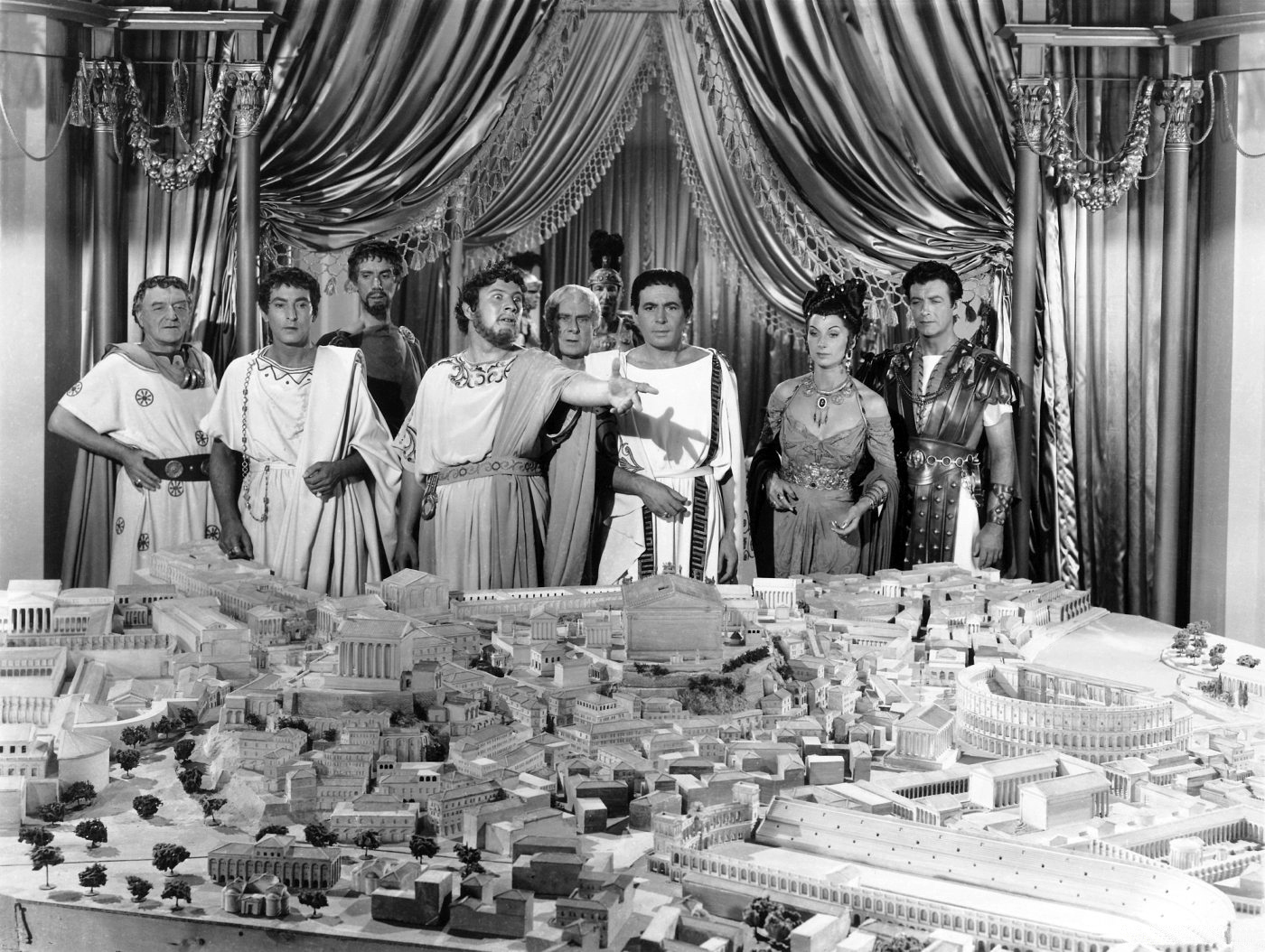
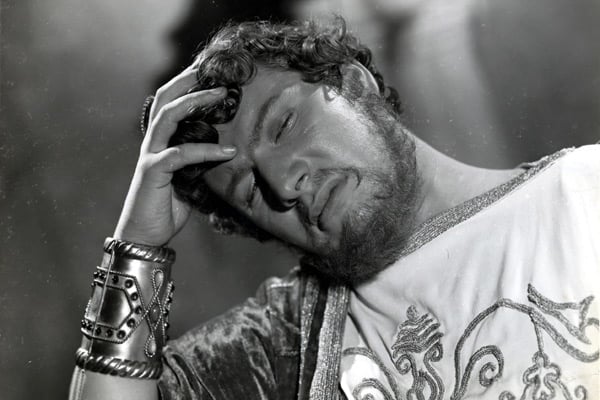
Quo Vadis tells two stories—of the Fall of Rome and the Rise of Christianity. Marcus Vinicus (Robert Taylor) returns from the wars to a very different Rome than the one he left; The Emperor Nero (Peter Ustinov) has declared himself a god, and the city is divided by his heinous act of murdering his wife and mother in order to marry the courtesan Poppaea (Patricia Laffan). Now, convinced of his own infallibility, the Emperor indulges his every whim and artistic pretension. That he's not very good at anything does not occur to him; anything a god can do must be significant. 
Vinicus, like the rest of Rome, indulges the Emperor—as long as what he does doesn't touch their lives, he can do anything he wants (Good Lord, we're still learning the wages of that sin!). For the returned tribune, what he wants is wine and wenching; Nero's wife is eyeing his lasciviously, but Vinicus sets his sights on the ward of the Senate,
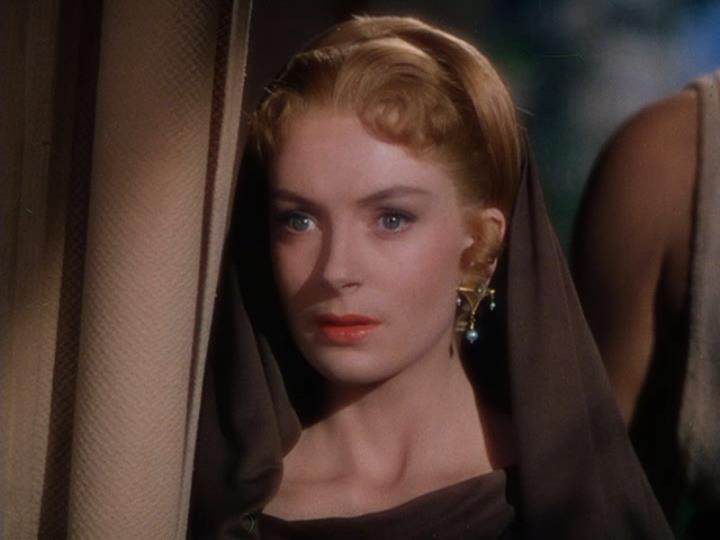
the captured princess of a Roman campaign, Lygia (Deborah Kerr). She is made a gift to him for his duty for Rome, but she initially spurns his advances. She's a follower of the teachings of the martyr Christ, as taught by his followers Paul (Abraham Sofaer) and Peter (Finlay Currie). This merely amuses Vinicus. But, when the Mad Nero decides he's going to design a new Rome in his own honor, and torches the old (without any evacuation plans), Vinicus sacrifices all to save Lygia. 
It takes a lot of screen-time to get to that point in the story, and the film still has to have
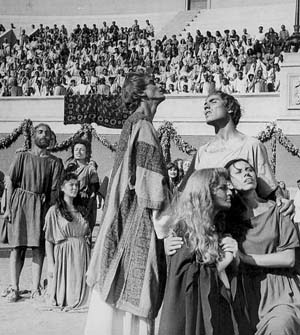
the persecution and throwing of Christians to the lions at Nero's behest, not to mention resolve all the story-tangles. So, the Christianity theme of Quo Vadis is given short shrift, despite the fact that the story hinges on it. As it ultimately leads to the establishment of The Church on the very spot where some of the events occurred, it undermines the religious under-pinning of the story. 
The acting is a bit arch, as well. Leo Genn does a good turn as one of Nero's sycophants, but Kerr and Taylor are stuck in theatrical star mode, Taylor seems a bit out of place as a Roman Tribune, and doth protest too much when playing the Roman egotist.* Peter Ustinov's Oscar-nominated turn as Nero is over-the-top and slobbering, a rare instance when the actor isn't doing precisely the right thing, even though the performance is an amusing one. All these elements lend a falseness to a story that has major significance to history and religion (however apocryphal it may be) 
The Latin words "Quo Vadis?" translates to "whither thou goest?" or "where are you going?"
It is what Simon Peter, fleeing Rome and its persecution of Christians, asks the passing vision of Jesus he encounters on the road. "Quo Vadis, Domine?" And the reply is "Eo Romam iterum crucifigi" (I am going to Rome to be crucified again), prompting Peter to return and sacrifice himself for his church. It's not a part of the "recognized" "approved" Bible—it is a section of the Apocrypha. And it is dramatized in the film with Christ speaking through the voice of a child. Peter goes back, and when confronted by his tormentors says "To die as Our Lord did is more than I deserve," to which the Roman guard replies in the tough-guy-henchman mode of the movie era, "We can change that." Another example of how this first modern Epic owes as much to LeRoy's gangster pictures as it does to the source material.** 
It's always terrible to play the "what if?" game—the movie on the screen is the movie that was made. But in its early stages, it was being developed, and would have been directed, by...
John Huston. Huston's historical films are always interesting for their attention to detail, and one ponders what he would have done with ancient Rome with a sad interest. His ironical eye would have been interesting, as well, when it came to Church matters. At that stage, before Huston's run-in's with Louis B. Mayer soured the deal (as reported in Lillian Ross's "Picture"), Marcus Vinicus was to be played by Gregory Peck and Lygia by Elizabeth Taylor, all of 19 years old. 
Now, Peck was not the most versatile of actors, but he could be counted on to deliver a prideful manliness with some depth, the kind that Taylor musters up as an oafish braggadocio. Taylor manages to pull off the scenes of Vinicus in distress, but Peck would have provided a younger, more believable protagonist.
Elizabeth Taylor would have been able to pull off the vulnerability that Kerr has difficulty providing, while also giving Lygia the same spine of steel as Kerr's. What might have been... One looks at this Quo Vadis and wishes things could have been different. 
"Whither thou goest?" At this point in the history of the Catholic Church...and our Nation—at this cross-roads they has reached—where it is caught in a choice between Unquestioned Authority and the culpability of its representatives, that question has never been more pertinent. 

Quo Vadis? Indeed.

* Taylor's presence and acting are lampooned a bit in The Coen Brothers' Hail Caesar!, in the form of George Clooney's dim star, Baird Whitlock. 

** Nero's last words in the film are the same as Johnny Rico's at the end of LeRoy's Little Caesar: Is this the end of (me)?"

Saturday, May 16, 2020

The Quiller Memorandum

In these days of communicable diseases and precautionary measures for the greater good, folks on both sides of the aisle and of every color-stripe are being a little flippant with the "N"-word—"Nazi." 

So, just for a refresher course, we are going to sub-set the "Spies" series we're doing with movies where there are Nazi's (you know, "the bad guys"—Indiana Jones fought them in Raiders of the Lost Ark!) 

And we're going to call it "Nazi's...Nazi's everywhere."

Oh. And "Saturday is "Take Out the Trash" Day...

The Quiller Memorandum (Michael Anderson, 1966) This low-key spy film came out in the Christmas glut of 1966, competing with two other spy films released at the same time: Funeral in Berlin, the second Harry Palmer film to star Michael Caine and Murderer's Row, the second of the "Matt Helm" films starring Dean Martin

Blame Bond.

The success of the James Bond series in the 1960's overwhelmed the movie marketplace with secret agents in plain sight, a rolodex of acronymically named organizations, disposable starlets, and a fawning desire to seem "hip" while toeing the party-line during the Cold War. It was a very odd time. 


The Quiller Memorandum slotted somewhere in between the two films, both in temperament and quality. Funeral was a typical spy film that took itself very seriously, while the Dean Martin picture was a parody of the Bond series (which itself is a bit of a parody) that took nothing seriously. And Quiller, which had an estimable cast and boasted a screenplay by Harold Pinter, should have been the best of the lot, but has a lackluster quality despite key ingredients. 
The film begins with the late-night murder of a man in a phone booth in Berlin, the consequences of which inspire a breakfast meeting between two British functionaries (played by George Sanders and Robert Flemyng), who supercilliously discuss the next person to take over the assignment that got the man killed—making him the second—with as much import given to the quality of the meal as to the matter of men's lives. Pinter's dialogue is circuitous, ambiguous and names are not used, merely initials.

Quiller (George Segal) is "on holiday" after an assignment in the Middle East and has been tapped for the assignment, the third man, and he is briefed on his task ("this is not an order...more of a request...") by Pol (Alec Guinness) in Berlin's Olympiastadiom ("...certain well-known personalities used to stand right up there" Pol deadpans). Quiller knew the other agents, knows that they refused cover on their assignments and that he will be watched for his protection. "The request" is to get a handle on the base of a strong Nazi element in Berlin, a new guard, "Youth...Nazi from top to toe_in the classic tradition...difficult to pinpoint. No one wears a brown shirt anymore, you see. No banners. Consequently, they're difficult to recognize—they look like everybody else."
Quiller begins by losing a company-man tailing him, then doubling back and finding what he wants. It's his contact who gives him research papers from the previous attempts. It's not promising: a receipt from a bowling alley and a swimming center, and an article about a teacher who has committed suicide after being accused of war crimes. He checks each location, glibly giving different covers, and blithely acting the fool, but finds nothing of interest other than the dead teacher's replacement, Inge Lindt (Senta Berger), but his interest is not particularly professional.
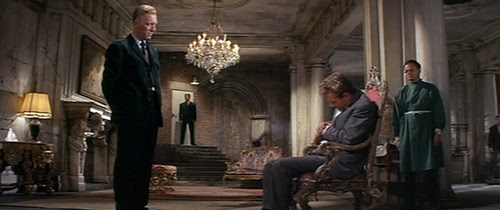
Quiller knows he's being watched, but his plan to let "the other side" know he's in town seems to be working only too well—the number of people matching his moves is starting to increase, but it is only when he is drugged*, kidnapped and interrogated by head-man Oktober (Max von Sydow) that his suspicions solidify. Perhaps his playfully losing his body-man speeding on the highway wasn't such a good strategy.
"You must be lonely sitting here among strangers." "No...I like meeting people.."
When the drugs wear off, Oktober begins the interrogation: "My name is Oktober. What's yours?" Quiller deflects, lies, makes up fanciful stories ("They call me 'Spike'"), moving around Oktober's direct questions and attempts to appeal to the hopelessness of his situation—he already knows who Quiller is and what his past assignments are, so Quiller's cheeky replies that he's a rare book purchaser at Doubleday's named O'Reilly-Kennety ("a double barreled name I found kind of weighty"), but this gets Oktober nowhere, so he zeroes in on his specific wants.

"You got a telephone around here? I should call my lawyer in New York, a guy called Kaspensky...
I'll make it collect so don't worry about that."
Oktober seeks "the exact location of your local Control in Berlin. We would like to know a little more about your current code-systems. We would like to be able to appreciate the extent of your knowledge about us. And also, what information, if any, your predecessor managed to pass to your Control. We would like to know the exact nature of your present mission in Berlin. You're a sensible man. You know perfectly well, you must give us this information since you have no alternative." Quiller considers this, looks a bit sheepish for a few beats then asks for a telephone to call his lawyer.
Sydow goose-steps a very fine line between menace and amusement during the sequence, cracking his knuckles and speaking in a cooing, clipped German accent, cajoling, seducing, grasping at straws of information that Segal babbles under further drug injections. But, Segal, try as he might, doesn't quite sell his struggles during the interrogation, except for a weak desperation. Perhaps it's because he's previously been so cocky and glib—but not in the manner of his minders with their noblesse oblique—he's a bit of a smart-ass, and if Segal was looking to inject some comedy in a straight-ahead thriller (that everyone else is treating satirically), it's at the cost of caring what he goes through and his competence at his job.
Oktober finally tires of his efforts and gives orders for another injection and when Quiller is out cold to kill him. But, Quiller wakes up on a half-submerged pier, shoe-less and groggy, but competent enough to hijack a taxi and escape pursuers. But, the point is: he's alive when he should be dead. The Nazi's want to use him as his Division does—to lead them to the opposition. At his next meeting with Pol—far less in the open that their previous one—Guinness' spy-master spells it out, using muffins: 
"Let me put it this way. There are two opposing armies drawn up on the field but there's a heavy fog-
they can't see each other. Oh, they want to, of course, very much. You are in the gap between them.
You can just see us, you can just see them. Your mission is to get near enough to see them, to signal their
 position to us so giving us the advantage. But if, in signaling their position to us, you inadvertently signal
 our position to them it is they who will gain a very considerable advantage.
That's where you are, Quiller. In the gap."
It's the most obtuse of missions without an end-game. Find out where they are, but don't tell them where we are. And Quiller, not sure of either side—having been set up as bait—and being used by friend and foe alike for the exact same purpose, becomes what he babbled under narcotics—"I am my own master." He'll do the job—give them the address of the Nazi base—but will do it his way, not telling them how, lest he be betrayed.
The film is so subtle for most of its length that when the film attempts to do something big, it comes off as ham-fisted, a bit like Segal's choice of mannerisms, played for comedy and without a lot of nuance. One wonders why he makes the choices he did, but one also wonders what would have happened to the overall tone of the film if the first choice, Charlton Heston had managed to secure the deal. One does not think it would be for the better.

Anderson's direction is better with location than people. Every so often, one gets a good composition with a cluster of actors in it, but most of the time, the shots are perfunctory and sometimes a bit clumsy, as with the shot of Senta Berger below. So much wasted space there, when he could have shown the gulf existing between Quiller and Ilsa—both kept alive as useful tools of the new Nazi's—by careful use of the widescreen format (even if subsequent versions have been cropped).
What does benefit the film is the odd score by Bond-composer John Barry, who abandons the Kentonesque jazz he'd employed in other thrillers and built his themes around a childish-tune played on a cymbalon, with an off-key whistling melody buried underneath that gets under one's skin, leaving an unsettling feeling of menace. It's not a soundtrack that would "chart," necessarily, (and has always made for an agitated listen) but it certainly works better at conveying the ambiguous ending.

It's a last-minute "save" that communicates a wistful dread at what the future will hold, the battle being won but the war being lost.

* The weaknesses of Pinter's script and Anderson's direction is on display right there. Quiller is knocked in the leg by a suitcase as he's leaving his hotel, turns around and demands "What's your name?" of the clumsy man, then walks to his car and flies on the Autobahn for several minutes to lose his handler. At a stop-light, the picture tilts and goes out of focus and one may wonder why Quiller is acting a bit stupid that he gets snatched. When he's strapped down by his inquisitors, he puts two and two together, and turns and looks at the man who bumped him (separate close-up of the man). "He did it!" he says almost happily. "Oh, hi, hello!" One is in danger of missing the whole thing if one has fallen asleep waiting for something to happen...which is a danger.

Friday, April 24, 2020

Walking Kurosawa's Road: The Quiet Duel

The inability to write about the films of Akira Kurosawa to my satisfaction led me to to take a different path: start at the beginning, take each film in sequence, one after the other, and watch the progression of the man from film-maker to Master. I'm hoping I can write more intelligently and more knowledgeably about his work by, step by step, Walking Kurosawa's Road.


The Quiet Duel (aka 静かなる決闘, Shizukanaru Kettō) (Akira Kurosawa, 1949) Watching The Quiet Duel (only released in the U.S. in 1979, made outside Toho Studios, and his only collaboration with Gojira! composer Akira Ifukube), was an interesting lesson in Kurosawa and his direction. The film's not available in usual circles (probably due to its production outside of Toho Studios), but after several attempts to find a copy, I relied on YouTube (never the best source for anything) for viewing. I was a bit distressed to see that there was no translation burned into the print used, but went on viewing, figuring that I'd get a sense of the visual and figure out the story later.

I found that I didn't need translation. Kurosawa was telling the story visually and I got a sense of character, relation, action and drama without being told what I was watching. I may not have the words precisely as intended, but the story and emotion were conveyed.


And that, ladies and gentlemen, is what cinema should be.


It was almost disappointing to hit the "cc" button and get the translation. It just told me what I already knew. And Kurosawa was telling the story so efficiently, I was surprised about how much information was being conveyed in so short a time.

The Quiet Duel is a particularly timely story—in these pandemic times—of how personal responsibility can affect the lives of others, and the acknowledgment that such personal responsibility is painful, but necessary. That it involves a medical professional affected by a patient is especially poignant now, but the story serves as a universal parable of personal duty versus the anarchy of selfishness.

Or is it the selfishness of anarchy? I tend to get those confused.
During the second World War, Army surgeon Dr. Kyoji Fujisaki (Toshirô Mifune) is working a particularly tough night in the OR. Despite the heat, it's raining buckets, enough that the tent roof is leaking into the surgical area. And the make-shift unit is more chaotic than usual: the lights are going out and the wounded keep coming in an endless stream. One of them is Susuma Nakada (Kenjirô Uemura), just another blasted body that needs to be repaired and on the razor's edge of life and death. Time is of the essence. So, the careful Dr. Kyoji can be forgiven when, in trying to tie off a suture, he takes off one of his surgical gloves to complete the task in order to move on to the next. But, when he reaches for his scalpel, he cuts his finger, bloodied from the soldiers wounds. Iodine is applied, but the damage is done. His blood is mixed with the soldier's. The two are inevitably tied. Blood brothers.
The operation is a success, on the surface. The soldier survives and will go on to a long life. But, the doctor overhears that Nakada has syphilis and sternly tells him (""Get treatment when you get back home. Don't spread your disease. If you do, you'll ruin people's lives.") that he should have it treated, not only for his own health, but the health of others. Nakada scoffs—he's fine, and he's not going to worry about it. But, the doctor has a blood-test done on himself. When the results are brought to him with silence, he already knows the result—he has contracted the disease. He is not fine. He will have to live with the ramifications for the rest of his life.
It is 1946, post-war. Dr. Kyoji returns to civilian life, working in the clinic— "Surgery, Obstetrician and Gynecologist"—of his father Dr. Konsoke Fujisaki (Takashi Shimura), and things have changed a bit. Kyoji is a diligent surgeon, but stoic and a bit of a ram-rod. His father chalks it up to his war experience, but he cannot explain why Kyoji has broken off his six year engagement to Misao Matsumoto (Miki Sanjô). She continues to come by the clinic to cook and to help, but also in a vain attempt to try to learn why the love of her life has decided to postpone their marriage, let alone cancel it completely. She can't get any answers from Kyoji, who is cold and advises that she move on. Neither can his father explain it, who keeps the pictures of the two when they were happy. He loves his son, but it's like he's a stranger now.
Kyoji is not mentioning his syphilis. There's a stigma attached to having a venereal disease, but as long as no blood is exchanged between himself and his patients, he can continue doing his job. But, his reasons for cutting Misao loose are obvious—he loves her still, but does not want to give her the disease and any children they may conceive will suffer horrendous medical consequences. So, he remains silent, but secretly uses the clinic's supply of salvarsan to give himself a weekly injection, so that, maybe, after years of treatment, he might be cured.
But, the depleting supplies of salvarsan have not gone unnoticed. The clinic's new apprentice nurse Rui Minegishi (Noriko Sengoku)—single, pregnant, and working at the clinic somewhat under protest at the suggestion of a local police corporal—is of a cynical disposition and catches the doctor taking the injection—so, it's not vitamins—and it only shows her how duplicitous even a high-and-mighty doctor like Kyoji can be. After all, didn't he dump his fiance with no explanation (as had been done to her)?
When nurse Rui discovers Kyoji's injecting salvarsan, the two form a cautious bond of the disgraced. But, with her knowing the truth, he won't be able to keep the secret contained; he tells his father, who, at last, understands the heavy burden he's been carrying and, now knowing the truth, takes the sad step of telling the Matsumoto family that their daughter has been released from the agreed engagement. Nurse Rui overhears the two doctors come to their understanding and comes away with more respect for Kyoji and an understanding of his burden. She begins to take her nursing duties more seriously, given Kyoji's example.
To the viewer, Kyoji's self-sacrificing altruism would appear to be a little hollow without some display of consequence beyond his own imposed martyrdom. One of the clinic's patients happens to be the wife of Nakada, the soldier Kyoji saved during that fateful operation. Kyoji seeks out the man to implore him to begin treatment for his syphilis and warns him of the ramifications on his child, but Nakada merely dismisses him, tells Kyoji he has no signs of syphilis, and warns him not to interfere with his family. Kyoji can only watch as the wife is not informed and Nature must take its course. 
The Quiet Duel was not released in the U.S. until 1979, maybe because of its origins from a different studio with a different distribution deal—Toho's films made their way to Janus—but maybe due to its subject matter, which might have slowed its showing. It could have been worse—Kurosawa's original plan was to end the film with Mifune's doctor going mad from the disease, but that script could not get past the censors of American Occupied Forces, who balked that the idea would discourage anyone with the disease to get treatment. It shows a bleaker view of life, and of doing the right thing, something that will show up later in Kurosawa's film. One interesting line from Kyoji's father has an interesting depth: "If he'd been happier, he might have been a snob."
The Quiet Duel is not regarded as a great Kurosawa film—it's set-bound, melodramatic, and rather sedate...and is not one of his later films! Those reactions are from folks who know that his best films are ahead, certainly the ones he's most known for. But, just my incident with the sub-titles tells me a lot.  All I need to know, really. Whatever language—or lack of it—that separates the communication of ideas and emotions and content from viewers, is something that Kurosawa has mastered by how he makes a film and the choices he makes. His film could be silent and everything still comes across. Communication is key in film-making with its special blend of telling stories through pictures. No matter the language, no matter the details, Kurosawa still manages to connect with audiences willing to watch and feel. That is what makes a master film-maker.

We'll see you further down the road.