Showing posts with label Maureen O'Hara. Show all posts

Friday, March 17, 2023

The Quiet Man (1952)

The Quiet Man
(
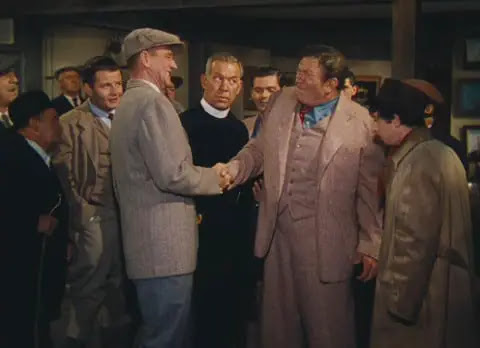
John Ford, 1952) "Trooper" Sean Thornton (John Wayne), ex-prize-fighter, comes back to the land of his birth, Innisfree, to reclaim his father's property in Ireland. Considered an outsider and a "Yank" he makes his peace with the locals—a pint is usually good enough to prove one's charity—and settles down for a simpler life than the one he knew.
 
And maybe forget.
 
There's just one hitch—it's "Red" Will Danaher (Victor McLaglen)—his neighbor on one side of his property is not interested in "easements." He has been looking balefully at that property for years, hoping to make it his own in pursuit of marriage with the widow Sarah Tillane (Mildred Natwick), who will have nothing to do with the brute. In spite, she sells the property to the green-horn Thornton and that is settled. Settlement is just what Thornton intends. But, it isn't easy, and he finds he has to go a few rounds with various opponents on their home turf. In Innisfree, it's war until there's peace.
It doesn't help that he's hit by "the lightning bolt" when he catches sight of a ginger sheep-tender and becomes instantly smitten. As the Luck of the Irish would have it, she's Mary Kate Danaher (
Maureen O'Hara), the sister of the one man in the emerald glow of Innisfree who despises him. Mary Kate makes him feel like he's gone 10 rounds in the ring without a decision, and their besottedness is mutual, but for Kate there are issues before romance that Thornton thinks are just damn archaic, having come from The New World. 
But...when in Rome (with Roman Catholics)... He's fine with the whole town knowing about it and he's reluctantly okay with the rituals—as Mary Kate prevaricates: "Well, we just started a-courtin', and next month, we, we start the walkin' out, and the month after that there'll be the threshin' parties, and the month after that..."of the very chaste chaperoned traditions in the country ("No patty-fingers, if you please!" warns squire Michaleen Oge Flynn—Barry Fitzgerald—"The proprieties at all times!"), even if the two adults are a bit long in the tooth to be treated as children, they can't help rebelling by jumping the buggy and setting off on their own, unsupervised. All well and good; they're two healthy adults with a rebellious streak that seems compatible—to which the ever-watchful community tacitly agrees. There's just that Danaher matter.
And that other Danaher matter: Mary Kate will not jump into marriage with Thornton without her dowry, which is being withheld by her lout of a brother. Now Squire Danaher objected to the marriage from the get-go, but some village conniving put the canard out there, that the widow Tillane would be more agreeable to marrying him if Mary Kate were out of the house. He consented to the marriage, and then was refused by the widow. In spite, he has decided to withhold Mary Kate's dowry and she won't get married without it.
And that's the last straw for Thornton, setting him down for the count. He came to Ireland to settle down—the consequences of a death at his hand in the ring—and has sworn to fight no more forever and leave the States and his past behind. But, for all the blarney and the twee village-life that he'd been expecting, all he gets is conflict. And, now, must fight again—gloves off this time, but the same Marquis of Queensbury rules—to fight for the woman he loves and against the old-school precepts and covenants that would keep them apart. To him, they're the same as the sheep-droppings that litter the countryside. And he's not the kind to count to 10.
Ford had wanted to make this movie for years—being romantically sentimental about the land of his parents (he was born in the state of Maine)—and made one of those "devil's bargain" deals with Republic Pictures—who didn't think the movie would be profitable and fought like Beelzebub to shoot it in black-and-white to cut costs—and put down some collateral to make a couple of Westerns beforehand in order to secure a promise to make this odd romantic comedy, which seemed way out of the captain's chair for the veteran director.
But, Ford's passion for Ireland comes through in every frame (even the ones shot in the studio), and it allowed him to cast some fine Irish actors (he'd do more with the community in later years) as well as his traditional stock company—his brother Francis, Ward Bond, Arthur Shields, McLaglen—and his two trusted key players, Wayne and O'Hara, to make a movie that was a little out of lock-step with what was "big" in the States (isn't defying lock-step what the movie is about?). He gets some of the best career-performances out of his cast—Wayne is particularly remarkable and nuanced—with moments that are very broad and some that are just economically and full-throttled perfect—think of Fitzgerald's line: "Impetuous! Homeric!"
That's the other thing about this movie. Although it's about adults acting like children, it also—for want of a better word—damned sexy. Wayne and O'Hara were friends—life-long pals, in fact, but never romantically interested in each other—but, their on-screen chemistry, nurtured by Ford in previous appearances together, is electric. Sparks fly between the two, because both were tough acts, head-strong and opinionated, challenging and supporting each other on-stage and off (they were quite different politically), but the two of them together made the most of every scene. They're just made for each other, at least on-screen. There are better actors, of course, but chemistry is magic, and has something more to do than technique and style.
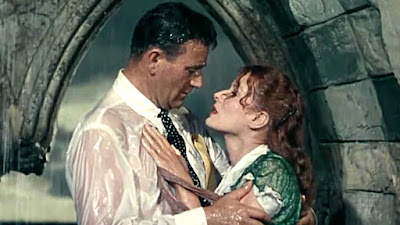
It's Ford's love-letter to Ireland (of course, he had to shoot it in Technicolor!), acknowledging the "ditriments" along with the glories of his father's land. He'd make more movies in Ireland, (a couple quite remarkable) but nothing has the off-kilter swagger that Ford at full steam could bring. And some of the images are just beautiful...museum-quality...and you get the full effect of why Ford referred to himself as "a picture-maker." That the frame is also bursting with drama, humor and corn, means that he had more than an artist's eye. He had the blarney down cold, and the magician's economy to both wow and startle.
He wanted Ireland to be proud of him. How could they not be?
The "Quiet Man" statue located in Cong, County Mayo...where parts were filmed.
 

Wednesday, March 15, 2023

Directed By John Ford

One of the delightful things about Steven Spielberg's film The Fabelmans is the late inclusion of maverick director David Lynch portraying maverick director John Ford in the recreation of the young Spielberg's meeting with him. Lynch "got" it exactly right—the irascibility, the bluntness, the crotchedly pugnaciousnes,...and the simplicity of the lesson being taught. He tells Spielberg something he knows, but not everything he knows. Just a tid-bit, that has served Spielberg well ever since (his film War Horse is a shining example of the lesson that Ford taught him that day). 

That's just a preamble for this expanded documentary that Peter Bogdanovich revised years after his death—the original was made in 1971 while Ford was still alive. One of these days (how often I say that!) I'll get back on track with the "History of John Ford" series I was doing. It's not complete yet, but the many John Ford entries I've run across while compiling an Index for this site tells me there's still a lot of work to do. 
 
For one thing, I can't believe I've never brought this over from my old movie blog. But, here it is:
 
Directed by John Ford (Peter Bogdanovich, 1971, 2006) Bogdanovich's essential primer is a "viewer's digest" of some big things that that made John Ford such a powerful director not only in individual films, but also across a career of experience. Generous clips from throughout his life's work illustrate points, punctuated by talking head clips from the '71 version including Ford himself (who is not very helpful, to say the least—by saying the least*—and is deliberately dismissive of doing the whole "critical analysis" thing, much like a comedian hates to explain a joke, or a magician a trick), as well as actors he worked with like John Wayne, Henry Fonda, and James Stewart
 
The 2006 update folds in Harry Carey, Jr., Maureen O'Hara, and analysis from Clint Eastwood, Martin Scorsese, Walter Hill, and Steven Spielberg, as well as Bogdanovich (you couldn't keep him out of one of his own documentaries, even if it's about another subject).
The update has everything from the original re-jiggered to add more points, but there's more of a "legacy" feel to the thing, now, as the casts of regulars Ford depended on have dwindled—Ford was still alive during the first version—and so the next generation who grew up and learned their craft sitting in the theater watching Ford's images talk about "what John Ford means to me." Also, as the man is gone now, there's a bit more psychological analysis and more delving into the man's irascible personality, already on full display in his interview.
But there is one troubling aspect to this "new" version, something that stuck in my craw when I saw it (and no doubt would result in Ford caning Bogdanovich if he got wind of it). There is a brief (very brief) examination of Mary of Scotland, Ford's only film directing Katherine Hepburn, and the subject of much speculation over what their relationship was. A sound clip is played of Hepburn's visit to Ford days before his death. The tape was allowed to run continuously, and their parting words to each other are played, words that they had no way of knowing were being recorded, and words that might not have been said if known they'd been overheard (Ford specifically asks her "Are they gone?"). It's nothing scandalous or huge. Ford merely says "I love you," and Hepburn says "it's mutual." But it feels like a violation of the departed by the parties that recorded it and who have re-presented it. And far too much is made of it (Really?  It was the inspiration for the names of O'Hara's and Wayne's characters in The Quiet Man?) in a gossipy, speculative fashion.
These were, after all, words from two people who must have known they'd never see each other again, and it's nice and it's lovely. But it's beneath the film, beneath Bogdanovich, and undercuts whatever scholarly impact the film might otherwise enjoy to make anything more of than the sweet parting gesture it is. The worst part is...there's no one to rebut, no one to protest, no one to defend...or even better yet, to correct the speculation. Even Ford's maxim of "When the legend becomes fact, print the legend" doesn't cover this
.
That aside (and it's my quibble, really), it's an invaluable first toe-dip into the films of Ford, and enriches the experience and appreciation of every film of his seen afterwards. One thing Bogdanovich did right (besides getting Turner Classic Movies to bank-roll it, so more people would see it, as the various clips from many studio sources would be very expensive) is he kept the original's essential narration by Orson Welles, Ford fan and student. The voices and faces and memories out of the past have as much weight and bearing as the films do, reverberating throughout history and time, feeling immortal and universal.
*


Friday, April 13, 2018

Our Man in Havana

Our Man in Havana (Carol Reed, 1959) A fascinating serio-comic counter-point to author Graham Greene and Reed's post-war classic The Third Man (made a decade earlier) in which the bold find they can make quite a killing in the cracks created in a transitional government. Reed's camera still swoops (courtesy of d.p. Oswald Morris), making sure that the distended Cinemascope frame is filled to the corners with detail, and the dark streets of Havana at night, (filmed after the revolution and with the quite mercenary permission of Fidel Castro*could be mistaken for post-war Vienna. The sun shines brighter, though, and so most of the internecine work of spies is done in the relative low-light of bars and brothels.
Greene's book was a cynical look at how Intelligence forces can show a distinct lack of intelligence when confronted with mis-information, but it is Reed's nifty idea to cast it with comedic actors, though not always playing for laughs.  With such as Burl Ives, Noel Coward, Ralph Richardson, Ernie Kovacs (he plays a corrupt Cuban police official straight, but it is still funny) and Alec Guinness, it seems more a comedy of errors: British ex-pat Jim Wormold (Guinness) is scraping by a living selling vacuum cleaners in Havana, while his daughter (Jo Morrow) is developing a taste for the expensive horsey set—something that could be provided by Captain Segura (Kovacks), who has an eye for the blonde girl. Wormold has other plans for her, like an expensive Swiss boarding school.  But where to get the money?
He is approached one day by Hawthorne (Coward, out of place in his dark suit and bowler hat in the mid-day sun of Havana) of the British secret service—or, as he is known, Agent 29500—to set up a bureau station for the service. For Wormold, it is extra cash, an all-expenses paid membership to the exclusive country club, and a more lavish life-style, all for keeping his daughter close. All the Service wants is results, which Wormold has trouble setting up—he is, after all, only a vaccuum cleaner salesman. Soon, he starts filing bogus reports, recruiting strangers as fellow agents (without their knowledge), building his station in importance to the delight of Hawthorne and his superior 'C' (Ralph Richardson).
However, becoming an important secret agent draws attention. He is soon assigned a secretary (Maureen O'Hara) by his superiors, wanting to build him up, and targeted for assassination by his enemies, wanting to shut him up.  Doesn't matter if the information he's sending is all wrong; with so many resources at his command, he's sure to dig up something sooner or later.  Scrutinized from both sides, the spy-game stops being so rewarding, and turns downright dangerous.
It's all played with a bit of a wink, with great comic actors under tight rein to let the material be funny without goosing it. Definitely worth seeing for the literate script, Reed's classic direction and the fine performances.  John le CarrĂ© would later use the basic subject matter for his book (and subsequent John Boorman film) The Tailor of Panama. 

* Filming in Cuba with set-visits from Castro and Ernest Hemingway:

Thursday, March 19, 2015

The History of John Ford: "The Cavalry Trilogy"

When Orson Welles was asked what movies he studied before embarking on directing Citizen Kane he replied, "I studied the Old Masters, by which I mean John Ford, John Ford, and John Ford." 

Running parallel with our series about Akira Kurosawa ("Walking Kurosawa's Road"), we're running a series of pieces about the closest thing America has to Kurosawa in artistry—director John Ford. Ford rarely made films set in the present day, but (usually) made them about the past...and about America's past, specifically (when he wasn't fulfilling a passion for his Irish roots). 

In "The History of John Ford" we'll be gazing fondly at the work of this American Master, who started in the Silent Era, learning his craft, refining his director's eye, and continuing to work deep into the 1960's (and his 70's) to produce the greatest body of work of any American "picture-maker," America's storied film-maker, the irascible, painterly, domineering, sentimental puzzle that was John Ford, John Ford, and John Ford.

Ford's Monument Valley
photographed by the writer in 1976

Fort Apache (1948)
She Wore a Yellow Ribbon (1949)
Rio Grande (1950)


"This is the West, sir. When the Legend becomes Fact, print the Legend"

Chronologically, they're out of order. Two are in black and white. The third in glorious Oscar-winning color. Some characters appear in two of the three films. One man's story forms a character arc across two films, but you don't have to see both to know his story. They're all about honor. They're all about duty. They're all about family. They're all about the U.S. Cavalry during the move West. They're about carving civilization out of a rough-hewn wilderness.
And they're about the devastation of the Native people to achieve it. Ford would tackle the subject of the inherent racism behind that tragedy starting with The Searchers five years after the last of these films, then throughout the rest of his westerns. He touches on it in these films, in the duplicity of the white bureaucrats, military men and profiteers and you can see the crack forming in history as it occurred and History as it was presented in text...and the movies, as obvious as the crags etched into the location of all three films-the magnificent Monument Valley on the Navajo Indian Reservation.
And there is a fourth story not told in these films, but behind the scenes, of a film director bucking the studio system, and in so doing, casting a safety net to a civilization whose extinction was being chronicled, and often celebrated, in that system.

Fort Apache (John Ford, 1948)
At Fort Apache, a finger of civilization has poked through the wild west. For the U.S. Cavalry, the isolated post has become home to some of the families of the men, and so tensions are high—there is unrest among the Apaches, led by Cochise—and security is a priority. Brought in to lead the way is Civil War general Owen Thursday (Henry Fonda), an arrogant ideologue and martinet, with his own vision of the West that has nothing to do with reality.

Any similarity to George Armstrong Custer is strongly suggested—this at a time when the legend of Custer was still very much in keeping with his widow's intentions of keeping her husband in the most heroic of lights, aided and abetted by fawning newspapermen, nickel-biographers, covetous land-barons, and even the Anheuser-Busch company.* Indeed, the "legend" of Custer would extend deep into the 1960's, decades after Ford's film.

Thursday takes no prisoners and no guff from his veteran cavalryman, Captain Kirby York (John Wayne), passed over for command of the fort, and who prefers a policy of negotiation. York doesn't blame the natives for the Apaches' anger, but, instead, the double-dealings of corrupt Indian agents. After watching years of uneasy relations shattered by Thursday's inflexibility, York must grit his teeth and watch as it leads to disaster, and then defend his superior officer's reputation for the good of the Corps.
Years later, in The Man Who Shot Liberty Valance, the dictum behind York's reactions were spelled out plainly: "When the Legend becomes Fact, Print the Legend." York does what he does for the good of the Cavalry, but by promoting the myth. he is complicit in the further hard-nosed approach exemplified by Thursday and the decimation of the tribes. The film's triumphant huzzahs to the U.S. Cavalry have a tinge of melancholy to them, as York's words are matched by a shot of riding troops in a pane of glass—a reflection.

She Wore a Yellow Ribbon (John Ford, 1949) Ford was encouraged by Wayne's performance in director Howard Hawks' Red River** to cast him as retiring Cavalry Officer Col. Nathan Brittles, a by-the-book cavalryman who bends rules until they almost snap. That includes personally negotiating with Cheyenne Chief Pony That Walks (Chief John Big Tree) to head off a bloody up-rising. She Wore a Yellow Ribbon is full of Ford's hi-jinx and low humor, with squabbling lovers (Joanne Dru, John Agar and Harry Carey, Jr.), drunken sergeants,*** and the imminent retirement looming. Ford had worked in color before (Drums Along the Mohawk) and his set-pieces are bright contrasts to the red clay of the Monument Valley dirt. There is one unnervingly beautiful sequence of a night-time trek through Monument Valley in the middle of a lightning storm, done over the objections of the Technicolor Consultant, who subsequently won an Oscar for their "work."
Along with Carey, McLaglen and other members of the Ford stock company, a new face appeared—Ben Johnson, who in 1971, would win an Academy Award for The Last Picture Show. He was a horse wrangler and rider in Ford's productions and proved invaluable on the set. So much so that Ford rewarded him with a speaking part as Trooper Tyree, the Unit's invaluable scout, the first of many roles Johnson would play for Ford.
And it contains one of my favorite Ford moments: Wayne 's Brittles confronting the Chief Pony That Walks , played by Seneca Chief John Big Tree. In a quavering, ancient voice and shouting his dialogue, the old man still holds his own against Wayne, who usually blew other actors off the screen. "Hallelujah, Nathan! I am a Christian!" he shouts in greeting. His appearance must have given strokes to the "suits" in Hollywood. A native! Doing a speaking part! And you can't understand him! Why couldn't Ford get Anthony Quinn or something?****
And here, we interrupt to tell a tale. An aside, certainly, but on a subject more important than movies. There's a reason Ford consistently shot his Westerns in Monument Valley. Pictorially, it has a lot to do with a representation of vast, uncivilized space--rough-hewn ancient structures that show no sign of man, an unmarked slate. But, practically, it was more than that. Monument Valley sits square in the Four Corners on the Navajo Reservation. And to use that location, Ford had to pay the tribe. If he'd gone to Arches National Park a day's drive away, the money would have gone to the State of Utah. But, Monument Valley, the tribe.
On top of that, Ford and his production team used the Native's as extras, stuntmen, horsemen, consultants—money in the pockets of each tribesman. Those long lines of native riders beading the horizon in Ford westerns? All paid employees. The women and children that stuff the frames of village shots are not merely there for "color." They were all paid to get the tribe through a tough winter in one of the more inhospitable environments on the continent. And the Chief John Big Tree, though he may have had difficulty with his lines (and probably learned them phonetically) was paid the highest scale, merely for speaking lines in the script. There is a reason there is a John Ford tourist center at Monument Valley, and why he was made an honorary chief. Ford's Westerns saved more Indians than were represented to be killed. And his politically incorrect first suggestions of white duplicity in the "taming" of the West (which would culminate in his films The Searchers and Cheyenne Autumn—in which he endeavored to make a movie about "The Trail of Tears") began to seep in the true story behind the "shoot-em-up's" and "Cowboys-and-Injuns" pictures which were a staple of American entertainment.
Ford's color sense and composition has a Master's eye.


Rio Grande (John Ford, 1950) To finance the third Cavalry film (after the $1.6 million budget of Yellow Ribbon), Ford turned to B-movie studio Republic Pictures. Ford yearned to make The Quiet Man there, but studio head Herbert Yates, with no confidence in the script, persuaded Ford to first make a sure-to-be-profitable John Wayne Western first, which would become Rio Grande.

Rio Grande takes a look at the further career of John Wayne's Lt. Col. Kirby Yorke (he's sprouted an "e" on the end of his name, for one thing). Estranged from his wife (
Maureen O'Hara), posted to the frontier to protect settlers from attacking Apaches, with inadequate forces to do the job, Yorke is feeling a lot of pressure, especially when Phil Sheridan asks him to cross into Mexico to confront the renegades where they're hiding. Then, on top of that, Yorke's son is stationed to his troop. Throughout the course of the movie, Yorke comes dangerously close to becoming the type of commander his old superior, Owen Thursday, was.

Ben Johnson returns as Trooper Tyree, as does Victor McLaglen as now Sgt. Major Quincannon. Harry Carey, Jr. plays another role entirely.
Ford made other westerns during this time period--Three Godfathers, his "Christmas Western," with Wayne, "Dobe" Carey and Pedro Armendariz, and Wagonmaster about the Mormon trek to Utah, with Ward Bond, Carey and Ben Johnson. But Ford's next film with a Cavalry presence would be The Searchers, in which, accompanied by a jaunty Irish tune, the heroes of this trilogy would be responsible for the murder of women and children, and one of the main characters would turn to the other and question them "What'd they kill her for? She didn't hurt nobody!"
In The Man Who Shot Liberty Valance a newspaperman tells Jimmy Stewart's Congressman Stoddard "This is the West, sir. When the Legend becomes Fact, print the Legend," "becomes" in the sense of casting a better light on the Truth.**** Ford filmed his "Cavalry Trilogy" with that maxim in mind, and had even showed its employment in distorting History. Now, in the last part of his storied career, he would tear the Legend away to expose Truth, and show Americans in their entertainment, what was lost in winning the West.


* The beer giant commissioned a painting (below) that was distributed and hung in every saloon that carried their product.

** "I didn't know the dumb son-of-a-bitch could act!" he would remark to Howard Hawks.

*** Played by Ford favorite, Victor McLaglen, whom Ford directed to a Best Actor Oscar for The Informer. McLaglen's character Sgt. Quincannon appears in the next Cavalry picture, Rio Grande, as well. There is a Sgt. Quincannon in Fort Apache, played by Dick Foran, rather than McLaglen. McLaglen plays the similar role of Sgt. Mulcahy in Fort Apache.


**** It was a common Hollywood practice to give the most prominent "foreign" role to white actors in make-up, and Ford was as much a victim of the practice as any director. In order to get his "Trail of Tears" epic Cheyenne Autumn made he was forced to use "name" stars such as Latinos Gilbert Roland, Dolores Del Rio, and Ricardo Montalban, and Italian Sal Mineo. Quinn, Mexican-American, has played Latino, Arab, Greek, Italian, Inuit, etc., etc.


***** He would feature the U.S. Cavalry again in two more movies in the last decade of his career—Sergeant Rutledge and Cheyenne Autumn—but the focus was less on the troop's accomplishments than on their failings that had been forgotten in the tellings of the tale.