Showing posts with label 1952. Show all posts

Wednesday, December 25, 2024

Walking Kurosawa's Road: Ikiru

The inability to write about the films of Akira Kurosawa to my satisfaction led me to to take a different path: start at the beginning, take each film in sequence, one after the other, and watch the progression of the man from film-maker to Master. I'm hoping I can write more intelligently and more knowledgeably about his work by, step by step, Walking Kurosawa's Road.


Ikiru (aka "To Live" aka 生きる)(Akira Kurosawa, 1952) For those who've seen more than just Akira Kurosawa's samurai films, this is the one that is most often cited as his crowning achievement.

Hard to argue.

Short on visual majesty, except in the sort of composition and eye for detail that Kurosawa brought to every film, with very little of what one would call "action," and inspired by the director's love for Russian Literature, Ikiru tells the story of a simple bureaucrat, a paper-shuffler, "a walking corpse," as the narrator describes "the protagonist."
 

Set in contemporary Japan, it follows Kanji Watanabe (Takashi Shimura), a Kainan civil servant (with the uninspiring title of "Section Chief of Public Affairs") who has worked for the same department for 30 years and who (we are told) has been "dead for twenty years"—that's around the time his last white paper on steps to improve efficiency in his department was summarily dismissed by his "higher-ups".
We see a typical day at his office. Kanji rubber-stamping papers with barely a glance, the same way that he handles a request from Sakai
(Haruo Tanaka) about the concerns of the Kuroe Women's Association—they want to drain a local cess-pool and create a children's park on the site, eliminating a health hazard and providing a benefit for Japan's version of "baby-boomers." Kanji basically runner-stamps them, sending them off to Public Works without any sort of entree or recommendation, where the mothers go through an all-day session of bureaucracy runarounds only to end up exactly where they started. 
Only when they return to his desk, Kanji is not there—he has uncharacteristically taken time off from his duties to go to the physician's office. He has certain symptoms—pains—which a fellow patient in the waiting room tells him could be stomach cancer, which is a death sentence. But (he's informed), the doctors, who wouldn't be able to treat the cancer, will tell him that it's merely a mild ulcer, there's no need to operate, and to eat whatever he wants (as long as it's easy to digest). The patient tells him that is his experience, and when Kanji is called to the doctor's office, his worst fears are answered. He's told he has a mild ulcer, there's no need to operate, and he can eat anything he wants (as long as it's easy to digest). That patient was telling the truth; the doctors will lie. His diagnosis is good news; it is a death sentence. The doctors can only watch as their cheery "spin" fills Kanji with despair. They know he is suffering, but they go on with their charade. That is how things are done, you see. To deviate from it might be disastrous.
At the doctor's office, Kanji has been given a taste of his own medicine and it is a bitter pill. He knows he has less than a year to live, but he has no idea how. Living has become a habit, something he has squandered, and, in his grief, he takes things to excess. "What would you do," his doctor asks his team after he's left "if you had only six moths to live?" Kanji staggers home, oblivious to the world, only to hear his son and his new wife arrive home, speculating on buying a new home with his money, and he recalls himself as a widower, raising the boy himself, the sacrifices, and can only cry himself to sleep.
The next day, he is not at work, nor is he for the next five days—¥50,000 has been taken out of his account—but no one can find him. It turns out he's been drowning his sorrows, pretty stupid for a man with stomach cancer, but the sake gives him oblivion and oblivion takes away the thoughts in his head—of his wasted life, his contemplation of suicide and his cowardice for not doing it. He blurts all this to a writer "of second-rate fiction" who finds Kanji's existential struggle romantic and vows to help him start living by taking him to pachinko parlors, cabarets, dance-halls and strip-joints, but it is all just drunken activity that only makes him feel worse. He is running in place and getting nowhere.
Still recovering from his night's activities with the writer, he has a chance encounter with a co-worker (
Miki Odagiri) who is overjoyed to see him. Feeling stifled by the job at Public Affairs, she was been wanting to quit but has needed his permission signed to begin work at a new job making children's toys. Watanabe takes her to his house to provide the needed seal for her petition, but the girl's presence makes the old man's son think that his father is foolishly stepping out with a younger woman, risking his inheritance. But, Watanabe, feeling isolated and alone, is merely clinging to her for her vitality and energy. She makes him laugh and ultimately inspires him to start a new path...in the same place where he began, where he feels he's been wasting his life for the last 30 years. But, that will all change.
At this point, Kurosawa changes the strict timeline he's been following and moves forward five months in the story. Watanabe is dead and at his memorial, his family and past employees gather in remembrance. Even the Deputy Mayor is there. The children's park has been built, which the Deputy Mayor is only too proud to take credit for, dismissing Watanabe's efforts. But, a grateful appearance at the wake by the Kuroe Women's Association seems to belie that, and Watanabe's co-workers, perhaps inspired by the generous rounds of warm sake, begin to swap stories of Watanabe's zeal in his last few months, uncharacteristically bending rules, hounding department heads and getting the park built.
Watanabe at his lowest...and his highest.
"But I was so much older then, I'm younger than that now.

To the point of even having his life threatened by local pimps who'd rather use the designated park-area for their own purposes. When they threaten retribution, he only looks at them with an ironic smile, at the joke only he can appreciate. By the end of the movie, the characters begin to appreciate the value of one, solitary life, however humble, however stifled. Appreciate it, but in a bureaucracy, maybe not inspired by it. Maybe.
 
But, the park is there. And it will be well-used, as Watanabe himself used it. No further marker is needed.

Ikiru is a quieter, less celebratory—and less dependent on angels, certainly—cousin to It's a Wonderful Life or A Christmas Carol (any of them). All tread a journey through darkness and the sorrow of the soul to emerge, at their respective ends, to the light and a celebration of life. It's why I offer this one for Christmas. As a sort of gift.

I can't recommend this one highly enough. I borrowed this from the Library and kept it for two months, revisiting it, picking details out of it, admiring how it blended tragedy and comedy, satire and spiritualism. If there was one Kurosawa film that I could choose in his entire work that I could view over and over again, it would be this lovely little miracle of a film.

It was remade (as, it seems, all of Kuosawa's films must) in 2022 as the quite decent British film, Living.
Kainan City Hall
 

Wednesday, April 17, 2024

Don't Bother To Knock

Don't Bother To Knock
(
Roy Ward Baker, 1952) The McKinley Hotel in New York is apparently not what it used to be. For example, there's no baby-sitting service, and that vexes the Joneses (Lurene Tuttle and Jim Backus), who are attending a soiree in the joint's ballroom. But, elevator operator Eddie Forbes (Elisha Cook Jr.) has a neat solution: his niece, Nell (Marilyn Monroe) has just come into town and needs a job. Eddie asks her to look after the Jones' kid, Bunny (Donna Corcoran) and she shows up to look after the kid while Mom and Dad are downstairs.
 
That's all neat and tidy...seemingly. What isn't neat and tidy is the on-going non-relationship between Skyways airline pilot Jed Towers (Richard Widmark) and a singer employed at the hotel, Lyn Lesly (Anne Bancroft, in her screen debut). Lyn had sent Jed a "Dear John" letter ending their six month relationship, sending him into a tail-spin. He's checked into the McKinley to confront her about it and doesn't like it when she tells him that he doesn't "have an understanding heart." Of course, he doesn't understand, so he goes back to his room to sulk ("The female race is always cheesing up my life!").
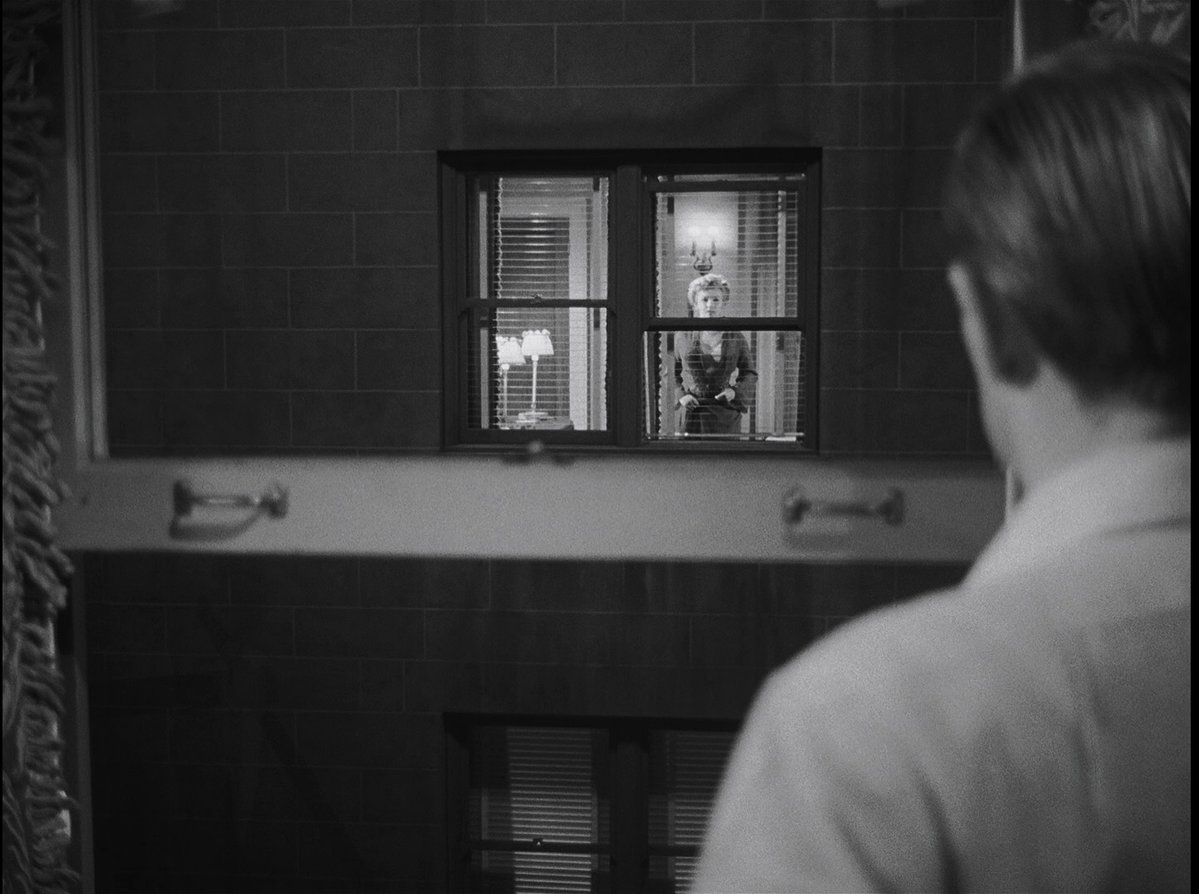
Across the way is the Jones' apartment, where Nell is baby-sitting, and makes herself at home. That means different things to different people, but to Nell it means trying on Mrs. Jones' negligee and earrings, lipstick, and shpritzing the woman's perfume. It's clear that Nell may not be the best sitter that could have been hired, and might actually need a sitter herself, given her disregard for the personal property of the folks who hired her. Dolling herself up, whatever her reasons, is enough to attract the interest of Jed, who's nursing the earlier break-up and a bottle of whiskey.
When Nell catches him peeping, she draws the blinds, which only amuses Jed. This being the 1950's and Jed being a "man's man" pilot and all, he calls her up on the house phone and tries to talk his way over for a night-cap, but Nell, after initially being interested, hangs up on him.
Meanwhile Eddie (because he knows "her history") stops by to check up on her and is shocked to find her in Mrs. Jones' "things" and tells her that she has to put everything back—he's had his job 14 years and he doesn't want her to do anything to risk it. Besides, if she wants the finer things in life she should stop mooning over her dead boyfriend and move on. She changes, but when Eddie leaves, she puts everything back on.
 
Then, she calls Jed and invites him over.
Even though the film is 70 years old, we'll stop there for spoilers because it's the surprises that make Don't Bother To Knock an interesting see. Nell is such a mystery with hair-pin turns that you wonder what could possibly happen next...and then you get jolted again. "I can't figure you out! You're silk on one side and sandpaper on the other!" Jed yammers in frustration. The truth is he won't figure her out, even Nell can't figure herself out. She's stuck in a loop and all people can do is follow her down her rabbit-holes.
Which is why it's amazing that it's Marilyn Monroe playing Nell. Monroe performances you always take with a grain of salt—at least a grain of sympathy or empathy—and not to make a pun of it but she's graded on the curve, allowances are made. And just as frustrated directors found out the hard way, Monroe knew that the camera loved her and knew how to use it. The camera was the one thing in Hollywood she could trust. With the bar of excellence seemingly lowered, you come away more than a little impressed.
What had she done before? Cameo's basically. In The Asphalt Jungle and All About Eve, she'd had scenes where she made an impression when she was on the screen, which was minimally. And the parts called for sexy but not voraciously so. Her dramatic role in Fritz Lang's Clash By Night was small, but Don't Bother to Knock, despite its pulp origins and low budget was a huge...if somewhat daunting... role—play "crazy" but sympathetic.
And she's pretty amazing at it. Even with sympathy filters up, there's a lot of work here that tosses the control that she maintained in most of her performances and you're struck by how genuinely alarming it is. Even on-set Bancroft was impressed: "It was a remarkable experience. Because it was one of those very few times in all my experiences in Hollywood when I felt that give and take that can only happen when you are working with good actors. There was just this scene of one woman seeing another woman who was helpless and in pain, and [Marilyn] was helpless and in pain. It was so real, I responded. I really reacted to her. She moved me so that tears came into my eyes."
Almost immediately, she would use her energies for the artifice of star performances that would turn Elton John's "candle-in-the-wind" into kleig lights.

Friday, March 17, 2023

The Quiet Man (1952)

The Quiet Man
(
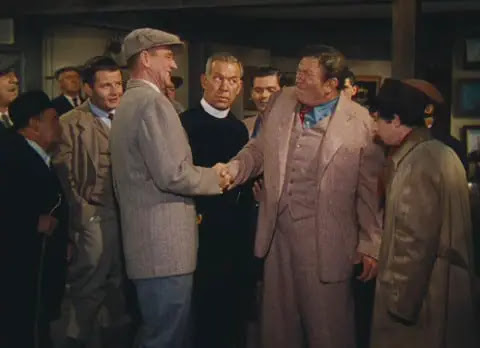
John Ford, 1952) "Trooper" Sean Thornton (John Wayne), ex-prize-fighter, comes back to the land of his birth, Innisfree, to reclaim his father's property in Ireland. Considered an outsider and a "Yank" he makes his peace with the locals—a pint is usually good enough to prove one's charity—and settles down for a simpler life than the one he knew.
 
And maybe forget.
 
There's just one hitch—it's "Red" Will Danaher (Victor McLaglen)—his neighbor on one side of his property is not interested in "easements." He has been looking balefully at that property for years, hoping to make it his own in pursuit of marriage with the widow Sarah Tillane (Mildred Natwick), who will have nothing to do with the brute. In spite, she sells the property to the green-horn Thornton and that is settled. Settlement is just what Thornton intends. But, it isn't easy, and he finds he has to go a few rounds with various opponents on their home turf. In Innisfree, it's war until there's peace.
It doesn't help that he's hit by "the lightning bolt" when he catches sight of a ginger sheep-tender and becomes instantly smitten. As the Luck of the Irish would have it, she's Mary Kate Danaher (
Maureen O'Hara), the sister of the one man in the emerald glow of Innisfree who despises him. Mary Kate makes him feel like he's gone 10 rounds in the ring without a decision, and their besottedness is mutual, but for Kate there are issues before romance that Thornton thinks are just damn archaic, having come from The New World. 
But...when in Rome (with Roman Catholics)... He's fine with the whole town knowing about it and he's reluctantly okay with the rituals—as Mary Kate prevaricates: "Well, we just started a-courtin', and next month, we, we start the walkin' out, and the month after that there'll be the threshin' parties, and the month after that..."—of the very chaste chaperoned traditions in the country ("No patty-fingers, if you please!" warns squire Michaleen Oge Flynn—Barry Fitzgerald—"The proprieties at all times!"), even if the two adults are a bit long in the tooth to be treated as children, they can't help rebelling by jumping the buggy and setting off on their own, unsupervised. All well and good; they're two healthy adults with a rebellious streak that seems compatible—to which the ever-watchful community tacitly agrees. There's just that Danaher matter.
And that other Danaher matter: Mary Kate will not jump into marriage with Thornton without her dowry, which is being withheld by her lout of a brother. Now Squire Danaher objected to the marriage from the get-go, but some village conniving put the canard out there, that the widow Tillane would be more agreeable to marrying him if Mary Kate were out of the house. He consented to the marriage, and then was refused by the widow. In spite, he has decided to withhold Mary Kate's dowry and she won't get married without it.
And that's the last straw for Thornton, setting him down for the count. He came to Ireland to settle down—the consequences of a death at his hand in the ring—and has sworn to fight no more forever and leave the States and his past behind. But, for all the blarney and the twee village-life that he'd been expecting, all he gets is conflict. And, now, must fight again—gloves off this time, but the same Marquis of Queensbury rules—to fight for the woman he loves and against the old-school precepts and covenants that would keep them apart. To him, they're the same as the sheep-droppings that litter the countryside. And he's not the kind to count to 10.
Ford had wanted to make this movie for years—being romantically sentimental about the land of his parents (he was born in the state of Maine)—and made one of those "devil's bargain" deals with Republic Pictures—who didn't think the movie would be profitable and fought like Beelzebub to shoot it in black-and-white to cut costs—and put down some collateral to make a couple of Westerns beforehand in order to secure a promise to make this odd romantic comedy, which seemed way out of the captain's chair for the veteran director.
But, Ford's passion for Ireland comes through in every frame (even the ones shot in the studio), and it allowed him to cast some fine Irish actors (he'd do more with the community in later years) as well as his traditional stock company—his brother Francis, Ward Bond, Arthur Shields, McLaglen—and his two trusted key players, Wayne and O'Hara, to make a movie that was a little out of lock-step with what was "big" in the States (isn't defying lock-step what the movie is about?). He gets some of the best career-performances out of his cast—Wayne is particularly remarkable and nuanced—with moments that are very broad and some that are just economically and full-throttled perfect—think of Fitzgerald's line: "Impetuous! Homeric!"
That's the other thing about this movie. Although it's about adults acting like children, it also—for want of a better word—damned sexy. Wayne and O'Hara were friends—life-long pals, in fact, but never romantically interested in each other—but, their on-screen chemistry, nurtured by Ford in previous appearances together, is electric. Sparks fly between the two, because both were tough acts, head-strong and opinionated, challenging and supporting each other on-stage and off (they were quite different politically), but the two of them together made the most of every scene. They're just made for each other, at least on-screen. There are better actors, of course, but chemistry is magic, and has something more to do than technique and style.
It's Ford's love-letter to Ireland (of course, he had to shoot it in Technicolor!), acknowledging the "ditriments" along with the glories of his father's land. He'd make more movies in Ireland, (a couple quite remarkable) but nothing has the off-kilter swagger that Ford at full steam could bring. And some of the images are just beautiful...museum-quality...and you get the full effect of why Ford referred to himself as "a picture-maker." That the frame is also bursting with drama, humor and corn, means that he had more than an artist's eye. He had the blarney down cold, and the magician's economy to both wow and startle.
He wanted Ireland to be proud of him. How could they not be?
The "Quiet Man" statue located in Cong, County Mayo...where parts were filmed.
 

Sunday, February 12, 2023

Don't Make a Scene: Ikiru (1952)

Why haven't I re-published this "Don't Make a Scene" from Akira Kurosawa's Ikiru? I don't know. But, an anglicized version of it—Living, starring Billy Nighy—is now in theaters, and maybe now is an appropriate time to publish it. There's never a good time.


The Story: In an early episode of "Inside the Actor's Studio," host James Lipton (as he typically does) asked his guest Gene Wilder the customary questions* that end the interview. When he asked Wilder "What is your LEAST favorite word, the comic actor's answer snapped back, bitterly, and with the clear-eyed directness of experience. 

"Cancer."


This is a scene about cancer. And medicine. And doctors. Seen lots of scenes like that in movies (there'll be one like this one, half a world and many genres away next week—a curious reflection of this film, as commonly happens with Kurosawa's films and his way of telling relatable tales**). But it is also about indifference, and that is unusual in movies, even today. The director-writer of the film is Akira Kurosawa, and so it is also infused with the Master's combination of humor and tragedy, pathos and cruelty, something he learned in the translations of the Elizabethan and Russian writers that so informed his style of story-telling. It is ironic in that the the man being informed of his disease (by, ironically, not being informed of his disease) is a government functionary—an ineffectual paper-pusher—Kanji Watanabe (Takashi Shimura), whose way of dealing with a problem is the bureaucratic answer to everything: ignore it, and maybe it will go away.

So, what he receives at this doctor's office is a taste of his own medicine. And it is a bitter pill.

Action!
PATIENT: Stomach?
PATIENT: Yeah, my stomach's bad, too. It's what they call "chronic."
PATIENT: These days I hardly feel alive unless my stomach hurts.
NURSE: Suzuki-san!
SUZUKI: Yes!
PATIENT: That man over there -
PATIENT: His doctor told him he has a bad ulcer. But trust me, it's stomach cancer.
PATIENT: In a word, that very thing.
PATIENT: And stomach cancer is practically a death sentence.
PATIENT: The doc usually says it's just a mild ulcer. And that there's no real need to operate. And that you can eat as much as you want, as long as it's easy to digest.
PATIENT: If that's what he tells you, you've got a year at most.
PATIENT: But if you've got these symptoms you won't last a year:
PATIENT: First, if the pain is kind of heavy.
PATIENT: Second, if you can't stop burping unpleasantly.
PATIENT: And your tongue's always dry. You can't get enough water and tea.
PATIENT: And then there's the diahrrea...
PATIENT: And if it isn't diahrrea, well, then, you're constipated.
PATIENT: Your bowel movements go black.
PATIENT: And then....
PATIENT: That meat you used to love so, you can hardly touch it anymore.
PATIENT: And whatever you eat, you vomit half an hour later.
PATIENT: And when stuff you ate last week comes up when you vomit, well, then you're done for.
PATIENT: You've hardly got three months...
FADE to NEXT SCENE...
NURSE: Watanabe-san. Watanabe Kanji-san.
NURSE: Watanabe-san.
WATANABE: Yes.
DOCTOR: Sit down.
DOCTOR: Sit down.
DOCTOR: Um...It looks like you've got a mild ulcer.
WATANABE: Honestly...
WATANABE: Please tell me...
WATANABE: ...the truth.
WATANABE: Tell me it's stomach cancer.
DOCTOR: Yeah. I just told you, it's a mild ulcer.
WATANABE: What about an operation? Can't you operate?
DOCTOR: Oh no, there's no need to operate. It'll heal on its own.
WATANABE: And my diet?
DOCTOR: Well, just use your common sense. As long as it's easy to digest...
DOCTOR: ...you can eat whatever you like.

Ikiru (To Live)
 
Words by Shinobu Hashimoto, Hideo Oguni, and Akira Kurosawa (Translation by Linda Hoaglund)

Pictures by Asakazu Nakai and Akira Kurosawa

Ikiru in available on DVD from The Criterion Collection


*
  1. What is your favorite word?
  2. What is your least favorite word?
  3. What turns you on?
  4. What turns you off?
  5. What sound or noise do you love?
  6. What sound or noise do you hate?
  7. What is your favorite curse word?
  8. What profession other than your own would you like to attempt?
  9. What profession would you not like to do?
  10. If Heaven exists, what would you like to hear God say when you arrive at the Pearly Gates? 

** That would have been this scene from The Shootist.