
And maybe forget.
 It doesn't help that he's hit by "the lightning bolt" when he catches sight of a ginger sheep-tender and becomes instantly smitten. As the Luck of the Irish would have it, she's Mary Kate Danaher (Maureen O'Hara), the sister of the one man in the emerald glow of Innisfree who despises him. Mary Kate makes him feel like he's gone 10 rounds in the ring without a decision, and their besottedness is mutual, but for Kate there are issues before romance that Thornton thinks are just damn archaic, having come from The New World.
  But...when in Rome (with Roman Catholics)... He's fine with the whole town knowing about it and he's reluctantly okay with the rituals—as Mary Kate prevaricates: "Well, we just started a-courtin', and next month, we, we start the
walkin' out, and the month after that there'll be the threshin' parties,
and the month after that..."—of the very chaste chaperoned traditions in the country ("No patty-fingers, if you please!" warns squire Michaleen Oge Flynn—Barry Fitzgerald—"The proprieties at all times!"), even if the two adults are a bit long in the tooth to be treated as children, they can't help rebelling by jumping the buggy and setting off on their own, unsupervised. All well and good; they're two healthy adults with a rebellious streak that seems compatible—to which the ever-watchful community tacitly agrees. There's just that Danaher matter.
But...when in Rome (with Roman Catholics)... He's fine with the whole town knowing about it and he's reluctantly okay with the rituals—as Mary Kate prevaricates: "Well, we just started a-courtin', and next month, we, we start the
walkin' out, and the month after that there'll be the threshin' parties,
and the month after that..."—of the very chaste chaperoned traditions in the country ("No patty-fingers, if you please!" warns squire Michaleen Oge Flynn—Barry Fitzgerald—"The proprieties at all times!"), even if the two adults are a bit long in the tooth to be treated as children, they can't help rebelling by jumping the buggy and setting off on their own, unsupervised. All well and good; they're two healthy adults with a rebellious streak that seems compatible—to which the ever-watchful community tacitly agrees. There's just that Danaher matter. And that other Danaher matter: Mary Kate will not jump into marriage with Thornton without her dowry, which is being withheld by her lout of a brother. Now Squire Danaher objected to the marriage from the get-go, but some village conniving put the canard out there, that the widow Tillane would be more agreeable to marrying him if Mary Kate were out of the house. He consented to the marriage, and then was refused by the widow. In spite, he has decided to withhold Mary Kate's dowry and she won't get married without it.
 And that's the last straw for Thornton, setting him down for the count. He came to Ireland to settle down—the consequences of a death at his hand in the ring—and has sworn to fight no more forever and leave the States and his past behind. But, for all the blarney and the twee village-life that he'd been expecting, all he gets is conflict. And, now, must fight again—gloves off this time, but the same Marquis of Queensbury rules—to fight for the woman he loves and against the old-school precepts and covenants that would keep them apart. To him, they're the same as the sheep-droppings that litter the countryside. And he's not the kind to count to 10.
 Ford had wanted to make this movie for years—being romantically sentimental about the land of his parents (he was born in the state of Maine)—and made one of those "devil's bargain" deals with Republic Pictures—who didn't think the movie would be profitable and fought like Beelzebub to shoot it in black-and-white to cut costs—and put down some collateral to make a couple of Westerns beforehand in order to secure a promise to make this odd romantic comedy, which seemed way out of the captain's chair for the veteran director.


There's just one hitch—it's "Red" Will Danaher (Victor McLaglen)—his neighbor on one side of his property is not interested in "easements." He has been looking balefully at that property for years, hoping to make it his own in pursuit of marriage with the widow Sarah Tillane (Mildred Natwick), who will have nothing to do with the brute. In spite, she sells the property to the green-horn Thornton and that is settled. Settlement is just what Thornton intends. But, it isn't easy, and he finds he has to go a few rounds with various opponents on their home turf. In Innisfree, it's war until there's peace.


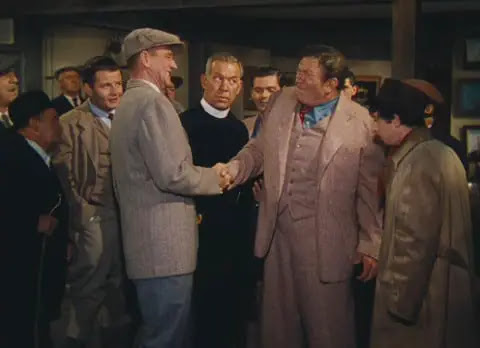


But, Ford's passion for Ireland comes through in every frame (even the ones shot in the studio), and it allowed him to cast some fine Irish actors (he'd do more with the community in later years) as well as his traditional stock company—his brother Francis, Ward Bond, Arthur Shields, McLaglen—and his two trusted key players, Wayne and O'Hara, to make a movie that was a little out of lock-step with what was "big" in the States (isn't defying lock-step what the movie is about?). He gets some of the best career-performances out of his cast—Wayne is particularly remarkable and nuanced—with moments that are very broad and some that are just economically and full-throttled perfect—think of Fitzgerald's line: "Impetuous! Homeric!"

That's the other thing about this movie. Although it's about adults acting like children, it also—for want of a better word—damned sexy. Wayne and O'Hara were friends—life-long pals, in fact, but never romantically interested in each other—but, their on-screen chemistry, nurtured by Ford in previous appearances together, is electric. Sparks fly between the two, because both were tough acts, head-strong and opinionated, challenging and supporting each other on-stage and off (they were quite different politically), but the two of them together made the most of every scene. They're just made for each other, at least on-screen. There are better actors, of course, but chemistry is magic, and has something more to do than technique and style.
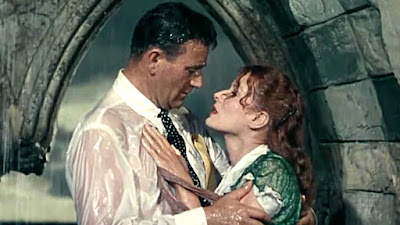 It's Ford's love-letter to Ireland (of course, he had to shoot it in Technicolor!), acknowledging the "ditriments" along with the glories of his father's land. He'd make more movies in Ireland, (a couple quite remarkable) but nothing has the off-kilter swagger that Ford at full steam could bring. And some of the images are just beautiful...museum-quality...and you get the full effect of why Ford referred to himself as "a picture-maker." That the frame is also bursting with drama, humor and corn, means that he had more than an artist's eye. He had the blarney down cold, and the magician's economy to both wow and startle.


He wanted Ireland to be proud of him. How could they not be?


The "Quiet Man" statue located in Cong, County Mayo...where parts were filmed.


