Showing posts with label Roy Ward Baker. Show all posts

Wednesday, April 17, 2024

Don't Bother To Knock

Don't Bother To Knock
(
Roy Ward Baker, 1952) The McKinley Hotel in New York is apparently not what it used to be. For example, there's no baby-sitting service, and that vexes the Joneses (Lurene Tuttle and Jim Backus), who are attending a soiree in the joint's ballroom. But, elevator operator Eddie Forbes (Elisha Cook Jr.) has a neat solution: his niece, Nell (Marilyn Monroe) has just come into town and needs a job. Eddie asks her to look after the Jones' kid, Bunny (Donna Corcoran) and she shows up to look after the kid while Mom and Dad are downstairs.
 
That's all neat and tidy...seemingly. What isn't neat and tidy is the on-going non-relationship between Skyways airline pilot Jed Towers (Richard Widmark) and a singer employed at the hotel, Lyn Lesly (Anne Bancroft, in her screen debut). Lyn had sent Jed a "Dear John" letter ending their six month relationship, sending him into a tail-spin. He's checked into the McKinley to confront her about it and doesn't like it when she tells him that he doesn't "have an understanding heart." Of course, he doesn't understand, so he goes back to his room to sulk ("The female race is always cheesing up my life!").
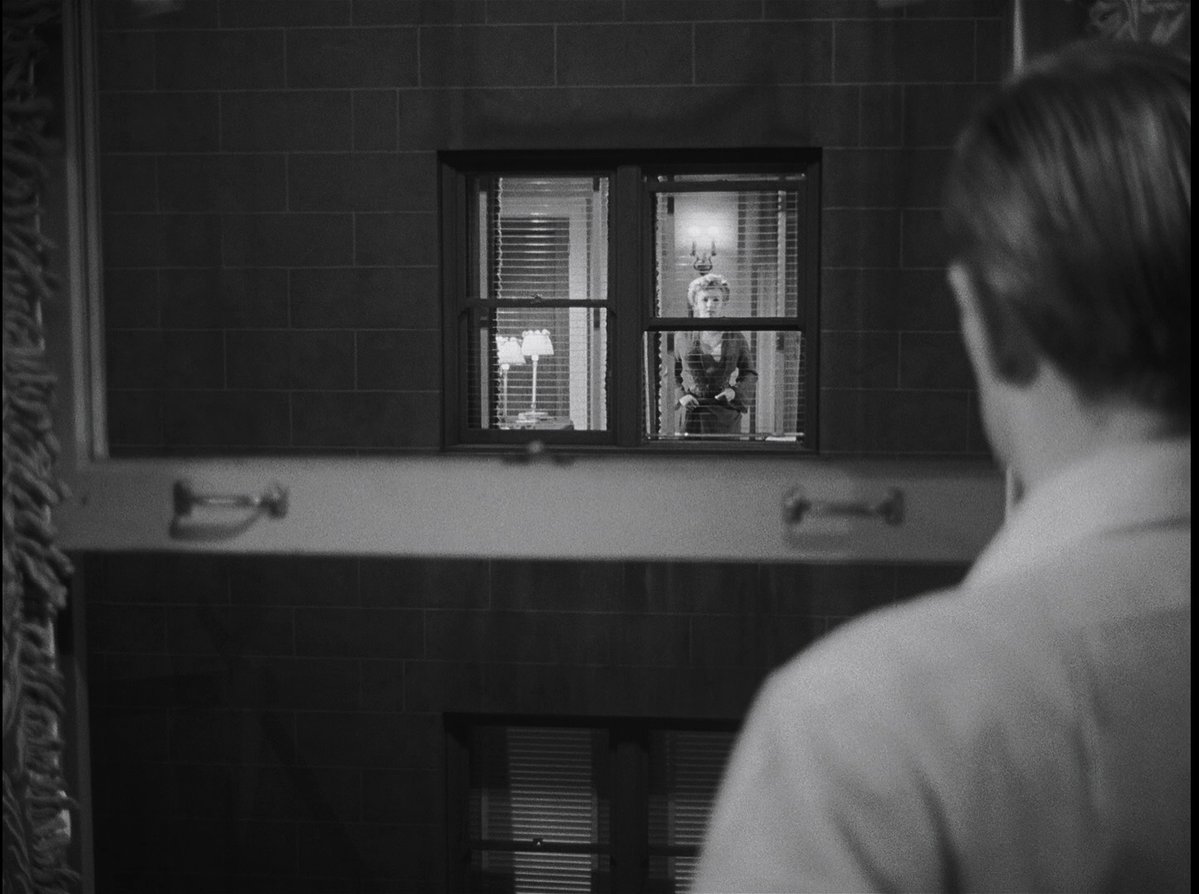
Across the way is the Jones' apartment, where Nell is baby-sitting, and makes herself at home. That means different things to different people, but to Nell it means trying on Mrs. Jones' negligee and earrings, lipstick, and shpritzing the woman's perfume. It's clear that Nell may not be the best sitter that could have been hired, and might actually need a sitter herself, given her disregard for the personal property of the folks who hired her. Dolling herself up, whatever her reasons, is enough to attract the interest of Jed, who's nursing the earlier break-up and a bottle of whiskey.
When Nell catches him peeping, she draws the blinds, which only amuses Jed. This being the 1950's and Jed being a "man's man" pilot and all, he calls her up on the house phone and tries to talk his way over for a night-cap, but Nell, after initially being interested, hangs up on him.
Meanwhile Eddie (because he knows "her history") stops by to check up on her and is shocked to find her in Mrs. Jones' "things" and tells her that she has to put everything back—he's had his job 14 years and he doesn't want her to do anything to risk it. Besides, if she wants the finer things in life she should stop mooning over her dead boyfriend and move on. She changes, but when Eddie leaves, she puts everything back on.
 
Then, she calls Jed and invites him over.
Even though the film is 70 years old, we'll stop there for spoilers because it's the surprises that make Don't Bother To Knock an interesting see. Nell is such a mystery with hair-pin turns that you wonder what could possibly happen next...and then you get jolted again. "I can't figure you out! You're silk on one side and sandpaper on the other!" Jed yammers in frustration. The truth is he won't figure her out, even Nell can't figure herself out. She's stuck in a loop and all people can do is follow her down her rabbit-holes.
Which is why it's amazing that it's Marilyn Monroe playing Nell. Monroe performances you always take with a grain of salt—at least a grain of sympathy or empathy—and not to make a pun of it but she's graded on the curve, allowances are made. And just as frustrated directors found out the hard way, Monroe knew that the camera loved her and knew how to use it. The camera was the one thing in Hollywood she could trust. With the bar of excellence seemingly lowered, you come away more than a little impressed.
What had she done before? Cameo's basically. In The Asphalt Jungle and All About Eve, she'd had scenes where she made an impression when she was on the screen, which was minimally. And the parts called for sexy but not voraciously so. Her dramatic role in Fritz Lang's Clash By Night was small, but Don't Bother to Knock, despite its pulp origins and low budget was a huge...if somewhat daunting... role—play "crazy" but sympathetic.
And she's pretty amazing at it. Even with sympathy filters up, there's a lot of work here that tosses the control that she maintained in most of her performances and you're struck by how genuinely alarming it is. Even on-set Bancroft was impressed: "It was a remarkable experience. Because it was one of those very few times in all my experiences in Hollywood when I felt that give and take that can only happen when you are working with good actors. There was just this scene of one woman seeing another woman who was helpless and in pain, and [Marilyn] was helpless and in pain. It was so real, I responded. I really reacted to her. She moved me so that tears came into my eyes."
Almost immediately, she would use her energies for the artifice of star performances that would turn Elton John's "candle-in-the-wind" into kleig lights.

Saturday, March 6, 2021

Five Million Years to Earth

Five Million Years to Earth (aka Quatermass and the Pit) (Roy Ward Baker, 1968) London is all a-natter about the recent discovery hitting the news—the discovery of the skeletons of "underground ape-men" during construction of the Hobb's End section of the London Underground. Paleontologist Dr. Romey (James Donald) and his assistant Barbara Judd (Barbara Shelley) have been called in to study and document the find and Romey speculates that the remains have been there for five million years.

It causes enough of a stir that the British Army is monitoring. They've been busy, informing Dr. Bernard Quatermass (Andrew Keir) of the British Experimental Rocket Group that they'll be joining his enterprise with the intention of employing military uses for the doctor's research, something that raises Quatermass' blood pressure considerably. But, when the excavators (particularly one played by Bee Duffel) uncover a metal object in the dig, Quatermass' new military overseer Col. Breen (Good Lord, it's Julian Glover!) invites the good doctor along to have a gander.
The military thinks its unexploded ordinance, but it's like no bomb they've ever seen: for one, the metal isn't magnetic, and it resists any attempts to cut through it with an acetylene torch—the damned thing doesn't even warm up. And the soldiers who've touched it for any length of time develop frost-bite symptoms. The substance is harder than diamonds, so it didn't come from the Nazis ("you ask von Braun" says Quatermass).
Original construction on the tube was in 1927, and about that time, Hobb's End was abuzz with rumors of spooks and spirits with sightings of a frightening type— "the figure was small like a hideous dwarf." There are scratch-marks on the walls of the abandoned tenement, and a local bobby gets the sweating yips inside the ruins. Appropriately, the place used to be spelled "Hob's End"—"Hob" being another name for the devil. It seems whenever someone digs in the area, "something" gets disturbed...and not in a good way.
That accelerates when attempts to get inside a sealed chamber of the metal "bomb" are attempted using a Borazon drill. It is unsuccessful, but the screeching caused in the process has an unnerving effect on the operator, Quatermass, Breen and Romey. Still, it does have a subsequent effect. The chamber begins to open, and inside is a honey-combed chamber with large insectoid creatures, long dead, that begin to disintegrate with their first contact with the air. Romey and Quatermass extract what they can and take the samples back to examine.
The upshot of all this is that those creatures came from Mars five million years ago in a colonization effort and finding only primitive hominids, used their technology to advance the race on the path to what would, at some point, become homo sapiens. How this is all determined is rather muddled in the explanation, as is a crucial sub-plot involving Romey's development of a gizmo that can tap into the ancient human psyche—wrestling with our alligator brains, as it were. A plan is made to use the device to record the readings when a subject is near the "bomb," and it creates a recording of hordes of hopping creatures in a marching pattern that, despite the primitive special effects, looks pretty darn good from reading brain-waves.
It seems the Martian locusts still have the power to influence us, and when the scientists' continued attempts to figure out what it is they're trying to figure out, disaster strikes in the form of a power cable hitting the bomb and sending out blasts of psychic energy that turn people crazy and start ripping up the infrastructure. Lord, we're turning into Martians! This must have seemed entirely uncivil, not to mention not posh in the England of the 1960's. And it's only through grim determination, self-sacrifice, and a conveniently placed crane, that everyone survives enough to take on the clean-up involved.
It isn't that it's bad. It's quite good in its ideas and the acting is professional, and even convincing, in even its dicier places. Having seen the original BBC teleplay, the film version was certainly compromised by the shorter story time and Hammer Studios' reluctance to put on the "what it all means to us" coda that sobers things up considerably, and the higher budget, for some reason, just distances the thing a couple steps from believability.

But, the ideas are there—that we're all just the product of some tinkering from another source, and that the dead can still have a powerful effect on the living—and are just creepy enough to raise the goosebumps and cause one to turn on the lamp (just in case). And the "common-folk" type of writing that seems to have leeched right out of movies in favor of bland archetypes.

It's one of those movies that would be a marvelous starting point for a remake, with some good ideas to germinate and just a bit more time to clean up the exposition. It always seems a better idea than to (as is the financial trend) to update past hits only to see them fall short.