Showing posts with label Jim Backus. Show all posts

Wednesday, April 17, 2024

Don't Bother To Knock

Don't Bother To Knock
(
Roy Ward Baker, 1952) The McKinley Hotel in New York is apparently not what it used to be. For example, there's no baby-sitting service, and that vexes the Joneses (Lurene Tuttle and Jim Backus), who are attending a soiree in the joint's ballroom. But, elevator operator Eddie Forbes (Elisha Cook Jr.) has a neat solution: his niece, Nell (Marilyn Monroe) has just come into town and needs a job. Eddie asks her to look after the Jones' kid, Bunny (Donna Corcoran) and she shows up to look after the kid while Mom and Dad are downstairs.
 
That's all neat and tidy...seemingly. What isn't neat and tidy is the on-going non-relationship between Skyways airline pilot Jed Towers (Richard Widmark) and a singer employed at the hotel, Lyn Lesly (Anne Bancroft, in her screen debut). Lyn had sent Jed a "Dear John" letter ending their six month relationship, sending him into a tail-spin. He's checked into the McKinley to confront her about it and doesn't like it when she tells him that he doesn't "have an understanding heart." Of course, he doesn't understand, so he goes back to his room to sulk ("The female race is always cheesing up my life!").
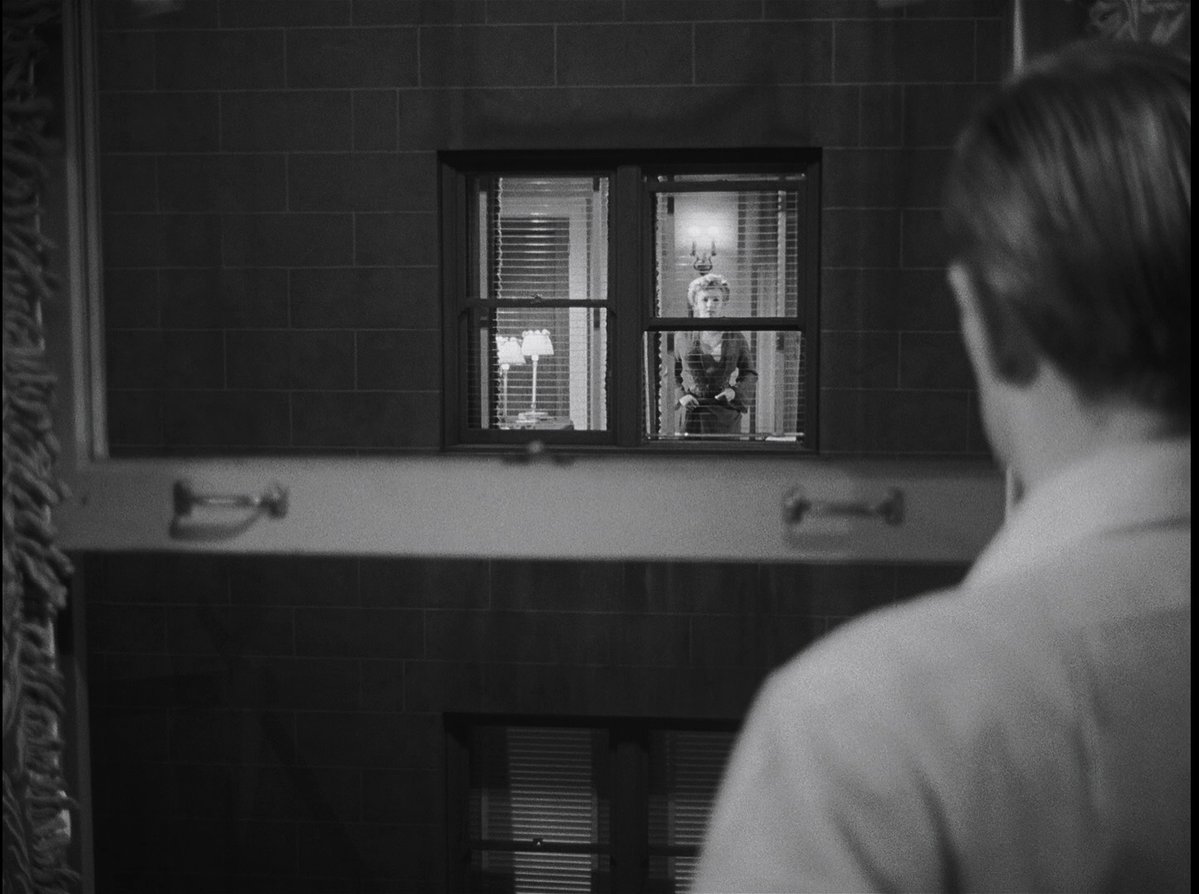
Across the way is the Jones' apartment, where Nell is baby-sitting, and makes herself at home. That means different things to different people, but to Nell it means trying on Mrs. Jones' negligee and earrings, lipstick, and shpritzing the woman's perfume. It's clear that Nell may not be the best sitter that could have been hired, and might actually need a sitter herself, given her disregard for the personal property of the folks who hired her. Dolling herself up, whatever her reasons, is enough to attract the interest of Jed, who's nursing the earlier break-up and a bottle of whiskey.
When Nell catches him peeping, she draws the blinds, which only amuses Jed. This being the 1950's and Jed being a "man's man" pilot and all, he calls her up on the house phone and tries to talk his way over for a night-cap, but Nell, after initially being interested, hangs up on him.
Meanwhile Eddie (because he knows "her history") stops by to check up on her and is shocked to find her in Mrs. Jones' "things" and tells her that she has to put everything back—he's had his job 14 years and he doesn't want her to do anything to risk it. Besides, if she wants the finer things in life she should stop mooning over her dead boyfriend and move on. She changes, but when Eddie leaves, she puts everything back on.
 
Then, she calls Jed and invites him over.
Even though the film is 70 years old, we'll stop there for spoilers because it's the surprises that make Don't Bother To Knock an interesting see. Nell is such a mystery with hair-pin turns that you wonder what could possibly happen next...and then you get jolted again. "I can't figure you out! You're silk on one side and sandpaper on the other!" Jed yammers in frustration. The truth is he won't figure her out, even Nell can't figure herself out. She's stuck in a loop and all people can do is follow her down her rabbit-holes.
Which is why it's amazing that it's Marilyn Monroe playing Nell. Monroe performances you always take with a grain of salt—at least a grain of sympathy or empathy—and not to make a pun of it but she's graded on the curve, allowances are made. And just as frustrated directors found out the hard way, Monroe knew that the camera loved her and knew how to use it. The camera was the one thing in Hollywood she could trust. With the bar of excellence seemingly lowered, you come away more than a little impressed.
What had she done before? Cameo's basically. In The Asphalt Jungle and All About Eve, she'd had scenes where she made an impression when she was on the screen, which was minimally. And the parts called for sexy but not voraciously so. Her dramatic role in Fritz Lang's Clash By Night was small, but Don't Bother to Knock, despite its pulp origins and low budget was a huge...if somewhat daunting... role—play "crazy" but sympathetic.
And she's pretty amazing at it. Even with sympathy filters up, there's a lot of work here that tosses the control that she maintained in most of her performances and you're struck by how genuinely alarming it is. Even on-set Bancroft was impressed: "It was a remarkable experience. Because it was one of those very few times in all my experiences in Hollywood when I felt that give and take that can only happen when you are working with good actors. There was just this scene of one woman seeing another woman who was helpless and in pain, and [Marilyn] was helpless and in pain. It was so real, I responded. I really reacted to her. She moved me so that tears came into my eyes."
Almost immediately, she would use her energies for the artifice of star performances that would turn Elton John's "candle-in-the-wind" into kleig lights.

Thursday, August 3, 2017

Above and Beyond

Above and Beyond (Melvin Frank and Norman Panama, 1952) The story of Lt. Col. Paul Tibbets who, during World War II, was charged with the task of training crews for the most secret bombing mission of the war—the dropping of the experimental atomic weapon that was concurrently being developed at Los Alamos. The story is different in a couple different ways: one, made in 1952, it dares to tell the story of the mental strain that such a highly secretive mission can have on the psyche, especially considering the destructive consequences the new bombs would bring; two, probably to draw a female audience, it tells the story from Tibbets' wife's point-of-view, of the hardships that a war-time marriage must go through, especially in a situation where the details of the operation cannot be disclosed to anyone, even if the secrets and responsibilities threaten to tear the marriage apart.  The choices come down to nuclear war or nuclear family. And both are extremely fissionable.

It's frustrating: Tibbets (Robert Taylor, far more nuanced than he usually is) working around the clock, must perfect the strategies for a potential suicide mission, while also consciously recognizing the horror his direct action will take—when offered an assignment, after readying the B-29 ("a flying death-trap," great commercial for Boeing) for high altitude combat missions, he's given a buzzer and told, "Now think—what would you do if that buzzer could end the war, but cause hundreds of thousands of Japanese lives." The idea rocks Tibbets back on his heels, considers all the options for forty seconds, then deliberately presses the buzzer.
Meanwhile, his wife (Eleanor Parker) must deal with long absences, no explanations, and the obvious stresses, the mission, which she knows nothing about, throws at them. To make matters worse, she billeted, along with the other airmen's wives (who are only too quick to blame her and her husband for their own living situation), at Wendover air base in Utah, a hell-hole with sub-standard housing, raising two kids (with their own short fuses), virtually fatherless. At first, it's suggested that she not come to Wendover, until the base's security officer (a tamped-down James Whitmore) opines that she being the only wife not on-base might arouse suspicions—the movie is full of such "damned is you do..." crossroads.
The scriptwriter-directors Frank and Panama, who were usually involved in lighter fare than this, do the character of Tibbets' wife no favors—she has difficulties, but domestically, not militarily, while a war rages on. She's given some egregiously selfish moments, like telling her bomber-pilot husband how she feels bad for all the kids on the ground caught in the situation—absolutely, and an extremely valid sentiment, but are you really going to tell your bomber-pilot husband that, when he's got his own guilt he's dealing with? At one point, remembering Tibbets' mother's name (which would eventually emblazon the Hiroshima bomber) she mopes "Enola—even the word backwards means 'alone.'" Yeah, honey, the world's a powder-keg and it's all about you. If you want something to worry about, how about your family turning to ash at ground zero? And, not that she'd know it, her husband might get caught in the flash-point or his bomber might get buffeted by a shock-wave, the result of a man-made conflagration no atomic engineer could predict, and the world had never seen. Tibbets as going through his own issues, but I'll bet his wife was faring better than her on-screen portrayal by Frank and Panama.
Still pretty interesting to see a 1950's film sanctioned by the Air Force (and especially General Curtis LeMay—played in the film by Jim Backus) that contemplates the use of atomic weapons and—despite pressing the buzzer—takes that long pause to consider the options and the terrible weight such a decision might impose.