Showing posts sorted by relevance for query The History of John Ford. Sort by date Show all posts

Wednesday, February 21, 2018

The History of John Ford: They Were Expendable

When Orson Welles was asked what movies he studied before embarking on directing Citizen Kane he replied, "I studied the Old Masters, by which I mean John Ford, John Ford, and John Ford."

Running parallel with our series about Akira Kurosawa ("Walking Kurosawa's Road"), we're running a series of pieces about the closest thing America has to Kurosawa in artistry—director John Ford. Ford rarely made films set in the present day, but (usually) made them about the past...and about America's past, specifically (when he wasn't fulfilling a passion for his Irish roots).

In "The History of John Ford" we'll be gazing fondly at the work of this American Master, who started in the Silent Era, learning his craft, refining his director's eye, and continuing to work deep into the 1960's (and his 70's) to produce the greatest body of work of any American "picture-maker," America's storied film-maker, the irascible, painterly, domineering, sentimental puzzle that was John Ford, John Ford, and John Ford.
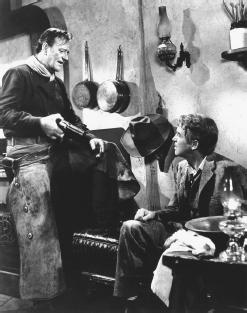
They Were Expendable (John Ford, Robert Montgomery, 1945) First things first: John Ford set up and shot the vast majority of They Were Expendable. He was adjusting a light on an elevated platform when he fell off of it, breaking his right leg. When a concerned M-G-M exec called Ford at the Florida hospital—they shot in Key Biscayne Florida—where he was in traction and asked when he was coming back to work, Ford barked back that he wasn't, that Montgomery was going to finish the picture. "First I've heard of it," Montgomery remembers thinking when he heard Ford say it (top-liners Montgomery and John Wayne drove him to the hospital at his insistence). Montgomery who had jitters about acting in the picture after serving in the Navy for 4 years, knew it wasn't going to be tough—all Ford had left were some close-up's of things already shot and he proceeded to "just think like Ford" and finished it up, except for the last scene which Ford directed after leaving his hospital bed against doctor's orders. So, that's why the co-directing notice at the top.
The movie didn't do well at the box-office; in 1945, when it was released right after V-J Day, movie-goers had become bored with the saturation of war movies in the theaters. And They Were Expendable told about the dark days of the Pacific War—after Pearl Harbor but before Midway and just after the evacuation of the Philipines—when things didn't look so positive. It might have been a case of battle-footage fatigue; the book on which it's based—"They Were Expendable" by William L. White—was a bestseller, and those who didn't buy the book might have read portions of it in Reader's Digest and Life Magazine. Plus, at the time of the book's events, the Japanese Navy was handing the Allied effort a severe whipping. Except for scenes where the crews' PT Boats achieve some sinkings in their few skirmishes with the Japanese Navy and the successful evacuation of MacArthur and his family, the command of Lt. John Brickley (Montgomery, based on Lt. John Bulkeley who received the Medal of Honor for his service) takes it from all sides: the Japanese Navy, which picks off the individual ships one by one, whittling their numbers and crews, and his own Navy that considers the small vessels capable of messenger duty and nothing more. 
The situation is frustrating enough that Lt. J.G. "Rusty" Ryan (Wayne) wants to transfer to destroyer duty and away from skippering "high-powered canoes", but keeps getting turned down. There's no doubting his devotion, though; during one run, he's injured but refuses medical care until he's finally hospitalized with blood poisoning, but only after he's been ordered to by "Brick." This does not sit well with "Rusty" in creasing his obstinacy, which doesn't ingratiate him with the hospital staff. Only one Army nurse, Sandy Davyss (Donna Reed)—after getting the brusque end of Ryan's frustrations—starts to break through his crust and the two begin an awkward often-interrupted romance.
Cribbing any munitions they can and keeping the PT boats together with spit and bailing wire, the boats manage to do some damage, but, at best, it's a stalling game, trying to keep Japanese forces from advancing, while the Navy rebuilds its fleet and repairs their carriers in the immediate aftermath of the Pearl Harbor attack. But, it's merely staving off the inevitable as more men die and more island terrain gets occupied, getting ever closer to their positions.
But, it becomes clear that the inevitable cannot be forestalled. Evacuation of all the Navy men is impossible, and those that can fight are turned over to the infantry, to face death or capture. Brickley and Ryan are two of the few who are shipped off for reassignment of training and building more PT boats, guiltily leaving their commands to their fates.
It's an unconventional war movie—certainly serving its propaganda purposes showing the spirit of the Naval forces despite the merciless conditions (Ford was right in the middle of his duties overseeing films for the Navy as part of the war effort and his experiences on Midway Island during that battle informed a lot of the work on this film), but it's completely atypical for its time in that it is not a story with the confidence of a victorious ending. They Were Expendable—despite being released after the war's end with an Allied victory—shows the U.S. Navy still reeling from the Pearl Harbor attack and trying to "make-do" in any way it can, the top brass, used to its aircraft carriers and destroyers at the ready, having to regroup and re-think its strategy (and being none too quick about it) with further attacks and certain capture right over the horizon for the forces stationed there. Any victories are piece-meal and certainly not decisive in the overall scheme of things. And we see the men go from "spit-and-polish" regimentation to looking like bedraggled castaways, uniformity going by the wayside in its efforts just to survive.
Soon, it is difficult to tell Navy from Army or Marines, their PT boats taken away or having to be abandoned, the sailors transformed to infantry and ground troops, because that is what it takes to survive, if survive is what they hope to do in a war-zone. Ultimately, Brickley has to even abandon his men to their fates because...orders. It doesn't sit well with him, eats at him even if he does all he can to have them prepared on that small little island, but it ties in with the whole theme of the film of service...and sacrifice. With more sacrifices to come.
But, it's strange to put this in the "History" of John Ford, although it's essential that it be there. The events were only a couple years old when the film was made, but given Ford's time working for the OSS—especially in his time on Midway just before the attack—he had a feel for how Navy-men worked, spent their time waiting, and how they dealt with stress...or didn't deal with it, it is a document of the American history that Ford was starting to specialize in, even as it was being made. Ford's picture is sentimentalized a bit (it IS Ford, after all), but with its interrupted romance, the military conflict with no resolution, and lives left in the balance, it is also one of his most melancholy films, far from a Hollywood standard crowd-pleaser, let alone a gung-ho war-film, so it was far more unconventional and rougher than most American movie-goers were used to.* 
It is also one of his best films, done on a tight schedule, but still with the sensitivity and artistry that Ford—at his best—could command. It is essential viewing for anyone interested in John Ford and the History of John Ford.

Ford put everybody's rank in the service in the credits, both out of pride
and to get a dig at John Wayne and Ward Bond, who did not serve.
Ford, Wayne and Wead would work together again, and a scene from that film will be Sunday's Scene.


* Compare it to Howard Hawks' Air Force, released the year before. It's essentially the same time-frame, same area of combat, much more fictionalized, with a clear "boo-yah" victory in its story-line. We'll take a look at THAT one in the foreseeable future.

Thursday, March 19, 2015

The History of John Ford: "The Cavalry Trilogy"

When Orson Welles was asked what movies he studied before embarking on directing Citizen Kane he replied, "I studied the Old Masters, by which I mean John Ford, John Ford, and John Ford." 

Running parallel with our series about Akira Kurosawa ("Walking Kurosawa's Road"), we're running a series of pieces about the closest thing America has to Kurosawa in artistry—director John Ford. Ford rarely made films set in the present day, but (usually) made them about the past...and about America's past, specifically (when he wasn't fulfilling a passion for his Irish roots). 

In "The History of John Ford" we'll be gazing fondly at the work of this American Master, who started in the Silent Era, learning his craft, refining his director's eye, and continuing to work deep into the 1960's (and his 70's) to produce the greatest body of work of any American "picture-maker," America's storied film-maker, the irascible, painterly, domineering, sentimental puzzle that was John Ford, John Ford, and John Ford.

Ford's Monument Valley
photographed by the writer in 1976

Fort Apache (1948)
She Wore a Yellow Ribbon (1949)
Rio Grande (1950)


"This is the West, sir. When the Legend becomes Fact, print the Legend"

Chronologically, they're out of order. Two are in black and white. The third in glorious Oscar-winning color. Some characters appear in two of the three films. One man's story forms a character arc across two films, but you don't have to see both to know his story. They're all about honor. They're all about duty. They're all about family. They're all about the U.S. Cavalry during the move West. They're about carving civilization out of a rough-hewn wilderness.
And they're about the devastation of the Native people to achieve it. Ford would tackle the subject of the inherent racism behind that tragedy starting with The Searchers five years after the last of these films, then throughout the rest of his westerns. He touches on it in these films, in the duplicity of the white bureaucrats, military men and profiteers and you can see the crack forming in history as it occurred and History as it was presented in text...and the movies, as obvious as the crags etched into the location of all three films-the magnificent Monument Valley on the Navajo Indian Reservation.
And there is a fourth story not told in these films, but behind the scenes, of a film director bucking the studio system, and in so doing, casting a safety net to a civilization whose extinction was being chronicled, and often celebrated, in that system.

Fort Apache (John Ford, 1948)
At Fort Apache, a finger of civilization has poked through the wild west. For the U.S. Cavalry, the isolated post has become home to some of the families of the men, and so tensions are high—there is unrest among the Apaches, led by Cochise—and security is a priority. Brought in to lead the way is Civil War general Owen Thursday (Henry Fonda), an arrogant ideologue and martinet, with his own vision of the West that has nothing to do with reality.

Any similarity to George Armstrong Custer is strongly suggested—this at a time when the legend of Custer was still very much in keeping with his widow's intentions of keeping her husband in the most heroic of lights, aided and abetted by fawning newspapermen, nickel-biographers, covetous land-barons, and even the Anheuser-Busch company.* Indeed, the "legend" of Custer would extend deep into the 1960's, decades after Ford's film.

Thursday takes no prisoners and no guff from his veteran cavalryman, Captain Kirby York (John Wayne), passed over for command of the fort, and who prefers a policy of negotiation. York doesn't blame the natives for the Apaches' anger, but, instead, the double-dealings of corrupt Indian agents. After watching years of uneasy relations shattered by Thursday's inflexibility, York must grit his teeth and watch as it leads to disaster, and then defend his superior officer's reputation for the good of the Corps.
Years later, in The Man Who Shot Liberty Valance, the dictum behind York's reactions were spelled out plainly: "When the Legend becomes Fact, Print the Legend." York does what he does for the good of the Cavalry, but by promoting the myth. he is complicit in the further hard-nosed approach exemplified by Thursday and the decimation of the tribes. The film's triumphant huzzahs to the U.S. Cavalry have a tinge of melancholy to them, as York's words are matched by a shot of riding troops in a pane of glass—a reflection.

She Wore a Yellow Ribbon (John Ford, 1949) Ford was encouraged by Wayne's performance in director Howard Hawks' Red River** to cast him as retiring Cavalry Officer Col. Nathan Brittles, a by-the-book cavalryman who bends rules until they almost snap. That includes personally negotiating with Cheyenne Chief Pony That Walks (Chief John Big Tree) to head off a bloody up-rising. She Wore a Yellow Ribbon is full of Ford's hi-jinx and low humor, with squabbling lovers (Joanne Dru, John Agar and Harry Carey, Jr.), drunken sergeants,*** and the imminent retirement looming. Ford had worked in color before (Drums Along the Mohawk) and his set-pieces are bright contrasts to the red clay of the Monument Valley dirt. There is one unnervingly beautiful sequence of a night-time trek through Monument Valley in the middle of a lightning storm, done over the objections of the Technicolor Consultant, who subsequently won an Oscar for their "work."
Along with Carey, McLaglen and other members of the Ford stock company, a new face appeared—Ben Johnson, who in 1971, would win an Academy Award for The Last Picture Show. He was a horse wrangler and rider in Ford's productions and proved invaluable on the set. So much so that Ford rewarded him with a speaking part as Trooper Tyree, the Unit's invaluable scout, the first of many roles Johnson would play for Ford.
And it contains one of my favorite Ford moments: Wayne 's Brittles confronting the Chief Pony That Walks , played by Seneca Chief John Big Tree. In a quavering, ancient voice and shouting his dialogue, the old man still holds his own against Wayne, who usually blew other actors off the screen. "Hallelujah, Nathan! I am a Christian!" he shouts in greeting. His appearance must have given strokes to the "suits" in Hollywood. A native! Doing a speaking part! And you can't understand him! Why couldn't Ford get Anthony Quinn or something?****
And here, we interrupt to tell a tale. An aside, certainly, but on a subject more important than movies. There's a reason Ford consistently shot his Westerns in Monument Valley. Pictorially, it has a lot to do with a representation of vast, uncivilized space--rough-hewn ancient structures that show no sign of man, an unmarked slate. But, practically, it was more than that. Monument Valley sits square in the Four Corners on the Navajo Reservation. And to use that location, Ford had to pay the tribe. If he'd gone to Arches National Park a day's drive away, the money would have gone to the State of Utah. But, Monument Valley, the tribe.
On top of that, Ford and his production team used the Native's as extras, stuntmen, horsemen, consultants—money in the pockets of each tribesman. Those long lines of native riders beading the horizon in Ford westerns? All paid employees. The women and children that stuff the frames of village shots are not merely there for "color." They were all paid to get the tribe through a tough winter in one of the more inhospitable environments on the continent. And the Chief John Big Tree, though he may have had difficulty with his lines (and probably learned them phonetically) was paid the highest scale, merely for speaking lines in the script. There is a reason there is a John Ford tourist center at Monument Valley, and why he was made an honorary chief. Ford's Westerns saved more Indians than were represented to be killed. And his politically incorrect first suggestions of white duplicity in the "taming" of the West (which would culminate in his films The Searchers and Cheyenne Autumn—in which he endeavored to make a movie about "The Trail of Tears") began to seep in the true story behind the "shoot-em-up's" and "Cowboys-and-Injuns" pictures which were a staple of American entertainment.
Ford's color sense and composition has a Master's eye.


Rio Grande (John Ford, 1950) To finance the third Cavalry film (after the $1.6 million budget of Yellow Ribbon), Ford turned to B-movie studio Republic Pictures. Ford yearned to make The Quiet Man there, but studio head Herbert Yates, with no confidence in the script, persuaded Ford to first make a sure-to-be-profitable John Wayne Western first, which would become Rio Grande.

Rio Grande takes a look at the further career of John Wayne's Lt. Col. Kirby Yorke (he's sprouted an "e" on the end of his name, for one thing). Estranged from his wife (
Maureen O'Hara), posted to the frontier to protect settlers from attacking Apaches, with inadequate forces to do the job, Yorke is feeling a lot of pressure, especially when Phil Sheridan asks him to cross into Mexico to confront the renegades where they're hiding. Then, on top of that, Yorke's son is stationed to his troop. Throughout the course of the movie, Yorke comes dangerously close to becoming the type of commander his old superior, Owen Thursday, was.

Ben Johnson returns as Trooper Tyree, as does Victor McLaglen as now Sgt. Major Quincannon. Harry Carey, Jr. plays another role entirely.
Ford made other westerns during this time period--Three Godfathers, his "Christmas Western," with Wayne, "Dobe" Carey and Pedro Armendariz, and Wagonmaster about the Mormon trek to Utah, with Ward Bond, Carey and Ben Johnson. But Ford's next film with a Cavalry presence would be The Searchers, in which, accompanied by a jaunty Irish tune, the heroes of this trilogy would be responsible for the murder of women and children, and one of the main characters would turn to the other and question them "What'd they kill her for? She didn't hurt nobody!"
In The Man Who Shot Liberty Valance a newspaperman tells Jimmy Stewart's Congressman Stoddard "This is the West, sir. When the Legend becomes Fact, print the Legend," "becomes" in the sense of casting a better light on the Truth.**** Ford filmed his "Cavalry Trilogy" with that maxim in mind, and had even showed its employment in distorting History. Now, in the last part of his storied career, he would tear the Legend away to expose Truth, and show Americans in their entertainment, what was lost in winning the West.


* The beer giant commissioned a painting (below) that was distributed and hung in every saloon that carried their product.

** "I didn't know the dumb son-of-a-bitch could act!" he would remark to Howard Hawks.

*** Played by Ford favorite, Victor McLaglen, whom Ford directed to a Best Actor Oscar for The Informer. McLaglen's character Sgt. Quincannon appears in the next Cavalry picture, Rio Grande, as well. There is a Sgt. Quincannon in Fort Apache, played by Dick Foran, rather than McLaglen. McLaglen plays the similar role of Sgt. Mulcahy in Fort Apache.


**** It was a common Hollywood practice to give the most prominent "foreign" role to white actors in make-up, and Ford was as much a victim of the practice as any director. In order to get his "Trail of Tears" epic Cheyenne Autumn made he was forced to use "name" stars such as Latinos Gilbert Roland, Dolores Del Rio, and Ricardo Montalban, and Italian Sal Mineo. Quinn, Mexican-American, has played Latino, Arab, Greek, Italian, Inuit, etc., etc.


***** He would feature the U.S. Cavalry again in two more movies in the last decade of his career—Sergeant Rutledge and Cheyenne Autumn—but the focus was less on the troop's accomplishments than on their failings that had been forgotten in the tellings of the tale.

Thursday, April 23, 2015

The History of John Ford: The Man Who Shot Liberty Valance

When Orson Welles was asked what movies he studied before embarking on directing Citizen Kane he replied, "I studied the Old Masters, by which I mean John Ford, John Ford, and John Ford." 

Running parallel with our series about Akira Kurosawa ("Walking Kurosawa's Road"), we're running a series of pieces about the closest thing America has to Kurosawa in artistry—director John Ford. Ford rarely made films set in the present day, but (usually) made them about the past...and about America's past, specifically (when he wasn't fulfilling a passion for his Irish roots). In "The History of John Ford" we'll be gazing fondly at the work of this American Master, who started in the Silent Era, learning his craft, refining his director's eye, and continuing to work deep into the 1960's (and his 70's) to produce the greatest body of work of any American "picture-maker," America's storied film-maker, the irascible, painterly, domineering, sentimental puzzle that was John Ford, John Ford, and John Ford.


The Man Who Shot Liberty Valance (John Ford, 1962) Even the mention of the title invokes a cynical irony for those who have seen it. This crowning glory in the long accomplished (dare one say legendary) career of director John Ford, 68 at the time of its filming, is a bitter pill of a film and a meditation on the inexorable march of time and the brutal boots of history.

It is about "becoming"—not just in the strictest sense of transitioning (although the town of Shinbone, in which it is set, is in the midst of leaving its old West roots behind to take its place as part of the Union of States), but also in the less used sense: of reflecting favorably on the subject to its advantage.

It is also about, as so many of
John Ford's films over the years, the taming of a wilderness, and the creation of a society. And the unbecoming truth that to create the veneer of civility, sacrifices must be made, just as sure as Sunday dinner.

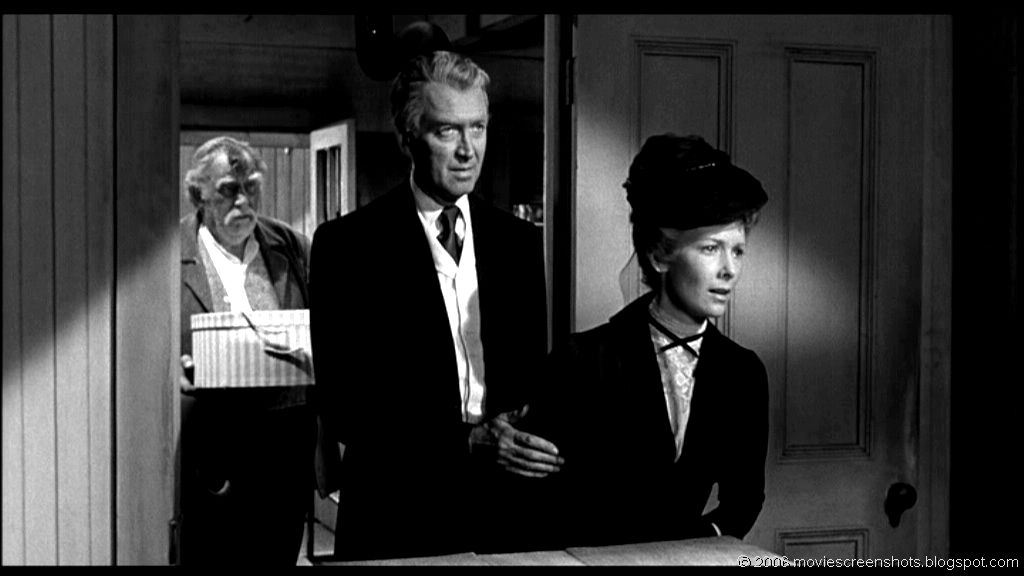
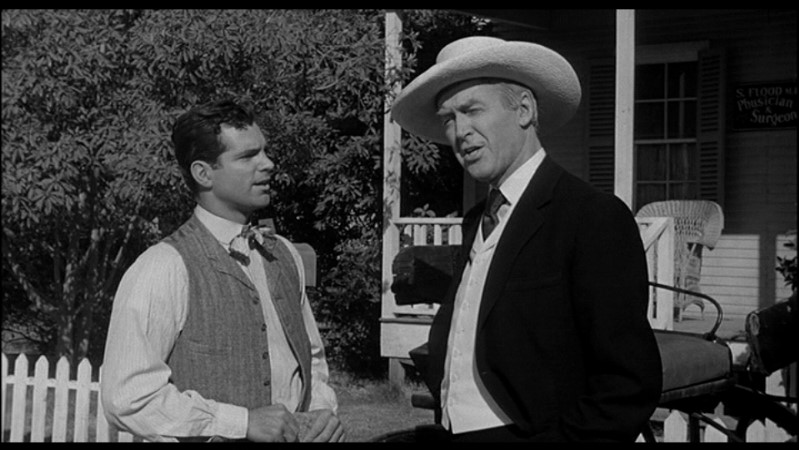
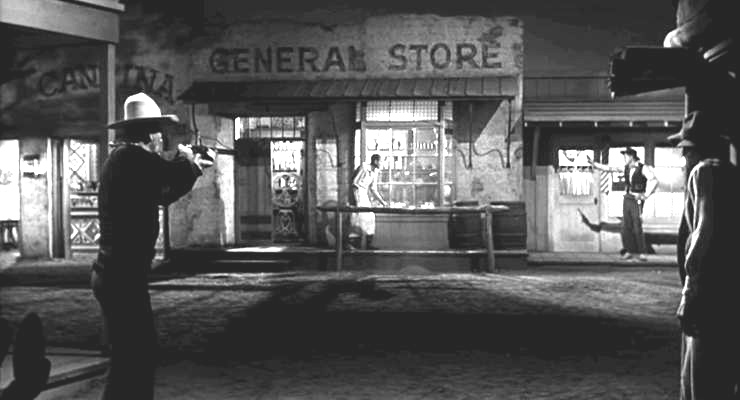
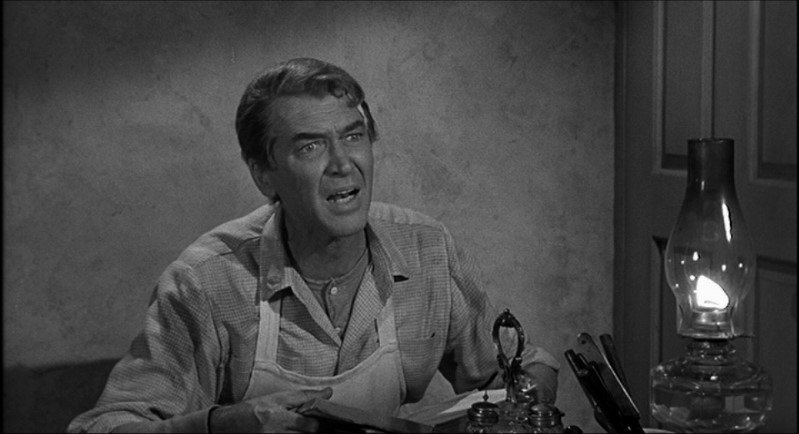
Senator Rance Stoddard and his wife Hallie (James Stewart, Vera Miles) return to the town of Shinbone to much hoopla. It is their home-town, of course, but as the Senator now spends all his time in Washington he doesn't get back there much. So the press start nosing around to get the where-fore's of why "The Man Who Shot Liberty Valance" (and rode that acclaim into politics), is there now. The occasion is a funeral for a man nobody knows (or has little regard for), but he's very important to the Stoddards—he is, after all, the man who brought them together. And as Hallie places a cactus on Stoddard's plain pine coffin, Stoddard relates the tale, one that blows away the Senator's folksy bluster with a scouring truth.

The Senator talks of his first coming to Shinbone as a greenhorn lawyer* and his run-in's with
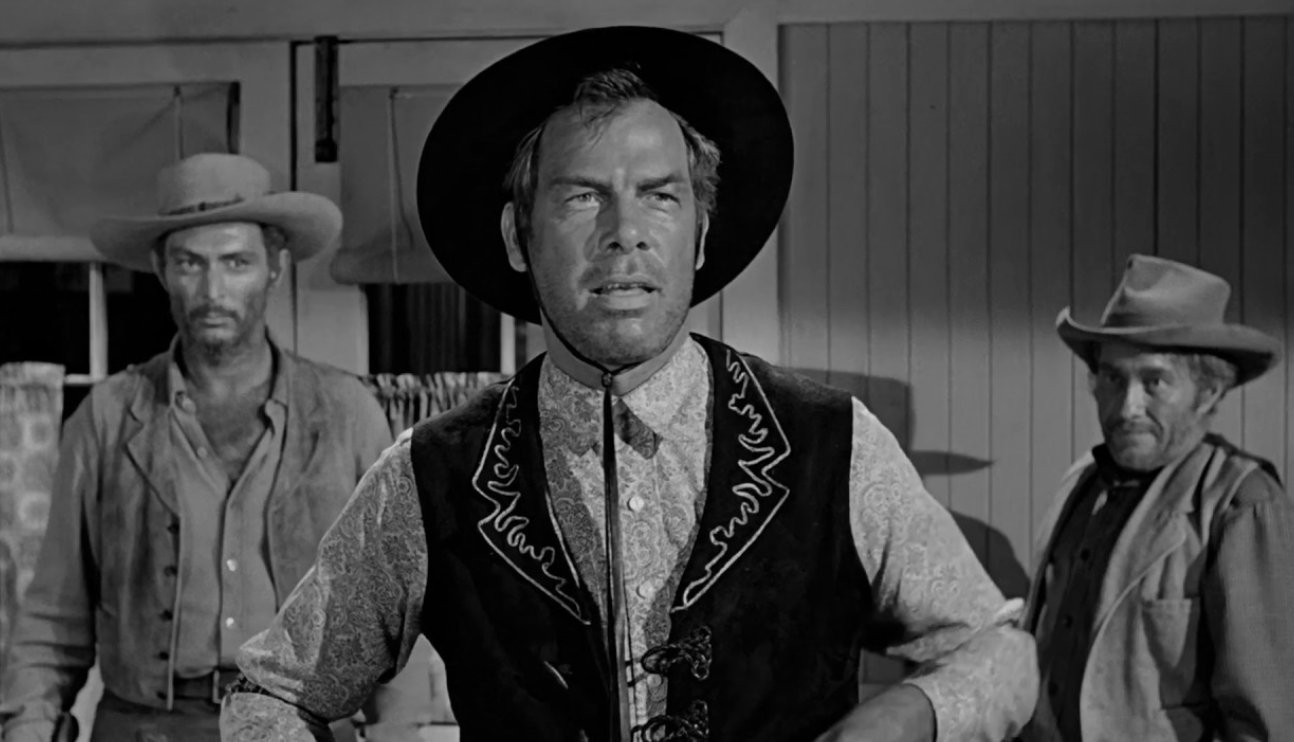
local bandit Liberty Valance (Lee Marvin, gloriously over-the-top), a malevolent thief and enforcer for the cattle industry who has the small town of Shinbone afraid to come out of their houses. Beaten and bleeding, Stoddard is brought to recover under the roof of the Ericson's (Jeanette Nolan, John Qualen, Miles) by Tom Doniphon
(John Wayne), who's sweet on Hallie and is building a house for the two of them outside the city limits. Doniphon is contemptuous of Stoddard's belief in law and order (calling him "Pilgrim," only one of two films where Wayne used that oft-parodied term), believing that the only way to stand up to anarchists like Valance is a loaded pistol.
I say "anarchists" pointedly, because The Man Who Shot Liberty Valance (Get it? "Liberty" Valance?) is as much about politics as it is a story about a love triangle in the Old West. You have the anarchistic, irresponsible Valance on one side and you have the "book-larned," law-and-order, taming-the-West-by-education-and-civics Stoddard on the other. In between, you have Doniphon, who's all for government (far as it goes) but in his time, you tame the West with bullets and hard work. But that time is passing. Doniphon is late to realize that that taming means the passing of the bad guys who will disrupt, but also good guys with a sense of entitlement. Ford chooses sides, and it's for civilization—because anything else is stagnation and waste. For all the talk of "Freedom" and "Rights," those are granted only under the auspices of control and Law. Because Valance represents not only unbridled freedom, but also the seeds of despotism. As a rancher, Doniphon knows those seeds will take over unless something stronger, hardier is planted in its stead.
Even if it means the death of his way of life.

Sacrifices must be made.

By the time the tale of Stoddard and his benefactor/mentor and rival is told, a bloom has, impossibly, appeared on the cactus, because like Stewart's lack of youth in the flash-backs and the old-age make-up for the young actors in the present, Ford is also playing with time, even going to his own past, using a piece of music from 1939's Young Mr. Lincoln (that put a melody to Lincoln's loss of his first love Ann Rutledge) for the scene of Hallie regarding Doniphon's burnt-out homestead. And so, the telling of the tale of a lifetime is enough time to ensure new life in movie terms.
In The Man Who Shot Liberty Valance, Ford goes so far as to state outright something he'd been alluding to throughout his career as a film-maker, story-teller and chronicler of the United States. Given a choice between printing the unvarnished truth or a myth for the common good, the newspaperman says, "This is the West, sir. When the legend becomes truth, print the legend."

There was never a better-stated justification of film-making.

It's a definitive statement of Ford's career directing movies. But Liberty Valance is also a bridge from Ford's early Westerns to the "modern" "oaters" of the 60's as Valance's wormy toadies are portrayed by Lee Van Cleef (of Sergio Leone's "Dollar" trilogy) and Strother Martin (part of Sam Peckinpah's stock company). Those film-makers were inspired by Ford, and in their own revisionist methods of "printing the truth," made their own legends.

And so the film is its own truth, summarizing one director's past as a pioneer and presaging the future of the Western film, on the edge of its demise, both "becoming" even in the depth of their cynicism.


* One of the criticisms of the film is that both Stewart and Wayne are playing young men when the two were both in their 50's. Wayne can get away with it (as he always plays old...and other reasons), but Stewart doesn't come across as a man in his 20's. I have something to say about that towards the end of the review.

Friday, July 10, 2015

The History of John Ford: Sergeant Rutledge

When Orson Welles was asked what movies he studied before embarking on directing Citizen Kane he replied, "I studied the Old Masters, by which I mean John Ford, John Ford, and John Ford."

Running parallel with our series about Akira Kurosawa ("Walking Kurosawa's Road"), we're running a series of pieces about the closest thing America has to Kurosawa in artistry—director John Ford. Ford rarely made films set in the present day, but (usually) made them about the past...and about America's past, specifically (when he wasn't fulfilling a passion for his Irish roots). In "The History of John Ford" we'll be gazing fondly at the work of this American Master, who started in the Silent Era, learning his craft, refining his director's eye, and continuing to work deep into the 1960's (and his 70's) to produce the greatest body of work of any American "picture-maker," America's storied film-maker, the irascible, painterly, domineering, sentimental puzzle that was John Ford, John Ford, and John Ford.

When the Founding Fathers decreed that "All men are created equal" in the Declaration of Independence, released 239 years ago, they weren't speaking of civil rights. They were actually refuting the divine right of Kings—that just because you're born in the house of Tudor, Stuart, Plantagenet or Windsor does not give the inherent or even god-given right to rule over other people, whatever their circumstances. That's what the slave-owners who wrote the Declaration meant. But, because that document and the Constitution deal with fundamental ideals of human rights—base-line ideals—on which this country and its governance are formed, they have become "living, breathing documents," and are just as subject to evolution as the species that came up with them, and cannot, in good conscience, remain inert without undergoing re-interpretation, as this country has seen in the last couple weeks. Things change and our laws and our practicing of them, must change, if they are to remain true to the spirit with which this Nation announced itself. The United States of America, that most hopeful of country names, is an experiment in whether a people can put aside their differences, their tribalism and their prejudices and govern themselves, not relying on some potentate given that position by birth. It's an experiment that hasn't been perfected yet—and given those mentioned factors of human beings—may never be perfect to everyone's liking. There are only two ways we, as a people, can only be truly equal—by either putting aside our prejudices and practicing what we preach or by dying. Evolution or extinction will make us all equal. Those are the only choices. But, progress, like evolution, slowly, inexorably gets changed. If anything has defined the history of the United States, it is the story of the African-American, brought over in slave-ships to be propertied labor, no better than cattle, and the Nation's waking up from its privileged slumber to realize that it was deluding itself to say "all men are created equal" in theory while violating it in the worst way in practice. That struggle is the struggle of the United States—to back up its high-minded words with action in everyday life.

Sergeant Rutledge (John Ford, 1960) "Mr. Lincoln said we're free. But that just ain't so."

So says Sergeant Braxton Rutledge (Woody Strode) in another in a series of lesser known films by master director John Ford. This is another—his last, in fact*—look at the U.S. Cavalry, but fills in one of the "gaps" in the "Western" era of the United States, post-Civil War—the era of the Buffalo Soldier, when men who were former slaves were allowed to join the Armed Forces in service to the country that had previously condoned, by inaction, their forced servitude. Sergeant Rutledge (the film) is John Ford's acknowledgment of that conundrum and the hypocritical attitude of the Nation towards the rights of slaves. It is one thing to free them. It is quite another to not keep them enslaved by treating them as second-tier citizens, not equal to the whites under the law. Ford always populated his films of American history with a varied populace—Swedes, Irish, Poles, Germans, Caucasians, mostly, but the occasional Latino, as well—but his films are remarkably free of immigrants of color. It was prescient of him to do Rutledge on the cusp of the Civil Rights era, and before Sidney Poitier broke the box-office color barrier.
Based on the novel "Captain Buffalo" (a title that Ford clearly preferred but was overruled when the studio proved to be white-knuckled about it) by author James Warner Bellah (who wrote the stories for Ford's "Cavalry trilogy" and the subsequent screenplay for The Man Who Shot Liberty Valance, it tackles the service of the Buffalo Soldiers, who, even while defending the Nation, were not equal under the law and not equal in the hearts and minds of the civilian populace they served. Sergeant Rutledge was far afield of the mainstream in its purpose of pointing out and condemning official and social prejudice. John Huston had tackled the same issue in a sub-plot of In This Our Life in 1946, when the word of a black man could not hold the weight against that of a prominent (or even a non-prominent) white in a court of law (And Rutledge appeared before a similarly themed book To Kill a Mockingbird was presented as film in 1961). White truth counts more than black truth. In fact, a white lie counts more than a black truth. The same applies in Sergeant Rutledge: Mr. Lincoln said they're free. But it just ain't so. Not as long as the color of one's skin is a consideration for justice...for anything... no matter the official platitudes saying otherwise.
"They're laying it on a little thick for Sergeant Rutledge", says Lt. Tom Cantrell (Jeffrey Hunter, top-billed, although he has less screen-time than Strode, no doubt due to Warners' fears of effect on box-office revenues) and it applies to the tactics inside the film and that of the director. Ford toys with our prejudices in this one, pushing emotional buttons, challenging our own best intentions as an audience against established prejudices, which he pokes and prods, in images that provoke. Against that, he puts forth acts of character that should weigh more than the impressions those images inspire. Those images are informed (or mis-informed) by the testimony of the witnesses in a military court-martial and trial of the title character, and "character" is the chief concern of each attestant, for good or ill. Because of the differing impressions and opinions that are presented as fact, Sergeant Rutledge is Ford's version of Rasho-mon, a tip of the stetson to Japan's director Akira Kurosawa who had been, in turn, evoking Ford throughout his career.
Black man's hand against a white woman's face: images that provoke.
It all revolves around what Rutledge calls "white woman trouble:" A girl (Toby Michaels) is found raped and murdered, and her father (who just happens to be in charge of the 9th Cavalry) is also found slain. Disapproving locals have seen Rutledge helping the headstrong Lucy Dabney—and their prejudices are as much against her as Rutledge—and when she ends up dead, accusing eyes immediately turn to him. Her father ends up dead, and Rutledge is nowhere to be found, deserted. His own 9th Cavalry is sent out to track him down, headed by Lt. Cantrell, who has come out to meet his love Mary Beecher (Constance Towers, so excellent in Ford's The Horse Soldiers from the previous year). Once caught, Rutledge proves too capable to hold on to and escapes. But, when the 9th is under peril from an ambush, he returns to warn them, his sense of duty overriding his surety that he would be incapable of facing a fair trial from the white military commanders sitting in judgement, or the townspeople who'd as soon lynch him as try him.
Lucy Dabney is found murdered—it is only the image that implies she's been violated.
Cantrell, based on Rutledge's actions warning the troop, agrees to serve as defense attorney at his court-martial, but its an uphill struggle. The prosecutor (Carleton Young) bases his case on circumstantial evidence, as well as playing on the prejudices of the court and the spectators (which are not far afield from his own). Rutledge knows he will be damned, but stands trial anyway, lest the accusations besmirch the rest of the 9th. Like in previous Ford Cavalry pictures, the Corps is greater than any one man, or even the truth. The Corps must be preserved, whatever the cost.
The symbolism doesn't get more obvious than this:
The lily-white gloved hand of the prosecutor accuses Rutledge.
It's in the trial portion where Ford becomes his most expressive directing, using lighting and stage techniques to move us from the courtroom testimony to the flashbacks of the events of the witnesses' narratives. Naturalism, which has been prevalent from the beginning of the film, transitions as we move from present into the past of memory and perspective, splintering reality and truth, as the case for and against Rutledge is built. At the same time, Ford uses comedy to show the absurdity and irony of the court's officials charged with the heavy burden of judging a man's life, being far less. Those moments of farce (which disarm any protests of stereotyping as the whites get the brunt of it), especially in the form of Col. Otis Fosgate (Willis Bouchey, in a role that might have been played by Ward Bond, if he had chosen to participate) and his bickering with his harridan of a wife (played by Billie Burke), might seem out of a place if Ford 1) didn't want to break up the drama a bit—as was his wont, and 2) showing the foolishness of the officials raises the stakes (conversely) of the drama by making them less resolute and dependable as authority figures.
One of the great joys for me of Sergeant Rutledge is to see the lengthy performance of one of my favorite character actors, Woodrow Wilson Woolbine Strode, who was usually "tasked" with playing dialogue-less African princes and warriors (he would even play one for Stanley Kubrick this same year in Spartacus) who had a distinctive face that photographed well from any angle.
 
Strode's acting is varied in quality, stiff and a little too brittle on occasion, but in his break-down scene on the witness stand with Ford's camera bearing down on him, he cracks and suddenly you see an amazing performance, right from the umbraged tilt of Strode's head at the prosecution's veiled bigotry, to the crumbling of that stoic face as he must finally reveal himself, rather than keeping his counsel and expressing himself by example. Strode was always a better physical actor (the way Redford is, the way John Wayne is) and some of his most memorable performances (like in Spartacus the same year and Once Upon a Time in the West) he has no lines at all. And Ford, who got more out of actors with looks and gestures than from reams of dialogue, trusted the planes of the face to reveal thoughts and feelings that might move, and even terrify, an audience. 
Folks dismiss Rutledge as one of Ford's "atonement" movies, never questioning why other directors didn't do something similar, nor considering why it was important for Ford to continue to tell the history of the States by filling in some of the less known gaps in "the taming of the West" (especially considering that television at the time was glutted with more typically conventional Western fare) or that market forces might not demand his reassessment of the Western saga. Certainly, the timing for Sergeant Rutledge to garner more attention might have been more appropriate for the later 60's, as opposed to when Ford made it...in 1960. I think Rutledge is brave, stirring, and damning, not just for its time but for ours, as well. We haven't yet reached the point where (as one sage put it) people can be judged by the content of the character and not by the color of their skin." "Mr. Lincoln said we're free. But it just ain't so." And the line continues: "Maybe some day. But not yet." And still not yet, past the time-setting of the film, or the day it was made. Some day we'll live up to our birthright: "all men are created equal." It's why we keep fighting...in the streets and in our hearts. Until we've beat ourselves color-blind.

Woody Strode, along with Jack Robinson, and Ken Washington when they played for UCLA
* Well, he did do some Cavalry coverage in Cheyenne Autumn (which we'll take a look at soon), but the true focus of that film is The Trail of Tears from the First People's point-of-view.

** The publicity department at Warner Bros had to fight two battle to reach an audience: 1) the director was considered an "old codger" who, although he was the only director who'd won three Oscars, was thought a little "out of touch" for young audiences; 2) the story was about a black man in a time before the Civil Rights marches of the '60's. So, the question is this: how do you be ahead of your time for modern audiences but still be an "old codger" in the eyes of the studio? Makes no sense. Now, look at the posters for Rutledge from the Warner publicity department that downplay the story and Strode in favor of a more prominently positioned white. And Ford stalwarts John Wayne and Ward Bond chose not to participate in the film, except to lend their names to generically complimentary praise-plugs.