The Professionals(Richard Brooks, 1966) In this post-modern Western (post-A Fistful of Dollars and pre-The Wild Bunch), a ranching tycoon (Ralph Bellamy) hires three soldiers-of-fortune, late of the Mexican Revolution, to rescue his wife Maria (Claudia Cardinale), who has been kidnapped by a Mexican revolutionary-turned-bandit, Jesus Raza (Jack Palance), the ransom being $100,000. The wages are $10,000 per man for a 9 day job. The three are Henry "Rico" Fardan (Lee Marvin), Jake Sharp (Woody Strode) and Hans Ehrengard (Robert Ryan), all with different skill-sets and temperaments, for a job that will require stealth, intricate planning, and an assault on an extremely well-guarded encampment deep in Mexico. Fardan is a weapons expert, Sharp, a former Apache scout and expert with a bow, silent and precise, while Ehrengard is a horse wrangler, with a regard for his charges, more than he does for human beings.
There's just one man missing: Bill Dolworth (Burt Lancaster), explosives expert. Fardan wants him for that expertise, but also because he and Dolworth rode with Pancho Villa during the Revolution, alongside Raza. But, sentimentality aside, they've been hired for a job and will ride against their former band-mate, and their history with him may prove valuable in the task. It's a job, pure and simple. It won't remain either.
The four start tracking Raza's gang to get a sense of tactics and escape routes. Dolworth sets up explosives in a particularly tight cliff-pass for their end-game, that can be abetted by a train route, the government transport which they spy Raza's men commandeering, while slaughtering all of the Mexican troops on-board. The small troop of professionals don't interfere and Ehrengard is aghast, but Dolworth explains that those troops were dangerous cut-throats who had been responsible for the destruction of a village, killing Fardan's wife in the process.
But, the train will making a handy means of escape to the mountains after the attack on Raza's encampment, so the four take on Raza's men and take it over. Now, they have a quick way to retreat. But now, the tough part begins: an assault on Raza's stronghold under cover of darkness and try to take Maria back. Ehrengard stays behind with the train while Fardan, Dolworth and Sharp continue the rest of the way, three men against a well-armed fortress.
Raza's place is scouted, the sentries timed, dynamite placed, the two biggest targets being a water tower and a machine-gun placement. For Fardan and Dolworth, it's set and forget, giving them an opportunity to get to the area where Maria is being kept, while Sharp—with arrows tricked up with dynamite—provides cover and distraction. Dolworth has the explosives on timed fuses, so there will be ample explosions to send Raza's men scurrying, with Sharp given the opportunity to improvise.
But, when professionals plan, God laughs. There's always got to be a surprise and The Professionals turns on a single phrase: "We've been had, amigo..." Their mission turns out out to be made on a false premise, and it's then that the four have to make decisions of conscience, for which the time in the revolution has provided ample experience. "Maybe there's only one revolution since the beginning: the good guys versus the bad guys. Trouble is, who are the good guys?" And can good guys do inherently good, even when their job is bad...
Oh, and since they have the woman, they have to find a way to get her back...and stay alive while doing so. It won't be made any easier by the fact that the train they have in waiting has been taken back by Garza's men, who have taken Ehrengard hostage...and they're not interested in any ransom—but maybe a trade will do. Maybe.
Brooks' film (based on Frank O'Rourke's "A Mule for the Marquesa") is a nifty little variation on John Ford's The Searchers, but has nothing to do with that film's underlying motivation of family cohesion and race hatred or hysteria. Here, it's all business that sets the search in motion, not family, and in the course of the film, it happens to turn that film's premise on its ear. Things are done for convenience, things are done for commerce, things are done for compromise. There's no passion here, it's a transaction. But, passion wins out in the end.
It's another of those macho films with a woman at the center of it, and its focus—even when Cardinale's Maria isn't on the screen, the characters are always pondering "What makes a woman worth $100,000?" It finally succumbs to a rough-hided romanticism, as if any of the characters would admit to it (which they wouldn't as their credo is usually demonstrated by actions and not words) that might be revolutionary echoes or merely respect. The dialog does get a little too philosophical in intent, but it does have one heck of a clever come-back at the end. And it's an entertaining ride.
There'll be another of the Western genre's "Searchers spin-off's" next week.
Ernest Hemingway wrote his short story "The Killers" in 1927 for Scribner's Magazine. It's a simple story about two gunmen who come to a small town diner in Summit, Illinois and briefly terrorize the nighthawks there (including Hemingway's young alter-ego, Nick Adams), before setting their sights for their target—a washed up fighter nicknamed "The Swede", who, curiously, accepts his fate and tells Nick (who runs to him at his boarding house to warn him) that he's tired of running and not to do anything because nothing can be done. Nick leaves town knowing full well "The Swede" will be killed, but he can't stand being there any more, knowing a man has surrendered to his fate and awaits his execution. Of "The Killers" Hemingway said "That story probably had more left out of it than anything I ever wrote. I left out all Chicago, which is hard to do in 2951 words." But that kernel of a story is perfect for a full-length motion picture (it's also been adapted into un-embellished short films, one by Andrei Tarkovsky as a student—see below), allowing film-makers to fill in the blanks, speculate about the circumstances that would set into motion the specifics of the short story, creating a preamble and, if one is concerned with the morality of the tale, an epilogue. But, the two most well-known adaptations of the tale titled "The Killers" take a completely different approach to the titular characters—in the first, making them secondary, and in the second, the driving narrative force—and its unknowable back-story. As the blurb for the later version says, "There's more than one way to kill a man."
The Killers(Robert Siodmak, 1946) Credited to Anthony Villiers (with unbilled contributions by John Huston and Richard Brooks), the movie starts with Hemingway and leaves him behind. Two toughs in suits, Al and Max (Charles McGraw and William Conrad) drive into Brentwood, New Jersey and case the burg. They check out the local service station of the Tri-State Oil co. and then set their sights on Henry's Diner across the street. Henry's offers boiled dinners but they don't come any more hard-boiled than Max and Al, who immediately start to get cute with the menu and calling the guy behind the counter "Bright Boy." They're looking for Pete Lund, "The Swede" ("What did Pete Lund ever do to you?" "He never had a chance to do anything to us..."), but Pete usually comes in at 6 and he's not there, so he's not showing up. So, Max and Al start to mess with the only other patron, Nick Adams (Phil Brown*), Lund's co-worker at the filling station, telling him to get in the kitchen with the cook (Bill Walker), where Al ties them up and Max stands guard. Satisfied that "The Swede" isn't showing up, the two leave, allowing Nick to get untied and warn Lund (Burt Lancaster). But, Lund won't leave saying, finally, enigmatically, "Once I did something wrong."
Pete is gunned down in his room by Al and Max. But, that's not the end of the story. Tri-State's insurance investigator Jim Reardon (Edmond O'Brien) is checking out the killing to see what's going to be done with Lund's $2500 life insurance policy. The local police aren't handling the case because the two gun-men are from out of state. Why? Examining Lund's body, he notices that the dead man's knuckles are scuffed up like the hands of a boxer and he has his office check out local rings. He tracks down the beneficiary, but she doesn't know any "Pete Lund," she knew him as "Mr. Nillsson," who stayed briefly at her boarding house. But why would he name her as beneficiary?
A check at the office finds that the victim's real name is Ole Andreson, ex-prize-fighter and that tip comes from Lt. Sam Lubinsky (Sam Levene) from the Philadelphia police department. Lubinsky once busted Andreson a few years back—ironic as the two grew up together and were friends since childhood. But, that's part of it. Lubinsky's wife, Lily (Virginia Christine) used to be sweet on the Swede (and Sam was sweet on her), but Ole dumped her for another woman, Kitty Collins (Ava Gardner), and Kitty was involved in rackets, and pretty soon, Ole was involved with both. It was Kitty that got Ole arrested when he took the fall for her shoplifting charge—and violently resisting arrest. But, Lubinsky wants in on Reardon's investigation because, as he says, "once a copper, always a copper."
Ole spends three years in jail, pining for Kitty and determined to make it on the outside. When he gets out, his former cell-mate, Charleston, tells him about a big job being planned, knocking over the payroll of the Prentiss Hat Co. (in Hackensack, New Jersey), the "biggest caper anyone's pulled in a long time" according to its ring-leader, "Big" Jim Colfax (Albert Dekker). When Ole goes to meet Charleston at the planning, he meets Colfax, "Blinky" Franklin (Jeff Corey), 'Dum-Dum' Clarke (Jack Lambert), and oh yeah...Kitty's there, as she's hooked up with Colfax again. Charleston, having spent too much of his life in prison, opts out. But, "the Swede" is in, probably because of Kitty's presence. But, it doesn't make relations between Colfax and Ole amicable. They get worse the night of the robbery.
The original meeting place to split the dough gets changed, and the only one who isn't let in on it is The Swede. That meeting place is burned down at about the planned time for the meeting. This leads to what Reardon ultimately calls "the double-cross to end all double-crosses," that will leave most of the culprits dead, including the two killers who started the gun-play, when it all gets figured out not-so-nice and not-so-simple.
Huston, Brooks and Villiers stage the story like Citizen Kane: a guy dies at the beginning and a snoop goes around talking to people trying to learn the big secret of the dead guy, interviewing them one by one, their stories told in flash-backs, running parallel forward courses to the ultimate answer of who put the killers onto Ole and why. Siodmak had a way with pulp material and he and cinematographer Woody Bredell produce some amazing lighting effects, whether its to highlight Gardner's cheek-bones or stage a murder without gunfire. It was the first movie of Burt Lancaster, launching his career, and the first big role of Ava Gardner's, while also giving Edmond O'Brien a chance with a major screen role of a type that he would continue to play throughout the 40's and early 1950's.
Mention should also be made of the tough brutal score by Miklos Rosza, which folks will recognize even if they've never heard of the composer or seen this version of The Killers. The opening bars over the Universal Studios logo are a stark four-note motif that is repeated whenever the hit-men Max and Al appear on-screen, and it so impressed a young producer named Jack Webb that he used it as the opening theme for his series "Dragnet" in all of its incarnations. It may inspire some audience giggles, but these things have to start somewhere.
Hemingway's reaction to this version of The Killers? I've read a couple stories—one where he went into the john and threw up; the other (from producer Mark Hellinger who had a vested interest) where he set up a private screening for Hemingway at his domicile in Sun Valley, Idaho. Hemingway attended the screening with an overcoat in which he had a full bottle of gin in one pocket and a full bottle of water in another. After the screening, he shows the two full bottles to the studio publicity man and and said "...didn't need 'em."
The Killers(Don Siegel, 1964) Adapted by Gene L. Coon (who was a showrunner/scripter for the best episodes of "Star Trek") and directed by Don Siegel (who was briefly attached to direct the first one), this version was originally designed to be a TV-movie, but was deemed "too violent" for "The Tube" and was thus released to theaters. Coon, who wrote it under the title "Johnny North,"**took a completely different approach to the adaptation, leaving out Hemingway's basic story and the characters that formed the basis of the original, but leaving in the plot that Huston and Brooks and Villiers designed for the back-story—and even—when it fit—some of the dialog. But, with one very important difference. This time, the point of view isn't from the investigating insurance agent. It's told from the point of view of the contract killers who are hired to "take out" the man "who just stood there and took it." Although, the two have a rule that they never discuss the work, this one is different enough that it makes the older one of the two gun-men curious and decides to do a little digging to find out what it was about this particular guy that he didn't run from certain death but just took it passively. Call it professional curiosity.
Charlie (Lee Marvin) and Lee (Clu Gulager) are an odd pair of hit-men. Lee is young and a bit of a goof-ball, almost child-like attracted to flashy things. Charlie is older and "going gray" and has been doing "this" ("this" being killing people) for a while. They show up at "The Sage School for the Blind" for a job and walk around unnoticed—two guys wearing shades indoors in a school where a lot of people wear shades. They head to the principal's office—she's sightless, too (the blind leading the blind?) and after viciously toying with her a bit to find out the location of their target "Jerry Nichols," they knock her unconscious and start casing the school for Jerry.
After some cursory reconnaissance, they find that "Jerry Nichols" is teaching an auto repair class in the school's basement. Even though "Nichols" is warned by a telephone call, he stays in the classroom, telling his students to get out quick. During the confusion of the exiting would-be mechanics, Lee and Charlie burst into the room, and "Jerry" (John Cassavettes) just stands there and takes several silenced slugs from the two hit-men, who use the confusion to briskly walk out.
On a train away from the scene, the two killers start to talk, but Charlie is ruminating on the hit. He recognized "Jeff" as Johnny North, former race car driver that might have had some criminal past. And he won't let it go. There are four elements that has him thinking: 1) Johnny North "just stood there and took it," while anybody else would try and run 2) the price for the "simple" hit was $25,000, an extraordinary sum of money to kill one guy and 3) Johnny North was involved "in a big mail-robbery in California, supposed to get away with a million bucks"—what happened to the million dollars and 4) the person who hired the hit wasn't worried about those million dollars "and the only person who doesn't worry about a million dollars is the guy who has a million dollars." He wants to find that million dollars.
It's partially curiosity, partially greed, but he and Lee decide to divert to Miami to find out more about the late Johnny North and that missing million dollars. They'll follow a trail of witnesses: first, Earl Sylvester (Claude Akins), Johnny's pit-boss and chief mechanic (and friend—very good friend), who witnessed Johnny get involved with one Sheila Farr (Angie Dickinson), who liked hanging around the pits and basically ran over Johnny going 90, until all he could think about was Sheila, to the point where his high-living brings him low when he crashes during a big race breaking his leg and messes up his peripheral vision, not that he could see anything beyond Sheila, anyway. Earl tells a hospitalized Johnny that he's not the first guy she's had a fling with, but she keeps going back to a guy named Jack Browning (Ronald Reagan), an older racketeer who can keep Sheila in the lifestyle that she's grown accustomed to. It's the last time Earl sees Johnny.
Next, they move to New Orleans where an acquaintance of Browning's, Mickey Farmer (Norman Fell) has a gymnasium. They turn the heat on Mickey (literally) and he picks up the next chapter of the story, where Browning and Farmer are planning a big mail robbery that depends on some fast driving on some bad road in a carthat might require a little tweaking of an engine. Browning can't do it, so Sheila recruits her old friend Johnny who's fallen on hard times driving demolition derbies. He's suspicious of the whole job, but Sheila's very convincing, especially when she tells Johnny that Browning plans on not splitting the million, and if Johnny can deal with Browning first, she and he can run away together. That's enough to seal the deal.
So, the next step is for Charlie and Lee to head to Los Angeles, where they find Browning has done very well for himself, going straight and starting a lucrative development and construction business. He has no idea what happened to the million dollars, or what happened to Johnny North after the robbery—he only has a vague idea where Sheila is, but Charlie and Lee are very persuasive with their pistols, telling him they want to meet Sheila to get the rest of the story and where that million dollars is. They say that he needs to arrange a meeting and if he doesn't—or if he plans a double-cross—they'll find him...eventually.
It's the meeting with Sheila that's the most disturbing. The hit-men have a time set up and they show up a couple hours before expected and are far rougher with Sheila than with any of the men they've interviewed, punching her around and even almost throwing her out a high apartment window. If Marvin and Gulager have the flashier parts, it's Dickinson who gets the best part and, as one might expect, she plays the hell out of it, both in her seductive flashbacks and the hysterics of her "interview" with Charlie and Lee. Ultimately, one shouldn't feel too sorry for the character—she's been in control the whole time, and is responsible for a lot of carnage along the way..
"...I don't have the time."
It's similar in composition (certainly with the introductory killing and the flashback structured piecing together of the story) to the earlier film, but the tone of the latter version of The Killers is—despite it's sunnier settings and color photography—tougher, grittier, and deeply cynical, especially considering that the vast majority of the characters in the 1964 version are completely unadmirable, back-stabbing sociopaths whose only redeeming quality is they're too busy turning on each other to do any permanent harm to the outside world of innocents, mostly represented as passive bystanders and watchers. The 1964 Killers is a bit like a circular firing squad, where the bad-guys get exactly what they deserve...from each other. It's almost a noir farce in living...and dying...color. Hemingway might have been horrified.
What Hemingway would have thought can't be known. He died by his own hand on July 2, 1961. A couple of after-after thoughts: Actress Virginia Christine appeared in both versions—as Lt. Sam Lubinsky's wife in the first, and as the principal of the Sage School for the Blind when Charlie and Lee are looking for Johnny. Older folks might remember her as "Mrs. Olson" hawking Folger's Coffee. Jack Browning was the last major role played by Ronald Reagan before he pursued his political ambitions.Older folks might remember him as a President of the United States. Even older folks remember him as an actor playing good guys. He's not too convincing playing a bad guy, but he does have a cynical rueful look that's endearing.
"If there's one thing in this world I hate, it's a double-crossing dame."
* Here's some juicy trivia for you: the actor who played Hemingway's alter-ego, Nick Adams, is the same Phil Brown who played Luke Skywalker's Uncle Owen in Star Wars. ** The screenplay was titled "Johnny North", but, for whatever reason—maybe due to some situations and lines of dialogue being similar—Universal Studios chose to hang it with the title "Ernest Hemingway's The Killers", a move that director Don Siegel was dead set against.
Bad Day at Black Rock(John Sturges, 1955) WWII vet John J. Macreedy (Spencer Tracy) steps off the train at Black Rock—the first time the train has stopped in four years. He's looking for a man named Komoko, and he is treated with an inexplicable hostility that he can't fathom and no one will explain. Macreedy, stoically—though increasingly crankily—sets out to find the man he's looking for, and has his life threatened several times by the town toughs (Ernest Borgnine, Lee Marvin and the town "boss" Robert Ryan). And though Macreedy may only have one hand, he's quite capable of using it to defend himself, and discover the town's secret that would force the tiny town's residents to kill.
It's hard to believe that Bad Day at Black Rock was considered "subversive" by its studio M-G-M when it was being made but, ten years after the end of World War II, it was considered a hot potato, especially while its production was going on in the waning days of the McCarthy hearings. One couldn't mistake the metaphor of a town cowed by a single man who bends rules to his favor, and harasses outsiders who ask questions.
Right off the bat, one is struck by an over-earnestness that feels false. The wide-screen titles* of a train careening through the Southwest desert is backed by a semi-hysterical Andre Previn score, full of sound and fury and signifying...a train. It feels overdone and pointlessly busy.
"No, I don't understand. But, while I'm pondering it... why don't you get a room ready for me..."
Previn will keep popping up, goosing the action like a teen-ager playing his radio too loud at a funeral,** and everything is done with such brutish heavy-handedness and self-importance that one could mistake this for a Stanley Kramer production.
Tracy is reliably lived-in as the maimed vet who comes to town, but he's a shade long-in-the-tooth for the role. Robert Ryan starts subtle and ends up chewing the cactus in much the same way that Lee Marvin and Ernest Borgnine do their dirtywork.***Walter Brennan, Dean Jagger and Anne Francis (the only female in town) round out the cast as sycophants and victims, weak in one way or another.
Spencer Tracy shows Ernest Borgnine what's what.
Ultimately it all comes down to a secret and the conspiracy to keep it that way beyond all reason; obviously, all these guys must have been part of the Bad Rock City Council. There are bursts of action including Tracy taking on Borgnine ("I'm part mule, part alligator") with one mutilated hand in his pocket, accomplishing some fancy karate and judo moves, something not often seen in '50's films. But one acknowledges that though the film's heart is in the right place, too much of it has spilled out onto its sleeve.
* Can someone explain to me, for the love of Mike, why this small-scale film about a veritable ghost-town of few actors was filmed in the widest of Cinema-scopes?
** In five years that "goosing" of slow material would pay off like gang-busters with Elmer Bernstein's energetic score for The Magnificent Seven.
***Ironically, Tracy would be nominated for a Best Actor Oscar that year and lose to...Ernest Borgnine, playing the title role of Marty.
When Orson Welles was asked what movies he studied before embarking on directing Citizen Kane he replied, "I studied the Old Masters, by which I mean John Ford, John Ford, and John Ford." Running parallel with our series about Akira Kurosawa ("Walking Kurosawa's Road"), we're running a series of pieces about the closest thing America has to Kurosawa in artistry—director John Ford. Ford rarely made films set in the present day, but (usually) made them about the past...and about America's past, specifically (when he wasn't fulfilling a passion for his Irish roots). In "The History of John Ford" we'll be gazing fondly at the work of this American Master, who started in the Silent Era, learning his craft, refining his director's eye, and continuing to work deep into the 1960's (and his 70's) to produce the greatest body of work of any American "picture-maker," America's storied film-maker, the irascible, painterly, domineering, sentimental puzzle that was John Ford, John Ford, and John Ford.
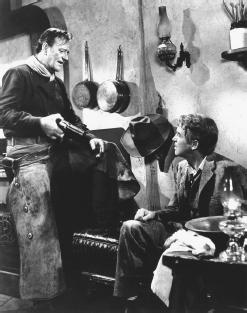
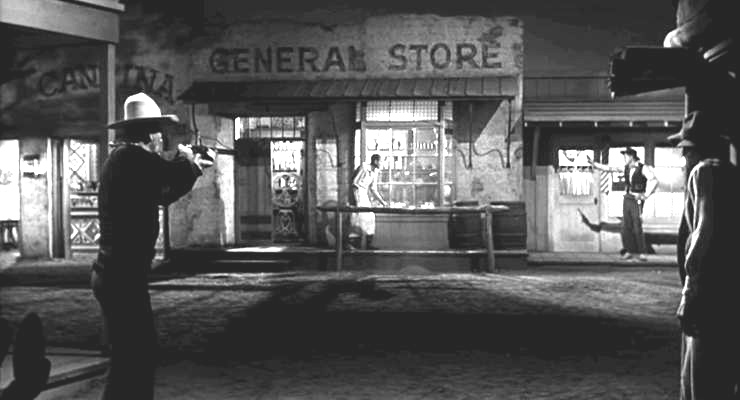
The Man Who Shot Liberty Valance(John Ford, 1962) Even the mention of the title invokes a cynical irony for those who have seen it. This crowning glory in the long accomplished (dare one say legendary) career of director John Ford, 68 at the time of its filming, is a bitter pill of a film and a meditation on the inexorable march of time and the brutal boots of history.
It is about "becoming"—not just in the strictest sense of transitioning (although the town of Shinbone, in which it is set, is in the midst of leaving its old West roots behind to take its place as part of the Union of States), but also in the less used sense: of reflecting favorably on the subject to its advantage.
It is also about, as so many of John Ford's films over the years, the taming of a wilderness, and the creation of a society. And the unbecoming truth that to create the veneer of civility, sacrifices must be made, just as sure as Sunday dinner.
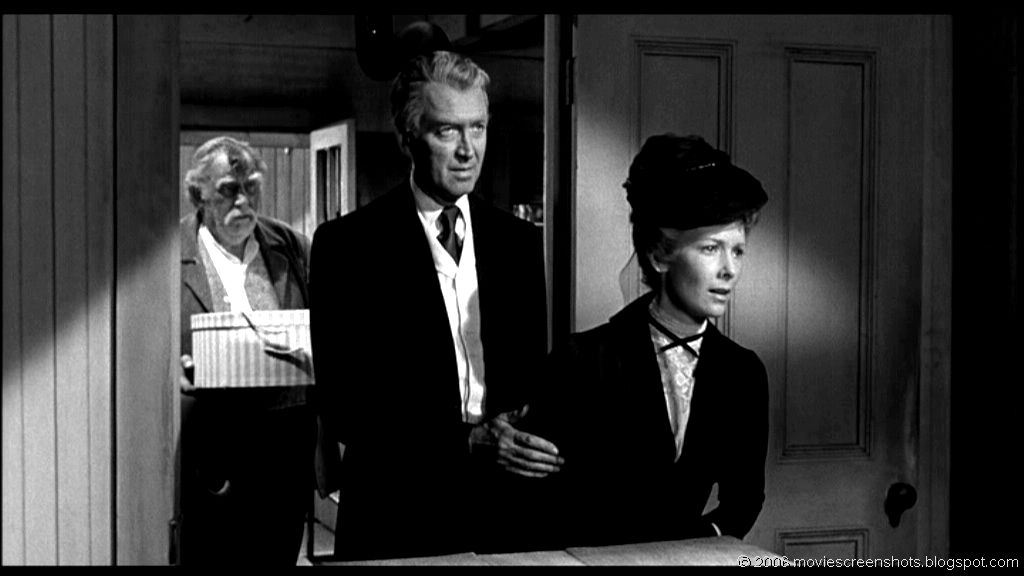
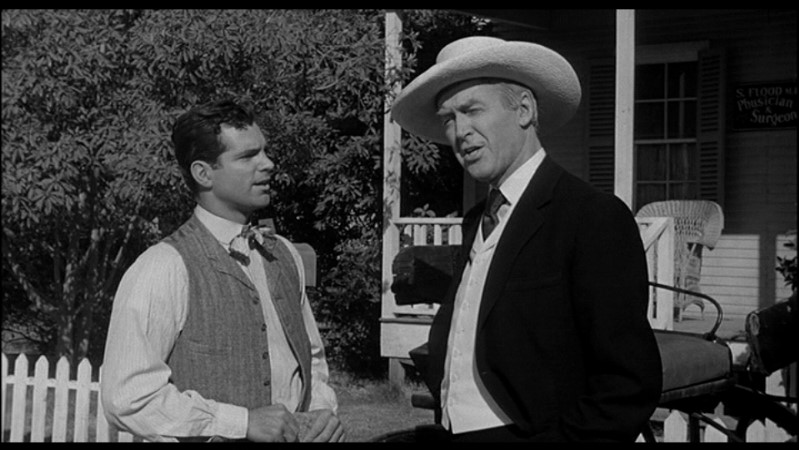
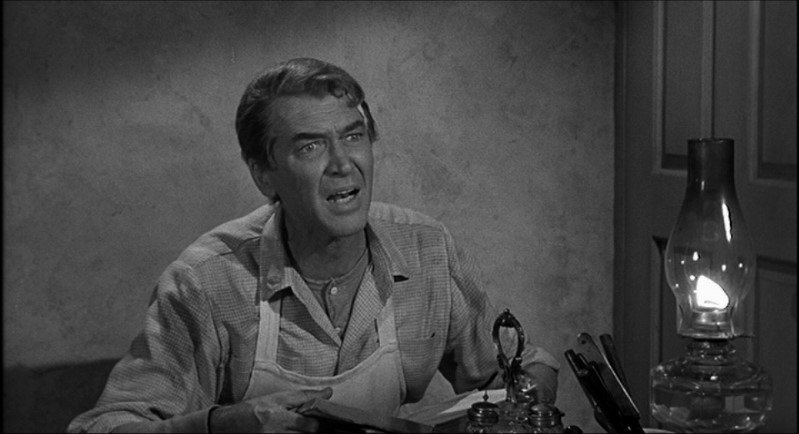
Senator Rance Stoddard and his wife Hallie (James Stewart, Vera Miles) return to the town of Shinbone to much hoopla. It is their home-town, of course, but as the Senator now spends all his time in Washington he doesn't get back there much. So the press start nosing around to get the where-fore's of why "The Man Who Shot Liberty Valance" (and rode that acclaim into politics), is there now. The occasion is a funeral for a man nobody knows (or has little regard for), but he's very important to the Stoddards—he is, after all, the man who brought them together. And as Hallie places a cactus on Stoddard's plain pine coffin, Stoddard relates the tale, one that blows away the Senator's folksy bluster with a scouring truth.
Even if it means the death of his way of life. Sacrifices must be made.
By the time the tale of Stoddard and his benefactor/mentor and rival is told, a bloom has, impossibly, appeared on the cactus, because like Stewart's lack of youth in the flash-backs and the old-age make-up for the young actors in the present, Ford is also playing with time, even going to his own past, using a piece of music from 1939's Young Mr. Lincoln (that put a melody to Lincoln's loss of his first love Ann Rutledge) for the scene of Hallie regarding Doniphon's burnt-out homestead. And so, the telling of the tale of a lifetime is enough time to ensure new life in movie terms.
In The Man Who Shot Liberty Valance, Ford goes so far as to state outright something he'd been alluding to throughout his career as a film-maker, story-teller and chronicler of the United States. Given a choice between printing the unvarnished truth or a myth for the common good, the newspaperman says, "This is the West, sir. When the legend becomes truth, print the legend."
There was never a better-stated justification of film-making.
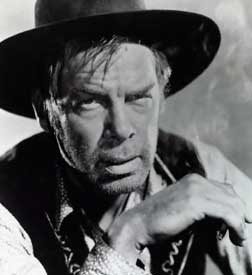
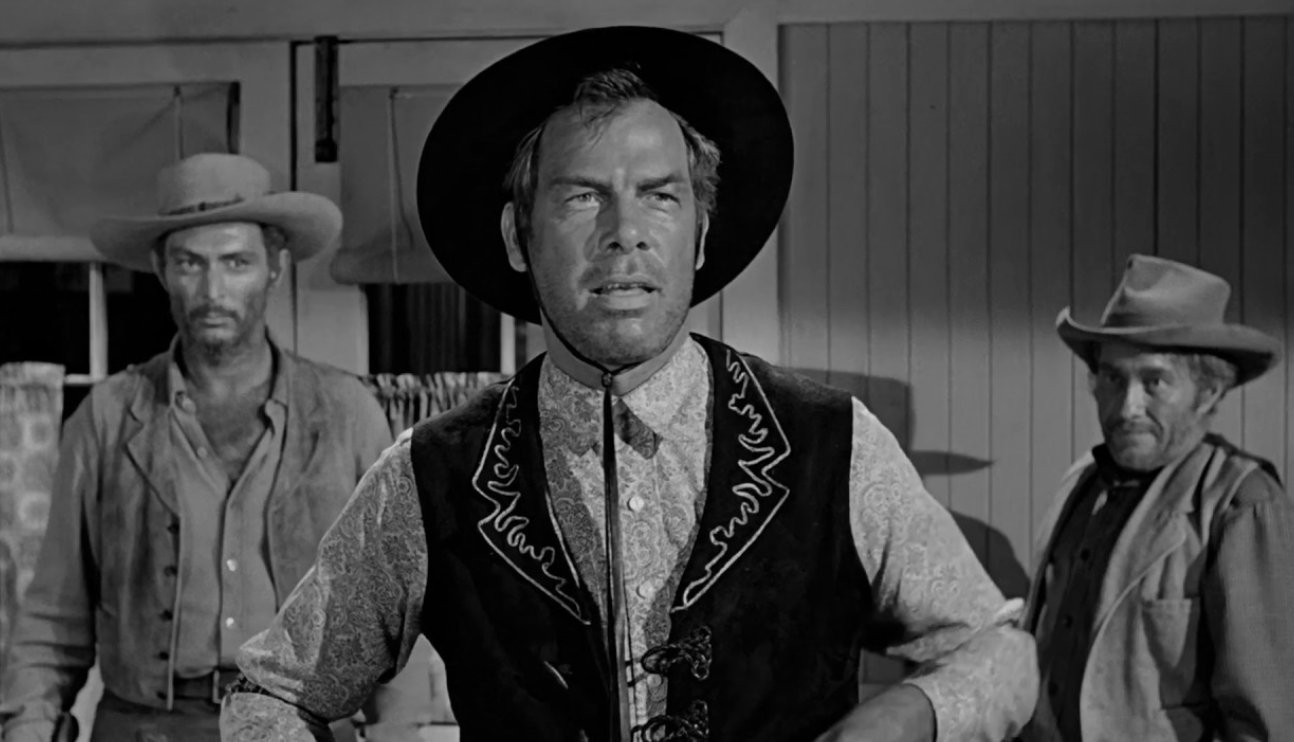
It's a definitive statement of Ford's career directing movies. But Liberty Valance is also a bridge from Ford's early Westerns to the "modern" "oaters" of the 60's as Valance's wormy toadies are portrayed by Lee Van Cleef (of Sergio Leone's "Dollar" trilogy) and Strother Martin (part of Sam Peckinpah's stock company). Those film-makers were inspired by Ford, and in their own revisionist methods of "printing the truth," made their own legends.
And so the film is its own truth, summarizing one director's past as a pioneer and presaging the future of the Western film, on the edge of its demise, both "becoming" even in the depth of their cynicism.
* One of the criticisms of the film is that both Stewart and Wayne are playing young men when the two were both in their 50's. Wayne can get away with it (as he always plays old...and other reasons), but Stewart doesn't come across as a man in his 20's. I have something to say about that towards the end of the review.