Showing posts with label Dean Jagger. Show all posts

Saturday, May 1, 2021

Vanishing Point

Saturday is traditionally "Take Out the Trash" Day...

Vanishing Point (Richard C. Sarafian, 1971) I guess it depends on how much you like cars. 

When I watched Vanishing Point, so many months ago, the sense of "underwhelment" was overwhelming. A cult film, it initially performed poorly at the box-office; some contend that it had a crucial few minutes cut out prior to its release.* But, when put on a double bill with the hit The French Connection, all of a sudden, people started to embrace it. It had "found" its audience.

Reading a lot of online reviews, I came across rather inarticulate generalizations—it was about speed, freedom, oppression of "the man" (the oppressed being represented by 70's stereotypes—it's own form of repression), but mostly about cars...specifically, a 1970 Dodge Challenger R/T V-8 (440 "cubes"). If you're someone who can immediately picture that in your mind or recall the feel of driving one, opening it up on long stretches of highway, and that rev's you up, it's your kind of film.
In the driver's seat is Kowalski (Barry Newman), a car delivery driver being pursued by the California Highway Patrol. It's Sunday morning. On the road ahead, a roadblock has been set up to stop him—two bull-dozers have been angled to prevent him from getting anywhere past Cisco, California. He turns around, looking for a way to by-pass the block, but finds he's boxed in by three cop-cars farther up the road. Trapped. He pulls off the road and considers his options...then turns to face the bull-dozers. He accelerates, passing a black Chrysler Imperial (how'd it get there?) and the movie freezes and goes to flashback.
That Imperial could have been him on Friday. He pulled into Argo's Car Delivery Service in Denver, Colorado at 11:30pm, delivering a black Imperial he'd driven since San Francisco. There's a white Dodge Challenger that needs to be delivered to San Francisco on Monday and Kowalski insists on doing the job over the objections of his supervisor who thinks he should get some rest from the road. Ignoring that, and wanting to get back on the road, he takes the job and heads for a Denver biker bar where he gets a supply of speed and makes a bet with his dealer that he can make it back to San-Fran by 3:00 pm on Sunday (if all goes well).
It won't. His speeding gets the attention of the highway patrol, but he manages to evade his first encounter with them, but that incident and his triple-digit motoring has them strategizing how to stop him. That puts him on the radar on radio station KOW and its blind dj named Super Soul (Cleavon Little—was there anything he wasn't great in?), who monitors the police frequencies and relays their plans over the airwaves—convenient for Kowalski, who has been listening to KOW on the entire trip. Super Soul's ecstatic chronicling of the Challenger's race** makes Kowalski a folk-hero, drawing crowds to the station and angering the law. The disc jockey's seemingly omniscient patter must surely have influenced George Lucas—who was a gear-head and who probably saw the movie—to incorporate an "Oz"-like disk jockey (played by Wolfman Jack) in American Graffiti.
For a guy in a hurry, Kowalski has a lot of diversions, slowing his time, including blown tires, hitch-hikers, snake-catchers, Pentecostals, a pointlessly nude cycling hippie chick, and a healthy dose of distracting flashbacks about his past as a police officer (irony!), and a failed career as a stockcar and motorcycle racer. Kowalski may be "the last American hero" to Super Soul, but my opinion is reflective of a headline for a review of the 1925 version of Lord Jim (which I found researching the 1965 version): "Stupid White Man Makes Bad Choices." The movie tries so hard to be edgy and "with-it" that it has Kowalski have an encounter with "Death" (Charlotte Rampling), a scene that was cut out of the original release. Heavy, dude.
It should feel like Hemingway-esque existentialism but instead feels like "Having a Bad Day" nihilism (that is if the nihilism had a point) with nothing to show for it at the end. Hell, Kowalski doesn't even win the bet! And although it's a tale told not by idiots—that Black Imperial segue at the beginning is a pretty nifty idea—it is "full of sound and fury, signifying nothing." And not even the nihilistic kind of "nothing." Just nothing, null set, fade to black. "Wow, dude." The guy...and the movie...shoulda taken that right turn at Albuquerque.

Nice wheels, though.
* The version I saw was the complete version, with the supposedly crucial scene of Charlotte Rampling in it. All one can say is that there was no nirvana moment making me think that it was a masterpiece. The scene only made me think the movie was more pretentious than in its over-reaching than the shorter version was.
** "And there goes the Challenger, being chased by the blue, blue meanies on wheels. The vicious traffic squad cars are after our lone driver, the last American hero, the electric centaur, the, the demi-god, the super driver of the golden west! Two nasty Nazi cars are close behind the beautiful lone driver. The police numbers are gettin' closer, closer, closer to our soul hero, in his soul mobile, yeah baby! They about to strike. They gonna get him. Smash him. Rape... the last beautiful free soul on this planet."

Saturday, May 26, 2018

Forty Guns

Forty Guns (Samuel Fuller, 1957) The opening to Sam Fuller's Forty Guns is typical of the director's way of giving his films a "thesis statement", or as he himself put it "if you're going to make a movie, the opening oughta give ya a hard-on!"

Well, that may not literally be true (although Fuller isn't too subtle about the phallic imagery of guns...and the women and men who handle them in the film), but there is a lot of dynamism in that opening sequence, even if nothing much actually happens in it.


Other than to tell you...you are watching a Sam Fuller movie!


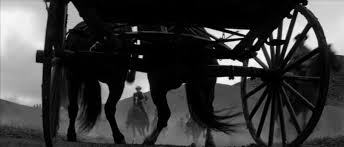
The first shot is vast and empty, with a tiny wagon in the lower quadrant of the shot, in an instant showing you the isolation of the West and the vast distances one has to travel to get anything done in this world. 

Inside the wagon are the Bonell boys on their way to the town of Tombstone (aren't we all?) on business: youngest brother Chico (Robert Dix) is going to board the stage at Tombstone to California, where, reluctantly it seems, will start a life of farming; oldest brother Griff (Barry Sullivan) is a former gunslinger, now working for the Attorney General's office, heading to Tombstone to arrest Howard Swain (Chuck Roberson) for mail robbery; mid-son Wes (Gene Barry) is riding along as Griff's "second gun"—always at the ready if Griff needs an extra gun protecting his back.
Just then, a veritable posse of forty one riders on horses descends from the hills and heads right for them on the same road, then splitting up, galloping on either side of the stilled wagon, its horses spooking from the challenge of so much momentum heading in their direction. Now, you'd think with all that space that such a collision would be nearly impossible to happen. But, that's part of Fuller's point—the land is vast, but seems to narrow dangerously once people get involved...especially people who always think they have the right of way.
Leading the pack by several lengths is a white horse ridden by a woman, Jessica Drummond (Barbara Stanwyck), and the missed altercation in the middle of nowhere speaks volumes about the character: daughter of one of the territory's great landowners, she has taken control of the ranch and wields a great deal of power of the county and the town. Her beloved brother Brockie (John Ericson) is a bit of a loose cannon and he and Swain are part of Drummond's outfit of forty gunmen who act as her ranch-hands, enforcers, and spies. She also has her thumb on Tombstone sheriff Ned Logan (Dean Jagger), no doubt hand-picked by Drummond to keep control over the town and free sway to her men. 
But, the balance of power shifts a bit when the Bonnell brothers come to town; when Brockie Drummond drunkenly challenges Marshall John Chisum (John Ford favorite Hank Worden) and cripples him with a shot to the leg (then proceeds to terrorize the town) Griff walks down Main Street to challenge Brockie—with brother Wes backing him up, strategically drawing a bead on the miscreant from a gunsmith shop window. As the town-folks scatter, Griff walks without hesitation and with a straight path to the drunken Drummond looking him in eyes before he takes his unceremoniously takes out his gun and cold-cocks him knocking him unconscious.
That's an "out there" sequence, risible, especially when someone recognizes Griff because "nobody walks like that," but there is a power to it because Fuller cuts between a track-in shot of Brockie awaiting his fate and the tight close-up of Griff's eyes staring him down as he moves toward him. The thought immediately comes to mind: "Oh, so that's where Sergio Leone got the idea..."
Griff's clocking of Brockie sets up a new dynamic in town. The kid is jailed, but the Drummond lawyer fast-tracks his release and the judge is a Drummond lackey, too. But Jessica is appreciative of the fact that Griff didn't just shoot her brother and be done with it. Truth is, Griff hasn't had to kill anybody in ten years and he'd just as soon keep that streak going. When Griff shows up at the Drummond spread (during formal dinner) and arrests Swain, Jessica doesn't put up much of a fuss. In fact, she offers Griff a job ("I need a strong man to carry out my orders," she says—"And a weak man to take them," counters Griff) which he refuses. Still, the two are taken with each other, despite the opposing circumstances.
Curio in a gunbarrell:
Wes sets his sights on Louvenia
Wes has his own interests. His earlier impromptu post at the gunsmith's has put him in the sights of the gunsmith's daughter Louvenia (Eve Brent)—who is actually more of the master craftsman than her father—and he decides he might want to settle down in Tombstone and become the marshal, replacing the crippled Chisum. But, the arrest of Swain, Brockie's inherent squirrelliness, makes the town a dangerous place for the Bonnell boys, just for being associated with Big Brother Griff.
But, even the bad guys, though slow to see a shift in power, realize that things might be changing and their sway over Tombstone might be coming to end—the easy way that Jessica turns Swain over to Griff, for instance (she doesn't want the controversy or the association with a mail-robber), how she dismisses everyone from her dinner table to speak with the agent alone. The weak man who has been taking orders from Drummond, Sheriff Logan, decides to take matters into his own hands.
Power-dynamic in conversation by Sam Fuller in 2-D:
Logan talks to Jessica, blocking her view of Griff,
but Fuller has them looking right at each other.
Logan sets up the killing of Swain (in jail—a neat trick) and an ambush of Griff Bonnell in a back-street (very few of those) in Tombstone to both throw suspicion off Jessica and keep Griff from doing any more damage. But, there's something more to it, too. Logan is such a conniving little milksop (and Jagger doesn't quite pull off the complexities of the character—perhaps, like Stanwyck and Sullivan, he shouldn't have tried and let the text do the heavy lifting informing their performances, lest it descend into camp), perhaps he's thinking he's also removing a romantic rival, a notion that, like all of his plans, are a bit half-baked.
Power dynamic by Sam Fuller in 3-D:
Griff about to be ambushed by the fellow in the window...if he steps forward
And any romance between Griff and Jessica wouldn't be half-baked, but a slow-burn. Their relationship is contentious but respectful at arm's length with the sort of barbed back-and-forth that Stanwyck has been perfecting since Baby Face and made an art of in Double Indemnity (this even has a variant of "I wonder if you wonder"—"I'm sure you're sure.") 

"You look upset." "I was BORN upset."

"I was bit by a rattlesnake here when I was 15." "Did the rattlesnake die?" 

For two other righteous individuals them would be fightin' words (or you would at least smile when you say that), but it seems to have fan the flames of love out in the desert. But, what seals the deal is Griff saving Jessica from being dragged by a horse in the middle of a tornado.

You read that right—being dragged by a horse in the middle of tornado.
Forty Guns does not compromise, takes chances, and constantly jumps the fence in the corral of the usual western fair, even while it celebrates the genre's past and, especially in the films of Sergio Leone, anticipates its future.

Thursday, March 8, 2018

Bad Day at Black Rock

Bad Day at Black Rock (John Sturges, 1955) WWII vet John J. Macreedy (Spencer Tracy) steps off the train at Black Rock—the first time the train has stopped in four years. He's looking for a man named Komoko, and he is treated with an inexplicable hostility that he can't fathom and no one will explain. Macreedy, stoically—though increasingly crankily—sets out to find the man he's looking for, and has his life threatened several times by the town toughs (Ernest Borgnine, Lee Marvin and the town "boss" Robert Ryan). And though Macreedy may only have one hand, he's quite capable of using it to defend himself, and discover the town's secret that would force the tiny town's residents to kill.

It's hard to believe that Bad Day at Black Rock was considered "subversive" by its studio M-G-M when it was being made but, ten years after the end of World War II, it was considered a hot potato, especially while its production was going on in the waning days of the McCarthy hearings. One couldn't mistake the metaphor of a town cowed by a single man who bends rules to his favor, and harasses outsiders who ask questions.

Right off the bat, one is struck by an over-earnestness that feels false. The wide-screen titles* of a train careening through the Southwest desert is backed by a semi-hysterical Andre Previn score, full of sound and fury and signifying...a train. It feels overdone and pointlessly busy.
"No, I don't understand. But, while I'm pondering it...
why don't you get a room ready for me..."
Previn will keep popping up, goosing the action like a teen-ager playing his radio too loud at a funeral,** and everything is done with such brutish heavy-handedness and self-importance that one could mistake this for a Stanley Kramer production.
Tracy is reliably lived-in as the maimed vet who comes to town, but he's a shade long-in-the-tooth for the role. Robert Ryan starts subtle and ends up chewing the cactus in much the same way that Lee Marvin and Ernest Borgnine do their dirty work.*** Walter Brennan, Dean Jagger and Anne Francis (the only female in town) round out the cast as sycophants and victims, weak in one way or another.
Spencer Tracy shows Ernest Borgnine what's what.
Ultimately it all comes down to a secret and the conspiracy to keep it that way beyond all reason; obviously, all these guys must have been part of the Bad Rock City Council. There are bursts of action including Tracy taking on Borgnine ("I'm part mule, part alligator") with one mutilated hand in his pocket,  accomplishing some fancy karate and judo moves, something not often seen in '50's films. But one acknowledges that though the film's heart is in the right place, too much of it has spilled out onto its sleeve.

* Can someone explain to me, for the love of Mike, why this small-scale film about a veritable ghost-town of few actors was filmed in the widest of Cinema-scopes?

** In five years that "goosing" of slow material would pay off like gang-busters with Elmer Bernstein's energetic score for The Magnificent Seven.

***Ironically, Tracy would be nominated for a Best Actor Oscar that year and lose to...Ernest Borgnine, playing the title role of Marty.