Showing posts with label Barbara Stanwyck. Show all posts

Wednesday, August 11, 2021

The Lady Eve

The Lady Eve
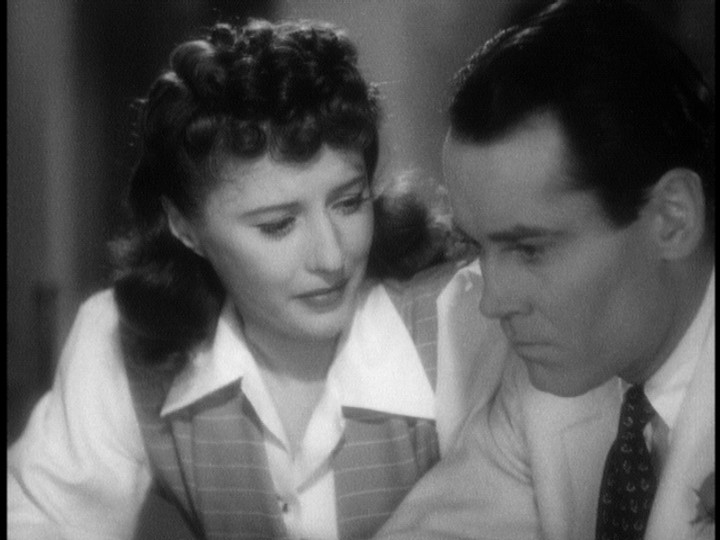
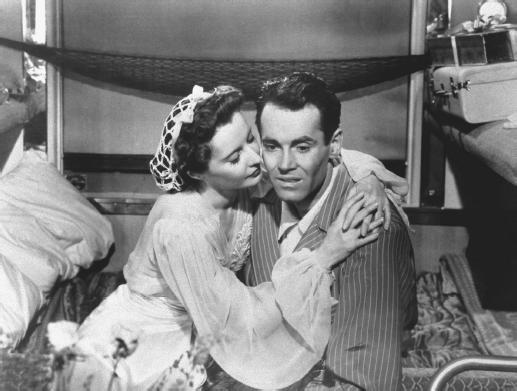
(Preston Sturges, 1941) Ale heir Charles "Hopsey" Pike (Henry Fonda) has been up the Amazon for a year as an ophiologist (emphasis on the "oaf."). The trip must have been made without a paddle because he can't tell two snakey grifters (Charles Coburn, Barbara Stanwyck playing a father-daughter con artist team—the family that preys together...) are trying to collect him...and his dough...on the cruise back to the States. She's already beaned him with an apple as he was boarding ship—it's not exactly Cupid's Arrow, but it'll do, in theory. After he gets hit, well, he's not a lot wiser.
 
Sturges' third film (and first big hit) is a distillation of every screwball romance that had come down the pike previously. As with the best screwball comedies, the woman has all the power and nobody could play power better or with more cruel humor than the ungainly Barbara Stanwyck, here as fast as quicksilver and, frankly, a bit tough to keep up with—you want to watch it twice just to see all of her nuances you missed. Her opponent...object of affliction...affection...is a combination of every man-handled man-type that you can have in these comedies. "Hopsey" Pike is well-off, a specialist in his field but a tenderfoot out of it—he can spot snakes in the jungle but not in the grass—somewhat sheltered and clumsy, and saves money on casting Ralph Bellamy by playing his own stuffed shirt. And being on a boat ensures that the ground is never too sure under his feet, the better for the sweeping off of. And the best guy to "take" in a "confidence" game is somebody who doesn't have any.
 
Confidence, that is. 
Henry Fonda
didn't play many rubes, as there was always something steely under his baby-blues; you couldn't hide his intelligence and Sturges doesn't try, making Hopsey book-smart, but virginally inexperienced and shy. One would say clumsy, given the right circumstances, which is where Stanwyck's Eugenia comes in, with her foot in the aisle to trip him up, literally. Pretty soon, that becomes Sturges' short-hand for letting you know that "Hopsey" is falling for Eugenia, a 40's comedy substitute for attraction being physically evident
But the best un-laid plans... Pretty soon, Eugenia is falling for Hopsey, as evidenced by her getting hot and bothered by his chosen field of study. "Slimey snake!" she yells as she wakes up from a nightmare.
Preston Sturges was always one for tweaking the censors, and with The Lady Eve, he's more than suggesting by associations of culture and psychology what's going on here in a knowing way—the biblical way of knowing, complete with snakes and apples and falls from innocence.
Things get complicated as
Eugenia must thwart her father's plans for fleecing the golden boy—she does actually care about him, but when Pike finds out what the two are up to, he breaks off with her, leaving her in a huff. If she was honest with him, he'd probably have done the same thing, so with that moral quandary and his making her feel cheap and all, she plots her revenge, with one of the best lines of spite to come out of Hollywood: "I need him like an axe needs a turkey!" Appropriate vindication mixed with a vindictiveness chaser ensues.
Well worth the time and effort to seek out,
The Lady Eve is a shining example of how sophisticated and down-and-dirty Hollywood comedy could get. And Stanwyck, one of the wiliest of actors, positively glows on-screen. In 1994, The Lady Eve became part of The National Film Registry as being "culturally, historically or aesthetically significant."
 
They don't mention that it's funny as the devil, too.

Thursday, September 5, 2019

These Wilder Years

These Wilder Years (Roy Rowland, 1956) James Cagney plays Steve Bradford, an executive who, for once, takes time off for himself to take care of some unfinished business. He leaves his board of directors in charge and makes it known that if there's an emergency, he can't be reached and somebody else will have to handle it. He's got important business of his own. He doesn't know long it will take, but until it's taken care of, he can't be reached.

He goes back to his hometown and seeks out an orphanage run by Ann Dempster (Barbara Stanwyck), whom he he had contacted previously. She repeats that what he is asking for is quite impossible—she cannot give out the information he seeks. There are rules. That's not the kind of answer Bradford like to hear. He's a captain of industry, a Master of the Universe. He's used to getting what he wants, and if he can't get it one way, he'll find another way to do it—the ends justify the means.
What he's looking for is his son, given up for adoption twenty years previously when he was less successful and less capable of the responsibility. Now, he wants to make amends and be the father he never thought he could be in the past. 
The film was made in 1957 and the subject of unwed mothers was something that was rarely discussed, let alone put on movie screens. If it was, it was slapped with a "Not recommended for General Audiences" label (the kiddies would have to wait for the rating system 11 years in the future). But, this movie had the social conscience—and the business-savvy knowing that the story would never be shown on people's new television sets (where Lucy and Desi had to sleep in separate beds on "I Love Lucy").

So, it makes for an interesting subject to see in a movie from that era; they're not very clinical about it, and don't even use the terms "pregnant" or "unwed mother," and emphasize that these are young girls in a fix and someone has to deal with it and protect all the parties involved. The young men involved in the process are never mentioned—perhaps because you'd have to mention sex—and the only evidence that this might be a shared responsibility is in the character of Bradford who owns up to it twenty years too late.
The reason I was drawn to These Wilder Years was to see old pro's like James Cagney and Barbara Stanwyck playing off each other—in the only time in their careers. The two are a couple of my favorite thesp's and they are not sentimental in their portrayals, playing subtle combatants over the information Cagney's Bradford wants. Bradford is so single-minded and so used to getting his own way that he takes legal action against the orphanage to get what he wants, using his company lawyer Rayburn (Walter Pidgeon, playing with a cynical practicality) to sue Dempster in order to release the information to him...and presumably every other prodigal father.
Stanwyck has the more sympathetic role here, and she plays it with a functionary's stern patience. And Cagney, as always, is a revelation. He has a scene where, quite to his surprise, he finds what he's looking for, and his reactions are a study in complexity, going from realization to surprise to fear to shame to regret without pause or revealing of technique. There's no acting, but considered reacting. It's another example—in a long-running career—of why Cagney is considered THE actor's actor and an artist of the highest caliber.


Saturday, May 26, 2018

Forty Guns

Forty Guns (Samuel Fuller, 1957) The opening to Sam Fuller's Forty Guns is typical of the director's way of giving his films a "thesis statement", or as he himself put it "if you're going to make a movie, the opening oughta give ya a hard-on!"

Well, that may not literally be true (although Fuller isn't too subtle about the phallic imagery of guns...and the women and men who handle them in the film), but there is a lot of dynamism in that opening sequence, even if nothing much actually happens in it.


Other than to tell you...you are watching a Sam Fuller movie!


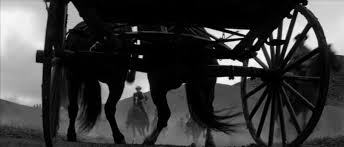
The first shot is vast and empty, with a tiny wagon in the lower quadrant of the shot, in an instant showing you the isolation of the West and the vast distances one has to travel to get anything done in this world. 

Inside the wagon are the Bonell boys on their way to the town of Tombstone (aren't we all?) on business: youngest brother Chico (Robert Dix) is going to board the stage at Tombstone to California, where, reluctantly it seems, will start a life of farming; oldest brother Griff (Barry Sullivan) is a former gunslinger, now working for the Attorney General's office, heading to Tombstone to arrest Howard Swain (Chuck Roberson) for mail robbery; mid-son Wes (Gene Barry) is riding along as Griff's "second gun"—always at the ready if Griff needs an extra gun protecting his back.
Just then, a veritable posse of forty one riders on horses descends from the hills and heads right for them on the same road, then splitting up, galloping on either side of the stilled wagon, its horses spooking from the challenge of so much momentum heading in their direction. Now, you'd think with all that space that such a collision would be nearly impossible to happen. But, that's part of Fuller's point—the land is vast, but seems to narrow dangerously once people get involved...especially people who always think they have the right of way.
Leading the pack by several lengths is a white horse ridden by a woman, Jessica Drummond (Barbara Stanwyck), and the missed altercation in the middle of nowhere speaks volumes about the character: daughter of one of the territory's great landowners, she has taken control of the ranch and wields a great deal of power of the county and the town. Her beloved brother Brockie (John Ericson) is a bit of a loose cannon and he and Swain are part of Drummond's outfit of forty gunmen who act as her ranch-hands, enforcers, and spies. She also has her thumb on Tombstone sheriff Ned Logan (Dean Jagger), no doubt hand-picked by Drummond to keep control over the town and free sway to her men. 
But, the balance of power shifts a bit when the Bonnell brothers come to town; when Brockie Drummond drunkenly challenges Marshall John Chisum (John Ford favorite Hank Worden) and cripples him with a shot to the leg (then proceeds to terrorize the town) Griff walks down Main Street to challenge Brockie—with brother Wes backing him up, strategically drawing a bead on the miscreant from a gunsmith shop window. As the town-folks scatter, Griff walks without hesitation and with a straight path to the drunken Drummond looking him in eyes before he takes his unceremoniously takes out his gun and cold-cocks him knocking him unconscious.
That's an "out there" sequence, risible, especially when someone recognizes Griff because "nobody walks like that," but there is a power to it because Fuller cuts between a track-in shot of Brockie awaiting his fate and the tight close-up of Griff's eyes staring him down as he moves toward him. The thought immediately comes to mind: "Oh, so that's where Sergio Leone got the idea..."
Griff's clocking of Brockie sets up a new dynamic in town. The kid is jailed, but the Drummond lawyer fast-tracks his release and the judge is a Drummond lackey, too. But Jessica is appreciative of the fact that Griff didn't just shoot her brother and be done with it. Truth is, Griff hasn't had to kill anybody in ten years and he'd just as soon keep that streak going. When Griff shows up at the Drummond spread (during formal dinner) and arrests Swain, Jessica doesn't put up much of a fuss. In fact, she offers Griff a job ("I need a strong man to carry out my orders," she says—"And a weak man to take them," counters Griff) which he refuses. Still, the two are taken with each other, despite the opposing circumstances.
Curio in a gunbarrell:
Wes sets his sights on Louvenia
Wes has his own interests. His earlier impromptu post at the gunsmith's has put him in the sights of the gunsmith's daughter Louvenia (Eve Brent)—who is actually more of the master craftsman than her father—and he decides he might want to settle down in Tombstone and become the marshal, replacing the crippled Chisum. But, the arrest of Swain, Brockie's inherent squirrelliness, makes the town a dangerous place for the Bonnell boys, just for being associated with Big Brother Griff.
But, even the bad guys, though slow to see a shift in power, realize that things might be changing and their sway over Tombstone might be coming to end—the easy way that Jessica turns Swain over to Griff, for instance (she doesn't want the controversy or the association with a mail-robber), how she dismisses everyone from her dinner table to speak with the agent alone. The weak man who has been taking orders from Drummond, Sheriff Logan, decides to take matters into his own hands.
Power-dynamic in conversation by Sam Fuller in 2-D:
Logan talks to Jessica, blocking her view of Griff,
but Fuller has them looking right at each other.
Logan sets up the killing of Swain (in jail—a neat trick) and an ambush of Griff Bonnell in a back-street (very few of those) in Tombstone to both throw suspicion off Jessica and keep Griff from doing any more damage. But, there's something more to it, too. Logan is such a conniving little milksop (and Jagger doesn't quite pull off the complexities of the character—perhaps, like Stanwyck and Sullivan, he shouldn't have tried and let the text do the heavy lifting informing their performances, lest it descend into camp), perhaps he's thinking he's also removing a romantic rival, a notion that, like all of his plans, are a bit half-baked.
Power dynamic by Sam Fuller in 3-D:
Griff about to be ambushed by the fellow in the window...if he steps forward
And any romance between Griff and Jessica wouldn't be half-baked, but a slow-burn. Their relationship is contentious but respectful at arm's length with the sort of barbed back-and-forth that Stanwyck has been perfecting since Baby Face and made an art of in Double Indemnity (this even has a variant of "I wonder if you wonder"—"I'm sure you're sure.") 

"You look upset." "I was BORN upset."

"I was bit by a rattlesnake here when I was 15." "Did the rattlesnake die?" 

For two other righteous individuals them would be fightin' words (or you would at least smile when you say that), but it seems to have fan the flames of love out in the desert. But, what seals the deal is Griff saving Jessica from being dragged by a horse in the middle of a tornado.

You read that right—being dragged by a horse in the middle of tornado.
Forty Guns does not compromise, takes chances, and constantly jumps the fence in the corral of the usual western fair, even while it celebrates the genre's past and, especially in the films of Sergio Leone, anticipates its future.

Friday, April 20, 2018

Clash By Night

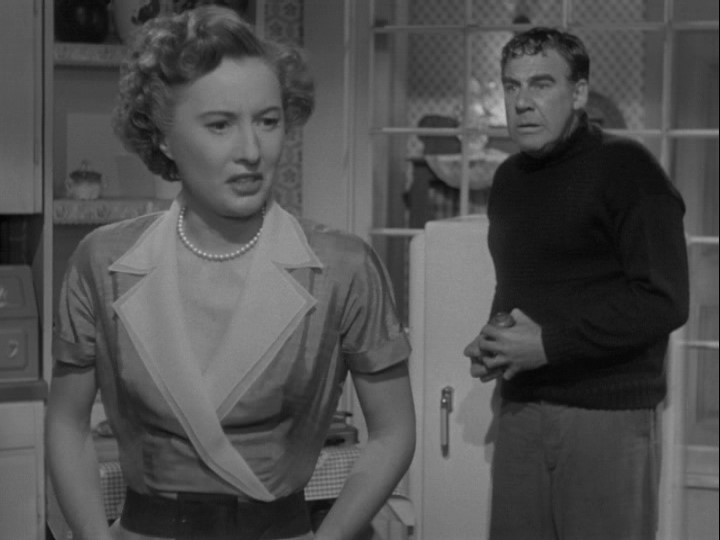
Clash By Night (Fritz Lang, 1952) Interesting. Fritz Lang directing Barbara Stanwyck, Paul Douglas, Robert Ryan and Marilyn Monroe in an adaptation of a play by Clifford Odets (produced on stage by Billy Rose!). Talk about clashes. The events take place in a fishing town and director Lang gets a lot of mileage with various shots of Nature—seals, gulls and a violently crashing surf—drawing parallels between the various top-feeders trying to take advantage of the spoils of the fishing fleet's daily labors. They're scavengers of opportunities and Lang keeps the beasts, both on land and sea, in the same universe, making a far more direct and poetic pictorial comment on the squalid life in town than any amount of purple prose Odets can provide.

Oh. And watch out for the nets. They come in all shapes and sizes and the guys casting them have teeth, too. You just don't see them immediately.
Mae Doyle (Stanwyck) comes back to Monterey, after years on the road, to move back into the family house with her brother (Keith Andes). "Home is where you come when you run out of other places," she snarls. But her purpose is not to settle down so much as to lick wounds. Her search for a better, easier life than working in a cannery (like Monroe's Peggy) or marrying a fisherman and raising kids has proven a bitter disappointment. She slinks back into town ("Home is where you go when you run out of places") and word gets 'round that Joe's sister's back, which attracts the attention of Jerry D'Amato (Douglas), a bachelor-fisherman living with his widowed father (Silvio Minciotti) and sleazy Uncle Vince (J. Carroll Naish). Mae and Jerry start seeing each other, but she rejects any advances he makes, telling him he doesn't even know her, "what kind of animal I am.  Do I have fangs?  Do I purr?"  
He takes her to meet his friend Earl (Robert Ryan), whom Jerry describes as "in the movie business;" He runs the projector at the local bijou. Earl's one piece of work. A sour drinker, married to a vaudeville dancer, he'll tell you all about what's wrong with women to your date. "Take any six of them. Throw them up in the air. The one who sticks to the ceiling, I like."* Mae is repulsed, but Jerry is still loyal to Earl, even though he'll talk bad about his friend behind his back.  "Jerry's the salt of the Earth—but he's not the right seasoning for you." (Ugh. Odets) Again, Mae's reaction to Earl is to be repulsed, which sends her right into the arms of Jerry, and any previous objections she had to marrying him are suddenly forgotten. Before long, they're hitched and have a daughter, which is upsetting to Jerry's opportunistic Uncle Vince, who will never put up with anything that interrupts his mooching lifestyle. Jerry ends up throwing him out.
But, Mae is still restless, and complications ensue that tie back to life in the animal kingdom, and the charm of aggressive males.  Because the movie then starts to take place solely at night, there are those that will call this a "film noir," the genre most commonly associated with gangsters, surly private eyes, never-spoken-of family secrets, and the evil impulses of men. Got the last one right, as the worst of people gets the better of others. But, the film noir genre is less prominent than the soap opera one, and it doesn't help that the material is sometimes eye-rollingly colorful. Still, the cast is uniformly excellent, and Lang's hand is sure, and makes puts everything in the proper perspective.


* This is one of the problems I have with Odets as a writer: that sentiment must mean something—at least to Odets—but it makes no sense to the rest of humanity, which is supposed to be his audience. I suppose it means that Earl doesn't like any woman; there's a better way to say it, I'm sure. But then I don't like Odets much—take any six of his works. Throw them up in the air. The one that sticks to reality, I like.

Saturday, May 27, 2017

Baby Face

Baby Face  (Alfred Green, 1933) The movie Baby Face is notorious for a bunch of reasons. It is "Pre-Code," that period of film-making between the introduction of sound (in 1927) and 1934 (the introduction of Shirley Temple) where Hollywood was aggressively flirting with more mature subject matter, to the point where religious groups particularly the Catholic Legion of Decency started fingering their beads in worry. Horror films became more explicit, gangster films started to rise in popularity with the one-two punch of The Great Depression and the Prohibition Era, and branched off to a sequel genre, the prison film.

And then there was sex. That subject crossed all genres. Even if the film was a cautionary tale about loose behavior you couldn't actually SHOW that loose behavior lest it then influence the behavior you're being warned about. It's the cinematic equivalent of restricting your sex education class to the subject of "abstinence."

As is usually the case with these things, "The Code" was a way to tamp down permissive, or even progressive, behavior in the movies—producers were persuaded to follow a path that was straight and narrow-minded, and so there was watchfulness for subversive behavior, political discontent, and overt sexuality. Somehow, the Marx brothers got past all that.
But, Baby Face didn't. Like a lot of pre-code films, once the Hays Office had their way, the most objectionable bits were excised like a ruptured appendix. The lucky ones were re-distributed with the shorter running times. The unlucky ones were simply re-made, sometimes scant months after the release of the original, and, with any luck, the original wasn't "filed" in the Hudson River, where in the more permissive 1980's, they started to crop up in home video releases. Baby Face was found at the Library of Congress, a "dupe negative" had survived uncut and it was first screened in 2004. 
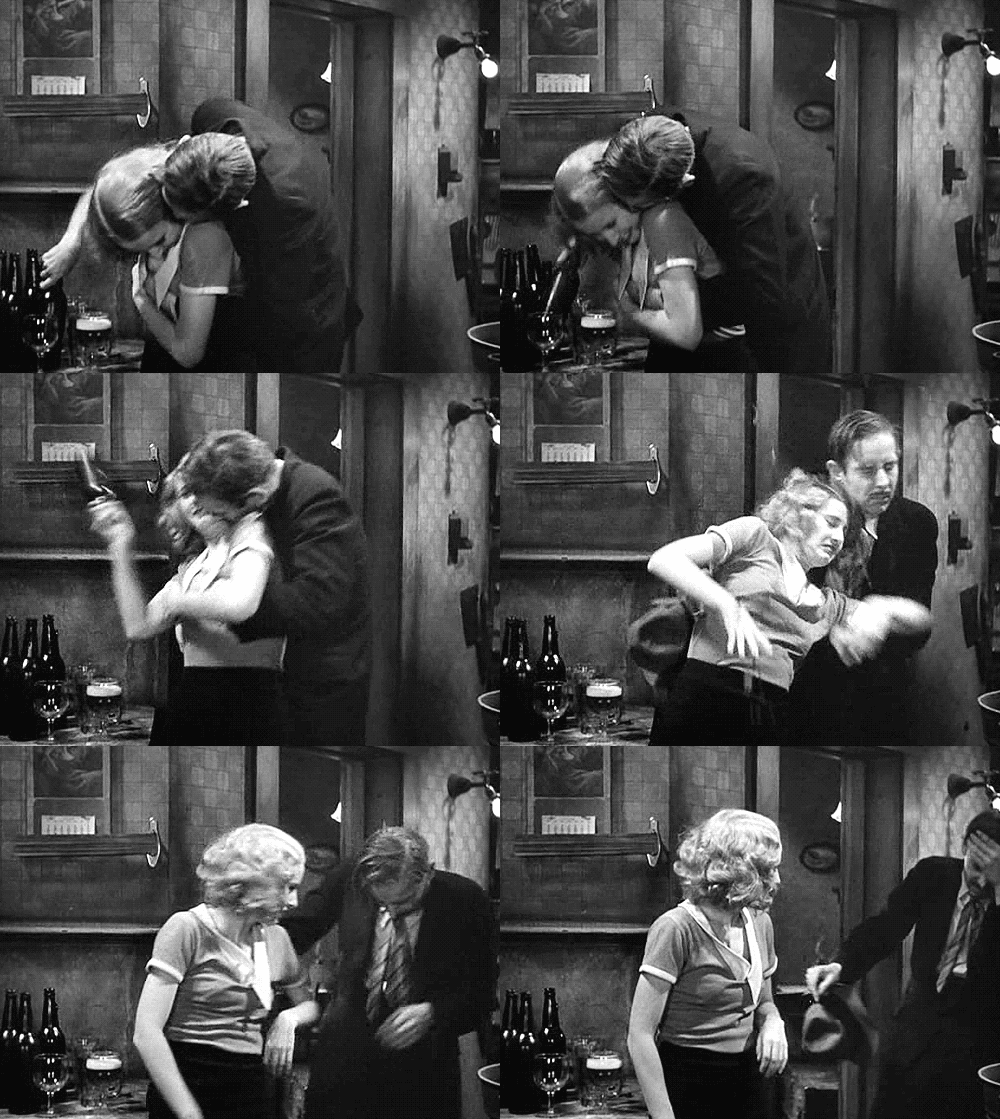
What they saw was Barbara Stanwyck starring as Lily Powers, a waitress/bartender at the speakeasy of her corrupt father (Robert Barrat). Lily has grown up tough, not for the least reason is that dear old dad had been using her as a chief draw to keep his business going, throwing men her way since she was 14. She's contemptuous of men, and why not? The dregs of society come through her father's door and she treats their low expectations of her with a biting sarcasm that only makes them weaker. "All the kindness and gentleness in me has been killed," she says at one point. And it's been a death of a thousand cuts, every grope, every grab, every compromise. She's trapped with no way out.
But, there is one door, and one day, a potential mentor walks through it—Cragg (Alphonse Ethier), a cobbler, with a bent toward philosophy, manages to break through her hard exterior with a book he insists she reads, written by Nietzsche. He tells her that she already has the weapons and the drive ("her potentialities") to get ahead in the world.
"A woman, young, beautiful, like you, can get anything she wants in the world. Because you have Power over men! But you must use men! Not let them use you. You must be a master! Not a slave. Look, here, Nietzsche says, "All life, no matter how we idealize it, is nothing more nor less than exploitation." That's what I'm telling you! Exploit yourself! Go to some big city where you will find opportunities. Use men! Be strong! Defiant! Use men! To get the things you want."
And so she does. She kicks the sawdust of the speakeasy off her shoes and leaves the night-crawlers behind, moving to the big city and sets aim on conquering the world of commerce, finagling her way (if one can use the term) into getting a job in the secretarial pool and sleeping, and blackmailing her way up the chain of command (Interesting to see John Wayne show up as one of her early disposable conquests—it's the only time these two power-houses worked together in their careers, and, of course, Stanwyck walks all over him, so early in his career).
Set to the songs "St. Louis Blues" and the newly popularized hit "Baby Face," Baby Face deconstructs the pot-boiler to bare essentials, under-pinning it with a philosophical base (Hitler was coming to power at the time, using the same sort of philosophy) and the screen-writers (from a story by one Mark Canfield) are street-smart and uncompromising in how Lily plays the middle-management suck-up's until she finally bags the big prize—the wealthy scion (George Brent) of the bank's founder.
If there's anything wrong with Baby Face, it might be that the writers are a little too fond of the double entendre's they spew out, accompanied by a punctuating eye-roll. They and the director go to that well a few too many times (to the point where my eyes started to instinctively roll), but there are so many surprises, so many chances being taken, that you give the movie a lot of latitude in taking things so far. And Stanwyck is always a joy to watch, even this early in her career. She is one of the great (great!) screen actors to come out of the pre-code era and she had the ability to grow and mature beyong just holding the attention of the camera.
Oh. And Mark Canfield, who wrote the story? He sold the treatment to Warner Brothers for a single dollar. Then skipped the studio to make a name for himself over at 20th Century Fox. His real name, by the way, was Darryl F. Zanuck.

Thursday, June 30, 2016

The Two Mrs. Carrolls (1947)

The Two Mrs. Carrolls (Peter Godfrey, 1947) Fans of Humphrey Bogart don't often mention this dark guignol of a thriller that marks the only pairing of Bogart with the considerable presence of Barbara Stanwyck, an actor as unafraid of projecting a dark side as he is, even if this particular film doesn't exploit it, as it fits in the mold of Stanwyck's other "women in peril" films. Stanwyck always managed to straddle the line between naturalism and theatricality, while Bogart was always uniquely Bogart, self-aware enough to know both his strengths and weaknesses as an actor (and a man) and call them up, albeit with a veneer of artificiality that passed for theatricality and artifice.

At the start of the film, everything is rosy, full of natural light fresh air and pristine waters as painter Geoffrey Carroll (Bogart) and his new love, Sally Morton (Stanwyck) are vacationing in the mountains on a fishing vacation. It's all hearts and flowers and the two are very much in love, Gerry paying less attention to the fish than in sketching Sally. But, a sudden squall puts a damper on things when, while giving Sally a protecting coat, a letter falls out of his pocket, addressed to Gerry's wife. Sally is shocked and breaks off the affair.
Gerry explains the situation. The letter is to ask his wife for a divorce. She has been an invalid since the birth of their child, and her estate will supply all the care she needs. But, when the first Mrs. Carroll dies, Gerry continues to pursue Sally, they marry and she moves in with Gerry and his daughter from his late wife, Beatrice.

Gerry is distant, locking himself in his studio to paint for hours on end. They argue about sending Gerry's daughter to a boarding school, which the kid does not want to go to, preferring to stay at home with Gerry and Sally. Sally talks to Beatrice (Ann Carter), who reveals that the first Mrs. Caroll was hardly an invalid, but actually quite healthy and died suddenly after Gerry had returned from a fishing trip (DUN-dun-dunnn) and finished his portrait of her as an angel of death.
This naturally freaks Sally out, especially after finding the key to Gerry's studio and seeing that he's working on a portrait of her...as an angel of death. Plus, Gerry is acting very interested in a vampiric young socialite (Alexis Smith), who has commissioned Gerry to paint her portrait—maybe she should just wait a while.
The director, Peter Godfrey, was a director-friend of Stanwyck's, and he has a stagey directorial style that is sunny and bright at the beginning of the film and becomes gradually more stage-bound, darker and more closed-in as the film progresses and the second Mrs. Carroll's suspicions become more real. The film has a couple of bizarre touches on top of Bogart's increasingly paranoid and— eventually—deranged performance: one is Gerry's truly horrific artistic style and the other is his means of dispatching his wives—by providing a helpful glass of warm milk before bed...to help them sleep, of course. They obviously haven't seen Hitchcock's Suspicion. Or Hitchcock's Notorious.
The chief enjoyments of The Two Mrs. Carrolls is the pairing of Bogart and Stanwyck, a truly unhinged performance by Bogart—he has a wonderful final line—and the generally creepy air permeating the film, even when it becomes ludicrous. Beyond that, there's not much there.

Tuesday, May 19, 2015

Ball of Fire

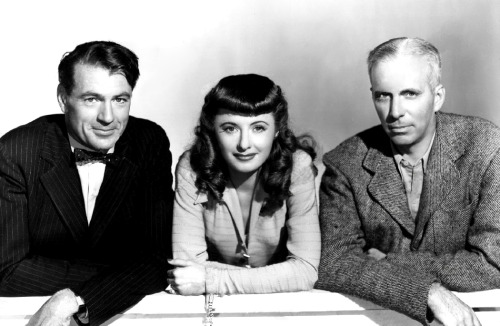
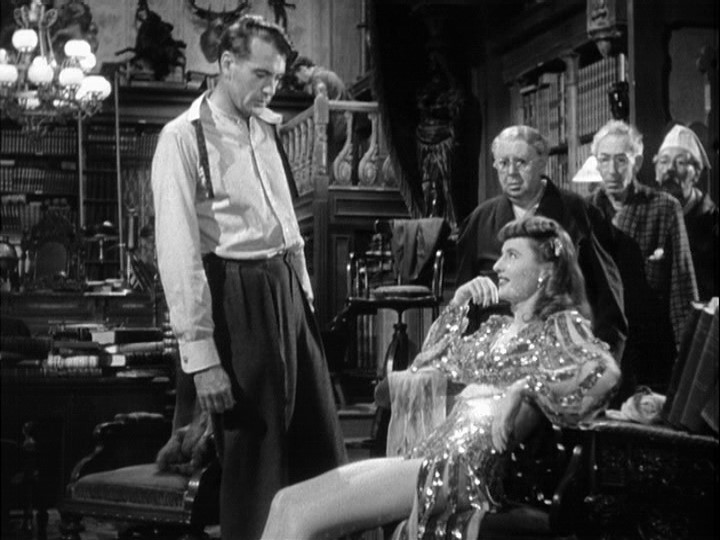
Ball of Fire (Howard Hawks, 1941) It doesn't get much better than this: screenplay by Charles Brackett and Billy Wilder (from a story by Wilder), produced by Samuel Goldwyn, photographed by Gregg Toland, music by Alfred Newman and directed by Howard Hawks. Add that it's a swing-era version of "Snow White" stock-piled by anything-but-dwarvish character actors (Henry Travers, Richard Hayden, Oscar Homolka, S.Z.Sakall), some nifty up-and-comers like Dana Andrews and Dan Duryea, and top-lined by Gary Cooper (in pixie-ish Capra mode) and Barbara Stanwyck (who usually runs on all cylinders, but seems turbo-charged in this one) and you have the makings of a great, stylish and culturally-winking comedy, with lots of great musical material, too.*

It's a charming conceit: years in the making, the Dutton Encyclopedia, written by eight myopic scholars, is hitting the skids just as it's hitting the "S" words. Professor Bertram Potts (Cooper) has just finished a 26 page treatise on "Slang," when a garbage-man walks in with some fancy (and utterly incomprehensible) patter that puts his research to shame. Potts determines that he will leave his ivory tower and venture forth into the world to see what all the...what's the word? *flip/flip*..."rhubarb" is about. He stumbles upon a nightclub (where Gene Krupa happens to be playing) and taking on the lead vocals is "Sugarpuss" O'Shea (Stanwyck, in full "bad-girl" mode), mob-moll to Joe Lilac (Andrews) who's being investigated by the New York cops. The focus of their flat-footing is Sugarpuss, who can give them a lot of inside information, so she has to go on the lam, and the professor's invitation to her to be a part of his slang symposium, gives her the perfect hideout, going "to the mattresses" with the eight encyclopediacs, even though under the distrusting baleful eye of their housekeeper, Miss Bragg.
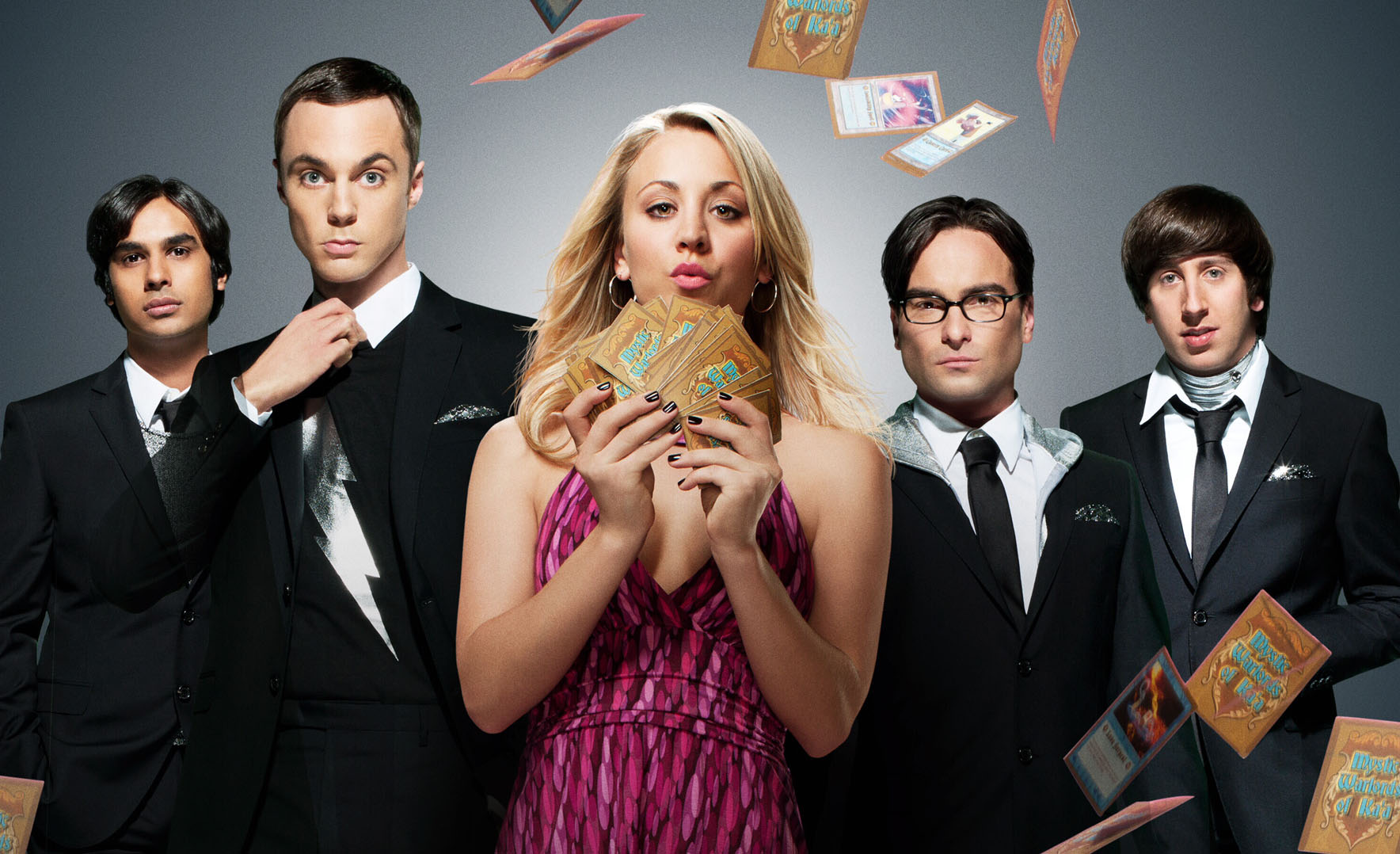
Complications arise, with the possibilities of broken and/or ventilated hearts, as it turns into a particularly pointy triangle between Potts, O' Shea and Lilac, with a suddenly energized Greek chorus of academics trying to deal, rather haplessly, with the real world. "Snow White" is the inspiration, but fans of "The Big Bang Theory" will also see that show's roots in this and its Grimm ancestor. One also has Ball of Fire to thank for Billy Wilder's directing career, as Hawks let him sit in on the set, auditing during the making of the film, observing, taking notes, prepping for his own directorial turn that year with The Major and the Minor.
This is one of the great unsung Hawks movies, slightly different from his formula, thanks to Brackett and Wilder's script, but it still falls under his M.O. of story material where a team of differently skilled people—in this case scholars—come together under circumstance to form a like-minded unit, even if, as here, it happens a little late in the proceedings. It was Hawks' version of making a film about film-making, but obliquely, showing that any group of gypsies can unite under a common goal despite their differences. It's part of the charm that makes Hawks one of the most American-minded of film-makers, those films being a reflection of the melting pot of the Great National Experiment.
* One of Hawks' trademarks is a musical number in the proceedings, often by amateurs to show they're bonding in their efforts.

  Ball of Fire was re-made eight years later by Hawks in a musical version called A Song is Born (also photographed by Toland, but this time in technicolor) starring Danny Kaye and Virginia Mayo.