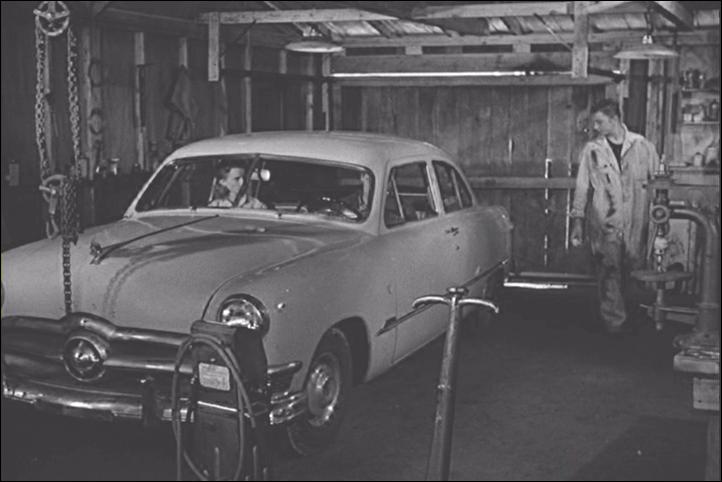
Thunder Road(Arthur Ripley, 1958) A B-movie curiosity that has gained cult status, especially in the southeast corner of the U.S., usually neglected by Hollywood. Although beloved by its corps of loyalists (there are "Thunder Road" fests every year), most folks only know it from writer-producer-composer-star Robert Mitchum's driving recording of the film's theme song. He co-wrote that song, as well as it's love ballad "The Whipoorwill," sung in the film by Keely Smith, the exotic—if dead-pan—wife-chanteuse of the Louis Prima Band.
The film, based on Mitchum's story-idea, concerns an ex-con Luke Doolin (Mitchum), who drives a souped-up Ford delivering moonshine hootch throughout Kentucky and Tennessee. The story has Luke as the hub of several tugs-of-war: there's the struggle between the still-men and the Treasury boys (represented by Gene Barry); a territorial tussle between the loose association of mountain-folk and the smuggling kingpin (Jacques Aubuchon) who wants control of their routes, by any way possible; then, he's caught between two girls after his affections—singer Francie Wymore (Smith), who wants him to settle and stop rum-running, and the girl who looks up to him (Sandra Knight), whether he's running or not. She's probably more suited to Luke's younger brother Robin (played by Mitchum's son, Jim—when Col. Tom Parker wanted too much money for Elvis Presley to play the part), who wants to be a part of the family business.
The film's directed by Arthur Ripley a B-movie veteran who'd started doing television work, but whose lasting legacy is as one of the industry stalwarts who established the UCLA film school. The film looks much older than it is, as it employs filming techniques that emphasized economy over spectacle, or even consistency, as in one scene where Gene Barry's monologue starts on location and ends up in a studio.
But dang! Some of the racing scenes are amazing, especially in some of the daylight scenes where it's readily apparent no camera tricks were used to speed things up—those hulking roadsters are really go that fast.
Mitchum is great in it—he rarely stepped out of his personal cruise control when acting, employing the same effective techniques as he had since The Story of G.I. Joe, but he stands out like a professional thumb in this film. Keely Smith has a startling look, but her acting ill-becomes her, as she's at her best at stillness—the more lines you give her, the worse she is. Barry is terrific in his "Just the Facts, Ma'am" mode, and Peter Breck and Mitchell Ryan are around to off-set some of the halting, amateurish acting of some of the cast.
Thunder Road is beloved as a cult film, but it's one of those films where love is blind and looks past the faults. One of those "not a great movie, but it's 'our' movie" movies.
Is the song in it? Yup. But it's sung as a ballad with just an acoustic guitar accompaniment, like it was being trilled on the porch, a part of memory and maybe of legend.
China Gate(Samuel Fuller, 1957) "...still fighting for her life, 100 miles from the China Gate is the dying village of San Toi, the last hold-out in the North. Her supplies have been ambushed, her ammunition depleted. But she fights, as she starves. Her only chance for survival is the American food air-drop from the South. The year, 1954. The day, Thursday. The time, 10 o'clock in the morning. All animals have been eaten. All but one." That one animal is a dog in the care of a small, semi-cross-eyed boy (William Hsieh), clever enough to avoid the citizens who might want to make a meal of the puppy. He probably gets it from his mother, Lia (Angie Dickinson, improbably), also known as "Lucky Legs", who has made an existence out of the rubble running a bar in VietNam—"Lucky's Bar," ironically, given the circumstances of French occupation and attacks from communist forces in the North and from China—and distributing liquor, mostly cognac, among the troops on both sides.
But, "Lucky" wants out. She wants a better life for herself, but, most especially, for her boy. It's why, when approached by French Legionnaires under Col. De Sars (Maurice Marsac) for a tough job—to take mercenaries on her floating delivery system up the river to the communist headquarters at the China Gate with the intention of blowing up their ammo dump embedded in the tunnels. For this, they offer her $5,000 and a new bar, but "Lucky" changes the terms. She'll do it if the French guarantees the boy's passage to America.
She's skeptical, of course; it's a dangerous mission and the China Gate is overseen by a Major Cham (Lee Van Cleef), who is in love with "Lucky." But, there's an added down-side—one that makes her refuse the job—the munitions expert charged with blowing up the stockpile is Sergeant John Brock (Gene Barry), "Lucky's" former husband and father of her child. He walked out on her when the boy was born, ashamed that the child looked so "asian." Brock appeals to Father Paul (the wonderful Marcel Dalio of Le Grande Illusion and The Rules of the Game...and Casablanca and To Have and Have Not and Catch-22 and so many others), who offers no assistance, blaming Brock for "Lucky's" falling on hard times after his rejection.
Brock must "man up" and appeal to "Lucky" to put aside her animosity towards him and take on the mission, if only for the child's sake. She relents and she joins the motley crew of mercenaries: French Captain Caumont (Paul Dubov); Brock and Goldie (Nat "King" Cole, who also sings the title song by Harold Adamson and Victor Young—his last score, completed by "his old friend" Max Steiner), both Korean War vets; Private Jaszi (Sasha Harden), a Czech anti-communist suffering from PTSD; Pvt. Andreadas (Gerald Milton) a Greek freedom fighter; and a combination of French and Vietnamese troops—including Charlie (the seemingly immortal James Hong).
The friction between Brock and "Lucky" is all too obvious to the band, leading to some division in the ranks—Goldie, in particular, resents Brock, despite their history together, as Goldie and his wife could never have kids and Brock's rejection of his own child due to racism and his treatment of "Lucky" is particularly galling. On the practical side, Brock divides up the primers for their explosives between the two of them, should something happen to him along the way.
There's plenty that goes wrong, with Jaszi's nightmares, night-time firefights and mined roads, while Brock struggles with his feelings and "Lucky" struggles with the duties of distracting the guards, while around her, men are dying and Brock is unrelenting—he still has feelings for her, but, with so much going around, his focus must be on the mission. He doesn't give himself a chance for thinking about the future. Goldie steps up and vows to "Lucky" that he will get her son back to the United States.
The tenor of things change when "Lucky" gets to the China Gate. She finds Cham there and he tells her that he loves her and will be happy to take her and her son to Moscow when his position there is done. She reminds Cham that he once hated the Communists and war, but he counters that, now that he has some power and a future with the Communists, things have changed. He shows her the ammo dump, housed in one of the tunnels and vows to take him with her to Moscow once victory is secured.
She reports back to Brock that she knows where the cache of explosives is, and finds that he's had a change of heart—he will take her and her son to the U.S. once the mission is over. Plans are made to infiltrate the tunnels and destroy them once darkness falls. All "Lucky" has to do is distract the guards, giving Brock and the men enough to plant the charges.
Fuller has always been one to chase the headlines, given his reporter background, and just as he made the first Korean war film at the time of the conflict, he anticipated the struggles in Vietnam before the U.S. became engaged. Filmed in Cinemascope and returning to black and white (color might have been fine for something like The House of Bamboo and its exoticism, but for the war-torn Vietnam and the preponderance of night-scenes, monochrome is far more dramatic), he also tackles the subject of race and prejudice—as he would again in later films—while it still simmered in the background of public consciousness.
He gets uniformly good performances out of all involved—even Barry and Dickinson seem to rise above the melodrama—but Fuller took a chance on noted recording artist Cole and was rewarded with a completely lived-in performance devoid of theatricality, but much depth, a risk given his role as the "conscience" of the film.
This would be the last film Fuller would direct for 20th Century Fox. His next, a Western called Run of the Arrow was filmed for RKO, but so impressed Universal that they picked it up for distribution. Fuller would continue his career as an independent film-maker.
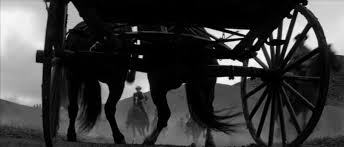
Forty Guns(Samuel Fuller, 1957) The opening to Sam Fuller's Forty Guns is typical of the director's way of giving his films a "thesis statement", or as he himself put it "if you're going to make a movie, the opening oughta give ya a hard-on!" Well, that may not literally be true (although Fuller isn't too subtle about the phallic imagery of guns...and the women and men who handle them in the film), but there is a lot of dynamism in that opening sequence, even if nothing much actually happens in it. Other than to tell you...you are watching a Sam Fuller movie! The first shot is vast and empty, with a tiny wagon in the lower quadrant of the shot, in an instant showing you the isolation of the West and the vast distances one has to travel to get anything done in this world.
Inside the wagon are the Bonell boys on their way to the town of Tombstone (aren't we all?) on business: youngest brother Chico (Robert Dix) is going to board the stage at Tombstone to California, where, reluctantly it seems, will start a life of farming; oldest brother Griff (Barry Sullivan) is a former gunslinger, now working for the Attorney General's office, heading to Tombstone to arrest Howard Swain (Chuck Roberson) for mail robbery; mid-son Wes (Gene Barry) is riding along as Griff's "second gun"—always at the ready if Griff needs an extra gun protecting his back.
Just then, a veritable posse of forty one riders on horses descends from the hills and heads right for them on the same road, then splitting up, galloping on either side of the stilled wagon, its horses spooking from the challenge of so much momentum heading in their direction. Now, you'd think with all that space that such a collision would be nearly impossible to happen. But, that's part of Fuller's point—the land is vast, but seems to narrow dangerously once people get involved...especially people who always think they have the right of way.
Leading the pack by several lengths is a white horse ridden by a woman, Jessica Drummond (Barbara Stanwyck), and the missed altercation in the middle of nowhere speaks volumes about the character: daughter of one of the territory's great landowners, she has taken control of the ranch and wields a great deal of power of the county and the town. Her beloved brother Brockie (John Ericson) is a bit of a loose cannon and he and Swain are part of Drummond's outfit of forty gunmen who act as her ranch-hands, enforcers, and spies. She also has her thumb on Tombstone sheriff Ned Logan (Dean Jagger), no doubt hand-picked by Drummond to keep control over the town and free sway to her men.
But, the balance of power shifts a bit when the Bonnell brothers come to town; when Brockie Drummond drunkenly challenges Marshall John Chisum (John Ford favorite Hank Worden) and cripples him with a shot to the leg (then proceeds to terrorize the town) Griff walks down Main Street to challenge Brockie—with brother Wes backing him up, strategically drawing a bead on the miscreant from a gunsmith shop window. As the town-folks scatter, Griff walks without hesitation and with a straight path to the drunken Drummond looking him in eyes before he takes his unceremoniously takes out his gun and cold-cocks him knocking him unconscious.
That's an "out there" sequence, risible, especially when someone recognizes Griff because "nobody walks like that," but there is a power to it because Fuller cuts between a track-in shot of Brockie awaiting his fate and the tight close-up of Griff's eyes staring him down as he moves toward him. The thought immediately comes to mind: "Oh, so that's where Sergio Leone got the idea..."
Griff's clocking of Brockie sets up a new dynamic in town. The kid is jailed, but the Drummond lawyer fast-tracks his release and the judge is a Drummond lackey, too. But Jessica is appreciative of the fact that Griff didn't just shoot her brother and be done with it. Truth is, Griff hasn't had to kill anybody in ten years and he'd just as soon keep that streak going. When Griff shows up at the Drummond spread (during formal dinner) and arrests Swain, Jessica doesn't put up much of a fuss. In fact, she offers Griff a job ("I need a strong man to carry out my orders," she says—"And a weak man to take them," counters Griff) which he refuses. Still, the two are taken with each other, despite the opposing circumstances.
Curio in a gunbarrell: Wes sets his sights on Louvenia
Wes has his own interests. His earlier impromptu post at the gunsmith's has put him in the sights of the gunsmith's daughter Louvenia (Eve Brent)—who is actually more of the master craftsman than her father—and he decides he might want to settle down in Tombstone and become the marshal, replacing the crippled Chisum. But, the arrest of Swain, Brockie's inherent squirrelliness, makes the town a dangerous place for the Bonnell boys, just for being associated with Big Brother Griff.
But, even the bad guys, though slow to see a shift in power, realize that things might be changing and their sway over Tombstone might be coming to end—the easy way that Jessica turns Swain over to Griff, for instance (she doesn't want the controversy or the association with a mail-robber), how she dismisses everyone from her dinner table to speak with the agent alone. The weak man who has been taking orders from Drummond, Sheriff Logan, decides to take matters into his own hands.
Power-dynamic in conversation by Sam Fuller in 2-D: Logan talks to Jessica, blocking her view of Griff, but Fuller has them looking right at each other.
Logan sets up the killing of Swain (in jail—a neat trick) and an ambush of Griff Bonnell in a back-street (very few of those) in Tombstone to both throw suspicion off Jessica and keep Griff from doing any more damage. But, there's something more to it, too. Logan is such a conniving little milksop (and Jagger doesn't quite pull off the complexities of the character—perhaps, like Stanwyck and Sullivan, he shouldn't have tried and let the text do the heavy lifting informing their performances, lest it descend into camp), perhaps he's thinking he's also removing a romantic rival, a notion that, like all of his plans, are a bit half-baked.
Power dynamic by Sam Fuller in 3-D: Griff about to be ambushed by the fellow in the window...if he steps forward
And any romance between Griff and Jessica wouldn't be half-baked, but a slow-burn. Their relationship is contentious but respectful at arm's length with the sort of barbed back-and-forth that Stanwyck has been perfecting since Baby Face and made an art of in Double Indemnity (this even has a variant of "I wonder if you wonder"—"I'm sure you're sure.") "You look upset." "I was BORN upset." "I was bit by a rattlesnake here when I was 15." "Did the rattlesnake die?" For two other righteous individuals them would be fightin' words (or you would at least smile when you say that), but it seems to have fan the flames of love out in the desert. But, what seals the deal is Griff saving Jessica from being dragged by a horse in the middle of a tornado. You read that right—being dragged by a horse in the middle of tornado.
Forty Guns does not compromise, takes chances, and constantly jumps the fence in the corral of the usual western fair, even while it celebrates the genre's past and, especially in the films of Sergio Leone, anticipates its future.
Seventy eight years ago tonight (at 8 pm EST, in fact), Orson Welles chose to do a radio broadcast just for Hallowe'en—a radio adaptation of H.G. Well's novel of "The War of the Worlds" on his "Mercury Theater On the Air" broadcast on the CBS radio network. Welles' "Mercury Theater" show was not that popular, and so a lot of people didn't hear the introduction of the piece stating clearly that it "presenting 'The War of the Worlds' by H.G. Wells"; most of those listening to the radio at that time of the evening were listening to the more popular "The Chase and Sanborn Hour", which featured ventriloquist Edgar Bergen and his dummy Charlie McCarthy (yes, a show with a ventriloquist was very popular on radio). But, twelve minutes into the comedy show, there was a song interlude, and people did then what they do now—they surfed the dial, looking for something better until the segment was over and they could turn back. And what they found was this:
At about twelve minutes in, the broadcast was just getting interesting: a faux dance music program was being presented and interrupted by "news bulletins" reporting that plumes of incandescent gas had been seen leaving the planet Mars and headed for Earth. A "return to scheduled programming." Then another interruption saying that meteorites have landed near Grover's Mill, New Jersey (as opposed to Woking, Surrey in Wells' novel) and Princeton expert Professor Richard Pearson (Welles) is brought in to speculate that there is no life on Mars. The next segment is a "live report" from Grover's Mill where "reporter Carl Phillips" (played by Frank Readick, who had "prepped" for this segment by listening to reporting of the explosion of The Hindenburg) reports on the opening of the cylindrical meteorites, the appearance of tentacled creatures wielding a death beam that incinerates the crowd... And then...silence.
The original script (by the ubiquitous Howard Koch) was deemed too dull by Welles, and a new draft was created, inspired by an Archibald MacLeish radio-play "Air Raid" (in which Welles had appeared). The idea was not to dramatize events as in the novel, but to use the medium of radio to provide the context and the drama of how such an invasion might play out under the circumstances and over the air-waves. More than the audio of a staged play (as most of these things were), it was very much of its source—a radio-play, by, of, and about the experience of getting the news live over this new medium, unfiltered and immediately...without a chance for resolution.
"Panic" may be too strong a word for the result, and the newspapers played it up to discredit the reliance of radio for news,* but there were many, many, many people who heard the simulated news-casts and, now used to recent advances that allowed "news flashes" interrupting programming, and at a time when Germany was making moves on Austria and Czechoslovakia, took them for the real thing. A cursory search on the dial would have told them that the only network broadcasting the events at Grover's Mill was CBS, but the events were so compelling that not many switched away. Some merely left their radios in their panic to avoid "the coming invasion." It wasn't until the 43 minute mark in the broadcast (which ran no commercials as it was not sponsored) that the network broke in to remind listeners that they were, in reality, listening to a radio-play. This was necessitated as the CBS switchboard in New York was flooded with calls to the point of incapacitation.
For Welles, three things happened: he became a nationwide celebrity, "The Mercury Theater On the Air" got a sponsor and became "The Campbell Soup Hour", and Welles was lured to Hollywood by RKO Studios, where they hoped he might make a film of "The War of the Worlds," to cash in on the notoriety. He had other plans.
A film of "The War of the Worlds" would have to wait.
The War of the Worlds(Byron Haskin, 1953) Twenty five years after Welles' broadcast, George Pal made a Technicolor movie out of Wells' novel. Like the radio broadcast, it updated the story for the times. The time is the present and the phenomenon is world-wide while the film concentrates on cylinders landing in Linda Rosa, California, outside of Los Angeles. By chance, Dr. Clayton Forrester (Gene Barry), a scientist involved with America's development of the atomic bomb happens to be fishing nearby when the nearest craft zooms overhead. Investigating, he finds a crowd of people, including Linda Rosa residents Silvia van Buren (Ann Robinson) and pastor Matthew Collins (Lewis Martin), her uncle. The glowing craft is giving off radioactivity and so three locals elect to stand guard until the thing cools down enough to be investigated, and Forrester elects to wait until morning in town.
Before he can return the meteorite opens up and a snake-like periscope rises from the crash. As the three men approach, the scope emits a shrieking heat-ray that atomizes them on the spot, and knocks out power to the town, alerting Forrester that something's happened and he finds out that Earth is under attack from Martian war-machines, shaped like flying manta-rays.**
** Although not a tripod as in the novel, the Martian attack-ships start off elevating on three beams of energy that then disappear (no doubt owing to the cost of animating)
The 1953 movie is interesting for its inclusion of nuclear power and weaponry into the mix—eight years after Hiroshima and amid other films that, at the time, used atomic energy to produce horrors in Nature. Religion is given far more importance in the 1953 movie than the novel (where Wells dismisses it entirely), although it proves ineffective in the short term, but is given the credit for the long-term outcome. Forrester stands in for Wells' unnamed narrator, separated from his fellow survivors and struggling to evade the war machines to get back to his wife—in the movie's instance, its the newly reunited Ms. van Buren, Forrester's former student.
Pal's version became a classic, one of the few science fiction films that the Hollywood establishment took notice of besides its receipts (in no small part due to Cecil B. DeMille's championing of it), winning a de facto Oscar for its spectacular effects combining wire-and-model work and animation (the machines were so popular they were re-used in Pal and Haskin's Robinson Crusoe on Mars). It is still well-regarded as a superior sci-fi adventure film. The Wells estate was so enthusiastic with the result that they gave Pal the pick of any of Wells' stories to make another film of. His choice was The Time Machine, which was released in 1960.
War of the Worlds(Steven Spielberg, 2005) Fifty two years after George Pal's film and sixty seven years after Welles' broadcast, Spielberg completed his unofficial trilogy of Earth invasion films (after Close Encounters of the Third Kind and E.T. the Extra-terrestrial) with his own version of the Wells story, again, updated for the times and without the article "the" in the title, so as to avoid confusion with the original. The invasion is, once again, world-wide, although attention is centered on the east coast of the United States. This "War" was made within the memory of the 9/11 attacks, as Spielberg stages large infrastructure-dusting battles that tip over intersections and vaporize human beings (leaving their clothes to float empty to the ground). The attackers are not named as "Martians" but acknowledged as "other-worldly" with a suspiciously complicated origin—evidently, they've been long buried in the Earth, only needing the transmission of a spirit via lightning storm that simultaneously energizes the war-machines and knocks out the surrounding power grid. These machines are more the design of Wells' original intent—ungainly tripods that still manage to do sizable damage with its heat-rays, black smoke, and red vegetation that carpets the area in a means of terra-forming (all from Wells' source novel).
Although it may seem like a "typical" Spielberg project, it is an odd blend of Wells' and Spielberg's sensibilities, and in fact, anti-Spielberg sensibilities. Wells' story was about his narrator trying to get back to his wife amidst the chaos of the war. Spielberg has the same story-line, but his protagonist is another Spielberg "common man" (or as common as Tom Cruise will allow himself to be), who must rise to the occasion—in this case Cruise's Ray Ferrier is a dead-beat, uninvolved dad who must get his kids back to his estranged wife, amidst all the chaos.
Given that CE3K and ET were films by a less mature Spielberg that broke families apart, while offering them a glimpse of the heavens, this time, Spielberg's protagonist is doing everything he can (as in Wells' novel) to re-unite his family. Spielberg has grown up by the time these aliens visit Earth. And yet, for all his heroics, the film has more in keeping with the ending of John Ford's The Searchers, as Ferrier is left standing in the street of his in-laws' brownstone (and they're played, naturally, by Gene Barry and Ann Robinson from the '53 version), satisfied enough that he has brought them together, but acknowledging that he is still an outsider without regard for acceptance as reward. He's done what he should have been doing all along. And mature enough now to not expect anything from it. It's one of my favorite Spielberg endings.
* The Slate article preceding this asterisk debunks the myth by citing lack of evidence—not the most reliable indicator—but what's strange is that when stations repeat the stunt (as reported on Radiolab's episode about the broadcast), the results tend to skew the same way. There are always going to be a few that will panic, and with mob-mentality as an accelerant, things can get out of hand...even for Martians to handle.
 Thunder Road (Arthur Ripley, 1958) A B-movie curiosity that has gained cult status, especially in the southeast corner of the U.S., usually neglected by Hollywood. Although beloved by its corps of loyalists (there are "Thunder Road" fests every year), most folks only know it from writer-producer-composer-star Robert Mitchum's driving recording of the film's theme song. He co-wrote that song, as well as it's love ballad "The Whipoorwill," sung in the film by Keely Smith, the exotic—if dead-pan—wife-chanteuse of the Louis Prima Band.