Showing posts with label H.G. Wells. Show all posts

Thursday, July 30, 2020

The Time Machine (1960)

The Time Machine (George Pal, 1960) We are all time-travelers, really, moving forward into the future one second at a time, for that is the natural order of things. The trouble comes when we want a little more speed...or go back, which is unnatural and out of order. Perhaps there is a core-wisdom to not want to live in the past or skip ahead to our future. But, folks have been writing time-travel stories since the Mahabharata (if we're to believe Wikipedia) because wouldn't it be nice to go back in time to meet this person, or to right a wrong, or because just now you thought of the perfect come-back you wish you had then.

It is speculated that time slows down, relatively, the closer you get to the speed of light (299,792,458 meters per second—it's just not a good idea; it's the law) or, more recently conceived, to a massive gravity source—say, a black hole. And there is speculation that by going faster than the speed of light, one could out-race time and catch up with it (as if it was a single-stream device, like a TIVO). Anyway, it worked (or will work) on "Star Trek."* 

Either way, back, or forth, it seems it takes a lot of effort and energy for so little time.

It's all theory, though. Tick-tick-tick is the speed of things. At least for now.


And...now.
In George Pal's version of the H.G. Wells novel, the time is January 5th, 1900. H. George Wells (Rod Taylor) stumbles (just in time) into the pre-arranged meeting with his friends and acquaintances, David Filby (Alan Young), Dr. Philip Hillyer (Sebastian Cabot), Anthony Bridewell (Tom Helmore), and Walter Kemp (the ubiquitous Whit Bissell), and he looks bruised and bedraggled. He has a story to tell them about how he got that way—over his last few hours—and it has a lot to do with their meeting the week before—one that ended with much scoffing and condescension about George's crazy ideas. 
At that meeting (as he reminds them), he posited the invention of a machine to cross "the fourth dimension"—time. He showed them a model, which—at the press of a switch—disappeared, and explaining to his gob-smacked and uncomprehending friends who wondered where it went that it was not a question of "where" it went but "when." The little model is still there, in that room, it's just in another time—where they are not. Philosophically, George is concerned that, with the Boer War going on and strife everywhere, that the answers to man's struggles must be in the future and he intends to see.
To a man, they are practical...and skeptical. His ideas and skills would be better put to helping the war effort, but George cannot be dissuaded. Fearing for his mind, Filby encourages George to see in the New Year with his family, but Wells refuses but assures his friend that he won't walk beyond his door that night. And, indeed, he won't. George decides to do that thing that all visionaries should be wary of—experimenting on oneself—and tests his full-size version of his time machine to travel, tentatively, into the future. He stops in 1917 and things have changed a bit—he monitors changes in fashion from a mannequin in a shop window across the street. Taking a tentative look outside, he runs into a person he thinks is Filby—but it's actually his son. Filby is dead and buried, and his son has just returned from The Great War. That doesn't auger well for Wells' dream of a better world, so he presses on.

A second trial takes him past WWII, where his time machine feels the effects of the blitz and he sees his rural town become surrounded by skyscrapers. Stopping in 1966, he's just "in time" to witness a nuclear bombardment that he only manages to escape with his machine. Volcanic activity leaves him sealed in a cave and he punches forward through time until erosion has taken its time and he can see daylight again. He stops at  October 12, 802701. And the world has changed considerably.
Oh, there's oxygen, conveniently—the nuclear winter and volcanic activity seems to have subsided and formed a livable atmosphere after 802,000 years. The Earth that he encounters is verdant, lush, and judging from the life-forms  appears to be in Malibu by way of Logan's Run.** Everybody is in their early 20's, are model-proportioned, and have sun-bleached blond hair (they're also extremely passive preferring to hang out by the river, and if someone falls in and is in danger of drowning, nobody helps—perhaps they're federal employees!)
But, these aren't the only bipeds roaming about in the 803rd century, merely the ones who see the light of day. Life has bifurcated to include another life-form that lives underground in a subterranean power-plant of tunnels and caves. These are the Morlocks, who prey—and feast—upon the youngsters (who should be called "Veal," but are, instead, called the "Eloi," who are beckoned to the underground chambers by a summons from a pyramid-like structure resembling a temple.
George is aghast at this, and by the Eloi's compliance; when a herd of Eloi is beckoned (including a comely Eloi he has become besotted with (played by Yvette Mimieux), he invades the Morlock Masonic and goes all "Spartacus" on them, inspiring a revolt against the Morlocks and saving the Eloi to return to a life of..."whatever" (that's exactly what they seem to be returning to...a life of "what-everrr") Despite his feelings for "Weena"—as he calls her—he decides to power up his time-machine and return to his present time...for a time, anyway.
It's a good little adaptation of the Wells book, full of fine antiquated period detail and adolescent thrills—if you're not thinking about it too much—which is a mark of the films of George Pal, ever-concerned with the whiz-bang image (effects are usually done in brisk stop-motion sequences) and, if there's a message, best to leave it immersed in sub-text or the basic DNA of the source. And Rod Taylor fit the bill for the type of just-charismatic-enough-for-the-budget star. Taylor hailed from Australia—adept enough that you'd never know it from the expert lack of accent (you could swear he was Canadian!), filtered down by years of stage, film and television work (this was his first starring role)—and makes a fine adventurer to identify with.

The film was remade in 2002 with Guy Pearce, and Nicholas Meyer made an excellent "cousin" film, Time After Time, in 1979. We'll be looking at the latter...some time.
Now, a final note about time-travel: don't dress lightly. 

The trouble with the depictions that we've seen is that they're a bit myopic—at least according to professional physics buzz-kill Dr. Neil Degrass Tyson. All time machines we've seen have been neatly rooted to the ground (at least, The Time Machine acknowledged that the very surroundings that it existed on would change over time). But, even as we're moving through time, so is the Earth. So is the Universe. 

But let's simplify it. In the same way that a plane has to aim for the spot its destination will be at the time of arrival, you also have to do on a more cosmic scale. The Earth travels in its orbit around the sun at 29.78 km/s. So, that means if we wanted to travel, let's say, a day in the future, we should take a rocket to the point where the Earth would be in 24 hours, which would be 1,598,784 miles down the ecliptic. Say we did travel 24 hours in time; without compensating for the constant movement of the Universe, we would end our time-journey with the Earth "'way over there", and we'd be gasping for air before our lungs would explode...because we'd be in space.

Always wear a space-suit when time travelling, kids (and take PLENTY of oxygen) because you may know WHEN you'll show up, but you might not know WHERE.
"Missed it by that much..."


* Michael Crichton's "Timeline" proposed a simpler, more catastrophic solution to time-travel; it can't exist. "Time" doesn't flow as is the conception of pre-quantum time-travel stories—"Time doesn't pass; we pass" says a tech in it—and that what has been more romantically termed "time travel" is actually space-travel to another dimension in the multi-verse that has branched off. One could "travel" to those alternative branches by atomizing the human body and, upon reaching that dimension, reconstructing the physical form from its genetic map. Sounds really, really complicated, but, again, it worked "so well" on "Star Trek." 
Transporter accident as imagined by the late, great Mort Drucker
* I didn't know this until I was doing some research on Pal, but he was trying to get a "Logan's Run" adaptation as early as 1968.

Sunday, October 30, 2016

The War of the Worlds Through the Years

Seventy eight years ago tonight (at 8 pm EST, in fact), Orson Welles chose to do a radio broadcast just for Hallowe'en—a radio adaptation of H.G. Well's novel of "The War of the Worlds" on his "Mercury Theater On the Air" broadcast on the CBS radio network. 
  
Welles' "Mercury Theater" show was not that popular, and so a lot of people didn't hear the introduction of the piece stating clearly that it "presenting 'The War of the Worlds' by H.G. Wells"; most of those listening to the radio at that time of the evening were listening to the more popular "The Chase and Sanborn Hour", which featured ventriloquist Edgar Bergen and his dummy Charlie McCarthy (yes, a show with a ventriloquist was very popular on radio). But, twelve minutes into the comedy show, there was a song interlude, and people did then what they do now—they surfed the dial, looking for something better until the segment was over and they could turn back.

And what they found was this:

At about twelve minutes in, the broadcast was just getting interesting: a faux dance music program was being presented and interrupted by "news bulletins" reporting that plumes of incandescent gas had been seen leaving the planet Mars and headed for Earth. A "return to scheduled programming." Then another interruption saying that meteorites have landed near Grover's Mill, New Jersey (as opposed to Woking, Surrey in Wells' novel) and Princeton expert Professor Richard Pearson (Welles) is brought in to speculate that there is no life on Mars. The next segment is a "live report" from Grover's Mill where "reporter Carl Phillips" (played by Frank Readick, who had "prepped" for this segment by listening to reporting of the explosion of The Hindenburg) reports on the opening of the cylindrical meteorites, the appearance of tentacled creatures wielding a death beam that incinerates the crowd...

And then...silence.

The original script (by the ubiquitous Howard Koch) was deemed too dull by Welles, and a new draft was created, inspired by an Archibald MacLeish radio-play "Air Raid" (in which Welles had appeared). The idea was not to dramatize events as in the novel, but to use the medium of radio to provide the context and the drama of how such an invasion might play out under the circumstances and over the air-waves. More than the audio of a staged play (as most of these things were), it was very much of its source—a radio-play, by, of, and about the experience of getting the news live over this new medium, unfiltered and immediately...without a chance for resolution. 

"Panic" may be too strong a word for the result, and the newspapers played it up to discredit the reliance of radio for news,* but there were many, many, many people who heard the simulated news-casts and, now used to recent advances that allowed "news flashes" interrupting programming, and at a time when Germany was making moves on Austria and Czechoslovakia, took them for the real thing. A cursory search on the dial would have told them that the only network broadcasting the events at Grover's Mill was CBS, but the events were so compelling that not many switched away. Some merely left their radios in their panic to avoid "the coming invasion." It wasn't until the 43 minute mark in the broadcast (which ran no commercials as it was not sponsored) that the network broke in to remind listeners that they were, in reality, listening to a radio-play. This was necessitated as the CBS switchboard in New York was flooded with calls to the point of incapacitation.

For Welles, three things happened: he became a nationwide celebrity, "The Mercury Theater On the Air" got a sponsor and became "The Campbell Soup Hour", and Welles was lured to Hollywood by RKO Studios, where they hoped he might make a film of "The War of the Worlds," to cash in on the notoriety. He had other plans.  

A film of "The War of the Worlds" would have to wait.
••••••••••••••••••••••••••••••••••••••••••••••••••••••••••••••••••••••

The War of the Worlds (Byron Haskin, 1953) Twenty five years after Welles' broadcast, George Pal made a Technicolor movie out of Wells' novel. Like the radio broadcast, it updated the story for the times. The time is the present and the phenomenon is world-wide while the film concentrates on cylinders landing in Linda Rosa, California, outside of Los Angeles. By chance, Dr. Clayton Forrester (Gene Barry), a scientist involved with America's development of the atomic bomb happens to be fishing nearby when the nearest craft zooms overhead. Investigating, he finds a crowd of people, including Linda Rosa residents Silvia van Buren (Ann Robinson) and pastor Matthew Collins (Lewis Martin), her uncle. The glowing craft is giving off radioactivity and so three locals elect to stand guard until the thing cools down enough to be investigated, and Forrester elects to wait until morning in town. 

Before he can return the meteorite opens up and a snake-like periscope rises from the crash. As the three men approach, the scope emits a shrieking heat-ray that atomizes them on the spot, and knocks out power to the town, alerting Forrester that something's happened and he finds out that Earth is under attack from Martian war-machines, shaped like flying manta-rays.** 
** Although not a tripod as in the novel, the Martian attack-ships start off
elevating on three beams of energy that then disappear
(no doubt owing to the cost of animating)
The 1953 movie is interesting for its inclusion of nuclear power and weaponry into the mix—eight years after Hiroshima and amid other films that, at the time, used atomic energy to produce horrors in Nature. Religion is given far more importance in the 1953 movie than the novel (where Wells dismisses it entirely), although it proves ineffective in the short term, but is given the credit for the long-term outcome. Forrester stands in for Wells' unnamed narrator, separated from his fellow survivors and struggling to evade the war machines to get back to his wife—in the movie's instance, its the newly reunited Ms. van Buren, Forrester's former student.
Pal's version became a classic, one of the few science fiction films that the Hollywood establishment took notice of besides its receipts (in no small part due to Cecil B. DeMille's championing of it), winning a de facto Oscar for its spectacular effects combining wire-and-model work and animation (the machines were so popular they were re-used in Pal and Haskin's Robinson Crusoe on Mars). It is still well-regarded as a superior sci-fi adventure film. The Wells estate was so enthusiastic with the result that they gave Pal the pick of any of Wells' stories to make another film of. His choice was The Time Machine, which was released in 1960.

••••••••••••••••••••••••••••••••••••••••••••••••••••••••••••••••••••••

War of the Worlds (Steven Spielberg, 2005) Fifty two years after George Pal's film and sixty seven years after Welles' broadcast, Spielberg completed his unofficial trilogy of Earth invasion films (after Close Encounters of the Third Kind and E.T. the Extra-terrestrial) with his own version of the Wells story, again, updated for the times and without the article "the" in the title, so as to avoid confusion with the original. The invasion is, once again, world-wide, although attention is centered on the east coast of the United States.

This "War" was made within the memory of the 9/11 attacks, as Spielberg stages large infrastructure-dusting battles that tip over intersections and vaporize human beings (leaving their clothes to float empty to the ground). The attackers are not named as "Martians" but acknowledged as "other-worldly" with a suspiciously complicated origin—evidently, they've been long buried in the Earth, only needing the transmission of a spirit via lightning storm that simultaneously energizes the war-machines and knocks out the surrounding power grid. These machines are more the design of Wells' original intent—ungainly tripods that still manage to do sizable damage with its heat-rays, black smoke, and red vegetation that carpets the area in a means of terra-forming (all from Wells' source novel). 
Although it may seem like a "typical" Spielberg project, it is an odd blend of Wells' and Spielberg's sensibilities, and in fact, anti-Spielberg sensibilities. Wells' story was about his narrator trying to get back to his wife amidst the chaos of the war. Spielberg has the same story-line, but his protagonist is another Spielberg "common man" (or as common as Tom Cruise will allow himself to be), who must rise to the occasion—in this case Cruise's Ray Ferrier is a dead-beat, uninvolved dad who must get his kids back to his estranged wife, amidst all the chaos. 
Given that CE3K and ET were films by a less mature Spielberg that broke families apart, while offering them a glimpse of the heavens, this time, Spielberg's protagonist is doing everything he can (as in Wells' novel) to re-unite his family. Spielberg has grown up by the time these aliens visit Earth. And yet, for all his heroics, the film has more in keeping with the ending of John Ford's The Searchers, as Ferrier is left standing in the street of his in-laws' brownstone (and they're played, naturally, by Gene Barry and Ann Robinson from the '53 version), satisfied enough that he has brought them together, but acknowledging that he is still an outsider without regard for acceptance as reward. He's done what he should have been doing all along. And mature enough now to not expect anything from it.

It's one of my favorite Spielberg endings.


* The Slate article preceding this asterisk debunks the myth by citing lack of evidence—not the most reliable indicator—but what's strange is that when stations repeat the stunt (as reported on Radiolab's episode about the broadcast), the results tend to skew the same way.  There are always going to be a few that will panic, and with mob-mentality as an accelerant, things can get out of hand...even for Martians to handle.

Thursday, October 27, 2016

The Island of Lost Souls (1932)

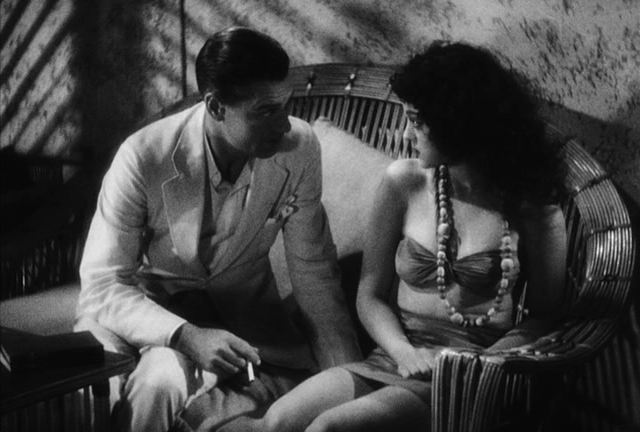
The Island of Lost Souls (Erle C. Kenton, 1932) You gotta be careful who you meet in your travels. As they say in Casablanca, there are vultures...vultures everywhere. Thing is, on The Island of Lost Souls (based on H.G. Wells' oft-filmed "The Island of Dr. Moreau"), they just might be vultures, literally.

Or, at least, some human-vulture hybrid.

Edward Parker (Richard Arlen), though, will take any port in a storm. Ship-wrecked, he's picked up by a freighter delivering supplies to a nearby island. After Parker causes some trouble after seeing the Captain attack one of the crewmen, he is thrown off the ship to the boat that meets it to pick up the supplies. It is manned by Montgomery (Arthur Hohl) and Dr. Moreau (Charles Laughton), and the doctor is only too happy to take the ship-wrecked Parker to his island.
It's not a pretty sight.  All jungle and dark and creepy, until Moreau introduces him to a young native named Lota (Kathleen Burke), who is entranced with Parker. While Parker tries to carry on a conversation with her, screams are heard, which frighten them, but mostly Lota, who enigmatically says that they come from "The House of Pain."
Parker investigates and finds Moreau and Montgomery performing surgery on a strange creature on an operating table. Alarmed that his host is a madman, Parker tries to leave the island but is stopped by a crowd of deformed brutes, until Moreau appears, cracks his whip and forces the creatures to obedience, making the Sayer of the Law (Bela Lugosi) recite the rules, which are echoed by the other creatures: 

Not to eat meat, that is the law. Are we not men?
Are we not men? 
Not to go on all fours, that is the law. Are we not men? 
Are we not men?
Not to spill blood, that is the law. Are we not men? 
Are we not men?

"Are we not men?"  Not just a Devo lyric (remember this was 1932. slightly before "their time"), but a profound question of identity. Turns out Moreau is a mad-man with God aspirations, an anti-Frankenstein, the difference being the German doctor was trying to bring life back from death, whereas the doctor with the South Seas practice is altering life, trying to "do" Darwin generations faster by "un-natural selection"—surgically, chemically, any way he can think of, attempting to turn animals into homo sapiens.
And doing a bad job, by the looks of it. The pre-code movie Moreau presages Dr. Mengele's work for the Nazis by a few years, with vivisection as a specialty, and dictator as a hobby.* Having started with plants and moving on in his designs, his hybrids live as beasts and only the one subject that has yielded the best results—Lota, "the Panther Woman"—has met his standards. Sociopathic in his methods, Messianic in his goals, he sees throwing Lota at Parker as an experiment in biology. Nothing more. And Laughton plays the scene like an avid voyeur.

Subsequent films have been make-up experiments to see how realistically latex can be applied to actors to make the illusion playable. The Island of Lost Souls does a fine job of it, but is expressly concerned with making the hybrids monsters, and the situation nightmarish (as opposed to believable). Realism isn't the goal with this version, so much as driving home the point of the novel (although Wells thought the result was completely different. burying the novel's intentions in horror—he was spared having to see the other versions).  

It should also be noted that this movie has nothing to do with Snapchat filters.
This movie inspired the phrase "The natives are restless."  No.  Really.

* "Moreau" has been filmed a couple times (once with Burt Lancaster and most recently with a risible Marlon Brando as Moreau, that was frankly a bit incomprehensible), but in those scenarios, the methods have been "magical" injections that can turn men to beasts and/or vice versa, more in tune with Dr. Jekyll than Dr. Moreau.  Supposedly, there's a new one in the works from Leonardo DiCaprio's company.