So, just for a refresher course, we are going to sub-set the "Spies" series we're doing with movies where there are Nazi's (you know, "the bad guys"—Indiana Jones fought them in Raiders of the Lost Ark!)
And we're going to call it "Nazi's...Nazi's everywhere."
Oh. And "Saturday is "Take Out the Trash" Day...
 The Quiller Memorandum (Michael Anderson, 1966) This low-key spy film came out in the Christmas glut of 1966, competing with two other spy films released at the same time: Funeral in Berlin, the second Harry Palmer film to star Michael Caine and Murderer's Row, the second of the "Matt Helm" films starring Dean Martin.
 Blame Bond.
The success of the James Bond series in the 1960's overwhelmed the movie marketplace with secret agents in plain sight, a rolodex of acronymically named organizations, disposable starlets, and a fawning desire to seem "hip" while toeing the party-line during the Cold War. It was a very odd time.
The Quiller Memorandum slotted somewhere in between the two films, both in temperament and quality. Funeral was a typical spy film that took itself very seriously, while the Dean Martin picture was a parody of the Bond series (which itself is a bit of a parody) that took nothing seriously. And Quiller, which had an estimable cast and boasted a screenplay by Harold Pinter, should have been the best of the lot, but has a lackluster quality despite key ingredients.


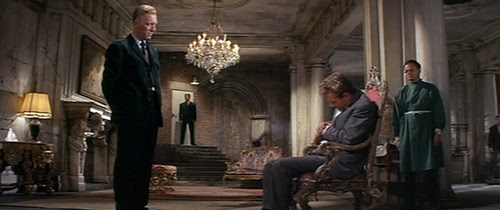
Quiller knows he's being watched, but his plan to let "the other side" know he's in town seems to be working only too well—the number of people matching his moves is starting to increase, but it is only when he is drugged*, kidnapped and interrogated by head-man Oktober (Max von Sydow) that his suspicions solidify. Perhaps his playfully losing his body-man speeding on the highway wasn't such a good strategy.
 |
| "You must be lonely sitting here among strangers." "No...I like meeting people.." |
When the drugs wear off, Oktober begins the interrogation: "My name is Oktober. What's yours?" Quiller deflects, lies, makes up fanciful stories ("They call me 'Spike'"), moving around Oktober's direct questions and attempts to appeal to the hopelessness of his situation—he already knows who Quiller is and what his past assignments are, so Quiller's cheeky replies that he's a rare book purchaser at Doubleday's named O'Reilly-Kennety ("a double barreled name I found kind of weighty"), but this gets Oktober nowhere, so he zeroes in on his specific wants.
 |
| "You got a telephone around here? I should call my lawyer in New York, a guy called Kaspensky... I'll make it collect so don't worry about that." |
Oktober seeks "the exact location of your local Control in Berlin. We would like to know a little more about your current code-systems. We would like to be able to appreciate the extent of your knowledge about us. And also, what information, if any, your predecessor managed to pass to your Control. We would like to know the exact nature of your present mission in Berlin. You're a sensible man. You know perfectly well, you must give us this information since you have no alternative." Quiller considers this, looks a bit sheepish for a few beats then asks for a telephone to call his lawyer.

Sydow goose-steps a very fine line between menace and amusement during the sequence, cracking his knuckles and speaking in a cooing, clipped German accent, cajoling, seducing, grasping at straws of information that Segal babbles under further drug injections. But, Segal, try as he might, doesn't quite sell his struggles during the interrogation, except for a weak desperation. Perhaps it's because he's previously been so cocky and glib—but not in the manner of his minders with their noblesse oblique—he's a bit of a smart-ass, and if Segal was looking to inject some comedy in a straight-ahead thriller (that everyone else is treating satirically), it's at the cost of caring what he goes through and his competence at his job.

Oktober finally tires of his efforts and gives orders for another injection and when Quiller is out cold to kill him. But, Quiller wakes up on a half-submerged pier, shoe-less and groggy, but competent enough to hijack a taxi and escape pursuers. But, the point is: he's alive when he should be dead. The Nazi's want to use him as his Division does—to lead them to the opposition. At his next meeting with Pol—far less in the open that their previous one—Guinness' spy-master spells it out, using muffins:
 |
| "Let me put it this way. There are two opposing armies drawn up on the field but there's a heavy fog- they can't see each other. Oh, they want to, of course, very much. You are in the gap between them. You can just see us, you can just see them. Your mission is to get near enough to see them, to signal their position to us so giving us the advantage. But if, in signaling their position to us, you inadvertently signal our position to them it is they who will gain a very considerable advantage. That's where you are, Quiller. In the gap." |

It's the most obtuse of missions without an end-game. Find out where they are, but don't tell them where we are. And Quiller, not sure of either side—having been set up as bait—and being used by friend and foe alike for the exact same purpose, becomes what he babbled under narcotics—"I am my own master." He'll do the job—give them the address of the Nazi base—but will do it his way, not telling them how, lest he be betrayed.

The film is so subtle for most of its length that when the film attempts to do something big, it comes off as ham-fisted, a bit like Segal's choice of mannerisms, played for comedy and without a lot of nuance. One wonders why he makes the choices he did, but one also wonders what would have happened to the overall tone of the film if the first choice, Charlton Heston had managed to secure the deal. One does not think it would be for the better.

Anderson's direction is better with location than people. Every so often, one gets a good composition with a cluster of actors in it, but most of the time, the shots are perfunctory and sometimes a bit clumsy, as with the shot of Senta Berger below. So much wasted space there, when he could have shown the gulf existing between Quiller and Ilsa—both kept alive as useful tools of the new Nazi's—by careful use of the widescreen format (even if subsequent versions have been cropped).

It's a last-minute "save" that communicates a wistful dread at what the future will hold, the battle being won but the war being lost.

* The weaknesses of Pinter's script and Anderson's direction is on display right there. Quiller is knocked in the leg by a suitcase as he's leaving his hotel, turns around and demands "What's your name?" of the clumsy man, then walks to his car and flies on the Autobahn for several minutes to lose his handler. At a stop-light, the picture tilts and goes out of focus and one may wonder why Quiller is acting a bit stupid that he gets snatched. When he's strapped down by his inquisitors, he puts two and two together, and turns and looks at the man who bumped him (separate close-up of the man). "He did it!" he says almost happily. "Oh, hi, hello!" One is in danger of missing the whole thing if one has fallen asleep waiting for something to happen...which is a danger.


