Showing posts with label Civil War. Show all posts

Wednesday, May 26, 2021

The Conspirator

Written at the time of the film's release...

"What About the Woman?"
or
"Inter Arma Enim Silent Leges"

Robert Redford's previous film—Lions for Lambs—was a self-indulgent tract on the tearing down of constitutional law in times of crisis—the short-cuts in due process and individual freedoms that occur when authorities are more concerned with short term results, rather than demonstrating the strengths that underpin the foundations of the Nation under attack. War is a very dangerous time; one must guard against attacks from without and within.

He needn't have bothered. History was already there with the same lessons, but distanced by time to demonstrate, rather than lecture and ostracize.

I was always fascinated by the Lincoln assassination and its aftermath.  As a grade-school student, I'd read books about those hysterical days following the surrender at Appomattox ending the Civil War, culminating in John Wilkes Booth's assassination of Lincoln (who, in trying to preserve the Union, had already done enough damage suspending habeas corpus during the course of the War), the man-hunt for the conspirators (whose intentions were to kidnap the President in exchange for Rebel prisoners) when Booth was killed, trapped in a burning barn, thus robbing the Nation of a cathartic trial (which probably would have been a kangaroo court anyway, to prevent the vain-glorious actor from speaking and fomenting discord in the wake of an uneasy truce). Short-cuts were made...civil trials disbanded in favor of more stringent military tribunals (sound familiar?)...and the conspirators deprived of any rights of the accused.*

Justice was thrown out the barred windows in the sake of revenge.
The Conspirator focuses
on only one of the accused,
Mary Surratt (played in the film by Robin Wright Penn), mother of conspirator John Surratt (who had fled to Virginia) and owner of the boarding house where much Virginia venom was pit during the war, along with some of the conspirators' planning sessions. Surratt was widowed, Catholic, a woman, Southern and sympathetic to its cause, all strikes against her. But that she was the mother of John was what damned her—his association with the plotters made the location of their meetings, planned or otherwise, a foregone conclusion, and her arrest and trial was national news—maybe the government could coerce the son to surrender to save the mother.
That might have worked if the government wasn't operating in the same manner the Rebels feared it would. The new President Johnson,
under advisement from Secretary of War Edwin Stanton (played by Kevin Kline, and more than making up for his performance in No Strings Attached) insured that the South would pay for Lincoln's death, just part of his crack-down on the South after the war. No insurrection, no slight would be tolerated, and justice would move fast and frequently recklessly.
Redford's film of the proceedings is
austere, but leaves no parallel with modern times (post 9/11) unparalleled. The facts are there, supported by generous newspaper headlines from the period bridging sequences, focusing on Surratt's defense by legal aide to Senator Reverdy Johnson (Tom Wilkinson), Frederik Aiken (James McAvoy, whose American accent is superb). The film is front-loaded with young stars (Evan Rachel Wood, Alexis Bledel, Justin Long) as acquaintances of Aiken's, all urging him to be cautious in his precipitously uphill battle to have Surratt acquitted, lest he fall under suspicion of the government as well. But, there are also good turns by Colm Meaney, Danny Huston, and Stephen Root, (who is fast becoming one of my favorite character actors).
There is little humor in the film, save bitter irony, but given the circumstances of the case, that is hardly unexpected. There are some subtle touches as well.  Like sunshine. Watch how Redford—always the Nature-boy—uses the sun throughout the movie (and the lack of sun). So many darkened, shuttered rooms reflecting that time of skulkers and hidden agendas. One doesn't have to make to big a leap remembering that the light of day is a natural disinfectant, especially in scurrilous times.
This is the first film of
The American Film Company, founded in 2008 by the Ricketts family, and even though it might seem tempting for the owners of the Chicago Cubs to re-write history, the purpose of the film-house is to present accurate portrayals of American History without the issuance of dramatic license.  It's a noble mission, but given that manifesto it guarantees that most of their films will not have a happy ending—I can't even think of a treaty that this Nation has agreed to and honored. One hopes that it can stay in business long enough to produce some great, accurate films about the hidden corners of the past.
The documentation of the hanging. 
Mary Surratt is on the left.


* Redford makes a cogent observation by also placing all the Ford Theater actors in custody, as well—they were, after all, associates of Booth—along with with the suspected assassins.

Tuesday, May 18, 2021

Lincoln

Noisy and Messy and Complicated
 
or 
WWLD?

At the end of John Ford's Young Mr Lincoln, "the jack-legged country lawyer" (as played by Henry Fonda) walks up a blighted horizon in the darkening gloom, as thunder rolls in the background, the rough-hewn fence he trudges along taking on the look of military barricades, as the young Lincoln walks with his long stride into the storm of history awaiting him. Steven Spielberg's Lincoln starts where Young... left off—with the sound of thunder over credits, which evolves into cannon-fire before placing us straight on in the middle of the Civil War, blue-on-gray, white-on-black (and the reverses) amid the blood and the mud of the Earth. The shots of the battlefield are tight, confusing, with no sense of place, no horizon—just a frame filled with humans killing each other by any means. No glory. No higher purpose. Just the immediacy of conflict. 
War is the point at which politics breaks down, and politics is where Spielberg's film is concerned to compare and contrast with today's stew of chicanery, graft, and playing fast and loose with the facts to the purpose of getting your way.  'Twas ever thus, and it was no different in Lincoln's time—they just didn't have cameras documenting everything then.

Young Mr. Lincoln: walking into a History still to occur.

\The approach is as good a starting place as any—that is, ending with Ford's last gambit—linking the two, as both films' main goal is to take the monument out of the man, and put him within reach of attainability, wart and all. The canonization of Lincoln began at the moment of his death with the pronunciation "now he belongs to the ages" and his visage, homely, homespun, ragged sunken and contemplative, has been preserved in nickel, bronze, marble, granite to the point where one can hardly imagine it as flesh and blood anymore. 
As portrayed by
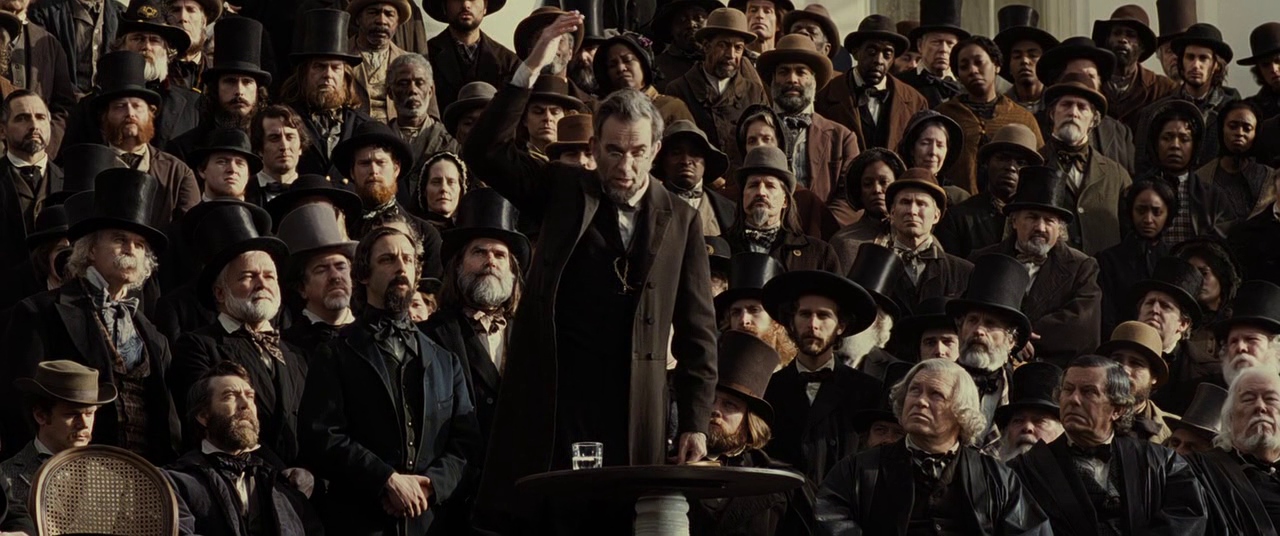
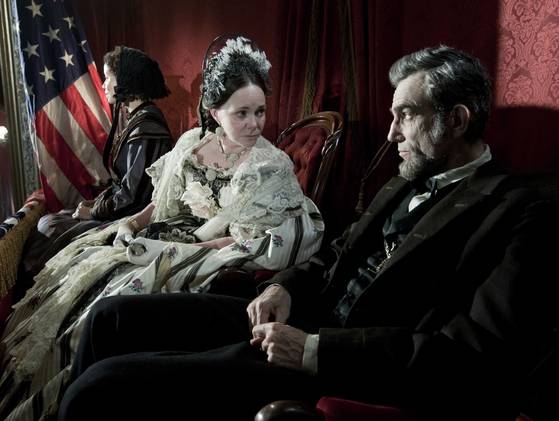
Daniel Day-Lewis, Lincoln is pitch-perfect, not only in his make-up, but his high tenor rasp of a voice, and—the remarkable part for me—in his still-legged gait that kicks and plants itself on the earth, not too steps away from the ragged dance of Wyatt Earp (Fonda, again) in My Darling Clementine. It's a big, robust cast—I had error alerts for all the names I tried to cram into this article's meta-data labels—but the hub of it all is Day-Lewis' Lincoln. Soldiers (including Lukas Haas) quote his Gettysburg Address back to him (which the President tries to staunch: "Been there, delivered that."*) His wife (Sally Field) constantly badgers him—but then she consistently badgers everybody, his cabinet is frequently frustrated by him, by his prevarications, his story-telling that constantly derails conversations to his agenda, and his thought processes which annoy them. "Actually," says Secretary of State Seward (David Straithairn) after Lincoln quotes verse, "I have no idea what you mean by that."
What he means may be too pragmatic for them, it's just how he expresses it that confounds. In one exceptional scene—Tony Kushner worked on this script for a long time and it shows—Lincoln explains in minute, often harsh, detail how he employed his newly granted War Powers Act and it comes down to what he thought he could get away with, legally.
His concern, in the waning days of the war, is to pass the 13th Amendment, thereby abolishing slavery, and it takes every trick, every dodge, every promise and appointment in the middle of a lame-duck Congress before the war could end. The timetable is critical: Lincoln has just been re-elected and is riding a wave of popularity; a crucial number of Congressmen are in their last days of their jobs and are looking to their futures and not to the wishes of their constituents; and, if the war ends, the urgency to pass the Amendment will dwindle, amidst the rebuilding of the Nation. Lincoln's Republicans will vote for it, but they need to tone down their rhetoric. The Democrats are dead-set against it, but getting Democrats to agree on anything is like herding cats and Lincoln wants to exploit the party's fractures into fissures.  
So, the problem is attacked from several fronts (if only the war had started that way): Preston Blair (Hal Holbrook), prominent Republican and journalist, is sent to the South to negotiate a Southern settlement, which the South is anxious to do (although Lincoln is reluctant). Meanwhile, he wheels and deals with the largesse of power, offering appointments, threats, anything to curry votes, and unleashes a trio of stooge-lobbyists (James Spader, John Hawkes, and Tim Blake Nelson) to press the flesh and pass the greenbacks (not "officially," though). Votes are critical. On the home-front, Lincoln's son Robert (Joseph Gordon-Levitt) is back from college, but feeling the weight of his kinship with the President and wants to enlist, which sends wife Mary Todd into another accusatory tailspin as she has barely survived the death of their son, Tad.
Throughout, Lincoln keeps his counsel. but sometimes erupts into spasms of frustrationwith "Molly" (as he calls her), the congress and his cabinet, choosing his moments and pressing his advantage, knowing no peace except what he can create for himself.
As good as Day-Lewis is, he's matched by Tommy Lee Jones as House Republican Thaddeus StevensIn chambers, Stevens sits and fumes, then reaches his limit and bursts out in loud insulting harangues, just in control enough to get his point across, and even smiling tightly—very tightly—when when dressed down by Mary Lincoln over his tight reins over The White House purse strings. Jones finds different ways to make his speeches crackle, while never betraying any sense that the words haven't sprung originally from his head. And Spielberg has given special attention to casting key roles with the like of great character actors like Bruce McGill, Michael Stuhlbarg, and Lee Pace who make their relatively small parts punch out and become memorable.
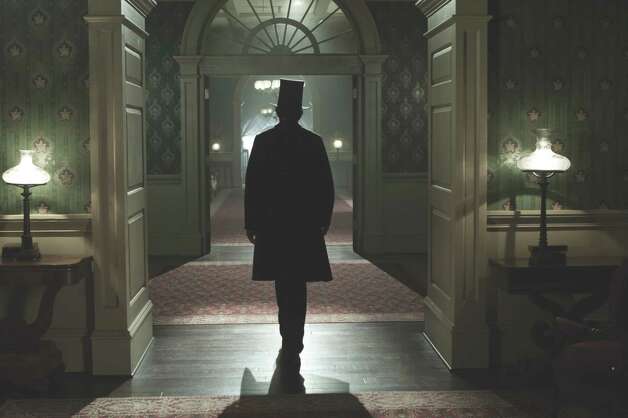
And Spielberg's eye for painterly detail shines, as Lincoln moves through the gloomy corridors of The White House or sets up an eerie dream sequence for the President. And in one lovely scene, between Lincoln and Ulysses S. Grant (Jared Harris), where the war's toll on Lincoln is expressed in Day-Lewis' exhausted eyes and the shadows of a long rank of soldiers trudging in front of a setting sun play across his face.  
You can't see the moving shadows

Spielberg's regular team of artists: Kaminski, Kahn, Carter, and Williams construct a great quilt of imagery and dynamics, making Lincoln a fascinating display of historical intimacy writ large.  It would make a superb triple bill sandwiched between Young Mr. Lincoln and The Conspirator.


* There's a nice contrast of Lincoln delivering a dedication at a flag-raising ceremony that lasts a measly few lines.  "That's my speech" he says as he tucks his paper back into his stove-top hat. They can't all be gems.

Sunday, February 3, 2019

Major Dundee

Major Dundee (Sam Peckinpah, 1965) Semi-restored version of Major Dundee that's a bit closer to the idea Sam Peckinpah had in mind when producer Jerry Bresler took the film over, edited it with a meat cleaver and threw on a wildly inappropriate score (a ranch massacre with bodies littering the desert and the main house on fire until it collapses is set to a bouncy Mitch Miller tune?* Say, what? Peckinpah has been accused of bad taste in his movies, but he'd never have pulled something as egregious as that!).

Peckinpah's first A-budget movie has a great story. A hard-nosed Union Major, Amos Dundee (Charlton Heston)** side-tracks a bit from the Civil War to capture or kill the marauding Apache chief who torched that outpost. To do so, he must cross the border to Mexico in a mission that doesn't officially exist. His requisitioned army of nobodies employs cut-throats and horse-thiefs, Confederate Rebels and Buffalo Soldiers. No one asks: Can't we all get along? It's just assumed that they can't, but a sense of order and hierarchy is maintained within the groups, while the groups test and prod each other en route.

The cast includes Richard Harris as leader of the Confederates (who has a past with Dundee), a small band made up of Peckinpah irreg'lars Ben Johnson, Warren Oates, L.Q. Jones and John Davis Chandler. Brock Peters is in charge of the Buffalo Soldiers. Slim Pickens and Dub Taylor are two of the criminals, R.G. Armstrong as a vengeful preacher and in Dundee's command are Michael Anderson Jr. (who narrates), Mario Adorf, Jim Hutton (whose character arc is almost as interesting as Harris' character's) and crusty scout James Coburn.
That's a great cast. 
And the film is full of detail (you want to see it on a big screen). There are some extraordinary screen-caps from the film below that show Peckinpah's innate ability to fuse landscape and character, not unlike John Ford, whom Peckinpah seems to emulate while presenting either a celebrational rabble or a ceremonial piety but infused with a more cynical rough-hewn presentation. I don't think John Ford would have had a soldier swatting flies away from a war wound, but I could be wrong.
Heston is a bit of an odd man out in the film, his acting rhythms are slower than Peckinpah is able to deal with in his cutting style (in fact, there's a couple places where Peckinpah cuts in the middle of Heston's reaction shots just to speed the man up a bit) and the clashes show. In an interview, R.G. Armstrong calls Heston "a poser," (which is certainly true, but also calls him "the nicest guy in Hollywood"—Heston gave up his salary to keep an embattled Peckinpah as director***), but Heston loosens up quite a bit in this film than he had in any previous one, setting a tone for his subsequent work as less heroic, more recognizably human presences.
But the movie falls apart somewhat, when the troop liberates a starving town from the French; everyone looks impoverished (even the dogs outside town are skin and bones), the exception being the widow Santiago (Senta Berger)**** whose nursing duties among the starving citizens hasn't reduced the glow in her cheeks or made her any less voluptuous. Her presence and the subsequent romance with Dundee just doesn't sit well with the grit of the rest of the movie, and so Peckinpah wounds Dundee and sets him on a rehabilitating toot that manages to negate a lot of the nobleness of the character, and undermines a couple other parts as well. 
A broken arch does not connect (and thus dooms any romance)
between Major Dundee and Teresa Santiago (Senta Berger)
Production began before a suitable third act was constructed, and Peckinpah was convinced that once filming had begun, the script would be hammered out. But production delays and disputes between the director, the studio and the producer ate up a lot of that valuable work-time. And Peckinpah began to drink, most days towards the end, showing up drunk on the set.
Peckinpah gives shape to Richard Harris' Captain Tyreen caught between
his sense of honor and loyalty to the Confederacy.

Still, up until the romance, it's a gritty, atypical Western story with integrity and a nice mature brusque edge to it. Studio interference would hamper this film and dog Peckinpah for the rest of his career.

The remains of Dundee's command escape the French across the Rio Grande.
A shot with such depth it approaches 3-D.

* The opening credits run over the shot of the house burning, and the structure collapses when the director's credit comes up. Peckinpah liked to do things like that.

** To give you a flavor of the writing by Peckinpah and Harry Julian Fink (Dirty Harry), Dundee is characterized as a "$70 red-wool, pure-quill military genius or the biggest damn fool in Northern Mexico."

*** When asked by a reporter if that would set a precedent among Hollywood actors, Heston said, "It's not even going to set a precedent with ME!" A great line.

**** Peckinpah was dissatisfied with the romance story-line imposed on the script but not the actress: Senta Berger would work with Peckinpah again (and James Coburn) in the director's fine Nazi war film Cross of Iron.


Wednesday, August 29, 2018

The General (1926)

The General (Clyde Bruckman/Buster Keaton, 1926) In April 1862, during the Civil War, a train, "The General," was stolen by a collection of Union soldiers who went hundreds of miles behind enemy lines on a sabotage mission to destroy rail-lines, snap telegraph communications, burn bridges, and generally disrupt supply and communication infrastructure for the Confederate Army by tearing up the tracks of the Atlantic and Western railroad from the town of Big Shanty (just north of Atlanta) to Chattanooga. The story is that when the Blue-legs stole the train, its conductor, one William Fuller (age merely 25), and the engineer pursued the hijackers on foot and track, by hand-car, and speeding backwards train—in other words, by any dogged means necessary—to try and stop the train-jackers, which they did for 87 miles before alerting the Confederacy of the raid. It became legendary as "The Great Locomotive Chase," when an account of the circumstances was published soon after in 1863. 
A scant 64 years later, director Bruckman had read the account and reminded film-comedian Buster Keaton about it, sparking a remembrance Keaton had of reading the story as a youth and the two began elaborate plans to tell the story as a silent feature, even going so far as trying to rent the original locomotive at that time on display in Chattanooga, for the film (they were turned down when the train's owners heard Keaton's plans for their relic was going to be a comedy).
Keaton was undeterred and found a section of the United States where vintage trains were still running—Oregon. Twenty miles south of the city of Eugene, Keaton set up shop in the town of Cottage Grove and, with a budget of $400,000, began what would many (including myself) regard to be his masterpiece, but also his greatest financial failure, which ultimately led to his selling his studio to M-G-M and being folded into their system and derailing his directing, and even his starring, career. 
It is 1861, and Johnny Gray (Keaton) is an engineer on "The General", a train of the Western and Atlantic Railroad. He pulls into Marietta, Georgia to see his sweetheart, Annabelle (Mack Sennett comedienne Marion Mack). On his visit, it's announced that war has broken out between the North and South, and Annabelle's father and brothers head into town to enlist. Johnny takes a short-cut, and gets there to be first in line, but is deeply disappointed when he is turned away—it is determined that his job as an engineer is more important to the war effort, but he isn't informed of that. All he knows is that he has been rejected, despite his repeated efforts. This makes him the subject of disdain in Annabelle's family and she tells him she will never look upon him again until he is in uniform. 
It is a year later, the war is raging, and Annabelle's father has been wounded in the war. As she goes to see him in Chattanooga, she, ironically, is taken aboard Johnny's train "The General" and, seeing him not fighting for the South, she treats him coldly. But, fate steps in. At the breakfast stop in Big Shanty, Union soldiers board the train and hijack it, taking with them a luckless Annabelle who has gone to retrieve money for breakfast from her trunk. Johnny sees the two loves of his life being stolen from the station and he gives chase, urging others to help. But, they all fall to the wayside as Johnny single-mindedly pursues, taking a hand-cart onto the tracks to try and catch up. Then, a bicycle, then another train. 
With a train that has less weight to haul, he's actually able to gain on the Union forces, but, they, fearing an army pursuing them by train—which, due to an unfortunate linkage failure is no longer true—they decide to tear their train apart to toss in the way of the pursuing train, and with which Johnny must deal as he moves along. As in the following memorably well-timed and potentially noggin'-clonking gesture:
When Orson Welles was making Citizen Kane at RKO, he stated that it was liking playing with the biggest, grandest train-set in the world. Now, imagine Keaton doing exactly the same thing with an actual train, mining the situation for every joke and "bit" he could muster as his engineer must play offense, defense and find ways to keep the train running with a limited supply of fuel and every additional structure that passes—a water tower, a large mortar (with cannonballs)—becomes the inspiration for a series of ingenious gags that alternately threaten and thrill, the two responses not being all that dissimilar. It was nothing Keaton hadn't already been doing for a decade, but, here, the work seems all the more inspired.
The General is also a movie about progress. Even as he pursues his quarry, there is a war going on in the background. In fact, he has been pursuing so long, that at some point (which he doesn't notice), Johnny crosses enemy lines. As he moves forward, Southern forces are retreating from an advancing Northern Army, but so concentrated is he in chopping firewood to stoke the engine, that he doesn't even notice. It's a joke that wouldn't work in a sound film (despite the masking thundering that a train makes while travelling, you would still probably hear a battle going on). But, in the world of silents, it's perfectly plausible and might even escape the notice of some viewers. It's here Keaton leaves History behind (the actual hijackers never made it to Chattanooga) and makes his own tracks of story, as once Johnny crosses enemy territory, he is no longer the pursuer, he is the pursued. He beats a hasty retreat.
At Chattanooga, Johnny is able to infiltrate Union headquarters without detection, and manages in his time there to rescue both Annabelle and his precious engine, heading back along the same tracks he had previously traveled—in the other direction. Only this second chase has a different dynamic: this time he and Annabelle are the ones being chased, followed by the Union soldiers on-board the very train he used to pursue them. The priority becomes keeping The General up to speed, supplying wood for the engine, while also keeping an eye on Annabelle, who has a propensity for getting in peril, or being charmingly useless, given the circumstances. 

Her priorities seem to be sweeping—not very helpful—and she's a poor judge of fire-wood, tossing away larger pieces if they have a knot in them and offering twigs as compensation. This evokes a response from Johnny where he first tries to strangle her in frustration and then kisses her for her efforts, marking a point where he loses his hapless love-sickness for her, but regains it as a stronger, more mature love, despite his frustrations with her. The character has grown, lost some of his innocence, but also deepens his feelings for her. In a microcosm, the moment is a small skirmish in The War Between Men and Women, far richer than most examples during the silent era where women were either Madonnas or Victims (but never whores) and where Men vacillated between apes and angels. It is truer than most of Keaton's romantic relationships in movies—women were either Madonnas or Frustrations, and eventually become comic props—but Keaton's protagonist, for the momentary baring of both sides of his id, seems far more transparent and far truer.
The single most expensive shot in the silent movie era.
The two are able to make it back to the Southern lines in time to warn the gray-coats and set up a trap that results in the most spectacular stunt that Keaton has ever staged—the scuttling of the Yankee locomotive by blowing up the bridge over which it is travelling. Scrupulously co-ordinated and filmed with multiple cameras, it was carried out in one unrepeatable "take." The entire production, including construction, began on May 27, 1926 and wrapped the following September 18th. By the end of it, it was rumored that the budget had grown to $1 million (some of which went to paying off local farmers for fires caused on their farms by embers from explosions and the trains), employed some 1500 locals (including 500 from the Oregon National Guard playing Union and Southern troops) and generated some 200,000 feet of film (reminiscent of the Civil War photography of Matthew Brady, as achieved by Keaton, Bruckman, and their cinematographers Bert Haines and Dev Jennings), which he edited over three months for a late December release.
The reviews were brutal at the time and the film lost money, changing Keaton's fortunes and earning him a reputation that prompted closer scrutiny of his film-making and budgets. But, posterity has been far kinder and more generous, and the film has been watched—or "scrutinized" far more than other films of the Silent Era. In 1971, Orson Welles called it "the greatest movie ever made about the Civil War."* In 1972, it was ranked #8 in the BFI's Sight & Sound Magazine poll of the greatest movies ever made (it was ranked #12 in 1982 and #32 in 2012). In 1989, the first year of its inception, it was voted into the United States Film Registry by the Library of Congress. It was the first silent era film to be issued in the HD format of Blu-Ray, and its legacy lingers on influencing the works of Chuck Jones, Blake Edwards, Steven Spielberg, Gore Verbinski, and anybody else who aspires to the gracefulness of visual comedy on film.


*

Tuesday, August 1, 2017

The Beguiled (2017)

Some Real Southern Hospitality
or
"Seems Having the Soldier Here is Having an Effect"

One can't mention Sofia Coppola's film of The Beguiled without saying that it is a remake of the 1971 collaboration between Clint Eastwood and his favorite director Don Siegel—the film credits the source novel by Thomas Cullinan (originally called "The Painted Devil"), but also the original's screenplay by Albert Maltz and Irene Kamp (both written under psuedonyms). It is one of the few box-office failures of Eastwood's career, but it is one of his favorites as it was Don Siegel's opinion that it was the best film he had directed. Universal Studios' handling of the film's marketing caused a rift between them and their star, which led to him leaving Universal for Warner Brothers, and one can only speculate why it did so poorly. Eastwood was Universal's biggest stars at the time and it was thought because the film was marketed as a typical Eastwood action film that it didn't succeed, being decidedly different in scope and purpose, and because Eastwood spends so much of the film laid-up from a war injury. Whatever the reason, The Beguiled is well-regarded as an atypical Eastwood film by both fans of the star and Siegel. That it also features a great performance by the legendary Geraldine Page doesn't hurt, either.
If it is so well-regarded, why the hell re-make it? Good question. The story, about a wounded Union soldier who is found and harbored by a Southern Seminary for young women, hasn't changed. It is still quite solidly in the Southern Gothic tradition. But, times have changed, and with it, the angle that Coppola approaches the story from.
It's a bucolic Virginia morning as Amy (Oona Lawrence), a young student of Miss Farnsworth's Seminary for Young Women, goes about her morning duties, picking berries, mushrooms, communing with nature. What she doesn't expect is that she'd come across Corporal John McBurney (Colin Farrell), a Union soldier of the 66th out of New York, splayed out under a tree, suffering from a nasty bullet wound to the leg. She's curious, a bit wary, but her instinct is to take him back to the seminary. "do you want to go back (to the Army)?" she asks him, as he leans on her for support. "Maybe," he says in a thick Irish brogue "when me leg stops bleeding."
The women are in the middle of a sewing lesson when he's collapsed onto the path before the front entryway. His wound is checked and it's bad. McBurney has just enough presence to say "I am grateful to be your prisoner" before he passes out. The head of the seminary, Miss Farnsworth (Nicole Kidman) gives instructions to the girls to lift him into the house to the parlor on the first floor. There, while the other girls gather like sparrows outside the locked door, she cleans his leg and stitches the wound, which is a bloody mess.
Miss Farnsworth's first instinct is to alert the Union soldiers who occasionally pass by, putting a blue rag on the fence that separates the seminary from the road out front. She is persuaded by the girls not to do so, at least until his leg is healed. To this, she agrees, but only for a limited time. When McBurney becomes conscious, he tells her that he deserted the battlefield after becoming wounded, and was only there because he'd accepted $300 to take another man's place in the Union army. He acquiesces to Miss Farnsworth's plans to send him away, but it's quite clear he doesn't want to go back into the service. Her loyalties become confused when a pair of Southern soldiers come to the house for food, and no word is mentioned about their unexpected guest.
The girls of the school become quite taken with Corporal McBurney, finding any excuse to be close by when anyone enters the room in order to sneak a peak at the soldier. Amy feels closest to him and protective as she's the one who found him. But, it is Miss Edwina Morrow (Kirsten Dunst), who has the deepest feelings for him. For his part, McBurney, fearing that he could be turned over to the Rebel soldiers at any time, tries to gain as many allies as possible in the house, concentrating on Miss Farnsworth, who has the most to lose by keeping him there, and Edwina, to whom he professes great affection. But, he is in the thoughts of all of the girls, and relations inside the house become strained with similar, if differing agendas. During evening prayers, one of the girls (Elle Fanning) sneaks to his room to give the Colonel a long, lingering kiss good-night.
When McBurney is recovered enough to be able to amble about with the use of a cane, Miss Farnsworth and the girls decide to throw him a dinner, show him "some real Southern hospitality." A well-intentioned idea on the whole, but in the particular, all of the girls try to out-do each other in impressing the Colonel, wearing their finest clothes and jewelry and trying one-up each other by telling him who made what in the dinner.
The evening ends with music and McBurney is treated to a performance by all the women, each of whom appraise him with their own thoughts—he must think he's in the luckiest position he could be in, but he is still a prisoner, and is probably losing that realization.
"...similar, if differing agendas"
As his strength grows, he starts to make a case with Miss Farnsworth that he could be useful as a groundskeeper, and begins to clear brush, trim trees, and generally tend to work that has been neglected during the war. All the time, he continues to make advances on Edwina, while not betraying anything but trustworthiness to Miss Farnsworth, who starts to see McBurney as a needed presence.
This can't come to any good, and with so much temptation, and a misguided idea that he might be gaining favor and some control over the situation, McBurney makes an error in judgement that further cripples him and causes the situation at the seminary to deteriorate at a rapid pace. He fails to realize that he is at the school's mercy. And the quality of mercy in times of war can be quite strained.
Coppola's direction is austere—far more austere and far less heated than Siegel's direction of the previous version. Siegel brought a quality of guignol and even a bit of horror to his version, while Coppola's is all surface gentility, betraying good manners that are always presented up-front, while their opposite simmers underneath. It is most interesting that, given the time interval between the versions, that Coppola's adaptation is not afraid to present that veneer of civility practically all of the way through—she is very much on the girls' side (and although one can hardly say that Siegel's film is on the side of McBurney, we are much more privy to the Eastwood's versions private reactions than we are to Farrell's, who only betrays any duplicity in times of desperation. Eastwood's corporal was a smiling fox, while Farrell is a wolf in sheep's clothing.
Coppola isn't afraid to show the fractured relationship of the girls, without a hint of judgment or condemnation that they might work against each other for their own ends. Each one sees a different side of McBurney, the one he wishes them to see, and that they act on instinct and are all individuals makes it a bit more understandable, empowering, but hardly feminist.

All's fair in love and war, Coppola's version of The Beguiled brings that home in one dark combination of both.