Showing posts with label Robin Wright Penn. Show all posts

Thursday, August 1, 2024

What Just Happened

I'd say "written at the time of the film's release" but I mention the DVD commentary, so it must have been a year later or so.

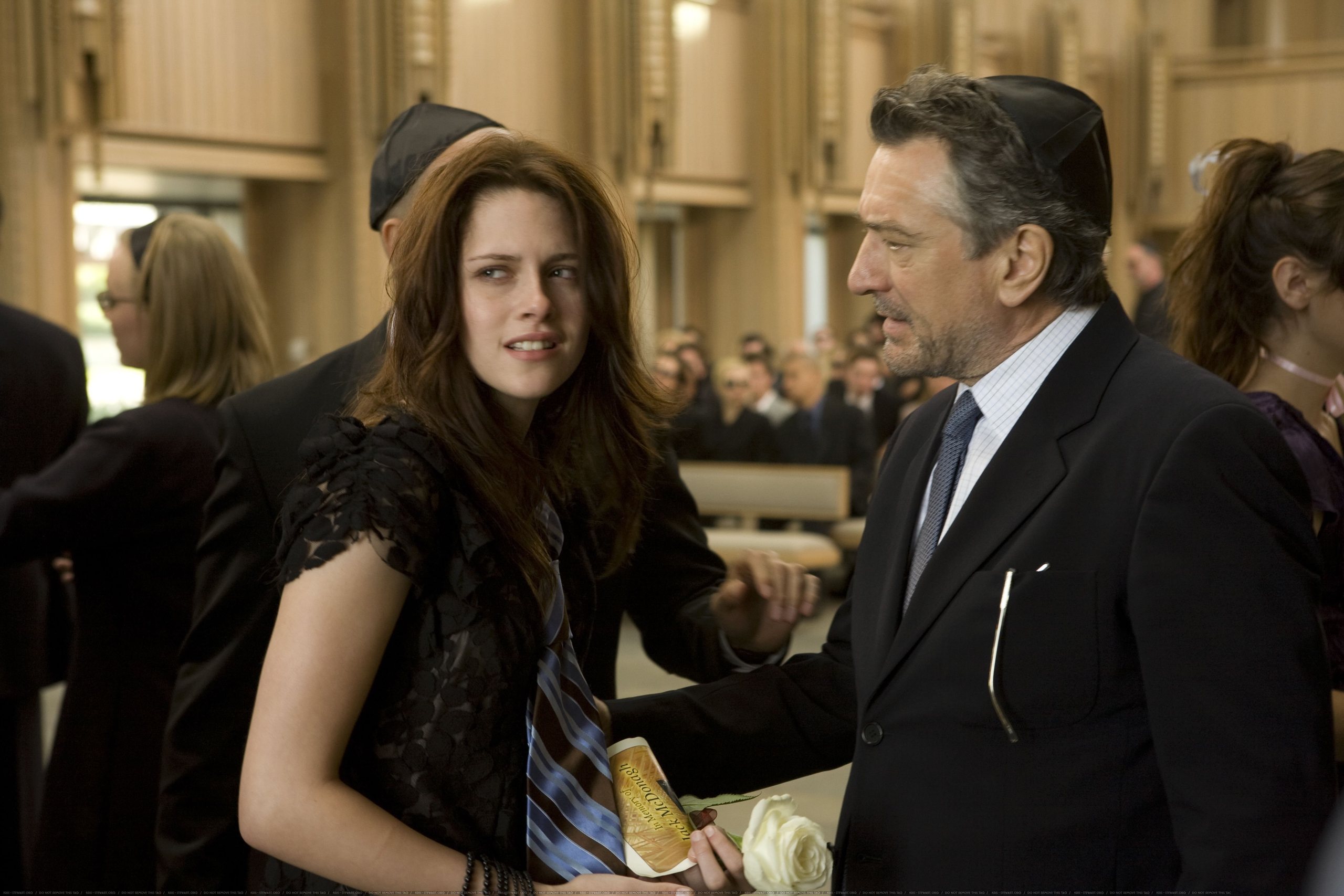
What Just Happened (Barry Levinson, 2008) Ben (Robert De Niro) is a producer in Hollywood and he has a tough life. His new movie starring Sean Penn just previewed and the audience reaction cards don't look good. The director, wanting to be "edgy," has a scene where the bad guys shoot Penn's dog, then kill Penn. Audiences are upset about the dog. The studio (run by Catherine Keener) is upset about the audiences and wants to re-cut the film, the director is upset about his "vision" being changed and refuses to cooperate. Ben wants the to keep the director happy, the studio happy, the audiences happy, the two ex-wives (including Robin Wright) and three ex-children (including Kristen Stewart) happy, while still worrying about where he's standing in a Vanity Fair "Power in Hollywood" photoshoot.

On top of that, he's got a big budget movie starting its shoot on Friday and the star (Bruce Willis playing Bruce Willis) is being payed $20 million to star in it, but there's one little hitch—he's grown "a Grizzly Adams" beard, and the studio is panicking—people want to see Bruce Willis when they see Bruce Willis and they want Ben to coax the temperamental star to shave it off, which he refuses to do for "artistic reasons."* Ben's life is an endless soliloquy of superficial arguments, hastily-composed rationalizations and insincere ego-stroking in the gamesmanship of Hollywood, played over a Blue-Tooth behind the wheel of a constantly in-motion Lexus. 
Based on producer
Art Linson's book (sub-titled "Bitter Hollywood Tales From the Front Line") and adapted by him for this film, it's a nice study of how removed from reality, logic and best practices the industry is. But, at the same time Barry Levinson's film of it, while duly making note of the sliding loyalties Ben displays, also seems to expect you to feel sorry for him. One would, if one didn't want to have this life. There is no tragedy here, merely minor inconveniences that whittle away at Ben's soul and career. But, he still has a roof over his head. He has a car (and the insurance for it), a cell-phone, a blue-tooth, a fancy-schmancy espresso machine, the ear of many Hollywood players, and the phone numbers of ambitious actresses. Boo to the Hoo. Yes, Hollywood's crazy...but it's not homeless and crazy.

That's why backstage dramas in tinsel-town are really only good when played for laughs, and should only be reserved when the writer-director-producer has completely run out of ideas (and when that happens, they should read a book, instead). You look at movies like
The Oscar, or The Big Knife, with the hand-wringing of the elite, and you can look right into the soul of industry people who have lost touch with their audiences**...like Norma Desmond screeching about her woes. It's why Sunset Blvd. is such a classic gem of a movie. Norma is crazy...and pathetic...and clueless.

Howard Hawks
had it right. After awhile, he was making movies about making movies—but, they were well-veiled allegories. Anytime Hawks had a group of disparate people coming together with a single goal in mind, he was talking about what he and his crew did for a living...only they were flying the mail, or capturing live rhinos, driving the cattle, getting the headline, or battling the monster at the research station...anything but making movies. That would be as much fun as watching sausages being made. If you want to complain about being in the entertainment industry, try pumping gas...then, have a drink or climb onto the shrink's couch. Don't get "meta" on the audience. They go to the movies to escape their troubles, not hear about yours.
But, like Fellini, pretty soon the writers start penning their autobiographies.  Linson might be thinking that he did a good job changing the names to protect the innocent, but listening to  his DVD audio commentary with director Levinson, one hears the vagueness, the "rote"-ness of his expressions, as if he's just passing through, and once the credits come up, he's already out the door (he's gone before the "A Barry Levinson Film" credit comes up). The two were in separated facilities recording their tracks, and as Linson gets up he says "Good seein' ya, Barry" "uh...talking to ya," says Levinson. "Oh.  Yeah...well..." says Linson. "We should get together when you come to New York."

Yes, we "really" should.

* True story, although I won't mention the movie or the star (it's easily found, actually).  But, it reminds me of the struggles Richard Donner had while making Superman, the Movie—making a man fly was easy compared to star-negotiations.  Donner had a meeting with Marlon Brando, where the actor was pitching character ideas that would keep him from having to appear on camera, like playing Superman's kryptonian father as a suitcase or "a green bagel," and Gene Hackman didn't want to shave his moustache to play Lex Luthor.  Donner finally said to Hackman on-set. "Look, Gene, you shave yours off and I'll shave mine off."  Hackman agreed, shaved and came back on-set.  "Okay, now it's your turn."  Donner then peeled off the fake moustache he'd been wearing, which delighted Hackman.

** (The same could be said for politicians—anybody in Washington looking at cutting the health-plans for those in the legislative branch...if not, why not?)

Wednesday, May 26, 2021

The Conspirator

Written at the time of the film's release...

"What About the Woman?"
or
"Inter Arma Enim Silent Leges"

Robert Redford's previous film—Lions for Lambs—was a self-indulgent tract on the tearing down of constitutional law in times of crisis—the short-cuts in due process and individual freedoms that occur when authorities are more concerned with short term results, rather than demonstrating the strengths that underpin the foundations of the Nation under attack. War is a very dangerous time; one must guard against attacks from without and within.

He needn't have bothered. History was already there with the same lessons, but distanced by time to demonstrate, rather than lecture and ostracize.

I was always fascinated by the Lincoln assassination and its aftermath.  As a grade-school student, I'd read books about those hysterical days following the surrender at Appomattox ending the Civil War, culminating in John Wilkes Booth's assassination of Lincoln (who, in trying to preserve the Union, had already done enough damage suspending habeas corpus during the course of the War), the man-hunt for the conspirators (whose intentions were to kidnap the President in exchange for Rebel prisoners) when Booth was killed, trapped in a burning barn, thus robbing the Nation of a cathartic trial (which probably would have been a kangaroo court anyway, to prevent the vain-glorious actor from speaking and fomenting discord in the wake of an uneasy truce). Short-cuts were made...civil trials disbanded in favor of more stringent military tribunals (sound familiar?)...and the conspirators deprived of any rights of the accused.*

Justice was thrown out the barred windows in the sake of revenge.
The Conspirator focuses
on only one of the accused,
Mary Surratt (played in the film by Robin Wright Penn), mother of conspirator John Surratt (who had fled to Virginia) and owner of the boarding house where much Virginia venom was pit during the war, along with some of the conspirators' planning sessions. Surratt was widowed, Catholic, a woman, Southern and sympathetic to its cause, all strikes against her. But that she was the mother of John was what damned her—his association with the plotters made the location of their meetings, planned or otherwise, a foregone conclusion, and her arrest and trial was national news—maybe the government could coerce the son to surrender to save the mother.
That might have worked if the government wasn't operating in the same manner the Rebels feared it would. The new President Johnson,
under advisement from Secretary of War Edwin Stanton (played by Kevin Kline, and more than making up for his performance in No Strings Attached) insured that the South would pay for Lincoln's death, just part of his crack-down on the South after the war. No insurrection, no slight would be tolerated, and justice would move fast and frequently recklessly.
Redford's film of the proceedings is
austere, but leaves no parallel with modern times (post 9/11) unparalleled. The facts are there, supported by generous newspaper headlines from the period bridging sequences, focusing on Surratt's defense by legal aide to Senator Reverdy Johnson (Tom Wilkinson), Frederik Aiken (James McAvoy, whose American accent is superb). The film is front-loaded with young stars (Evan Rachel Wood, Alexis Bledel, Justin Long) as acquaintances of Aiken's, all urging him to be cautious in his precipitously uphill battle to have Surratt acquitted, lest he fall under suspicion of the government as well. But, there are also good turns by Colm Meaney, Danny Huston, and Stephen Root, (who is fast becoming one of my favorite character actors).
There is little humor in the film, save bitter irony, but given the circumstances of the case, that is hardly unexpected. There are some subtle touches as well.  Like sunshine. Watch how Redford—always the Nature-boy—uses the sun throughout the movie (and the lack of sun). So many darkened, shuttered rooms reflecting that time of skulkers and hidden agendas. One doesn't have to make to big a leap remembering that the light of day is a natural disinfectant, especially in scurrilous times.
This is the first film of
The American Film Company, founded in 2008 by the Ricketts family, and even though it might seem tempting for the owners of the Chicago Cubs to re-write history, the purpose of the film-house is to present accurate portrayals of American History without the issuance of dramatic license.  It's a noble mission, but given that manifesto it guarantees that most of their films will not have a happy ending—I can't even think of a treaty that this Nation has agreed to and honored. One hopes that it can stay in business long enough to produce some great, accurate films about the hidden corners of the past.
The documentation of the hanging. 
Mary Surratt is on the left.


* Redford makes a cogent observation by also placing all the Ford Theater actors in custody, as well—they were, after all, associates of Booth—along with with the suspected assassins.