Thursday, September 26, 2024
Super/Man: The Christopher Reeve Story
Wednesday, February 7, 2018
Superman II: The Richard Donner Cut
But a lot of fan-boys did care, noting a slight change of tone in the three years between I and II. A lot had happened: the firing of Richard Donner over "creative differences" (those being he spent too much money, he cared too much about the movie to worry about the budget, and he wasn't a toadie to the producers), and the replacement with Richard Lester, no slouch as a director, but who didn't give a rat's ass about superhero movies. Web-sites had for years been acruing sightings of bits and pieces of "Donner" grail from International versions and "Expanded" television showings, and Michael Thau who assembled this thing, created new effects (a bit crude), re-edited John Williams' original score and Ken Thorne's work on II,, and grabbed whatever footage he could (including for one crucial scene only available from Margot Kidder's and Christopher Reeve's auditions) to create this dog's breakfast of a "movie."** It is incomplete with big holes in the narrative, and with only crucial Lester-directed scenes grudgingly included—Donner and Mankiewicz grouse and complain about the changes made to "their" movie in the commentary track but do give Lester (never named) and the re-writers some credit once. It makes a one-on-one comparison dodgy and a bit unfair, in both movies' favors.
The first thing one misses (after goggling over alternate takes and a wealth of new Marlon Brando and Gene Hackman footage--all shot by Donner, he only had them for a limited amount of time) is the cracker-jack/spin-on-a-dime editing of Stuart Baird, who cut the first Chris Reeve "Superman" film. The relative pace of this film, by comparison, is slack, alarmingly so. Donner and Baird in the first were far more brutal in their cutting and it made for a dynamic experience.
But I have to give the nod to the Donner cut, first, because they remained faithful to the source, and, second, because they made a far-more interesting two-movie arc than combining the first with Lester's Version. Let me explain.
Whatever money the Salkinds made, they blew it artistically, because "Superman"/"Superman II" as Donner/Mankiewicz intended, was one of those rare things--a "religious film without Jesus." Yes, there are those direct parallels that Bryan Singer picked up on (and made too much out of in his "Superman Returns") of the Father who bequeaths his Only Son for Mankind. But it goes further. It also makes a direct, dramatic use of that ambiguous phrase Jor-El line "The Son becomes the Father, and The Father, the Son." It brings closure to Superman's ties to his home-planet and abandons him completely to Earth. It also shows why Kal-el deserves the name of "Superman." And it showed a much better performance by Christopher Reeve, than was ever displayed again in the series. The actor in Reeve played Part One, so he could sink his acting chops into Part Two. Not using the Donner segments robbed people of seeing a pretty incredible Reeve performance.
Jor-El, Superman's father--played by Marlon Brando, plays a critical role in Part II. When Lois Lane's movie-length attempt to unmask Clark Kent as Superman comes to fruition, they whisk away to his Fortress of Solitude for some alone-time, and Dad does not approve, chastising Kal-el for hubris and selfishness, telling him his reward is the happiness his good works provides. But Kal wants Lois ("this human," Jor-El dismisses her), and to do that, he must live as one of them, and have his powers removed permanently by a "red-sun generator,"*** which will make him an ordinary man. Kal-El steps into the chamber and as the process strips him of his powers, Jor-El casts a disapproving look at Lois Lane.
The human couple, Clark and Lois, leave the Fortress, the diner scene happens where Clark gets beat up, and learns about the Kryptonian villains taking over the U.S. government. Realizing what he's done, and there's no one but him who could stop them. he treks back to the empty Fortress, the crystal controls he used to communicate with Jor-El obliterated. Kal-El breaks down, acknowledges his weakness and mistake and hears nothing in reply. Finally, he cries out "Father!"
Donner (and Thau) cuts to a far-shot as the cry echoes in the crossed beams of the Fortress. And one recalls the words of Christ on the Cross: "My God, My God, why have you abandoned me?"But there is a shred of hope. Or a shard. Amidst the rubble, the original green, glowing crystal that Kal found in his Exodus-ship is still glowing, and with it, he is able to contact Jor-El one last time.
Jor-El admonishes Kal for his transgression, and tells him that there is only one way to get his powers back, and that is to transfer the final energies that allows them contact; for Superman to regain his powers will destroy the last vestiges of energy that is the Jor-El "program." Kal-El is reluctant, but Jor-El begins the process, appearing to him corporeally to touch as they say goodbye and to transfer his power to his son, destroying himself: The Son becomes the Father, and the Father becomes the Son.

Kal is knocked unconscious, the other crystal conduits are destroyed. There's the battle with the Kryptonian villains (but without the expanding sticky "S"-shields and simulacrum tricks, per Newman and Lester--what? Superman's powers aren't enough?), Luthor is carted away, and then the coda: Superman flies Lois out of the Fortress, turns, gives it one last look, opens his eyes...wide, and destroys the Empty Fortress with his heat-vision. Here are frames from that sequence, without any further explanation--but one more Bible quote:


"When I was a child, I spoke as a child, I felt as a child, I thought as a child. Now that I have become a man, I have put away childish things."1 Corinthians 13:11
Yeah, I wouldn't call it "The Richard Donner Cut." I'd call it "The Last Temptation of Superman."
For all its patchwork quality, for its holes and inconsistent effects, I'd still have to say I prefer "The Donner Cut," as it maintains the consistent vision of the first movie and brings the story proper to a conclusion. The Lester Version let go of the internal logic for thirty pieces of silver, and undermined the biblical implications to replace it with slapstick and inconsistencies from out of left-field. One is left unsatisfied with both, and pining for what would have been the greatest super-hero film ever made.
* Donner was much more involved with "The Extended Cut" that Warner Brothers commissioned after Christopher Reeve's death, where Donner was able to go in and add some sequences that the producers and Warner Brothers wanted removed to cut down the length of the film—and in that way squeeze in a couple more showings per night at your local theater.
** Okay, some history: Between the first and second films, Donner was "let go" (probably because he was carefully doing his directing chores and running over budget —to the point where filming of the second film was cut short) and Lester (a "fast" director who usually "printed" his first take) was hired. For financial reasons (the producers didn't want to pay him his full salary), all of Marlon Brando's scenes for the second film were scrapped and Susannah York brought back in to play Lara, Kal-el's mother (who never appeared post-Krypton explosion in the first film) from beyond the grave. Gene Hackman's footage was used, but cut way down. Why? In order for Lester to receive the director credit, he must have directed at least 50% of the movie, and so a lot of Donner footage was edited out to bring about that mathematical percentage, thus, Hackman's role of Lex Luthor was greatly reduced. A pity as Hackman is terrific in the movie (in Lester's scenes, Lex Luthor is usually facing AWAY from the camera so as not to see that a stand-in was used).
*** Okay, non-comic-book nerds bear with me: See, Krypton, Superman's home planet, had a red sun, so bathing him in "red solar energy" takes away all the powers that Earth's "yellow sun" gives him, and at this point everything breaks down because once Kal-el goes outside, he should get his powers back, but let's just GO with it, because by the movie's internal logic, he should still have a "dense molecular structure" that makes him invulnerable, and he could still put up a fight with that. But why bring all this up, really? It's all dogma, which, I guess, is appropriate. Comic books, like a religion, require the faith of a child, willing to believe.
Thursday, March 31, 2016
Get Off the Lawn, You "Damned" Kids!
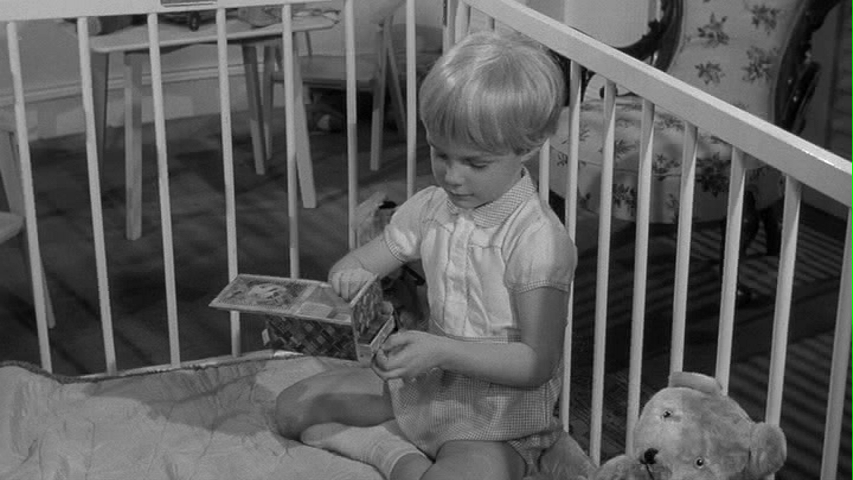
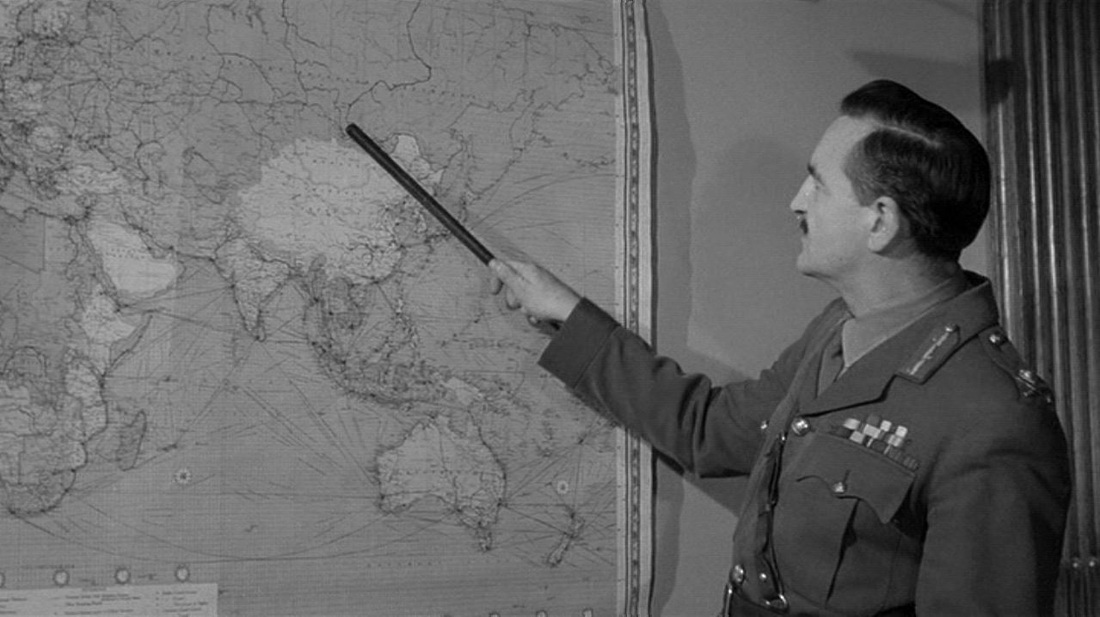
In the town of Midwich, professor Gordon Zellaby (George Sanders) is making a call to his brother-in-law Alan Bernard (Michael Gwynn) when all of a sudden, he falls unconscious. So does the family dog. Bernard is alarmed at this and can't raise anyone in town, so he investigates and being in the military he doesn't do it subtly. What he finds is that everyone within a few mile radius of city center is unconscious...or will become unconscious (even taking preventative measures like gas-masks) if they enter within that "zone"—aeroplanes flying overhead will have their pilots drop off, the planes crashing.
It's a mystery. Why this town? Why this effect? But, two hours later, everyone awakens, mystified. They felt a cold sensation before they dropped, but that was it. The disturbance is forgotten.
Until two months later, when it's determined that every woman "of child-bearing years" in Midwich is pregnant. For Zellaby and his wife (Barbara Shelley), it's a miracle though it's a little late in life for him. But, for the unmarried women in town, and for the women with husbands away, it's not only embarrassing, it has to be some bizarre mistake...and when it's confirmed it makes things uncomfortable, socially. For awhile they're stigmatized, but before long (and with the doctor's confirmation) it's determined that all the women are pregnant...and they don't how.
And...if things don't go their way, they can influence the thoughts and actions of others, an act apparent when their eyes begin to glow white. The children, as they grow older and become more sophisticated, become even odder—walking as a group by themselves, dressing themselves, speaking in a tone, sophisticated and cold.**
The military doesn't want to do anything subtle, but Zellaby, with doubts as to their origin, staves off their eradication by seeing if he can teach them in their own segregated school (naturally). The trouble is, the children don't want to do anything subtle, either, and these kids are of a mind to stop the problem of bullying by any means necessary.This is a great film, which doesn't shirk societal issues at the same time it doesn't pin down exactly what the hell is going on here. The fact is the kids are here and dealing must begin. But how, never mind why. Plus, it's a genuine horror-fest, making one web-site's list of "10 movies pregnant women should never watch."*** Apt. And one curious anomaly about the film is that the strange glowing eyes that signal some heavy brain-work on the part of the children (and figures in the denouement) is only seen in American prints of the film. Interesting, as they seem to appear in the British posters for the film.
![]() |
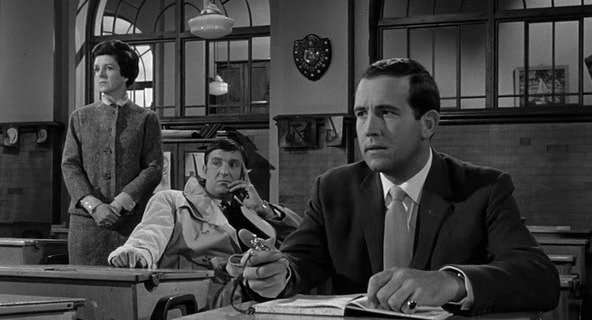
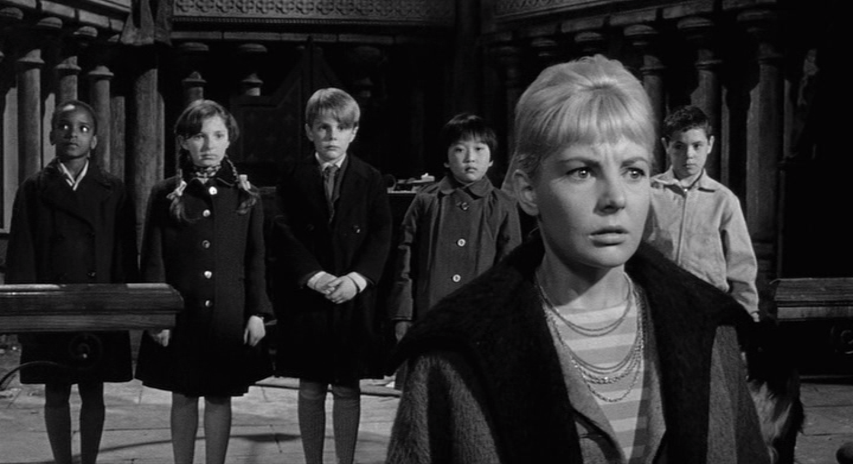
Children of the Damned (Anton M. Leader, 1964) If Village of the Damned leaves things unexplained, Children of the Damned just complicates the issue, rather than coming up with any concrete answers. The six titular children have the same powers and intellect, but not the same attributes. None of them has the tell-tale white hair or the slightly high browline as the first crop of kids. And there's only one child from Britain; the others, flown in by the UN, come from Russia, China, India, America, and Nigeria and their abilities are only discovered by a UNESCO survey on child development. The lead investigators in England, psychiatrist Tom Llewelynn (Ian Hendry) and geneticist Dr. David Neville (Alan Badel, laconically ironic) are looking into the why's and wherefore's of young Paul Looren (Clive Powell), a child of extraordinary learning skills that are frankly off their charts. A visit to his single mother only ends with her tossing them out and their disbelief in her claiming she was never "touched by a man."Llewelynn and Neville make an odd duck duo,**** the shrink earnest and straightforward and the geneticist cracking wise with every line. Their investigations come up with no reason why these kids have these abilities, they just do, and when Britain's Secret Service tries to take control of young Paul, he sets up a distraction and scampers, seeking out the other five children and taking up residence in an abandoned church, with Paul's aunt (Barbara Ferris) as hostage/mouthpiece. The various embassies want each of their children back to exploit them, weaponizing them, in effect. Llewlynn is thunderstruck by the idiocy of that: "As soon as one of them knows your plan, then the others will know it." So much for Cold War secrets.
![]() |
| Neville and Llewelynn, U.N. observers...observing |
Children of the Damned is slightly diminished from its original, but on its own is one of those great science fiction films of limited scope and budget that still manages to evoke the sense of a much larger concept, despite narrowing down what the children "are," while giving the film a sense of cautionary tragedy that the first film doesn't have. Less a horror film than a story of sociological and political paranoia, Children of the Damned features good performances and an efficiently crackling script (by John Briley—he would go on to write Cry Freedom and Gandhi) and manages to stand on its own terms, apart from the first film, as an entertaining, if very unsettling film.
Village of the Damned (John Carpenter, 1995) This updated version of the original follows the same plot structure of the first, with less emphasis on the mysterious circumstances that cause the "immaculate" pregnancies in the town of "Midwich, California," less stigma—it is the '90's, after all, there's even the subject, given the circumstances, of aborting the children—and more emphasis on the children and the violence they mete out on the town. In color, and sporting a good cast of stars (with Christopher Reeve—his last role before his crippling riding accident—Linda Kozlowski—she of the "Crocodile Dundee" series—Michael Paré, Mark Hamill and Kristie Alley), these kids are more pointedly accusatory, speak in archly threatening whispers,***** and action-oriented, and unusually vicious in the way they have their victims destroy themselves—impaled on a broom, blinding an eye-doctor, having one of the parents driving into a propane tank (rather than a brick wall), another performs an autopsy on herself, and the botched military intervention in another country alluded to in the first film is dutifully played out with all the blood-bags the budget can allow—and Carpenter doesn't cut away as the original did. There's no implication here, which (as it usually is) isn't as powerful as leaving your audience's squirming imagination to do the dirty work.
![]() |
| Christopher Reeve's doctor hates talking to kids. |
**** And no, I don't think they're gay, even if they do share a flat in London (separate rooms, mind you). Both are on assignment from Unesco in London.
***** Unfortunately, the kids' performances are melodramatically threatening, a bit like Patty McCormick in The Bad Seed.


.jpg)