Showing posts with label Thomas Mitchell. Show all posts

Friday, June 4, 2021

Anytime Movies #4: - Only Angels Have Wings

While I catch up on the reviews still in "Draft" phase here, I'll re-run a feature I ran when I first started this blog seven years ago,* when it was suggested I do a "Top Ten" List.

I don't like those: they're rather arbitrary; they pit films against each other, and there's always one or two that should be on the list that aren't because something better shoved it down the trash-bin.

So, I came up with this: "Anytime" Movies.


Anytime Movies are the movies I can watch anytime, anywhere. If I see a second of it, I can identify it. If it shows up on television, my attention is focused on it until the conclusion. Sometimes it’s the direction, sometimes it’s the writing, sometimes it’s the acting, sometimes it’s just the idea behind it, but these are the movies I can watch again and again (and again!) and never tire of them. There are ten (kinda). They're not in any particular order, but the #1 movie IS the #1 movie.


While in college, I worked as a movie projectionist, and had an opportunity to show many great films for the various film courses being taught. But one film left a distinct impression—over the course of five days I had to show it eight times. I got to know it pretty well. Its name is -Only Angels Have Wings and it was directed by one of the great director-producers, Howard Hawks.

Hawks directed all types of movies, many of them classics of their genre: westerns (
Rio Bravo, Red River); mystery/noir (The Big Sleep); adventure (To Have and Have Not, Hatari!) and comedy (Bringing Up Baby, His Girl Friday). He even produced one of the first truly classic science fiction films (The Thing! [From Another World]), and an iconic musical (Gentlemen Prefer Blondes). Despite the genre, and despite the decade in which it was produced each film is unmistakably a Hawks film – a group of men (and women, but usually men) of diverse talents must come together to achieve a singular goal, be it to drive a huge herd of cattle to Missouri, or contain the alien threat, or capture a live rhinoceros, or get the bad guy to the Marshall (alive if possible) or ferry the refugees to safety, or find the dinosaur clavicle, or land a millionaire.

Conflict is achieved by introducing a newcomer to the mix who doesn’t understand the synergy of the group and who must learn “the code” to belong, and that keeps the group in cohesion. And so much the better if they do it without talking about it much.

That’s the Hawks formula, and he was able to create enough variations in the design that his films all seem different, even though they’re always telling the same basic story—a story that’s a metaphor for movie-making.
**

“Hello, professional”

Why -Only Angels Have Wings out of all those classics? It is the ultimate Hawks movie. Watch any of those others and you’ll hear similar lines and see similar situations, but in Angels, everything is distilled to the basic essence of the tale to become the best Hemingway story Hemingway never wrote. Distilled? The majority of the film takes place in one set! For this band of professionals, the goal is to fly the mail from the port city of Barancca through a narrow passage in the Andes utilizing one of a number of prop aircraft, all in need of repair. The men realize they’re merely links in a chain getting the mail…or a doctor…or a shipment of nitro-glycerin…to its destination with the threat of death flying right alongside. So hazardous is the job for these civilian-pilots that their base is a revolving door for the new blood who have to prove themselves. It’s "The Right Stuff” twenty years before Tom Wolfe popularized the phrase.
Grant, Barthelmess, and Mitchell play one of a few triangulations in -Only Angels Have Wings

And it’s prime Hawks. For instance, watch the cigarettes. In a Hawks film, they’re visual short-hand for relationships—who’s in need and who can provide, who’s giving, who’s dependable, giving, taking, reading other's thoughts. More than any other Hawks film, except perhaps Rio Bravo, the flame that’s there when you need it is a gambit that crams twice the information into the film, and reveals more about the characters than their deliberately circumspect dialog—what
Frank Capra called Hawks’s “three-corner dialog”—was allowed. To come right out and say things point-blank, well, not only would it be corny and unbelievable…it just wasn’t done in Hawks's circles.

Hawks also liked to use music to convey mood. But it usually isn’t a Hollywood background score, as it's indigenous music—in this case, the bar band at Dutchy’s bar/mercantile and air terminal (this is a couple of years before
Casablanca). They set the mood, provide a little extra entertainment value, some local color for a set-bound movie and when the time is right and there’s a meeting of minds it’s reflected in a musical number in which everyone participates. Again, no one has to come out and say ”We’re all thinking the same way.” They’re all singing the same song, so it’s understood.

"Boy, things happen fast around here, don't they?"

There’s also the unspoken ethos of the professional—you do your job to the best of your ability and you don’t talk about it. You don’t brag. You don’t cut corners and you don’t dwell on it. You do your job, you move on. You do your job right and people will notice. Do your job wrong and everyone suffers. In this way the group can depend on each other while staying out of their debt. In this movie-atmosphere, bit-players are allowed to shine. Yeah, the movie revolves around
Cary Grant (and the only role where he would be more stoic than he is here would be playing the icy spy Devlin in Hitchcock’s Notorious) and the delightful Jean Arthur—she could turn on a dime from tragedy to comedy and give you change back with a toothy smile—but even the lowliest of character-actors get great moments of screen-time. Also of note are a very young Rita Hayworth at the start of her career and Richard Barthlemess—a former silent screen star who didn’t make the transition to “talkies.” He plays a pilot who must prove himself to the others and that he can “cut” it in their world. Art imitates life.

And then there’s
Thomas Mitchell, who might well be the greatest character actor to never achieve name-above-the-title status. A veteran of many a Frank Capra comedy—and whose most prominent role would be as Scarlett O’Hara’s father in Gone with the Wind—here he plays a character with the title “The Kid,” even though he’s the oldest of the pilots. So much of the movie centers on him that his one character fulfills every plot device except love interest, although with Hawks one could never be too sure of that, either. ***

Ultimately it’s Mitchell’s Kid who provides the means for Grant’s character to express his feelings, which, typically, he does without really having to, and in a way that makes it obvious to everybody involved. And as if anybody missed the point how dependent everyone is on each other, most of the pilots wind up injured, “winged” so that by the end of the movie, two pilots have to perform the job of one to fly each mail-run. Perhaps the better title may have been “-Only Angels Have Two Wings.”

It’s all done so economically, so breezily and with so little in the way of “action” that one may get through the entire movie before realizing that mostly everybody just talked…without really coming out and saying what they mean. Everything is shot at eye-level. There’s nothing fancy in the camera-work. The story is the King, and everyone is working towards making the whole thing work…like professionals.
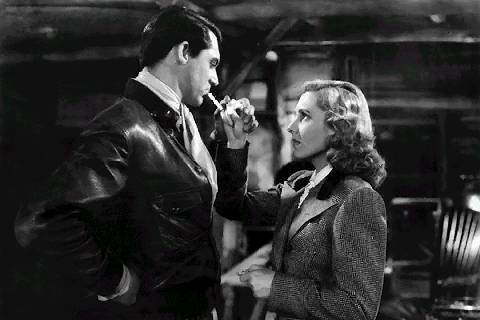
Cary Grant needs a match. Jean Arthur carries a torch.

Anytime Movies:
The Searchers
* And, on Sunday, we'll put up a "Don't Make a Scene" feature from each week's film.

** Hawks was well-known for taking different stories and turning them into the Hawks formula, sometimes rewiting the entire film on a day to day basis to get there. The most extreme example of this is El Dorado, which after ten minutes of one story suddenly veers into becoming a remake of the earlier Hawks-John Wayne western Rio Bravo. When Hawks called John Wayne to ask if he’d star in yet another western, Rio Lobo, Wayne knew exactly what he was getting into. “Do I get to play the drunk this time?” he drawled.

*** Someday, someone far more intelligent than I is going to go through the Hawks filmography with an eye towards sexual politics—whether it’s the leering banter between 
Montgomery Clift and John Ireland in Red River, or Cray Grant in drag in Bringing Up Baby (“I went GAY all of a sudden!!”) and I Was a Male War Bride, or some of the more bizarre stagings of musical numbers in Gentlemen Prefer Blondes.  And then there’s the long line of husky-voiced women in his movies who are one of “the boys,” from Rosalind Russell to Lauren Bacall all the way up to future Paramount Studios exec Sherry Lansing. For all the macho posturing exhibited in his movies, there are hints that Hawks never completely “bought” into it and is enjoying winking at it. He may well be second only to James Whale in sneaking so much gay subtext into his movies.

Friday, May 21, 2021

Anytime Movies #6: Mr. Smith Goes to Washington

While I catch up on the reviews still in "Draft" phase here, I'll re-run a feature I ran when I first started this blog seven years ago,* when it was suggested I do a "Top Ten" List.

I don't like those: they're rather arbitrary; they pit films against each other, and there's always one or two that should be on the list that aren't because something better shoved it down the trash-bin.

So, I came up with this: "Anytime" Movies.


Anytime Movies are the movies I can watch anytime, anywhere. If I see a second of it, I can identify it. If it shows up on television, my attention is focused on it until the conclusion. Sometimes it’s the direction, sometimes it’s the writing, sometimes it’s the acting, sometimes it’s just the idea behind it, but these are the movies I can watch again and again (and again!) and never tire of them. There are ten (kinda). They're not in any particular order, but the #1 movie IS the #1 movie. 

I’m very suspicious of patriotism (I always recall the "last resort of a scoundrel" remark), yet nothing moves me so much like a movie extolling the virtues of America. The promise "to form a more perfect Union," as it was outlined in The Constitution, as opposed to lining people's pockets, or to lionize the undeserving, or to maintain the status quo because it's comfortable.

Anybody who's fought for this country knows it's not comfortable (and if they did, they were promoted too soon!)

It wasn’t until I was voting on the
Emmy’s that I sat down and watched TV's “The West Wing.” I figured it was going to be a vapid “America-Love It or Leave It” tract (starring Rob Lowe), even if it did have Martin Sheen playing the President, in which case, I could leave it. But TWW was a serious look at government work—its glories and  disappointments, the combination of ego and sacrifice. It could criticize individuals and “ideology for ideology’s sake,” but one thing it never ever criticized was the idea of Public Service, no matter what side of the aisle it was on. At the same time the country is being run by crooks specializing in an institutionalized form of bribery and graft, there is an infrastructure of people for whom government service is a sacred trust (well, there’s gotta be ONE!) “The West Wing” paid tribute to that corps of people wherever they might be, week after week, and it made for refreshingly positive TV. It also made for a refreshing look at our nation as it stands.

And so, too, does
Mr. Smith Goes to Washington. Made in 1939, it plays like it was written yesterday. When I saw it for the first time—right after “Watergate”—I found it amazingly prescient. But, no, it was talking about its own times. The problems just keep re-occurring again and again. And again. Whoever doesn’t know history is doomed to repeat it, and with every fresh crop of people governing, they’ll keep making the same mistakes. Maybe they think they’re unique. Maybe they just don’t know history. They say that if you keep making the same mistake over and over, it’s a sign of insanity. Well, psychology never factored in term limits.

Mr. Smith… is the story of a local youth leader who is appointed to the Senate after the incumbent suddenly dies. This runs afoul of the state’s political machine that ran that late senator as well as the state's senior Senator, Paine (Claude Rains)—who just happens to be an idol of the new senator’s. But, "The Machine" lets it happen, as Smith is a yokel, and their boy, Paine, will be able to keep him in line.
It wouldn’t work if director Frank Capra didn’t have tall awkward Jimmy Stewart—not James, Jimmy—whose every stammered syllable bespoke humility. But get him talking about America or Liberty of The Capitol Dome and the stutter disappears in a fervent stage whisper that trails off in awe. Mr. Smith isn’t sure of himself, but he’s sure sure of the Country.
And Washington, D.C. is just the place to shake him up with a few lashes of the Beltway. Stewart could be frustratingly folksy, but for Capra (and for Hitchcock and Anthony Mann) he could be unnervingly vulnerable and, at the other end of the bi-pole, dramatically unhinged. The last act of Mr. Smith…—the filibuster against false charges of graft—features Stewart in both phases. At one point, he's knee-deep in political hate-mail, clutching it in his hands and looking skyward like Jesus at Gethsemane. Then a few short paragraphs about “lost causes” later, he’s at his most defiant. “You think I’m licked! You ALL think I’m licked!!” That was his Oscar-winning performance, not the next year’s The Philadelphia Story where the “cynical reporter” bit just didn’t wash with someone who looked so homespun. The filibuster scene always brings a lump to my throat, and it’s not sympathy pains for Stewart’s frayed larynx.
Now, I’ve read the original screenplay to “Mr. Smith Goes to Washington.” It ends with a big parade honoring the completely vindicated Smith, surrounded by his boy-rangers, supported by the woman-he-loves (Jean Arthur, again, who manages to make her extraordinarily jaded Senate Aide adorable, even when she’s at her worst—and she has a great drunk scene with Thomas Mitchell. Hmmm, Thomas Mitchell, again). Why, even the disgraced Senator Paine is being lionized in the sequence. Oh, it’s just so sweet, your eyes could roll back in their sockets and jam and stick that way. As Arthur’s Miss Saunders tipsily says in the film, “Nah, I can’t think of anything more shappy!” “Capra-corn” is what the very self-aware director called it.
So, he cut it. Orson Welles has said: "If you want a happy ending that depends, of course, on where you stop your story." Capra leaves his story’s ending ambiguous. Oh, you could call the riotous goings-on at the end a Happy Ending—but all of Paine’s Senate pals are trying to calm him down, telling him it’s okay…everything’s all right, we're still on your side. The only solace Jefferson Smith is granted is in the sympathetic smile from the Vice-President (played by John Ford’s silent cowboy film-star Harry Carey) before he collapses in a heap of his enemy’s mass-generated letters. The movie "celebration" has all the weight of an Al Gore victory celebration on Election Day 2000--a case of premature exaltation. But nothing's been solved. No one's been cleared. Nothing has been decided. There is just misunderstanding and confusion. Carey leans back and has a chaw while the chaos of Democracy continues unabated. It may not be a "happy" ending, considering the sequence that was shelved. It may not even be a dramatically satisfying ending. But it is representative of the loud, messy process that turns the gears of Democracy. 

However slow-moving, however off-course, they still turn.

Jeferson Smith (Jimmy Stewart) looks for guidance.

Anytime Movies:
Chinatown
American Graffiti
To Kill a Mockingbird
Goldfinger

Bonus: Edge of Darkness

Washington turns out for the Mr. Smith premier—they weren't happy.
From Wikipedia:  "Alben W. Barkley, a Democrat and the Senate Majority Leader, called the film 'silly and stupid', and said it 'makes the Senate look like a bunch of crooks'."

* And, on Sunday, we'll put up a "Don't Make a Scene" feature from each week's film.

Saturday, April 3, 2021

While the City Sleeps

Saturday is traditionally "Take Out the Trash" Day, and while this film is certainly "trashy," it's sophisticatedly multi-layered.

While the City Sleeps (Fritz Lang, 1956) 

"I wonder what the nice people are doing tonight?" asks esteemed writer-author-journalist-TV personality Walter Mobley (Dana Andrews).

Well he should ask, because there are few nice people in his circle of work, which happens to be some form of multi-headed Hydra of journalism, known as Kyne Enterprises. The head of Kyne has just died and the heir-apparent Walter Kyne (Vincent Price) is now in charge, but is a bit feckless and knows nothing of the news business, nor, apparently is he willing to have anybody tell him about it as he decides to delegate. He's going to create a new Executive Director position that will answer to him without having to know all the details. But who is it going to be?
There're many to choose from, besides Mobley, an Edward R. Murrow-type: there's also the urbane head of the wire-service Mark Loving (George Sanders); crusty newspaper head John Day Griffith (Thomas Mitchell); and there's television head "Honest" Harry Kritzer (James Craig). They all want the job and will stoop to any advantage to get it. But Walter has other ideas. He's going to make the contenders fight for it in a "Hunger Games" kind of run-off—winner take-all, and the losers...well, they extend to more than Kyne Headquarters.
It just so happens they're in the news business and New York has a big news story: there's a serial killer in town breaking into apartments and attacking women and has been labeled "The Lipstick Killer"—that would be the ironically-named Robert Manners (John Drew Barrymore), a nervous, slimy type dressed in leathers. It's okay that we know who it is—Lang starts the film out with him carrying out one of his strangulations—as the director is more interested in the power struggle of the media elites eating each other to get the job of "Top Toady."

Meanwhile, as they connive, deceive, and block each other from finding whodunnit, the City sleeps, albeit not very peacefully.
This is territory Lang has worked with before, as early as his silent films for UFA in Germany. In his films Metropolis, Spies, the "Mabuse" features, authority figures wrangle in power struggles completely ignoring the plights of the ordinary citizens who might fall victim as a result. But, those films involve cat-and-mouse games between authorities and criminal masterminds. In Where the City Sleeps, the field of play is publishing/broadcasting, and the criminal is not mastermind, but a craven nobody like the child-murderer of Lang's M. While the department-heads wring their hands worrying about advantage, he's in the streets looking for opportunity.
Lang's film has enough layers that one might even miss that his film is lumping the newsmongers in with the serial killer in more ways than mutual benefit. For instance, how do they maneuver and manipulate the "contest" to their advantage? By throwing women under the bus, of course: Loving uses writer Mildred Donner (Ida Lupino) to seduce Mobley in order to get any inside info from the anchor (it doesn't matter that Mobley is engaged to Loving's secretary, Nancy Liggett, played by Sally Forrest); Kritzer is having an affair with Kyne's wife (Rhonda Fleming) in order to use her as a mole for scoops and news oh his standing in the contest and so she can talk up her lover—they've even set up a rendezvous apartment, which happens to be close to Liggett's, as well; and finally, Mobley hatches a scheme with the police lieutenant working the case (Howard Duff) to set up the "Lipstick Killer" using his fiancée as bait. "Nice!"
Mobley's little scheme is to go on the air, using inside knowledge of the investigation and taunt the Killer into targeting his fiancée as an act of revenge. Then, it should be an easy thing to just keep tabs on her until the killer makes his move. Easier said than done, and things get dicey enough that it gives these paragons of the public trust a little taste of terror in the midst of stabbing each other in the back for a single rung up the power ladder.  
The cast is great; everybody's a character actor who can milk their scenes for all they're worth and rattle off movie lines like they're still stuck in the 40's. The only thorn among roses is Barrymore, who seems to have gotten directions from Lang that might have been more effective in the silent era. He's all slack-jawed, hooded-eye malice who could only look like more of a pervert if he had the letter "M" chalked on his leather jacket.
Still, that's the only glaring misstep from one of the masters of German cinema, still employing the old tricks and getting away with it (because the tricks were novel and original when he invented them). One still sees the high-contrast shadows—even though the film is mostly a daylight picture, it's still considered "noir"—the surprises just out of frame, the window-partitioned world, and décor that reflects character. Lang even gets to use his old trick of having his actors facing the camera and delivering their lines directly to the audience, challenging them—in the age of television, it happens all the time!

I first saw While the City Sleeps—one of the last films Lang made in America—about a year ago, and I notice it's becoming a staple of movie channels, especially those that feature packages of "noir films." It's becoming more and more available and makes for entertaining viewing.

Friday, April 10, 2020

The History of John Ford: Stagecoach (1939)

When Orson Welles was asked what movies he studied before embarking on directing Citizen Kane he replied, "I studied the Old Masters, by which I mean John Ford, John Ford, and John Ford." 

Running parallel with our series about Akira Kurosawa ("Walking Kurosawa's Road"), we're running a series of pieces about the closest thing America has to Kurosawa in artistry—director John Ford. Ford rarely made films set in the present day, but (usually) made them about the past...and about America's past, specifically (when he wasn't fulfilling a passion for his Irish roots). 

 In "The History of John Ford" we'll be gazing fondly at the work of this American Master, who started in the Silent Era, learning his craft, refining his director's eye, and continuing to work deep into the 1960's (and his 70's) to produce the greatest body of work of any American "picture-maker," America's storied film-maker, the irascible, painterly, domineering, sentimental puzzle that was John Ford, John Ford, and John Ford.


Stagecoach (John Ford, 1939) This classic western was hailed as the first "adult western" when it premiered and changed many folks' minds about the viability of the dusty genre to tell stories beyond those of bank-robbers and Indians and greedy rustlers and romancing school-ma'rms. Oh, and singing cowboys. It went beyond childhood fantasies and explored something beyond the white hat/black hat simplicity of early "oaters" to look at things like hypocrisy and duplicity.

Ford tells the story (based on a script by Dudley Nichols from a story, "Stage to Lordsburgh" by Ernest Haycox ) of a motley group of passengers thrust together on an event-filled stagecoach ride to Lordsburgh. That's the bones of it. But, it's not so much the location work, the horses, or the gun-play as it is the interaction between a coach of people on the outskirts of civilization—or what passes for "civilization" out there on the prairie. 
The stagecoach is being driven by Buck (Andy Devine) with Marshall Curley Wilcox (George Bancroft) riding shotgun; the Marshall is taking that position because there's news that "The Ringo Kid" has broken out of prison, vowing revenge on the Plummer brothers for the murder of his father and brother. The Plummers are in Lordsburgh, so chances are "Ringo" is headed there, as well, giving the Marshall a chance to catch him before any one else is killed.
But, there's another reason: Geronimo is on the warpath, and a stagecoach is just the sort of thing he and his Apache band will be looking for. Not that the passengers loading in the town of Tonto in the Arizona Territory are all that valuable: there's Lucy Mallory (Louise Platt), a young Army wife with a secret on the last leg of a journey to re-unite with her husband; the gambler Hatfield (John Carradine), who takes pity on the woman for her long journey and chooses to accompany her; there's Sam Peacock (Donald Meek), a liquor salesman. The city's "Law and Order League" are kicking out two of the passengers: Doc Boone (Thomas Mitchell), the town doctor and town drunk, and "a lady of pleasure," Dallas (Claire Trevor). A last minute addition is the town banker, Henry Gatewood (Berton Churchill), who blusters and bullies his way onto the stage, making for crowded conditions.
They don't make much head-way until they run into another orphan—"Ringo" (John Wayne), yep, just as the Marshall thought, on his way to Lordsburgh with death on his mind, but a horse that's gone lame, and so he hails down the stage with a rifle-cock, dust-blown and sweating in one of the grandest introductions that Ford ever allowed one of his actors.* "Ringo" does intend to confront the Plummers, but he's glad to see the Marshall and Buck, anyway, as they're old friends. And, heck, sure, he did a jail-break, but there's no reason to get ornery about it, as the Marshall's just doing his job and he sure could use that coach-ride.
It might've been healthier to catch the next one. It's crowded on that stagecoach and Ringo is relegated to the floor, caught in the middle between bickering, loathing, and often drunken passengers. Ringo stays friendly and guileless. So much so that he treats Dallas with the same respect that he does Mrs. Mallory—at the first stop at Dry Fork, when everyone else sits for a lunch-break, he offers her a chair (next to him, in fact), the haughtier passengers move away from their company. At Dry Fork, their cavalry escort moves on to Apache Wells—there's been an incident and Mallory's husband has gone off with them—but, the coach passengers vote to move on despite the lack of troops watching over them.
They make it to Apache Wells, but their stay there will be unexpectedly long: first, Mrs. Mallory is informed that her husband has been injured in a skirmish with Apaches nearby, which leads to a medical emergency that forces them to stay the night, forces Doc Boone to sober up, and allows some folks' opinion of Dallas to change. 

But not Ringo. Her actions only cements his opinion of her, and before the next day dawns, he proposes to her, which just puts her in a state of confusion. She thinks he's naive and doesn't know about her, but he doesn't care. Then, there's the little matter of his heading for Lordburgh—he's not going to let go of his blood-feud, and for Dallas, that's a prospect that can only lead to a very short marriage and widow's weeds.
Dallas and Ringo concoct a desperate plan for his escape—she grabs a rifle, he grabs a horse and he's off before Wilcox can notice he's gone. But, once he does, it doesn't take him long to find him. He's stopped, looking off at the horizon. The Apaches are sending war-signals, and no matter what delicate condition the passengers are in, they're heading for Lordsburgh, pronto.
There begins a sequence for which Ford became famous—a desperate chase across the desert with no cover in sight, with everyone riding at top-gallop, break-neck. This one is augmented and devised by the work of legendary stuntman/arranger Yakima Canutt (who was recommended for the job by Wayne). To this day, it's an amazing show of guts and bravery. The most amazing of which are two shots that are unbroken—where Canutt plays an Apache warrior who leaps from his horse to the lead-horse of the stagecoach, is then "shot" by Ringo and falls back between the horses and between the wheels of the wagon. The other he doubles for Ringo, as he leaps from horse-back to horse-back trying to retrieve the reigns of the lead horses dropped by Buck when he's shot during the fire-fight.
Canutt's work was so respected by Ford that the stunt-man was put on the payroll of every subsequent Ford film (unless he was working on another picture), whether his services were needed or not.

Stagecoach was made in that Golden Year of 1939, probably the apex of Hollywood output as far as high-end quality. It has aged very well, balancing out things that seem merely quaint today (but were radical in its era) with things that still boggles the mind and eye. One of those things is the cinematography of Bert Glennon, a workmanlike photographer who Ford would rely during his RKO days before setting up stables at 20th Century Fox. Ford would call on him again for his glorious Wagonmaster.
It's been remade (twice, both wildly inferior to the original), made John Wayne a star, won Thomas Mitchell his Oscar, and changed the Western genre from kiddie fare to acceptable adult material. It also earned Ford another of his innumerable "Best Director" nominations at the Academy Awards.

And Orson Welles watched it forty times before making Citizen Kane.
John Wayne walking in 1939, the way he'd walk the rest of his Western career.

* It's a "truck-in" shot, a difficult maneuver as you have to maintain focus for the entire distance. They didn't, as one can see in Stagecoach, even though it has a great effect. But, they would when Ford did the same trick on Wayne in The Searchers. Why he did it for Wayne here is one of those John Ford mysteries. Wayne had worked in the background of a lot of Ford films, and the director was definitely grooming him to become an actor—even a star. But, director Raoul Walsh got him first, changing Marion Morrison's name to "John Wayne" and starring him in his film The Big Trail, a massive wide-screen (65 mm and stereo sound) wagon-train epic, which is a great movie, but it failed to make back its substantial costs at the box-office. Wayne was left to languish, making B and C-grade Westerns at Monogram and Mascot Studios, until Ford wore off his "snit" about Wayne's seeming "betrayal" and cast him in Stagecoach. This elaborate intro shot may have been Ford's penance.

Wednesday, December 25, 2019

It's a Wonderful Life

It's a Wonderful Life (Frank Capra, 1946) It's a legendary movie that was a failure upon release. It was the first movie by an Oscar winning populist director, an immigrant to the U.S., after serving as the chief propagandist for the Armed Services during the horrific days of World War II.

The war had changed him. And when Frank Capra started work on a new project, it was a tough sell. But, Capra started a new production company, Liberty Films (with two other director-veterans, George Stevens and William Wyler) and the first project was an adaptation of a self-published short story by Phillip Van Doren Stern, "The Greatest Gift." RKO bought the film rights and after several drafts (by such as Dalton Trumbo, Clifford Odets and Marc Connelly, RKO encouraged Capra to read the short story, and Capra championed it, starting work on a script with a handful of writers—along with the credited husband-wife team of Frances Goodrich and Albert Hackett, there were contributions by Michael Wilson, Jo Swerling, and even Dorothy Parker.

It is Christmas Eve in Bedford Falls. The thoughts and prayers there are causing a stir in Heaven and an angel-in-training (Henry Travers), but not—to use Lincoln's phrase—one of the "better angels," is dispatched to help one man, George Bailey (James Stewart) from throwing away his greatest gift—his life. But, what has transpired in that life to reach that point? For fully 99 minutes of the film's 129 minute length, the potential angel Clarence—and we—are given his history. 
George has big dreams, but they are always dashed by circumstance and sacrifice for "the right thing." George is a victim of that old saw "life is what happens while we're busy making other plans." Life, the Depression, the decisions of others, all conspire to make George's life one of desperation, stuck in his hometown at a job he didn't intend...that makes him forget that he has an adoring wife (Donna Reed) and a clutch of kids at home, which might be taken away from him if the prominent banker in town (Lionel Barrymore) makes good on his plot to destroy George and his family's little savings-and-loan, made possible by the banker's theft of its assets.
It's a good life, but not the one George wanted, but he might even lose that, and so on that snowy dark Christmas Eve, he contemplates taking matters into his own hands and taking his own life, before it can be taken from him. For 3/4 of the movie's length, George is put through the grinder, sees all the work and sacrifice gone to naught, and the realization—from the banker's words—that he's worth more dead than alive. In a monetary sense, it may be true, but worth is more than dollars and cents. And with incarceration looming over him, George is only looking at the bottom line. And he's reached it.
What could be worse?

It is only by heavenly intervention that George can be shown the ledger of his life by contrast. Clarence grants him a look into an alternative version of the Universe—one in which he had never been born. And everything has changed—the people he's known, the people he's helped, his families that never knew him and never existed, the city he grew up in, all are a Dark Universe version of what he had known. The big difference is that no one knows him; he was never born. He is shown the significance of his life by the void that is left in its absence. His Christmas gift is the revelation of just how much his life is worth and the difference it has made.
It's a novel way to look at life, not too far different from the fantastical approach The Archers had with A Matter of Life and Death (released at approximately the same time) in dealing with the affairs on Earth—elements of fantasy are mixed with the hammering bluntness of recognizable reality to deal with matters that might be common with the audience. At the same time, Capra uses the flashback technique (ala Citizen Kane) to tell most of his story and compress a life into pertinent highlights, the better to mix and match the contrasting realities and make them as recognizable and significant to the audience as they do to George. We experience his horror to the alternate "Non-George" reality as soon as he does.
The film starts in Heaven, takes us through Purgatory and Hell as surely as "The Divine Comedy," and lands us back to Capra's version of Heaven—a democratized solution to the issues that have, given George's nightmare vision, been reduced in significance. For Bedford Falls, thoughts and prayers are not good enough—little do they know their significance to George—but grassroots actions, good-intentioned, save the day. Money, the root of George's depression, is volunteered, and George's worth is satisfied, both in their actions to his charity, but also in a way that would impress even a banker.

Significantly, the film begins and ends with the ringing of a bell—a call to action and attention. 
The film is a depressive's nightmare, yet it has endured, long past its lackluster run at the box-office, and despite—and probably because of—a slippage into the public domain due to clerical neglect, as a Christmas classic since the 1970's, cheering and warming the hearts of millions for the special film that it is. There isn't much dissension in that, and its message of the worth of one life and its impact can touch anybody.

For example: I had an acquaintance, a quite brilliant writer, who, after battling a long and terrible disease, joined with his family one night, all together, to watch It's a Wonderful Life, and, satisfied, went to bed where he passed away in his sleep. I can't think of It's a Wonderful Life without thinking of him, as little interaction as I had with him, and the two are inextricably linked. That's the significance of one life, how powerful it can be, and how it can influence the lives of others. We are "The Greatest Gift" to the world when we can make it a better place, when we can change it—for the better—and when we can see the individual value of the person, despite the attempt to turn us all into statistics, metrics, hits, followers, samples or net worth.


As baseball announcer Red Barber used to say, God doesn't count the net worth or toys at the end of a life, He counts the scars.

Merry Christmas to you all.