Showing posts with label Jean Arthur. Show all posts

Thursday, May 23, 2024

Shane

Shane
(
George Stevens, 1953) George Stevens came back from World War II a changed man...and a changed director. As documented in Mark Harris' book "Five Came Back" and its subsequent documentary, Stevens had started his career a director of comedies, but, after the war, he became a different film-maker. His service in the Second World War was in the combat motion picture unit from 1944 to 1946, where he documented the landing at Normandy, the Battle of the Bulge, the liberation of Paris and the uncovering of the horrors at the Dachau concentration camp, where he stated that he realized his function deepened from simple documentarian to collecting evidence of the greatest atrocities of the century. His footage was crucial in the post-war Nazi trials, but, he found no solace in the role he played. As he wrote to his first wife in 1945 "if it hadn't been for your letters . . . there would have been nothing to think cheerfully about, because you know that I find much [of] this difficult to believe in fundamentally."
 
Coming back from the war, he co-founded Liberty Films with fellow Army Signal Corpsmen Frank Capra and William Wyler, but made no films for the fledgling production house and the company folded. He would not make another film until I Remember Mama (1948), a film that bore some resemblance to his own upbringing in America. Then, 1951's A Place in the Sun, a dark tale of a man's duplicity and fall from grace, won him an Academy Award for Best Director. 
 
His follow-up film was far-afield from the subject matter that was associated with Stevens both pre-war and post-war—a Western that sharply demarcated right and wrong, almost naively making a world where good wins out over bad, without the complications and hollow justifications of an adult sensibility, Shane
In the Jackson Hole Valley of the Grand Tetons, the family Starrett are homesteading in a wild area still trod by deer and elk. In fact, in one miraculous shot an elk frames an approaching stranger between its antlers. When Joe jr. (
Brandon De Wilde), out stalking deer with his bullet-less rifle, spots the stranger coming onto their land, he alerts his Pa (Van Heflin), who is still trying to get rid of a stump he's been hacking away at for months. He and wife Marian (Jean Arthur) have been homesteading in Jackson Hole for some time, but he is frequently being sabotaged by cattle baron Rufus Ryker (Emile Meyer), who claims the land as his for grazing rights and has made it a campaign to rid the valley of "squatters," by having his men (including Ben Johnson and John Dierkes) run roughshod over Starrett's and the other homesteaders' properties).
So, Joe Sr. isn't altogether welcoming, seeing a stranger enter his property. He tells the buckskin wearing newcomer (Alan Ladd)
, who is suspiciously vague about what he's dong there, to vamoose.
As bad luck would have it, before Shane can reach the fence, Ryker and his goons show up with news. It seems Ryker is going to be providing beef for the nearby reservation and he needs Starrett's land for them to graze. Joe refuses and things start to get testy, until, finally, Ryker starts making threats.
At which point, the stranger re-enters the scene and introduces himself as "a friend of Starrett's" and seeing how he's armed, too, Ryker backs off with a final warning to clear out or the Rykers will clear them out themselves. The stranger's intervention casts him in a different light to Starrett, and introductions are made.
The stranger's name is "Shane." Just "Shane." No indication if that's christian or surname. And, for his stance on behalf of Starrett's family he's invited to stay the night and have a meal, which he compliments as "an elegant dinner." Then, without any prompting, he goes out and works on cutting out that stump as a thanks. Starrett goes out to help and between the two of them, they're able to clear the stump at night-fall, a task that the homesteader had been working on weeks. Starrett asks if Shane wants to work there, as he most certainly seems to want to help.
So, who is Shane? He doesn't say where he came from, and as to where he's going? "Heading North—one place or 'nother. Some place I haven't been." Some place he isn't known is what he means. That would seem to be a contradiction as he's quiet. Polite. Keeps his counsel. Knows his place even if he doesn't have a place. He's rootless...in a community trying to establish them. He feels comfortable there, despite that, but never so comfortable that he can't be snapped out of it at the first sign of trouble. He doesn't make trouble, but he's seen enough to know trouble will almost certainly come to him as it seems to have come to him in the past.
He's twitchy. When little Joey pumps his unloaded rifle, Shane whips around, ready to draw down on him. He's haunted, probably because of his skill with a gun and having had to use it. And he's ridden into a situation where trouble could come from across the fence, ready to tear that fence down if it's in the way. Ryker is one of those breed of men who fought hard to establish his stake and will fight just as hard to keep things the way they were when there was no one else but him. He's not interested in community—he's all the community he needs—and he resents seeing what he thinks is his from being parceled out to newcomers. To "others."
It's why the homesteaders are being harassed. Some have suffered enough intimidation that they're threatening to leave and it's only the entreaties of Starrett that keep them from leaving. Shane, himself, is on the receiving end of those taunts from one of Ryker's men, Calloway (Johnson), which ultimately leads to an old-fashioned bar-fight that wrecks the Grafton bar. Given the intervention of Shane into the struggle, Ryker brings in reinforcements, a sadistic gunfighter named Jack Wilson (
Jack Palance), who takes a satisfied glee in gunning down anyone he can provoke into a fight.
For a Western of that era, Stevens ramped up the level of violence than what audiences were used to. His fights were messy affairs that were tightly edited to maximize the cuts and scrapes one associated with the usual dust-ups. And anyone seeing Shane remembers the shoot-outs where a bullet could propel a person backwards like they were yanked off their feet (which they were, due to some discrete cabling).
In such a world it's no wonder that Marian Starrett tells her young son "Joey, don't get to liking Shane too much." There's always the possibility that a man such as Shane won't be sticking around for too long, whether riding out of town or being buried in the cemetery that overlooks the slip of a town. But, the kid can't really help himself. Shane is something of a mystery, not saying much, but giving the child the same level of attention as he does the father and the mother. That makes an impression on a kid. And his proficiency with his fists and his guns—all fascinating to little Joey—endears the man to the boy.*
Stevens is playing with Myth in Shane, and nowhere so boldly as in little Joey's hero-worship of the competent stranger, his version of a White Knight, who gives him a lesson in strength in restraint (something Joey doesn't quite comprehend) as well as the cold competency in "doing what has to be done." To standing up in the face of wickedness, not backing down, no matter the consequences, and fighting the good fight. At times, it's almost too much, with Stevens cutting back and forth between fights and Joey's wide-eyed reactions to the fireworks.
And it all comes to a head when, once the killing is done, Shane takes his leave, having brought resolution—but hardly peace—to Jackson Hole. The dirty work is done, and just as there was no place for a killer like Wilson, there isn't for Shane, either. And despite the child's entreaties, there is no going back...not from what you've done. And not from what you've seen. It's a weird scene, simultaneously a bit over the top, but also punches the gut on an emotional level. Even more so when you take in George Stevens' history in the war.
That ending resonates...and haunts. Not so much as a small child's plaintive pleas, but of the echoes embedded in them of a director who had seen the worst atrocities perpetrated by man, and, through that boy, implores 
the darkening wilderness for a world of forbearance and a return of the merely and simply decent. 

In context, Shane is so much more than "a Western", and is heart-breaking. Fundamentally.
 
* And to the point, author Raymond Chandler (who'd written a couple of Ladd's noirish movies) had said this about Ladd some years earlier: "Ladd is hard, bitter and occasionally charming, but he is after all a small boy's idea of a tough guy."

Tuesday, June 8, 2021

Seven Chances

Seven Chances (Buster Keaton, 1925) In this 56 minute feature, Buster Keaton must survive the rocky road to getting married...or else. 

Seven Chances is a few films in one: it starts with a brief prologue in tableau'd fades of a stalled romance between Jimmy Shannon (Keaton) and Mary Jones (Ruth Dwyer) as they don't communicate as the seasons change around them, and Mary's puppy becomes a full-grown dog.*

Then, the plot thickens. A financial broker on the verge of bankruptcy, he is informed that his grandfather has bequeathed him seven millions of dollars on one condition—he must be married by 7 pm on his 27th birthday (which happens to be that day). His first instinct is to marry Mary, but circumstances force him to look elsewhere, and he spends the day trying desperately to get married, but is refused at every drop to his knees.  

Next, an ad is placed in the paper for a bride, which produces an entire church-load of potentials, which, once panic ensues, begins a long drawn out chase, first through the streets of 20's Los Angeles (in scenes highly reminiscent of
Keaton's 1922 short Cops, but with the added joke of runners in white dresses and long veils). As is typical with Keaton, the ideas build, usually logically from barriers and obstructions and passers-by thrown into the mix, the silent equivalent of a parkour course which the dexterous (and seemingly boneless) Keaton must dodge, duck and dance around while scampering at full tilt.
Of course, there must be a chase...
But, once out of the city limits, Nature starts to come into play with expected and unexpected obstacles that keep piling on, literally, in an extended sequence where Keaton, running down an impossibly long hill, must avoid an avalanche of boulders, that seem bent on pushing him around. The sequence came out of a preview, where a scene of a flopping Keaton dislodging some rocks, start following him down hill, which he quickly tries to avoid. The shot garnered the biggest laugh of the preview, so Keaton went back and shot some more footage and built another routine out of it, building, building, building, extending the momentum, and the resulting audience reaction until he was satisfied.
There are a couple of brief un-PC moments (one of which will fly by modern audiences, but it involves the mentioning of a '20's female impersonator), and there's just a whiff of misogyny here—a mob of women is still a mob, though—but, then part of the joke is that if Jimmy can't have "his" girl, any girl will do, but it's belied by all of the "any" girls rejecting him outright. Also of interest is a brief peak at a young Jean Arthur in the role of a country club receptionist.

Anything involving Keaton on-screen is worth seeing, and good for quite a few laughs...when one isn't gaping in wonderment of what the man was capable of, and capable of doing.

The country portion of the Seven Chances chase scene.
The scene at :30 inspired the extended avalanche scene.

* And it's shot in the primitive version of Technicolor!


Friday, June 4, 2021

Anytime Movies #4: - Only Angels Have Wings

While I catch up on the reviews still in "Draft" phase here, I'll re-run a feature I ran when I first started this blog seven years ago,* when it was suggested I do a "Top Ten" List.

I don't like those: they're rather arbitrary; they pit films against each other, and there's always one or two that should be on the list that aren't because something better shoved it down the trash-bin.

So, I came up with this: "Anytime" Movies.


Anytime Movies are the movies I can watch anytime, anywhere. If I see a second of it, I can identify it. If it shows up on television, my attention is focused on it until the conclusion. Sometimes it’s the direction, sometimes it’s the writing, sometimes it’s the acting, sometimes it’s just the idea behind it, but these are the movies I can watch again and again (and again!) and never tire of them. There are ten (kinda). They're not in any particular order, but the #1 movie IS the #1 movie.


While in college, I worked as a movie projectionist, and had an opportunity to show many great films for the various film courses being taught. But one film left a distinct impression—over the course of five days I had to show it eight times. I got to know it pretty well. Its name is -Only Angels Have Wings and it was directed by one of the great director-producers, Howard Hawks.

Hawks directed all types of movies, many of them classics of their genre: westerns (
Rio Bravo, Red River); mystery/noir (The Big Sleep); adventure (To Have and Have Not, Hatari!) and comedy (Bringing Up Baby, His Girl Friday). He even produced one of the first truly classic science fiction films (The Thing! [From Another World]), and an iconic musical (Gentlemen Prefer Blondes). Despite the genre, and despite the decade in which it was produced each film is unmistakably a Hawks film – a group of men (and women, but usually men) of diverse talents must come together to achieve a singular goal, be it to drive a huge herd of cattle to Missouri, or contain the alien threat, or capture a live rhinoceros, or get the bad guy to the Marshall (alive if possible) or ferry the refugees to safety, or find the dinosaur clavicle, or land a millionaire.

Conflict is achieved by introducing a newcomer to the mix who doesn’t understand the synergy of the group and who must learn “the code” to belong, and that keeps the group in cohesion. And so much the better if they do it without talking about it much.

That’s the Hawks formula, and he was able to create enough variations in the design that his films all seem different, even though they’re always telling the same basic story—a story that’s a metaphor for movie-making.
**

“Hello, professional”

Why -Only Angels Have Wings out of all those classics? It is the ultimate Hawks movie. Watch any of those others and you’ll hear similar lines and see similar situations, but in Angels, everything is distilled to the basic essence of the tale to become the best Hemingway story Hemingway never wrote. Distilled? The majority of the film takes place in one set! For this band of professionals, the goal is to fly the mail from the port city of Barancca through a narrow passage in the Andes utilizing one of a number of prop aircraft, all in need of repair. The men realize they’re merely links in a chain getting the mail…or a doctor…or a shipment of nitro-glycerin…to its destination with the threat of death flying right alongside. So hazardous is the job for these civilian-pilots that their base is a revolving door for the new blood who have to prove themselves. It’s "The Right Stuff” twenty years before Tom Wolfe popularized the phrase.
Grant, Barthelmess, and Mitchell play one of a few triangulations in -Only Angels Have Wings

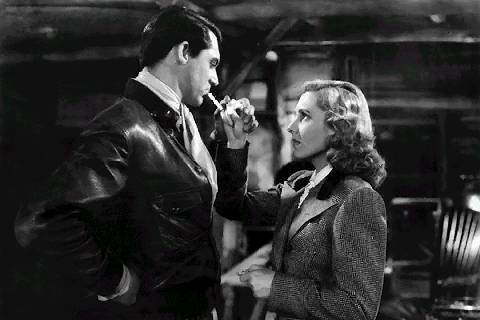
And it’s prime Hawks. For instance, watch the cigarettes. In a Hawks film, they’re visual short-hand for relationships—who’s in need and who can provide, who’s giving, who’s dependable, giving, taking, reading other's thoughts. More than any other Hawks film, except perhaps Rio Bravo, the flame that’s there when you need it is a gambit that crams twice the information into the film, and reveals more about the characters than their deliberately circumspect dialog—what
Frank Capra called Hawks’s “three-corner dialog”—was allowed. To come right out and say things point-blank, well, not only would it be corny and unbelievable…it just wasn’t done in Hawks's circles.

Hawks also liked to use music to convey mood. But it usually isn’t a Hollywood background score, as it's indigenous music—in this case, the bar band at Dutchy’s bar/mercantile and air terminal (this is a couple of years before
Casablanca). They set the mood, provide a little extra entertainment value, some local color for a set-bound movie and when the time is right and there’s a meeting of minds it’s reflected in a musical number in which everyone participates. Again, no one has to come out and say ”We’re all thinking the same way.” They’re all singing the same song, so it’s understood.

"Boy, things happen fast around here, don't they?"

There’s also the unspoken ethos of the professional—you do your job to the best of your ability and you don’t talk about it. You don’t brag. You don’t cut corners and you don’t dwell on it. You do your job, you move on. You do your job right and people will notice. Do your job wrong and everyone suffers. In this way the group can depend on each other while staying out of their debt. In this movie-atmosphere, bit-players are allowed to shine. Yeah, the movie revolves around
Cary Grant (and the only role where he would be more stoic than he is here would be playing the icy spy Devlin in Hitchcock’s Notorious) and the delightful Jean Arthur—she could turn on a dime from tragedy to comedy and give you change back with a toothy smile—but even the lowliest of character-actors get great moments of screen-time. Also of note are a very young Rita Hayworth at the start of her career and Richard Barthlemess—a former silent screen star who didn’t make the transition to “talkies.” He plays a pilot who must prove himself to the others and that he can “cut” it in their world. Art imitates life.

And then there’s
Thomas Mitchell, who might well be the greatest character actor to never achieve name-above-the-title status. A veteran of many a Frank Capra comedy—and whose most prominent role would be as Scarlett O’Hara’s father in Gone with the Wind—here he plays a character with the title “The Kid,” even though he’s the oldest of the pilots. So much of the movie centers on him that his one character fulfills every plot device except love interest, although with Hawks one could never be too sure of that, either. ***

Ultimately it’s Mitchell’s Kid who provides the means for Grant’s character to express his feelings, which, typically, he does without really having to, and in a way that makes it obvious to everybody involved. And as if anybody missed the point how dependent everyone is on each other, most of the pilots wind up injured, “winged” so that by the end of the movie, two pilots have to perform the job of one to fly each mail-run. Perhaps the better title may have been “-Only Angels Have Two Wings.”

It’s all done so economically, so breezily and with so little in the way of “action” that one may get through the entire movie before realizing that mostly everybody just talked…without really coming out and saying what they mean. Everything is shot at eye-level. There’s nothing fancy in the camera-work. The story is the King, and everyone is working towards making the whole thing work…like professionals.

Cary Grant needs a match. Jean Arthur carries a torch.

Anytime Movies:
The Searchers
* And, on Sunday, we'll put up a "Don't Make a Scene" feature from each week's film.

** Hawks was well-known for taking different stories and turning them into the Hawks formula, sometimes rewiting the entire film on a day to day basis to get there. The most extreme example of this is El Dorado, which after ten minutes of one story suddenly veers into becoming a remake of the earlier Hawks-John Wayne western Rio Bravo. When Hawks called John Wayne to ask if he’d star in yet another western, Rio Lobo, Wayne knew exactly what he was getting into. “Do I get to play the drunk this time?” he drawled.

*** Someday, someone far more intelligent than I is going to go through the Hawks filmography with an eye towards sexual politics—whether it’s the leering banter between 
Montgomery Clift and John Ireland in Red River, or Cray Grant in drag in Bringing Up Baby (“I went GAY all of a sudden!!”) and I Was a Male War Bride, or some of the more bizarre stagings of musical numbers in Gentlemen Prefer Blondes.  And then there’s the long line of husky-voiced women in his movies who are one of “the boys,” from Rosalind Russell to Lauren Bacall all the way up to future Paramount Studios exec Sherry Lansing. For all the macho posturing exhibited in his movies, there are hints that Hawks never completely “bought” into it and is enjoying winking at it. He may well be second only to James Whale in sneaking so much gay subtext into his movies.

Friday, May 21, 2021

Anytime Movies #6: Mr. Smith Goes to Washington

While I catch up on the reviews still in "Draft" phase here, I'll re-run a feature I ran when I first started this blog seven years ago,* when it was suggested I do a "Top Ten" List.

I don't like those: they're rather arbitrary; they pit films against each other, and there's always one or two that should be on the list that aren't because something better shoved it down the trash-bin.

So, I came up with this: "Anytime" Movies.


Anytime Movies are the movies I can watch anytime, anywhere. If I see a second of it, I can identify it. If it shows up on television, my attention is focused on it until the conclusion. Sometimes it’s the direction, sometimes it’s the writing, sometimes it’s the acting, sometimes it’s just the idea behind it, but these are the movies I can watch again and again (and again!) and never tire of them. There are ten (kinda). They're not in any particular order, but the #1 movie IS the #1 movie. 

I’m very suspicious of patriotism (I always recall the "last resort of a scoundrel" remark), yet nothing moves me so much like a movie extolling the virtues of America. The promise "to form a more perfect Union," as it was outlined in The Constitution, as opposed to lining people's pockets, or to lionize the undeserving, or to maintain the status quo because it's comfortable.

Anybody who's fought for this country knows it's not comfortable (and if they did, they were promoted too soon!)

It wasn’t until I was voting on the
Emmy’s that I sat down and watched TV's “The West Wing.” I figured it was going to be a vapid “America-Love It or Leave It” tract (starring Rob Lowe), even if it did have Martin Sheen playing the President, in which case, I could leave it. But TWW was a serious look at government work—its glories and  disappointments, the combination of ego and sacrifice. It could criticize individuals and “ideology for ideology’s sake,” but one thing it never ever criticized was the idea of Public Service, no matter what side of the aisle it was on. At the same time the country is being run by crooks specializing in an institutionalized form of bribery and graft, there is an infrastructure of people for whom government service is a sacred trust (well, there’s gotta be ONE!) “The West Wing” paid tribute to that corps of people wherever they might be, week after week, and it made for refreshingly positive TV. It also made for a refreshing look at our nation as it stands.

And so, too, does
Mr. Smith Goes to Washington. Made in 1939, it plays like it was written yesterday. When I saw it for the first time—right after “Watergate”—I found it amazingly prescient. But, no, it was talking about its own times. The problems just keep re-occurring again and again. And again. Whoever doesn’t know history is doomed to repeat it, and with every fresh crop of people governing, they’ll keep making the same mistakes. Maybe they think they’re unique. Maybe they just don’t know history. They say that if you keep making the same mistake over and over, it’s a sign of insanity. Well, psychology never factored in term limits.

Mr. Smith… is the story of a local youth leader who is appointed to the Senate after the incumbent suddenly dies. This runs afoul of the state’s political machine that ran that late senator as well as the state's senior Senator, Paine (Claude Rains)—who just happens to be an idol of the new senator’s. But, "The Machine" lets it happen, as Smith is a yokel, and their boy, Paine, will be able to keep him in line.
It wouldn’t work if director Frank Capra didn’t have tall awkward Jimmy Stewart—not James, Jimmy—whose every stammered syllable bespoke humility. But get him talking about America or Liberty of The Capitol Dome and the stutter disappears in a fervent stage whisper that trails off in awe. Mr. Smith isn’t sure of himself, but he’s sure sure of the Country.
And Washington, D.C. is just the place to shake him up with a few lashes of the Beltway. Stewart could be frustratingly folksy, but for Capra (and for Hitchcock and Anthony Mann) he could be unnervingly vulnerable and, at the other end of the bi-pole, dramatically unhinged. The last act of Mr. Smith…—the filibuster against false charges of graft—features Stewart in both phases. At one point, he's knee-deep in political hate-mail, clutching it in his hands and looking skyward like Jesus at Gethsemane. Then a few short paragraphs about “lost causes” later, he’s at his most defiant. “You think I’m licked! You ALL think I’m licked!!” That was his Oscar-winning performance, not the next year’s The Philadelphia Story where the “cynical reporter” bit just didn’t wash with someone who looked so homespun. The filibuster scene always brings a lump to my throat, and it’s not sympathy pains for Stewart’s frayed larynx.
Now, I’ve read the original screenplay to “Mr. Smith Goes to Washington.” It ends with a big parade honoring the completely vindicated Smith, surrounded by his boy-rangers, supported by the woman-he-loves (Jean Arthur, again, who manages to make her extraordinarily jaded Senate Aide adorable, even when she’s at her worst—and she has a great drunk scene with Thomas Mitchell. Hmmm, Thomas Mitchell, again). Why, even the disgraced Senator Paine is being lionized in the sequence. Oh, it’s just so sweet, your eyes could roll back in their sockets and jam and stick that way. As Arthur’s Miss Saunders tipsily says in the film, “Nah, I can’t think of anything more shappy!” “Capra-corn” is what the very self-aware director called it.
So, he cut it. Orson Welles has said: "If you want a happy ending that depends, of course, on where you stop your story." Capra leaves his story’s ending ambiguous. Oh, you could call the riotous goings-on at the end a Happy Ending—but all of Paine’s Senate pals are trying to calm him down, telling him it’s okay…everything’s all right, we're still on your side. The only solace Jefferson Smith is granted is in the sympathetic smile from the Vice-President (played by John Ford’s silent cowboy film-star Harry Carey) before he collapses in a heap of his enemy’s mass-generated letters. The movie "celebration" has all the weight of an Al Gore victory celebration on Election Day 2000--a case of premature exaltation. But nothing's been solved. No one's been cleared. Nothing has been decided. There is just misunderstanding and confusion. Carey leans back and has a chaw while the chaos of Democracy continues unabated. It may not be a "happy" ending, considering the sequence that was shelved. It may not even be a dramatically satisfying ending. But it is representative of the loud, messy process that turns the gears of Democracy. 

However slow-moving, however off-course, they still turn.

Jeferson Smith (Jimmy Stewart) looks for guidance.

Anytime Movies:
Chinatown
American Graffiti
To Kill a Mockingbird
Goldfinger

Bonus: Edge of Darkness

Washington turns out for the Mr. Smith premier—they weren't happy.
From Wikipedia:  "Alben W. Barkley, a Democrat and the Senate Majority Leader, called the film 'silly and stupid', and said it 'makes the Senate look like a bunch of crooks'."

* And, on Sunday, we'll put up a "Don't Make a Scene" feature from each week's film.

Saturday, May 7, 2016

The Whole Town's Talking

The Whole Town's Talking (John Ford, 1935) Director John Ford never made an outright screwball comedy (not even his service comedies, but one could make a case for the inadvertent Tobacco Road), but he comes close with this Columbia studio gangster version of "The Prince and the Pauper" (based on a story by W.R. Burnett, who wrote "Little Caesar" and did dialogue work on Scarface)

Bookish ad drone Arthur Ferguson Jones (Edward G. Robinson) lives by The Book—never late for work, always does his job, never stands out. But he oversleeps one morning and events start to cascade. He gets in late to the office, is arbitrarily chosen to be fired to be "made an example of," and when he's on the street, he's arrested for bearing a startling resemblance to "Killer" Mannion (Robinson again) a notorious racketeer. Jones becomes a sensation, with reporters clamoring for interviews, and police and politicians making political hay out of the arrest.
Only one trouble—they have the wrong man. When "the real" Mannion is arrested at the same time Jones is in jail, the police realize their mistake, but before setting Jones free, they give him a letter, explaining to any official who he really is, despite the resemblance, so no further misunderstandings can happen.

Jones' world turns upside down—he becomes a sensation, attracting the attention of the wise-cracking Wilhelmina "Bill" Clark (Jean Arthur), as well as the town newspaper, which begins exploiting Jones' bizarre story for headlines.
Then, things get complicated, story-wise and technically. Mannion escapes from jail and is waiting for Jones when he gets home from work. Ford stages it as if it's going to be the standard actor/stand-in substitution, even employing some "Kirk-lighting" to keep the gangster-actor's identity under wraps. Then, begins some of the most intricate split-screen work seen before or since. Robinson is a consummate professional and never slips characterization and he's always looking himself in the eye when he talks. Ford shoots long takes of dialogue between the two Robinson characters and there's nary a hesitation.
This movie was made in 1935, a mere eight years after The Jazz Singer ushered in sound. Yet this double-performance tricks border on the magical. In the shot above, Jones (on the left) will hand the newspaper—with its incriminating headlines to Mannion (on the right). The hand-off will occur behind the lamp—a pretty simple feint. How, then, do you explain Jones handing his letter of identity to Mannion (so that he can carry out his crimes undisturbed by the police) in full frame with no lamp or other stick of furniture as camouflage? How do you explain the dialogue scenes between Jones and Mannion where the latter is smoking a cigar and the smoke enters Jones' field of vicinity? How do you explain the mirror shot of Robinson's Jones seeing Robinson's Mannion behind him in reflection (reflected rear-projection?)?


Ford was a director of telling details, but the intricacies of these special effects shots are something above and beyond the typical character moments that Ford was becoming famous for. These little acts of magic were designed to sell the double act to an audience already on the look-out for tell-tale signs of discontinuity and trickery. Ford was already a master of the frame and of visual story-telling from years of directing during the silent era. But his co-conspiracy with Robinson (they would not work together again until Cheyenne Autumn in 1964) to create two distinctive personalities is one of their great little tricks on the audience, making this minor film (for both) something of a triumphant challenge.
Which Mannion is it?

Thursday, March 3, 2016

The Talk of the Town

The Talk of the Town (George Stevens, 1942) One could almost look at The Talk of the Town as being a sequel of sorts to Mr. Smith Goes to Washington, focusing on the judicial branch, rather than the legislative, and with more of a divided heart as to what kind of movie it should be.  

Part of that may be the number of screenwriters involved. Not only is Mr. Smith's scripter Sidney Buchman present, but also Irwin Shaw (both men would feel the lash of the blacklist in the 1950's) and Dale Van Every for story adaptation.  That many cooks typing away may explain the sometimes lurching tone from comedy to romance to high-mindedness to, uh, the underlying plot-line that once-in-awhile gets attended to.


The "main" interest is: who will Nora Shelley (Jean Arthur) end up with, romantically?  Stevens shot two endings and let preview audiences decide. Case closed.

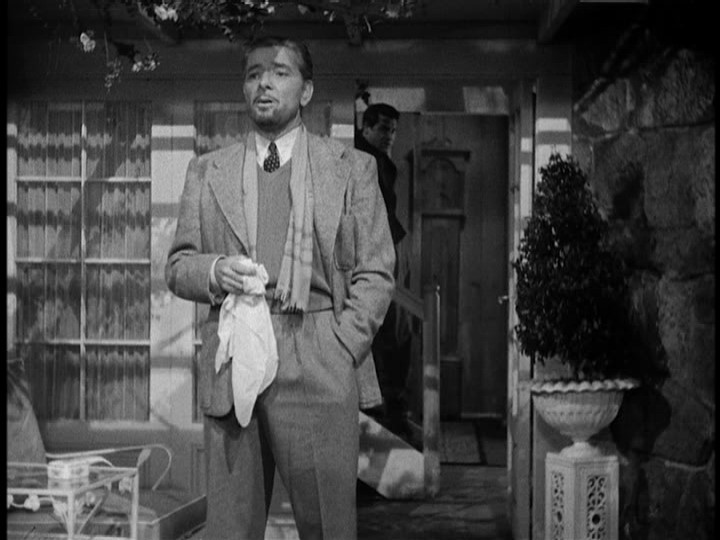
It's the least material aspect to the film in the first place. The plot involves the burning of a local mill and the framing of mill worker and "activist" (one assumes a unionist) Leopold Dilg (Cary Grant) for arson and the murder of the plant foreman.  Everything is stacked against Dilg from the mill owner calling for his blood in the sympathetic press, to the trial judge being in Holmes' hip-pocket. Dilg escapes from prison (in a dramatic opening sequence that's a bit out of sync with the rest of the movie) and hides out in "Sweetbrook," the rental house run by his high-school acquaintance Nora, who's trying to get the place in shape for the impending arrival of a temporary lodger, law dean Michael Lightcap (Ronald Colman) who's taking the Summer off to write a book.  This being a comedy, Lightcap arrives early—the night Dilg has stumbled his way in—and Nora has to hide the runaway in the attic, while the police comb the area looking for him.
"Hilarity ensues"
After a restless first night for all—nervous Nora has spent the night in another room and Dilg snores in his attic roost leading Lightcap to advise Nora she needs to do something about her adenoids—the complications begin: Dilg is too restless a spirit and cranky an agitator to to stay cooped in the attic; Lightcap needs a secretary and to keep Dilg under wraps and separated from Lightcap, Nora takes the job; and then, to raise the stakes, a local Senator stops by to tell Lightcap he's being nominated for the Supreme Court. So, politics being what they are (the same as always), if there's any hint of scandal, oh, like, say, harboring a wanted fugitive in your house, it could hurt the professor's chances of being one of the Supremes (depending on who's in The White House, of course).

Dilg being Dilg, he can't stay under wraps for long, and he's soon hiding in plain sight as "the gardener," and his views of the law leads to some sparring over the letter of the law and how it can conflict with the intent, especially when those intentions are not honorable to the spirit of the law, and Lightcap finds himself embroiled in a conflict of interest, where his cloistered view from his ivory tower looks pretty good in theory, but bares only a conversational similarity to its practical applications in the world of dog-eat-dog.
That's the meat of The Talk of the Town, but the screenwriters and Stevens must gild it with a "who gets the girl" story-line that will satisfy the jury of the audience. Stevens let the answer to the question be decided by a preview audience of peers—with nothing decided until the very last second. With Colman as a sophisticated book-smart professional with a lot of learning to do, and Grant as am earnest dreamer, it's hard to choose, but Arthur is, as always, a delight, finding ways to make the quick-witted Nora flustered, but with the best of intentions and the most charming of choices.  Like the movie, she's a bit of a mess, but an enjoyable one.

Wednesday, May 28, 2014

Anytime Movies (Transplanted): - Only Angels Have Wings

While I have a few reviews "in the works," It's as good a time as any to re-boot (actually transplant from the old movie blog) a feature I started years ago, when it was suggested I do a "Top Ten" List. 

I don't like those: they're rather arbitrary; they pit films against each other, and there's always one or two that should be on the list that aren't because something better shoved it down the trash-bin. 

So, I came up with this: "Anytime" Movies. 

Anytime Movies are the movies I can watch anytime, anywhere. If I see a second of it, I can identify it. If it shows up on television, my attention is focused on it until the conclusion. Sometimes it’s the direction, sometimes it’s the writing, sometimes it’s the acting, sometimes it’s just the idea behind it, but these are the movies I can watch again and again (and again!) and never tire of them. There are ten (kinda). They're not in any particular order, but the #1 movie IS the #1 movie.

While in college, I worked as a movie projectionist, and had an opportunity to show many great films for the various film courses being taught. But one film left a distinct impression—over the course of five days I had to show it eight times. I got to know it pretty well. Its name is -Only Angels Have Wings and it was directed by one of the great director-producers, Howard Hawks.

Hawks directed all types of movies, many of them classics of their genre: westerns (
Rio Bravo, Red River); mystery/noir (The Big Sleep); adventure (To Have and Have Not, Hatari!) and comedy (Bringing Up Baby, His Girl Friday). He even produced one of the first truly classic science fiction films (The Thing! [From Another World]), and an iconic musical (Gentlemen Prefer Blondes). Despite the genre, and despite the decade in which it was produced each film is unmistakably a Hawks film – a group of men (and women, but usually men) of diverse talents must come together to achieve a singular goal, be it to drive a huge herd of cattle to Missouri, or contain the alien threat, or capture a live rhinoceros, or get the bad guy to the Marshall (alive if possible) or ferry the refugees to safety, or find the dinosaur clavicle, or land a millionaire.

Conflict is achieved by introducing a newcomer to the mix who doesn’t understand the synergy of the group and who must learn “the code” to belong, and that keeps the group in cohesion. And so much the better if they do it without talking about it much.

That’s the Hawks formula, and he was able to create enough variations in the design that his films all seem different, even though they’re always telling the same basic story—a story that’s a metaphor for movie-making.
*

“Hello, professional”

Why -Only Angels Have Wings out of all those classics? It is the ultimate Hawks movie. Watch any of those others and you’ll hear similar lines and see similar situations, but in Angels, everything is distilled to the basic essence of the tale to become the best Hemingway story Hemingway never wrote. Distilled? The majority of the film takes place in one set! For this band of professionals, the goal is to fly the mail from the port city of Barancca through a narrow passage in the Andes utilizing one of a number of prop aircraft, all in need of repair. The men realize they’re merely links in a chain getting the mail…or a doctor…or a shipment of nitro-glycerin…to its destination with the threat of death flying right alongside. So hazardous is the job for these civilian-pilots that their base is a revolving door for the new blood who have to prove themselves. It’s "The Right Stuff” twenty years before Tom Wolfe popularized the phrase.
Grant, Barthelmess, and Mitchell play one of a few triangulations in -Only Angels Have Wings

And it’s prime Hawks. For instance, watch the cigarettes. In a Hawks film, they’re visual short-hand for relationships—who’s in need and who can provide, who’s giving, who’s dependable, giving, taking, reading other's thoughts, . More than any other Hawks film, except perhaps Rio Bravo, the flame that’s there when you need it is a gambit that crams twice the information into the film, and reveals more about the characters than their deliberately circumspect dialog—what
Frank Capra called Hawks’s “three-corner dialog”—was allowed. To come right out and say things point-blank, well, not only would it be corny and unbelieveable…it just wasn’t done in Hawks's circles.

Hawks also liked to use music to convey mood. But it usually isn’t a Hollywood background score it's indigenous music—in this case, the bar band at Dutchy’s bar/mercantile and air terminal (this is a couple of years before
Casablanca). They set the mood, provide a little extra entertainment value, some local color for a set-bound movie and when the time is right and there’s a meeting of minds it’s reflected in a musical number in which everyone participates. Again, no one has to come out and say ”We’re all thinking the same way.” They’re all singing the same song, so it’s understood.

"Boy, things happen fast around here, don't they?"

There’s also the unspoken ethos of the professional—you do your job to the best of your ability and you don’t talk about it. You don’t brag. You don’t cut corners and you don’t dwell on it. You do your job, you move on. You do your job right and people will notice. Do your job wrong and everyone suffers. In this way the group can depend on each other while staying out of their debt. In this movie-atmosphere, bit-players are allowed to shine. Yeah, the movie revolves around
Cary Grant (and the only role where he would be more stoic than he is here would be playing the icy spy Devlin in Hitchcock’s Notorious) and the delightful Jean Arthur—she could turn on a dime from tragedy to comedy and not miss a step— but even the lowliest of character-actors get great moments of screen-time. Also of note are a very young Rita Hayworth at the start of her career and Richard Barthlemess—a former silent screen star who didn’t make the transition to “talkies.” He plays a pilot who must prove himself to the others and that he can “cut” it in their world. Art imitates life.

And then there’s
Thomas Mitchell, who might well be the greatest character actor to never achieve name-above-the-title status. A veteran of many a Frank Capra comedy—and whose most prominent role would be as Scarlett O’Hara’s father in Gone with the Wind—here he plays a character with the title “The Kid,” even though he’s the oldest of the pilots. So much of the movie centers on him that his one character fulfills every plot device except love interest, although with Hawks one could never be too sure of that, either. **

Ultimately it’s Mitchell’s Kid who provides the means for Grant’s character to express his feelings, which, typically, he does without really having to, and in a way that makes it obvious to everybody involved. And as if anybody missed the point how dependent everyone is on each other, most of the pilots wind up injured, “winged” so that by the end of the movie, two pilots have to perform the job of one to fly each mail-run. Perhaps the better title may have been “-Only Angels Have Two Wings.”

It’s all done so economically, so breezily and with so little in the way of “action” that one may get through the entire movie before realizing that mostly everybody just talked…without really coming out and saying what they mean. Everything is shot at eye-level. There’s nothing fancy in the camera-work. The story is the King, and everyone is working towards making it work…like professionals.

Cary Grant needs a match. Jean Arthur carries a torch.

The Searchers
Mr. Smith Goes to Washington
Chinatown
American Graffiti
To Kill a Mockingbird
Goldfinger

Bonus: Edge of Darkness


* Hawks was well-known for taking different stories and turning them into the Hawks formula, sometimes rewiting the entire film on a day to day basis to get there. The most extreme example of this is El Dorado, which after ten minutes of one story suddenly veers into becoming a remake of the earlier Hawks-John Wayne western Rio Bravo. When Hawks called John Wayne to ask if he’d star in yet another western, Rio Lobo, Wayne knew exactly what he was getting into. “Do I get to play the drunk this time?” he drawled.

** Someday, someone far more intelligent than I is going to go through the Hawks filmography with an eye towards sexual politics—whether it’s the leering banter between 
Montgomery Clift and John Ireland in Red River, or Cray Grant in drag in Bringing Up Baby (“I went GAY all of a sudden!!”) and I Was a Male War Bride, or some of the more bizarre stagings of musical numbers in Gentlemen Prefer Blondes.  And then there’s the long line of husky-voiced women in his movies who are one of “the boys,” from Rosalind Russell to Lauren Bacall all the way up to future Paramount Studios exec Sherry Lansing. For all the macho posturing exhibited in his movies, there are hints that Hawks never completely “bought” into it and is enjoying winking at it. He may well be second only to James Whale in sneaking so much gay subtext into his movies.