Showing posts with label Edward G. Robinson. Show all posts

Friday, June 28, 2024

The Cincinnati Kid

The Cincinnati Kid
(Norman Jewison, 1965) One of the great poker movies, from a novel by Richard Jessup, written by Ring Lardner Jr. (the first studio film bearing his name after being blacklisted during the McCarthy era) and Terry Southern and directed by Norman Jewison.
That's the credits on the final film...and legitimately so. But, at the start of filming, everything was different. The film was originally bearing a screenplay by Paddy Chayevsky—who was warned by Steve McQueen (who had a lot of clout and would throw his weight around on-set) "I'm better at walking than talking"—re-written by Lardner and to be directed (in black and white) by Sam Peckinpah. The Hustler—a film about compulsive gambling (in that case, pool) to the detriment of life—had been a big hit and critical darling...and had picked up quite a few Oscar nominations. So, producer Martin Ransohoff must have had that in mind when this film was being cobbled together in pre-production.

Well, once filming started, Ronsohoff was shocked by the dailies Peckinpah was bringing in—there were scenes that didn't relate to the script—and fired him almost immediately (stories conflict on the details) and quickly hired Norman Jewison, who was most known for directing Doris Day movies, and the production was shut down, giving the new director time to re-assess and make changes. Charles Eastman and Terry Southern were hired to do some re-writing, and Jewison switched to color film—he thought filming red and black playing cards in black and white was counter-productive. 
Talk about gambling.

A New York Times story published Dec. 7th stated: "In trying to put “The Cincinnati Kid” before the cameras, Mr. Ransohoff and MetroGoldwyn ‐ Mayer have run through nearly every possible difficulty that can arise in contemporary Hollywood."
We meet "The Kid", Eric Stoner (McQueen) pitching pennies with a shoeshine boy (Ken Grant), who knows the Kid, knows his reputation and is in a hurry to beat him. Of course, he loses. And the Kid rubs it in: "You're just not ready for me yet." But, the youngster watches him saunter down the street with a lean and hungry look. Everybody will have that look at one point or another.
The Kid, you see, holds markers on everybody in New Orleans, which is fine except that he has to go across the river to dredge up a decent stud game, which—tonight—brought him $194 and the near-opportunity of a shiv between his ribs. But, there's a new game in town: Lancey Howard (
Edward G. Robinson), "The Man", has stepped off a train in the city and is looking for action. The Shooter (Karl Malden), the best dealer in town and who's been bested by Howard in the past, knows The Kid wants to play against The Man, if only to prove he's the best in the game, and the Kid knows he can beat him. He knows it. Shooter had those dreams, too...once.
But, it's making him a bit preoccupied and more self-absorbed than he usually is. So much so that he's ignoring his girl Christian (Tuesday Weld) to the point where she's taking up with Shooter's bad-girl wife, Melba (Ann-Margret), who's so bad that she cheats at jigsaw puzzles. That's not Kitten with a Whip-bad...but it's bad as Chris is naive and Melba is anything but.
The Kid knows all about Melba's habits, but he's focused on the game and all-in. "
Listen, Christian, after the game, I'll be The Man. I'll be the best there is. People will sit down at the table with you, just so they can say they played with The Man. And that's what I'm gonna be, Christian." She can't break through the wall of chips he's seeing, so she leaves town to go back to the folks'.
But, there's another game in town.
Howard has an invitation to play stud with the very wealthy and very competitive William Jefferson Slade (Rip Torn) and the two go at it in a high-stakes 30 hour game that Slade ends up losing...to the tune of  six grand. And Slade doesn't like to lose...to anybody. Oh, he plays the Southern Gentleman just fine. But, he tells Shooter—who dealt the game—that he wants to "gut" the old man the way he feels gutted, and using Melba as a chip, coerces Shooter to slide the Kid the right cards in the inevitable match between them. This goes against everything Shooter believes in, but, with Melba in the mix...
It's gun-slingers meeting over green felt rather than the town square and Robinson is the fast-draw every twitchy trigger-finger kid wants to best. And just about everybody in the movie has skin in the game, if only to see The Man meet his match. With so much interest by outside parties, I come away (after a third viewing) convinced the game is rigged—the odds of the hand being dealt are very long—either
45,102,781 to 1 or 332,220,508,619 to 1, depending who you believe. But, it makes a good story, no matter the odds.
Steve McQueen's poker-face.
Jewison called it his "ugly duckling" film—given his short amount of pre-production time, how could it not?—and considered McQueen the most difficult actor he ever worked with (although he chose to work with him again!), but the film manages to hold up pretty well. There's just enough nodding to New Orleans to give it an exotic air, it's filled with with great actors—Dub TaylorRon SobleRobert DoQuiJoan Blondell (!!), Jack WestonJeff Corey, Torn...and Cab Calloway (fer cryin' out loud!), how could it not be entertaining?
 
Yeah, there's issues. Script issues, mostly. But given the paper changing hands so often, and McQueen's way of up-ending tables for the sake of "image," it's surprising that it's as consistent as it is. The Kid zigs when he should zag a couple times—he's supposed to be savvy and be able to "read" people but he gets blind-sided too many times to believe it. 
Steve McQueen's poker-face, when he thinks he's winning.
And there's two endings—the one Jewison had in mind and one mandated by Ransohoff and the studio. The one I've seen the most I don't believe for a heart-beat. I'm out. But the one ending with the freeze-frame? That's aces.


One of the nicest thing about The Cincinatti Kid is the score by Lalo Schifrin, which includes
an End-Title song sung by the inimitable Ray Charles.
It's one of my favorite movie-songs, not only because of Charles
but because it uses the word "pyramid" as a verb.


Saturday, October 7, 2023

Seven Thieves

Seven Thieves
(Henry Hathaway
, 1960) One of the posters for Seven Thieves screams out the cast of characters in this Cinemascope black and white film and manages to have its own little obfuscation in there: The Dancer! (Joan Collins) The Professor! (Edward G. Robinson) The Baron! (Eli Wallach) The Gambler! (Rod Steiger) The Beatnik! (Eli Wallach) The Muscle Boy! (Berry Kroeger) The Safe Cracker! (Michael Dante). Well, kinda, the characters are a bit more nuanced than that, and "The Beatnik" is a stretch for a jazz saxophone player, but, it was the parlance of the time...and Wallach, in the film, fills the bill of two of those mentioned. Hey! It's a Heist film, and one should expect some fudging of the truth here and there, even in...and maybe especially in...the advertising.
 
Seven Thieves may be long forgotten—I'd never heard of it until Todd Liebenow of "The Forgotten Film-cast" podcast gave me a choice of four films to consider discussing in an up-coming episode.* Seven Thieves was a tempting subject—directed by Henry Hathaway—with a cast that included Wallach, Edward G. Robinson, Rod Steiger, Alexander ScourbySebastian Cabot, and Joan Collins. The cast alone makes it worth seeing, even if it only amounts to another variation on the One Last Big Score Caper Movie.
Professor Theo Wilkins (Robinson) is a discredited ex-patriate living in Monte Carlo. He spends his time at the beach explaining to little children how to collect shells, but, in the back of his mind is a plan. All he needs is one last "element" to bring it all together and keep it all together in order to pull it off. That "element" shows up one day in the form of gambler and thief Paul Mason (Steiger), who has affection for the old man, but is reluctant to get involved in another of the old man's quixotic ventures.
The plan, Wilkins explains, is to steal 4,000,000 from the vault of the casino at Monte Carlo, which will require some special equipment and specialized personnel, all of which he has, but he needs Mason, his trusted mentor, to join the group in order to keep his motley crew of conspirators in line.
The key to the whole enterprise is the casino employee (Scourby) who is so besotted with "exotic dancer" Melanie (Collins) that he will do anything for her, even rob his employer. But, he merely provides information (and invitations) to make the job go smoother...and faster. Time, you see, is the critical element here, with an elaborate distraction on the night of a special celebration at the casino. Security is tight, but it just might be too tight to take advantage of. 
47 minutes in (after much bickering and negotiating), the caper starts, involving a trick wheel-chair, a cyanide pill, a conveniently open window, some safe-cracking tools, some steady nerves and balance, and the casino manager's reluctance to have "a scene" disrupt the joint's big night. It just about comes off without a hitch...but, after all, there needs to be some element of suspense to make the movie enjoyable. 
Now, this was made in 1960, so movie-morals hadn't loosened up so much that producers might let the thieves actually get away with their ill-gotten gains. But, here, they do...but manage to have it both ways so that Boston Blue Noses and the Catholic Legion of Decency won't condemn the film for celebrating "the wages of sin." It's a rather thin ledge the film has to negotiate to do it...and far-thinner than the one that had to accommodate Rod Steiger. But, it still manages to be a semi-enjoyable film, with quite a few things to admire.
 
* The movie we decided on was The Blue Max and the episode discussing it is here.

Wednesday, July 10, 2019

The Last Gangster

The Last Gangster (Edward Ludwig, 1937) Six years after ushering in the gangster film with his portrayal of Johnny Rico in Little Ceasar for Warner Brothers, Edward G. Robinson was playing another one named Joe Krozac in a property titled Another Public Enemy, written by William Wellman, the man who wrote and directed James Cagney's Public Enemy. For whatever reason, the property made it over to M-G-M, not the tough-as-nails "Home of the Crime Drama" Warner Brothers, and got gussied up with the Metro house style and a more family-friendly story-line. The result is a curious mixture of crime and melodrama, re-titled The Last Gangster.  

In this one, Robinson plays Joe Krozac, a mob-boss with a very loose mob, but a lot enemies, including the Kile brothers, whom he manages to wipe out except for one, Acey Kile (Alan Baxter) who manages to survive but swears revenge. 
It's bad timing because Krozac has taken an extended trip to Europe and returns with a bride from the old country, Talya (Rose Stradner), who knows nothing of his criminal activities. But, she can't help but notice the prosperity and shady character's in Joe's life, like Curly (Lionel Stander), who's a bit sketchy. But, you'd think she'd notice there's something a little "off" about Joe; when she announces she's pregnant, Joe's response is "Why, I'm so happy I'd like to go up and punch someone in the nose!"
But, life...and the law...can be inconvenient. Joe is convicted of tax evasion and sent to Alcatraz for ten tears—that's a lot of childhood to miss out on—and he vows that no pen can hold him, not for ten years. But, life is different on the inside and although his reputation helps, there are enemies on the inside, plus his gang on the outside, who want to know where he stashed all his loot before going to the Big House.But, however big he talks, he's still there when Talya gives birth—to a boy. Visitations to Alcatraz are bittersweet, as Joe cannot hold his child, but only watch him through prison-grills. On one of those visits, a newspaper scribbler named Paul North (James Stewart) sees the poignant scene and decides to make hay out of it, feigning sympathy for Talya and buying the child a toy gun, all the better to get a picture of the toddler making like father, like son and plastering it all over the newspaper. His editor is happy, but North quits in a fit of delayed conscience.
North apologizes to Talya, and she is drawn to his remorse, something completely foreign to Joe Krozec. Eventually, their marriage breaks down—Talya divorces Krozec and marries North, adopting Joe's child—and Joe loses track of them, as they move and North changes his name.

Stewing prison, Joe can't do anything about it, but he's determined to get his family back.

Robinson was attracted to the movie, even though he'd tired of playing gangsters, preferring better scripts and better writers than the genre churned out. And even though Wellman was associated with the genre—and grown out of it—the ideas of the story, originally titled "Another Public Enemy," were less concerned with mob life, but its consequences, and M-G-M was a cut above the more meat-and-potatoes Warner lot.
Still, The Last Gangster is more soap than pulp, and as much as script-writer John Lee Mahin tries to keep the script tough, he can't help but make the mobster more sympathetic than the good folks like the North family. Probably, it's Robinson's portrayal, which is far stronger than Stradner's "woe is me" immigrant wife (Louise Rainer was originally sought, but turned it down) and Stewart's weak portrayal.*
It has to be considered some kind of misfire when the actions of responsible people who are genuinely doing the right thing for a child, can't generate more sympathy over a jilted mobster. 

The Last Gangster would not prove to be the last gangster role for Robinson—just one of the lesser ones.

* I'm always fascinated by odd pairings of stars and seek them out to see what the results of such chemistry experiments are. Anybody expecting sparks between Robinson and Stewart will be disappointed. It's Robinson's show and Stewart's merely a dull co-star. The two wouldn't appear in another movie together until 1964's Cheyenne Autumn, but had no scenes together.

Wednesday, June 12, 2019

Smart Money (1931)

Smart Money (Alfred E. Green, 1931) Done-on-the-cheap Warner Bros. programmer made the year after Edward G. Robinson's star-turn in Little Ceasar and the same year as Cagney's in The Public Enemy and is an version of the studios' series of spare, street-tough films that would dominate their output in the 30's and 40's, glamorizing the life of a gangster, but making sure that they came to a bad end.

Robinson plays Nick the barber, a lucky Greek son of a gun, who runs a gambling joint in the back-room of his tonsorial parlor (thus making both ends of his establishment a "clip-joint.") Nick is king of his own gambling castle, and while its good to be the king,there's the tendency to want to expand the fiefdom by conquering new territory.

With a stake firmly established from his cronies back home, he takes off for New York to take on the big city gamblers, wished well by all the lovable mooks he's already taken for a ride at the train station.  But, what he learns is its a whole new game in the tony high rises, where only part of the bluffing and double-dealing occurs at the table. Why, even the hat-check girl is looking to separate you from your cash. Nick learns to trust no one, and to bluff his way out of any situation with a cock-sure patter of platitudes.  But, that's a slippery slope, and he soon finds that success costs.  
Its a treat to see Robinson and Cagney play off each other, the only time they did so—Robinson all-voice and punchy delivery, and Cagney sly and bantamy, physically, in one of his rare supporting roles. They're chummy at the beginning, but when success shows up, they start to have territory issues, its murder. This one is all performance, in varying styles, between character actors fresh out of the silent era, and the leads who were blazing new trails, and the director's hand is almost invisible.
Green is known, but mostly unknown, as the director of The Jolson Story, The Jackie Robinson Story, The Eddie Cantor Story...making that a "storied" career. He was a fine director of women and coaxed terrific performances from Bette Davis and Barbara Stanwyck early in their careers—and they were already formidable. He was fast, versatile and would direct up to five pictures a year. He didn't shy away from racy material in the pre-Code era and would tackle it directly with shameless brio. And he's remarkably free of the sort of Hollywood white-wash that was prevalent at the time. Minorities were cast, and not caricatured or minstrelled in his films, but treated like any other character actor, which is quite remarkable to see in that day and age. His output was undistinguished when you look at the titles (and there are 111 of them), but individually, it would be interesting to see a few more of them (I've seen this one, The Jackie Robinson Story and Baby Face) to see if that liberal sensibility is maintained throughout.


Tuesday, February 12, 2019

The Woman in the Window (1944)

The Woman in the Window (Fritz Lang, 1944) The ex-patriate German film-stylist (Metropolis) makes the first of his "love-is-a-trap" film noirs with Edward G. Robinson, Joan Bennett, and Dan Duryea. The second, Scarlet Street (Lang's next film) will be a nightmarish tale of lust, betrayal and greed that will skirt the Hays Code of having one of the triangle getting away with murder, but The Woman in the Window will be a bit more sedate...almost text-book.

Richard Wanley (
Robinson) is a professor of criminal psychology, so you'd think he'd knows his stuff, but it seems he's only good at the theory. While his wife and kids are out of town for the Summer, Wanley becomes enamored with a portrait of a young woman in a store window (theory), and after a club-night with the boys (among whom is detective Raymond Massey), he comes across the woman in the flesh and accepts an invitation to her apartment. Turns out she's the moll of a notorious money-changer, see? And N.M.C. shows up at the apartment, looking to serve Wanley a Harvey Wallbanger.

Things get ugly and somebody gets dead. It's up to the Good Professor to do some Bad Things to keep his reputation intacto, not to mention his corpus.
The wonderful thing about Lang is he kept making his scary German films (like M, his "Mabuse" spy-fantasies) in Hollywood, with a budget that would make glossier his mouse-trap films. Lang knew how to tell his stories in shadow, and even include the vast area outside the frame in the mix to keep audiences guessing as to what would happen next—his protagonists (and they're not always heroes) have to run his maze of ever-tightening traps that will mean loss of freedom or death ("or worse!" as they used to say on the "Batman" TV show—which employed some Lang techniques—with this director you couldn't be sure if Death was the end of it).
Here, Lang dips his toe into the dark murky water that he will dive in head-first with Scarlet Street, sketching a nightmare scenario and cautionary tale, preparing for the final deadly masterpiece of his next film.
Provocative, stylish and downright cruel, the cinema of Fritz Lang spoke of high themes and low instincts and if he's not the father of "film-noir," he's certainly a very close uncle.*

* According to Wikipedia the term "film noir"—"black cinema"—was coined by the French Press—they also make damn fine coffee—in 1946, after the post-war arrival of American films The Maltese FalconDouble IndemnityLauraMurder, My Sweet," and...The Woman in the Window. So, the five fathers of "Noir" are John Huston, Billy Wilder, Otto Preminger, Edward Dmytryk, and Fritz Lang—three Germans and two Americans (shudder!)

Tuesday, June 13, 2017

The Stranger (1946)

The Stranger (Orson Welles, 1946) Fairly conventional film from Orson Welles, which means it's a surrealist experiment in style for everyone else. Welles did this one under a time-constraint (which might be why the thing looks lush and complicated at the beginning and a might skimpy towards the end). It's Welles' least favorite of his films and the only film he directed that turned a profit at the time of its release.

Here, Welles is having fun with the idea of a Nazi war criminal hiding in plain sight in a small American college town. He's become a professor—college prof's being allowed certain eccentricities, like a secret allegiance to Der Fuehrer
—and he has wooed and become engaged to a Supreme Court Justice's daughter (
Loretta Young with her "deer-in-the-headlights" look). But for Nazi's it's safety in numbers, usually in concentric patterns. So when another war criminal is allowed to escape as bait by a War Crimes Commission, he heads straight for Harper, Connecticut, picturesque in Fall, and his superior, Franz Kindler (Welles), hiding as Professor Charles Rankin, hoping to start a Fourth Reich. As the professor is a clock-hobbyist, Kindler's precise deceptions begin to ungear. His current project, the old school clock tower with its carouseling angels and demons in pursuit high above the town is his refuge.
He should be keeping his eyes on the ground and the dogged—one might say "pugged"—pursuit by War Crimes investigator Wilson (Edward G. Robinson, whose good "badness" is used to great effect). Welles and his screenwriters (with an assist by John Huston) have a lot of fun with the global affairs effecting a small town and its eccentric collection of rubes, who prove to be inconveniently adept at things: the busy-body checkers hustler has a good memory and the town gossips are good sources of information, especially when they're in the dark about what secrets they have. Pretty soon, suspicion is sewn and in a small town, word gets around.
Welles manages to make a propaganda film, a detective story, a woman-in-jeopardy tale, with elements of comedy, AND show concentration camp footage all in one story-line (filmed in 1946!), couched in a popular entertainment (for George Schaefer who brought Welles to Hollywood) and knock it out before heading to Rio De Janeiro to film The Lady from Shanghai.
It's lower-tier pulp Welles, which still puts it far above Hollywood's average.

Shadows of The Stranger
Loretta Young's shadow of a doubt about her new husband (Welles) who's just come home.
"Use Gym Equipment at Your Own Risk" says a sign.
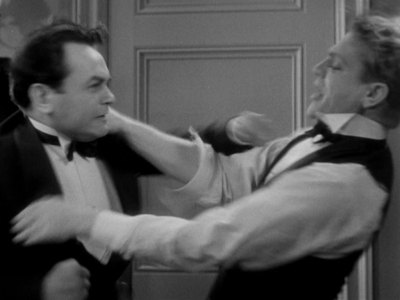
Edward G. Robinson is about to get clocked with a ring.
An informant is faceless and anonymous.
A Nazi criminal is on the run, and gets his picture taken for a fake passport.
Welles' shadows turn that same Nazi...into Adolph Hitler?

But don't take my word for it! As The Stranger is in the Public Domain, you can watch it or download it here

Thursday, December 15, 2016

Dr. Ehrlich's Magic Bullet

Dr. Ehrlich's Magic Bullet (William Dieterle, 1940) Credit Adolph Hitler for inspiring this film after decreeing in 1938 that "scientific discoveries by Jews are worthless."  There are all manner of refutations to such drivel, but producer Hal Wallis chose to focus on Dr. Paul Ehrlich, who, mere decades previously in Der Fuehrer's domicile, managed to rise above the medical community's flirting with anti-semitism by the sheer brilliance—and obvious results—of his research with the body's own facilities for fighting infections by creating blood serums for diseases, starting, along with Emil Behring, with diptheria in 1894.

But, that was just the beginning for Ehrlich. He began research on immunizations, their techniques, and other types of basic forms of therapy—what he termed, for the laymen and the money-men, "magic bullets" that would target and kill the diseases without harming any of the blood-stream's useful cells. 


John Huston worked on the screenplay (which won an Oscar nomination, losing out to Preston Sturges' The Great McGinty) and one can see the same template he would use to tailor the screenplay for his later film of Freud. We start seeing Ehrlich (played by Edward G. Robinson, who was anxious to get away from his gangster/thug roles) as the medical school nerd, barely tolerated by the senior staff at the medical facility because 1) he's Jewish, 2) he's curious, more so than the other students and 3) he uses an extensive amount of lab time on his own research, which is dismissed as frivolous.
It's hardly frivolous, but it's a stepping stone for more accurate diagnoses than the circumstantial evidence favored and relied upon by the older doctors (and form the basis of their expertise...and seniority). Ehrlich is experimenting with various dyes to enhance the parts of cells so they can easily be discerned through the microscope. The research is championed by one of his classmates in favor with the older doctors, Emil von Behring (Otto Kruger), who sees the value of isolating the nuclei of cells for diagnostic purposes. 
Now, that there is a procedure, a test subject is needed. Ehrlich attends a lecture on tuberculosis, and is able to obtain a sample of the bacterium for study. After much experimentation, he is able to tailor his techniques to isolate and target those cells with his identifying techniques, but in the process, catches the disease himself.
For recuperation, he goes to warmer climates of Egypt with his wife (Ruth Gordon), and in discussions with the doctors there, learns of their studies of the body's immune system and with Behring's help, starts work on a diptheria vaccine for an epidemic that is raging through the country's children at the time. His work is hailed as a major break-through in the treatment of disease through anti-biotics and immunization, but his own country looks at the work with skeptical eyes.

There's an interesting parallel between the science and the political: just as Ehrlich makes his greatest strides, the resistance to his work becomes stronger, as a disease will grow in its own resistance against treatment. Ehrlich will suffer set-backs both in his work and in the arena in which he pursues it, equating professional jealousy and outright prejudice as diseases in their own right. Given the tenor and nature of the the times in which the film was made, it's a carefully embedded message to attack a problem that might be cured in the subconscious, making the film a "magic bullet" of its own.

Dr. Paul Ehrlich c. 1908