That's the credits on the final film...and legitimately so. But, at the start of filming, everything was different. The film was originally bearing a screenplay by Paddy Chayevsky—who was warned by Steve McQueen (who had a lot of clout and would throw his weight around on-set) "I'm better at walking than talking"—re-written by Lardner and to be directed (in black and white) by Sam Peckinpah. The Hustler—a film about compulsive gambling (in that case, pool) to the detriment of life—had been a big hit and critical darling...and had picked up quite a few Oscar nominations. So, producer Martin Ransohoff must have had that in mind when this film was being cobbled together in pre-production.
Well, once filming started, Ronsohoff was shocked by the dailies Peckinpah was bringing in—there were scenes that didn't relate to the script—and fired him almost immediately (stories conflict on the details) and quickly hired Norman Jewison, who was most known for directing Doris Day movies, and the production was shut down, giving the new director time to re-assess and make changes. Charles Eastman and Terry Southern were hired to do some re-writing, and Jewison switched to color film—he thought filming red and black playing cards in black and white was counter-productive.
Talk about gambling.
A New York Times story published Dec. 7th stated: "In trying to put “The Cincinnati Kid” before the cameras, Mr. Ransohoff and MetroGoldwyn ‐ Mayer have run through nearly every possible difficulty that can arise in contemporary Hollywood."
We meet "The Kid", Eric Stoner (McQueen) pitching pennies with a shoeshine boy (Ken Grant), who knows the Kid, knows his reputation and is in a hurry to beat him. Of course, he loses. And the Kid rubs it in: "You're just not ready for me yet." But, the youngster watches him saunter down the street with a lean and hungry look. Everybody will have that look at one point or another.
The Kid, you see, holds markers on everybody in New Orleans, which is fine except that he has to go across the river to dredge up a decent stud game, which—tonight—brought him $194 and the near-opportunity of a shiv between his ribs. But, there's a new game in town: Lancey Howard (Edward G. Robinson), "The Man", has stepped off a train in the city and is looking for action. The Shooter (Karl Malden), the best dealer in town and who's been bested by Howard in the past, knows The Kid wants to play against The Man, if only to prove he's the best in the game, and the Kid knows he can beat him. He knows it. Shooter had those dreams, too...once.
But, it's making him a bit preoccupied and more self-absorbed than he usually is. So much so that he's ignoring his girl Christian (Tuesday Weld) to the point where she's taking up with Shooter's bad-girl wife, Melba (Ann-Margret), who's so bad that she cheats at jigsaw puzzles. That's not Kitten with a Whip-bad...but it's bad as Chris is naive and Melba is anything but.
The Kid knows all about Melba's habits, but he's focused on the game and all-in. "Listen, Christian, after the game, I'll be The Man. I'll be the best
there is. People will sit down at the table with you, just so they can
say they played with The Man. And that's what I'm gonna be, Christian."She can't break through the wall of chips he's seeing, so she leaves town to go back to the folks'.
But, there's another game in town. Howard has an invitation to play stud with the very wealthy and very competitive William Jefferson Slade (Rip Torn) and the two go at it in a high-stakes 30 hour game that Slade ends up losing...to the tune of six grand. And Slade doesn't like to lose...to anybody. Oh, he plays the Southern Gentleman just fine. But, he tells Shooter—who dealt the game—that he wants to "gut" the old man the way he feels gutted, and using Melba as a chip, coerces Shooter to slide the Kid the right cards in the inevitable match between them. This goes against everything Shooter believes in, but, with Melba in the mix...
It's gun-slingers meeting over green felt rather than the town square and Robinson is the fast-draw every twitchy trigger-finger kid wants to best. And just about everybody in the movie has skin in the game, if only to see The Man meet his match. With so much interest by outside parties, I come away (after a third viewing) convinced the game is rigged—the odds of the hand being dealt are very long—either 45,102,781 to 1or 332,220,508,619 to 1, depending who you believe. But, it makes a good story, no matter the odds.
Steve McQueen's poker-face.
Jewison called it his "ugly duckling" film—given his short amount of pre-production time, how could it not?—and considered McQueen the most difficult actor he ever worked with (although he chose to work with him again!), but the film manages to hold up pretty well. There's just enough nodding to New Orleans to give it an exotic air, it's filled with with great actors—Dub Taylor, Ron Soble, Robert DoQui, Joan Blondell (!!), Jack Weston, Jeff Corey, Torn...and Cab Calloway (fer cryin' out loud!), how could it not be entertaining?
Yeah,
there's issues. Script issues, mostly. But given the paper changing
hands so often, and McQueen's way of up-ending tables for the sake of
"image," it's surprising that it's as consistent as it is. The Kid zigs
when he should zag a couple times—he's supposed to be savvy and be able
to "read" people but he gets blind-sided too many times to believe it.
Steve McQueen's poker-face, when he thinks he's winning.
And there's two endings—the one Jewison had in mind and one mandated by Ransohoff and the studio. The one I've seen the most I don't believe for a heart-beat. I'm out. But the one ending with the freeze-frame? That's aces.
One of the nicest thing about The Cincinatti Kid is the score by Lalo Schifrin, which includes
an End-Title song sung by the inimitable Ray Charles.
It's one of my favorite movie-songs, not only because of Charles
The Story: In the DVD commentary track of In the Heat of the Night (with director Norman Jewison, cinematographer Haskell Wexler, Lee Grant and Rod Steiger), Jewison can't remember who came up with it, but it wasn't initially in the script (although it was put in a revised script at the time of filming).
It was the slap. The first time a black man slapped a white man in a motion picture. Although it had been long past due.
At the first screening in San Francisco, Jewison was aggrieved to hear laughter in the audience at two dramatic points—specifically, the line "They call me Mister Tibbs!" and this slap—and was considering removing both, when his editor (and future director) Hal Ashby—a cooler, hipper head—advised him that the crowd, rather than thinking it was funny, was actually enjoying it. Jewison thought those moments would certainly shock an audience...but he hadn't quite made the leap that they'd approve. Both stayed. The film went on to do well at the box office and won the the Best Picture Oscar that year, over Bonnie and Clyde, The Graduate, Guess Who's Coming to Dinner (also featuring Poitier) and...Dr. Dolittle (which...believe it or not...almost featured Poitier).
If there was a King of Cool in the 60's, I wouldn't go with the usual answer of Steve McQueen, I'd go with Sidney Poitier. Yes, he could be a bit of a poser, but, he was also quietly subversive, especially here. Coming up from playing angry juveniles and token roles, Poitier rather quickly rose up the cast-lists to be become a featured player and then, starring roles in, co-starring in The Defiant Ones, then starring in Porgy and Bess, A Raisin in the Sun, Pressure Point, until he became the clear name-above-the-title with Lillies of the Field, for which he won the Best Actor Oscar becoming the first African-American actor to do so. Perhaps more significantly, Poitier, had the clout that, rather than taking a higher salary, he opted to take a percentage of the film's profits. He had become a box-office draw, no longer dependent on the property he was in or his co-stars. It became obvious that audiences were coming to see him.
That brings power. And Poitier carefully began to pick and choose projects where he could push boundaries to become more that "that nice black man" on-screen, to bring edgier textures, broad subject matter and better opportunities, going on to produce and direct. He knew he had an audience. He was going to use it.
It's always great to watch him work. Jewison and Poitier knew they were treading dangerous ground with the slap, but, after some (I think) unnecessary screen-time waiting for a reaction from the Gillespie and Endicott characters, Poitier's Tibbs answers Endicott's impotent threat "There was a time I could have had you shot" with the slightest of smiles, and straightens the lay of his suit before marching out the door, not even watching his back. Nice. Little details like that always makes Poitier fun to watch...and the King of Cool.
The Set-Up: Wealthy industrialist and contractor Philip Colbert has been found dead in an alley-way of Sparta, Mississippi. That doesn't happen much in small-town Sparta, and Police Chief Bill Gillespie (Rod Steiger) is under some pressure to find out who the killer is. He's grasping at straws and jailing anyone—even one of his officers (Warren Oates) on just a suspicion. The first person he suspects is the stranger waiting for a train at a bus station; he turns out to be Detective Virgil Tibbs (Sidney Poitier) from Philadelphia visiting his mother in Sparta. After talking to Tibbs' superior, Gillespie recruits him to help solve the murder and the two begin a mutually-suspicious inquiry of suspects, given Tibbs' lines of inquiry. He knows the killer bludgeoned Colbert, that he moved the body to the alley-way, that he's right-handed, and that—driving the victim's car after the murder—there were traces of osmunda—fern root—on the car's brake. Tibbs and Gillespie go to speak to Eric Endicott (Larry Gates)—of Endicott Cotton—a prominent Sparta resident, and who opposed Colbert's factory, fearing an influx of new African-American workers to the area.
Action.
Gillespie and Tibbs
GILLESPIE You going to come right out and ask him where he was last night?
TIBBS (a put-down) Let's just—sniff around a bit first. All right?
Before Gillespie can react, Tibbs starts for the front door, Gillespie going after him.
CLOSE MOVIING SHOT - The two men
GILLESPIE (accusative) Is there anything you know you haven't told me?
Gillespie draws abreast of Tibbs as they arrive at the front door.
TIBBS AND GILLESPIE
TIBBS I found a piece of osmunda in Colbert's car.
He rings the bell.
GILLESPIE You found what?
TIBBS (cool) On the brake pedal. Osmunda?
(a beat)
TIBBS Fern root?
Gillespie remains baffled.The door opens. Inside an elderly Negro butler with white hair looks out, past Gillespie towards Tibbs.
GILLESPIEChief Gillespie. Oh, is Mr. Endicott here?
BUTLERPlease come in, Yes, suh. He's out in the greenhouse.
Gillespie enters, Tibbs following.
BUTLER Would you follow me, please?
INT. RECEPTION HALL - MED. FULL SHOT - DAY
The butler shows the two men to the parlor, but the butler's eyes reproach Tibbs, seeming to be a warning and a scolding simultaneously.
INT. THE PARLOR - GILLESPIE AND TIBBS - DAY
move into the mid-room as the butler vanishes.
Gillespie looks around the tastefully-furnished room.
He seems tense and out-of-place. Tibbs, on the contrary, seems at ease.
They hear footfalls, see Endicott appear through the french doors leading to the adjoining greenhouse.
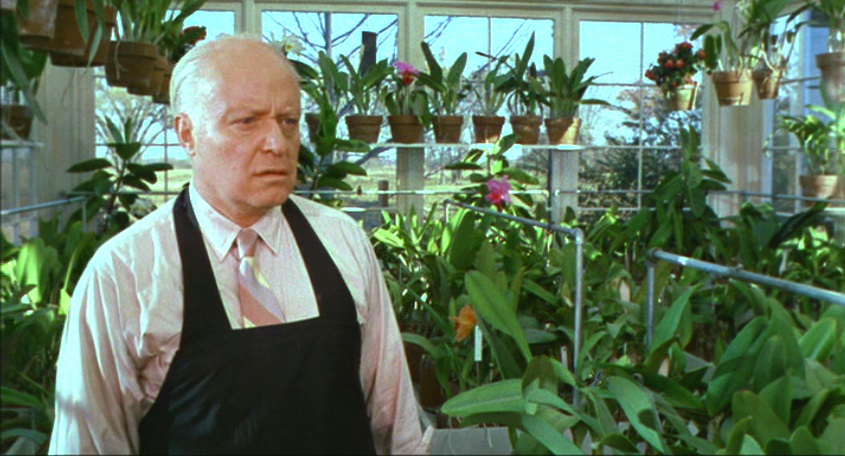
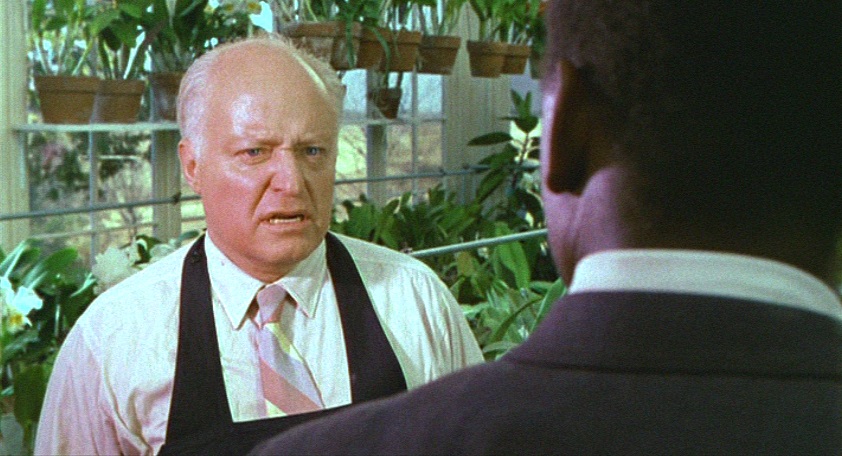
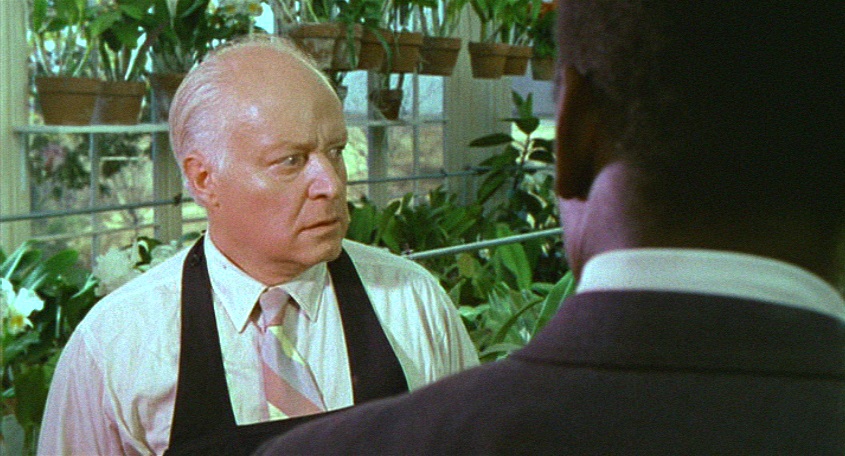
He is wearing an apron and carrying a tiny instrument used by orchid-fanciers for cross-pollination. He looks rich, secure, cultured, and affable, King of the Haves.
ERIC ENDICOTT: Gillespie.
-
CHIEF BILL GILLESPIE: Mr. Endicott.
GILLESPIE:This here's Virgil.
-
ENDICOTT:Mr. Tibbs.
DETECTIVE VIRGIL TIBBS: How do you do, sir?
ENDICOTT:Oh, may I have Henry fetch you
somethin'? Some light refreshment?
-
GILLESPIE:No, thank you. We're all right (the way we are)...
-
TIBBS (interrupting):Well,
TIBBS:I'll have something cold, something soft. Anything.
ENDICOTT:Henry, bring in a pitcher of lemonade. I'll have one, too.
HENRY: Yes, sir.
ENDICOTT: Investigating any crime of violence has got to be a most unpleasant occupation. Is there any way that I can be of help?
Endicott notices how Gillespie glances over at Tibbs, as though for counsel. Gillespie seems to be at a loss for words. Tibbs seems to be appreciating the Civil War portrait of Endicott's great grandfather which hangs above the fire-place.
GILLESPIE (finally) Virgil here is—trying to set me up a—sort of—timetable.
ENDICOTT Sounds intelligent.
(to Tibbs)
ENDICOTT I was told you had some trouble this morning at the hotel.
Gillespie gives Tibbs a sharp look of reproof.
TIBBS Nothing important.
ENDICOTT I apologize for that particular clerk. He's suffering, I fear, from the white man's historical guilt. He can't seem to adjust to—the changing times.
Tibbs...then moves a few steps to an orchid plant.
TIBBS (To Endicott) May I compliment you, sir...
TIBBS:I didn't know it was possible
to grow this species locally.
-
ENDICOTT:Oh, you like flowers?
-
TIBBS:I do.
ENDICOTT:Well, Mr. Tibbs, do you know
anything about orchids?
-
In the Heat of the Night is available on DVD and Blu-Ray from MGM Home Entertainment.
* The first draft has this appear after Endicott's slap: "Tibbs has all he can do to restrain himself. The butler drops his head, starts to pray. 'For him, Uncle Tom', Tibbs says furiously, 'not for me!'" That doesn't feel playable to me...certainly not by Poitier...yeah, better and more efficient to just back-hand the guy.
The Viviene Sanders' book "Civil Rights and Race Relations in the U.S." cites Poitier as the inspiration quoting him: "I said, 'I'll tell you what, I'll make this movie for you if you give
me your absolute guarantee when he slaps me I slap him right back and
you guarantee that it will play in every version of this movie. I try
not to do things that are against nature."


 We meet "The Kid", Eric Stoner (McQueen) pitching pennies with a shoeshine boy (Ken Grant), who knows the Kid, knows his reputation and is in a hurry to beat him. Of course, he loses. And the Kid rubs it in: "You're just not ready for me yet." But, the youngster watches him saunter down the street with a lean and hungry look. Everybody will have that look at one point or another.