Showing posts with label Steve McQueen. Show all posts

Friday, June 28, 2024

The Cincinnati Kid

The Cincinnati Kid
(Norman Jewison, 1965) One of the great poker movies, from a novel by Richard Jessup, written by Ring Lardner Jr. (the first studio film bearing his name after being blacklisted during the McCarthy era) and Terry Southern and directed by Norman Jewison.
That's the credits on the final film...and legitimately so. But, at the start of filming, everything was different. The film was originally bearing a screenplay by Paddy Chayevsky—who was warned by Steve McQueen (who had a lot of clout and would throw his weight around on-set) "I'm better at walking than talking"—re-written by Lardner and to be directed (in black and white) by Sam Peckinpah. The Hustler—a film about compulsive gambling (in that case, pool) to the detriment of life—had been a big hit and critical darling...and had picked up quite a few Oscar nominations. So, producer Martin Ransohoff must have had that in mind when this film was being cobbled together in pre-production.

Well, once filming started, Ronsohoff was shocked by the dailies Peckinpah was bringing in—there were scenes that didn't relate to the script—and fired him almost immediately (stories conflict on the details) and quickly hired Norman Jewison, who was most known for directing Doris Day movies, and the production was shut down, giving the new director time to re-assess and make changes. Charles Eastman and Terry Southern were hired to do some re-writing, and Jewison switched to color film—he thought filming red and black playing cards in black and white was counter-productive. 
Talk about gambling.

A New York Times story published Dec. 7th stated: "In trying to put “The Cincinnati Kid” before the cameras, Mr. Ransohoff and MetroGoldwyn ‐ Mayer have run through nearly every possible difficulty that can arise in contemporary Hollywood."
We meet "The Kid", Eric Stoner (McQueen) pitching pennies with a shoeshine boy (Ken Grant), who knows the Kid, knows his reputation and is in a hurry to beat him. Of course, he loses. And the Kid rubs it in: "You're just not ready for me yet." But, the youngster watches him saunter down the street with a lean and hungry look. Everybody will have that look at one point or another.
The Kid, you see, holds markers on everybody in New Orleans, which is fine except that he has to go across the river to dredge up a decent stud game, which—tonight—brought him $194 and the near-opportunity of a shiv between his ribs. But, there's a new game in town: Lancey Howard (
Edward G. Robinson), "The Man", has stepped off a train in the city and is looking for action. The Shooter (Karl Malden), the best dealer in town and who's been bested by Howard in the past, knows The Kid wants to play against The Man, if only to prove he's the best in the game, and the Kid knows he can beat him. He knows it. Shooter had those dreams, too...once.
But, it's making him a bit preoccupied and more self-absorbed than he usually is. So much so that he's ignoring his girl Christian (Tuesday Weld) to the point where she's taking up with Shooter's bad-girl wife, Melba (Ann-Margret), who's so bad that she cheats at jigsaw puzzles. That's not Kitten with a Whip-bad...but it's bad as Chris is naive and Melba is anything but.
The Kid knows all about Melba's habits, but he's focused on the game and all-in. "
Listen, Christian, after the game, I'll be The Man. I'll be the best there is. People will sit down at the table with you, just so they can say they played with The Man. And that's what I'm gonna be, Christian." She can't break through the wall of chips he's seeing, so she leaves town to go back to the folks'.
But, there's another game in town.
Howard has an invitation to play stud with the very wealthy and very competitive William Jefferson Slade (Rip Torn) and the two go at it in a high-stakes 30 hour game that Slade ends up losing...to the tune of  six grand. And Slade doesn't like to lose...to anybody. Oh, he plays the Southern Gentleman just fine. But, he tells Shooter—who dealt the game—that he wants to "gut" the old man the way he feels gutted, and using Melba as a chip, coerces Shooter to slide the Kid the right cards in the inevitable match between them. This goes against everything Shooter believes in, but, with Melba in the mix...
It's gun-slingers meeting over green felt rather than the town square and Robinson is the fast-draw every twitchy trigger-finger kid wants to best. And just about everybody in the movie has skin in the game, if only to see The Man meet his match. With so much interest by outside parties, I come away (after a third viewing) convinced the game is rigged—the odds of the hand being dealt are very long—either
45,102,781 to 1 or 332,220,508,619 to 1, depending who you believe. But, it makes a good story, no matter the odds.
Steve McQueen's poker-face.
Jewison called it his "ugly duckling" film—given his short amount of pre-production time, how could it not?—and considered McQueen the most difficult actor he ever worked with (although he chose to work with him again!), but the film manages to hold up pretty well. There's just enough nodding to New Orleans to give it an exotic air, it's filled with with great actors—Dub TaylorRon SobleRobert DoQuiJoan Blondell (!!), Jack WestonJeff Corey, Torn...and Cab Calloway (fer cryin' out loud!), how could it not be entertaining?
 
Yeah, there's issues. Script issues, mostly. But given the paper changing hands so often, and McQueen's way of up-ending tables for the sake of "image," it's surprising that it's as consistent as it is. The Kid zigs when he should zag a couple times—he's supposed to be savvy and be able to "read" people but he gets blind-sided too many times to believe it. 
Steve McQueen's poker-face, when he thinks he's winning.
And there's two endings—the one Jewison had in mind and one mandated by Ransohoff and the studio. The one I've seen the most I don't believe for a heart-beat. I'm out. But the one ending with the freeze-frame? That's aces.


One of the nicest thing about The Cincinatti Kid is the score by Lalo Schifrin, which includes
an End-Title song sung by the inimitable Ray Charles.
It's one of my favorite movie-songs, not only because of Charles
but because it uses the word "pyramid" as a verb.


Saturday, February 6, 2021

The Towering Inferno

Saturday is usually "Take Out the Trash Day".  
 
For this particular entry, a "Burn Ban" is strictly enforced.

The Towering Inferno (John Guillermin, Irwin Allen, 1974)
"Inferno!
See the flames light up San Fran-cisco
While us lesser-paid stars fry like Crisco
Inferno!
We're trapped in this dreadful In-fer-no!"
 
From Mad Magazine #182 (April 1976) "Go to Blazes!" ("New Musicals Based on Big Movies")
(sung to the tune of "Maria" from "West Side Story")
It was one of those situations where two studios were going to be making competing movies on the same subject, in this case, the story of a high-tech skyscraper that experiences a devastating multi-floor fire. 20th Century Fox had the rights to the book "The Glass Inferno" by Thomas N. Scortia and Frank M. Robinson. Warner Brothers had the rights to "The Tower" by Richard Martin Stern. Rather than going into competition with each other (and potentially undermining each others' box-office potential), Fox (and "Glass Inferno") producer Irwin Allen convinced the two studios to join forces on one project to be called The Towering Inferno. In this first-of-its-kind arrangement, the two studios would share production costs and split the domestic and international box-office receipts. After Allen had a hit with Fox's The Poseidon Adventure, both studios were amicable to make money on the burgeoning disaster movie wave, with Allen, the self-dubbed "Master of Disaster" leading the project. Screenwriter Stirling Silliphant mixed and matched characters and incidents from both books to create the screenplay. 
Then, the casting began. With the budget afforded by two studios footing the bill, Allen upped his game by top-loading this movie with two of the biggest box-office draws at the time, Paul Newman and Steve McQueen (the two had only worked on one movie—McQueen's film debut—Somebody Up There Likes Me, and had had careers where both eyed each others' movies covetously, narrowly avoiding being paired in Butch Cassidy and the Sundance Kid). But, who got top billing is a little controversial. It would take an art director's creativity to come up with the poster—McQueen's name appeared (reading left to right) as first, but Newman's (reading top to bottom) would be slightly over his. Faye Dunaway's career was in resurgence, so she played the love interest, and William Holden, after being rebuffed for top billing, settled for third. Fred Astaire and Jennifer Jones both came out of retirement to work, and the rest of the cast was filled out by the journey-men television actors (like Richard Chamberlain, Robert Vaughn, Susan Blakely, and Robert Wagner) who received scripts with prominent coffee-rings staining them.
The plot is as straight-forward as a fuse: a San Francisco multi-use skyscraper catches fire on the night of a big gala celebrating its completion. In attendance at the swank top-floor Promenade Room are developer James Duncan (Holden), architect Doug Roberts (Newman), his fiancee Susan Franklin (Dunaway), as well as local dignitaries including the Mayor, a Senator (Vaughn) and the developer's duplicitous cost-cutting electrical contractor/son-in-law (Chamberlain). During a routine test of the electrical system during the day, a short occurs that starts a fire on the building's 81st floor. Roberts is alerted to this by Security Chief Jernigan (O. J. Simpson), who mans a monitoring system that appears to be ripped out of the submarine "Seaview." (Dammit, those things always sparked!)

This gets compounded when the public relations man for Holden's firm (Wagner), quite understandably, wants to turn on every light in the building once it hits dusk. Roberts objects—turn on all the lights at night? Are you crazy?—but is over-ruled for the photo op. (Oh, you'll get pictures, alright). One wonders how the thing got built with such a light-weight electrical grid, although I'm sure it wasn't done with candle-power as everything in the building seems to be combustible. But, then, we are talking about a company that would consider building the world's tallest glass building on one of the shiftiest fault-lines in the Americas, indicating a lot of unhelpful shaky thinking. Architect Roberts can gripe about people not doing their jobs, but shouldn't architects be thinking "location, location, location?"
The fire, when it starts, begins in a storage room on the 81st floor—high enough to make it nearly impossible to reach with a hook-and-ladder, central enough to do damage to core-stair-wells once it gets going and embedded enough that you can't hose it down from the air. But, smoke is seen from the floor via the closed circuit TV system and the San Francisco Fire Department is called. Investigating the system alert, Roberts head for the floor in question and one of his engineers is roasted trying to save a security guard. 
Roberts calls Duncan to the danger, but the developer has too many politicians upstairs he wants to talk to about zoning for other projects. With the certitude of the beaches being safe, he doesn't order an evacuation. That doesn't occur until the SFFD shows up and a grousing Battalion Chief Mike O'Halloran (McQueen) forces the issue. While the VIP's decide between men, women, children, and well-placed politicians—and stars who have a back-end deal—to leave the top-floor party room, Halloran and Co. decide what will be the best way to get the fire out, and as it's starting to jump up floors, the height of the building becomes the crux of the problem. Exploding gas-lines exploding only amplify the problem.
While Roberts works to evacuate people in the building not in the Promenade Room, O'Halloran works on the fires below the 81st floor, trying to reach the 65th floor where the Duncan Enterprises offices are located, but too late to save Wagner's P.R. man and his mistress from being consumed in the flames. Up at the Promenade Room, those gas explosions stop the express elevator carrying passengers down right into the fully-engulfed 81st floor and stopping the main way to get down the tower.
An attempt is made to land a rescue helicopter on the skyscraper's roof, but high winds destabilize the chopper and send it crashing to the roof, exploding and causing even more fires. Stairways from the top are engulfed by smoke, and those venturing into them soon find that the explosions have smashed floor-lengths of stairs. That leaves only two ways down—the outside scenic elevator and a make-shift way the fire brigade are fighting hard to set up.
That involves setting up a breech's buoy system stretching from the tower's roof to the roof of a neighboring skyscraper across the street, which can hold a limited number of people and is susceptible to those treacherous winds. But, that is looking like the only option as a building-wide power failure has rendered the observation elevator worthless. So, an alternate plan is made to secure a gravity brake to the elevator, snip it away from it's cables, and control the descent using the brake. 

Because everything has worked so well so far. 
It starts to look like The Glass Tower has been designed mostly to sabotage any effort to get around in it...(criminy, at one point, one of the emergency fire-doors is stuck because it's blocked by spilled concrete...who built this thing?) And by this time, there are so many floors and people on them to keep track of that one is ready to just throw up their hands and say "Okay, I'm going to change the batteries on my smoke-alarm!"—if not for the fear that even that might cause a horrendous burst of flames. It's wearying and disheartening and the bodies pile up so that you might become numb to it—like Faye Dunaway in the picture below.
Sure, it's a Disaster Movie—that's very well understood—and one goes into these things expecting a high body count. I mean, the posters used to scream "WHO WILL SURVIVE?" Plus, this thing just bores right into the primal fear centers with fire scenarios and great heights from which to fall. There's a hysterical element to The Towering Inferno that is almost gleeful in its ability to snatch hope from any kind of rescue scenario, leaving it to a revelation that is rather preposterous for a building so high to miraculously solve all of the problems in one swell...flood. But, at that point in the movie, you're willing to just accept it so the damned thing can end.
Frankly, one wonders what the fascination is beyond pyromania. The film was one of the biggest money-makers of its years and is generally sited as the "greatest" (whatever that means) of the "disaster film" cycle. After this torch-song, the cycle ran out of gas...or any other flammable material; Irwin Allen had to resort to killer bees for his next film. Perhaps the appeal is the one I have watching the yearly Academy Awards—hoping against hope that something will go wrong. But, seeing Hollywood Elites get some sort of comeuppance cannot overcome someone's tendency to acrophobia and pyrophobia.* Especially when the characters are such flammable paper tigers.

There's an added element to the dis-taste. Can anyone have any fun watching this movie post-9/11, when the world watched in real time while the Twin Towers were attacked and very real human beings fell from the sky. Accuse me of being a namby-pamby all you want. Anyone who doesn't think of that extended nightmare watching this and feel one's gorge rising a bit, probably hasn't been born yet.   
Jennifer Jones and Fred Astaire contemplating why they came out of retirement for this.

It appeals to all of our worst instincts. That tendency to watch catastrophe and not turn away. Even if that catastrophe is this dumpster-fire of a movie. 
"I got first billing." "I got TOP billing." "I play 'the girlfriend'"

* As far as I know there is no officially-designated, diagnosable fear of bad movies. Will have to consider some names.


Friday, April 17, 2020

The Magnificent Seven (1960)

So, I was talking to a co-worker about movies. Our tastes are different. "What'd you watch last night?" I asked. 
"Oh! Great movie! The Magnificent Seven!" 
"You've never seen The Magnificent Seven?"
 "No-oo." 
"Well, finally, we can agree on something...The Magnificent Seven is a classic!" 
"Yeah. And I lo-ove Chris Pratt!"

(Long Silence)

"What?" I spluttered. "Wha...Chris Pratt?" 
"Yeah, he's so great..." 
"You mean you're talking about that Denzel Washington mess?" 
"Yeah, he's great, too."
"No, no, no, no, no!" (I explained). "You HAVE to see the Yul Brynner version!" 
"Who?" 
"Yu...okay, Steve McQueen's in it!" 
"Who?" 

At this point, I started pulling what's left of my hair out—not to try and explain Yul Brynner, of course (Good thing I didn't lead with Horst Bucholz or Brad Dexter) and explained in the most condescending way possible that if she didn't see Charles Bronson in it, it just isn't The Magnificent Seven

I wonder if she ever did.

The Magnificent Seven (John Sturges, 1960) Sturges' remake of Akira Kurosawa's Seven Samurai as a Western (more accurately South-western) with cowboys (more accurately gun-slingers) is a rousing crowd-pleaser (while still maintaining the original's final resigned tone). This is not only due to Kurosawa's indestructible original tale of warriors from a by-gone age quixotically trying to save the residents of an agrarian town from bandits, but also for the charismatic cluster of stars vying for screen-time with "The King" himself, Yul Brynner.* Steve McQueen, coming off the "Wanted: Dead or Alive" series was particularly shameless about trying to grab the spotlight from Brynner. 

"It doesn't bother me," the older actor would tell Sturges. "All I have to do to upstage them is take off my hat."
In this version, it's a Mexican village being robbed by bandito's led by Eli Wallach's Calvera that cause a trio of farmers to go searching for "gun-fighters"  (they are told that gun-fighters are cheaper than guns) to take on the thieving gang. One by one, the odd troop are assembled including up-and-coming stars McQueen, Charles Bronson, Robert Vaughn, James Coburn, Brad Dexter and Horst Bucholz,** all pistolero's down on their luck and taking on the job—for their various reasons, be it bravado, assumed reward, paternalism, loyalty—until something better comes along. It's a dangerous temporary job, so the stakes have to be personal, beyond the measly compensation for the task. They are all aware that the risk to themselves is high, but not as much as the risk to the farmers.
Each of the seven have their reasons, but each of them have their own style of combat, making the final assault on the town (after a couple of skirmishes and a temporary change of fortune) that much more dramatic as each gun-fighter has to fight their own battles in their own individual style. And it doesn't matter what style they use...they always seem to do it cool.
When one compares the Kurosawa original with Sturges' adaptation, one notices a big difference—Nature. Sturges' stage is a big blue-skied sand-blasted valley-scape that doesn't much change and makes no impact on the outcome, whereas Kurosawa staged the original's dynamic set-pieces in a violent rain-storm, increasing the odds and making them more mythic, with the Heavens themselves having a stake in the conflict. Kurosawa wasn't complaining, though. He reportedly liked the American version so much he presented John Sturges a ceremonial sword.
Momentum is kept up by some sharp writing (by blacklister Walter Bernstein and Walter Newman, both credits replaced after much bickering about changes made on set by William Roberts) but also by a rousing Copland-esque score by Elmer Bernstein*** that manages to goose the action up several notches from how it's paced on screen. This might be sacrilege to say (as the score is so iconic and tied to the movie as much as a pack of Marlboro's), but it's almost like Bernstein is trying too hard in places, as when the theme thumps along when Chris (Brynner) and Vin (McQueen) are riding a buckboard to a confrontation.

Curiously the pacing is a bit slower when the words stop and the action begins, but one hardly notices when Bernstein is controlling the tempo.
The transition (and translation) from Japan to Mexico is a bit seamless, despite the lack of atmospherics, and just as the Samurai have their distinct characteristics, so, too, do the gunfighters--only Horst Bucholz, given an outlandish billing in retrospect, fails to rise to the potential of the others. The genius of the film is Kurosawa's, but this Americanized version still has its own unique charms, enough to make The Magnificent Seven a huge success in its own right. A couple years later, the same tack was used to create a westernized version of Kurosawa's Yojimbo,**** and launched the "Spaghetti Western" and the career of its chief architect, Sergio Leone.


The Magnificent Seven was voted into the the National Film Registry in 2013.


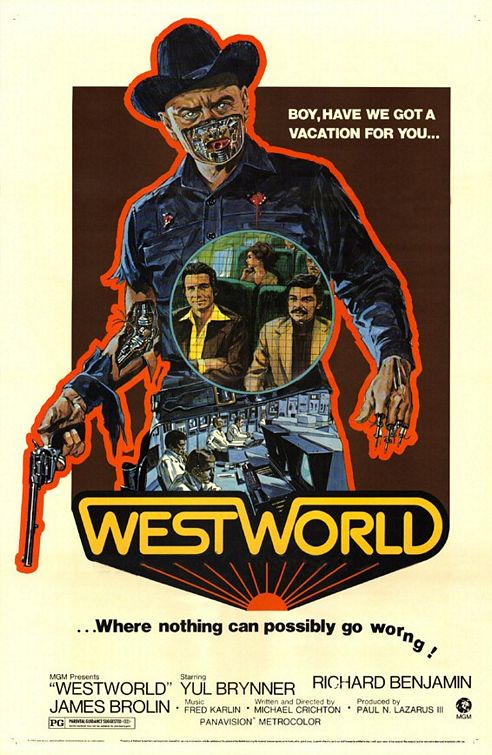
* Brynner cut such a fine figure as a gunslinger (despite his Russian heritage—his character's ethnicity was explained away as "Cajun") that he came back for the first sequel The Return of the Seven, and was the emblematic robot shootist in Westworld and its sequel Futureworld.
** The closest I could come to finding a movie that had so many future stars (and Brad Dexter) in it is Francis Coppola's The Outsiders.
*** Bernstein's theme became known as "The Marlboro Theme" because it was used as the background music for that brand's (now extinct) cigarette commercials. The prolific Bernstein (no relation to Leonard) only won one Oscar for his music--for the musical score to Thoroughly Modern Millie.

**** That would be A Fistful of Dollars, starring Clint Eastwood.


***** The film's story would be used...again...as A Bug's Life. And, anyone remembering Roger Corman's Battle Beyond the Stars will see more than a resemblance to The Magnificent Seven (beyond just the casting of Robert Vaughn).


Saturday, June 15, 2019

Le Mans

Le Mans (Lee Katzin, 1971) An interesting hybrid of documentary/Euro-artsy-pretense film/movie-star vanity project about the annual 24 hours running of Le Mans. I say an interesting hybrid, but it's not all that interesting, it's not all that good, but the documentary portions, the building-up-to, the crowds traipsing in, the everyday activities of the circus of a race environment, the crews working, the owners fretting, the drivers prepping, and the sometimes elegant dance of the vehicles are the most interesting portion of the film.  

What isn't interesting is anything involving actors, including the superstar actor who spear-headed the project for Warner Bros., Steve McQueen, initially with director John Sturges* (they had worked together on three other pictures, including the classic The Magnificent Seven and The Great Escape), and when the two had those pesky "creative differences" (he stopped by executive producer Bob Relyea's office and said "I'm going home" not mentioning that he was going back to the United States and quitting the movie), TV director Lee Katzin came in to over see the production.
McQueen was passionate about racing and wanted desperately to make a film about it and the professional drivers committed to a life of making left turns. He had a chance when John Frankenheimer approached him to star in his production of Grand Prix, but the two did not get along—their meeting lasted 30 minutes, it is said—and McQueen, instead, traveled to Taiwan to make The Sandpebbles. McQueen's friend and fellow TV-western star and racing enthusiast James Garner took the role*, which made McQueen's desire to make "his" racing film even more obsessional, determined to make "the ultimate racing film," which, at the time of Sturges' participation was entitle "Day of the Champion." But, there was one element missing—a script. McQueen's "vision" was to be unencumbered with a narrative that might limit the racing footage, ala Haskell Wexler's Medium Cool with the style of a film he particularly admired Claude Lelouch's A Man and a Woman.
With his back-to-back successes of The Thomas Crown Affair and Bullitt, McQueen achieved superstar status and had enough power to make any film for any studio in Hollywood, as long as he starred in it. He started prepping for his film of Le Mans, by going to the annual race in 1969 and plotting out camera angles and logistics for an event that only lasted for 24 hours and only once a year. McQueen's big plan was to actually race in Le Mans in the 1970 race, but Warner Bros. prohibited it due to insurance concerns—if McQueen was injured in a crash, they would lose $6 million. Professional driver Jonathan Williams would drive the "camera" car***—one camera facing forward, two cameras facing back. McQueen and crew filmed the race and crowds garnering enough documentary footage that they could work around the lack of crowds (and race) by focusing on the pit area and the track itself for subsequent filming.
But, filming what? The ideas were in McQueen's head and although outlines of what the movie would be had gone through dozens of revisions, the star would not commit to setting things down on paper in black and white, and refusing to succumb to Hollywood "formula". He wanted to keep all creative options open. Sturges quit half-way through post-race filming, and without his professional film-making supervision...and no script, Warner Bros. pulled out of the deal, and the film, already in production, was taken over by Cinema Centers, who clamped down on the production. There needed to be a script, there needed to be a schedule (with an end date) and there needed to be a budget set in stone...and a director with firm hands on the wheel...and given the situation, McQueen had to act for free, and merely as actor. McQueen agreed to the demands, signing the legal documents: "Steve McQueen...with blood"
The studio flew in Katzin, who brought in a lot of technical skill with cameras, but knew nothing of cars or racing. McQueen and crew were resistant, but McQueen eventually liked what Katzin was bringing to the film and the film wrapped in the fall as the leaves of the trees had to be painted green, lest they betray the season difference, and $1.5 million over budget. They had a million feet of exposed film that needed to be whittled down to theatrical length, with a semblance of a story. That process took a year, the film debuting in June 1971.
The movie is wordless for the first 37 minutes—and is the best part of the film, actually. It tells the story of Michael Delaney (McQueen), returning to race at Le Mans after the previous year being involved in a crash that killed racer Piero Belgetti. There are those among the racing community who hold Delaney responsible, including Belgetti's widow, Lisa (Elga Andersen), but that doesn't prevent there being a mutual attraction between the two—after all, it's Steve McQueen, and he never needed to do much talking or explain much. Something about the blue eyes.
But, during the race there is a major crash that distracts Delaney who, to avoid hitting a slower car, causes his own car to pinball between guard-rails, totaling it. He's out of the race. But, the crash has caused ripples among the racers, and Delaney is called upon to replace a driver who quits during the middle of the race, giving him a chance to redeem himself finally. 

As one can see, there isn't much of a story. It's all in the images and the racing and jockeying for position. All the energy of the movie is of the kinetic mechanical variety, with nothing moving forward, certainly not the lives, careers, or relationships of the characters who could be crash-test dummies for all they advance or evolve.
When one watches Le Mans, one sees a curio of film-making, from a time when there were facile experiments in style, editing, zooms and focusing, that came out of the late 1960's and studio strictures were going out the stage double-doors as younger, more experimental film-makers were given chances to attract "the youth market." At the time, television was only too happy to adapt such trends as they came from necessity due to smaller budgets and Katzin after Sturges veers in that direction. These experiments did not stand the test of time or of fashion and were tossed for the indulgences they were, instead of examples of communicative film-language. But, they remain in films like Le Mans...because you can't out-race time.
The best way to watch the film is the way you would watch a race at the track—this is, to sit riveted during the racing sequences, and any time any of the actors show up, head for the nearest concession stand and get a beer...or make your own version of a pit-stop. When you hear the engines approaching again, head back for the screen.
In the documentary, Steve McQueen: The Man and Le Mans, actress Louise Edlind (who plays the wife of a rival racer to McQueen's character) sums up the film well: "From an actor's point of view, lousy. But, from his point of view—from a racing point of view—lovely. From a car's point of view, beautiful." 

Precisely. If it's cars you want, Le Mans is a dream come true for aficionado's for its accuracy in depicting racing in that particular era. If it's drama you want, skip it. If it's a good film you want, it will be frustrating unless you're a McQueen "completist." This was Steve McQueen's big disappointment in his career, but it still accomplishes a bit of what he wanted—to give audiences a sense of what a thrill racing was for him. But, if you're not driving, a film of racing is merely left turns. 

* Sturges participated between his films, the space-disaster Marooned and the Clint Eastwood Western Joe Kidd.

*

***—interestingly, the camera car came in 8th in 1970.