Showing posts with label Charles Bronson. Show all posts

Tuesday, October 29, 2024

House of Wax

House of Wax
(André de Toth, 1953) Oh, the money studio mogul Jack Warner invested in 3-D, only to see it fade away when the craze lost its "zhuzh" and no longer distracted Americans from their newly bought black-and-white broadcast television sets (epic films with wide-screen dynamics was more successful). The 1950's "3-D craze" had a little less dimension to it, fad-wise (and not very many other major studio productions were made in that format) but, that doesn't take away from the fact that Warner's investment in House of Wax created a technological achievement in film, being the first color 3-D movie with stereophonic sound—a feat that made it a surprisingly big hit at the box-office (more so than the monophonic color 3-D film, Bwana Devil) when it was first released (to those theaters that could actually accommodate the new processes), and also, ironically, made the film a staple of those new-fangled television sets (which is where I constantly ran into it in my youth). It also managed to revive the status of Vincent Price, who would spend the rest of his career starring in horror films, sometimes being the most expensive items in their budgets.
Jerrod and his Marie Antoinette—the wax-figure is "portrayed" by lead actress Phyllis Kirk
 
Based on an earlier Warner film, 1933's The Mystery of the Wax Museum—that was directed by Michael Curtiz in two color Technicolor—it tells the story of gifted sculptor Professor Henry Jerrod (Price), who is having a bit of a falling-out with his principal investor Matthew Burke (Roy Roberts)—Burke wants to see Jerrod's wax museum become a bit more sensational to attract business while Jerrod wants to concentrate on more life-like attractions on a par with his sculptures of Cleopatra, Joan of Arc, and his personal favorite, Marie Antoinette. While Burke is upstairs going over the books, Jerrod takes a meeting with art critic Sidney Wallace (Paul Cavanagh) to see if he'd be interested in buying Burke out.
Wallace is funding some archaeological dig of other and will be out of the country for three months, but fully intends to fund Jerrod's expansion of his wax museum when he returns. This is promising news for Jerrod, but not for Burke who won't wait three months and turns on Jerrod, starting a fire in the museum to burn the place to the ground to collect the insurance money. That he has left Jerrod unconscious in the burning building is of no concern to him. And the gas-lights in the structure only ensures the sculptor's doom, creating a spectacular explosion that destroys the man...and his life's work.
The unseemly Mr. Burke cashes his insurance check for 25k—nobody being very good at checking for accelerants in 1902—and doling out just enough of it to attract gold-diggers like Cathy Gray (a blonde, pre-"Addams Family"
Carolyn Jones), reassured that the body of Jerrod was never found. He shouldn't be so presumptive, as when he goes to stash the remainder of his money in his safe (fireproof, I hope!), he is attacked in his room and strangled by a mysterious black-cloaked figure, who then takes a rope and hangs the body in the walk-up's elevator shaft to make it appear a suicide.
Cathy is preparing for her upcoming date with a new fella, being helped into her frills by her housemate, Sue Allen (
Phyllis Kirk). Sue is having trouble making the rent, but Cathy assures her that she'll lend her some money if Sue's attempt to get a job as a hat-check girl falls through. It does, but after a shakedown by her landlord, Sue goes to her room and checks on Cathy, only to find her dead, and the perpetrator still in the room—a black-cloaked figure with a misshapen, scarred face. She screams and escapes through the window with the figure in hot pursuit.
She manages to lose the strange murderer in the foggy streets and finds shelter at the home of a friend (Angela Clarke) and her son Andrew (
Paul Picerni), and the next day, they go to the police (in the form of Frank Lovejoy and Dabbs Greer), who are a bit skeptical of Sue's story. But, then, they're not much help in the case of Cathy's murder—as her body has gone missing from the morgue! It's the latest in a string of disappearing corpses that they can't explain.
 Price, a young Charles Bronson, and Cavanagh
 
But, remember that art critic Sidney Wallace? He comes back into town to meet with Professor Jerrod, who is quite alive, but wheelchair-bound and his hands burned so horribly that he can only supervise the work of his assistants: Carl Hendricks (Nedrick Young) and the deaf/mute Igor (Charles Bronson, but at the time going by Charles Buchinskey). Jerrod has changed his mind about things since the previous museum's fire—now he's going to only focus on exhibits of the macabre, a chamber of horrors, if you will, of the past and present day. Including one exhibit of the suicide of Matthew Burke...with a remarkably life-like wax figure that, in the first real incident of fragrant 3-D usage falls forward into the screen—realistically enough that it must've seemed like it was falling in people's laps. With that little shock comes...
It's the half-way point of the film, and a reel change was required, but with both projectors each showing one part of the 3-D image, the proceedings had to be interrupted to manage it. I used to run projectors, but nothing as sophisticated as in the theaters, so how they managed to keep everything in sync, I wouldn't know (what happens if the film in one of the reels breaks...do they have to swap out as many frames in the other reel?*). Anyway, that's not the most interesting thing about the 3-D process. The most interesting thing was that director Andre dé Toth was blind in one eye and wore an eye-patch over it, so he couldn't have seen the 3-D images if he tried!
It's in the second part of the film where the 3-D tricks really start coming in fast, threatening to invade the audience's space: there are two more fainting spells toward the camera (as a result of squeamish reactions to Jerrod's house of horrors) as well as a rather gratuitous sequence involving the museum's barker enticing ticket-buyers with a paddle-ball breaking the fourth wall by threatening to knock the audience's popcorn out of their hands) and an equally unnecessary can-can sequence where the dancers threaten to kick out jaws, and one chorine throws her derriére in your face (the 3-D version of putting butts in seats?). But, there are subtler things—flying angel decorations, splintering doors, one prominent fist. And it must have been a shock to suddenly see Charles Bronson's henchman pop up in the frame during a critical juncture. It's not can-can girls, but it probably caused a lurch in the customers.
Still, the strength of the movie is
dé Toth's direction, done in long, tracking takes (which would have really showed off the changing perspectives in 3-D), especially the tours of each of the wax museums usually done in one sweeping tour, aided by Jerrod's "waxing" poetic about his creations. And dé Toth had a good eye (but only one) for composition, so that when he did cut away, it was always to something interesting and striking.
And, say what you will about the "Perils of Pauline" style-finish, it is a nerve-jangler with our heroine threatened to be entombed in her own wax coffin for display, and if the elaborate device used to do so isn't exactly practical, it is impressive looking, rivaling the sparking laboratories of previous screen-villains, and there's another sequence involving split-second timing with a guillotine that provides an unexpected jolt (enough that the actor involved did it under protest).
But, dramatically, the movie doesn't fool anyone. One can guess the identity of the black-cloaked figure on a murderous (and covetous) rampage in turn-of-the-century New York nearly as soon as he appears—unless you're six (which is what I was when I first saw it and the revelation was as shocking as finding out who Darth Vader was much later in my film-watching) and have had no previous experience with movie-making sleight-of-hand. You'd have to be conked in the head with a paddle-ball to be surprised by it (hmmm...maybe that's why they did it...!). But, the movie is true to its melodramatic roots (the original play on which it and the earlier version premiered in 1932).
House of Wax was voted into The National Film Registry in 2014 for being "culturally, historically, or aesthetically significant." Given its breakthroughs in color 3-D and stereophonic sound one should add "technologically" as well.

* Answer: Yeah, they did, or the resulting de-synchronization of images would cause headaches or even nausea faster than you could say "des-synchronization"!
 
"The film's out of SYNC!!"
 

Friday, June 11, 2021

Anytime Movies #3: Once Upon a Time in the West

While I catch up on the reviews still in "Draft" phase here, I'll re-run a feature I ran when I first started this blog seven years ago,* when it was suggested I do a "Top Ten" List.

I don't like those: they're rather arbitrary; they pit films against each other, and there's always one or two that should be on the list that aren't because something better shoved it down the trash-bin.

So, I came up with this: "Anytime" Movies.


Anytime Movies are the movies I can watch anytime, anywhere. If I see a second of it, I can identify it. If it shows up on television, my attention is focused on it until the conclusion. Sometimes it’s the direction, sometimes it’s the writing, sometimes it’s the acting, sometimes it’s just the idea behind it, but these are the movies I can watch again and again (and again!) and never tire of them. There are ten (kinda). They're not in any particular order, but the #1 movie IS the #1 movie.


Landscapes.

That’s what’s featured in
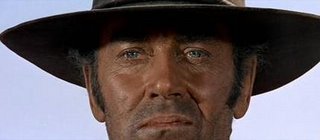
Sergio Leone’s Once Upon a Time in the West. Whether it’s the vast, aboriginal spaces of Monument Valley—an affectionate genuflection to the films of John Ford—or the intricately chiseled planes of the faces of Charles Bronson and Henry Fonda—you spend a lot of time looking at both in Once….—as well as deep close-ups of the faces of Jason Robards and Claudia Cardinale. There is one shot where Bronson ever so slowly relaxes a smile out of existence. Bronson does it so subtly you don’t know what’s happening until it’s happened. It’s one of the things I look forward to in the Dance of Death of Once Upon a Time in the West. Here are some others:


1. “Looks Like We’re Shy One Horse…” The first twelve minutes. A dilapidated train station in the middle of nowhere. Three long-coated bad-men wait for a train. They while away the time, each in their own unique fashion. Driven mostly by sound and filmed in extreme close-ups, the sequence, accompanied by the homely squeak of a windmill—one of the out-sized sound effects typical of Leone’s westerns—and the jokey placement of the credits, rolls on and on until a confrontation ends explosively. It’s an opening of great economy and intricate film-making. Few words are spoken throughout. I’ve shown students this sequence to show just how much presence and atmosphere simple sound effects can bring to a scene. It’s just the opening gambit in a plot by two men who are playing against each other. It will take the entire movie to explain why.


2. “You Don’t Know How To Play” The gist of Once Upon a Time in the West is a chess game with lives and futures as the playing pieces. As scripted by Sergio Leone and his co-scenarists--the soon to be master of Italian horror films Dario Argento and the young Bernardo Bertolucci--the movie is a series of moves and counter-moves by the antagonists, each one trying to tame the frontier in their own way, and taking their own sweet time about it. Each has to make the pieces fall their way. For the first-time viewer it can be maddening following the strategems of the four participants in the story, but by the end the motivations and loyalties—or lack of them—become clear.
3. “People Scare Easier When They’re Dyin’” The villain of the piece is the meanest, rottenest most conniving scumbag to ever walk a dusty street and spit on it. “Frank” is a sadist who smiles when he kills and for the first time in his life he has a patron with a vision—one big enough for Frank to start to see how there might be such a thing as a future, and that one man can own it. He just can’t understand why people are getting in his way.
4. “Instead of Talking, He Plays. And When He Better Play, He Talks.” The composer and the director did it backwards. Ennio Morricone wrote the music for the film first and Leone built his sequences around the music, playing it on-set to establish mood. There are two spectacular pay-offs--one in the previously mentioned Monument Valley sequence. But the other is at a train station where Claudia Cardinale, has just arrived from New Orleans to find no one to meet her. After a long wait (which is actually mercifully short for a Leone western) she decides to hire passage. Sounds disappear as she is seen through a station window talking to an official, and then the camera HEAVES up and over the roof, and in a burst of music reveals a burgeoning western town full of life and activity. It’s as if all of America is presented in that one astounding crane shot. My wife audibly gasped when she saw the shot in some movie clip program on TV, so stunning is the effect. And more than a little of the power of that shot is due to Morricone’s music and the angelic voice of Edda Dell’Orso, wordlessly cooing an ode to the country and to the protagonist around whom the movie and the future hinges.
5. “Ma’am, It Seems To Me You Ain’t Caught The Idea” For the first time in a Leone western, a woman is the hero, but like her predecessor—"The Man with No Name"—she is flawed and has some learning to do, and it’s up to Leone’s trio of men – another man with no name (going under the aliases of dead men), a wolf-like vagabond-thief, and the villain, Frank—to push, prod, blackmail, challenge and coerce her into a new role. It’s a role each man knows they’ll have no part of, and that, for a time, she is reluctant to fulfill. In the last shot of the film, she is seen bringing water to the railroad work-crew who will be bringing people and prosperity to what will be her town. It may seem a servile role, but as we pull away and follow the disappearing tracks to the frontier, leaving her to her future, she begins to bark orders, to direct and take charge. Her station will become a cornerstone of the push west. “This movie drips with testosterone,” a colleague once told me after a screening. Yes, but Leone includes a healthy shot of estrogen as, for the first time, he is dealing with a story that not only leaves the past behind, but also looks forward to the future.
After his spectacular success with the "Dollars" trilogy starring Clint Eastwood, Leone was given a lot of money, quite a bit of it from Paramount Pictures, to not make his next planned film (based on the novel, "The Hoods" which would eventually become his last film Once Upon a Time in America) but make his next production a western. When he delivered this slow-moving epic on a small scale writ large, the full length film (2 hours, 46 minutes) became a hit in Europe, but Paramount cut what it considered "extraneous" material—a full 25 minutes of it—for its American release.* The film was a bomb in the States. It was released, after all, in 1968, the year of Bullitt, Rosemary's Baby, and 2001: a Space Odyssey. Cinema, and its audience, was changing. The next year Easy Rider would be a huge hit. Once Upon a Time in the West might have seemed a little archaic to the youth audience. Eastwood, a popular star outside of the Leone films by then, wasn't in it. Bronson—popular in Europe, but a supporting actor in America—was. Fonda, Cardinale, and Robards, perfectly cast though they are, did not bring in droves of film-goers.
But, despite its reputation from the box-office performance upon its release in America, the film has developed a cult following here—more than that, it is acknowledged as a masterpiece of film-making, one of the great films of the 20th Century, maybe a little behind-the-times for the box-office, but certainly ahead of its time for the influence it has had on subsequent film-makers.

For me, it is simply beautiful, dusty and hard-scrabble though it is. Some of the images, some of the sequences, run through my head daily, and Morricone's music "ear-worms" into my head once a week. It is still, despite the acolyte-directors who "one-off" the style and sometimes the film, wholly original, while acknowledging its debt to films of the past, presenting them in its own unique way. You'll never see a wide-screen film filled so interestingly as Once Upon a Time in the West. Filled and brimming. Rustic and operatic, Once Upon a Time in the West is a fairy-tale of Myth and History—film history—while making its own.
Claudia Cardinale: The West wrapped around her little finger.

Anytime Movies:
Once Upon a Time in the West
-Only Angels Have Wings
The Searchers

* And, on Sunday, we'll put up a "Don't Make a Scene" feature from each week's film.

** There had been a precedent: United Artists cut 16 minutes from the nearly 3 hour The Good, The Bad, and the Ugly. And Paramount made a worse decision when it eventually released Leone's Once Upon a Time in America: restructuring the director's intricate flashback structure into a chronological narrative, which robbed the movie of its melancholy tone, and removed any mystery the film contained. Curiously, the longer film is fascinating throughout, but Paramount's re-edit seemed interminable. It just shows the differences between a genuine film-maker and studio hacks.

Friday, April 17, 2020

The Magnificent Seven (1960)

So, I was talking to a co-worker about movies. Our tastes are different. "What'd you watch last night?" I asked. 
"Oh! Great movie! The Magnificent Seven!" 
"You've never seen The Magnificent Seven?"
 "No-oo." 
"Well, finally, we can agree on something...The Magnificent Seven is a classic!" 
"Yeah. And I lo-ove Chris Pratt!"

(Long Silence)

"What?" I spluttered. "Wha...Chris Pratt?" 
"Yeah, he's so great..." 
"You mean you're talking about that Denzel Washington mess?" 
"Yeah, he's great, too."
"No, no, no, no, no!" (I explained). "You HAVE to see the Yul Brynner version!" 
"Who?" 
"Yu...okay, Steve McQueen's in it!" 
"Who?" 

At this point, I started pulling what's left of my hair out—not to try and explain Yul Brynner, of course (Good thing I didn't lead with Horst Bucholz or Brad Dexter) and explained in the most condescending way possible that if she didn't see Charles Bronson in it, it just isn't The Magnificent Seven. 

I wonder if she ever did.

The Magnificent Seven (John Sturges, 1960) Sturges' remake of Akira Kurosawa's Seven Samurai as a Western (more accurately South-western) with cowboys (more accurately gun-slingers) is a rousing crowd-pleaser (while still maintaining the original's final resigned tone). This is not only due to Kurosawa's indestructible original tale of warriors from a by-gone age quixotically trying to save the residents of an agrarian town from bandits, but also for the charismatic cluster of stars vying for screen-time with "The King" himself, Yul Brynner.* Steve McQueen, coming off the "Wanted: Dead or Alive" series was particularly shameless about trying to grab the spotlight from Brynner. 

"It doesn't bother me," the older actor would tell Sturges. "All I have to do to upstage them is take off my hat."
In this version, it's a Mexican village being robbed by bandito's led by Eli Wallach's Calvera that cause a trio of farmers to go searching for "gun-fighters"  (they are told that gun-fighters are cheaper than guns) to take on the thieving gang. One by one, the odd troop are assembled including up-and-coming stars McQueen, Charles Bronson, Robert Vaughn, James Coburn, Brad Dexter and Horst Bucholz,** all pistolero's down on their luck and taking on the job—for their various reasons, be it bravado, assumed reward, paternalism, loyalty—until something better comes along. It's a dangerous temporary job, so the stakes have to be personal, beyond the measly compensation for the task. They are all aware that the risk to themselves is high, but not as much as the risk to the farmers.
Each of the seven have their reasons, but each of them have their own style of combat, making the final assault on the town (after a couple of skirmishes and a temporary change of fortune) that much more dramatic as each gun-fighter has to fight their own battles in their own individual style. And it doesn't matter what style they use...they always seem to do it cool.
When one compares the Kurosawa original with Sturges' adaptation, one notices a big difference—Nature. Sturges' stage is a big blue-skied sand-blasted valley-scape that doesn't much change and makes no impact on the outcome, whereas Kurosawa staged the original's dynamic set-pieces in a violent rain-storm, increasing the odds and making them more mythic, with the Heavens themselves having a stake in the conflict. Kurosawa wasn't complaining, though. He reportedly liked the American version so much he presented John Sturges a ceremonial sword.
Momentum is kept up by some sharp writing (by blacklister Walter Bernstein and Walter Newman, both credits replaced after much bickering about changes made on set by William Roberts) but also by a rousing Copland-esque score by Elmer Bernstein*** that manages to goose the action up several notches from how it's paced on screen. This might be sacrilege to say (as the score is so iconic and tied to the movie as much as a pack of Marlboro's), but it's almost like Bernstein is trying too hard in places, as when the theme thumps along when Chris (Brynner) and Vin (McQueen) are riding a buckboard to a confrontation.

Curiously the pacing is a bit slower when the words stop and the action begins, but one hardly notices when Bernstein is controlling the tempo.
The transition (and translation) from Japan to Mexico is a bit seamless, despite the lack of atmospherics, and just as the Samurai have their distinct characteristics, so, too, do the gunfighters--only Horst Bucholz, given an outlandish billing in retrospect, fails to rise to the potential of the others. The genius of the film is Kurosawa's, but this Americanized version still has its own unique charms, enough to make The Magnificent Seven a huge success in its own right. A couple years later, the same tack was used to create a westernized version of Kurosawa's Yojimbo,**** and launched the "Spaghetti Western" and the career of its chief architect, Sergio Leone.


The Magnificent Seven was voted into the the National Film Registry in 2013.


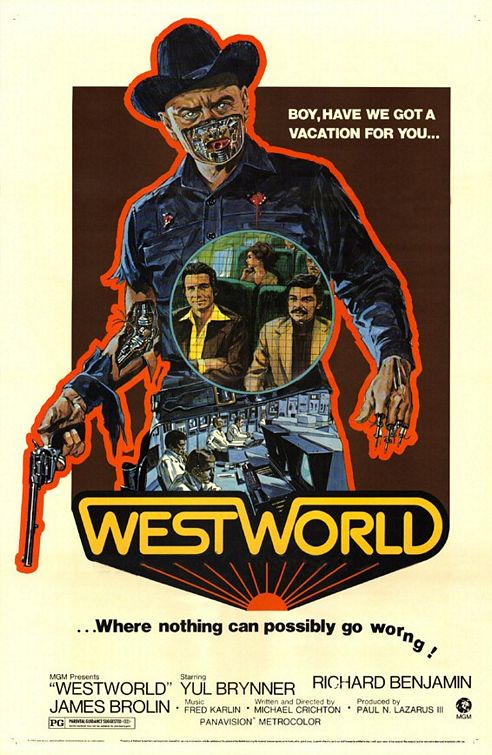
* Brynner cut such a fine figure as a gunslinger (despite his Russian heritage—his character's ethnicity was explained away as "Cajun") that he came back for the first sequel The Return of the Seven, and was the emblematic robot shootist in Westworld and its sequel Futureworld.
** The closest I could come to finding a movie that had so many future stars (and Brad Dexter) in it is Francis Coppola's The Outsiders.
*** Bernstein's theme became known as "The Marlboro Theme" because it was used as the background music for that brand's (now extinct) cigarette commercials. The prolific Bernstein (no relation to Leonard) only won one Oscar for his music--for the musical score to Thoroughly Modern Millie.

**** That would be A Fistful of Dollars, starring Clint Eastwood.


***** The film's story would be used...again...as A Bug's Life. And, anyone remembering Roger Corman's Battle Beyond the Stars will see more than a resemblance to The Magnificent Seven (beyond just the casting of Robert Vaughn).


Thursday, September 18, 2014

The Dirty Dozen

The Dirty Dozen (Robert Aldrich, 1967) Another one of those films I've had (uh..) dozens of opportunities to see, but never bothered is this, Aldrich's off-set war-genre film, combining the heroics of The Guns of Navarone with the nihilism of The Magnificent 7.  

The Army chooses a loose cannon, Maj. John Reisman (Lee Marvin) to train and command a squad of brig-rats on a suicide mission behind enemy lines before D-Day. The inmates are a motley crew of renegades, degenerates and non-com's (as in non-conformists), who need no training to be bad to the enemy. If they survive, their jail sentences (and for some, death sentences) will be commuted. If they don't, well, war is Hell.

But it's not a cell. And these guys have nothing left to lose, and given the situation, they're American kamikaze's, who might just make it to freedom, like any other soldier...if they make it through.

The movie is top-heavy with male character actors.  Besides Marvin, there's Robert Ryan, Ernest Borgnine, George Kennedy, Robert Webber, Richard Jaeckel, and Aldrich's Mike Hammer, Ralph Meeker. Those are the good guys. The cons include Charles Bronson, Clint Walker, Telly Savalas, Jim Brown, John Cassavettes, Donald Sutherland, and Trini Lopez (hey, where's Don Rickles and Bobby Darren?)
Bronson gets a promotion in this one, becoming the Steve McQueen to Marvin's Yul Brynner, Cassavettes has the biggest character arc and the showiest performance (despite underplaying his death scene) winning a Best Supporting Actor nomination, Savalas has the most colorful role as a Bible-spouting psycho, and Jim Brown has the moment everybody remembers—sprinting across a courtyard throwing grenades down air vents, moving so fast the camera crew can barely keep him in the view-finder.
Aldrich—never one to be very conventional no matter what genre he was tackling—manages to make his anti-war, anti-authority statements in the story set-up; these guys have little choice but to hang it all out in combat, and, ironically, they're the best-suited to do all the dirty work, even if nobody is shooting at them in the initial stages. At the time of its release, the film got all sorts of flack for its violence, which Aldrich manages to get away with by merely suggesting things with quick cut-aways, but it looks extraordinarily tame today (and, in fact, would look tame two years after its own release when The Wild Bunch would take movie violence to a whole new level). It might even get by with a light PG rating today.
But despite the dirt-dog-grubbiness of the whole thing, the director still manages to throw in some testosterone-laced sentimentality into it, then pulls back during the big action sequence as more and more men fall in battle and the director only affords them quick shots in death. Pretty soon, you lose track of who made it and who didn't, and a pre-End-Credits roll-call of the dead is the only verification—not everybody gets their death scene, further undercutting any sense of heroics, despite the war-time setting. And let's face it, most of the deaths occur by trapping the victims (party-guests mostly) in a cellar and burning them alive by drenching them in gasoline, and setting them alight with grenades. It's never made clear why this might help the Normandy Invasion effort, but one shouldn't look too closely at the movie for any sort of authenticity.

Wednesday, June 4, 2014

Anytime Movies (Transplanted): Once Upon a Time in the West

While I have a few reviews "in the works," It's as good a time as any to re-boot (actually transplant from the old movie blog) a feature I started years ago, when it was suggested I do a "Top Ten" List. 

I don't like those: they're rather arbitrary; they pit films against each other, and there's always one or two that should be on the list that aren't because something better shoved it down the trash-bin. 

So, I came up with this: "Anytime" Movies. 

Anytime Movies are the movies I can watch anytime, anywhere. If I see a second of it, I can identify it. If it shows up on television, my attention is focused on it until the conclusion. Sometimes it’s the direction, sometimes it’s the writing, sometimes it’s the acting, sometimes it’s just the idea behind it, but these are the movies I can watch again and again (and again!) and never tire of them. There are ten (kinda). They're not in any particular order, but the #1 movie IS the #1 movie.


Landscapes.

That’s what’s featured in
Sergio Leone’s Once Upon a Time in the West. Whether it’s the vast, aboriginal spaces of Monument Valley—an affectionate genuflection to the films of John Ford—or the intricately chiseled planes of the faces of Charles Bronson and Henry Fonda—you spend a lot of time looking at both in Once….—as well as deep close-ups of the faces of Jason Robards and Claudia Cardinale. There is one shot where Bronson ever so slowly relaxes a smile out of existence. Bronson does it so subtly you don’t know what’s happening until it’s happened. It’s one of the things I look forward to in the Dance of Death of Once Upon a Time in the West. Here are some others:


1. “Looks Like We’re Shy One Horse…” The first twelve minutes. A dilapidated train station in the middle of nowhere. Three long-coated bad-men wait for a train. They while away the time, each in their own unique fashion. Driven mostly by sound and filmed in extreme close-ups, the sequence, accompanied by the homely squeak of a windmill—one of the out-sized sound effects typical of Leone’s westerns—and the jokey placement of the credits, rolls on and on until a confrontation ends explosively. It’s an opening of great economy and intricate film-making. Few words are spoken throughout. I’ve shown students this sequence to show just how much presence and atmosphere simple sound effects can bring to a scene. It’s just the opening gambit in a plot by two men who are playing against each other. It will take the entire movie to explain why.


2. “You Don’t Know How To Play” The gist of Once Upon a Time in the West is a chess game with lives and futures as the playing pieces. As scripted by Sergio Leone and his co-scenarists--the soon to be master of Italian horror films Dario Argento and the young Bernardo Bertolucci--the movie is a series of moves and counter-moves by the antagonists, each one trying to tame the frontier in their own way, and taking their own sweet time about it. Each has to make the pieces fall their way. For the first-time viewer it can be maddening following the strategems of the four participants in the story, but by the end the motivations and loyalties—or lack of them—become clear.
3. “People Scare Easier When They’re Dyin’” The villain of the piece is the meanest, rottenest most conniving scumbag to ever walk a dusty street and spit on it. “Frank” is a sadist who smiles when he kills and for the first time in his life he has a patron with a vision—one big enough for Frank to start to see how there might be such a thing as a future, and that one man can own it. He just can’t understand why people are getting in his way.
4. “Instead of Talking, He Plays. And When He Better Play, He Talks.” The composer and the director did it backwards. Ennio Morricone wrote the music for the film first and Leone built his sequences around the music, playing it on-set to establish mood. There are two spectacular pay-offs--one in the previously mentioned Monument Valley sequence. But the other is at a train station where Claudia Cardinale, has just arrived from New Orleans to find no one to meet her. After a long wait (which is actually mercifully short for a Leone western) she decides to hire passage. Sounds disappear as she is seen through a station window talking to an official, and then the camera HEAVES up and over the roof, and in a burst of music reveals a burgeoning western town full of life and activity. It’s as if all of America is presented in that one astounding crane shot. My wife audibly gasped when she saw the shot in some movie clip program on TV, so stunning is the effect. And more than a little of the power of that shot is due to Morricone’s music and the angelic voice of Edda Dell’Orso, wordlessly cooing an ode to the country and to the protagonist around whom the movie and the future hinges.
5. “Ma’am, It Seems To Me You Ain’t Caught The Idea” For the first time in a Leone western, a woman is the hero, but like her predecessor—"The Man with No Name"—she is flawed and has some learning to do, and it’s up to Leone’s trio of men – another man with no name (going under the aliases of dead men), a wolf-like vagabond-thief, and the villain, Frank—to push, prod, blackmail, challenge and coerce her into a new role. It’s a role each man knows they’ll have no part of, and that, for a time, she is reluctant to fulfill. In the last shot of the film, she is seen bringing water to the railroad work-crew who will be bringing people and prosperity to what will be her town. It may seem a servile role, but as we pull away and follow the disappearing tracks to the frontier, leaving her to her future, she begins to bark orders, to direct and take charge. Her station will become a cornerstone of the push west. “This movie drips with testosterone,” a colleague once told me after a screening. Yes, but Leone includes a healthy shot of estrogen as, for the first time, he is dealing with a story that not only leaves the past behind, but also looks forward to the future.
After his spectacular success with the "Dollars" trilogy starring Clint Eastwood, Leone was given a lot of money, quite a bit of it from Paramount Pictures, to not make his next planned film (based on the novel, "The Hoods" which would eventually become his last film Once Upon a Time in America) but make his next production a western. When he delivered this slow-moving epic on a small scale writ large, the full length film (2 hours, 46 minutes) became a hit in Europe, but Paramount cut what it considered "extraneous" material—a full 25 minutes of it—for its American release.* The film was a bomb in the States.  It was released, after all, in 1968, the year of Bullitt, Rosemary's Baby, and 2001: a Space Odyssey. Cinema, and its audience, was changing. The next year Easy Rider would be a huge hit. Once Upon a Time in the West might have seemed a little archaic to the youth audience. Eastwood, a popular star outside of the Leone films by then, wasn't in it. Bronson—popular in Europe, but a supporting actor in America—was. Fonda, Cardinale, and Robards, perfectly cast though they are, did not bring in droves of film-goers.
But, despite its reputation from the box-office performance upon its release in America, the film has developed a cult following here—more than that, it is acknowledged as a masterpiece of film-making, one of the great films of the 20th Century, maybe a little behind-the-times for the box-office, but certainly ahead of its time for the influence it has had on subsequent film-makers.

For me, it is simply beautiful, dusty and hard-scrabble though it is. Some of the images, some of the sequences, run through my head daily, and Morricone's music "ear-worms" into my head once a week. It is still, despite the acolyte-directors who "one-off" the style and sometimes the film, wholly original, while acknowledging its debt to films of the past, presenting them in its own unique way. You'll never see a wide-screen film filled so interestingly as Once Upon a Time in the West. Filled and brimming. Rustic and operatic, Once Upon a Time in the West is a fairy-tale of Myth and History—film history—while making its own.
Claudia Cardinale: The West wrapped around her little finger.

-Only Angels Have Wings
The Searchers
Mr. Smith Goes to Washington
Chinatown
American Graffiti
To Kill a Mockingbird
Goldfinger

Bonus: Edge of Darkness


* There had been a precedent: United Artists cut 16 minutes from the nearly 3 hour The Good, The Bad, and the Ugly. And Paramount made a worse decision when it eventually released Leone's Once Upon a Time in America: restructuring the director's intricate flashback structure into a chronological narrative, which robbed the movie of its melancholy tone, and removed any mystery the film contained. Curiously, the longer film is fascinating throughout, but Paramount's re-edit seemed interminable. It just shows the differences between a genuine film-maker and studio hacks.