Showing posts with label Joan Bennett. Show all posts

Friday, May 6, 2022

Little Women (1933)

Little Women
(George Cukor, 1933) Pre-code version of Louisa May Allcott's much-beloved novel of the March family struggling with life in mid-Civil War America. "Pre-code," but we're talking Louisa May Allcott here, so don't expect anything surprising eyebrow raising, other than director Cukor's penchant for laying the iron on stuffed shirts and exposing society's pretensions and hypocrisies.
 
No, this is Little Women, so there is warm homespunnery, with an encouragement towards spunkiness of the actresses—much too old for the parts (but, jeez, Katharine Hepburn and Joan Bennett, who's going to complain?)—playing the March sisters, consigned to different fates for womanhood in the 19th century: home and hearth, marrying rich, seeking a risky independence (for awhile, anyway) or early death. The story is multi-faceted with the emphasis on self-improvement, charity towards others, positive attitudes in times of strife, and the spark of imagination.
 
Oh, and family values. Ambition is good, but when kept in small orbits...like, within horse-cart distance. Family is all.
Cukor directing Kate Hepburn directing
 
Cukor wanted to work less on the star-crossing and budding relationships and concentrate on the charity, selflessness and bonding in what would become the blueprint for all subsequent versions of Allcott's Women (there had been two previous silent versions), and although times and tastes have changed, one can't quibble too much with the acting, everything is done with such brio and conviction that, even if something questionable does come up, there will be something that punches you in the gut within a minute. Hepburn, of course, shines, but everyone else is good, too, particularly Henry Stephenson as the somewhat reticent Mr. Laurence.
And now, something a little personal: while watching the film, a flash of memory happened as one of the March sisters admonishes the others for quarreling. "Birds in their little nests agree" in a lilting sing-song. I remember as a child (3? 4?) my grandmother saying the exact same words with just the same inflection. The source of the phrase is from "Divine and Moral Songs for Children"* published in 1715 by Isaac Watts. Now, Watts was a prolific hymn-writer, but he was a Protestant (where my family was traditionally Catholic), so I'm not sure where my grandmother picked it up, but it probably was this version of Little Women

At the time of its release, RKO's version of Little Women was seen as wholesome entertainment (back in Hollywood's salacious "pre-code era") with an emphasis on "making do" and charity for the less fortunate. 1933 was, after all, deep into The Great Depression and that lilt and those circumstances make me certain my grandmother saw it. My mother certainly did at the age of 22. She was always an admirer of Katherine Hepburn and when the star toured Seattle in 1981 with "The West Side Waltz" (at the 5th Avenue Theater), I made sure to get tickets for her. And me, too.

It's funny how movies can reach back in time and space and link generations together over a shared memory. Small orbits...
 
* Song 17 goes like this:

1. Whatever brawls disturb the street,
There should be peace at home;
Where sisters dwell, and brothers meet,
Quarrels should never come.

2. Birds in their little nests agree;
And ’tis a shameful sight,
When children of one family
Fall out, and chide, and fight.

3. Hard names at first, and threatening
They are but noisy breath,
May grow to clubs and naked swords,
To murder and to death.

4. The devil tempts one mother’s son,
To rage against another;
So wicked Cain was hurried on
‘Till he had kill’d his brother.

5. The wise will let their anger cool,
At least before ’tis night;
But in the bosom of a fool,
It burns till morning light.

6. Pardon, O Lord, our childish rage,
Our little brawls remove;
That, as we grow of riper age,
Our hearts may all be love.


Thursday, June 3, 2021

The Man in the Iron Mask (1939)

The Man in the Iron Mask (James Whale, 1939) "The Man in the Iron Mask" is a genuine part of French history, and the identity of the man (who probably wore a mask of black velvet cloth, rather than iron—blame Voltaire) is still one of speculation.

But, most people know "The Man in the Iron Mask" from his fictionalized appearance in Alexandre Dumas' last volume of his "D'Artagnan Romances" series, "The Vicomte de Bragellone: Ten Years Later" where the story is the last section, comprised of Chapters 181 to 269. In it, Dumas opines that the prisoner is Phillipe, the twin brother of King Louis IV. The Musketeer, Aramis, learns of this subterfuge and attempts a coup by replacing "The Sun King" with Phillipe, in league with the Musketeers Porthos, but not D'Artagnan. The coup is overturned in no small part due to D'Artagnan's efforts, but he refuses to turn against his old comrades when Louis orders then arrested and killed.
Versions of the story had been filmed in the silent era, and the film follows the story of Allan Dwan's 1929 Douglas Fairbanks version for this, its first foray in the sound era. In that, Phillipe's existence is not erased—merely expunged—by having him raised in Gascony under the care of d'Artagnan (Warren William, "the King of the Pre-Code"*) on advisement of the King's courtier Colbert (Walter Kingsford), who wishes no confusion about the line of succession, and fearing that Phillipe could be used by forces to unseat the future King. Such information is to be kept under the strictest of confidences, as it could lead to blackmail (as it does when cardinal's messenger Fouquet (Joseph Schildkraut) uses the information to become Minister of Finance under the young King Louis IV (Louis Hayward).
King Louis is a foppish lout, and Fouquet uses his position as Minister to impose a crippling tax on his people, including the ones in Glascony and that causes a bit of commotion when it comes time to pay at the d'Artagnan house, where guests Porthos (Alan Hale), Athos (Bert Roach), and Aramis (Miles Mander) hold off the tax collectors, but are captured when confronted by the King's guard. The advisor Colbert alerts Louis to the startling resemblance to him, and, knowing that an assassination plot is imminent, blackmails Phillipe to impersonate him or his friend-Musketeers will be executed.
For Louis, it's a great plan to avoid being killed, but it has a couple of negative consequences: first, when the attack does come Phillipe is able to thwart it and, rather than have them killed, spares their lives, which wins him favor in the public eye; second, Louis's betrothed, the Princess Maria Theresa (Joan Bennett) of Spain finds the false Louis far more attractive than the real king, who's carrying on an affair with the Mademoiselle de la Valliere (Marion Martin).
After a swashbuckling escape from Louis' clutches, Phillipe is recaptured and Louis decides to hang him, but a decree that no royal blood be spilled (and that Louis couldn't stand to see someone who looks like himself swinging from the gallows) gives him a more sadistic alternative—throwing his brother into the Bastille, his face hidden by an iron mask that can only be unlocked with a key in the king's possession. Phillipe will be forgotten in prison, doubly encased, until his beard grows so long inside the mask that he will be strangled by it.
Whale's work on this plays to his many strengths, displayed in his work in the 1930's, starting in 1931 with his iconic Frankenstein and its sequel, the equally iconic (but lesser known) The Old Dark House, The Invisible Man, and Show Boat. The film is designed to the 9's, with extraordinarily elaborate decors and costumes, and the dungeons of the Bastille are things of nightmare. Plus, his special effects work is fully on display in the elaborate split-screen work, allowing Louis Hayward to play both parts, without any seams or noticeable delays in dialogue. And Whale's florid directing is much in display in Hayward's wild-eyed King Louis and his Finance Minister, Fouquet, while Hayward's Phillipe approaches the hyperbolic ministrations (much as Claude Rains did in The Invisible Man) in his dungeon scenes. When one's expressions can't be seen, emotive body language supplies the desperation. It's a remarkable work, and even though produced in 1939, still is the best version of The Man in the Iron Mask I've seen.
* I'm becoming a real fan of Warren William, who is pretty much forgotten in the annals of cinema, despite the fact that he had the swashbuckling verve of Errol Flynn in this, and his heroes—including the first screen version of "Perry Mason" and a Sam Spade twice-removed in Satan Met a Lady—and his villains could be unapologetically moustache-twirling (as in Employees' Entrance).

Tuesday, February 12, 2019

The Woman in the Window (1944)

The Woman in the Window (Fritz Lang, 1944) The ex-patriate German film-stylist (Metropolis) makes the first of his "love-is-a-trap" film noirs with Edward G. Robinson, Joan Bennett, and Dan Duryea. The second, Scarlet Street (Lang's next film) will be a nightmarish tale of lust, betrayal and greed that will skirt the Hays Code of having one of the triangle getting away with murder, but The Woman in the Window will be a bit more sedate...almost text-book.

Richard Wanley (
Robinson) is a professor of criminal psychology, so you'd think he'd knows his stuff, but it seems he's only good at the theory. While his wife and kids are out of town for the Summer, Wanley becomes enamored with a portrait of a young woman in a store window (theory), and after a club-night with the boys (among whom is detective Raymond Massey), he comes across the woman in the flesh and accepts an invitation to her apartment. Turns out she's the moll of a notorious money-changer, see? And N.M.C. shows up at the apartment, looking to serve Wanley a Harvey Wallbanger.

Things get ugly and somebody gets dead. It's up to the Good Professor to do some Bad Things to keep his reputation intacto, not to mention his corpus.
The wonderful thing about Lang is he kept making his scary German films (like M, his "Mabuse" spy-fantasies) in Hollywood, with a budget that would make glossier his mouse-trap films. Lang knew how to tell his stories in shadow, and even include the vast area outside the frame in the mix to keep audiences guessing as to what would happen next—his protagonists (and they're not always heroes) have to run his maze of ever-tightening traps that will mean loss of freedom or death ("or worse!" as they used to say on the "Batman" TV show—which employed some Lang techniques—with this director you couldn't be sure if Death was the end of it).
Here, Lang dips his toe into the dark murky water that he will dive in head-first with Scarlet Street, sketching a nightmare scenario and cautionary tale, preparing for the final deadly masterpiece of his next film.
Provocative, stylish and downright cruel, the cinema of Fritz Lang spoke of high themes and low instincts and if he's not the father of "film-noir," he's certainly a very close uncle.*

* According to Wikipedia the term "film noir"—"black cinema"—was coined by the French Press—they also make damn fine coffee—in 1946, after the post-war arrival of American films The Maltese FalconDouble IndemnityLauraMurder, My Sweet," and...The Woman in the Window. So, the five fathers of "Noir" are John Huston, Billy Wilder, Otto Preminger, Edward Dmytryk, and Fritz Lang—three Germans and two Americans (shudder!)

Saturday, August 15, 2015

Man Hunt/Rogue Male

If someone pontificates the blanket statement "there's never been a remake of a film better than the original," here's a rebuttal (besides, say, True Grit) you can have at the ready:

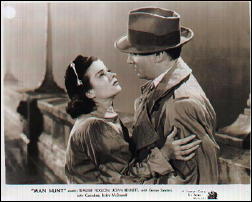
Man Hunt (Fritz Lang, 1941) Dudley Nichols' adaptation of the 1939 Geoffrey Household novel that begins with a sure-fire set-up: a big game hunter, Captain Alan Thorndike (Walter Pidgeon), travels to Berchtesgaden to shoot Adolf Hitler right in the Berghof with a long-range rifle. He "takes the shot," but then, on second thought loads a bullet into the chamber...too late. He's discovered, taken prisoner and tortured for information by Major Quive-Smith (George Sanders, at his most impenetrably cold). The Major wants the Captain to admit that his intent was to kill Der Fuhrer (something he understands being an avid sportsman himself) and sign a confession to that effect, saying that he was doing it for the British government.  Thorndike refuses, is beaten, then dumped over a cliff to make his death appear an accident.

But Thorndike survives, and makes his way back to England, barely ahead of his Nazi pursuers. With the aid of a cockney lass, Jerry Stokes (Joan Bennett), he manages to elude his pursuers, going, literally, underground by living in a makeshift cave and living off the land. But a cave has one drawback—it only has one exit, and this proves to be a weakness in Thorndike's cat-and-mouse with the Nazis.

It's a corker of a story, told with the visual paranoia that Lang excelled at. It's one long chase that finally goes elementally one-on-one. Where Nichols diverges from Household (aside from actually naming the dictator the author's anonymous hunter aims for, no doubt with the approval of the director, a German exile*) is in a neat insertion of a "woman's part," through the extended English city section, which becomes a deus ex machina for the final confrontations. "Jerry Stokes" was a Nichols creation, it being thought that giving Thorndike a visible love interest for the audience to identify with, would more humanize Thorndike and his quest.  "Jerry" has her origins in the book, but was only suggested. Nichols, Lang, and Bennett made flesh what Household only used as a back-story.   

Rogue Male (Clive Donner, 1976) BBC film of the Household novel that keeps the original more in its sights. Where Man Hunt is urban, has a love interest, and is quite light-hearted at times, Rogue Male is more to the point, quite brutal (the shots of Peter O'Toole's Thordyke after being beaten to a bloody pulp are tough to watch) and extends the cave scenes, making them much more a part of the story (Pidgeon spends barely 20 minutes in the cave in Man Hunt) as they are in the book.

But it is the character of Thorndyke where the two most diverge—Pidgeon's captain does what he does to survive. That's certainly true of O'Toole's characterization (it has to be!), but one also gets the sense that this hunter prefers life in a cave to one in the aristocracy. Any hint of romance is purely prologue, giving an ethereal quality to the unnamed woman, that O'Toole merely suggests with a melancholy cast of his eyes. Written with 20/20 hindsight by Frederic Raphael, the film is far more political than either the book or first film could ever hope to be at the time they were written, given the historical perspective nearly forty years can bring. Smart, intelligent, unwavering, the BBC version of Household's novel is an adaptation worthy of the anonymous Hunter.

The Lang version is more stylish and romantic, but Donner's TV-version has the novel down cold. O'Toole once stated that it is the favorite of all films.

* This supposedly worried 20th Century Fox exec Darryl F. Zanuck, as well as The Breen Office, as America, at the time, was neutral in the European War, not entering the fray until the attack on Pearl Harbor.